Moving a Heavy Safe Across LVT With Runners, Ramps, and Guards
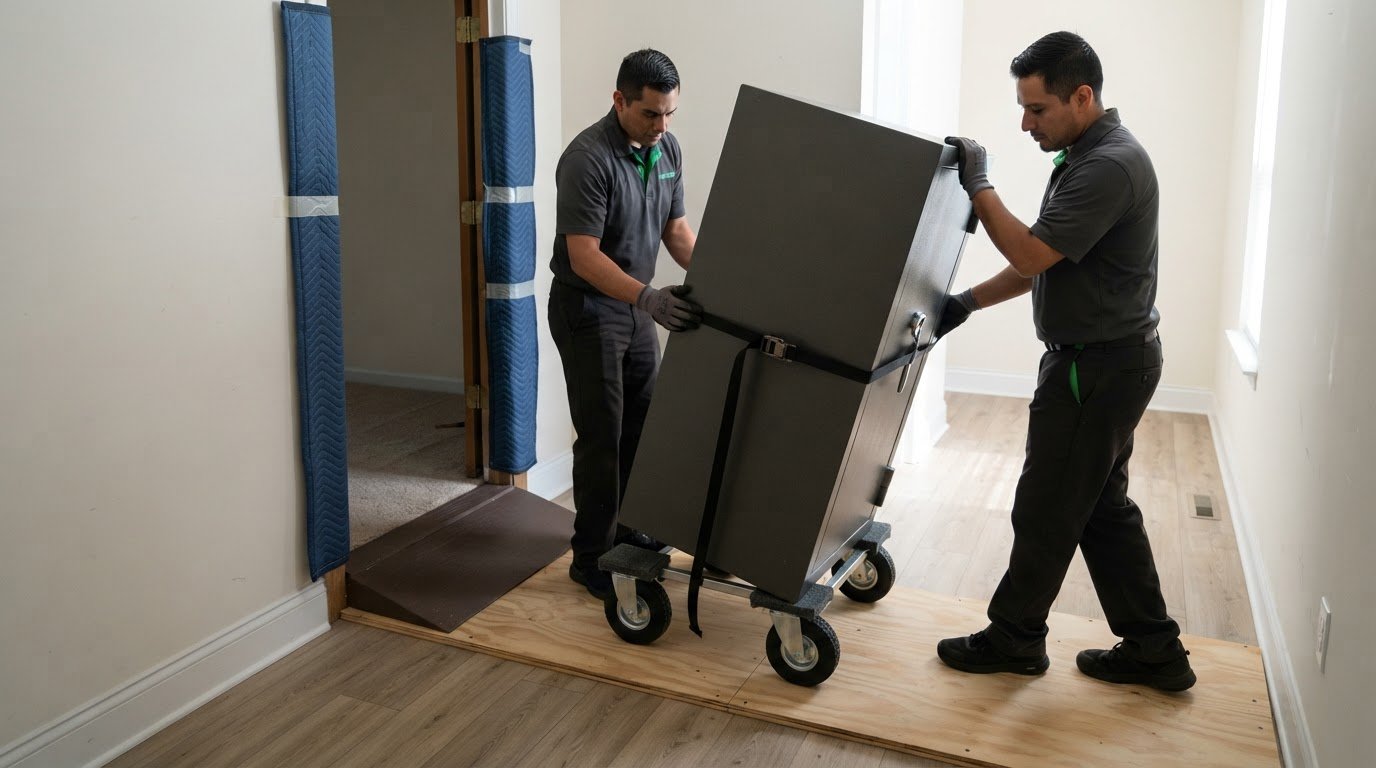
Put a rigid, continuous path between the safe and the floor. For moving a heavy fire safe across luxury vinyl tile without dents in Fairfax, use plywood runners along the route, keep their joints tight, and move the safe under control instead of sliding it directly over the vinyl.
A heavy safe puts intense pressure on a small area, so a soft blanket alone may not spread the load enough. Clean the floor before laying protection, cover thresholds and landing areas, and plan each turn in advance. These steps help reduce the risk of dents, scratches, and tears.
This guide explains what to place under the safe, how to map a clear route, and how to handle transitions between rooms. It also covers when runners, ramps, and guards make sense, and why a safe that is too heavy or awkward to control calls for experienced moving help.
Key Takeaways
- Sweep or vacuum the route before laying floor protection so grit doesn’t get trapped beneath the safe’s weight.
- Use a continuous protective path, and keep dolly wheels clean, non-marking, and balanced under the load.
- Measure doorways, halls, and stairwells along the full route, allowing at least 2 inches of clearance beyond the safe’s dimensions.
- Choose rigid runners to spread pressure across luxury vinyl, and secure overlapping sections to prevent gaps or shifting.
- Approach thresholds slowly and squarely; ramps or threshold plates can help the dolly cross changes in floor height under control.
1. How to protect floors when moving a safe
The safest way to move a heavy fire safe across luxury vinyl tile is to lift it onto suitable moving equipment, then travel over a continuous, stable protective path. Before placing runners or sheets, clean the floor and the underside of every protector. Grit trapped beneath a loaded board can scratch vinyl, hardwood, or tile as the safe moves.
No Fairfax- or Virginia-wide permit requirement specific to residential safe moves is established here. Managed buildings may set their own elevator, loading-hour, and floor-protection rules, so include those requirements in the route plan.
Start with a broom or vacuum. Remove sand, grit, small stones, and loose debris from the entire route, including corners and thresholds. Wipe away residue and let the floor dry before placing protection. Check the undersides of plywood, runners, pads, and moving equipment too. A single hard grain trapped under a sheet can drag across the finish under the safe’s weight.
Match the protection to the surface. On luxury vinyl, use felt or cotton pads for light furniture contact; rubber pads may stain the flooring. A blanket can buffer scratches, but a heavy safe needs a rigid path to spread pressure. For hardwood, clean first, then lay clean protective boards or runners. Tile also benefits from rigid protection at impact points. On carpet, use a firm, stable path that won’t bunch beneath dolly wheels.
Protect floating click-lock vinyl without pinning it in place. This flooring needs room to expand and contract, so don’t trap it beneath kitchen cabinets or heavy fixed appliances. For a temporary safe move, place protection over the flooring rather than fastening it through the planks. Keep seams flat and avoid leaving heavy equipment parked in one spot.
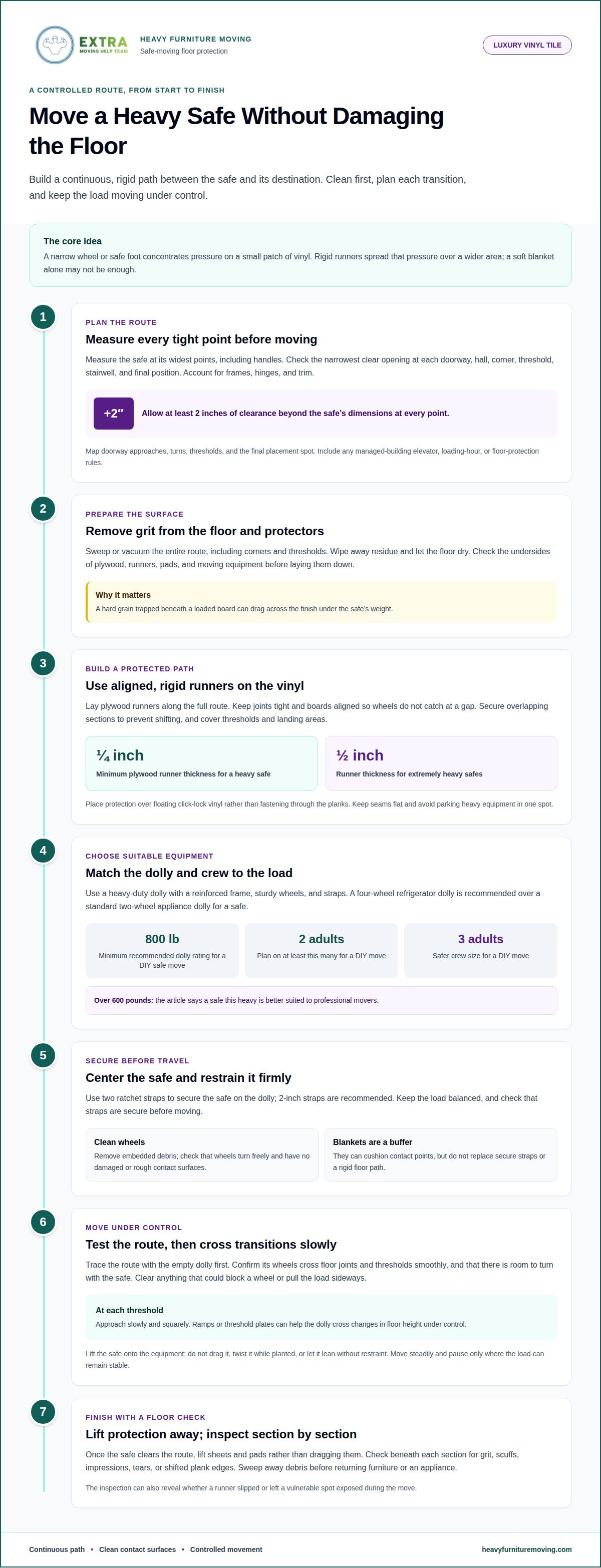
Concentrated weight is the main concern. A narrow wheel or foot presses on a small patch of vinyl, and a long pause can leave an impression. Rigid runners spread the pressure over a wider area. For a heavy safe, use plywood runners at least quarter-inch thick; extremely heavy safes call for half-inch runners. Keep boards aligned so moving equipment doesn’t catch at a joint.
Once the safe clears the route, lift the protection rather than dragging it. Remove sheets and pads carefully, then inspect the floor beneath them section by section. Look for grit, scuffs, impressions, tears, or shifted plank edges. Sweep away debris before returning furniture or an appliance. This final check can also reveal whether a runner slipped or left a vulnerable spot exposed during the move.
2. Why is route planning so important for preventing “safe moving floor damage”?
A planned route helps keep a loaded safe moving smoothly instead of stopping, twisting, or shifting over vulnerable flooring. Dolly wheels concentrate weight in small areas, so a sudden turn or pause can press hard into luxury vinyl. Map the path first, including doorway approaches, thresholds, turns, and the final placement spot. Decide where the crew can stop safely without leaving the load on exposed flooring.
For a heavy safe, plan on at least two adults for a DIY move; three are safer. Use a heavy-duty dolly rated for the load, with a reinforced frame, sturdy wheels, and straps. A heavy-duty dolly rated for at least 800 pounds is recommended for a DIY safe move. A safe weighing more than 600 pounds is better suited to professional movers.
Choose a dolly with clean, non-marking wheels. Clean wheels reduce the chance of grit being pressed or dragged across the floor, while non-marking rubber wheels help avoid scuffs. Inspect every wheel before loading: remove embedded debris, check that the wheels turn freely, and avoid equipment with damaged or rough contact surfaces. Keep the load balanced so one side doesn’t bear extra pressure or pull the dolly off course.
Match the dolly to the safe and route. A four-wheel refrigerator dolly is recommended over a standard two-wheel appliance dolly for moving a safe. Heavy-duty safe or appliance dollies should have reinforced frames, robust wheels, and built-in straps. Two ratchet straps help secure the safe, and 2-inch straps are recommended. Keep the safe centered and restrained before moving; moving blankets can cushion contact points, but they don’t replace secure straps.
Use controlled lifting to place the safe on the dolly. Don’t drag it, twist it while it’s planted, or let it lean against the dolly without restraint. A shifting load can tip, catch a wheel, or force a sudden correction. On vinyl, that correction may grind a wheel against the surface or concentrate pressure in one spot. Move steadily and pause only where the load can remain stable.
Before the move, trace the route with the empty dolly. Check that its wheels cross thresholds and floor joints smoothly, and make sure there’s room to turn with the safe. Clear loose items that could block a wheel or pull the load sideways. A doorway that looks passable can still force a sharp pivot if the approach is too tight.
For a safe that feels too heavy to control, don’t improvise with a smaller dolly or extra force. A heavy lifting moving service can help manage bulky loads and route challenges with suitable moving equipment.
3. Measuring doors, hallways, and stairwells
Measure the safe and every part of its route before moving day. The route includes the doorway, hallway, corners, thresholds, stairwell, and final position. Allow at least 2 inches of clearance beyond the safe’s dimensions at every point. A clear opening on paper may still be difficult if a tight turn blocks the safe’s wider side.
Start by measuring the safe’s height, width, and depth. Measure its widest points, including handles or other parts that stick out. Then measure the narrowest clear opening at each doorway, not just the door panel. Include the frame, hinges, and trim that reduce usable space. Record the measurements so you can compare the route consistently.
Next, measure the safe in the position it will travel. If it sits on a dolly, account for the combined height and width of the load and equipment. A doorway that clears the safe alone may not clear the dolly handles or straps. Measure the loaded setup, then compare it with each doorway and hallway pinch point.
Hallways require more than a straight-width check. Measure the open floor space at corners, where the safe may need to turn. Look for projecting shelves, radiators, doorstops, and furniture that could catch a corner or force a pivot. Clear obstacles before laying floor protection. A controlled, straight approach reduces the chance of scraping a wall or twisting the safe over delicate vinyl.
Check thresholds and changes in floor height along the route. Measure the available approach space on both sides, since a dolly needs room to meet a threshold steadily. Note floor transitions, raised strips, and narrow landings. A tight approach can push the wheels sideways and increase the risk of a scratch or sudden stop.
For stairs, measure the stairwell width, landing depth, and turning space at each change in direction. Include handrails and wall projections in the clear space. A safe may fit on one stair but not around the landing turn. Moving a heavy safe on stairs calls for specialized equipment and professional handling, not an improvised route.
Use a simple route record: note each opening’s clear width and height, each hallway’s narrowest point, and every landing’s usable space. Compare those measurements with the safe’s travel position before moving it. If a doorway is too tight, identify the obstruction or an alternate route before loading the safe. Don’t force it through and risk damage to the floor, frame, or safe.
Finish with a walk-through from the starting point to the destination. Confirm that doors can stay fully open, the path is clear, and floor protection won’t reduce clearance at a tight threshold. This preparation helps the moving team keep the safe aligned instead of making a last-minute turn in a delicate area.
4. Protecting luxury vinyl from pressure dents and tears
Luxury vinyl can dent when a safe’s weight presses through a small wheel or contact point. Use a rigid protective path to spread the concentrated load, not just a thin covering. For safe moves, plywood runners should be at least quarter-inch thick; extremely heavy safes call for half-inch runners. Lay them across the full travel line, including the approach to each doorway.
To move a heavy fire safe across luxury vinyl tile without dents in Fairfax, use plywood as the firmest option among common temporary coverings. Carpet offcuts or folded bed sheets can cushion an item that cannot be lifted and slid, but they don’t distribute pressure like rigid boards. Use them as a buffer beneath a stable path, not as the only layer under loaded dolly wheels.
Keep the route continuous. Overlap plywood sheets or tape them together so seams don’t open as the dolly rolls. A gap can catch a wheel or create a pinch point beneath the safe. Keep boards flat, without curled edges, and extend protection across thresholds and landing areas. If a runner shifts, stop and reset it before moving again.
Rugs and PVC chair mats can protect vinyl from chair wheels and routine rolling, but they aren’t a substitute for rigid runners under a safe. Soft castors and felt tips also help protect floors beneath lighter furniture. For a safe, use a protective path that stays stable under the load rather than placing a loose rug where it could bunch beneath dolly wheels.
Guard areas the safe could strike. Pad doorway trim, wall corners, and nearby furniture with moving blankets, then secure the padding so it can’t fall into the route. At a tight corner, keep the safe aligned with the dolly and avoid pivoting while its weight bears on one spot. Controlled turns help protect both the vinyl and the wall.
Move the safe steadily over the protected path. Don’t leave a loaded dolly parked on one section of vinyl. For a long pause, move the load to a stable area with protection underneath. Even a commercial appliance dolly needs a clear, firm path; its wheels can press through soft coverings if the safe remains stationary.
After the move, lift each board and sheet instead of dragging it. Inspect the vinyl for scuffs, tears, raised edges, or pressure marks. Most dents in vinyl flooring don’t come out, but a damaged plank can often be replaced individually. Check for damage before returning furniture or an appliance to the area. Careful setup is key to moving a heavy fire safe across luxury vinyl tile without dents in Fairfax.
5. Runners, carpet film, ramps, and threshold plates
Use a firm, continuous path to carry the safe across luxury vinyl, then handle each floor transition slowly. Plywood boards spread pressure beneath dollies, while carpet offcuts or folded sheets can cushion an item that cannot be lifted. Loose carpet film or plastic alone isn’t stable under loaded wheels. Keep every layer flat and secure, with no gaps that could catch a wheel.
Residential gun safes range from 200 to over 1,000 pounds. Mid-size fireproof safes weigh 200 to 400 pounds, while large fireproof models can exceed 500 pounds. A single luxury vinyl plank can hold up to 500 pounds, but that figure isn’t a safe’s floor-load rating. The safe’s total weight, contact points, load distribution, and floor construction all matter.
To assess the load, find the safe’s weight and consider how its base or dolly wheels contact the floor. Don’t treat a plank’s weight rating as permission to roll a heavy safe directly over exposed vinyl. A heavy load on a small wheel creates concentrated pressure. Spread that pressure over a rigid protective path and avoid leaving the safe stationary in one spot.
Set runners before moving, with boards meeting or overlapping so the dolly never rolls across an exposed seam. At a doorway, protect the frame and threshold with secured padding that won’t slide beneath the wheels. For a change in height, use a stable ramp or threshold plate suited to the equipment and load. Align its edges with the route, not at an angle across it.
Cross thresholds and grout lines slowly, with dolly wheels approaching as close to a right angle as the route allows. This helps prevent a wheel from catching and jolting the safe sideways. Keep the load balanced, maintain control through the transition, and don’t twist the safe while its weight rests on stationary wheels. The ramp must stay steady throughout the crossing.
DIY decisions should account for both weight and handling experience. A move under 300 pounds may be realistic for many people with proper equipment. For a safe weighing 300 to 600 pounds, DIY is recommended only for people with real moving experience. Hire professional movers for safes over 600 pounds, and don’t attempt a DIY move over 1,000 pounds.
Carpet film may protect a carpeted stretch, but it doesn’t replace load-spreading boards beneath a safe on vinyl. Check the entire path before moving, including the ramp, plates, and each board seam. If the safe’s weight or route makes controlled handling difficult, get help moving a heavy safe.
Heavy Furniture Moving
Heavy Furniture Moving helps with demanding residential moves when a safe’s weight, a tight route, or floor protection makes handling difficult. The moving team can assist with heavy lifting and plan the move around your home’s layout, including the path across luxury vinyl. That support can reduce the strain of managing a heavy load and delicate flooring at the same time.
Consider professional help when the safe is too heavy to control steadily, the route includes stairs, or you can’t set up a stable protective path. Heavy Furniture Moving also offers Movers Near Me, Exercise Equipment Moving, Sofa Hoisting, and in-home furniture moving for other bulky household items.
Contact Heavy Furniture Moving to discuss help with your move.
Plan the Safe’s Final Position Before Moving Day
Before moving the safe, decide exactly where it will sit and which way it will face. That choice affects the final turn, clearance around the safe, and whether it blocks a doorway or everyday storage. When moving a heavy fire safe across luxury vinyl tile without dents in Fairfax, plan for the destination as well as the route out of the room.
Sketch the room and mark the safe’s footprint on the plan. Consider how you’ll open its door, reach nearby items, and keep the surrounding area usable. Settling these details first can prevent a second repositioning after the safe arrives. If the placement changes, revise the route and protection plan before lifting begins.
If the safe or its final position makes the move difficult to manage, let a moving team handle the heavy work. Contact Heavy Furniture Moving for help, and take the next step with a clear plan.
Frequently Asked Questions
What can I put under heavy furniture to move it?
For heavy furniture, use a rigid board path or a suitable furniture dolly, not a thin plastic sheet alone. For a cabinet moving across one room, clean plywood can provide a firm surface beneath its wheels. Felt pads work better under furniture legs during a short repositioning. Choose support based on the item’s weight and movement, and don’t use a loose blanket where it could bunch or slip.
What is the best way to “protect floor moving safe” to prevent dents or cracks?
Use a stable, load-spreading path and keep the safe under control as it moves. A vinyl plank’s ability to support weight doesn’t mean a small dolly wheel can safely carry a heavy load across it. For example, don’t leave a loaded safe parked in one spot while adjusting a doorway. Check the flooring after the move, especially where wheels paused or crossed a threshold.
Do heavy appliances dent vinyl flooring?
Yes, a heavy appliance can dent vinyl if its feet or casters concentrate pressure in small areas. A refrigerator left in place distributes weight differently from one repeatedly rolled across the floor. Floating click-lock flooring also needs room to expand and contract, so it shouldn’t be pinned beneath fixed appliances. Protect the route during appliance moves, and avoid dragging feet or casters across the planks.
Why is route planning so important for preventing “safe moving floor damage”?
Planning helps you spot tight turns, floor transitions, and places where the load might need to stop. For example, a hallway turn may require a wider approach than the doorway itself. Last-minute pivots can make wheels skid or press into one spot. A clear route also helps the crew position protective boards before the safe reaches a delicate threshold.
Can a heavy fire safe dent, crack, or damage luxury vinyl plank flooring?
Yes. A heavy safe can leave an impression or tear vinyl if its weight bears on a narrow foot, wheel, or sharp edge. Tile can also crack from an impact at an edge or weak point. Damage depends on the safe’s contact points, how the load moves, and the floor beneath it. Most vinyl dents don’t come out, though a damaged plank can often be replaced individually.
Are appliance sliders or plywood sheets safe to use on luxury vinyl flooring?
They can help when matched to the task. Felt-backed sliders suit smooth hard floors for short, level repositioning, but not stairs or steep ramps. Plywood can create a firm travel path under heavy equipment, but keep its underside and the floor clean. Avoid hard-plastic sliders designed for carpet on vinyl, and don’t let board edges catch or scrape the planks.
When should I hire professional safe movers in Fairfax, Virginia?
Hire professional movers when the safe is beyond your team’s experience, exceeds 600 pounds, or must travel on stairs. Wrap, blankets, and straps are included on every job. The crew measures before lifting, which helps plan the item’s route through the home.
Frequently Asked Questions
For heavy furniture, use a rigid board path or a suitable furniture dolly, not a thin plastic sheet alone. For a cabinet moving across one room, clean plywood can provide a firm surface beneath its wheels. Felt pads work better under furniture legs during a short repositioning. Choose support based on the item’s weight and movement, and don’t use a loose blanket where it could bunch or slip.
Use a stable, load-spreading path and keep the safe under control as it moves. A vinyl plank’s ability to support weight doesn’t mean a small dolly wheel can safely carry a heavy load across it. For example, don’t leave a loaded safe parked in one spot while adjusting a doorway. Check the flooring after the move, especially where wheels paused or crossed a threshold.
Yes, a heavy appliance can dent vinyl if its feet or casters concentrate pressure in small areas. A refrigerator left in place distributes weight differently from one repeatedly rolled across the floor. Floating click-lock flooring also needs room to expand and contract, so it shouldn’t be pinned beneath fixed appliances. Protect the route during appliance moves, and avoid dragging feet or casters across the planks.
Planning helps you spot tight turns, floor transitions, and places where the load might need to stop. For example, a hallway turn may require a wider approach than the doorway itself. Last-minute pivots can make wheels skid or press into one spot. A clear route also helps the crew position protective boards before the safe reaches a delicate threshold.
Yes. A heavy safe can leave an impression or tear vinyl if its weight bears on a narrow foot, wheel, or sharp edge. Tile can also crack from an impact at an edge or weak point. Damage depends on the safe’s contact points, how the load moves, and the floor beneath it. Most vinyl dents don’t come out, though a damaged plank can often be replaced individually.
They can help when matched to the task. Felt-backed sliders suit smooth hard floors for short, level repositioning, but not stairs or steep ramps. Plywood can create a firm travel path under heavy equipment, but keep its underside and the floor clean. Avoid hard-plastic sliders designed for carpet on vinyl, and don’t let board edges catch or scrape the planks.
Hire professional movers when the safe is beyond your team’s experience, exceeds 600 pounds, or must travel on stairs. Wrap, blankets, and straps are included on every job. The crew measures before lifting, which helps plan the item’s route through the home.