McLean Couch Hoisting Cost and Balcony Lift Pricing
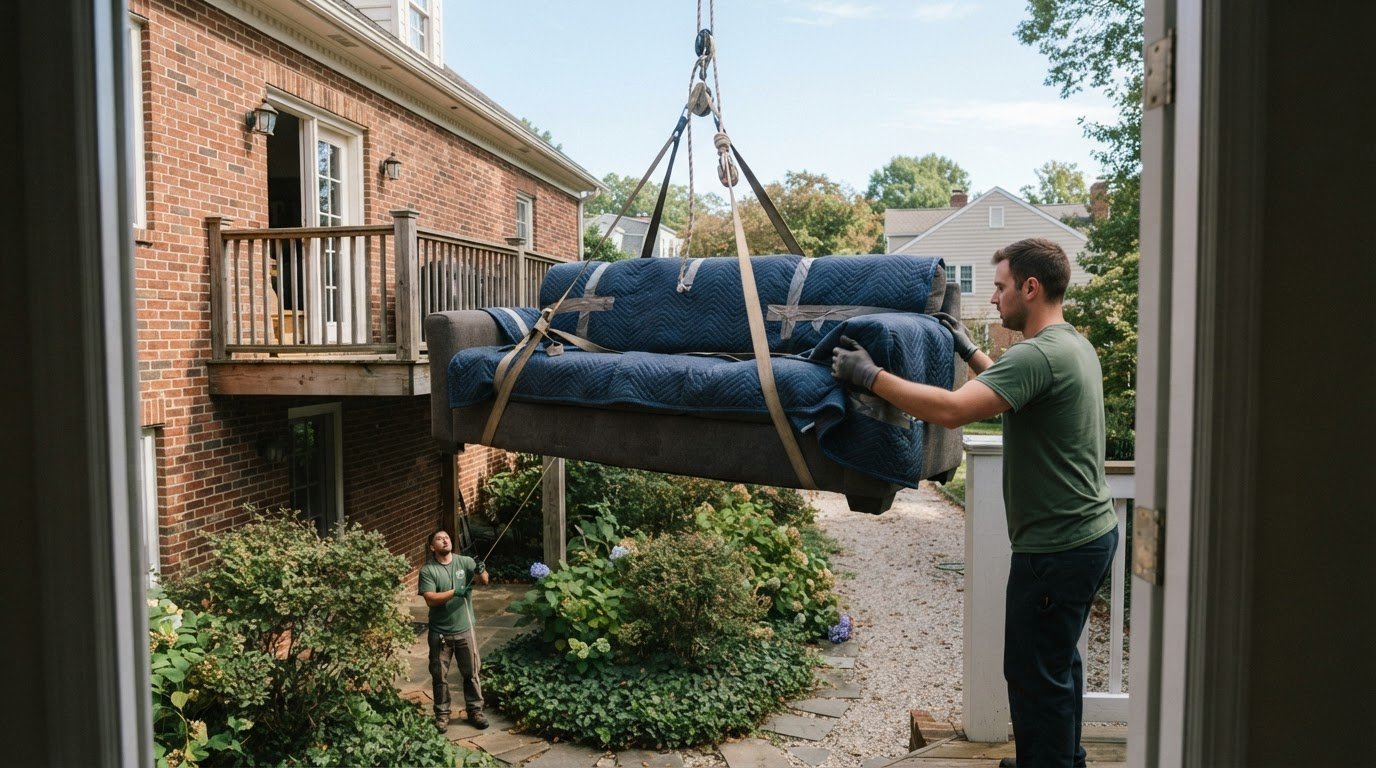
A couch that won’t fit through the stairs may still be lifted over a second-floor balcony. The cost to hoist an oversized couch over a second-floor balcony in McLean in 2026 depends on the couch’s weight and size, the lift height, and how easily the crew can reach and work at the building. The price is based on the specific job and provided after a quote request, not as a one-size-fits-all figure.
It’s reasonable to want a clear price before moving day, especially when a tight stairwell or doorway makes the delivery feel uncertain. A balcony lift can offer a practical route, but the setup and safe access matter just as much as the couch itself.
This guide explains what can shape a sofa-hoisting quote, what details help describe your couch and property, and which safety checks matter before a lift begins. You’ll also learn how the process works and when sofa hoisting can help get a bulky piece upstairs without forcing it through a narrow interior route.
Key Takeaways
- A hoisting quote depends on the couch’s weight, lift height, and how accessible the work area is.
- Clear information about the couch and the route to the balcony helps shape a flat-rate quote around the job.
- Furniture protection and secure rigging are key parts of planning a lift that avoids damage.
- Balcony, railing, and anchor-point checks help the crew assess the lifting setup before moving the couch.
- Learn how the available hoisting approach can depend on the building layout and the access around it.
How much does furniture hoisting cost?
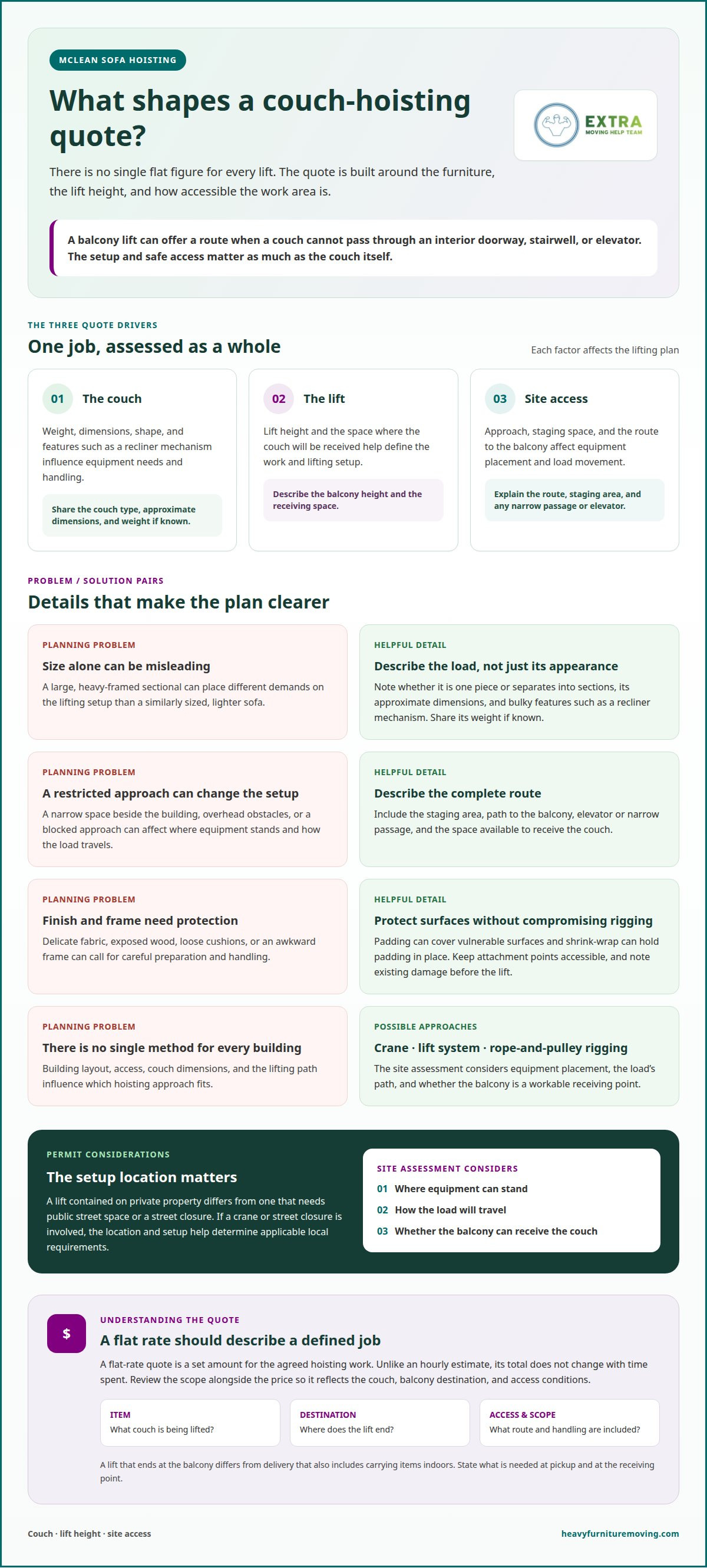
There’s no single flat figure for every McLean couch lift. The quote reflects the furniture, lift height, rigging needs, and access at the property.
Rigging Equipment and Furniture Protection
Rigging connects the couch to lifting equipment and controls its path past the building. The setup needs to suit the couch’s shape and the route to the balcony. For example, a wide sectional may need a different position and support arrangement than a compact sofa. The crew also considers where the load could swing or contact the exterior.
Furniture protection helps guard fabric, corners, and exposed wood during moving. Before the lift, padding can cover vulnerable surfaces, while shrink-wrap can hold the padding in place. Wrapping should not block secure attachment points or conceal damage that needs attention. Look for a plan that addresses both the couch’s finish and how the rigging will support it.
These choices affect the work involved. A couch with loose cushions, delicate trim, or an awkward frame may need careful preparation before it leaves the ground. Its size and access route also shape how the crew positions the load. The aim is to protect the couch while keeping the lifting connections secure.
Lift Capacity and Furniture Weight
Lift capacity must account for the couch’s weight, not just its visible size. A large sectional with a heavy frame can place different demands on the lifting setup than a similarly sized, lighter sofa. Share the item’s weight if known, or describe the couch so the crew can assess the load and equipment needs.
Share the couch type, approximate dimensions, and any features that add bulk, such as a recliner mechanism. Also describe the balcony height and the space where the couch will be received. Those details help the crew assess the lift as one connected task, rather than judging the furniture by appearance alone.
For your quote, Heavy Furniture Moving considers the couch, lift height, and site access, then gives you a price for your specific job. Text a photo of the couch and stairs to help describe the work and get a clear quote.
Permits and Hoisting Methods
There isn’t one permit answer for every McLean or Fairfax County hoist. A lift contained on private property differs from one that needs public street space or a street closure. If a crane or street closure is involved, include the location and setup in your planning so the applicable local requirements can be determined.
Possible hoisting methods include a crane, a lift system, or rope-and-pulley rigging. The building layout, available access, couch dimensions, and lifting path influence which method fits. A clear route from the staging area to the balcony helps the crew plan equipment placement and protect the furniture during the move.
During the site assessment, the crew considers where equipment can stand, how the load will travel, and whether the balcony provides a workable receiving point. A narrow space beside the building, overhead obstacles, or a blocked approach can change the setup. Those conditions, along with lift height and furniture weight, shape the method and quote.
Flat-rate hoist quotes and pricing factors
A useful flat-rate quote describes the couch lift as a defined job, not an open-ended clock. Its scope should reflect the item, lifting height, and access conditions at the property.
Flat-Rate Hoist Quotes
A flat-rate quote gives you a set amount for the agreed hoisting work. It differs from an hourly estimate, where the final total changes with time spent. Read the scope alongside the price: does it describe the couch, the balcony destination, and the access conditions used to build the quote? Clear details make it easier to understand what the amount covers.
For example, a quote based on a direct path to an open balcony may not describe the same work as a narrow courtyard approach. If an elevator is part of the route, its size and access can affect how the couch reaches the hoisting area. Accurate details help keep the quote tied to the actual move.
Factors That Determine Hoisting Costs
The main factors are the couch’s weight, lift height, and site accessibility. A bulky sectional may need different handling from a smaller sofa, even when both go to the same floor. A tight staging area or restricted approach can also change how the crew positions equipment and prepares the lift.
Describe the item and its destination together. Include whether the couch is one piece or separates into sections, where the crew can stage, and whether an elevator or narrow passage affects access. These details help match the quote to the full route, rather than only the balcony height.
Finish and condition matter to the work plan, too. Delicate fabric, exposed wood trim, or an existing tear calls for careful handling and documentation before moving. Note these features when describing the furniture. That gives the crew a clearer picture of protection needs and any special care the finish requires.
Keep the quote focused on the actual service. A furniture delivery that includes carrying items indoors differs from a lift that ends at the balcony. Likewise, removing cushions or separating a modular sectional can change how the item is prepared. State what needs to happen at pickup and at the receiving point so the quote matches the task.
The exact figure depends on the specific job and is given in a quote for your case. Weight, lift height, and site access shape the assessment, while the stated scope shows what the quote covers. For a couch that needs an exterior route, review the details of sofa hoisting as part of planning the move.
Hoisting a couch or sectional to an upper floor
A balcony lift can provide a route when a couch cannot pass through an interior doorway, stairwell, or elevator. The crew plans around the furniture, the building, and the path from the staging area to the upper-floor opening.
Start with the couch’s shape and construction. A one-piece sofa, a reclining couch, and a sectional with detachable pieces each present different handling needs. The crew considers the overall dimensions, weight, cushions, legs, and frame before choosing how to position the load. A sectional that separates may be lifted in sections, while a one-piece couch must remain supported as one item.
Next comes the route. The crew considers where equipment can be set up, how close it can get to the building, and whether trees, roof edges, or other obstacles affect the lift path. A second-floor balcony may be reachable from one side, while a courtyard or narrow approach may require a different setup. The receiving area also needs enough room to bring the couch inside without twisting it against the opening.
Before lifting, the team prepares the item and the work area. Cushions can be removed when that helps reduce loose parts, and vulnerable surfaces can be covered with protective padding. The crew then positions the rigging so the couch stays supported during movement. Careful handling matters at the balcony edge, where the load changes direction from the exterior route into the room.
Building access can affect timing and coordination. For example, an apartment or condo may require advance scheduling with property management or a certificate of insurance on file before a hoist. Those arrangements are separate from the physical lift, so include the property’s access process in the plan.
The crew’s sequence is straightforward:
- Review the couch’s dimensions, weight, and whether it separates.
- Assess the setup area and the path to the balcony.
- Protect exposed furniture surfaces and prepare the rigging.
- Raise and guide the couch toward the receiving opening.
- Move the item into the room and clear the lift area.
A careful plan also accounts for the space inside the destination room. A couch can clear the balcony and still need room to turn through the interior entry. For example, the crew may position the sofa near the opening first, then guide it toward the intended wall after it is fully inside. This makes final placement part of the move plan, not an afterthought.
Descriptions such as “licensed and insured” don’t explain the route, load, or setup for a specific couch. The practical details are the furniture dimensions, the building access, the balcony position, and the equipment plan. Sharing those details gives the crew a clear starting point for a safe, coordinated lift.
Safety checks for balconies, railings, and anchor points
Before lifting a couch, the crew assesses the balcony, route, and rigging setup as one work area. A clear opening matters, but so do the landing space, nearby surfaces, and the points supporting the lift.
The balcony inspection starts with the floor and edges. The crew looks for visible damage, loose materials, obstructions, and enough clear space to receive the couch. For example, stored planters or patio furniture can block the landing area or force an awkward turn. Clearing the path helps the team guide the load without striking nearby items.
Railings deserve separate attention. A railing helps define the balcony edge, but it should not automatically be treated as an anchor point. The crew assesses where the rigging can be attached and whether the proposed setup suits the lift. If an attachment point is uncertain, the team needs a different plan before moving the couch.
Anchor points and rigging must work together. The crew identifies suitable attachment locations, checks that the lines can travel along the planned route, and considers how the couch may shift as it rises. A sectional with an uneven shape, for example, may need careful positioning to stay balanced. The load should not be guided against a window frame or balcony edge.
The receiving opening also needs a close look. The crew checks the width and height of the balcony doorway or window opening, then considers the couch’s orientation as it enters. Curtains, screens, furniture, and doors can interfere with the path. A clear interior landing area gives the team room to bring the couch inside without twisting it against the frame.
Before the lift begins, the crew can use a practical sequence:
- Inspect the balcony surface, edge, and receiving area.
- Identify the rigging attachment points and planned travel path.
- Clear objects near the opening and inside the landing area.
- Coordinate signals so the team can guide the couch together.
- Pause if the load shifts or the route becomes obstructed.
People and pets should stay clear of the lift path and landing zone while the couch is moving. The crew should also account for nearby windows, exterior walls, and anything below the balcony. These checks reduce avoidable contact and keep attention on the load.
A trained crew’s site assessment focuses on the actual balcony and couch, not a generic checklist alone. Insurance documentation has a separate role; it does not establish that a railing or anchor point is suitable for rigging. Matching the lift setup to the visible conditions is the key safety step.
Are crane, lift, or rope-and-pulley services available for couch hoisting in McLean?
Couch hoisting is an option when stairs, doorways, or an elevator cannot accommodate the furniture. The right lifting method depends on the couch, building access, lift height, and space available around the property. A crane, mechanical lift, or rope-and-pulley arrangement may suit different site conditions, but these methods aren’t interchangeable.
A crane may be considered when the building layout and outdoor setup provide a workable position for the equipment. The crew needs to assess where it can be placed and whether the couch can travel from that position to the balcony without obstruction. A tight driveway, limited staging space, or overhead obstacles can affect the plan.
A mechanical lift or rope-and-pulley setup may suit a different access route. The couch’s size and weight matter, as does the path from the staging area to the upper-floor opening. For example, a sectional that separates into sections presents a different load from a one-piece sofa. The crew assesses these details before selecting an approach.
The assessment also accounts for the receiving point. A balcony with a clear opening may offer a direct route, while a narrow landing or nearby window can restrict how the couch is turned. The team considers the load’s orientation, the room inside, and where the crew can guide the furniture once it reaches the balcony.
For a clear assessment, provide details about:
- The couch type, approximate dimensions, and whether it separates.
- The floor and balcony or window location.
- Outdoor access, including driveways, walkways, and staging space.
- Visible obstacles, such as trees, overhangs, or nearby structures.
- Building access steps, including any management scheduling process.
Those details help match the method to the actual job. They also help identify whether equipment placement or the receiving area could complicate the lift. A method that works at one McLean property may not fit another, even when both involve a second-floor couch.
Don’t choose a method from the equipment name alone. Focus on how the crew plans to position, raise, guide, and receive the specific couch. Lift height, item weight, and access conditions all shape that plan, along with the available route and landing space.
Share your couch and property details to plan a sofa-hoisting quote around the access conditions and lifting route.
Heavy Furniture Moving: Sofa Hoisting
Heavy Furniture Moving provides Sofa Hoisting for a couch that can’t fit through the stairs, doorway, or elevator. Turn to this service when an exterior lift offers a practical route to an upper-floor balcony and you need help planning around the furniture and building access.
To describe the job, share the couch’s dimensions, whether it separates into sections, its destination floor, and the balcony or window access. Include any tight staging areas or obstacles that could affect the lifting path. These details help frame the hoisting work and quote for your specific move.
If a balcony lift looks like the right solution, text a photo of the couch and stairs to Heavy Furniture Moving for a quote.
Get your couch lift plan moving
Turn the balcony lift from a difficult delivery into a defined next step. For the cost to hoist an oversized couch over a second-floor balcony in McLean in 2026, focus on getting a quote that reflects your specific move rather than relying on a broad estimate. A clear plan starts with the route, the building’s access process, and the couch’s destination.
Heavy Furniture Moving offers Sofa Hoisting for oversized furniture, alongside Movers Near Me and Exercise Equipment Moving. Whether you’re arranging one challenging couch move or need help with other heavy items, choose the service that fits the work in front of you. Keep the building’s access arrangements in view as you plan, so the lifting work and property coordination fit together.
Ready to take the next step? Contact Heavy Furniture Moving for a hoist quote. A clear quote request can help turn a tight stairwell problem into a workable moving plan.
Frequently Asked Questions
Can you hoist a couch over a balcony?
Yes, a couch can be hoisted over a balcony when the furniture and access conditions suit the lift. This can help when a sofa cannot pass through the home’s entry route. Heavy Furniture Moving offers Sofa Hoisting, with wrap, moving blankets, and straps included on every job. Share whether the couch has removable legs or separates into sections, since that affects preparation and handling.
What size and weight can you hoist?
There isn’t one universal size or weight limit for every balcony hoist. The crew assesses the actual item and lift conditions. Share the couch’s dimensions, its weight if known, and whether it has a reclining mechanism or detachable sections so the load can be evaluated accurately.
What is the average cost to hoist an oversized couch over a second-floor balcony in McLean, Virginia in 2026?
There isn’t a single average figure that applies to every McLean couch hoist. The exact quote depends on the job rather than a general market number. For the cost to hoist an oversized couch over a second-floor balcony in McLean in 2026, provide the item details and property access information for a case-specific quote. Heavy Furniture Moving gives flat-rate quotes for most single heavy items.
What factors affect the price of hoisting a couch into a second-floor home?
The main factors are the couch’s weight, lift height, and site accessibility. The route can also matter: a blocked staging area or limited space near the balcony may change the setup. For example, a sectional that separates into manageable pieces differs from a one-piece sofa. Include the destination and any building access steps in your job details so the quote reflects the actual work involved.
What do McLean and Northern Virginia moving companies charge for furniture hoisting?
Charges vary by company and job, so there’s no single rate for McLean or Northern Virginia. Heavy Furniture Moving uses flat-rate pricing for most single heavy items, with the price provided upfront by phone. Other labor is billed hourly with a 2-hour minimum. Those are different pricing arrangements, so identify whether your request is a single couch hoist or part of broader moving labor.
What safety risks and weather conditions can delay or prevent a balcony couch hoist?
Conditions that prevent a stable setup or controlled movement can delay a lift. Wind, rain, or icy surfaces may affect visibility, footing, or the crew’s ability to guide furniture safely. A blocked landing area, damaged balcony surface, or unsuitable rigging location can also stop preparations. The crew assesses conditions at the property and proceeds only when the couch and lifting route can be handled safely.
Frequently Asked Questions
Yes, a couch can be hoisted over a balcony when the furniture and access conditions suit the lift. This can help when a sofa cannot pass through the home’s entry route. Heavy Furniture Moving offers Sofa Hoisting, with wrap, moving blankets, and straps included on every job. Share whether the couch has removable legs or separates into sections, since that affects preparation and handling.
There isn’t one universal size or weight limit for every balcony hoist. The crew assesses the actual item and lift conditions. Share the couch’s dimensions, its weight if known, and whether it has a reclining mechanism or detachable sections so the load can be evaluated accurately.
There isn’t a single average figure that applies to every McLean couch hoist. The exact quote depends on the job rather than a general market number. For the cost to hoist an oversized couch over a second-floor balcony in McLean in 2026, provide the item details and property access information for a case-specific quote. Heavy Furniture Moving gives flat-rate quotes for most single heavy items.
The main factors are the couch’s weight, lift height, and site accessibility. The route can also matter: a blocked staging area or limited space near the balcony may change the setup. For example, a sectional that separates into manageable pieces differs from a one-piece sofa. Include the destination and any building access steps in your job details so the quote reflects the actual work involved.
Charges vary by company and job, so there’s no single rate for McLean or Northern Virginia. Heavy Furniture Moving uses flat-rate pricing for most single heavy items, with the price provided upfront by phone. Other labor is billed hourly with a 2-hour minimum. Those are different pricing arrangements, so identify whether your request is a single couch hoist or part of broader moving labor.
Conditions that prevent a stable setup or controlled movement can delay a lift. Wind, rain, or icy surfaces may affect visibility, footing, or the crew’s ability to guide furniture safely. A blocked landing area, damaged balcony surface, or unsuitable rigging location can also stop preparations. The crew assesses conditions at the property and proceeds only when the couch and lifting route can be handled safely.