How to Move a Heavy Peloton Tread Up Stairs in Vienna
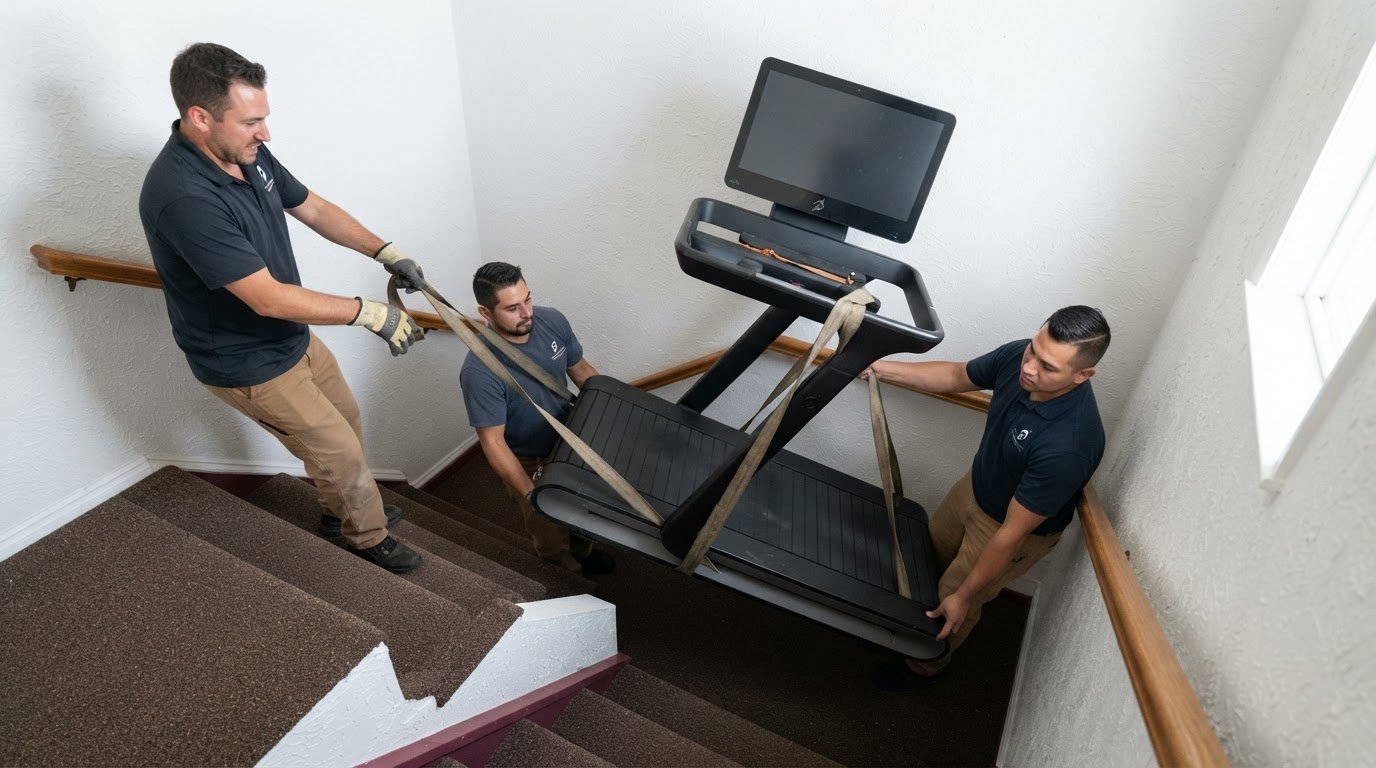
Moving a heavy Peloton Tread up two flights of stairs in Vienna starts with checking the machine’s dimensions and whether the full route has enough clearance for the equipment and movers.
Weight is only one part of the challenge. Tight turns, narrow landings, and restricted access all affect how the carry should be planned. Before moving day, prepare the route details, check building access rules, and share the layout with your moving team.
Key Takeaways
- Plan the booking around the full route, including stair turns, landings, and access to the destination.
- Measure tight points along the way so you can spot clearance problems before moving day.
- Use the Tread’s model-specific instructions to plan what to remove and how to protect the equipment.
- Review how moving and handling the Tread may relate to its warranty before choosing a disassembly approach.
- Arrange experienced moving help when the stairs, turns, or handling demands make the move difficult to manage safely.
Booking and timing
Plan around the building’s access rules and the complete route to the Tread’s new location. Gather these details before arranging the move.
Check Building Moving Rules
Ask the property manager or homeowners association about procedures for moving large equipment. Yes, apartment buildings and homeowners associations may set their own rules, such as when moves can happen or which entrances residents must use. Requirements vary by property, so confirm the rules for both the pickup and destination addresses.
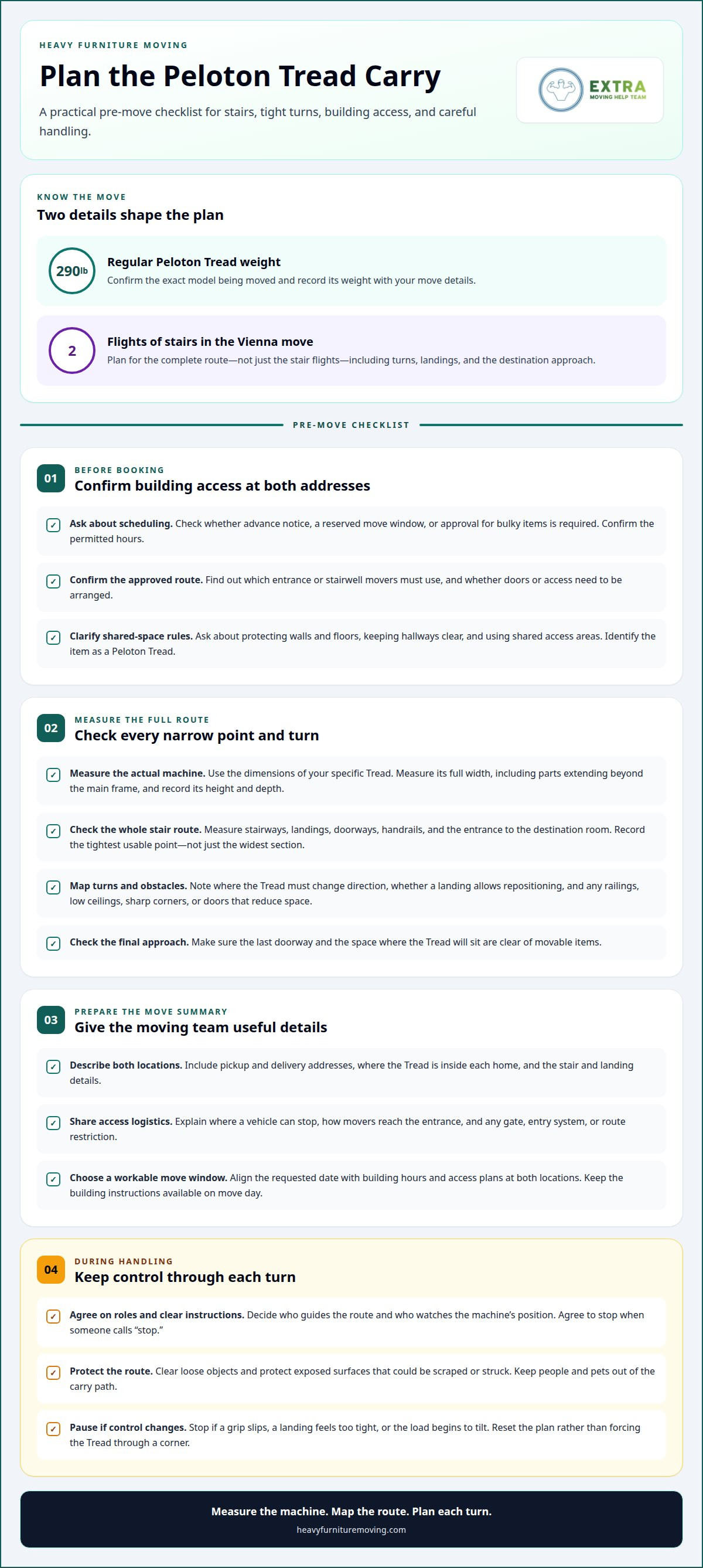
- Ask about scheduling. Find out whether the building requires advance notice, a reserved move window, or approval for bulky items. Share the intended moving day and ask which hours are permitted. This helps prevent a crew arriving when the building cannot accommodate the move.
- Confirm the approved route. Ask whether movers can use the main entrance, service entrance, or a particular stairwell. Check if doors need to be held open or access arranged. A route restriction can affect how the Tread is carried, so identify it before setting the booking.
- Clarify shared-space rules. Ask about protecting walls and floors, keeping hallways clear, and using any shared equipment or access areas. Tell the building contact that the item is a Peloton Tread. A clear description helps them explain any relevant procedures without confusing it with smaller fitness equipment.
Plan Booking and Timing
Prepare a concise move summary before selecting a date. Include the pickup and delivery addresses, the Tread’s location inside each home, and the fact that the route includes two flights of stairs. Accurate details help the moving team plan the labor and route rather than relying on assumptions.
- Describe the stairs and landings. Note the stairway shape, turns, landing size, and any narrow points. Mention railings, low ceilings, sharp corners, or doors that reduce usable space. If a landing turns tightly, describe where the turn occurs and whether the Tread must change direction there.
- Share access details. Explain where a vehicle can stop, how movers reach the entrance, and whether the building has access instructions. Include any gate, entry system, or route restriction that could delay reaching the stairs. Keep the move details consistent for both addresses.
- Choose a workable move window. Align the requested date with the building’s allowed hours and the access plan at both locations. Leave room to manage entry and protect shared areas, rather than booking around an assumed quick carry. Keep building instructions available for the moving team on move day.
Moving a Peloton Tread
Moving a Peloton Tread upstairs calls for both equipment-handling experience and a plan for the stair route. Heavy Furniture Moving provides exercise equipment moving, including difficult in-home carries. Share the machine and access details when arranging the move.
Check Stairway and Landing Clearances
Measure the entire route before moving the machine. Check the stairwell, landings, doorways, handrails, and entrance to the destination room. A clear stair section can still lead to a tight landing, so assess every turn.
- Record narrow points. Note where a doorway, railing, or corner reduces the usable space. Measure the route at the tightest point, not only across the widest part of a stairwell.
- Map each turn. Identify where the Tread must change direction and whether a landing gives enough room to reposition it. A short landing between stair runs can be harder to navigate than a straight flight.
- Plan the destination approach. Check the last doorway and the space where the equipment will sit. Clear movable items from that path so the carry doesn’t end with a sudden stop or awkward turn.
Assess Injury and Property Damage Risks
Consider the risks before lifting. A heavy, bulky machine can shift during a stair carry, strain a mover, or hit walls, railings, floors, and door frames. Rushing or using poor hand positions can make it harder to control, especially on a turn or landing.
- Assign clear roles. Decide who guides the route and who watches the machine’s position. Agree on simple instructions before lifting, such as stopping when someone says “stop.” Don’t try to correct a shift without first securing control.
- Protect contact points. Clear the stairs and cover exposed surfaces that could be scraped or struck. Keep the route free of loose objects, and avoid carrying around people or pets moving through the same space.
- Stop when control changes. Pause if a grip slips, a landing feels too tight, or the load begins to tilt. Resetting the plan is safer than forcing the machine through a corner. For difficult stairs, experienced fitness-equipment movers can bring focused handling skills.
Use a deliberate pace on both flights. Keep communication steady through each turn, and don’t rush the final approach into the room. A careful plan for moving a heavy Peloton Tread up two flights of stairs in Vienna can help limit avoidable strain and contact with the home. If the Tread cannot pass a tight point with controlled handling, stop and reassess the move before lifting it again.
How much does a Peloton Tread weigh, and what are its dimensions?
Use the dimensions of your actual machine, rather than an assumed footprint, to plan its route through the home.
- Record the Tread’s weight and model. Start with the regular Peloton Tread’s 290-pound weight, then identify the exact model being moved. Keep the model name with your move notes. That gives the moving team a clear equipment description and helps avoid treating the Tread like a compact exercise bike.
- Measure the machine’s full width. Use a tape measure across the widest points, including parts that extend beyond the main frame. Write down the measurement and where you took it. A console or side rail may affect the space needed, so measure the assembled equipment rather than estimating from its appearance.
- Measure its height and depth. Record the Tread’s height from floor level to its highest point, then measure its front-to-back length. Note which ends you used. These measurements help describe the machine’s shape when approaching a doorway, stairwell, or landing, where height and length can matter as much as width.
- Include the carrying position in your notes. The Tread may need a different orientation at a doorway than on a straight hallway. List the width, height, and depth together, and identify which side faces forward. For example, note whether a narrow entrance meets the Tread’s long side or its shorter end.
- Compare measurements with the route. Measure door openings, stairwell access points, and the usable space at each landing. Compare those clearances with the Tread’s recorded dimensions. A route that appears wide enough in a straight line may still require a turn that needs more room.
- Map each turn using the measurements. Sketch the route from the current room to the destination, marking doorways and corners. Add the Tread’s dimensions beside the tightest points. This makes it easier to discuss whether the machine can change direction without hitting a wall, railing, door frame, or ceiling.
- Share one measurement sheet when arranging the move. Keep the model, 290-pound weight, three dimensions, and route notes together. Include a simple example, such as a narrow doorway followed by a landing turn. That gives the moving team useful details for planning how to handle the Tread through the home.
Keep the Tread’s weight entry distinct from notes for other Peloton equipment. These figures can help distinguish equipment when several items are being moved, but they do not replace the weight recorded for the Tread. Label each entry with its model name so the moving team does not confuse one machine’s measurements or weight with another’s.
Before the move, check that the measurement sheet describes the assembled Tread and the route it will take. Keep any notes about a doorway, turn, or landing beside the relevant measurements, rather than relying on a general room estimate. If the route or machine setup changes, review the notes with the moving team so the plan still reflects the equipment and access points they will encounter.
What does Peloton recommend for moving a Tread, and does moving it affect the warranty?
Use current Peloton documentation for model-specific moving instructions. Don’t assume that moving the machine automatically voids coverage or that every type of damage is covered. Warranty terms and circumstances matter.
- Find instructions for your exact Tread model. Use the current Peloton owner documentation before planning disassembly or lifting. Instructions for another Peloton machine may not apply to your Tread. Follow the guidance for preparing the equipment, handling its components, and moving it. Don’t substitute advice for a Bike or another treadmill model.
- Separate manufacturer instructions from general moving advice. Tips about carrying bulky equipment can help with route planning, but they aren’t automatically Peloton’s directions. Use Peloton’s guidance for equipment-specific steps. Treat stair measurements, clear hallways, and coordinated carrying as separate planning tasks for your home.
- Review warranty terms before the move. Read the warranty that applies to your Tread and focus on its coverage, exclusions, and damage terms. Don’t rely on a broad claim that moving always cancels coverage. Don’t assume damage during a move is necessarily covered, either. The written terms are the basis for understanding coverage.
- Keep the paperwork with your move details. Save the relevant warranty information and the model-specific moving instructions together. Note the Tread’s condition before moving, including visible marks or loose parts. Clear notes can help you describe what happened if a question about the equipment comes up after the move.
- Plan around stairs without improvising equipment steps. Share the route details, including two flights, turns, and landing constraints, with the people handling the Tread. Keep Peloton’s equipment instructions available during planning. If the stairs require a carrying position or disassembly that conflicts with those instructions, pause and resolve that conflict before lifting.
- Keep a clear record of any issue. If the Tread appears damaged or behaves differently after the move, record the symptoms and when they appeared. Compare them with the applicable warranty language and Peloton’s guidance. Avoid taking the machine apart further while the concern remains unclear, since additional handling can complicate the account of what occurred.
What stairway width, turns, and landing clearances are needed to move a Peloton Tread?
Measure the complete route before moving the Peloton Tread. Width alone won’t show whether the machine can turn through a landing or doorway.
- Measure the narrowest stairway point. The page states that all stairways must have a minimum width of 22 inches, according to the U.S. Environmental Protection Agency. For this move, compare the usable width with the Tread’s actual dimensions. Account for handrails, trim, and other fixed features that reduce the open passage.
- Measure the Tread itself. Record its width, height, and length, using the assembled equipment and the parts that project farthest. Don’t rely on a guessed model size. Compare each dimension with the narrowest point along the stairs, and consider how the machine’s orientation changes the space it needs.
- Check every landing as a turning space. A landing must allow the Tread to change direction without striking a wall or railing. Measure its usable depth and width, not just the open area visible from the stairs. For example, a landing may fit the machine’s length but leave too little room to pivot around a corner.
- Trace each turn from both directions. Follow the route from the lower floor to the upper floor, including any doorway before or after a landing. Note whether a turn is sharp, whether a door swings into the path, and whether a railing narrows the space. A clear straight flight doesn’t prove that the full route works.
- Check overhead clearance. Look for low ceilings, lights, or sloped sections above stair steps and landings. Compare those obstacles with the Tread’s height in the position needed for carrying. A route may have enough floor width but still restrict the machine when it tilts or changes angle.
- Mark problem areas on a route sketch. Draw both flights, landings, and doorways, then label the tightest measurements. Include fixed obstacles and the direction of each turn. This gives everyone a shared picture of where the Tread could bind or contact a surface during the carry.
- Use the measurements to decide whether to proceed. Compare the tightest clearances with the Tread’s dimensions and its planned orientation. If a corner leaves no room to reposition the machine, don’t force the turn. Resolve the route problem before lifting, rather than discovering it halfway up the stairs.
Experience with a Peloton Bike offers a reminder that a difficult turn can change the moving plan. The author began wondering how to move her Peloton Bike two years after getting it. A 90-degree turn at a stair landing can make partial disassembly necessary when moving a Peloton Bike, so assess the landing before lifting rather than assuming the machine can be carried through intact.
That does not mean taking apart every Bike for a normal move: the Peloton Bike's frame and flywheel should stay together during a normal move. Keep this distinction clear when planning the route, and do not treat Bike-specific handling as a substitute for checking the Tread’s measurements and clearances. If a turn leaves too little room to reposition the equipment, pause and decide on a workable plan before starting the carry.
Heavy Furniture Moving
Heavy Furniture Moving handles exercise equipment moves when stairs, tight turns, or heavy lifting make the job difficult to manage alone. Its Exercise Equipment Moving service can help plan the Tread’s route through your home.
When arranging the move, share the Tread’s model, stairway layout, landing turns, and any building access rules. These details help the team plan the equipment’s path through your home. For help carrying a Tread upstairs in Vienna, contact Heavy Furniture Moving.
Make the Next Move With a Clear Plan
Before moving day, turn your route notes into a shared plan. Decide who will manage access, where the Tread will go, and how the carrying team will communicate at each turn. For moving a heavy Peloton Tread up two flights of stairs in Vienna, that preparation helps everyone approach the job with the same information.
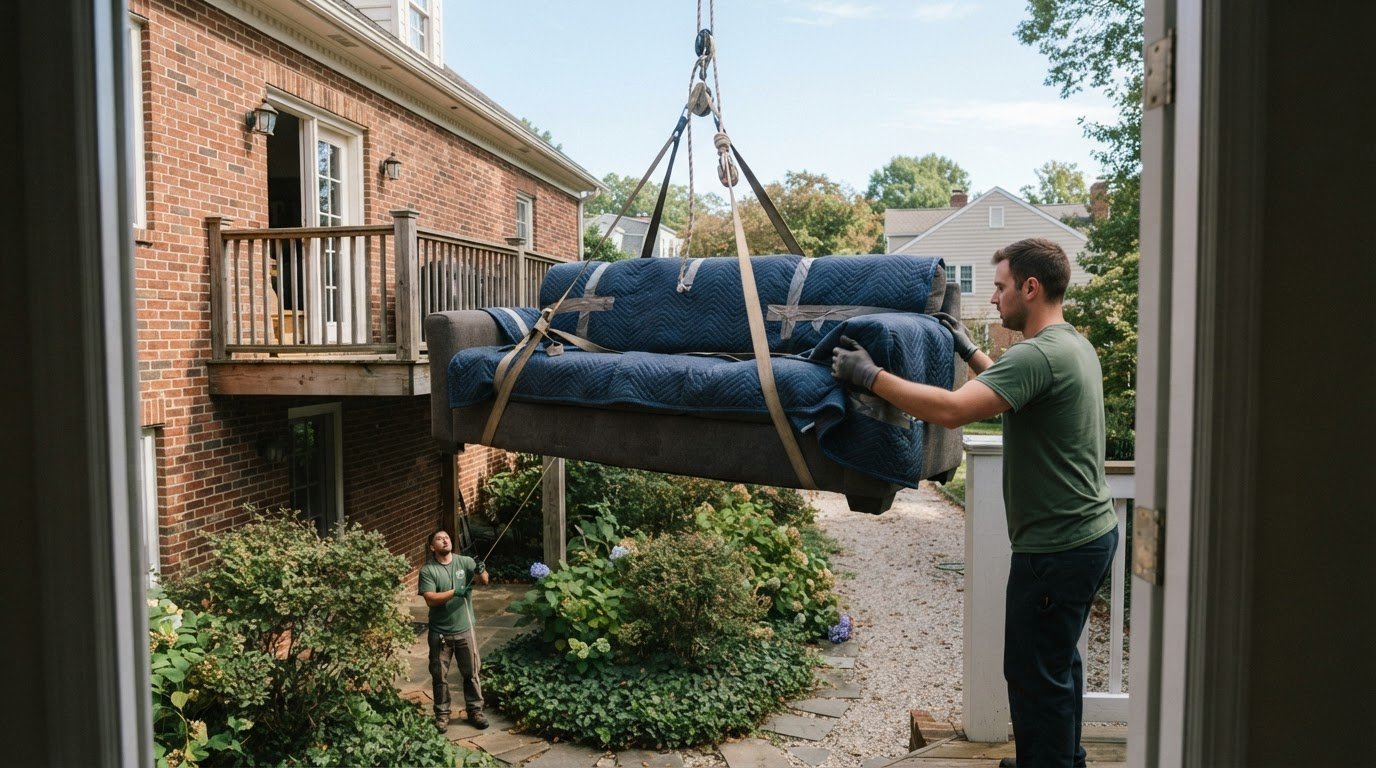
Heavy Furniture Moving helps with demanding household moves through services including Movers Near Me, Exercise Equipment Moving, and Sofa Hoisting. If the Tread’s weight or stairway layout makes the move difficult to handle yourself, get help with the lifting and route planning.
Contact Heavy Furniture Moving to discuss your move. With a clear plan and the right support, you can take the next step with confidence.
Frequently Asked Questions
Which Vienna, VA movers handle heavy exercise equipment and stair carries?
Heavy Furniture Moving handles exercise equipment moves in Vienna, Virginia, including difficult in-home carries. Share the Tread’s location, stair layout, and any tight turns so the team can plan for the home’s access. Mention details such as a narrow hallway before the stairs, not just the room where the machine starts and ends.
Can a Peloton Tread be disassembled for moving up stairs?
A treadmill console can be disassembled and reassembled during a move, but don’t assume the entire Peloton Tread should come apart. Follow the instructions for your exact model, and don’t remove components without guidance. Share tight turns and doorways with the moving team to help determine whether limited disassembly would be useful.
What equipment and number of movers are needed to carry a Peloton Tread upstairs safely?
For difficult stairs, clear the route and protect exposed contact points. Use experienced fitness-equipment movers and agree on clear roles for guiding the route and monitoring the machine.
Frequently Asked Questions
Heavy Furniture Moving handles exercise equipment moves in Vienna, Virginia, including difficult in-home carries. Share the Tread’s location, stair layout, and any tight turns so the team can plan for the home’s access. Mention details such as a narrow hallway before the stairs, not just the room where the machine starts and ends.
A treadmill console can be disassembled and reassembled during a move, but don’t assume the entire Peloton Tread should come apart. Follow the instructions for your exact model, and don’t remove components without guidance. Share tight turns and doorways with the moving team to help determine whether limited disassembly would be useful.
For difficult stairs, clear the route and protect exposed contact points. Use experienced fitness-equipment movers and agree on clear roles for guiding the route and monitoring the machine.