International Movers in McLean, VA: Customs Broker Role
A customs broker supports customs clearance; the mover connects that process to pickup, packing, and delivery. If you’re comparing international furniture movers McLean VA, understanding where those responsibilities split can help prevent paperwork gaps and missed handoffs. Your mover coordinates the physical move and shipment logistics, while a customs broker handles customs documentation and communication with border authorities within the broker’s authorized role.
It’s common to wonder who prepares each document, who responds to customs questions, and when information needs to be passed along. Incomplete or inconsistent details can complicate a move, especially when pickup, shipping, clearance, and final delivery each have separate milestones. A clear division of responsibilities makes the process easier to manage.
This guide explains when a customs broker may be involved, what the broker typically handles, and how that role differs from your mover’s. You’ll also learn what shipment details to organize and how packing support and coordinated logistics can connect your McLean pickup to overseas delivery.
Key Takeaways
- See how a customs broker’s clearance role differs from the mover’s work coordinating furniture and shipment logistics.
- Follow the main handoffs, from inventory and packing through documentation, clearance, and delivery.
- Learn which shipment details to gather early and which forms or declarations depend on the destination.
- Use a clear sequence to plan an overseas furniture move with international furniture movers McLean VA.
- Understand how coordinated packing and shipment planning can connect your McLean pickup with later delivery milestones.
International Furniture Movers in McLean, VA: Why a Customs Broker May Be Involved
Who handles customs clearance when your furniture leaves McLean for an overseas destination? The answer depends on the route and destination requirements, but a customs broker and a mover have different roles. A broker supports customs clearance in the relevant jurisdiction. The mover coordinates the physical shipment, including packing, pickup, transport arrangements, and delivery planning.
What does a customs broker do in an international furniture move?
A customs broker is a specialist who helps an importer prepare or submit customs information and communicate with customs authorities, within the broker’s authorized role. The Customs Broker on Wikipedia offers a general overview of the profession. For a household move, the broker’s exact duties depend on the destination, shipment details, and applicable rules. One country’s process may not apply to another.
The broker may help organize declarations and address questions about the information submitted. If shipment details are missing or inconsistent, customs authorities may request clarification, which can affect progress while the issue is addressed. Keep item descriptions and shipment information organized, and verify the forms and requirements that apply to your destination.
Is a customs broker the same as an international mover?
No. A mover coordinates the physical and logistical side: preparing an inventory, planning packing, arranging pickup, coordinating shipment details, and connecting those steps to delivery. A customs broker supports clearance. The roles can interact when information passes between the customer, mover, and broker, but one does not automatically replace the other.
A customs broker supports the movement of shipment information through customs; a mover coordinates the furniture’s journey from pickup toward delivery.
This distinction helps clarify handoffs. When comparing international furniture movers McLean VA, map who coordinates packing and shipment milestones, and identify who handles customs-related information. Heavy Furniture Moving coordinates international shipment logistics and offers packing support, connecting local preparation with later shipment milestones.
Broker involvement and responsibilities can vary with the route, transport mode, shipment, and destination requirements. Confirm which customs process applies to the destination, and keep shipment coordination and clearance responsibilities clear in your plan.
How Customs Clearance Fits Into Furniture Shipping From McLean
An overseas furniture shipment moves through several connected stages. Start with an inventory of the furniture and household goods. Use it to plan packing, then organize shipment details and share the relevant information with the parties handling transport and clearance. After customs processing, the shipment can continue toward delivery at its destination.
For a McLean pickup, packing and shipment coordination connect what is prepared at home with the information needed for the next stages. The sequence can vary with the route and transport mode, and carrier arrangements affect who manages particular milestones. The U.S. Department of Commerce explains the role of brokers in federal import requirements and U.S. licensing in its U.S. Customs Brokers and Freight Forwarders overview. Destination procedures can differ, so verify requirements for the country receiving your shipment.
Which parties handle each shipment handoff?
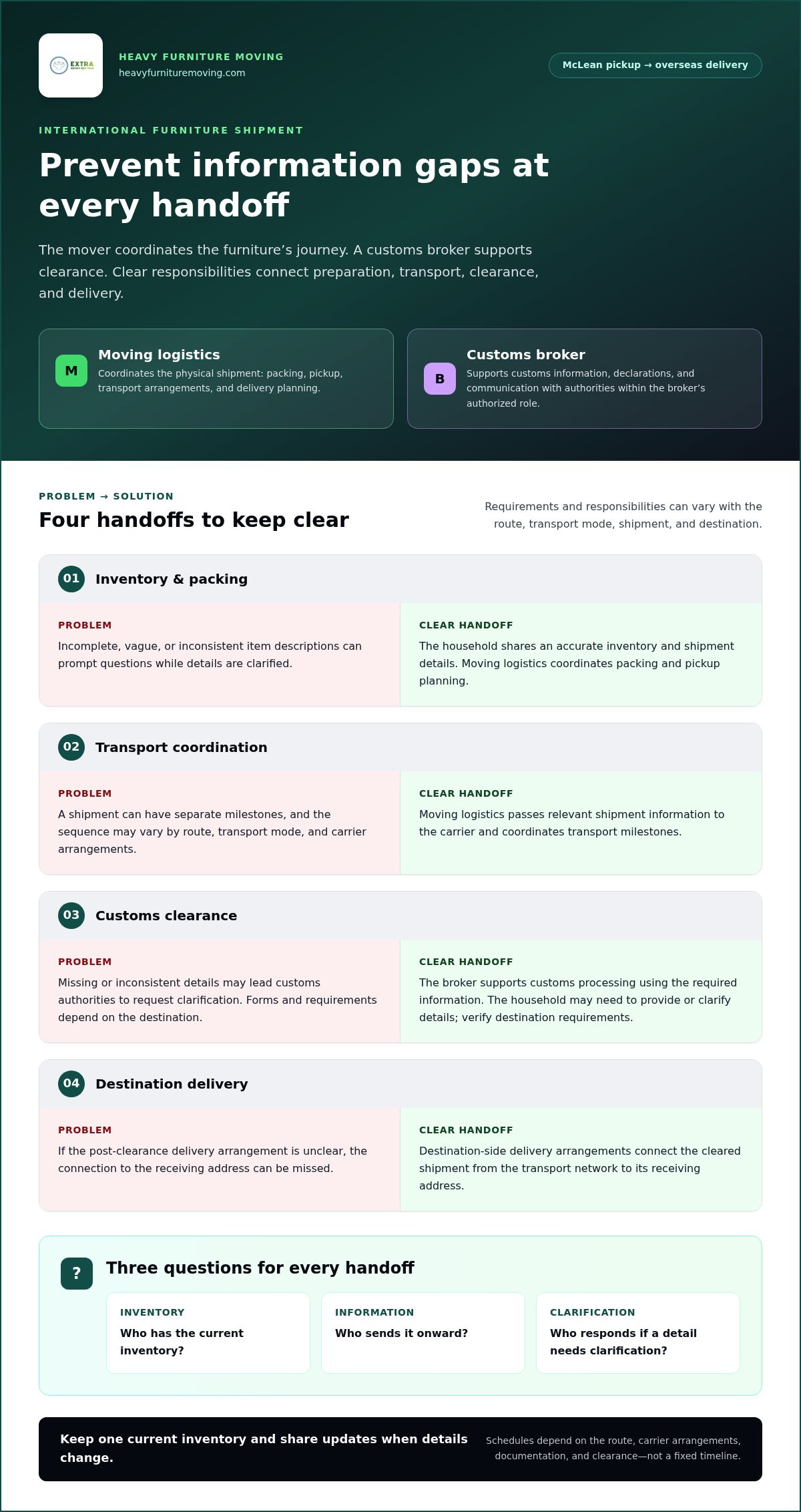
Treat each handoff as an information checkpoint. The household provides accurate item details and records. The moving logistics team coordinates preparation and shipment details. The carrier handles transport, while a customs broker supports clearance within the relevant jurisdiction. Destination-side delivery arrangements connect the cleared shipment to its receiving address.
Preparation: The household shares an inventory and shipment details; moving logistics coordinates packing and pickup planning.
Transport: Moving logistics passes relevant shipment information to the carrier and coordinates transport milestones.
Clearance: The broker uses the required information to support customs processing; the household may need to provide or clarify details.
Delivery: Destination-side arrangements carry the shipment from the transport network to the receiving address.
Communication may overlap, but the handoff should stay clear: who has the current inventory, who sends it onward, and who responds if a detail needs clarification?
What can delay customs clearance or furniture delivery?
Incomplete, inconsistent, or vague descriptions can prompt questions while information is clarified. For example, an inventory that describes an item differently from its supporting shipment records can create confusion. Destination-specific forms and other requirements may also affect progress. Schedules depend on the route, carrier arrangements, documentation, and clearance, so don’t rely on a fixed timeline.
Accurate, consistent shipment information supports smoother handoffs from pickup through clearance and delivery. Keep one current inventory and share updates when details change. For a connected path from McLean preparation to international shipment milestones, explore international shipment coordination.
Customs Broker vs. Moving Logistics: Which Support Does Your Move Need?
A customs broker and a moving logistics team handle different parts of an overseas furniture move. The broker supports customs clearance. Moving logistics organizes the physical shipment, from inventory and packing coordination to transport milestones and delivery planning. A move may involve both functions working together, depending on the shipment and destination.
A broker does not replace an organized furniture-moving plan. Clearance work does not prepare your inventory, protect furniture for transport, or coordinate pickup. Moving logistics, in turn, does not replace customs expertise when clearance support is needed.
| Role | Purpose | Typical tasks | Shipment stage and handoffs |
|---|---|---|---|
| Customs broker | Support customs-clearance requirements | Help prepare or submit customs information within the broker’s authorized role; address clearance questions | Works with the importer and relevant customs authorities using shipment information shared for clearance |
| Moving logistics team | Organize the furniture shipment | Coordinate inventory details, packing, pickup, shipment milestones, and delivery planning | Connects household preparation with carrier arrangements and shares relevant shipment details with the parties involved |
| Household | Provide accurate information about the goods | Describe items and supply requested records or clarifications | Shares details with the moving logistics team and, when needed, the broker |
When is customs-broker support relevant?
Broker support may be relevant when household goods enter another country and customs clearance must be addressed. The destination, shipment contents, and local procedures determine what information or assistance is needed. Don’t assume one country’s forms or process apply elsewhere. Use general examples as a starting point, then verify current requirements for the specific destination and shipment.
What should coordinated moving logistics cover?
Keep one current record of the goods being shipped. Clear descriptions help align the inventory, packing plan, and shipment details shared at each handoff. If an item is added, removed, or changed, update the record so the information stays consistent. This can reduce avoidable confusion, though it can’t guarantee a particular clearance or delivery outcome.
Heavy Furniture Moving coordinates international shipments and offers packing support. This connects local preparation in McLean with later shipment milestones. If you’re comparing international furniture movers McLean VA, look for a plan that makes responsibilities and information handoffs easy to understand.
Prepare Your McLean Furniture Shipment: Documents and Questions to Organize
A clear, consistent record gives everyone handling your overseas move the same starting point. Before packing begins, gather the details you know and separate them from forms or rules that depend on the destination. This keeps planning organized without assuming one country’s process applies everywhere.
What shipment information should you gather first?
Build an itemized inventory of the furniture and household goods you plan to ship. Use specific descriptions instead of broad labels. For example, list a dining table and chairs separately rather than grouping them as “furniture.” Note each item’s condition and keep descriptions consistent across your inventory, packing records, and shipment communications.
- Shipment inventory: Item descriptions, quantities, and condition notes.
- Move details: McLean pickup address, destination address, recipient information, and relevant contact details.
- Packing information: Items needing packing support and details that may help shape the packing plan.
- Supporting records: Purchase, ownership, or other records that may apply to your shipment.
- Route details: Shipment and transport information requested for the planned route.
Keep one current version of the inventory. If plans change, update it before sharing it again. Matching records help the household, moving logistics team, carrier, and customs broker work from the same information. The supporting documents needed depend on the destination and shipment.
Which customs details must be checked for the destination?
Separate general preparation from destination-specific requirements. Before shipment, verify the receiving country’s current import restrictions, required forms, and procedures for household goods. Don’t rely on a form or rule from another move, even if the route seems similar.
Some shipments may involve product classification references such as Harmonized System (HS) codes. These codes classify goods, but the correct classification depends on the specific item. Don’t assign codes based on a broad furniture label. Have any needed classifications reviewed against the actual goods and applicable destination rules.
Also check current U.S. export filing requirements for your shipment. AES and Electronic Export Information (EEI) may come up during that review, but whether a filing applies depends on current rules and shipment details. Verify guidance through appropriate official sources rather than assuming a requirement or exemption.
If you’re comparing international furniture movers McLean VA, look for a logistics plan that keeps packing details and shipment records aligned. Organize your international furniture move with shipment coordination and packing support that connect McLean preparation to later milestones.
Coordinate International Furniture Movers in McLean With a Clear Next Step
An overseas furniture move is easier to organize when you break it into clear steps. Define the destination first. Then build an inventory, plan how each item will be packed, and coordinate the shipment milestones connecting your McLean home to delivery abroad. This sequence gives the moving logistics team useful details for planning and links local preparation to the next stages.
What information helps start an international furniture move?
Gather the basics before planning. You don’t need every destination form in hand to outline the move, but accurate starting details help clarify the work ahead.
- Origin and destination: The pickup location in McLean or elsewhere in Northern Virginia, plus the overseas destination and receiving address if known.
- Approximate inventory: The main furniture and household goods you expect to ship, including large or unusually shaped pieces.
- Access details: Relevant information about stairs, narrow hallways, elevators, parking, or other conditions that could affect pickup and handling.
- Packing needs: Items needing packing support and any special handling considerations you already know.
- Desired timing: Your preferred move window and important dates. The plan depends on project details, carrier arrangements, route, and other shipment milestones, so avoid assuming a fixed schedule.
These details connect household preparation with shipment planning. As the inventory and route become clearer, keep updates consistent across the records and communications used for the move.
How can Heavy Furniture Moving support the logistics?
Heavy Furniture Moving coordinates international shipments and provides residential moving, packing, and unpacking support. This logistics work links furniture preparation and local pickup with later shipment milestones, helping organize the physical move and its information handoffs.
Customs clearance is a distinct function. A customs broker supports clearance-related processes, while moving logistics coordinates the furniture shipment. Keeping these responsibilities clear helps you understand who handles each part without expecting one function to replace the other.
If you’re looking for international furniture movers McLean VA, start with the destination, a working inventory, access details, and your preferred timing. Then plan the route from preparation toward shipment and delivery. Discuss your international furniture move with Heavy Furniture Moving and take the next step with a clear picture of your shipment needs.
Set Up Your McLean Furniture Move With Clear Handoffs
A smoother overseas move starts with knowing who handles each step. A customs broker supports clearance, while moving logistics coordinates the furniture’s preparation and journey. Keep your inventory and shipment details consistent, and verify forms and entry requirements for the destination.
For households comparing international furniture movers McLean VA, coordinated planning can connect local pickup and packing with later shipment milestones. Heavy Furniture Moving supports international shipment logistics, residential moving, and packing and unpacking in McLean and Northern Virginia, including Fairfax, Woodbridge, Manassas, Manassas Park, Aldie, Ashburn, McLean, Vienna, Reston, Centreville, Chantilly, Clifton, Dumfries, South Riding, Fairfax Station, Haymarket, and Gainesville.
Start with your destination, a working furniture inventory, and your packing needs. Plan your international furniture move with Heavy Furniture Moving and take the next step with a clearer path from preparation to shipment.
Frequently Asked Questions
What does a customs broker do for an international furniture move?
A customs broker helps with customs-clearance steps for goods entering a country, within the broker’s authorized role. For a furniture shipment, that can include helping prepare or submit customs information and addressing questions about the declaration. The broker works from shipment details, so clear item descriptions and consistent records matter. The specific process depends on the destination, the goods, and applicable requirements.
Do I need a customs broker to ship furniture from McLean overseas?
Not necessarily for every move, but broker support can be helpful with international clearance. Depending on the destination and its requirements, an individual may be able to handle their own customs process. If you’re planning a move with international furniture movers McLean VA, distinguish between export arrangements from the United States and import clearance at the destination. Verify what the receiving country requires for your shipment.
Can international furniture movers handle customs clearance for me?
Moving logistics and customs clearance are separate functions. A moving team can coordinate international shipment logistics, packing, and residential moving support; that work is distinct from customs clearance. Heavy Furniture Moving serves McLean and Northern Virginia communities including Fairfax, Woodbridge, Manassas, Manassas Park, Aldie, Ashburn, McLean, Vienna, Reston, Centreville, Chantilly, Clifton, Dumfries, South Riding, Fairfax Station, Haymarket, and Gainesville. Moving logistics connects local preparation with shipment milestones, while customs-related responsibilities depend on the destination and the parties involved.
What documents are needed to ship household furniture internationally?
Start with an itemized inventory that clearly describes each piece, plus the origin, destination, recipient, and shipment details requested for your route. Keep relevant purchase, ownership, or other supporting records available. Forms and declarations vary by destination and shipment, so there isn’t one universal document list. Verify current requirements for the receiving country, and keep item descriptions consistent across your inventory and shipment communications.
How long does customs clearance take for furniture shipments?
There isn’t one reliable clearance timeframe for every furniture shipment. The route, carrier arrangements, destination procedures, paperwork, and any questions raised during clearance can affect the schedule. Review expected shipment milestones for your move, and keep time-sensitive plans flexible. Complete, consistent shipment information can help avoid preventable clarification requests, but it can’t guarantee a specific clearance or delivery date.
What happens if furniture shipment paperwork is incomplete?
Missing or inconsistent information may lead to questions or requests for clarification before the shipment moves to its next milestone. An unclear item description or details that differ between records can create confusion. Keep one current inventory and share updates with the parties coordinating the shipment and clearance. The effect of a paperwork issue depends on the destination’s process and the details needing correction.
Are customs duties charged on furniture sent overseas?
They may be, depending on the destination country, the furniture, and the shipment’s circumstances. Some destinations may apply duties, taxes, exemptions, or other import rules to household goods. Don’t assume furniture receives the same treatment in every country or that a rule for personal belongings applies to household goods. Check current destination-specific requirements before shipping, and factor any applicable charges into your planning.
Frequently Asked Questions
A customs broker is a specialist who helps an importer prepare or submit customs information and communicate with customs authorities, within the broker’s authorized role. The Customs Broker on Wikipedia offers a general overview of the profession. For a household move, the broker’s exact duties depend on the destination, shipment details, and applicable rules. One country’s process may not apply to another. The broker may help organize declarations and address questions about the information submitted. If shipment details are missing or inconsistent, customs authorities may request clarification, which can affect progress while the issue is addressed. Keep item descriptions and shipment information organized, and verify the forms and requirements that apply to your destination.
No. A mover coordinates the physical and logistical side: preparing an inventory, planning packing, arranging pickup, coordinating shipment details, and connecting those steps to delivery. A customs broker supports clearance. The roles can interact when information passes between the customer, mover, and broker, but one does not automatically replace the other. A customs broker supports the movement of shipment information through customs; a mover coordinates the furniture’s journey from pickup toward delivery. This distinction helps clarify handoffs. When comparing international furniture movers McLean VA, map who coordinates packing and shipment milestones, and identify who handles customs-related information. Heavy Furniture Moving coordinates international shipment logistics and offers packing support, connecting local preparation with later shipment milestones. Broker involvement and responsibilities can vary with the route, transport mode, shipment, and destination requirements. Confirm which customs process applies to the destination, and keep shipment coordination and clearance responsibilities clear in your plan. An overseas furniture shipment moves through several connected stages. Start with an inventory of the furniture and household goods. Use it to plan packing, then organize shipment details and share the relevant information with the parties handling transport and clearance. After customs processing, the shipment can continue toward delivery at its destination. For a McLean pickup, packing and shipment coordination connect what is prepared at home with the information needed for the next stages. The sequence can vary with the route and transport mode, and carrier arrangements affect who manages particular milestones. The U.S. Department of Commerce explains the role of brokers in federal import requirements and U.S. licensing in its U.S. Customs Brokers and Freight Forwarders overview. Destination procedures can differ, so verify requirements for the country receiving your shipment.
Treat each handoff as an information checkpoint. The household provides accurate item details and records. The moving logistics team coordinates preparation and shipment details. The carrier handles transport, while a customs broker supports clearance within the relevant jurisdiction. Destination-side delivery arrangements connect the cleared shipment to its receiving address. Preparation: The household shares an inventory and shipment details; moving logistics coordinates packing and pickup planning. Transport: Moving logistics passes relevant shipment information to the carrier and coordinates transport milestones. Clearance: The broker uses the required information to support customs processing; the household may need to provide or clarify details. Delivery: Destination-side arrangements carry the shipment from the transport network to the receiving address. Communication may overlap, but the handoff should stay clear: who has the current inventory, who sends it onward, and who responds if a detail needs clarification?
Incomplete, inconsistent, or vague descriptions can prompt questions while information is clarified. For example, an inventory that describes an item differently from its supporting shipment records can create confusion. Destination-specific forms and other requirements may also affect progress. Schedules depend on the route, carrier arrangements, documentation, and clearance, so don’t rely on a fixed timeline. Accurate, consistent shipment information supports smoother handoffs from pickup through clearance and delivery. Keep one current inventory and share updates when details change. For a connected path from McLean preparation to international shipment milestones, explore international shipment coordination. A customs broker and a moving logistics team handle different parts of an overseas furniture move. The broker supports customs clearance. Moving logistics organizes the physical shipment, from inventory and packing coordination to transport milestones and delivery planning. A move may involve both functions working together, depending on the shipment and destination. A broker does not replace an organized furniture-moving plan. Clearance work does not prepare your inventory, protect furniture for transport, or coordinate pickup. Moving logistics, in turn, does not replace customs expertise when clearance support is needed.
Broker support may be relevant when household goods enter another country and customs clearance must be addressed. The destination, shipment contents, and local procedures determine what information or assistance is needed. Don’t assume one country’s forms or process apply elsewhere. Use general examples as a starting point, then verify current requirements for the specific destination and shipment.
Keep one current record of the goods being shipped. Clear descriptions help align the inventory, packing plan, and shipment details shared at each handoff. If an item is added, removed, or changed, update the record so the information stays consistent. This can reduce avoidable confusion, though it can’t guarantee a particular clearance or delivery outcome. Heavy Furniture Moving coordinates international shipments and offers packing support. This connects local preparation in McLean with later shipment milestones. If you’re comparing international furniture movers McLean VA, look for a plan that makes responsibilities and information handoffs easy to understand. A clear, consistent record gives everyone handling your overseas move the same starting point. Before packing begins, gather the details you know and separate them from forms or rules that depend on the destination. This keeps planning organized without assuming one country’s process applies everywhere.
Build an itemized inventory of the furniture and household goods you plan to ship. Use specific descriptions instead of broad labels. For example, list a dining table and chairs separately rather than grouping them as “furniture.” Note each item’s condition and keep descriptions consistent across your inventory, packing records, and shipment communications. Keep one current version of the inventory. If plans change, update it before sharing it again. Matching records help the household, moving logistics team, carrier, and customs broker work from the same information. The supporting documents needed depend on the destination and shipment.
Separate general preparation from destination-specific requirements. Before shipment, verify the receiving country’s current import restrictions, required forms, and procedures for household goods. Don’t rely on a form or rule from another move, even if the route seems similar. Some shipments may involve product classification references such as Harmonized System (HS) codes. These codes classify goods, but the correct classification depends on the specific item. Don’t assign codes based on a broad furniture label. Have any needed classifications reviewed against the actual goods and applicable destination rules. Also check current U.S. export filing requirements for your shipment. AES and Electronic Export Information (EEI) may come up during that review, but whether a filing applies depends on current rules and shipment details. Verify guidance through appropriate official sources rather than assuming a requirement or exemption. If you’re comparing international furniture movers McLean VA, look for a logistics plan that keeps packing details and shipment records aligned. Organize your international furniture move with shipment coordination and packing support that connect McLean preparation to later milestones. An overseas furniture move is easier to organize when you break it into clear steps. Define the destination first. Then build an inventory, plan how each item will be packed, and coordinate the shipment milestones connecting your McLean home to delivery abroad. This sequence gives the moving logistics team useful details for planning and links local preparation to the next stages.
Gather the basics before planning. You don’t need every destination form in hand to outline the move, but accurate starting details help clarify the work ahead. These details connect household preparation with shipment planning. As the inventory and route become clearer, keep updates consistent across the records and communications used for the move.
Heavy Furniture Moving coordinates international shipments and provides residential moving, packing, and unpacking support. This logistics work links furniture preparation and local pickup with later shipment milestones, helping organize the physical move and its information handoffs. Customs clearance is a distinct function. A customs broker supports clearance-related processes, while moving logistics coordinates the furniture shipment. Keeping these responsibilities clear helps you understand who handles each part without expecting one function to replace the other. If you’re looking for international furniture movers McLean VA, start with the destination, a working inventory, access details, and your preferred timing. Then plan the route from preparation toward shipment and delivery. Discuss your international furniture move with Heavy Furniture Moving and take the next step with a clear picture of your shipment needs. A smoother overseas move starts with knowing who handles each step. A customs broker supports clearance, while moving logistics coordinates the furniture’s preparation and journey. Keep your inventory and shipment details consistent, and verify forms and entry requirements for the destination. For households comparing international furniture movers McLean VA, coordinated planning can connect local pickup and packing with later shipment milestones. Heavy Furniture Moving supports international shipment logistics, residential moving, and packing and unpacking in McLean and Northern Virginia, including Fairfax, Woodbridge, Manassas, Manassas Park, Aldie, Ashburn, McLean, Vienna, Reston, Centreville, Chantilly, Clifton, Dumfries, South Riding, Fairfax Station, Haymarket, and Gainesville. Start with your destination, a working furniture inventory, and your packing needs. Plan your international furniture move with Heavy Furniture Moving and take the next step with a clearer path from preparation to shipment.
A customs broker helps with customs-clearance steps for goods entering a country, within the broker’s authorized role. For a furniture shipment, that can include helping prepare or submit customs information and addressing questions about the declaration. The broker works from shipment details, so clear item descriptions and consistent records matter. The specific process depends on the destination, the goods, and applicable requirements.
Not necessarily for every move, but broker support can be helpful with international clearance. Depending on the destination and its requirements, an individual may be able to handle their own customs process. If you’re planning a move with international furniture movers McLean VA, distinguish between export arrangements from the United States and import clearance at the destination. Verify what the receiving country requires for your shipment.
Moving logistics and customs clearance are separate functions. A moving team can coordinate international shipment logistics, packing, and residential moving support; that work is distinct from customs clearance. Heavy Furniture Moving serves McLean and Northern Virginia communities including Fairfax, Woodbridge, Manassas, Manassas Park, Aldie, Ashburn, McLean, Vienna, Reston, Centreville, Chantilly, Clifton, Dumfries, South Riding, Fairfax Station, Haymarket, and Gainesville. Moving logistics connects local preparation with shipment milestones, while customs-related responsibilities depend on the destination and the parties involved.
Start with an itemized inventory that clearly describes each piece, plus the origin, destination, recipient, and shipment details requested for your route. Keep relevant purchase, ownership, or other supporting records available. Forms and declarations vary by destination and shipment, so there isn’t one universal document list. Verify current requirements for the receiving country, and keep item descriptions consistent across your inventory and shipment communications.
There isn’t one reliable clearance timeframe for every furniture shipment. The route, carrier arrangements, destination procedures, paperwork, and any questions raised during clearance can affect the schedule. Review expected shipment milestones for your move, and keep time-sensitive plans flexible. Complete, consistent shipment information can help avoid preventable clarification requests, but it can’t guarantee a specific clearance or delivery date.
Missing or inconsistent information may lead to questions or requests for clarification before the shipment moves to its next milestone. An unclear item description or details that differ between records can create confusion. Keep one current inventory and share updates with the parties coordinating the shipment and clearance. The effect of a paperwork issue depends on the destination’s process and the details needing correction.
They may be, depending on the destination country, the furniture, and the shipment’s circumstances. Some destinations may apply duties, taxes, exemptions, or other import rules to household goods. Don’t assume furniture receives the same treatment in every country or that a rule for personal belongings applies to household goods. Check current destination-specific requirements before shipping, and factor any applicable charges into your planning.