How to Move a Heavy Armoire into a Walk-In Closet
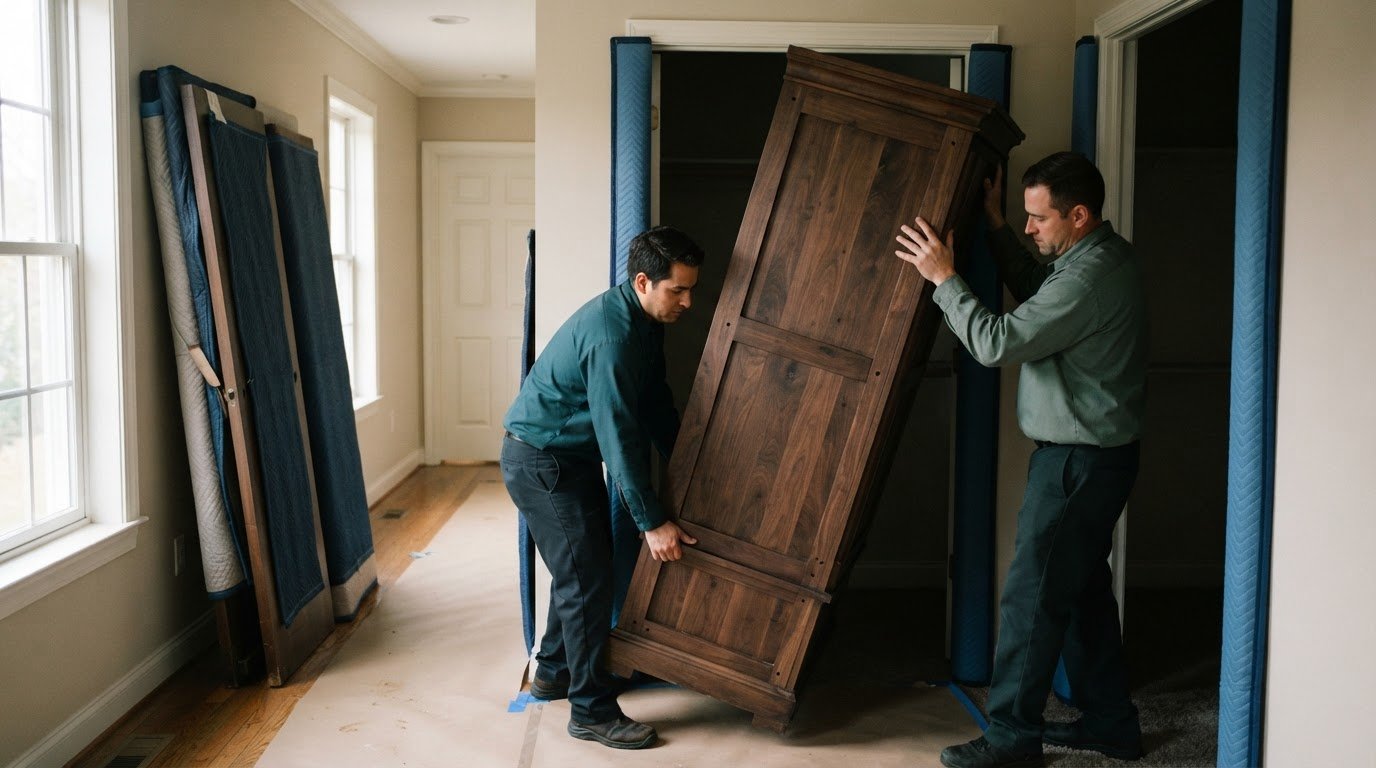
The armoire may be sturdy, but tight turns and a narrow closet entrance can make the move tricky. Moving a heavy wooden armoire into a walk-in closet in South Riding starts with a professional assessing the furniture, measuring the route, and planning how to protect the home and the piece. If wardrobe doors leave too little clearance, removing them may help the armoire pass through safely.
You want the armoire moved without scraping walls, marking floors, or stressing its joints. A clear plan helps the crew navigate hallways and doorways safely and lets you know what to prepare before the lift.
Learn what movers assess, how they protect the furniture and your home, and when removing wardrobe doors can make a tight passage easier to navigate. Knowing which details matter helps you prepare before the armoire moves to its new place.
Key Takeaways
- Learn how movers clear the path and assess the armoire before lifting.
- See how protective measures help guard furniture, floors, walls, and door frames.
- Understand what makes narrow turns and closet entrances challenging to navigate.
- Find out when removing wardrobe doors may create enough clearance for the move.
- Know when in-home furniture movers can help handle a heavy armoire with care.
How professional movers clear and measure the route
Parking access and the indoor path are separate parts of planning an armoire move. Parking rules depend on where the vehicle is positioned in South Riding or Loudoun County.
-
Prepare the Moving Path for Professional Movers
Clear the route from the armoire to the walk-in closet before the crew arrives. Move shoes, baskets, rugs, and small furniture away from halls and doorways. Keep pets and household members clear of the path while the movers work. Tell the crew about stairs, uneven floorboards, or doors that will not stay open so they can plan for those obstacles.
-
How Professional Movers Measure the Route
Have the movers measure the armoire and every restricted part of its route, including hallway widths, door openings, and the closet entrance. They compare the piece’s height, width, and depth with the available clearance. A doorway may look wide enough, yet the turn just beyond it may be too tight. Measuring each point helps the crew plan the armoire’s orientation.
- Ask the movers to assess the whole route, not just the closet doorway. It may include a bedroom exit, hallway corner, or change in floor level. An armoire might clear a doorway straight on but need more space to turn into the closet. Identifying these pinch points helps the crew plan where the piece can rotate and where they need clear working space.
-
Consider the Armoire’s Weight
A solid wood armoire’s weight varies with its dimensions, construction, and attached features. There is no single typical weight for every piece. Emptying it reduces the load and prevents belongings from shifting or being damaged. Mention mirrors, drawers, or built-in components so the movers can account for them when handling and positioning the furniture.
- When the crew arrives, point out the armoire, the destination closet, and any concerns along the route. Professional movers plan the lift around the piece and its path. A wardrobe should be lifted with at least one other person, and moving it upstairs calls for two people to coordinate. A professional crew can organize the work and route before the move begins.
How professional movers protect furniture, floors, walls, and door frames
Ask the movers to match protective measures to the armoire’s finish and the route. The right setup helps reduce the risk of scratches, dents, and sudden shifts.
-
How Professional Movers Protect the Furniture During Transport
Have the movers wrap the armoire before it leaves the room. Moving blankets or similar padding can protect finished surfaces from scrapes and bumps. The crew should secure the covering so it stays in place as the piece changes direction. Point out delicate trim, veneer, mirrors, or loose hardware that need particular care. Secure doors and drawers so they do not swing or slide during handling.
-
How Professional Movers Use Sliders or Other Equipment
Let the crew choose equipment to suit the armoire’s base, weight, and flooring. Furniture sliders may help on suitable floors, while a protective rug may be better for another surface. The wrong material can shift, catch, or scuff the floor. Movers should position supports evenly and check that the armoire is balanced before moving it. Do not drag it directly across hardwood or tile.
-
How Professional Movers Tilt and Slide the Armoire
Have the movers control any tilt instead of letting the armoire tip freely. A measured tilt can help them position a slider or adjust the angle through a tight space. They should keep the base supported, move gradually, and coordinate their actions. A sudden shift while turning near a doorway, for example, could bring an upper corner into the frame. Stop if the piece feels unstable.
-
Avoid Tipping and Damage
Ask the crew to keep the armoire upright whenever the route allows. Tipping can shift its center of weight, strain joints, loosen trim, or put pressure on doors and decorative details. Losing balance may also damage a floor, wall, or door frame, or trap a hand beneath the furniture. The risk increases if the armoire is top-heavy, unevenly loaded, or moved over an obstacle without a controlled plan.
- Keep the route clear while the crew handles the piece, and tell them about any newly noticed floor or wall damage before work begins. Movers can then adapt their protection and handling to the actual conditions. For help with a heavy piece that needs careful indoor handling, explore heavy furniture moving help.
How professional movers maneuver an armoire through narrow spaces
Movers adjust the armoire’s position for each turn, doorway, and change of direction. The right approach depends on the piece’s shape and the clearance along the route.
- Approach each tight passage with the armoire aligned for the next move, not just the nearest opening. At a hallway corner, movers assess whether the piece should enter straight or at an angle. They watch for its widest points, including projecting trim and handles. A small adjustment before the turn can prevent the armoire from scraping the wall.
- Use a controlled pivot whenever the armoire needs to change direction. Movers coordinate their positions so one end does not swing into a door frame while the other clears the corner. Turning from a bedroom doorway into a short hall, for example, may call for gradual movement instead of one sharp rotation. The crew pauses if the piece binds or there is not enough room to turn.
- Keep the armoire’s widest side in mind as it passes through a narrow opening. A piece that fits facing forward may need a different orientation to clear a nearby wall or closet return. Movers adjust the angle gradually and reassess the space. They do not force the furniture through if an edge catches, since pressure can damage the armoire or surrounding surfaces.
- Use clear, consistent instructions at every turn. One mover can guide the direction while the others control the armoire. Short cues such as “pause,” “turn,” or “forward” help everyone move together. This is especially useful at a tight bedroom entrance, where the person guiding the far side may see a door frame or wall that others cannot.
- Change the approach if the route includes a step, threshold, or uneven floor transition. Movers account for how the armoire’s base meets the change, keeping it steady so an edge does not catch. A raised threshold at the closet entrance, for example, may require careful positioning before the piece moves forward. The crew stops and resets if the base does not clear smoothly.
- Choose a different route or handling plan if the armoire cannot pass without pressure. A narrow turn may leave too little room for a safe pivot, even if the doorway itself looks wide enough. Movers can reassess the orientation, consider another path, or plan to remove parts of the furniture. Pushing a stuck piece can scratch it, loosen its joints, or damage your home.
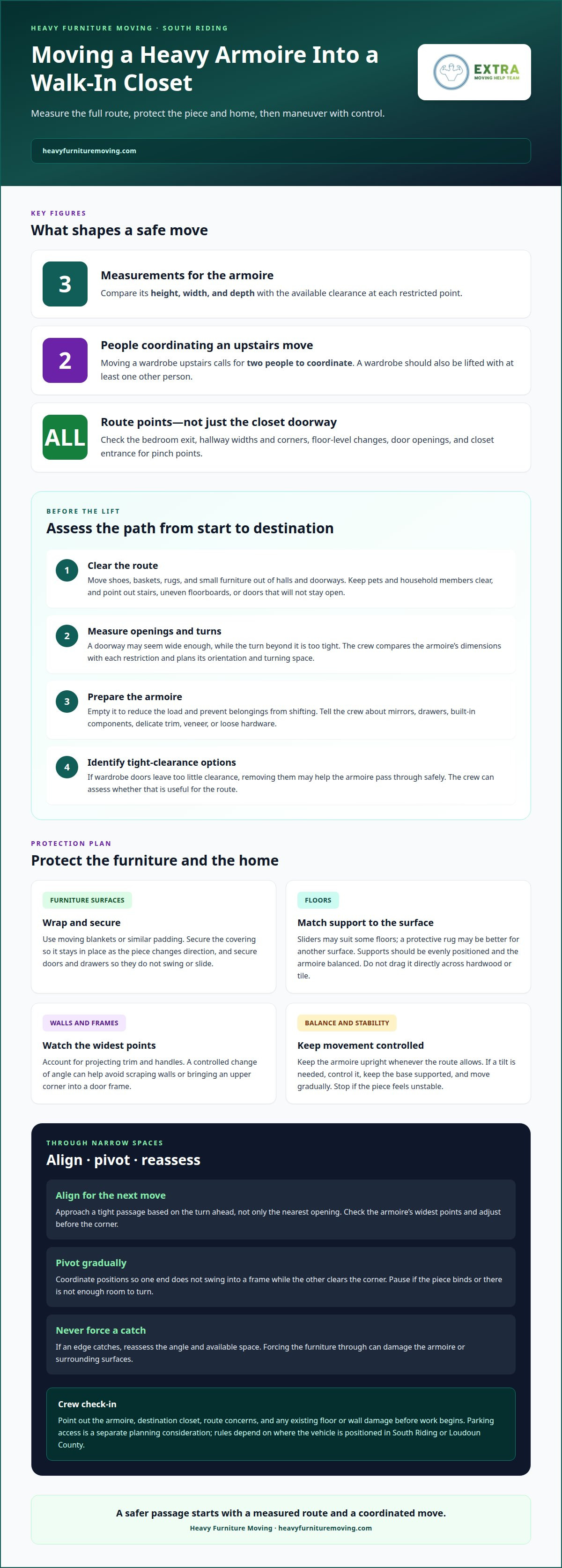
How professional movers measure the route and assess tight spaces
Walk-in closet doorways and hallways vary from home to home, so no single measurement applies to every South Riding move. For moving a heavy wooden armoire into a walk-in closet in South Riding, movers measure the actual openings and compare them with the furniture’s shape.
-
How Professional Movers Measure the Closet Doorway
Have the movers measure the closet entrance at its narrowest clear point, between trim and other fixed obstructions. They should also note the opening’s height and the space just beyond it. The doorway may be wide enough for the armoire but leave too little room to angle or straighten it inside the closet. A wall return just past the entrance, for example, can restrict the turn.
-
How Professional Movers Check Hallway Dimensions
Ask the crew to assess every hallway section, not only its widest stretch. They look for narrow points near door casings, wall corners, and nearby furniture. A hallway may have plenty of straight clearance but still restrict a turn at a bedroom entrance. Movers compare these pinch points with the armoire’s widest side and the angle needed to guide it toward the closet.
- Compare the armoire’s full shape with the route measurements. Its width, depth, height, and projecting details all affect clearance. A carved top or side trim may extend beyond the cabinet body and change how it passes through an opening. Movers account for these features rather than relying on the cabinet’s basic dimensions. This helps them identify where a straight approach works and where careful angling is needed.
- Check the approach and turning space at every doorway. Measuring only across the opening will not show whether the armoire can rotate before reaching it. Movers consider the space outside the door, nearby walls, and the room beyond. A bedroom door opening onto a short hall, for example, may allow less turning room than the doorway suggests.
- Include fixed obstacles and changes in the floor plan. Movers note door stops, wall-mounted fixtures, closet shelving, and narrow passages beside furniture. They also check whether a door can open fully without reducing clearance. A shelf near the closet entrance may obstruct the armoire’s upper corner even if the base fits through.
- Use the measurements to choose a route and handling position before lifting. Movers identify the tightest point, then plan how the armoire will enter and turn beyond it. For moving a heavy wooden armoire into a walk-in closet in South Riding, this assessment can show whether another path or orientation is more practical than the direct approach.
When professional movers may remove wardrobe doors
Movers may remove wardrobe doors if they limit clearance or create extra risk during a turn. When the armoire’s construction allows, it can often be disassembled and reassembled safely with careful handling.
- Check whether the doors prevent the armoire from clearing a doorway or turning into the closet. Movers compare the piece’s shape with the route’s tightest point. If removing the doors creates useful clearance, they can take them off before moving the cabinet. If there is enough room, leaving them attached avoids an unnecessary handling step.
- Inspect how each door is attached before removing it. Hinges, sliding tracks, and decorative hardware need different handling. Movers can support a door as they release its fasteners, reducing stress on the wood and connection points. A heavy mirrored door needs particular care because an impact or twist could damage the glass or frame.
- Keep removed doors and hardware organized for reassembly. Movers can group the fasteners and protect each detached door from bumps and scratches. Keep doors out of the travel path, especially near a hallway turn or closet entrance, so a loose panel or piece of hardware does not become an obstacle.
- Decide whether to remove other parts only after assessing the armoire’s construction. Shelves or drawers may come out, while a frame or joined section may not be designed to separate. Forcing a joint can loosen the structure or cause visible damage. A professional can distinguish removable components from parts that should remain assembled.
- Plan the lift with enough coordinated help for the armoire and route. A wardrobe should be lifted with at least one other person, and two people should coordinate when moving it upstairs. The crew needed also depends on the piece’s size, weight, grip points, and route obstacles, so movers plan their positions before lifting.
- Reattach the doors only after the armoire reaches its final position. Movers can check that hinges or tracks sit correctly and that each door opens without catching. If the cabinet has shifted during placement, they can adjust its position before restoring the doors. For a heavy piece that needs careful handling and door removal, arrange professional armoire moving help.
Heavy Furniture Moving
Heavy Furniture Moving can plan and handle a heavy armoire move into a walk-in closet. Turn to the team if the piece is difficult to lift, the route has tight turns, or the doorway may require removing wardrobe doors. The crew’s in-home furniture moving service is designed for the practical challenges of moving bulky furniture inside your home, including narrow spaces. Share the armoire’s dimensions, the closet location, and any stairs or tight passages so the team can plan around the actual route. Mention if the piece needs disassembly for clearance. For help moving your armoire, contact Heavy Furniture Moving.
Plan the Move Around Your Home
For moving a heavy wooden armoire into a walk-in closet in South Riding, plan around the furniture and your home’s layout. Consider where the armoire will sit, whether its doors need to come off, and what access the movers will need. Clear details help the team prepare a practical plan.
Heavy Furniture Moving also offers Movers Near Me, Exercise Equipment Moving, and Sofa Hoisting. If the armoire is difficult to handle because of its size or route, professional help can take the heavy lifting off your hands and bring a careful approach to the move.
Contact Heavy Furniture Moving to discuss moving your armoire. With a plan for the space and the piece, you can look ahead to a closet that’s ready for its new centerpiece.
Frequently Asked Questions
How much does it cost to move a heavy wooden armoire in South Riding, VA?
The cost depends on the move details, including the armoire and the work involved. Heavy Furniture Moving uses flat-rate pricing for most single heavy items, while labor is billed hourly with a two-hour minimum. Stairs and wrapping are included in the quote before work begins. The crew provides the total upfront, so you can review the job price before the move starts.
Which movers serve South Riding and specialize in heavy furniture?
Heavy Furniture Moving serves South Riding and handles residential moves involving heavy, bulky furniture. Its moving support can suit an armoire relocation that needs careful indoor handling, rather than a full-home move. When describing the job, mention whether the armoire is upstairs, has mirrors or attached features, or needs to enter a closet with limited access. These details help the team understand the move.
How do professional movers measure an armoire and route it into a walk-in closet?
Movers compare the armoire’s height, width, and depth with the route’s tightest openings and turning areas. They assess the closet entrance, adjoining hallway, and the space available to change the furniture’s angle. A useful detail is whether shelves or trim project beside the opening. If the route is especially constrained, sharing a photo of the armoire and nearby passage can help communicate the layout.
What equipment do professional movers use to move a heavy armoire safely?
For a heavy armoire, the crew can use protective blankets, shrink film, and ratchet straps to protect and secure the furniture during handling. The right setup depends on the piece and the route. Heavy Furniture Moving also uses dollies for truck and pod loading, but the armoire’s shape and indoor path determine the right handling approach. No single tool suits every move.
How do professional movers protect floors, walls, and the armoire during the move?
Crews can use masonite floor protection and door-jamb covers to help shield vulnerable surfaces, while blankets and shrink film protect the armoire. A narrow doorway, for example, may need frame protection where the furniture passes closest. The crew secures protective materials so they stay in place during the move. Tell the team about delicate finishes or flooring so they can give those surfaces appropriate attention.
Frequently Asked Questions
The cost depends on the move details, including the armoire and the work involved. Heavy Furniture Moving uses flat-rate pricing for most single heavy items, while labor is billed hourly with a two-hour minimum. Stairs and wrapping are included in the quote before work begins. The crew provides the total upfront, so you can review the job price before the move starts.
Heavy Furniture Moving serves South Riding and handles residential moves involving heavy, bulky furniture. Its moving support can suit an armoire relocation that needs careful indoor handling, rather than a full-home move. When describing the job, mention whether the armoire is upstairs, has mirrors or attached features, or needs to enter a closet with limited access. These details help the team understand the move.
Movers compare the armoire’s height, width, and depth with the route’s tightest openings and turning areas. They assess the closet entrance, adjoining hallway, and the space available to change the furniture’s angle. A useful detail is whether shelves or trim project beside the opening. If the route is especially constrained, sharing a photo of the armoire and nearby passage can help communicate the layout.
For a heavy armoire, the crew can use protective blankets, shrink film, and ratchet straps to protect and secure the furniture during handling. The right setup depends on the piece and the route. Heavy Furniture Moving also uses dollies for truck and pod loading, but the armoire’s shape and indoor path determine the right handling approach. No single tool suits every move.
Crews can use masonite floor protection and door-jamb covers to help shield vulnerable surfaces, while blankets and shrink film protect the armoire. A narrow doorway, for example, may need frame protection where the furniture passes closest. The crew secures protective materials so they stay in place during the move. Tell the team about delicate finishes or flooring so they can give those surfaces appropriate attention.