How to Transport a Heavy Quartz Vanity Top Safely in Haymarket
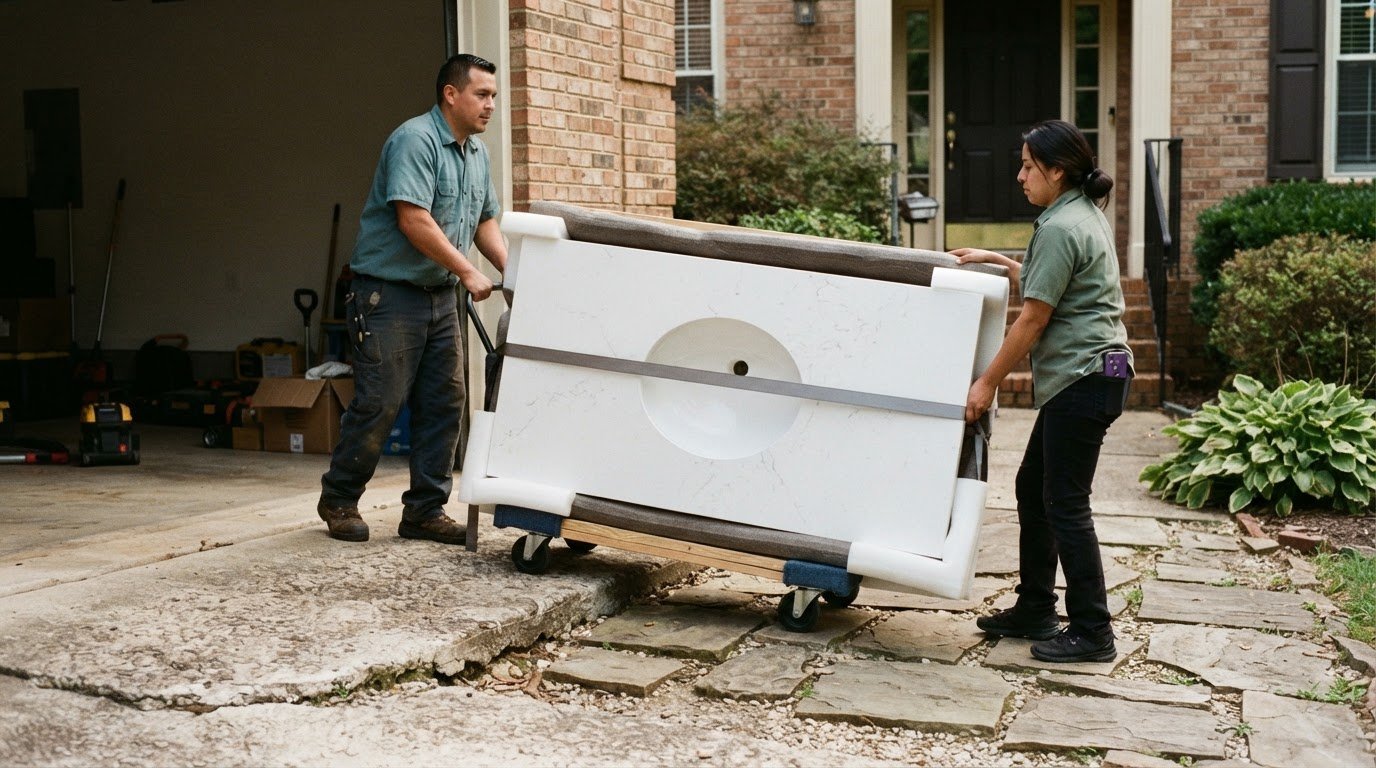
A dolly can move a heavy quartz vanity top a short distance, but only when the slab stays upright, supported, and secured against shifting or impact. To learn how to transport a heavy quartz vanity top safely in Haymarket, focus on controlled handling: stone countertops need at least two people, and their weight and cutouts make balance and support critical. A dolly helps with movement, but it cannot protect an unsupported slab.
It’s understandable to want a simple way to get a heavy top through a home without damaging the stone, floors, or walls. This guide explains how professional movers use a dolly, carry and position the slab, protect its vulnerable edges, and pad and strap it for transport.
You’ll also learn why upright support matters, how uneven surfaces affect a move, and what can make a vanity top harder to handle. Careful planning and controlled movement make the trip from pickup to installation more manageable.
Key Takeaways
- Plan the route around thresholds, gravel, and uneven pavement so the slab can be moved slowly without dragging or jolting it.
- Account for the vanity top’s dimensions, thickness, cutouts, and weight when planning the move and choosing the vehicle.
- Use padded upright support to limit flex and keep the stone steady during loading and transport.
- Give extra protection to corners, sink openings, and narrow sections, where impact can cause damage.
- Learn how padding and load-rated straps work together to reduce shifting and vibration on the road.
Moving slabs across uneven surfaces
A dolly can move a quartz top a short distance if the slab stays upright, supported, and secured. Planning how to transport a heavy quartz vanity top safely in Haymarket means considering the slab, vehicle, and route together.
-
Professional Slab Inspection and Measurement
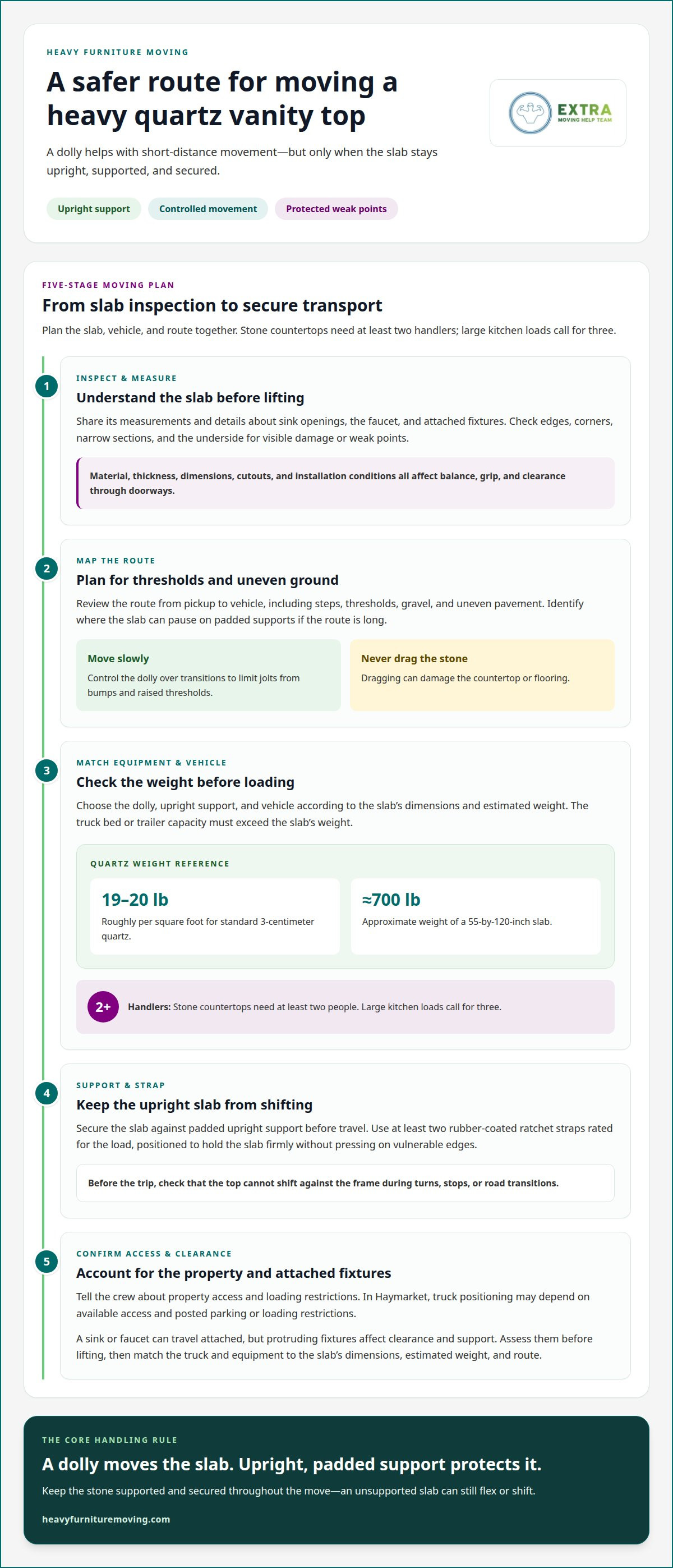
Share the top’s measurements and details about its sink opening, faucet, and attached fixtures. Before lifting, movers inspect the edges, corners, narrow sections, and underside for visible damage or weak points. They consider the material, thickness, dimensions, cutouts, and installation conditions together. These details affect balance, grip, and whether the slab can pass through doorways without striking trim. For how to transport a heavy quartz vanity top safely in Haymarket, this assessment informs the handling plan from the start.
-
Planning Professional Routes Across Uneven Surfaces
Show the moving team the route from pickup to vehicle, including thresholds, steps, gravel, and uneven pavement. Movers plan where the slab can pause on padded supports if the route is long. They move the dolly slowly over transitions and never drag the stone, which could damage the countertop or flooring. The crew controls each movement to limit jolts from bumps and raised thresholds.
- Have movers match the vehicle and equipment to the slab’s weight and dimensions. A standard 3-centimeter quartz slab weighs roughly 19 to 20 pounds per square foot; a 55-by-120-inch slab weighs around 700 pounds. The truck bed or trailer capacity must exceed the slab’s weight. Movers select a dolly for short-distance handling and upright support for transport. Stone countertops need at least two handlers; large kitchen loads call for three.
-
Professional Slab Strapping
Ask the moving team to secure the upright slab against its padded support before travel. Quartz transport requires at least two rubber-coated ratchet straps rated for the load. Movers position the straps to hold the slab firmly without pressing on vulnerable edges. The crew checks that the top cannot shift against the frame during turns, stops, or road transitions.
- Tell the crew about property access and loading restrictions. In Haymarket, movers plan truck positioning around available access and posted parking or loading restrictions. Quartz tops can travel with a sink or faucet attached, but protruding fixtures affect clearance and support. The crew assesses those parts before lifting. Movers also choose a suitable truck and equipment based on slab dimensions, estimated weight, and the route.
Can professional movers transport a granite countertop without breaking it?
Yes. Movers reduce breakage and carrying risks by matching the crew, support, and vehicle to the slab’s weight, dimensions, and condition.
-
Matching Stone Weight to Truck Payload
Share the countertop’s dimensions and thickness so movers can estimate its weight before loading. A standard 3-centimeter granite top weighs about 18-20 pounds per square foot. Material and thickness affect a stone countertop’s weight.
- Have the moving team estimate quartz weight from its surface area and thickness. For a standard 3-centimeter slab, the estimate is roughly 19 to 20 pounds per square foot. Length and width determine the area; multiplying that area by the material estimate gives a working total. Sink and cooktop cutouts change the slab’s shape, but don’t remove the need to plan support around vulnerable sections.
- Match the loaded vehicle to the slab and the rest of the cargo. The truck bed or trailer capacity must exceed the slab’s weight. If the combined load approaches 80% of the truck’s payload rating, the guide recommends multiple trips.
-
Preventing Cracks and Carrying Injuries During a Professional Move
Use a trained crew and suitable lifting equipment instead of asking one person to carry the slab. Stone countertops require at least two people for safe moving; large kitchen loads call for three. Movers protect grip with stone-carrying clamps or suction lifters, and keep the slab supported instead of allowing its weight to pull unevenly on one edge.
- Have movers account for weak points before lifting. Sink cutouts, corners, and narrow sections can crack if the slab flexes or receives a sharp impact. A quartz slab can weigh more than 700 pounds, making controlled team handling essential. The crew should coordinate each lift and set-down, keep hands clear of pinch points, and use padded supports during pauses.
For a heavy countertop move that needs extra lifting help, explore heavy lifting moving service.
Should professional movers transport a granite countertop flat or upright?
Professional movers transport stone upright whenever possible. A padded A-frame supports the slab and helps reduce flex that could lead to cracks during travel.
- Choose upright support for the vehicle, rather than laying the slab flat. A quartz top carried flat can flex over bumps, placing stress across the stone. Movers use an A-frame rack to hold the slab upright and distribute its support along the frame. For transport, the slab should lean against the padded frame at roughly 15 degrees from vertical, not rest flat on the truck bed.
- Match the A-frame to the slab and vehicle before loading. The rack needs a stable base and adequate support to hold the stone without rocking. A-frame designs use two legs with horizontal and vertical supports between them, helping keep the frame steady as the vehicle moves. The slab’s dimensions and cutouts also affect how it sits against the frame.
- Place padding between the stone and every point where it contacts the frame. Moving blankets or foam help cushion the slab from vibration and impact. Position the top so its edges and corners don’t press directly against hard surfaces. Keep the frame and slab clear of cargo that could shift into them, and check that the padding stays in place after securing the stone.
- Secure the upright slab to the A-frame before the vehicle moves. Ratchet straps hold it against the padded support and limit shifting during turns and stops. The mover checks that the slab remains stable without applying direct pressure to vulnerable edges. A dolly can help with short-distance movement, but it doesn’t replace the A-frame during vehicle transport.
- Drive to suit the secured load and road surface. Keep speed under 5 mph when crossing railroad crossings or speed bumps, where a sudden jolt can stress the slab. On highways, keep the loaded vehicle below 55 mph. Slow further over rough pavement, and avoid abrupt turns or stops that could make the stone shift against its supports.
Protecting slab edges, faces, and cutouts
Sink openings, corners, and narrow countertop sections are vulnerable during handling. Professional movers protect these areas before lifting, carrying, or placing the quartz top.
- Identify vulnerable areas before the first lift. Movers examine each corner, exposed edge, sink cutout, and narrow section for existing chips or cracks. These areas are more exposed to impact or flex than a broad, uninterrupted surface. Inspection helps the crew plan where to support the slab and avoid using a cutout or fragile edge as a grip point.
- Cover the countertop face with moving blankets, foam padding, or heavy protective wrap. Padding cushions the quartz from vibration and contact during movement. Movers keep the covering smooth and secure so loose folds don’t bunch against an edge or leave part of the face exposed. They also keep hard tools and loose cargo from pressing against the finished surface.
- Protect corners and exposed edges as separate contact points. Movers add cushioning wherever the slab could touch a doorway, support, dolly, or vehicle surface. They guide the top through tight spaces with its corners clear of walls and trim. At a threshold, the crew coordinates the movement to prevent an edge from striking the raised transition.
- Keep sink and cooktop openings clear of lifting pressure. A cutout interrupts the stone’s continuous surface, so movers support the surrounding slab rather than bearing down on the opening. For a vanity top with a sink cutout, the crew checks that supports contact stable sections and straps don’t press across a narrow bridge of quartz. This helps reduce concentrated pressure during handling.
- Recheck the padding after each change in position. During a pause, loading, or placement, movers make sure blankets still cover the face and cushions remain between the slab and hard supports. Shifting can expose a corner or let stone rub against the frame. The crew corrects the padding before continuing, especially after navigating a doorway or setting the top down.
- Maintain protection through final placement. Movers keep the slab supported while positioning it near the vanity base, then lower it in a controlled motion. They avoid setting down one corner first or sliding the stone across a hard surface. Once the top is in place, the crew removes protective material without dragging it across exposed edges or the finished face.
Ratchet straps and protective padding
For a quartz slab, padding cushions contact while load-rated straps secure it to its support. Professional movers prepare both before the vehicle travels.
- Cover the stone before positioning straps. Moving blankets, foam padding, or heavy protective wrap cushion a countertop from vibration and impact. Movers protect the face and contact points along the support, keeping exposed stone from rubbing against hard surfaces. When transporting multiple slabs, wrap each one in a moving blanket to separate and cushion it.
- Choose straps rated for the load and suited to the slab’s support. Quartz transport requires at least two rubber-coated ratchet straps rated for the load. Ratchet straps secure stone to an A-frame and help prevent movement during transport. The crew matches the straps to the combined load rather than judging capacity by appearance.
- Use enough tie-downs to hold the slab steady. A separate recommendation for stone countertops calls for at least 4 heavy-duty tie-down straps. The strap count and placement should hold the slab against its A-frame without leaving it free to shift. The movers distribute restraint across the supported slab, rather than concentrating pressure on one corner.
- Keep straps away from vulnerable areas. Sink cutouts, corners, and narrow countertop sections can crack under impact or stress. Movers route straps over padded, supported sections, not across openings or exposed edges. Padding between the strap and quartz helps prevent direct contact, while stable A-frame support keeps the strap from pulling the slab out of position.
- Inspect the setup after tightening each strap. Movers confirm the slab remains upright against the padded frame and doesn’t rock or slide. They also check that blankets haven’t shifted to expose an edge or face. A strap should secure the load without leaving a hard buckle pressed against the stone.
- Match specialized straps to their stated capacity and size. Those details describe the strap, but they don’t replace proper slab support, load ratings, or attention to contact points.
- Recheck the padding and restraints after loading the slab. A blanket can move as the crew positions the stone, and a strap can settle against a different area. Before departure, movers confirm that each protective layer covers its intended contact point and the top is secured against shifting.
Need experienced help with heavy lifting and secure handling? Arrange heavy lifting moving service.
Heavy Furniture Moving
Heavy Furniture Moving helps with residential moves involving heavy and bulky items. If your quartz vanity top needs careful lifting and coordinated handling, the team’s heavy lifting moving service is a practical next step. The team also offers local moving help for larger household moves, where the slab may be one part of a broader move. Share the top’s size, weight estimate, cutouts, and access details so the plan reflects the handling needs. Contact Heavy Furniture Moving to discuss moving your vanity top or other bulky household items in Haymarket and nearby communities.
Make your next move with a clear plan
Planning how to transport a heavy quartz vanity top safely in Haymarket starts with the details that shape the job. Note the pickup and delivery locations, access conditions, and whether the top will move with its sink or faucet attached. Share these details with the moving team so they can plan around the item and route. If the vanity top is part of a larger household move, consider how its delivery fits with the rest of your plans.
Heavy Furniture Moving helps with residential moves and bulky household items. Its offerings include Movers Near Me, Exercise Equipment Moving, and Sofa Hoisting. For help planning your move, Contact Heavy Furniture Moving. A clear handoff is a solid first step toward getting your vanity top where it needs to go.
Frequently Asked Questions
How do professional movers use a dolly to move a countertop?
Movers use a dolly for controlled movement along a short, clear route. They keep the countertop upright, supported, and secured so it cannot slide or tip as the dolly crosses a doorway or threshold. For a tight turn, the crew pauses and repositions rather than forcing the slab around a corner. A dolly helps move the load, but doesn’t replace proper support while carrying or transporting it.
How much does a quartz vanity top weigh per square foot?
A standard 3-centimeter quartz slab weighs roughly 19 to 20 pounds per square foot. Thickness and overall dimensions affect the estimate, while sink openings and other cutouts change the shape and support needs. Movers use the top’s actual measurements to plan handling and vehicle capacity.
How many professional movers are needed to lift and carry a heavy quartz vanity top?
At least two people are needed to move a stone countertop safely, with three preferred for a large load. A quartz slab weighing more than 700 pounds calls for at least two experienced handlers, and three are preferred. The crew size also depends on the slab’s dimensions, access route, and cutouts. Coordinated lifting matters: everyone needs to move and set the top down together.
What tools and protective equipment should professional movers use to transport a quartz vanity top safely?
Professional movers can use a suitable dolly for short moves, an upright A-frame for transport, and stone-carrying clamps or suction lifters for secure grip. Moving blankets, foam padding, or heavy protective wrap cushion the surface and contact points. Load-rated ratchet straps secure the slab to its support. The right setup depends on the top’s size, weight, cutouts, and route through the home.
How do professional movers wrap and secure a quartz vanity top for transport?
Movers cushion the stone with moving blankets, foam, or heavy protective wrap, then secure it against a padded support. The crew positions them to hold the slab steady without pressing on exposed corners or sink openings. When transporting multiple slabs, each one should have its own moving blanket for cushioning.
Do professional movers carry a quartz vanity top vertically or lay it flat?
They transport stone upright whenever possible, supported against a padded A-frame. The recommended position leans the slab roughly 15 degrees from vertical. Carrying quartz flat can allow it to flex over bumps, increasing crack risk. For short-distance movement, a dolly can help if the slab remains supported vertically. Movers choose a carrying position based on the route, slab shape, and available support.
How do professional movers load and secure a quartz vanity top in a truck or van?
Movers load the slab upright against a padded A-frame, then secure it with straps to limit shifting during travel. Before loading, they account for the slab’s estimated weight and confirm the truck bed or trailer capacity exceeds it. They also keep cutouts and edges clear of pressure points. A stable load keeps the stone supported instead of resting flat across the vehicle bed.
What do professional countertop movers charge in Haymarket, Virginia?
The cost depends on the move’s details, including the slab’s weight and dimensions, pickup and delivery access, and the work involved. Heavy Furniture Moving provides an upfront quote before work begins. For a Haymarket move, share the countertop’s measurements, cutouts, locations, and any stairs or tight access points when requesting a quote. These details help determine the right labor and handling plan.
Frequently Asked Questions
Movers use a dolly for controlled movement along a short, clear route. They keep the countertop upright, supported, and secured so it cannot slide or tip as the dolly crosses a doorway or threshold. For a tight turn, the crew pauses and repositions rather than forcing the slab around a corner. A dolly helps move the load, but doesn’t replace proper support while carrying or transporting it.
A standard 3-centimeter quartz slab weighs roughly 19 to 20 pounds per square foot. Thickness and overall dimensions affect the estimate, while sink openings and other cutouts change the shape and support needs. Movers use the top’s actual measurements to plan handling and vehicle capacity.
At least two people are needed to move a stone countertop safely, with three preferred for a large load. A quartz slab weighing more than 700 pounds calls for at least two experienced handlers, and three are preferred. The crew size also depends on the slab’s dimensions, access route, and cutouts. Coordinated lifting matters: everyone needs to move and set the top down together.
Professional movers can use a suitable dolly for short moves, an upright A-frame for transport, and stone-carrying clamps or suction lifters for secure grip. Moving blankets, foam padding, or heavy protective wrap cushion the surface and contact points. Load-rated ratchet straps secure the slab to its support. The right setup depends on the top’s size, weight, cutouts, and route through the home.
Movers cushion the stone with moving blankets, foam, or heavy protective wrap, then secure it against a padded support. Quartz transport requires at least two rubber-coated ratchet straps rated for the load. The crew positions them to hold the slab steady without pressing on exposed corners or sink openings. When transporting multiple slabs, each one should have its own moving blanket for cushioning.
They transport stone upright whenever possible, supported against a padded A-frame. The recommended position leans the slab roughly 15 degrees from vertical. Carrying quartz flat can allow it to flex over bumps, increasing crack risk. For short-distance movement, a dolly can help if the slab remains supported vertically. Movers choose a carrying position based on the route, slab shape, and available support.
Movers load the slab upright against a padded A-frame, then secure it with straps to limit shifting during travel. Before loading, they account for the slab’s estimated weight and confirm the truck bed or trailer capacity exceeds it. They also keep cutouts and edges clear of pressure points. A stable load keeps the stone supported instead of resting flat across the vehicle bed.
The cost depends on the move’s details, including the slab’s weight and dimensions, pickup and delivery access, and the work involved. Heavy Furniture Moving provides an upfront quote before work begins. For a Haymarket move, share the countertop’s measurements, cutouts, locations, and any stairs or tight access points when requesting a quote. These details help determine the right labor and handling plan.