How to Safely Move a Treadmill to the Basement in Fairfax
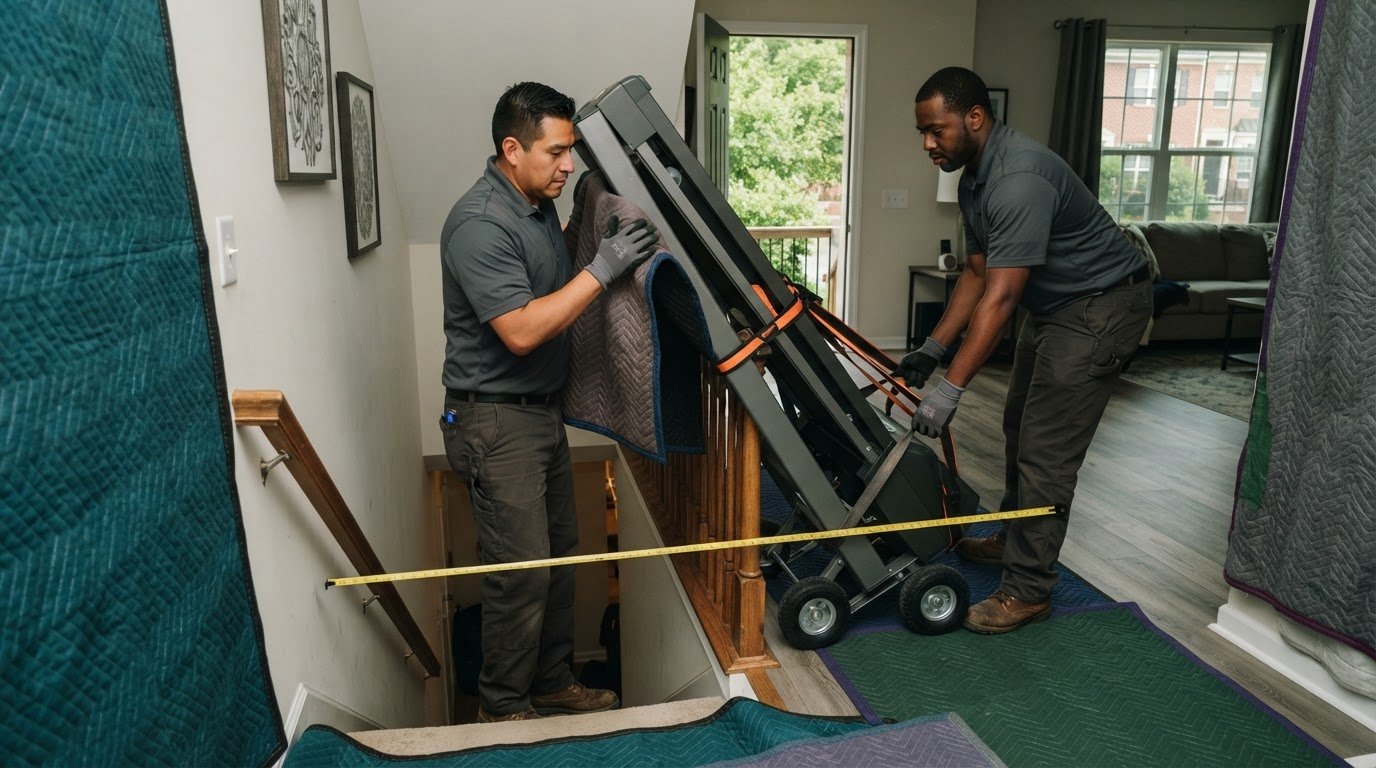
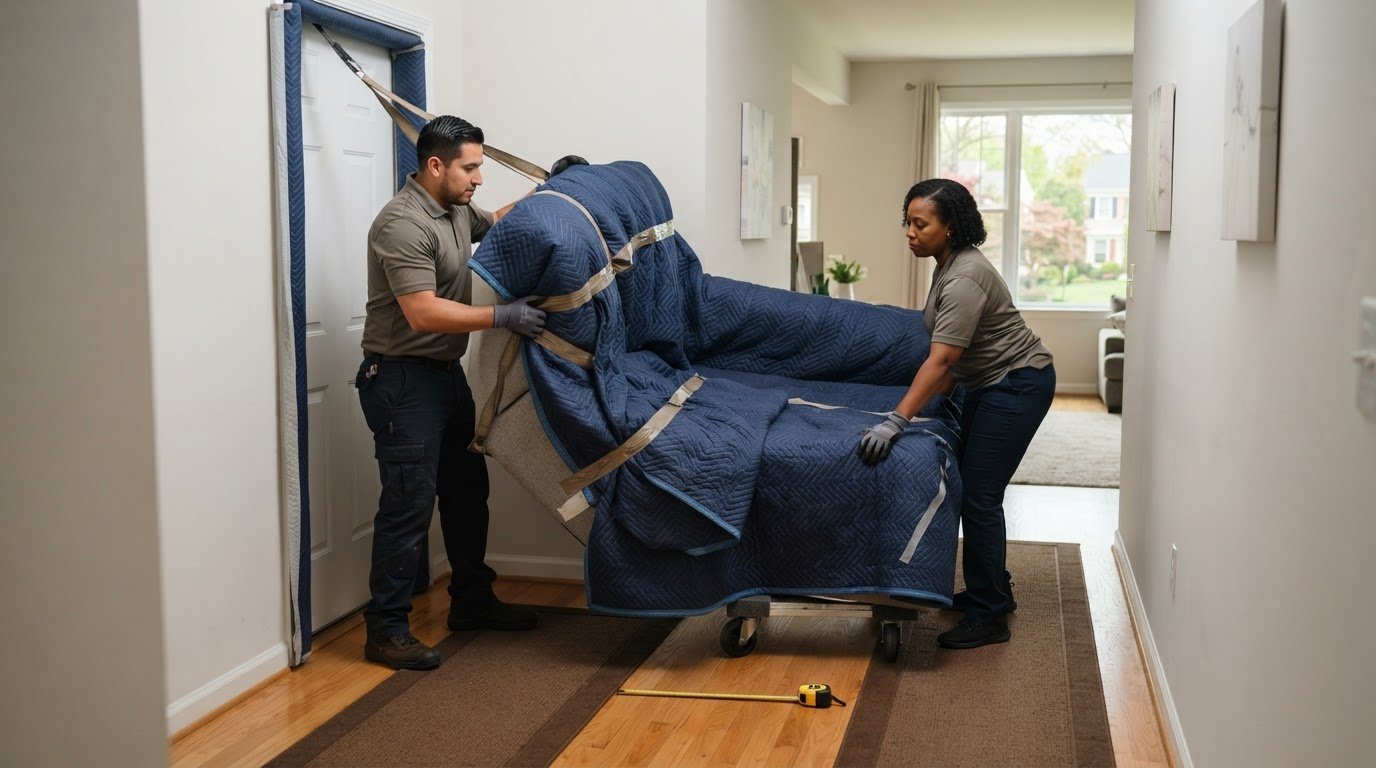
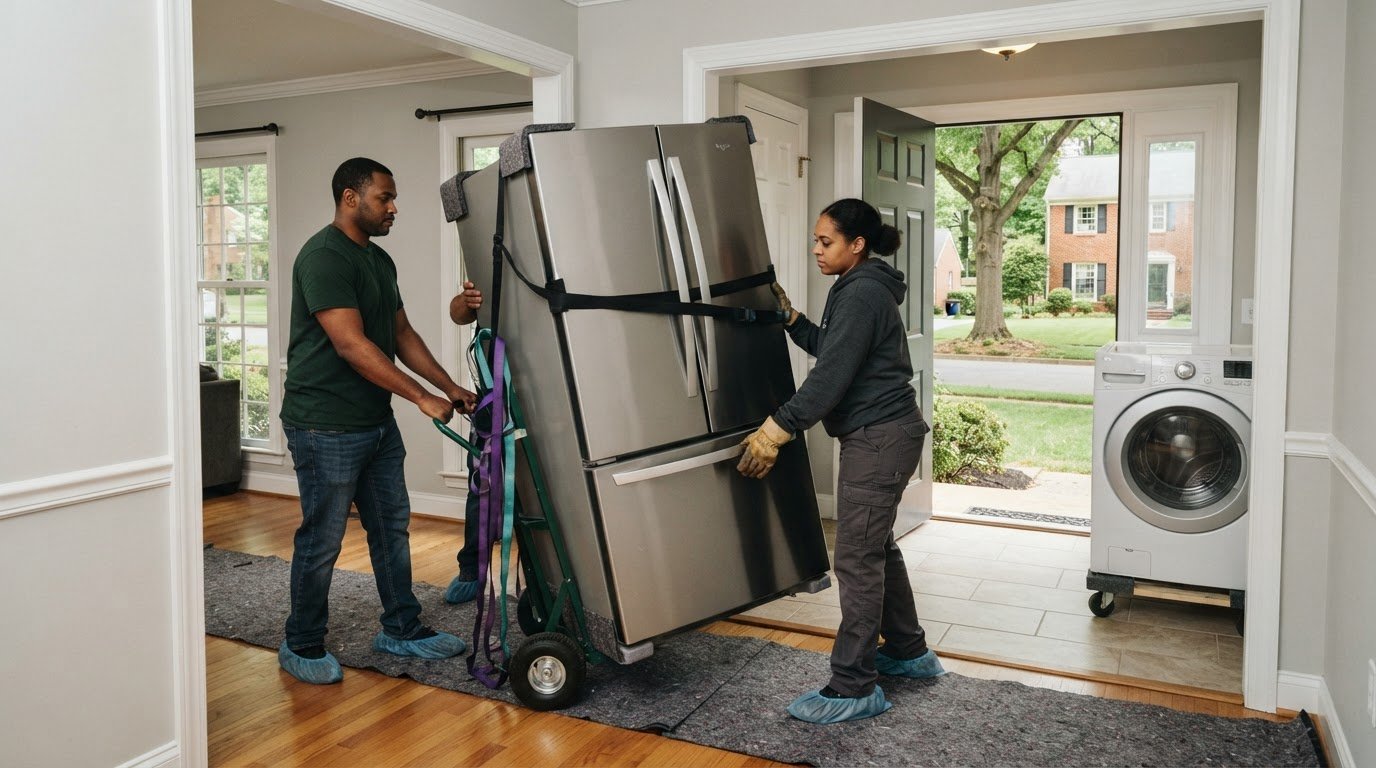
Before lifting anything, plan the full route from the treadmill’s current position to the basement. If you’re figuring out how to safely move a treadmill to the basement Fairfax homeowners should check doorways, turns, landings, and stair clearance first. A machine that fits through the basement door may still be too awkward to guide around a narrow turn or down a steep staircase.
There’s more to consider than the treadmill’s weight. A slip can injure someone or damage the machine, floors, walls, or handrails. Measuring the route and checking for obstacles can reveal problems before the move begins, rather than halfway down the stairs.
This guide explains what to measure, how to prepare the treadmill and protect your home, and when a DIY move may be unsafe. Match the machine and route to the people available to help. If the stairs are tight or the treadmill is difficult to control, Heavy Furniture Moving provides exercise-equipment moving help in Fairfax.
Key Takeaways
- Check the treadmill’s moving position and the entire basement route, including clearance at turns and landings.
- Use a practical preparation sequence: consult the manual, clear the path, measure key points, and agree on a move plan.
- Assess the stairs and the available helpers before deciding whether a DIY move is manageable.
- Set checkpoints before the stairs and at landings or turns. Stop if the treadmill becomes difficult to control.
- For a narrow, steep, or awkward route, Heavy Furniture Moving offers exercise-equipment moving help.
Before moving a treadmill to a Fairfax basement, assess the risks
A treadmill can be heavy, awkward to grip, and difficult to control on stairs. Being able to lift one end doesn’t mean you can safely guide the full machine down a flight, around a turn, and into the basement. Consider the treadmill’s size and design, the whole route, room to pause at landings, and whether the people helping can maintain control throughout the move.
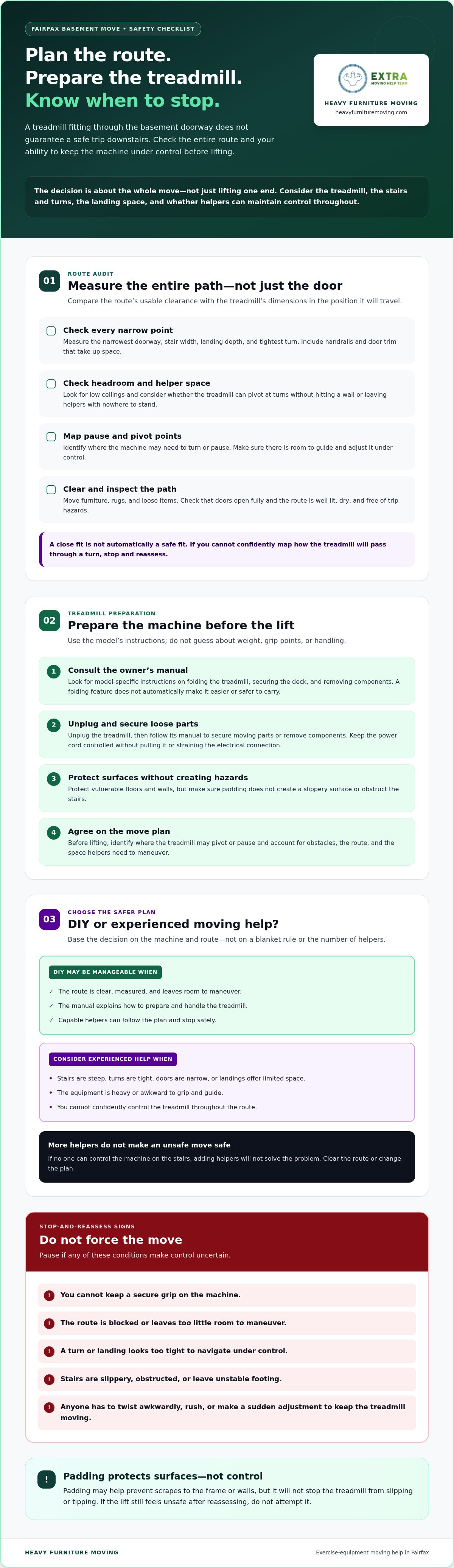
Use this assessment to decide whether the move is manageable, not to find a reason to force it. Stop and reassess if you notice any of these warning signs:
- You can’t keep a secure grip on the machine.
- The route is blocked or leaves too little room to maneuver.
- A turn or landing looks too tight to navigate under control.
- The stairs are slippery, obstructed, or otherwise leave you with unstable footing.
What makes basement treadmill moves difficult?
A treadmill’s size and weight affect more than the effort needed to lift it. Its long frame can be hard to pivot in a hallway or stairwell, and its weight may shift when tilted. On stairs, the downhill movement can be difficult to control. Low ceilings, narrow doorways, tight turns, and small landings may also leave little room to adjust your hold or position.
Protecting the treadmill and controlling its movement are separate concerns. Padding can help prevent scrapes to the frame or walls, but it won’t stop the machine from slipping or tipping. Safe handling depends on maintaining steady control without rushing to clear an obstacle. For broader background on lifting and carrying risks, see Manual handling of loads.
When should you pause instead of attempting the move?
Don’t guess about the treadmill’s weight, safe grip points, or whether it will clear a tight spot. Consult the owner’s manual for model-specific handling instructions. If you can’t confirm how to hold the machine or picture how it will pass through the route, stop to reassess before lifting.
During the move, pause if anyone has to twist awkwardly, rush, or make a sudden adjustment to keep the treadmill moving. Adding helpers won’t solve the problem if no one can control the machine on the stairs. Clear the route or change the plan. If the lift still feels unsafe, don’t attempt it. Heavy Furniture Moving handles exercise equipment and other heavy household items in Fairfax, including challenging indoor moves.
Measure the Fairfax basement route and prepare the treadmill
Measure before you lift. A treadmill may fit through the basement doorway but still be hard to turn on the stairs, where there’s less room to angle it. To plan how to safely move a treadmill to the basement Fairfax homeowners should compare the full route with the treadmill’s dimensions in the position it will travel.
- Consult the manual. Look for model-specific instructions on folding the treadmill, securing the deck, or removing components. A folding feature doesn’t automatically make a treadmill easier or safer to carry.
- Clear the path. Move furniture, rugs, and loose items. Check that doors can open fully and that the route is well lit, dry, and free of trip hazards.
- Measure the machine and route. Record the treadmill’s dimensions in its intended moving position. Compare them with the narrowest doorway, stair width, landing depth, and tightest turn.
- Plan the move. Identify where the machine may need to pivot or pause. Account for handrails, door trim, low ceilings, and the space needed for helpers to maneuver.
How do you check whether a treadmill fits downstairs?
Measure usable clearance, not just the width of an opening. Include anything that takes up space, such as handrails and trim, and check the headroom along the stairs. At a turn, consider whether the treadmill can change direction without hitting a wall or leaving helpers with nowhere to stand. Compare each measurement with the machine’s dimensions, leaving room to guide and pivot it. If you can’t confidently map the turn, don’t assume a close fit is a safe fit.
How should you prepare the machine and path?
Unplug the treadmill, then follow its manual to secure moving parts or remove components. Keep the power cord controlled, without pulling it or straining the electrical connection. Protect vulnerable floors and walls, but make sure any padding doesn’t create a slippery surface or obstruct the stairs. Stanford University’s guidance on safe lifting techniques also emphasizes planning how a load will be handled before lifting begins.
Your measurements may show that the route is too tight or awkward for a DIY move. Heavy Furniture Moving provides exercise-equipment moving help for challenging treadmill routes in Fairfax.
DIY or professional movers: choose the safer option for Fairfax stairs
The right choice depends on the treadmill and the route, not on a blanket rule that every move needs a crew or that extra helpers will make any move safe. Consider the stair angle, turns, landing space, the machine’s handling instructions, and whether everyone involved can keep it controlled. Decide how to safely move a treadmill to the basement before lifting begins, not after the machine is on the stairs.
| Factor | DIY considerations | Reasons to hire help |
|---|---|---|
| Route | Clear, measured path with room to maneuver. | Steep stairs, tight turns, narrow doors, or limited landings. |
| Machine | Manual explains how to prepare and handle it. | Heavy or awkward equipment is difficult to grip or guide. |
| People | Capable helpers can follow a plan and stop safely. | No one can confidently control the machine through the full route. |
| Move plan | Roles and communication are clear before lifting. | The plan depends on improvising equipment or rushing through obstacles. |
When might a DIY move be manageable?
A DIY move may be more manageable when the route is clear, measurements leave room to maneuver, and the manual provides usable handling instructions. Before lifting, agree on who leads, who supports, and what everyone will say to stop. Make sure each person can pause the move without losing control. Don’t improvise with unsuitable equipment or continue if the group can’t guide the treadmill steadily.
When does professional treadmill-moving help make sense?
Reconsider DIY if the stairs are steep, a turn is tight, a landing is small, or the treadmill feels too heavy or awkward for the available helpers. Heavy Furniture Moving handles exercise equipment and bulky household items, including difficult indoor routes. If your Fairfax basement presents a challenge, explore treadmill and exercise equipment moving services.
More hands don’t automatically mean more control. If helpers would need to twist, rush, or change grip on the stairs, stop and choose a safer plan. The right option is the one that suits the specific machine, route, and people available in your home.
If the route is suitable, move the treadmill downstairs in planned stages
Proceed only if the route is clear, the treadmill has been prepared according to its manual, and everyone involved can control it without rushing. A measured route is a starting point, not a guarantee that the move will remain safe once the machine is in motion. Work through planned checkpoints, and stop whenever control becomes uncertain.
How can you keep the move controlled?
Before lifting, choose one person to lead communication. That person calls each pause and change in direction, and everyone should know how to stop the move. Keep bystanders and pets away from the stairs, landings, and nearby doorway. Move deliberately, following the treadmill’s manual and your plan. Don’t rush, twist to force a turn, or continue if anyone can no longer manage their part comfortably. Avoid relying on a set number of helpers or a generic lifting method. What’s manageable depends on the machine and route.
- Before the stairs: Pause on stable ground. Confirm the route is still clear, footing is secure, and everyone is ready.
- At a landing or turn: Stop before maneuvering. Check the available space and agree on the next movement before changing direction.
- At any warning sign: Stop if grip, communication, or clear footing is lost. Reassess before proceeding.
What should you do if the treadmill catches or feels unstable?
Don’t force the treadmill past a step, doorway, or corner. A sudden push can shift the machine or make it harder to control. Don’t release it abruptly or try to reposition your hands while it’s unsupported. Ask everyone to stop and hold only if they can do so safely. Return to a stable position only if that can be done without adding risk. Otherwise, keep the move paused and get experienced help.
A pause is a useful checkpoint, not a failure. If the treadmill keeps catching, the route doesn’t allow a controlled turn, or the group can’t agree on the next step, don’t continue downstairs. Heavy Furniture Moving handles exercise equipment and heavy household items in Fairfax. Get help moving your treadmill when the route calls for experienced handling.
Get experienced treadmill-moving help in Fairfax when the basement route is challenging
A difficult basement route calls for a practical decision, not a test of determination. If the stairs are steep, the turn is tight, or the treadmill can’t be kept under control, don’t rush or try to muscle through. The space available and your ability to maintain control matter more than speed.
Heavy Furniture Moving handles exercise equipment and heavy household items in Fairfax. Professional help is a practical option when the treadmill is awkward to maneuver or the route leaves little room to pause. For more information about local services, see reliable movers in Fairfax and Northern Virginia.
What information helps plan a Fairfax basement treadmill move?
Share details about the machine and the full path to its destination. Keep the treadmill’s model information or manual handy if you have it. Describe the stairs, doorways, turns, landings, and basement space, especially any areas with limited room to maneuver. Photos can help show the layout.
Also explain whether any parts have already been removed or whether a component needs to stay assembled. This helps plan around the actual treadmill and access challenges instead of assuming every machine or basement is alike.
How can you make the next step simple?
Explain that the treadmill needs to go to the basement, describe the route, and point out any tight access or handling concerns. Heavy Furniture Moving provides exercise-equipment moving services for treadmill moves in Fairfax. Clear details help frame the job around the machine and the challenges of the route.
If you’re unsure the treadmill can be guided safely downstairs, leave the lift to experienced movers. Get help moving your treadmill safely.
Make a safe plan for your treadmill’s trip downstairs
A safer move starts with the route, not the lift. Measure doorways, stairs, turns, and landing space, then check the treadmill manual before folding or securing any parts. If the route is tight or anyone can’t maintain control, pause instead of pushing ahead. Determination and extra hands can’t make an unsafe descent safe.
Planning a treadmill move means matching the approach to the machine, home, and available helpers. If the stairs are steep, the turn is awkward, or the equipment feels difficult to control, experienced help is a practical choice. Heavy Furniture Moving specializes in exercise equipment and heavy household items, including treadmill moves in Fairfax.
Get help moving your treadmill safely with Heavy Furniture Moving.
Frequently Asked Questions
Can I move a treadmill to my basement by myself?
A solo move is generally a poor fit for a heavy, awkward treadmill on stairs. You may not be able to control the machine and manage your footing at the same time. Check the manufacturer’s instructions and assess the full route before moving it. If the treadmill is difficult to control, the stairs are tight, or you’re unsure you can handle it safely, stop and arrange experienced moving help.
How do I know if my treadmill will fit down basement stairs?
Measure the treadmill in the position it will travel, then compare its dimensions with the narrowest doorway, stair section, landing, and turn. Include handrails, trim, ceiling clearance, and room to pivot. Check the measurements against the manufacturer’s guidance. A close fit on paper doesn’t prove you can carry the treadmill safely through the route, particularly around a turn or onto a landing.
Should I disassemble a treadmill before moving it downstairs?
Follow the instructions for your exact treadmill model. Some parts may fold or detach, while other components should stay assembled or require specific handling. Don’t guess, force a hinge, or remove parts without manufacturer guidance. If you do remove hardware, keep it together so it doesn’t get lost. Secure moving sections as directed, and don’t assume folding the machine makes it safer to carry.
What should I do before moving a treadmill to the basement?
Read the manual, unplug the machine, and prepare it as the manufacturer directs. Clear and light the route, keep people and pets away, and measure doorways, stairs, turns, and landings. Identify a place where the treadmill can pause safely. Start by assessing the route and whether you can maintain control. Tight turns or poor footing can make a DIY move a poor choice.
Can a treadmill be damaged when carried down stairs?
Yes. An impact, uncontrolled tilt, or strain on moving parts can damage the treadmill. Contact with walls or handrails can also mark the home. The risks depend on the machine and the route. Follow the model’s handling instructions, don’t force the treadmill through a tight space, and stop if it can’t be kept stable. Protecting surfaces can help prevent scrapes, but it doesn’t replace controlling the machine throughout the move.
When should I hire treadmill movers in Fairfax?
Consider experienced help if the treadmill is awkward to handle, the basement stairs are steep, the route has tight turns, or available helpers can’t comfortably control the move. Heavy Furniture Moving handles exercise equipment and heavy household items in Fairfax and nearby communities, including Woodbridge, Manassas, Manassas Park, Aldie, Ashburn, Mclean, Vienna, Reston, Centreville, Chantilly, Clifton, Dumfries, South Riding, Fairfax Station, Haymarket, and Gainesville.
Do treadmill movers need to disassemble the machine?
Whether a part needs to be removed depends on the treadmill model, the manufacturer’s instructions, and the basement route. Don’t assume every treadmill folds or can be safely taken apart. Share the model details or manual with the moving team, and mention any parts you’ve already removed or that must remain assembled. That information helps plan around the equipment’s design and the home’s access points.
Frequently Asked Questions
A treadmill’s size and weight affect more than the effort needed to lift it. Its long frame can be hard to pivot in a hallway or stairwell, and its weight may shift when tilted. On stairs, the downhill movement can be difficult to control. Low ceilings, narrow doorways, tight turns, and small landings may also leave little room to adjust your hold or position. Protecting the treadmill and controlling its movement are separate concerns. Padding can help prevent scrapes to the frame or walls, but it won’t stop the machine from slipping or tipping. Safe handling depends on maintaining steady control without rushing to clear an obstacle. For broader background on lifting and carrying risks, see Manual handling of loads.
Don’t guess about the treadmill’s weight, safe grip points, or whether it will clear a tight spot. Consult the owner’s manual for model-specific handling instructions. If you can’t confirm how to hold the machine or picture how it will pass through the route, stop to reassess before lifting. During the move, pause if anyone has to twist awkwardly, rush, or make a sudden adjustment to keep the treadmill moving. Adding helpers won’t solve the problem if no one can control the machine on the stairs. Clear the route or change the plan. If the lift still feels unsafe, don’t attempt it. Heavy Furniture Moving handles exercise equipment and other heavy household items in Fairfax, including challenging indoor moves. Measure before you lift. A treadmill may fit through the basement doorway but still be hard to turn on the stairs, where there’s less room to angle it. To plan how to safely move a treadmill to the basement Fairfax homeowners should compare the full route with the treadmill’s dimensions in the position it will travel.
Measure usable clearance, not just the width of an opening. Include anything that takes up space, such as handrails and trim, and check the headroom along the stairs. At a turn, consider whether the treadmill can change direction without hitting a wall or leaving helpers with nowhere to stand. Compare each measurement with the machine’s dimensions, leaving room to guide and pivot it. If you can’t confidently map the turn, don’t assume a close fit is a safe fit.
Unplug the treadmill, then follow its manual to secure moving parts or remove components. Keep the power cord controlled, without pulling it or straining the electrical connection. Protect vulnerable floors and walls, but make sure any padding doesn’t create a slippery surface or obstruct the stairs. Stanford University’s guidance on safe lifting techniques also emphasizes planning how a load will be handled before lifting begins. Your measurements may show that the route is too tight or awkward for a DIY move. Heavy Furniture Moving provides exercise-equipment moving help for challenging treadmill routes in Fairfax. The right choice depends on the treadmill and the route, not on a blanket rule that every move needs a crew or that extra helpers will make any move safe. Consider the stair angle, turns, landing space, the machine’s handling instructions, and whether everyone involved can keep it controlled. Decide how to safely move a treadmill to the basement before lifting begins, not after the machine is on the stairs.
A DIY move may be more manageable when the route is clear, measurements leave room to maneuver, and the manual provides usable handling instructions. Before lifting, agree on who leads, who supports, and what everyone will say to stop. Make sure each person can pause the move without losing control. Don’t improvise with unsuitable equipment or continue if the group can’t guide the treadmill steadily.
Reconsider DIY if the stairs are steep, a turn is tight, a landing is small, or the treadmill feels too heavy or awkward for the available helpers. Heavy Furniture Moving handles exercise equipment and bulky household items, including difficult indoor routes. If your Fairfax basement presents a challenge, explore treadmill and exercise equipment moving services. More hands don’t automatically mean more control. If helpers would need to twist, rush, or change grip on the stairs, stop and choose a safer plan. The right option is the one that suits the specific machine, route, and people available in your home. Proceed only if the route is clear, the treadmill has been prepared according to its manual, and everyone involved can control it without rushing. A measured route is a starting point, not a guarantee that the move will remain safe once the machine is in motion. Work through planned checkpoints, and stop whenever control becomes uncertain.
Before lifting, choose one person to lead communication. That person calls each pause and change in direction, and everyone should know how to stop the move. Keep bystanders and pets away from the stairs, landings, and nearby doorway. Move deliberately, following the treadmill’s manual and your plan. Don’t rush, twist to force a turn, or continue if anyone can no longer manage their part comfortably. Avoid relying on a set number of helpers or a generic lifting method. What’s manageable depends on the machine and route.
Don’t force the treadmill past a step, doorway, or corner. A sudden push can shift the machine or make it harder to control. Don’t release it abruptly or try to reposition your hands while it’s unsupported. Ask everyone to stop and hold only if they can do so safely. Return to a stable position only if that can be done without adding risk. Otherwise, keep the move paused and get experienced help. A pause is a useful checkpoint, not a failure. If the treadmill keeps catching, the route doesn’t allow a controlled turn, or the group can’t agree on the next step, don’t continue downstairs. Heavy Furniture Moving handles exercise equipment and heavy household items in Fairfax. Get help moving your treadmill when the route calls for experienced handling. A difficult basement route calls for a practical decision, not a test of determination. If the stairs are steep, the turn is tight, or the treadmill can’t be kept under control, don’t rush or try to muscle through. The space available and your ability to maintain control matter more than speed. Heavy Furniture Moving handles exercise equipment and heavy household items in Fairfax. Professional help is a practical option when the treadmill is awkward to maneuver or the route leaves little room to pause. For more information about local services, see reliable movers in Fairfax and Northern Virginia.
Share details about the machine and the full path to its destination. Keep the treadmill’s model information or manual handy if you have it. Describe the stairs, doorways, turns, landings, and basement space, especially any areas with limited room to maneuver. Photos can help show the layout. Also explain whether any parts have already been removed or whether a component needs to stay assembled. This helps plan around the actual treadmill and access challenges instead of assuming every machine or basement is alike.
Explain that the treadmill needs to go to the basement, describe the route, and point out any tight access or handling concerns. Heavy Furniture Moving provides exercise-equipment moving services for treadmill moves in Fairfax. Clear details help frame the job around the machine and the challenges of the route. If you’re unsure the treadmill can be guided safely downstairs, leave the lift to experienced movers. Get help moving your treadmill safely. A safer move starts with the route, not the lift. Measure doorways, stairs, turns, and landing space, then check the treadmill manual before folding or securing any parts. If the route is tight or anyone can’t maintain control, pause instead of pushing ahead. Determination and extra hands can’t make an unsafe descent safe. Planning a treadmill move means matching the approach to the machine, home, and available helpers. If the stairs are steep, the turn is awkward, or the equipment feels difficult to control, experienced help is a practical choice. Heavy Furniture Moving specializes in exercise equipment and heavy household items, including treadmill moves in Fairfax. Get help moving your treadmill safely with Heavy Furniture Moving.
A solo move is generally a poor fit for a heavy, awkward treadmill on stairs. You may not be able to control the machine and manage your footing at the same time. Check the manufacturer’s instructions and assess the full route before moving it. If the treadmill is difficult to control, the stairs are tight, or you’re unsure you can handle it safely, stop and arrange experienced moving help.
Measure the treadmill in the position it will travel, then compare its dimensions with the narrowest doorway, stair section, landing, and turn. Include handrails, trim, ceiling clearance, and room to pivot. Check the measurements against the manufacturer’s guidance. A close fit on paper doesn’t prove you can carry the treadmill safely through the route, particularly around a turn or onto a landing.
Follow the instructions for your exact treadmill model. Some parts may fold or detach, while other components should stay assembled or require specific handling. Don’t guess, force a hinge, or remove parts without manufacturer guidance. If you do remove hardware, keep it together so it doesn’t get lost. Secure moving sections as directed, and don’t assume folding the machine makes it safer to carry.
Read the manual, unplug the machine, and prepare it as the manufacturer directs. Clear and light the route, keep people and pets away, and measure doorways, stairs, turns, and landings. Identify a place where the treadmill can pause safely. Start by assessing the route and whether you can maintain control. Tight turns or poor footing can make a DIY move a poor choice.
Yes. An impact, uncontrolled tilt, or strain on moving parts can damage the treadmill. Contact with walls or handrails can also mark the home. The risks depend on the machine and the route. Follow the model’s handling instructions, don’t force the treadmill through a tight space, and stop if it can’t be kept stable. Protecting surfaces can help prevent scrapes, but it doesn’t replace controlling the machine throughout the move.
Consider experienced help if the treadmill is awkward to handle, the basement stairs are steep, the route has tight turns, or available helpers can’t comfortably control the move. Heavy Furniture Moving handles exercise equipment and heavy household items in Fairfax and nearby communities, including Woodbridge, Manassas, Manassas Park, Aldie, Ashburn, Mclean, Vienna, Reston, Centreville, Chantilly, Clifton, Dumfries, South Riding, Fairfax Station, Haymarket, and Gainesville.
Whether a part needs to be removed depends on the treadmill model, the manufacturer’s instructions, and the basement route. Don’t assume every treadmill folds or can be safely taken apart. Share the model details or manual with the moving team, and mention any parts you’ve already removed or that must remain assembled. That information helps plan around the equipment’s design and the home’s access points.