How to Move a Sectional Couch That Won't Fit Through a Door
A sectional that looks too wide for the doorway may still fit when it’s measured and angled correctly. If you're working out how to move an oversized sectional couch that won't fit through a doorway in Centreville, the first step is comparing the couch’s diagonal depth with the narrowest clear opening along the route. A 40-inch-deep sofa can have a diagonal depth closer to 34 or 35 inches, so a 32-inch doorway may still be a tight squeeze.
It’s easy to focus on the front door and overlook a hallway turn, stair landing, or interior doorway that creates the real obstacle. The good news is that practical steps can improve clearance and help control a bulky sectional without forcing it through or scraping walls and floors.
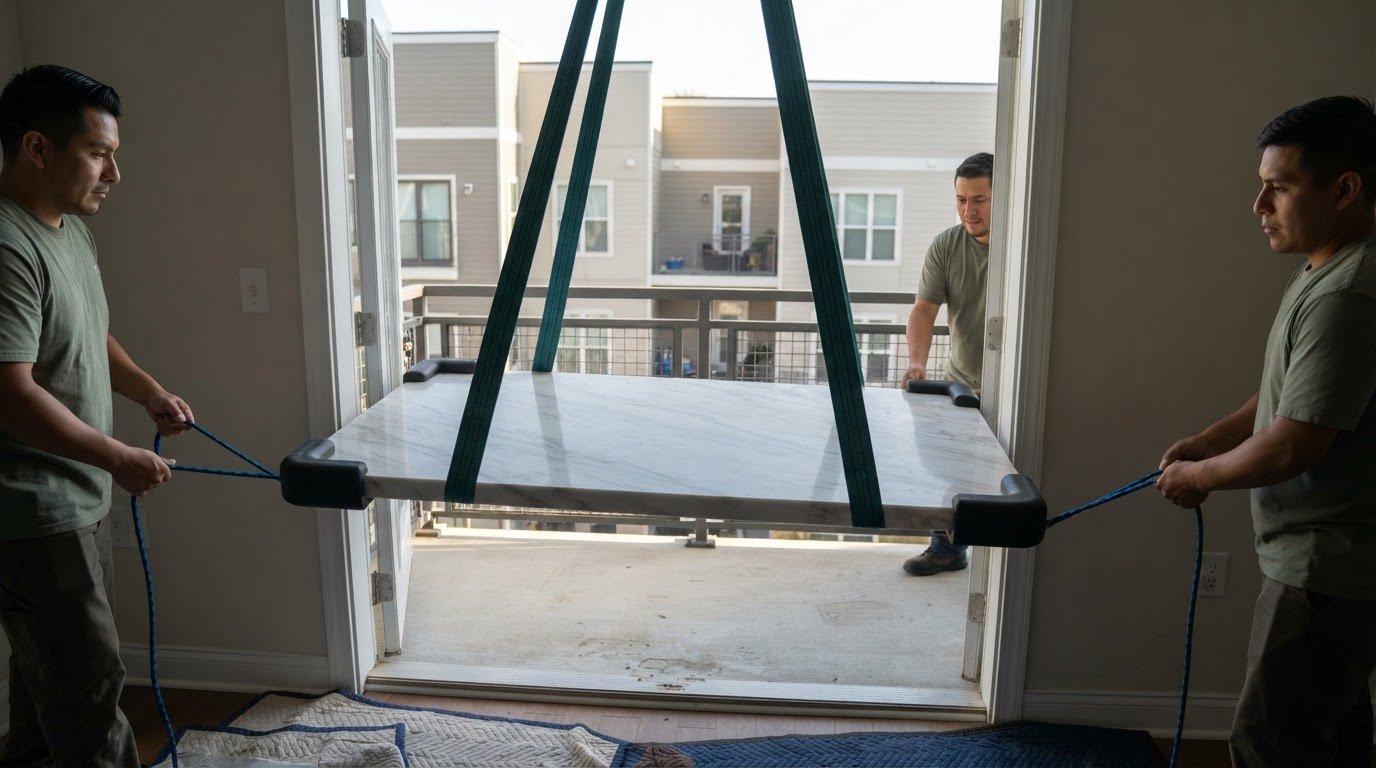
This guide explains how movers measure the full route, assess whether the sectional can be separated, and use straps, a dolly, or furniture sliders to handle each piece. You’ll also learn when removing a door or its legs may help, and when a tight turn or stairwell calls for another plan. The goal is a safe, controlled move, not a wrestling match in the doorway.
Key Takeaways
- Compare the sectional’s diagonal depth with the doorway’s narrowest clear opening to judge whether it can pass at an angle.
- Assess whether removing the door, hinges, or stops can create useful clearance without risking damage.
- Map the entire route, including hallway turns, stair landings, and any tight interior doorways.
- Match the moving method to the obstacle: straps, a dolly, or furniture sliders can help control different parts of the move.
- Know when a bulky sectional or difficult route calls for professional furniture-moving help.
How Do Professional Movers Measure a Doorway for a Sofa?
Movers compare a sofa’s diagonal depth with the doorway’s narrowest clear opening, then measure every turn and landing along the route. If you’re deciding how to move an oversized sectional couch that will not fit through a doorway in Centreville, these measurements help identify the tightest point before lifting begins.
-
Have Professionals Measure the Doorway and Couch
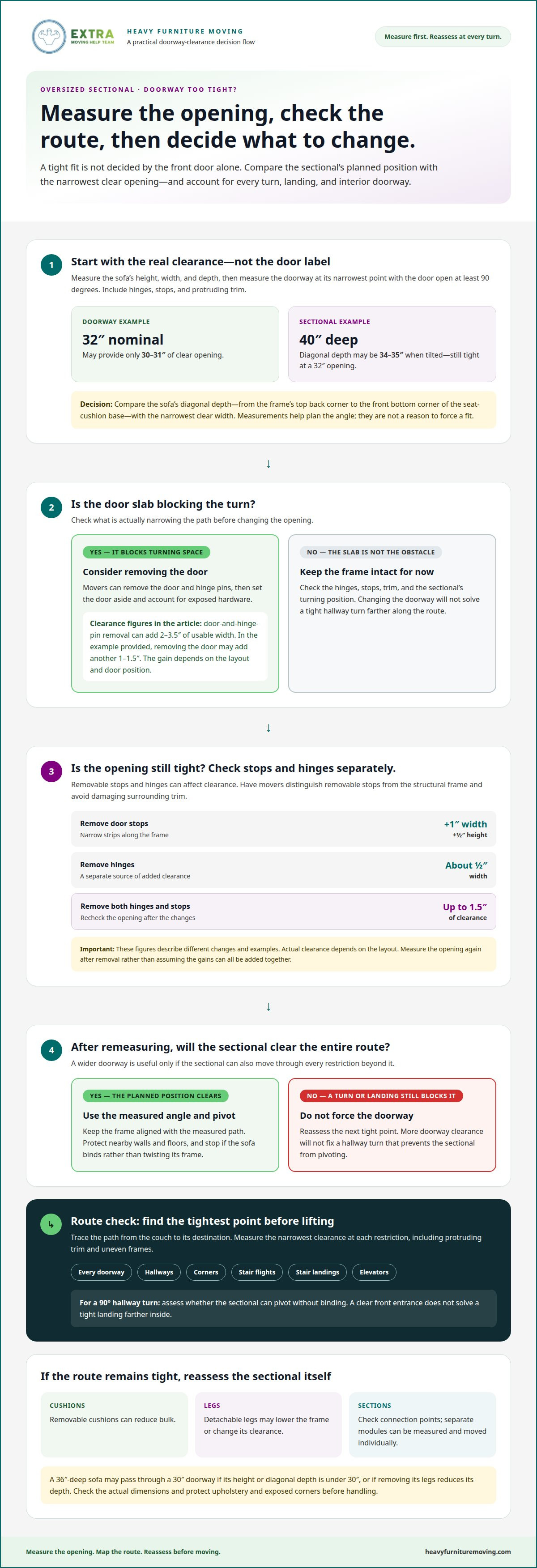
Start by recording the sofa’s height, width, and depth, then measure the doorway at its narrowest point. With the door open at least 90 degrees, movers account for the door, hinges, stops, and protruding trim. A nominal 32-inch doorway may provide only 30 or 31 inches of clear opening, so the frame, not just the door slab, matters.
-
Compare Diagonal Depth With Doorway Width
Measure the sofa’s diagonal depth from the frame’s top back corner to the front bottom corner of its seat-cushion base. Compare that figure with the doorway’s clear width. A 40-inch-deep sofa may have a diagonal depth of 34 or 35 inches when tilted, but that remains tight against a 32-inch opening. Movers use the measurements to plan the angle before lifting.
-
Have Professionals Measure the Entire Route
Map the sofa’s path through each interior doorway, hallway, corner, and stair landing. Measure the narrowest clearance at every point, including protruding trim and uneven frames. For a 90-degree hallway turn, movers assess whether the sectional can pivot without binding. A clear front entrance won’t solve a tight landing farther inside the home.
- Check what changes the sofa’s dimensions before choosing a maneuver. Removable cushions can reduce bulk, while detachable legs may lower the frame or change its clearance. A 36-inch-deep sofa may pass through a 30-inch doorway if its height or diagonal depth is under 30 inches, or if removing its legs reduces its depth.
- Identify the sectional’s connection points and consider whether disassembly would make the move easier. Separate modules can be measured and moved individually, but don’t force a connected frame through an opening. Check the upholstery and exposed corners before handling so protective padding can cover likely contact points.
- Use the measurements to settle the moving position before carrying the sofa. If a 34-inch diagonal meets a 32-inch opening, treat the clearance as tight and plan a careful tilt and pivot. For anyone researching how to move an oversized sectional couch that will not fit through a doorway in Centreville, the key is to keep the frame aligned with the measured path. Protect nearby walls and floors, and stop if the sofa binds rather than twisting its frame.
How Professional Movers Remove Door Hinges and Stops for Extra Clearance
Removing a door, its hinges, or its stops can sometimes create more clearance. Compare the expanded opening with the sectional’s dimensions before deciding how to proceed.
-
Have Professionals Remove the Door From Its Hinges
Have movers take the door off its hinges when the slab blocks the sectional’s turning space. Removing the door and hinge pins can add 2 to 3.5 inches of usable doorway width. Movers handle and set the door aside, then account for the exposed hinge hardware. The change helps most when the couch’s tightest turning dimension is close to the opening.
- Check whether the door itself is the obstacle before altering the frame. With the door open at least 90 degrees, movers can identify whether its edge still narrows the path. Removing the door may add another 1 to 1.5 inches of width in the example provided. The exact gain depends on the layout and where the door sits during the turn.
-
Have Professionals Remove Door Stops
Ask movers to assess the stops along the frame if the opening remains tight. Removing door stops can add 1 inch of width and ½ inch of height. Those narrow strips can limit a couch’s corner even when the door is already off. Movers should distinguish removable stops from the structural frame and avoid damaging the surrounding trim.
- Consider hinges and stops as separate sources of clearance. Removing hinges can free about ½ inch of width, while removing stops can add 1 inch of width and ½ inch of height. Together, removing hinges and stops can provide up to 1.5 inches of clearance. Movers use these gains to reassess the angle, not to force a tight fit.
-
Have Professionals Measure the Clear Opening
Measure the opening again after removing the door and stops. A nominal 32-inch doorway may have only 30 or 31 inches of clear space before those changes. Check the narrowest width and the available height, including any remaining hardware or trim. Compare those measurements with the sectional’s planned position through the frame.
- Use the revised measurement to decide whether the doorway change solves the specific obstruction. If the opening improves but a hallway turn still prevents the sectional from pivoting, more doorway clearance won’t fix the route. For a difficult sectional move, professional sectional moving help can account for the opening and the next tight point together.
How Professional Movers Check Doorways, Hallways, Corners, and Stair Landings
Professional movers trace the sectional’s full path, not just its route through the front door. They measure each restriction and plan turns before carrying the couch.
-
Have Professionals Check the Full Moving Path
Have movers inspect every doorway, hallway, stair flight, landing, and elevator between the couch and its destination. They note narrow openings, protruding trim, uneven frames, and corners that limit a turn. At an elevator, they assess both the entrance and the available interior space. A clear doorway at the start doesn’t prove the sectional can pass the next landing.
-
Plan the Tight Hallway Turn With Professional Movers
Ask movers to assess a hallway turn before they lift the sectional into it. At a 90-degree corner, a hook or S-pivot maneuver changes the couch’s angle in stages. The team checks how its length and depth relate to the turn’s diagonal clearance. This technique needs controlled movement; forcing the frame can scrape the wall or upholstery.
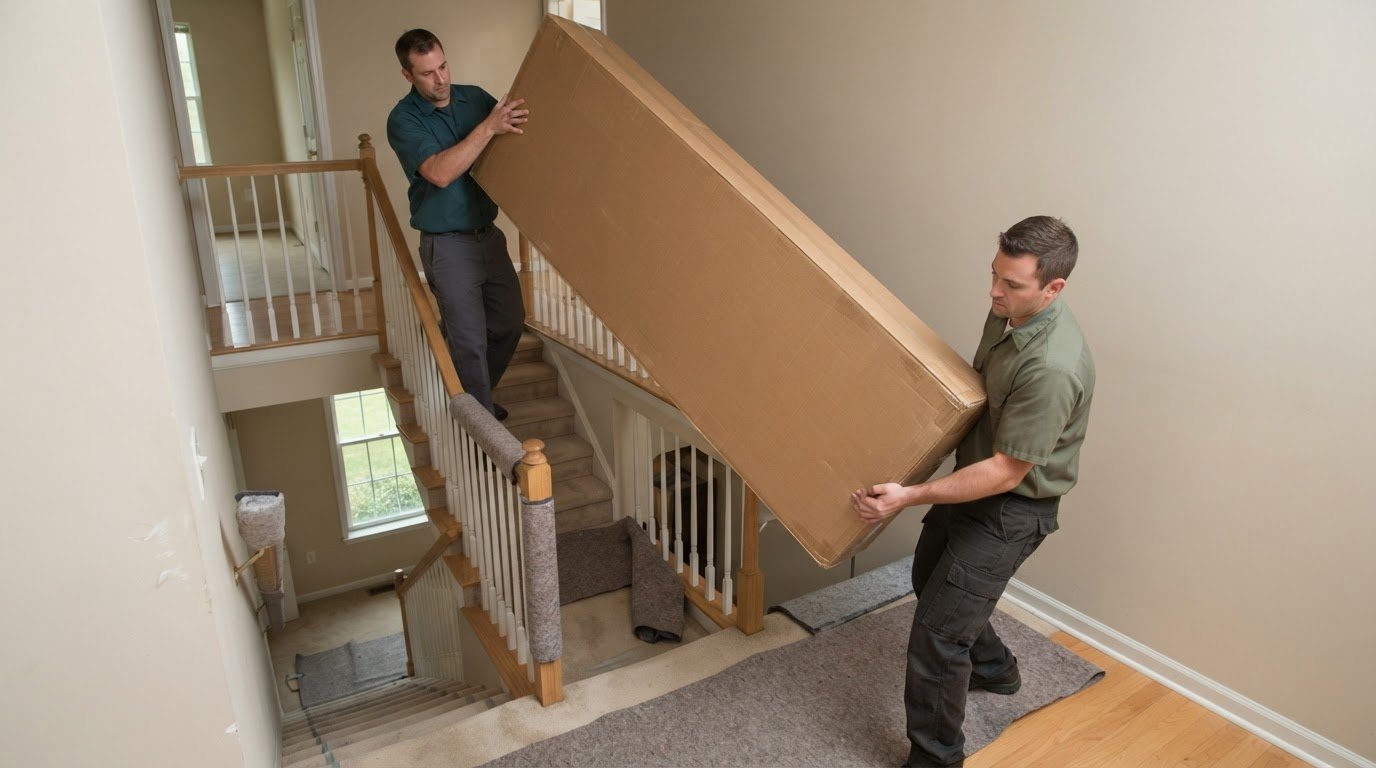
- Measure each stair landing in the direction the sectional must travel. Movers compare the landing’s usable space with the couch’s length and the angle needed to turn. A stairwell with a tight 90-degree turn may require hoisting the sectional over the railing if its length exceeds the turn’s diagonal clearance. That decision depends on the measured route, not the stairwell alone.
- Check both sides of each corner for obstacles that could block a pivot. A hallway may be wide enough before the turn but too tight beyond it. Look for door frames, wall projections, and nearby furniture that could restrict the couch’s rotation. Decide which end should lead, and adjust the orientation before reaching the corner.
- Protect the surfaces most exposed during each turn. Use padding where the sectional could touch a wall, door frame, or stair rail. Keep the couch under control as it rounds a corner instead of letting an edge drag across the floor. Note any fabric or frame sections that need extra care as the direction changes.
- Use the route assessment to plan a workable sequence. If an elevator follows a narrow hallway, decide how to align the sectional with the elevator opening before entering. If a stair landing interrupts the path, assess that transition separately. A sectional that clears a straight hallway may still need a different angle at the landing.
- Stop if the couch binds or you lose control of its weight. A hard stop at a corner means the angle or route needs reassessment, not more force. Return to the last open area, change the orientation, and use a hook or S-pivot technique only if the measured clearance allows it.
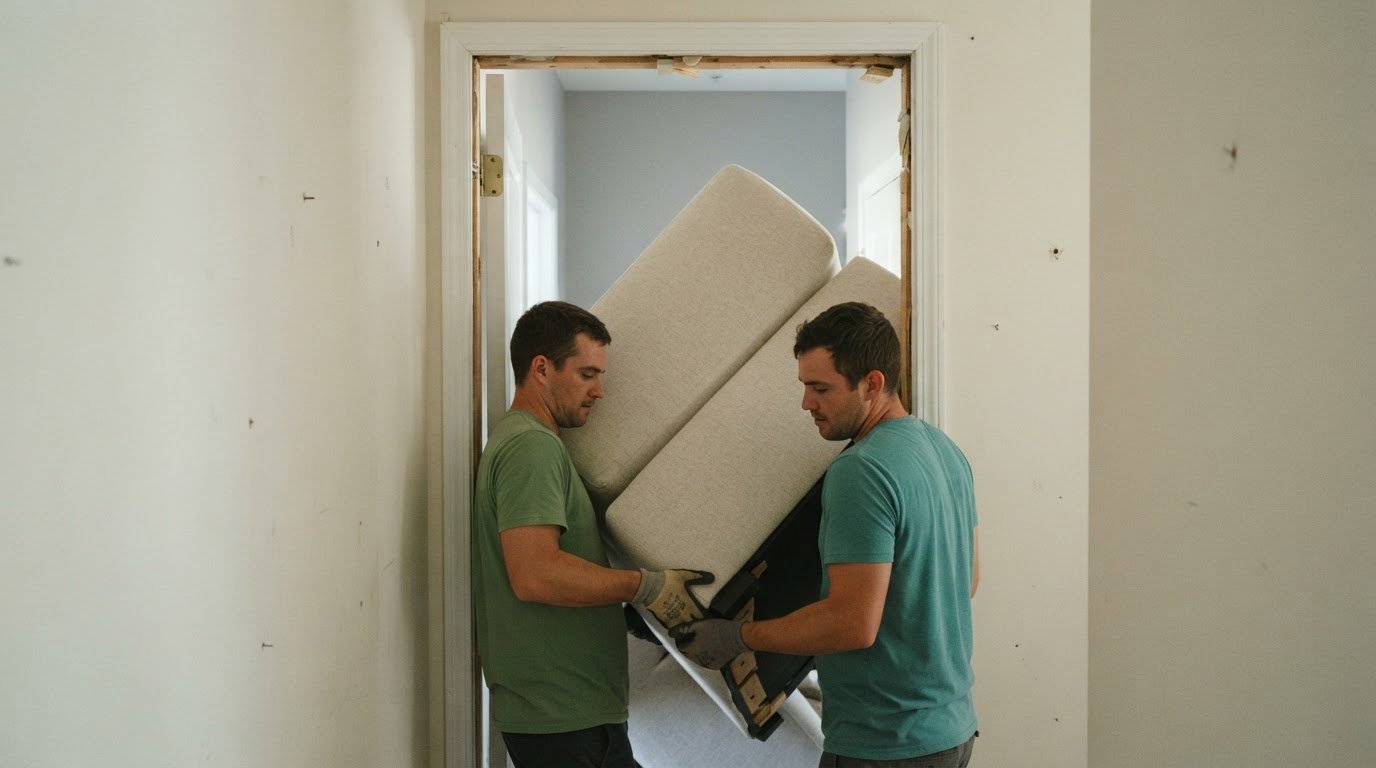
Sofa too big to fit through door?
Professional movers compare the couch’s smallest rotating dimension with the doorway’s clear opening. If the measurements still conflict, they assess upright positioning, another entryway, or sectional disassembly.
-
Have Professional Movers Compare Sofa and Doorway Dimensions
Compare the sofa’s height, depth, and width with the doorway’s narrowest opening. Tilting a sofa can change the dimension that must pass through the opening, so assess its diagonal clearance as well as its depth. Professional movers consider the frame and cushions separately, then plan around the dimension that controls the turn. Don’t judge the fit from the sofa’s front width alone.
-
Have Professional Movers Assess Whether to Stand the Sofa Upright
Ask movers to assess whether the sofa can be angled upright through the doorway. They check its diagonal and rotating dimensions against the opening before changing its position. A leading corner may enter at roughly 30 to 45 degrees off vertical, then pivot as the rest follows. The available height matters too. Movers avoid forcing the upholstery or twisting the frame against the door jamb.
- Have movers consider whether removable legs or feet change the fit. Removing wooden feet, bun legs, or corner glides can reduce total frame height by 3 to 6 inches. That change may give the sofa more room to tilt through a narrow opening. Movers account for the couch’s remaining height and its path after the doorway, rather than treating leg removal as an automatic solution.
-
Ask Professional Movers About an Alternative Entryway
Compare the front door with other possible entryways, such as a wider side or rear entrance. Assess each route for openings, turns, and landing space. A larger doorway won’t help if a hallway corner blocks the couch just beyond it. Consider the complete path and choose an entrance that gives the sectional room to turn.
-
Have Professional Movers Disassemble the Sofa
Ask movers to assess whether the sectional separates into modules or has removable legs and cushions. Unbolting sectional components can reduce them to pieces that are 30% to 50% smaller. Smaller sections may pass through a doorway that blocks the connected sofa. Movers should consider the construction before disassembly, since customer disassembly can void many USA- and Amish-made furniture warranties.
- Choose the next step from the measurements, not from a forceful test. Most sofas fit through a standard 32-inch doorway after cushions and legs are removed and a tilt-and-pivot technique is used. Professional movers match that approach to the sofa’s dimensions, the doorway height, and the remaining route. If the couch still binds, they reassess its position or route instead of pushing harder.
How Professional Movers Use Moving Straps, Dollies, and Furniture Sliders
Professional movers choose equipment around the sectional’s weight, shape, and route. Straps help control a lift, dollies roll furniture across suitable flat areas, and sliders help reposition pieces with less dragging.
- Protect the sectional before handling it. Wrap exposed upholstery and vulnerable corners with moving blankets, then secure the covering so it stays in place. Check whether cushions or loose parts should be removed first. For example, a blanket can shield a fabric arm from the doorway as the frame passes through.
- Use moving straps when the sectional needs a controlled lift or carry. Position them to support the load and coordinate movements to keep the couch stable as it changes direction. Straps don’t widen a tight doorway, so follow the measured angle and keep the frame clear of door hardware.
- Use a dolly for a section that can roll along a suitable, level path. Secure the piece and guide the dolly around obstacles instead of carrying it the full distance. Before rolling, check for thresholds, sharp turns, and changes in floor surface. A dolly helps across open areas, but it doesn’t replace a controlled lift on stairs.
- Place furniture sliders under sections that need repositioning across a suitable floor. Lift the couch enough to position the sliders, then guide it instead of pulling on the upholstery or scraping the base. Consider the floor surface and furniture feet before choosing this method. Sliders can help align a piece before a doorway maneuver.
- Match the tool to each part of the route. A dolly may work in a clear hallway, while straps can offer more control at a doorway. Sliders can help with short adjustments near the opening. Consider the sectional’s shape and the route before switching tools, rather than trying to use one device everywhere.
- Keep small pieces and hardware together if the sectional separates. Protect removed cushions and components with blankets, and organize the connection hardware for reassembly. Don’t leave loose parts where they could obstruct the route. Moving sections separately may make handling easier, with straps or a dolly suited to different parts of the move.
- Bring in help when the sectional is too bulky to control through a narrow passage. Professional handling combines the right equipment with coordinated movement and protection for furniture and home surfaces. For a sectional that needs careful lifting and repositioning, get help with your heavy furniture move.
Heavy Furniture Moving
Heavy Furniture Moving helps when a sectional’s size, tight turns, or stairs make the move difficult. The team can assess the couch and route, plan how to handle the heavy pieces, and protect your home during the move. If the sectional cannot pass through the available doorway, sofa hoisting may be an option when the home’s layout allows.
Share the sectional’s measurements, the tightest doorway or turn, and any stairs along the route. These details help define the challenge and shape the moving plan. For hands-on help with a bulky couch in Centreville, contact Heavy Furniture Moving.
Make the Next Move With a Clear Plan
Choosing how to move an oversized sectional couch that will not fit through a doorway in Centreville starts with one practical decision: who will manage the difficult parts of the move? A sectional can be costly to replace and hard to maneuver, so avoid turning a tight passage into a test of strength. Set the goal first: move the couch without rushing or losing control.
Before moving day, decide whether you need help with the sectional alone or with broader furniture moving. This keeps your request focused on the work you need. A professional team can handle the bulky piece while you prepare your home and settle into the next space.
Take the next step at your pace. Contact Heavy Furniture Moving to discuss help with your sectional move. A manageable plan can turn a stressful obstacle into a straightforward next step.
Frequently Asked Questions
Do Most Sofas Fit Through Standard Doors?
Most sofas can fit through a standard 32-inch doorway when cushions and legs are removed and movers use a tilt-and-pivot maneuver. A long chaise or a tight turn can change the answer, even if the sofa clears the doorway itself. Treat the entrance and the next hallway or landing as one route. For a Centreville home, the narrowest point along that route determines the practical plan.
How Do Professional Movers Separate a Sectional Couch Before Moving It?
Professional movers locate the sectional’s connecting brackets or clips, then separate the modules where the design allows. They keep detached hardware together so it’s available for reassembly and avoid pulling connected pieces apart at an angle. After reassembly, check that every connector is fully engaged. Set aside two minutes for that final check, especially when the couch will be used soon after the move.
Should You Hire Movers for a Sectional With Multiple Awkward Pieces?
Consider professional help for a sectional with more than three modules, especially when several pieces must pass through narrow turns. That range describes the sectional move, not every home’s route or layout.
How Do Professional Movers Measure an Oversized Sectional Couch and Doorway for Clearance?
Movers compare each section’s dimensions with the tightest opening and turning space on the route. They account for the sectional’s shape, including a chaise or extended arm, and identify whether a section must rotate to clear the frame. Cushions and removable legs can change the dimensions being assessed. Share which piece seems most difficult, so the plan addresses that obstruction rather than the sofa’s overall footprint alone.
How Do Professional Movers Remove Sectional Couch Legs, Cushions, Arms, and Connectors for Moving?
Movers remove cushions and detachable legs when those parts can be safely taken off, then examine how the sections connect. Arms and other structural pieces should only be removed when the couch’s construction allows it. Customer disassembly can void many USA- and Amish-made furniture warranties. Keep removed hardware together, and after reassembly spend two minutes checking that each sectional connector is fully engaged.
How Do Professional Movers Pivot or Angle a Sectional Couch Through a Narrow Doorway or Hallway?
Movers guide the sectional through in controlled stages, changing its angle as the leading end clears the opening. At a 90-degree hallway turn, a hook maneuver can help redirect the couch around the corner. The team must coordinate the turn so one end doesn’t press into the wall while the other is still crossing the doorway. If the frame binds, they reassess instead of forcing it.
Can an Oversized Sectional Be Disassembled or Taken Apart for Moving?
Yes, a sectional can often be separated into modules if its connectors are designed to disengage. Moving pieces separately may make a tight entrance manageable, but don’t take apart structural parts without understanding the couch’s construction. Customer disassembly can void many USA- and Amish-made furniture warranties. Keep connectors and hardware together, then confirm each connection is fully engaged after reassembly.
What Tools and Equipment Do Professional Movers Use to Move a Heavy Sectional Couch Safely?
Movers may use straps, dollies, sliders, and moving blankets, choosing equipment to suit the couch and route. Heavy Furniture Moving uses ratchet straps, shrink film, masonite floor protection, and door-jamb covers to protect the home. A dolly can help on a suitable flat route, while padding protects surfaces where the sectional passes close. Equipment supports controlled handling, but it doesn’t replace route planning.
Frequently Asked Questions
Most sofas can fit through a standard 32-inch doorway when cushions and legs are removed and movers use a tilt-and-pivot maneuver. A long chaise or a tight turn can change the answer, even if the sofa clears the doorway itself. Treat the entrance and the next hallway or landing as one route. For a Centreville home, the narrowest point along that route determines the practical plan.
Professional movers locate the sectional’s connecting brackets or clips, then separate the modules where the design allows. They keep detached hardware together so it’s available for reassembly and avoid pulling connected pieces apart at an angle. After reassembly, check that every connector is fully engaged. Set aside two minutes for that final check, especially when the couch will be used soon after the move.
Consider professional help for a sectional with more than three modules, especially when several pieces must pass through narrow turns. That range describes the sectional move, not every home’s route or layout.
Movers compare each section’s dimensions with the tightest opening and turning space on the route. They account for the sectional’s shape, including a chaise or extended arm, and identify whether a section must rotate to clear the frame. Cushions and removable legs can change the dimensions being assessed. Share which piece seems most difficult, so the plan addresses that obstruction rather than the sofa’s overall footprint alone.
Movers remove cushions and detachable legs when those parts can be safely taken off, then examine how the sections connect. Arms and other structural pieces should only be removed when the couch’s construction allows it. Customer disassembly can void many USA- and Amish-made furniture warranties. Keep removed hardware together, and after reassembly spend two minutes checking that each sectional connector is fully engaged.
Movers guide the sectional through in controlled stages, changing its angle as the leading end clears the opening. At a 90-degree hallway turn, a hook maneuver can help redirect the couch around the corner. The team must coordinate the turn so one end doesn’t press into the wall while the other is still crossing the doorway. If the frame binds, they reassess instead of forcing it.
Yes, a sectional can often be separated into modules if its connectors are designed to disengage. Moving pieces separately may make a tight entrance manageable, but don’t take apart structural parts without understanding the couch’s construction. Customer disassembly can void many USA- and Amish-made furniture warranties. Keep connectors and hardware together, then confirm each connection is fully engaged after reassembly.
Movers may use straps, dollies, sliders, and moving blankets, choosing equipment to suit the couch and route. Heavy Furniture Moving uses ratchet straps, shrink film, masonite floor protection, and door-jamb covers to protect the home. A dolly can help on a suitable flat route, while padding protects surfaces where the sectional passes close. Equipment supports controlled handling, but it doesn’t replace route planning.