How to Move a Heavy Mahogany Desk in Fairfax Station Safely
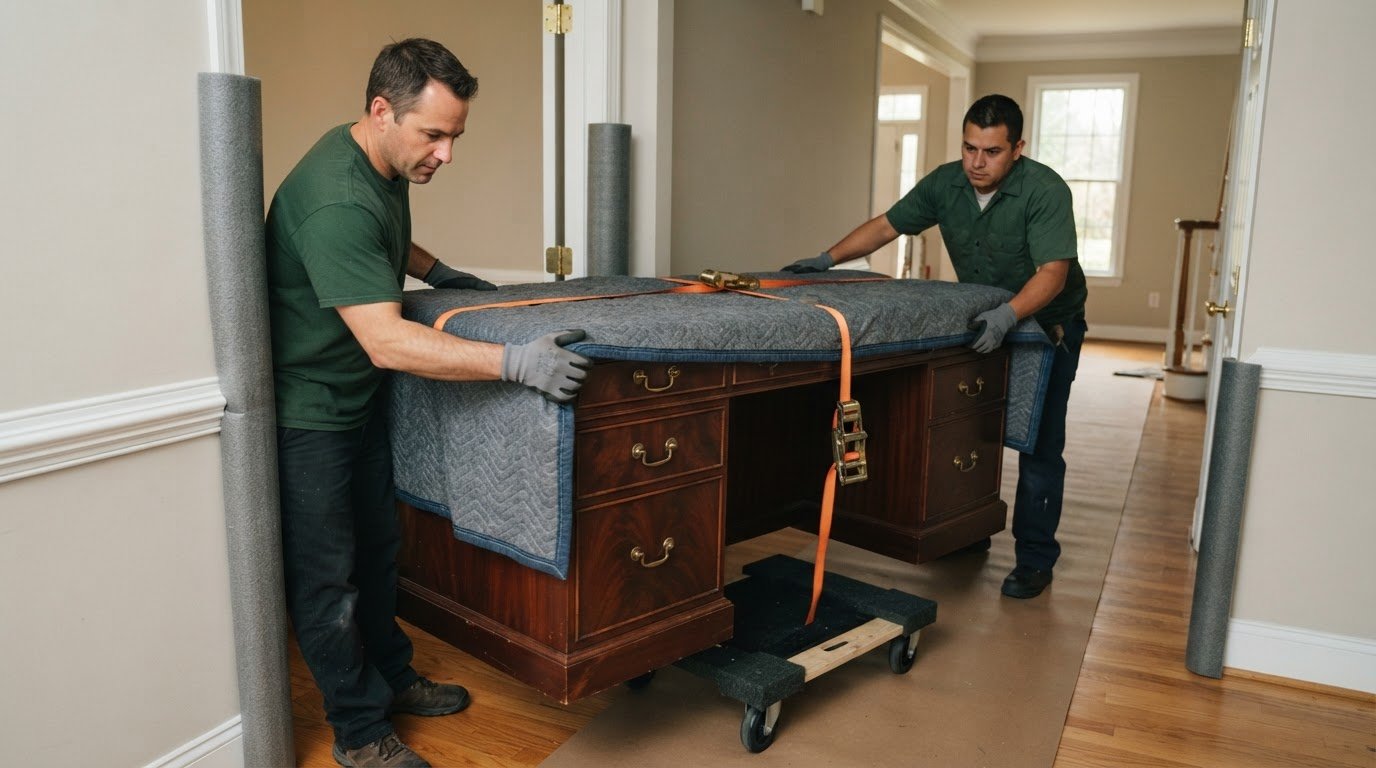
A heavy mahogany desk is a poor load to move by muscle alone. For moving a heavy executive mahogany desk without back strain in Fairfax Station, professional movers assess the desk and route, secure removable parts, and use suitable sliders, a dolly, and straps. Professional help is recommended for desks over 200 pounds and whenever stairs are involved.
It’s easy to focus on a desk’s weight and overlook the tight turns, doorways, and floors along the route. Moving a heavy executive mahogany desk without back strain in Fairfax Station takes planning: protect the home, keep the desk stable, and coordinate each move. This guide explains how to prepare the desk, clear and measure the path, and use moving equipment to reduce physical strain and damage risk. It also covers when professional heavy-lifting help makes sense.
Key Takeaways
- Learn how movers remove or secure desk parts so drawers and fittings stay controlled during the move.
- See how measuring the path and clearing obstacles helps prevent delays and awkward turns.
- Find out how floor coverings and corner protection help guard both the home and the mahogany finish.
- Understand how movers choose sliders, dollies, and straps to keep the desk stable in transit.
- Recognize when a heavy desk or stairway makes professional lifting help the safer choice.
Disassembling and securing desk parts
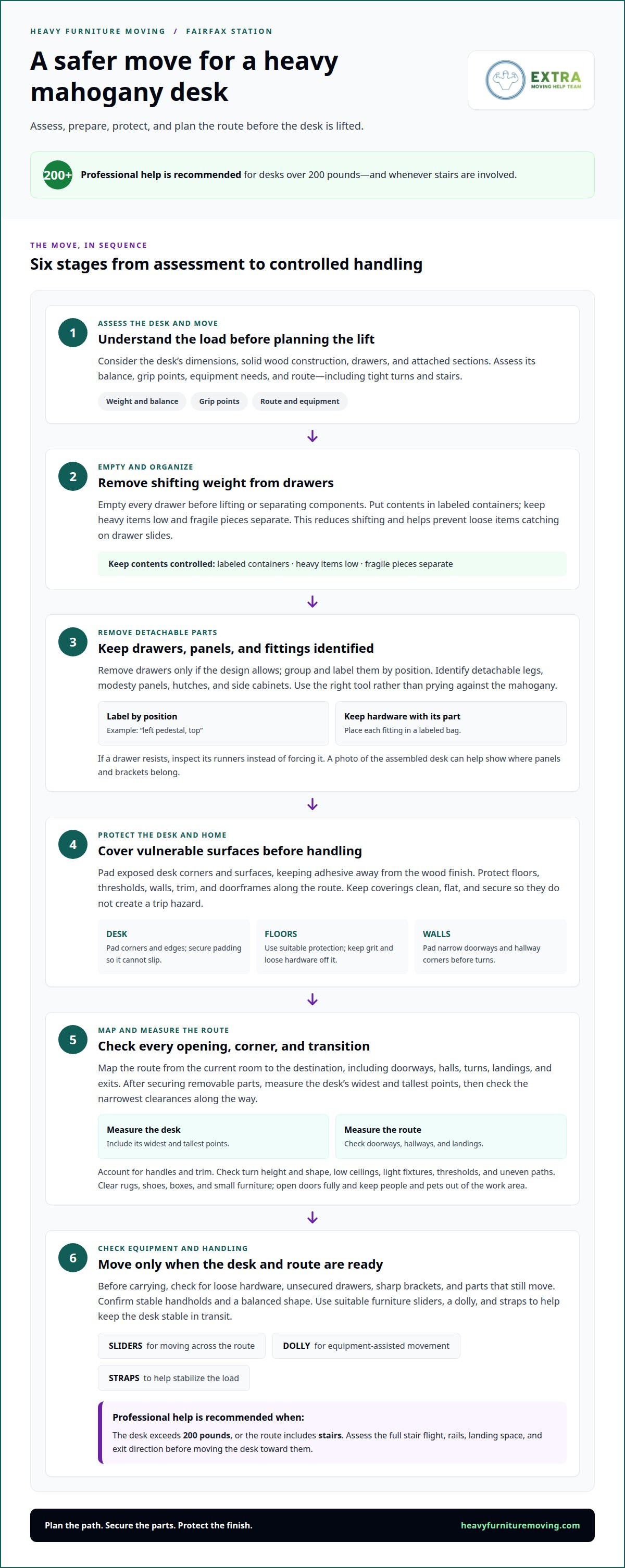
- Estimate the desk’s weight by considering its dimensions, wood construction, drawers, and attached sections. A solid mahogany desk with full drawers is different from one with a hollow center. Movers assess the desk’s balance, grip points, equipment needs, and route when planning the lift. A broad desk facing tight turns or stairs calls for different coordination than a compact desk on a clear path.
- Empty every drawer before lifting the desk or separating its components. Files, books, and accessories add weight and can shift when the desk tilts. Set the contents aside in labeled containers, with heavy items low and fragile pieces separate. This also keeps loose objects from catching on drawer slides during handling.
- Check how each drawer and removable panel is secured before taking it out. Remove drawers only if the design allows, then group and label them by position. For example, marking a drawer “left pedestal, top” makes it easier to return to the right opening. If a drawer resists, inspect its runners rather than forcing it.
- Identify detachable legs, modesty panels, hutches, and side cabinets. Check visible screws and fittings, then use the right tool to separate parts without prying against the mahogany. Put each fitting in a labeled bag and keep it with the matching component. A photo of the assembled desk can help show where brackets and panels belong.
- Secure the main desk and detached pieces for handling. Wrap exposed corners and surfaces with protective padding, keeping adhesive away from the wood finish. Bundle smaller components so they cannot shift or get separated during the move. A detached hutch, for example, should travel as its own stable piece, not rest loosely on the desktop.
- Inspect the desk after disassembly and before carrying it. Movers check for loose hardware, unsecured drawers, sharp brackets, and parts that still move. They confirm that the remaining body has stable handholds and a balanced shape. If the desk exceeds 200 pounds, professional help is recommended; stairs also call for professional help.
Planning and measuring the route
- Map the full path from the desk’s current room to its destination. Include each doorway, hall, turn, stair landing, and exit. For moving a heavy executive mahogany desk without back strain in Fairfax Station, movers plan each transition before carrying begins. Note where the team can pause safely and where a change in direction may require extra room.
- Measure the desk after securing removable parts, including its widest and tallest points. Then measure the narrowest doorway, hallway, and landing along the route. Account for handles, trim, and anything else that reduces usable clearance. Check every tight spot: fitting through the entrance does not mean the desk will turn easily farther inside.
- Check the height and shape of every turn, not just the width of openings. A hallway corner may require tilting or rotating the desk, while a low ceiling or light fixture can limit that movement. Consider the desk’s position at each turn and whether an alternate route offers more room. A clear plan helps prevent last-minute maneuvering.
- Clear rugs, shoes, boxes, and other tripping hazards from the route. Move small furniture, open doors fully, and keep pets and people out of the work area. Leave the hallway beyond the doorway clear so movers have room to reposition without stepping around household items.
- Inspect thresholds and floor transitions that could affect equipment or footing. Carpet edges, raised doorways, and uneven outdoor paths can complicate the move. Identify each transition and plan a controlled approach. If the route includes stairs, assess the full flight, rails, landing space, and exit direction before moving the desk toward them.
- Confirm the final placement before the desk leaves its current room. Measure the intended wall space and account for doors, cabinets, and windows that must remain accessible. Moving a heavy executive mahogany desk without back strain in Fairfax Station also means knowing where it will go. Tell the moving team your preferred position and any access limits.
Protecting floors, walls, and desk corners
- Identify the surfaces beneath and around the desk before bringing in moving equipment. Hardwood, tile, carpet, and finished thresholds may need different protection. Use clean coverings that lie flat and stay in place. Secure them without creating a trip hazard, and keep the route covered through turns and doorways.
- Protect hardwood and tile from concentrated pressure and scratches. Use stable floor coverings between the desk or moving equipment and the finished surface. Keep grit, hardware, and debris off the covering, since particles can rub against flooring under weight. At each threshold, check that the protection is smooth and aligned before moving the desk across it.
- Protect carpet from snags and drag marks. Before moving the desk, cover the carpeted route with suitable protection and check its edges. Avoid dragging desk feet across carpet fibers, which can catch or pull. If the route changes from carpet to hard flooring, secure the transition before continuing.
- Shield vulnerable wall areas along the route, especially beside narrow doorways and hallway corners. Place protective padding where the desk could brush a painted wall, trim, or doorframe. Keep it in position during turns rather than relying on a correction after contact. At a tight corner, slow down and guide the desk clear of both walls.
- Cushion the mahogany desk’s corners and exposed edges before handling. Use clean padding to separate the wood from straps, doorframes, and nearby surfaces. Secure it so it cannot slip as the desk changes angle. Avoid placing tape directly on the finish, since adhesive may leave residue or affect the surface. Cover decorative edges without pressing hard against them.
- Check the protection as the desk moves, not just at the starting point. After a doorway or turn, pause to confirm that floor coverings remain flat and corner padding is secure. If a cover shifts, stabilize the desk before adjusting it. Keep protection beneath equipment until the desk reaches its planned position, then remove the coverings carefully.
Using furniture sliders and dollies
Professional movers reduce strain by matching equipment to the desk, floor, and route. They use sliders for controlled movement on suitable floors and a dolly when the desk can be loaded securely. Crew members coordinate each lift, bend their knees, lift with their legs, and avoid twisting.
- Assess the desk’s base and the floor before choosing sliders. Check whether the feet or pedestal edges provide stable contact, then select sliders suited to the surface. Smooth floors and carpet require different slider surfaces. Avoid placing a slider beneath fragile trim, which could crack under pressure or shift during movement.
- Position sliders under supported points, not decorative edges. Raise one side only enough to place a slider, then lower the desk carefully before working on another side. This keeps the desk supported during setup. Check that each slider sits flat and aligned so the desk moves steadily instead of pivoting around one corner.
- Move the desk in small, controlled sections across the room. Movers guide the load from stable contact points and watch the leading edge, slider position, and floor covering. At a doorway, they stop before the desk reaches the frame, reassess its angle, and adjust the path. They don’t force a slider over a floor transition.
- Use a dolly only if its platform can support the desk securely. Consider the desk’s shape, balance, and available lifting points before raising it. Position the desk so it stays controlled while rolling. A long executive desktop that overhangs the platform may need a different handling plan rather than an unstable dolly setup.
- Keep the desk steady while loading and rolling the dolly. Coordinate the lift and lower the desk onto the platform without dropping or jolting it. Check that the load does not rock, shift, or block the person guiding the wheels. Slow down at turns and keep the dolly aligned with the cleared route.
- Choose sliders or a dolly based on the full route, not convenience alone. Sliders can help move a supported desk across a suitable floor; a dolly can transport a stable load. Stairs, thresholds, tight turns, and uneven surfaces may change the plan. Pause and reposition equipment whenever the desk no longer moves safely.
How professional movers use lifting and ratchet straps
Professional movers reduce strain by coordinating the lift, keeping the desk close, bending their knees, and lifting with their legs. They avoid twisting and use straps to help control the load, not as a substitute for a clear route or coordinated handling.
- Assess the desk and route before choosing a lifting method. Consider its size, weight distribution, grip points, and attached sections, along with the doorways, turns, and stairs ahead. A balanced desk on a clear floor needs different handling from a bulky desk approaching a narrow landing.
- Agree on commands before lifting. Decide who will guide the front, who will support the opposite side, and when the team will stop. Clear cues such as “lift,” “hold,” and “lower” keep everyone moving together. If someone needs a pause, stop rather than shifting the desk unpredictably.
- Take a stable position before raising the desk. Plant your feet securely, bend your knees, and keep the load close to your body. Lift with your legs and avoid twisting your back. To change direction, coordinate a careful turn with your feet rather than rotating under the desk’s weight.
- Use lifting straps only when they suit the desk and planned carry. Position them to help distribute the load and maintain control while protecting the mahogany finish from rubbing. Check that straps stay secure and do not catch on drawer pulls, edges, or door hardware. Keep the desk steady as it moves.
- Secure a bulky desk to a dolly with two straps. Position the desk securely on the platform, then fasten the straps to prevent shifting during transport. Tighten them enough to hold the load without pressing carelessly against finished wood or fragile trim. Before rolling, check the desk’s balance and the dolly’s route.
- Pause and reset whenever the load becomes awkward. Movers stop before a tight turn, uneven threshold, or stair transition, then reassess their grips and equipment. They don’t twist or pull sharply to force the desk through. For a heavy executive desk, coordinated heavy lifting help can handle the demanding carry.
Heavy Furniture Moving
Heavy Furniture Moving helps with challenging furniture moves that call for careful handling and coordinated lifting. Turn to the team when your mahogany desk is difficult to carry, the route is tight, or placement inside your home requires care. Share the desk’s size, detachable parts, stairs, and narrow turns so the move can be planned around the item and its route. These details help the movers prepare equipment and protect your home. For help moving a heavy executive desk in Fairfax Station, contact Heavy Furniture Moving.
Make the next move with confidence
A desk move is also a chance to choose a placement that works for your room and routine. Consider where you’ll sit, how the drawers will open, and whether the desk leaves a clear path through the space. Sharing your preferred spot helps the moving team plan the final placement around how you use the room.
For moving a heavy executive mahogany desk without back strain in Fairfax Station, professional support can take the strain of handling and maneuvering off your shoulders. Heavy Furniture Moving also offers Movers Near Me, Exercise Equipment Moving, and Sofa Hoisting.
Arrange professional desk-moving help from Heavy Furniture Moving, and take the next step toward placing your desk safely in its new spot.
Frequently Asked Questions
How much does it cost to hire movers for a heavy executive desk in Fairfax Station, VA?
The cost depends on the desk, access conditions, and handling required. Heavy Furniture Moving provides upfront quotes before work begins, with hourly labor and a two-hour minimum or flat-rate pricing for most single heavy items. Stairs and wrapping are priced before the job starts, and wrap and straps are included. Share the desk’s details and describe any stairs or tight access to help shape an accurate quote.
Which local movers in Fairfax Station specialize in heavy furniture or piano moving?
Heavy Furniture Moving handles residential moves involving heavy furniture and provides specialized piano handling. Its service area includes Fairfax Station and nearby communities such as Fairfax, Woodbridge, Manassas, Manassas Park, Aldie, Ashburn, McLean, Vienna, Reston, Centreville, Chantilly, Clifton, Dumfries, South Riding, Haymarket, and Gainesville. Describe the item and destination so the move can be planned for the local route.
What equipment do professional movers use for a heavy desk, such as a furniture dolly, lifting straps, or sliders?
Movers choose equipment according to the desk’s shape, balance, and route. A dolly can help transport a securely positioned desk over a suitable surface, while sliders can assist with controlled movement across compatible flooring. Straps help stabilize a load during handling. Heavy Furniture Moving provides blankets, straps, and dollies for truck and pod loading work; customers supply their own vehicle.
How do professional movers disassemble and protect a mahogany desk before moving it?
Identify detachable sections and fittings before taking anything apart, then keep related hardware with its matching piece. Protect exposed surfaces and corners with clean moving materials. For a mahogany finish, avoiding direct adhesive contact helps reduce the risk of residue. Point out delicate trim or a loose fitting to the moving team before handling begins.
How do professional movers handle a heavy desk through narrow doors, stairs, or tight hallways?
Movers assess the desk’s orientation and available clearance before attempting a tight passage. They coordinate movement, pause where a turn or landing changes the angle, and adjust the approach rather than forcing the desk through. For stairs, the route and landing space affect how the load is controlled. Share photos of the desk and stairway to help plan the handling.
What floor and wall protection do professional movers use when moving heavy furniture?
Protection can include blankets around furniture, masonite floor protection, and door-jamb covers. Heavy Furniture Moving uses these materials as part of its protective measures. The crew chooses where to place them based on the route, such as shielding a doorway where the desk must turn or covering a vulnerable floor section. Mention finished floors, painted walls, and delicate trim when describing the move.
How many people are needed to move a heavy executive desk safely?
There is no fixed crew size; movers determine it based on the desk’s estimated weight, balance, grip points, equipment, and route. Professional help is recommended for desks over 200 pounds or whenever stairs are involved.
Frequently Asked Questions
The cost depends on the desk, access conditions, and handling required. Heavy Furniture Moving provides upfront quotes before work begins, with hourly labor and a two-hour minimum or flat-rate pricing for most single heavy items. Stairs and wrapping are priced before the job starts, and wrap and straps are included. Share the desk’s details and describe any stairs or tight access to help shape an accurate quote.
Heavy Furniture Moving handles residential moves involving heavy furniture and provides specialized piano handling. Its service area includes Fairfax Station and nearby communities such as Fairfax, Woodbridge, Manassas, Manassas Park, Aldie, Ashburn, McLean, Vienna, Reston, Centreville, Chantilly, Clifton, Dumfries, South Riding, Haymarket, and Gainesville. Describe the item and destination so the move can be planned for the local route.
Movers choose equipment according to the desk’s shape, balance, and route. A dolly can help transport a securely positioned desk over a suitable surface, while sliders can assist with controlled movement across compatible flooring. Straps help stabilize a load during handling. Heavy Furniture Moving provides blankets, straps, and dollies for truck and pod loading work; customers supply their own vehicle.
Identify detachable sections and fittings before taking anything apart, then keep related hardware with its matching piece. Protect exposed surfaces and corners with clean moving materials. For a mahogany finish, avoiding direct adhesive contact helps reduce the risk of residue. Point out delicate trim or a loose fitting to the moving team before handling begins.
Movers assess the desk’s orientation and available clearance before attempting a tight passage. They coordinate movement, pause where a turn or landing changes the angle, and adjust the approach rather than forcing the desk through. For stairs, the route and landing space affect how the load is controlled. Share photos of the desk and stairway to help plan the handling.
Protection can include blankets around furniture, masonite floor protection, and door-jamb covers. Heavy Furniture Moving uses these materials as part of its protective measures. The crew chooses where to place them based on the route, such as shielding a doorway where the desk must turn or covering a vulnerable floor section. Mention finished floors, painted walls, and delicate trim when describing the move.
There is no fixed crew size; movers determine it based on the desk’s estimated weight, balance, grip points, equipment, and route. Professional help is recommended for desks over 200 pounds or whenever stairs are involved.