How to Move a Heavy Live Edge Dining Table Upstairs in Aldie
For moving a heavy live edge dining table upstairs in Aldie, first check whether the legs can be removed so you can carry the tabletop and legs separately. Measure every stair turn, landing, doorway, and ceiling clearance before lifting. A table that seems manageable in an open room can become difficult to control on a tight staircase.
Plan the route before handling the weight. Check the table’s dimensions, stair turns, and the help you’ll need. Removing detachable legs can make the pieces easier to carry, but the tabletop still needs a clear path and steady control.
This guide explains how to measure the route, decide whether to hire professional movers, and protect the table and your home. You’ll also learn how to disassemble and secure the pieces, assign roles, and allow time for a careful carry and reassembly. Start with the stairs, not the lifting.
Key Takeaways
- Map the table’s full route, including doorways, landings, ceiling clearance, and the space needed to pivot.
- Choose professional help when the table’s size, weight, or staircase makes a controlled carry difficult.
- Separate removable legs and hardware from the tabletop, then protect and label the pieces for reassembly.
- Gather suitable moving gear and assign clear roles before lifting so the team can keep a steady, coordinated pace.
- Build extra time and helping hands into the plan to avoid rushing a tight or unfamiliar move.
Planning for turns and stairway bottlenecks
Before carrying a table upstairs or downstairs, map the route and identify tight turns, landings, and doorways. For a move in Aldie or Loudoun County, insurance documents, certificates, and stair-carry fees depend on the mover’s terms and the job, so don’t assume they are automatic. A heavy table can strain carriers, and a slip or collision can damage walls, railings, stair edges, or the tabletop.
-
Map Stair Turns and Bottlenecks
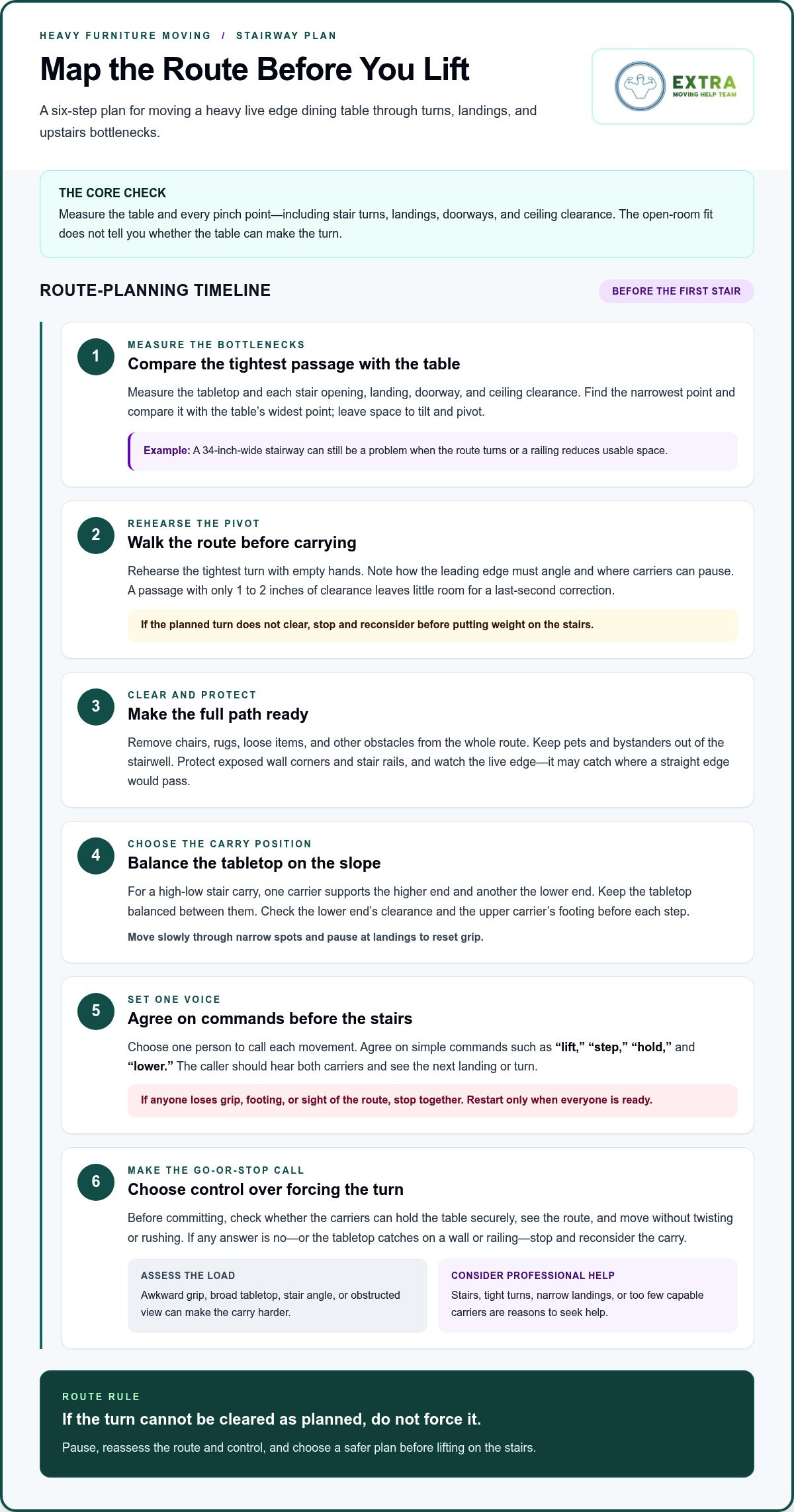
Measure the table and each pinch point, including the stair opening, landing, doorway, and ceiling clearance. A 34-inch-wide stairway can still become a problem where the route turns or a railing narrows the usable space. Mark the tightest passage and compare it with the table’s widest point. Leave room to tilt and pivot without scraping walls or catching an edge.
-
Apply the High-Low Stair Technique
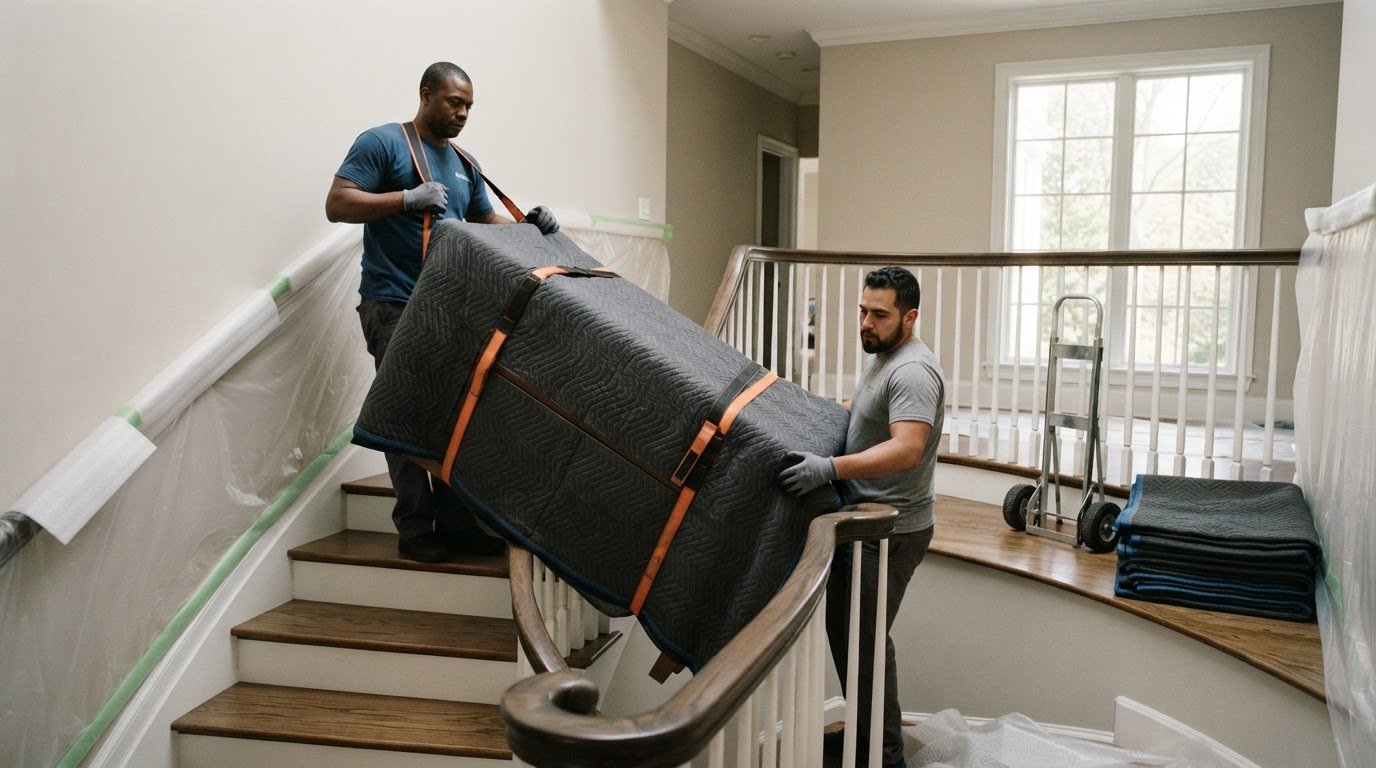
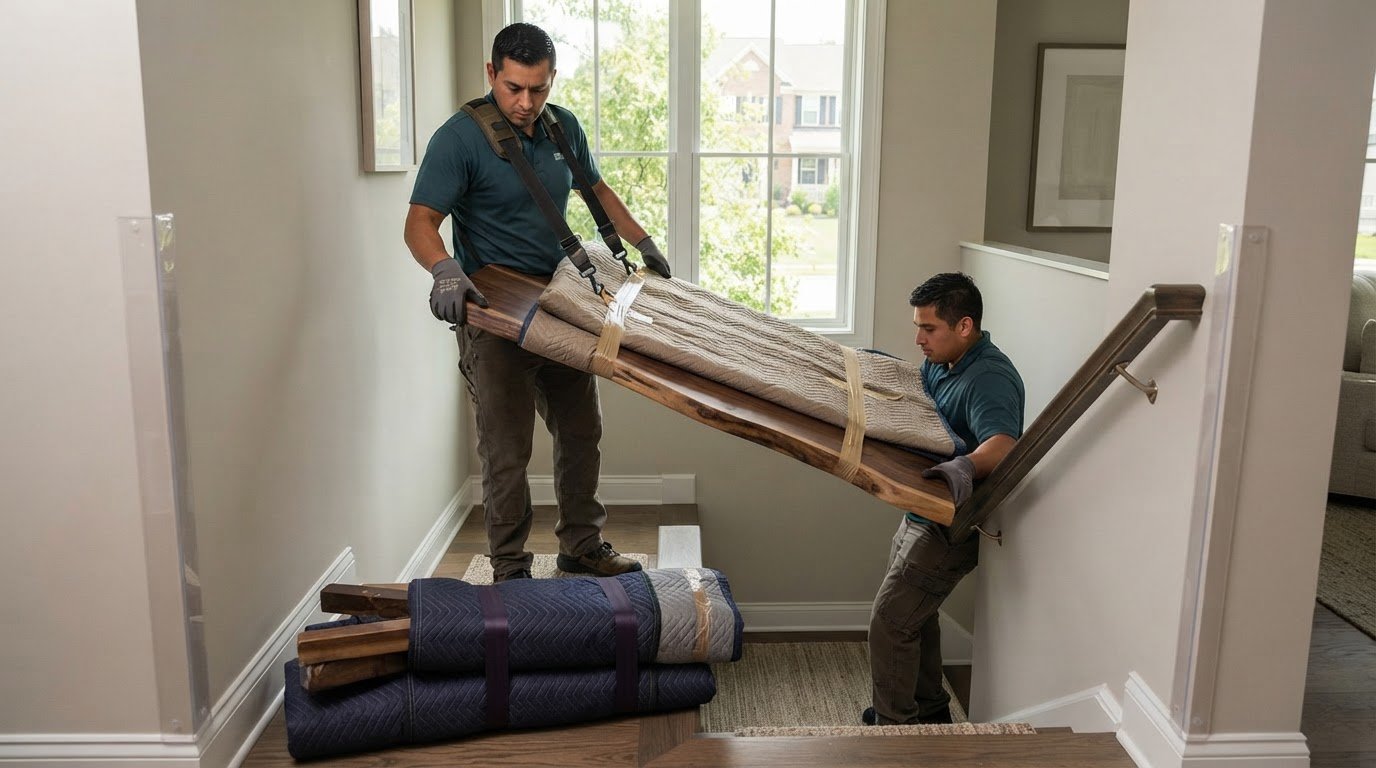
Have one carrier support the higher end and another the lower end, keeping the tabletop balanced between them. This high-low position helps manage the slope. Before each step, check the lower end’s clearance and the upper carrier’s footing. Don’t force a turn if the tabletop catches on a wall or railing.
-
Coordinate Stair-Carry Communication
Choose one person to call each movement, using commands such as “lift,” “step,” “hold,” and “lower.” Agree on them before reaching the first stair. The caller should be able to hear both carriers and see the next landing or turn. If anyone loses grip, footing, or sight of the route, stop together and restart only when everyone is ready.
-
Clear the Route Before Lifting
Remove chairs, rugs, loose items, and other obstacles before carrying the table. Check the entire route from the room to the upstairs destination, including the space needed to turn at each landing. Keep pets and bystanders out of the stairwell. A clear path gives carriers room to adjust without stepping over clutter or backing into furniture.
-
Test the Turn Without Rushing
Before lifting, walk the table’s route and rehearse the tightest pivot with empty hands. Note where the leading edge must angle and where carriers can pause. A passage with only 1 to 2 inches of clearance leaves little room for a last-second correction. If the table cannot clear the turn as planned, stop and reconsider the carry before putting weight on the stairs.
-
Protect Contact Points
Protect exposed wall corners and stair rails along the route, and keep the table clear of those surfaces as you carry it. Watch the live edge as well as the tabletop corners: its irregular outline may catch where a straight edge would pass. Move slowly through narrow spots and pause at landings to reset your grip.
Recognizing when to hire professional movers
- Compare the table’s weight with what each person can control. NIOSH lifting guidance uses a 51-pound load constant as the maximum recommended lift under ideal conditions. A broad tabletop, stair angle, awkward grip, or obstructed view can make the real carry harder than that ideal.
- Take stone seriously. The Natural Stone Institute advises that one person should not manually lift stone items over 75 pounds. A live edge table may combine a heavy top with a shape that makes hand placement difficult. If the tabletop is stone, or you can’t confidently control its weight and balance, hire professional movers rather than testing your grip on the stairs.
- Consider professional help if the route includes stairs, a tight turn, a narrow landing, or little room to reset your grip. These conditions leave less space to correct a tilt or pause safely. A failed attempt to carry a dining table upstairs intact took two hours. Don’t lift if the route requires a maneuver your helpers can’t control safely.
- Look for practical experience moving bulky furniture through difficult indoor routes. Skilled movers can assess the table’s balance, identify safe pause points, and plan how each person will guide the load. They may start by disassembling large furniture rather than forcing it through a tight space. This helps prevent rushed decisions during the carry.
- Hire help if your group lacks enough capable carriers or a clear person to coordinate the move. A dining table needs steady control at both ends, especially when the top is wide or awkward to grip. Don’t count someone as a carrier if they can’t hold securely or follow instructions. If anyone’s footing or grip becomes uncertain, stop the move.
- Use a simple go-or-stop test before committing: can the carriers hold the table securely, see the route, and move without twisting or rushing? If any answer is no, professional assistance is the safer choice. OSHA safe-lifting guidance, as summarized by the National Safety Council, says loads over about 50 pounds should not be lifted manually. Treat that guidance as a reason to assess the load carefully, not as proof that a difficult stair carry is manageable.
Stairs, tight turns, or a narrow elevator are reasons to hire professional movers. The page cites well over 100,000 injuries each year linked to carrying items such as furniture on stairs, while DIY moving damage costs American households hundreds of millions of dollars annually.
Disassembling a table before moving it upstairs
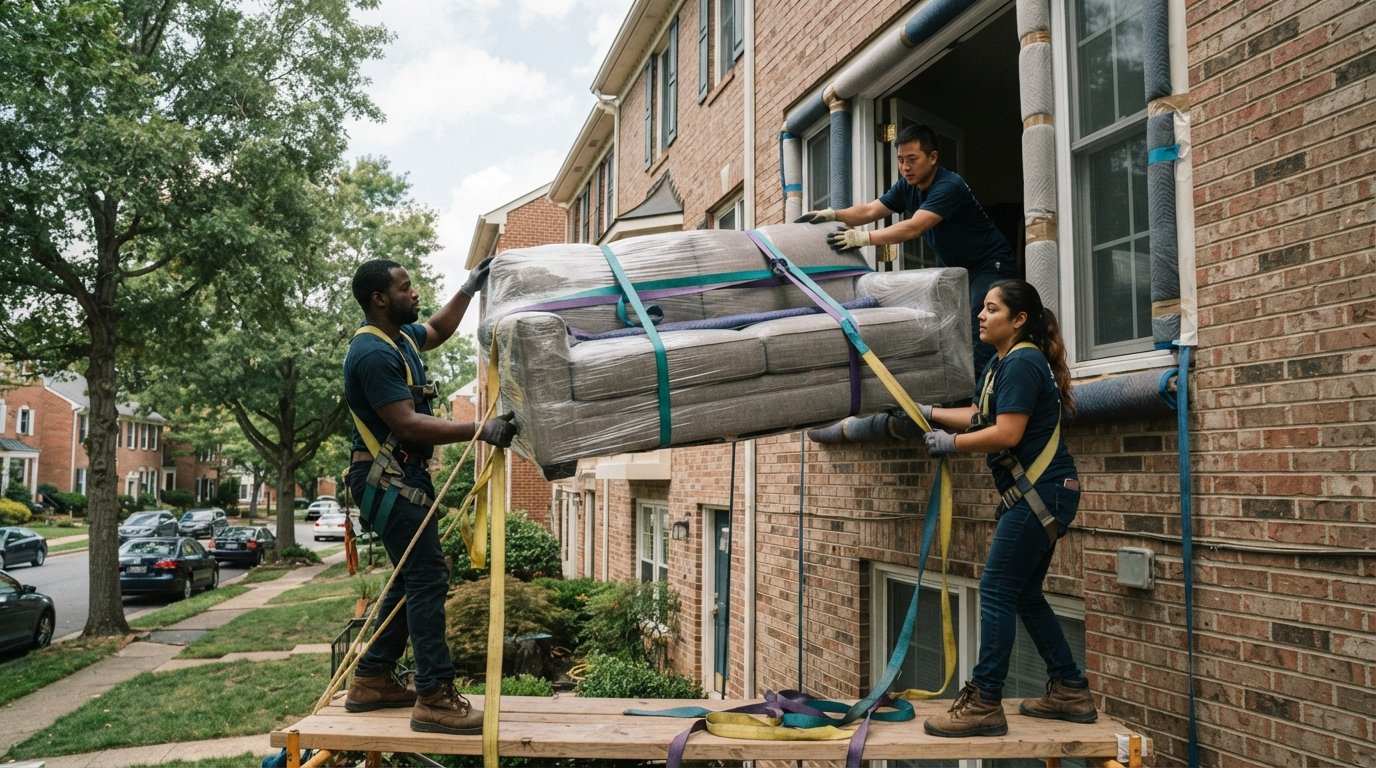
If the legs detach, carrying the tabletop and legs separately is usually the practical first option, followed by reassembly upstairs. Hoisting through a window or using a stair lift depends on suitable access and equipment, so neither is automatically safer or cheaper. The cost depends on the job. Heavy Furniture Moving offers labor-only help, and wrap, blankets, and straps are included on every job.
- Check how the table is assembled before loosening anything. Look underneath for fasteners connecting the legs to the tabletop, and use the correct tool. The documented table example had four detachable legs. If the joints look unfamiliar or damaged, stop rather than forcing a connection that could split or loosen.
- Photograph the underside and each leg connection before removal. Put each joint’s fasteners in a separate labeled bag and keep the bags with the table parts. The photos and labels help identify where each leg belongs during reassembly. Don’t mix the hardware with fasteners from other furniture.
- Remove the legs while the tabletop rests securely on a stable surface. Have someone steady the top as you loosen each connection, so it doesn’t tip as its support changes. Set the detached legs somewhere they won’t become a tripping hazard. Keep the tabletop supported rather than balancing it on an edge.
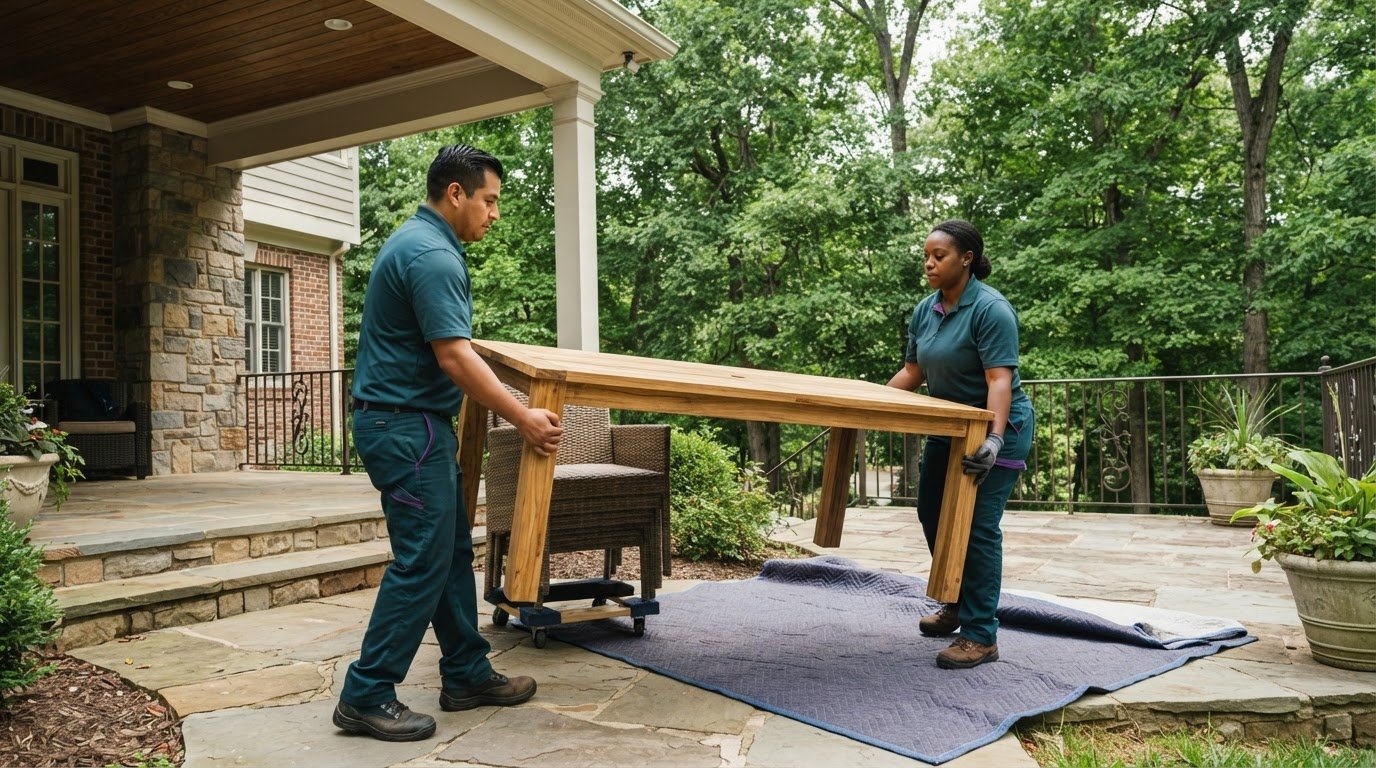
- Protect the finish and live edges before carrying any part. Place clean padding between the surface and its covering, and don’t stick adhesive directly to the finish. Pad irregular edges so they don’t strike door frames or railings. Keep grit, tools, and loose hardware away from the tabletop to avoid scratches.
- Carry stone slabs vertically on end, not flat, as this article’s handling guidance specifies. Keep the slab controlled and supported through each turn; don’t rest an edge against stairs or a wall. For a wooden top, use enough carriers to maintain a steady hold and protect the finished face throughout the route.
- Move the tabletop and legs as separate pieces, then reassemble them on a clear upstairs surface. The successful example followed that sequence, and moving its disassembled parts upstairs and reassembling them took 15 minutes. Treat that as one example, not a schedule for every table. Match each leg to its photo and labeled hardware before tightening connections.
The writer observed that movers he had hired began by disassembling large furniture rather than measuring it first. That is a reminder to inspect the construction before settling on a route or lifting plan, not a rule for every table. If a connection is unclear, measure and reassess rather than forcing a part loose or assuming it will come apart cleanly.
The goal isn’t to skip measuring, but to avoid letting measurements replace a direct check of how the table is built. Use what you can verify about its joints to choose the next step, and pause if you’re uncertain. A deliberate assessment helps prevent disassembly from becoming an experiment with the tabletop under strain.
Allowing extra time and resources
Plan the time and equipment before moving the table. A rushed start can leave helpers searching for tools while the table blocks a doorway.
-
Allow Extra Time
Set aside time for preparation, the carry, and reassembly, not just the trip upstairs. A couple expected their dining-table move to take 30 minutes, but a tight route or unexpected adjustment can extend the job. Greg McKeown recommends buffering schedules or other resources by 50 to 100% in Essentialism: The Disciplined Pursuit of Less. Use that buffer to avoid rushing.
- Break the job into stages: clear the path, prepare the table, move each piece, and reassemble it. Allow time for each stage. Don’t plan to carry the tabletop while someone is still clearing chairs from the landing. Pausing to reset your grip or adjust padding is part of the move, not a reason to hurry.
- Choose helpers who can stay focused through the carry. Assign each person a role before lifting, such as supporting one end, guiding the route, or keeping the destination clear. Keep the landing available for a controlled pause. If a helper needs to leave, wait until the team is together rather than improvising with fewer people.
- Prepare the upstairs destination before the table leaves its current room. Clear the floor, open the doorway, and decide where the tabletop will rest during reassembly. Keep the tools and labeled fasteners together nearby. This prevents carriers from holding a heavy piece while someone searches for a clear surface or misplaced hardware.
-
Gather Safety Equipment
Gather work gloves, moving blankets, padding, tape, and the tool needed to detach the legs. Use gloves for a secure grip and place clean blankets between the tabletop and other surfaces. Put tape on the blanket, not the table’s finish. Set everything near the starting point so nobody has to leave during preparation.
- Check every item before the carry. Make sure blankets cover the surfaces and live edges that may contact a doorway, and keep padding from slipping under hands. Place the leg fasteners and tool in a labeled container. Don’t use a cart or lifting aid unless it can safely handle the table’s shape and route; unstable gear adds another problem to manage.
- Keep a flashlight and a clear communication plan ready for the stairwell. Use the light to spot obstacles or low-clearance points, then remove them before lifting. Agree on simple commands such as “hold” and “lower,” and position the caller where carriers can hear. Begin only when the equipment, helpers, and destination are ready.
What equipment is needed to move a heavy dining table safely up stairs?
Gather protection, hand tools, and clear communication aids before lifting. Match each item to the table’s material and the route through your home.
- Cover the tabletop with clean moving blankets to protect its finish. Place padding between the surface and any wrap, and keep grit away from the wood. Secure the covering without sticking tape directly onto the finish. Pad exposed live edges that could catch on a doorway or stair rail.
- Wear work gloves that let each carrier grip securely. Check that they fit and don’t slip against the table or its protective covering. Gloves don’t replace a stable hold, so plan hand positions before lifting. If the table is too awkward to grip, change the carrying plan instead of relying on gloves alone.
- Set out the tool needed to remove the legs, along with a small labeled container for the fasteners. This keeps hardware from scattering across the floor. A photo of the underside can help you match legs during reassembly. Don’t start disassembly until you have a stable surface for supporting the tabletop.
- Protect exposed wall corners and stair rails with suitable padding. Clear rugs and loose objects instead of trying to cover every obstacle. Keep stairs and landings free of blankets, tools, and hardware while carrying. A dropped tool on a step can interrupt the move and create a hazard.
- Use a flashlight to inspect dim stair corners, the underside of a landing, and the destination. Check the route before lifting and remove anything that could interfere with safe footing. Use a phone flashlight only while stationary, not while carrying the table. The person guiding the route needs clear hands and attention.
- For a stone tabletop, choose equipment and handling methods suited to the material. Carry stone slabs vertically on end, not flat. Don’t rely on ordinary straps, a household cart, or improvised supports unless they suit the load and route. Poorly suited equipment can shift the slab or make it harder to control on stairs.
- Arrange equipment at the starting point and assign one person to manage tools and communication. Keep the destination clear for setting down the tabletop and reassembling the legs. If the table’s weight or stair route calls for experienced handling, get help with a heavy table move before starting the carry.
Heavy Furniture Moving: Movers Near Me
Heavy Furniture Moving provides local help with heavy and bulky furniture. Its Movers Near Me service can help when a live edge table’s weight, stair turns, or narrow landing make carrying it yourself difficult. Share the table’s shape and route details so the move can be planned for the job.
For an in-home move, Heavy Furniture Moving can help carry furniture through your home. The company also moves exercise equipment and provides sofa hoisting for large items that need a careful route through challenging spaces. Wrap, blankets, and straps are included on every job.
Contact Heavy Furniture Moving to discuss help with your table move.
Make the Next Move with Confidence
Before moving day, decide how much of the work you’ll handle yourself. A careful plan for moving a heavy live edge dining table upstairs in Aldie starts with an honest assessment of the table, route, and available help. If the carry seems beyond your team’s ability, arranging support early lets you focus on preparing the home and protecting the table instead of improvising on the stairs.
Heavy Furniture Moving can help with a challenging furniture move when you want capable hands for the heavy lifting. Share the table’s details and the stairway layout so the task is clear from the start. You don’t need to turn a difficult carry into a test of strength. Take the next step at your pace and contact Heavy Furniture Moving for help.
With a sound plan and the right support, you can make room for the table upstairs and enjoy its natural character in its new setting.
Frequently Asked Questions
Which movers in Aldie or Loudoun County specialize in heavy furniture and stair carries?
Heavy Furniture Moving provides local help with heavy, bulky household items in Aldie. Its Movers Near Me service can help move a heavy live edge dining table upstairs in Aldie when the route calls for careful indoor handling. Describe whether the tabletop detaches, whether it’s wood or stone, and where the staircase changes direction. These details help clarify the work involved.
How can you measure a table and staircase to check whether the table will fit upstairs?
Measure the table’s length, width, thickness, and height, including its dimensions with removable legs detached. Measure the narrowest clear width at each doorway and stair section, plus the landing depth and ceiling clearance above every turn. Sketch the route and mark railings or wall projections that reduce clearance. Compare tilted table positions with each tight point, not just the straight stair section.
How many movers are recommended for carrying a heavy live-edge table upstairs?
For moving a heavy live edge dining table upstairs in Aldie, the right crew size depends on the table’s weight, dimensions, material, grip points, and stair layout. A detachable top changes the lift compared with carrying the assembled table, while stone needs controlled handling. Assign everyone a clear role and make sure each person can maintain a stable hold and follow the carry plan.
Frequently Asked Questions
Heavy Furniture Moving provides local help with heavy, bulky household items in Aldie. Its Movers Near Me service can help move a heavy live edge dining table upstairs in Aldie when the route calls for careful indoor handling. Describe whether the tabletop detaches, whether it’s wood or stone, and where the staircase changes direction. These details help clarify the work involved.
Measure the table’s length, width, thickness, and height, including its dimensions with removable legs detached. Measure the narrowest clear width at each doorway and stair section, plus the landing depth and ceiling clearance above every turn. Sketch the route and mark railings or wall projections that reduce clearance. Compare tilted table positions with each tight point, not just the straight stair section.
For moving a heavy live edge dining table upstairs in Aldie, the right crew size depends on the table’s weight, dimensions, material, grip points, and stair layout. A detachable top changes the lift compared with carrying the assembled table, while stone needs controlled handling. Assign everyone a clear role and make sure each person can maintain a stable hold and follow the carry plan.