How to Safely Move a Heavy Oak Dresser Down Curved Stairs
The dresser isn’t the only thing at risk on a curved staircase. If you’re figuring out how to safely move a heavy solid oak dresser down curved stairs in Fairfax, never make the descent alone; professional movers are recommended for a solid-wood dresser weighing more than 150 pounds. Protecting the wood and controlling each turn matter just as much as getting the dresser downstairs.
With curved stairs, the main challenge is often not just the dresser’s weight. Tight turns, stair rails, and exposed corners can scrape the oak or damage your home. A careful plan helps reduce those risks and shows when the move is too difficult to handle yourself.
Learn how to clear and measure the route, empty and protect the dresser, and choose equipment suited to the stairs. You’ll also see when curved steps, a heavy load, or a tight landing make professional help the safer choice.
Key Takeaways
- Measure the dresser and every tight turn before lifting, then clear the full route of obstacles.
- Empty the drawers and protect the oak finish and exposed corners before moving the dresser.
- Choose moving equipment that keeps the load stable and controlled on curved stairs.
- Know when the stairway’s turns, landings, or load make professional moving help the safer choice.
Furniture sliders, moving straps, and protective equipment
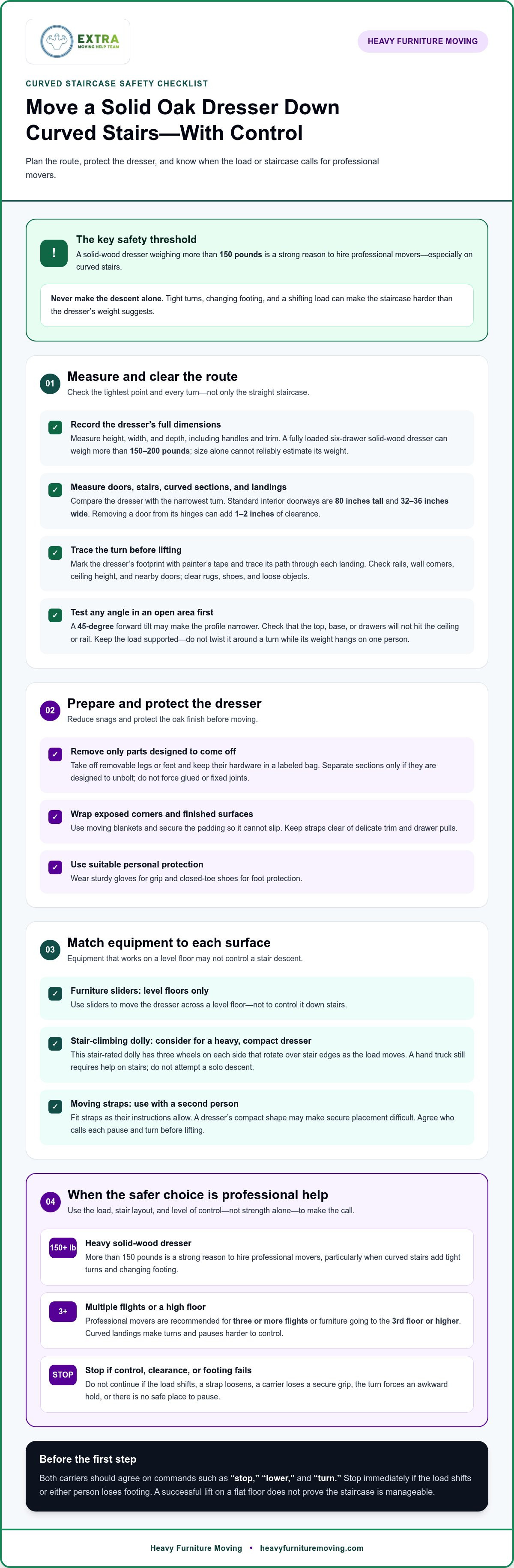
A solid oak dresser’s weight depends on its dimensions, wood thickness, drawer count, and construction, so size alone cannot give a reliable estimate. A fully loaded six-drawer solid-wood dresser can weigh more than 150-200 pounds.
- Measure the dresser and every narrow point. Record its height, width, and depth, including handles and trim. Measure the doorway, stair width, curved sections, and landings. Standard interior doorways are 80 inches tall and 32 to 36 inches wide. Compare the dresser’s measurements with the tightest turn, not just the straight staircase. Removing a door from its hinges can add 1-2 inches of clearance.
- Test the route before lifting. Mark the dresser’s footprint on the floor with painter’s tape, then trace the turn through each landing. Check handrails, wall corners, ceiling height, and nearby doors. Clear rugs, shoes, and loose objects from the path. A dresser that clears a straight doorway may still bind where a curved stair narrows or turns.
- Try a controlled angle only after measuring. Tilting furniture forward at a 45-degree angle can make its profile narrower when it will not fit upright. Before carrying, test the angle in an open area and check whether the dresser’s top, base, or drawers would strike the ceiling or rail. Keep the load supported; don’t twist the dresser around a turn while its weight hangs on one person.
- Remove parts that block the turn. Take off removable legs or feet and secure the hardware in a labeled bag. If the dresser has sections designed to separate, unbolt them according to their construction. Don’t force apart glued or fixed joints. Removing a protruding part may create the clearance needed for a landing, while preserving the dresser’s structure.
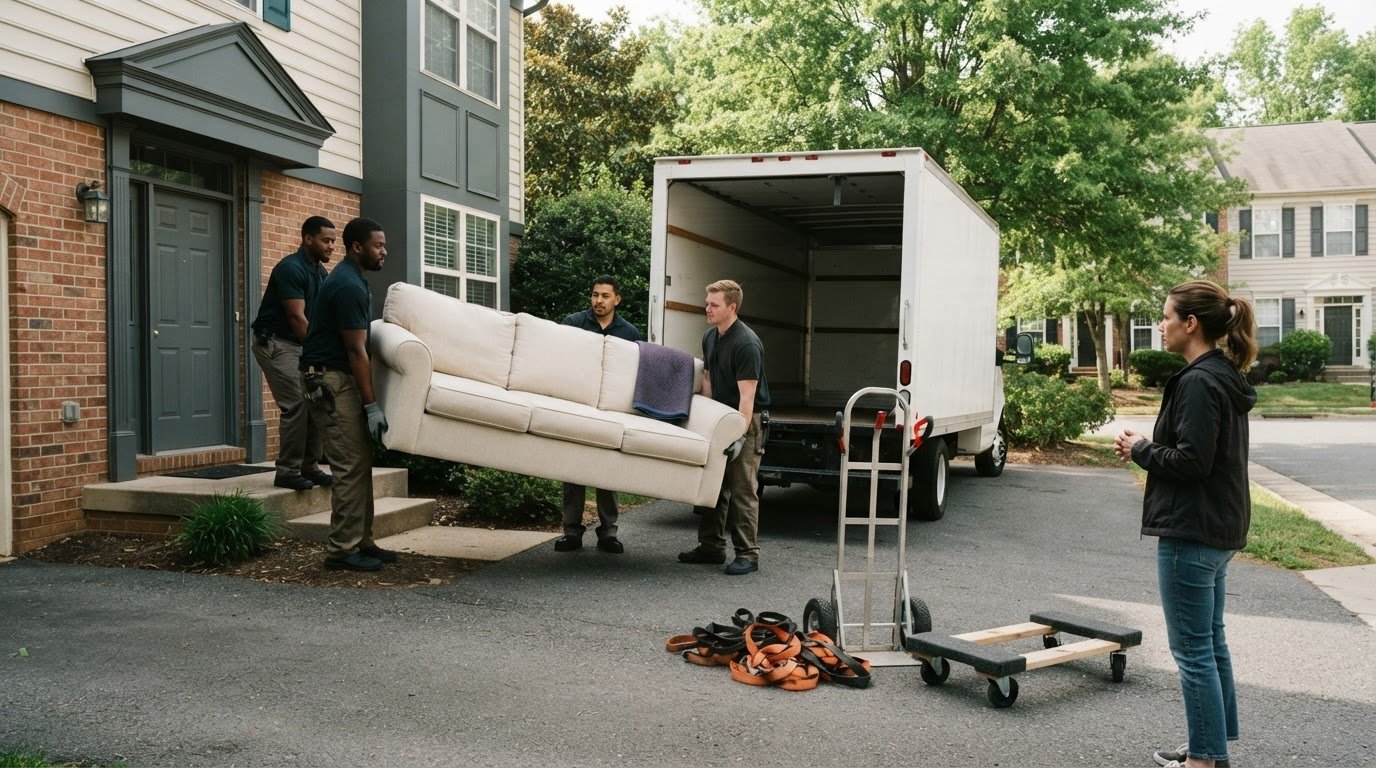
- Choose protection that suits the surface. Use furniture sliders to move the dresser across a level floor, not to control a stair descent. Wrap exposed corners and finished surfaces with moving blankets, then secure the padding so it cannot slip. Wear sturdy gloves and closed-toe shoes for grip and foot protection. Keep straps clear of delicate trim and drawer pulls.
- Set moving straps for two-person carrying. Furniture moving straps are used for two-person lifts of long items such as couches. With a dresser, position the straps as their instructions allow and keep both carriers coordinated. Agree on who calls each pause and turn before lifting. Stop if the load shifts, a strap loosens, or either person loses a secure grip.
When to hire professional movers
- Compare the dresser’s weight with the stair challenge. A solid-wood dresser exceeding 150 pounds is a strong reason to hire professional movers. Curved stairs add tight turns and changing footing, so carrying the load demands more than raw strength. A heavy dresser can shift suddenly if one carrier loses balance. Don’t treat a successful lift on a flat floor as proof that the staircase is manageable.
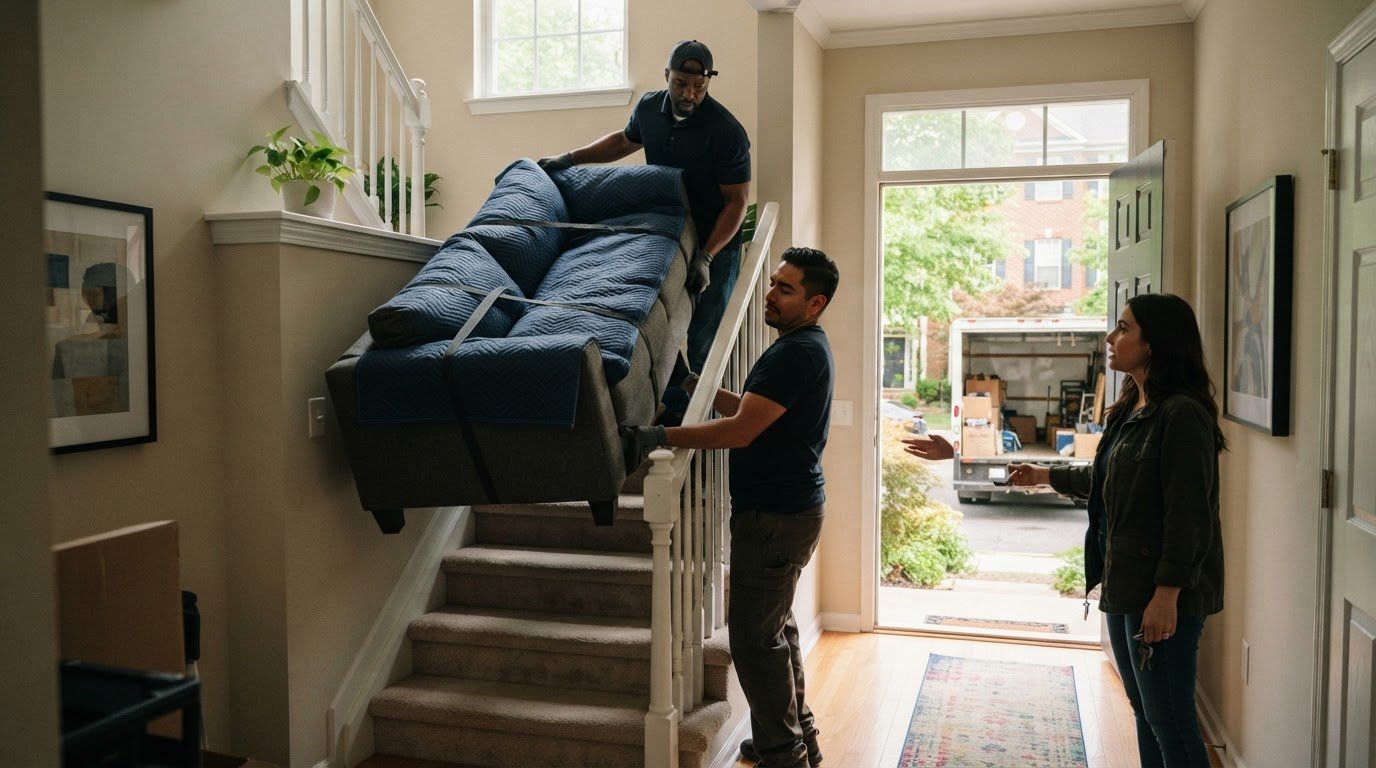
- Never move a heavy dresser downstairs alone. A second person can help steady the load and watch the route, but only if both people can grip and move it safely. Agree on commands such as “stop,” “lower,” and “turn” before lifting. The taller person should be below and the shorter person above when two people carry furniture downstairs by hand.
- Choose professional help for multiple flights. Professional movers are recommended for a dresser move involving three or more flights of stairs, and for furniture going to the 3rd floor or higher. Each flight adds another stretch of carrying and another place to pause or change direction. A curved landing makes those transitions harder because the load must turn while remaining controlled.
- Get help if you plan to use a hand truck. A hand truck is a two-wheeled upright dolly that tilts backward. Moving furniture downstairs with one still requires help, especially when a curved stair limits maneuvering room. If the dresser starts to tip, a helper may not be able to stop it safely. Don’t attempt a solo descent with a hand truck.
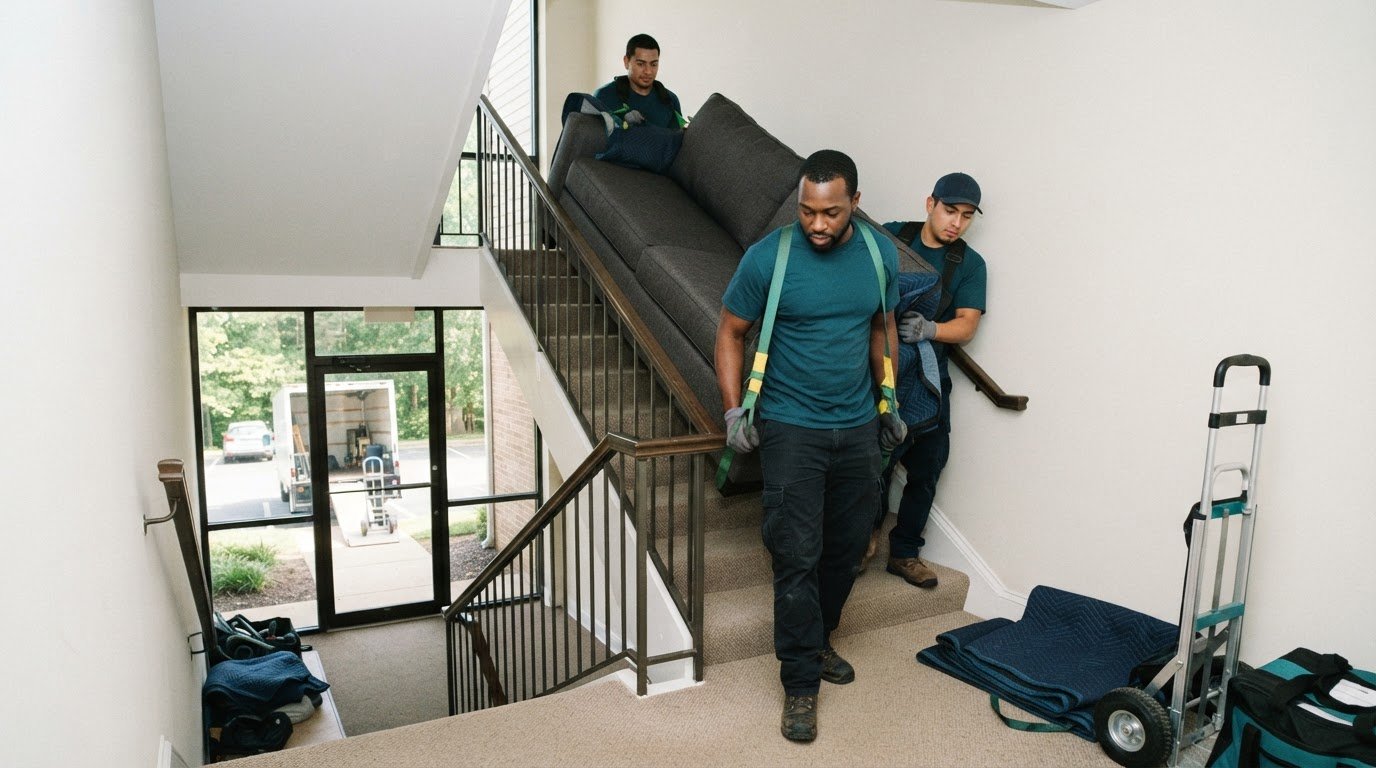
- Account for the person at the bottom. During a downstairs carry, the lower person often bears a different share of the load than the upper person. A 200-pound sofa can feel like a 240-260-pound load to the person at the bottom in the staircase example. The exact handling differs for a dresser, but the example shows why uneven weight and poor coordination matter.
- Stop if control, clearance, or footing fails. Hire movers if carriers can’t keep the dresser stable, if the turn forces an awkward grip, or if the stairs leave no safe place to pause. A damaged oak edge is costly to repair, and a dropped dresser can also strike walls, rails, or steps. For support with a difficult descent, local moving help can take the lifting challenge off your hands.
Using moving blankets, sliders, dollies, and straps
Choose equipment that can control the dresser on each surface and through every turn. Use floor sliders only on level floors, and switch to stair-rated equipment before starting down the steps.
-
Use Blankets, Sliders, and Dollies
Cover the dresser with moving blankets and secure the padding so it cannot slip over corners or handles. Use furniture sliders only to move it across level floors, not to control a stair descent. For a heavy, compact item such as a solid oak dresser, a stair-climbing dolly may help. Its three wheels on each side rotate over stair edges as the load moves.
-
Use Shoulder-Dolly Moving Straps
Fit shoulder-dolly straps according to their instructions and use them with a second person. Moving straps can help with two-person lifts, but a dresser’s compact shape may make secure placement difficult. Keep straps clear of drawer pulls and delicate trim. Pause if the load shifts, either person loses footing, or the straps no longer support the dresser evenly.
- Pick a dolly that suits the dresser. Hand trucks with stair sliders suit tall, sturdy furniture. A hand truck is a two-wheeled upright dolly that tilts backward. Secure the dresser to the truck before moving, and take the stairs one step at a time. Keep the load controlled with a helper. Avoid stair rollers: a third helper must continually reposition them, making the load difficult to control.
- Choose help based on the route, not just the floor. A dresser weighing about 100 pounds or less may suit one person on a same-floor, flat surface. A dresser weighing up to about 200 pounds may suit two people on a flat floor. Neither example makes a curved-stair descent a solo job. Stairs change the balance and leave less room to recover if the dresser shifts.
- Keep drawers from sliding during movement. Remove drawers if doing so makes the dresser easier to control, and carry them separately. If drawers remain inside, secure them so they can’t open as the dresser tilts. Check the fastenings again before each stair flight. A drawer sliding outward can change the load’s balance or catch against a wall.
- Understand the cost factors for one dresser. The price depends on the case and is given after a quote request; the route, stair access, dresser weight, and equipment needs affect the job. A single-item move still involves handling the furniture and controlling it through the home. Consider those details when deciding whether DIY equipment is suitable for the move.
Planning and clearing the route before lifting
- Map the full route before moving any pieces. Start at the dresser’s room and trace the path to its destination. Include each doorway, stair turn, landing, and hallway. Mark where carriers must rotate, change grip, or pause. Planning how to safely move a heavy solid oak dresser down curved stairs in Fairfax starts with the complete route, not just the staircase. A curved section can create a tight turn even when the straight stairs look wide enough.
- Measure the narrowest points. Record the dresser’s height, width, and depth, including handles and trim. Compare those measurements with the tightest doorway, stair section, and landing. Standard interior doorways are 80 inches tall and 32 to 36 inches wide. Check the dresser’s clearance in the position you’ll carry it, since a measurement at the entrance won’t show whether it can turn at the landing.
- Check clearance using the dresser’s actual shape. Include projecting handles, trim, and any parts extending beyond the frame. A stairway example shows a dresser with 26 inches of negative clearance in a 34-inch-wide stairway, meaning it cannot fit in that position. Use measurements to consider a different orientation or remove protruding parts. Don’t start carrying if the route depends on forcing the dresser past a wall or rail.
- Inspect every landing and overhead obstacle. Measure ceiling height above each landing and identify the space needed to turn. An armoire example has only 3 inches of clearance below a 75-inch landing ceiling, making the turn a tight squeeze. Check light fixtures, railings, and wall corners as well. A clear stair tread doesn’t guarantee enough space to rotate a tall dresser safely.
- Clear loose hazards along the route. Remove rugs, shoes, small tables, and anything else that could shift underfoot. Open doors fully and secure them so they won’t swing into the carrying path. Keep each landing free of boxes and furniture, and make sure carriers can see every stair edge. A clear route also gives the team room to pause without stepping around obstacles.
- Gain doorway clearance where it helps. Removing a door from its hinges can add 1 to 2 inches of clearance. Take it off before lifting and move it away from the stair entrance. That extra space may solve a doorway pinch, but it won’t fix a narrow curved stair or low ceiling. For how to safely move a heavy solid oak dresser down curved stairs in Fairfax, assess each restriction separately.
- Walk through the plan with every carrier. Point out the tight turn, landing, and intended pause points. Agree on simple commands such as “stop” and “lower” before lifting. Make sure everyone knows which way the dresser will face at each turn. If it can’t pass without blocking footing, scraping a surface, or forcing an awkward twist, revise the plan before starting.
Protecting a dresser during transport
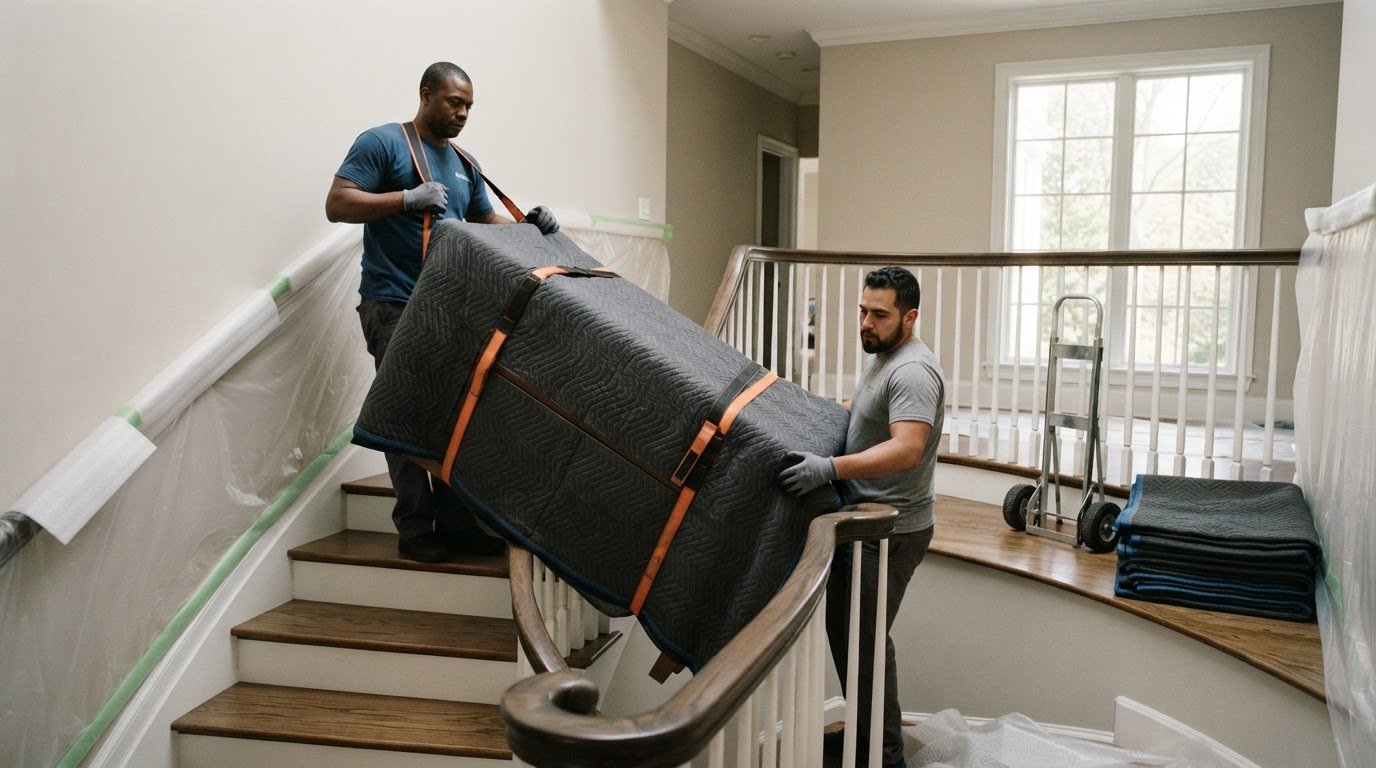
Cover the oak dresser with moving blankets, pad exposed corners, and protect the curved stair rails, walls, and floors before carrying. Keep floor coverings flat and secure to prevent tripping.
- Prepare the wood before wrapping. Remove dust and loose debris with a soft, dry cloth so grit won’t rub against the finish. Check the dresser for damp spots before covering it. Place a clean moving blanket over each finished surface, then overlap the edges. Don’t let buckles, hooks, or strap hardware touch the oak directly.
- Pad corners and carved details. Fold extra blanket material around sharp dresser corners, raised trim, and projecting handles. Secure the padding around the blanket, not with tape stuck to the finish. For example, cover a protruding drawer pull before turning past a stair rail. Check that the padding stays in place as carriers adjust their grip.
- Protect the curved rails and walls. Place padded covers over the rail and the wall section nearest each turn. Secure coverings so they won’t slide during carrying, but avoid adhesive on painted walls or finished wood. A dresser can swing outward when carriers navigate a curve, so pad the outside wall and rail where contact is most likely.
- Cover floors without creating a new hazard. Lay protective runners across the approach and destination floors, then flatten and secure every edge. Avoid loose carpet, curled mats, or plastic that shifts underfoot. Keep the stair treads clear unless a protective covering sits firmly and allows stable footing. A sliding runner can put both the dresser and carriers off balance.
- Keep the load straight where the staircase allows. Hold the dresser steadily and move slowly through each turn. Don’t drag a wrapped dresser over stair edges or force it against a wall to make the corner. Pause at a landing if the padding shifts, then adjust it before continuing. Keep hands clear of pinch points between the dresser, rail, and wall.
- Inspect the protection between flights. At each landing, look for a blanket that has slipped, an exposed corner, or a strap pressing into the finish. Reposition the covering before moving again. Once the dresser reaches a flat floor, lift it clear of runners before removing the blankets. This prevents grit trapped underneath from scratching the oak.
- Get help for a difficult curved descent. If the dresser can’t pass without scraping the rail or losing a straight, controlled position, don’t force the turn. Get help moving heavy furniture when careful handling and home protection are central concerns.
Heavy Furniture Moving: Movers Near Me
Heavy Furniture Moving handles bulky furniture moves when curved stairs make a dresser difficult to control. Its Movers Near Me service can help when the load, tight turns, or risk to your home makes a do-it-yourself descent impractical. In-home furniture movers can manage the lifting and maneuvering needed to move a heavy piece through your home.
Heavy Furniture Moving also offers Exercise Equipment Moving and Sofa Hoisting for other large items that need careful handling. When describing your dresser move, share its size, the stair layout, and any landing constraints. These details help the team understand the item and the route.
For help moving a heavy dresser, contact Heavy Furniture Moving.
Choose Your Next Move With Confidence
A difficult staircase can make a furniture move about more than the dresser itself. If you’re deciding how to safely move a heavy solid oak dresser down curved stairs in Fairfax, consider whether you can control the descent without risking the wood, your home, or the people carrying it. Decide before moving day, rather than letting time pressure push you into an unsafe lift.
If the staircase feels beyond your crew’s ability, get help instead of forcing the move. Heavy Furniture Moving handles challenging furniture moves, so you can focus on preparing for the dresser’s new place in your home.
Contact Heavy Furniture Moving to discuss your move. Take the next step with a plan that respects the dresser and the people handling it.
Frequently Asked Questions
How to measure a dresser and curved staircase before moving it?
Measure the dresser’s height, width, and depth, including handles. Then note the narrowest point on the stairs and the turning space on each landing. Compare those measurements with the dresser held in the position you plan to carry it. Check whether its widest edge can clear the inside curve without catching the rail. Also note low ceilings and door openings, since clearance can change at every turn.
How to move a heavy dresser safely down curved stairs step by step?
Empty and secure the dresser, protect its finish, and make sure everyone carrying it understands the route before lifting. Move at a controlled pace, pausing at landings to reset grips and check the load. Coordinate each turn instead of twisting suddenly. Stop if the dresser shifts, anyone loses stable footing, or the next turn requires forcing the piece through.
What equipment is needed to move a heavy dresser down stairs?
Use moving blankets to cushion the finish, secure padding around corners, and choose a stair-capable dolly suited to the dresser. A stair-climbing dolly has three wheels on each side that rotate over stair edges. Straps may help with a coordinated two-person lift, but position them securely. Floor sliders are for level surfaces, not for guiding furniture down stairs.
How many people are needed to move a heavy dresser down curved stairs?
Never carry a heavy dresser downstairs alone. The crew needed depends on the dresser’s weight and shape, the stair width, and the space each person has to grip and turn. Furniture moving straps are designed for two-person lifts, but a curved landing can require more controlled handling than a straightforward carry. If the carriers cannot keep the dresser balanced and communicate clearly, stop and get professional help.
Should dresser drawers and doors be removed before moving?
Remove drawers if doing so makes the dresser lighter and easier to control, then carry them separately. Secure any drawers left in place so they cannot slide open during a tilt or turn. Remove doors only if they are designed to come off and doing so improves clearance. Keep screws and hardware together in a labeled bag, and do not force fixed joints or fittings.
What are the risks of moving a heavy dresser down stairs without professional help?
On a turn, a dresser can shift, catch a rail, or slip from a carrier’s grip. This can damage the oak finish, stair walls, flooring, or handrail, and a sudden loss of balance can cause injury. A hand truck also requires assistance on stairs. Stop if the load blocks a carrier’s view or leaves no safe place to pause.
How much do Fairfax VA movers charge to move a heavy dresser down curved stairs?
The cost depends on the move. Important details include the dresser’s weight and dimensions, the number and shape of stair flights, landing clearance, and the equipment needed. When requesting a quote, describe the curved sections and any tight turns. Those route details matter even when moving just one dresser.
How to find insured furniture movers in Fairfax Virginia for difficult stair moves?
For a difficult Fairfax stair move, contact Heavy Furniture Moving about its Movers Near Me service. Describe the dresser, stair turns, and landing layout, and ask about the insurance documentation and coverage that apply. Heavy Furniture Moving also handles in-home furniture moves. Clear route details help the team understand the challenge in your home.
Frequently Asked Questions
Measure the dresser’s height, width, and depth, including handles. Then note the narrowest point on the stairs and the turning space on each landing. Compare those measurements with the dresser held in the position you plan to carry it. Check whether its widest edge can clear the inside curve without catching the rail. Also note low ceilings and door openings, since clearance can change at every turn.
Empty and secure the dresser, protect its finish, and make sure everyone carrying it understands the route before lifting. Move at a controlled pace, pausing at landings to reset grips and check the load. Coordinate each turn instead of twisting suddenly. Stop if the dresser shifts, anyone loses stable footing, or the next turn requires forcing the piece through.
Use moving blankets to cushion the finish, secure padding around corners, and choose a stair-capable dolly suited to the dresser. A stair-climbing dolly has three wheels on each side that rotate over stair edges. Straps may help with a coordinated two-person lift, but position them securely. Floor sliders are for level surfaces, not for guiding furniture down stairs.
Never carry a heavy dresser downstairs alone. The crew needed depends on the dresser’s weight and shape, the stair width, and the space each person has to grip and turn. Furniture moving straps are designed for two-person lifts, but a curved landing can require more controlled handling than a straightforward carry. If the carriers cannot keep the dresser balanced and communicate clearly, stop and get professional help.
Remove drawers if doing so makes the dresser lighter and easier to control, then carry them separately. Secure any drawers left in place so they cannot slide open during a tilt or turn. Remove doors only if they are designed to come off and doing so improves clearance. Keep screws and hardware together in a labeled bag, and do not force fixed joints or fittings.
On a turn, a dresser can shift, catch a rail, or slip from a carrier’s grip. This can damage the oak finish, stair walls, flooring, or handrail, and a sudden loss of balance can cause injury. A hand truck also requires assistance on stairs. Stop if the load blocks a carrier’s view or leaves no safe place to pause.
The cost depends on the move. Important details include the dresser’s weight and dimensions, the number and shape of stair flights, landing clearance, and the equipment needed. When requesting a quote, describe the curved sections and any tight turns. Those route details matter even when moving just one dresser.
For a difficult Fairfax stair move, contact Heavy Furniture Moving about its Movers Near Me service. Describe the dresser, stair turns, and landing layout, and ask about the insurance documentation and coverage that apply. Heavy Furniture Moving also handles in-home furniture moves. Clear route details help the team understand the challenge in your home.