How to Move a Commercial Treadmill Upstairs With Straps and a Dolly
A folding treadmill does not always need to be taken apart, but stairs make the decision more demanding. For moving a heavy commercial-grade treadmill upstairs with moving straps in Haymarket, the key factors are whether the deck folds and locks, the machine’s weight, and the dimensions of the stair route.
It is reasonable to wonder whether straps alone can handle the load. They can help stabilize a treadmill and distribute its weight, but a machine dolly and a clear plan for each turn and step matter too. A heavy or non-folding model may require partial disassembly or a larger professional crew.
This guide explains when a treadmill can stay assembled, which measurements and access details affect the move, and how professionals use straps and a machine dolly on stairs. You will also learn what information to share when arranging help, so the team can plan for the treadmill and route before moving day.
Key Takeaways
- Use the treadmill’s owner’s manual to guide folding or disassembly, and secure the safety key separately before the move.
- Map the full route, including doorway widths, stair turns, and ceiling clearance, so tight spots are identified before lifting begins.
- On stairs, coordinate each step: the person below controls the pace while the person above steadies the frame.
- Secure the treadmill to a machine-moving dolly before rolling, and keep the power cord tucked away so it can’t snag.
- For a difficult stair route or a heavy commercial machine, Exercise Equipment Moving can take the strain out of planning and handling.
Can You Move a Treadmill Without Taking It Apart?
In Haymarket, follow the applicable HOA or building rules for moving and access, along with the terms of the relevant insurance policy. These documents determine any notice, access, or protection steps for moving large equipment.
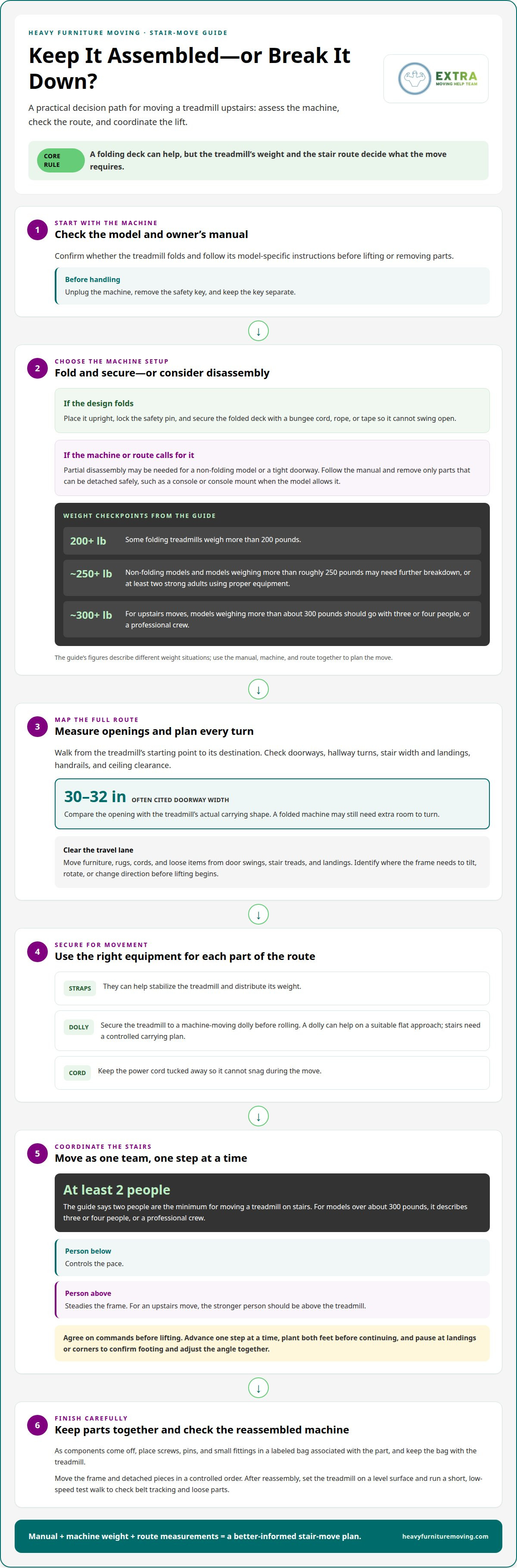
- Check the model and its manual. Before lifting, professional movers identify whether the treadmill folds and review its owner’s manual for model-specific moving instructions. They unplug the machine, remove the safety key, and keep it separate. The manual helps determine which parts can be folded, secured, or removed without stressing the frame or damaging connected components.
- Fold and lock the deck when the design allows it. Movers place a folding treadmill in its upright position and lock the safety pin before moving it away from its original spot. They secure the folded deck with a bungee cord, rope, or tape so it cannot swing open during handling. Folding may keep a machine intact for a straightforward route, but it doesn’t make a heavy treadmill suitable for solo lifting.
- Choose partial disassembly when the machine or route calls for it. Some folding treadmills weigh more than 200 pounds. Non-folding treadmills and models weighing more than roughly 250 pounds may need further breakdown, or at least two strong adults using proper equipment. Movers weigh the machine’s size, frame, and stair route together. A tight doorway can make partial disassembly the better option, even when the deck folds.
- Remove only parts needed for safe clearance. If the assembled treadmill won’t fit through a doorway, movers follow the manual to detach components that can be removed safely, such as a console or console mount when the model allows it. They protect exposed connections and keep the main frame controlled during each lift. Disassembly should create a manageable shape, not leave the machine unstable or strip parts that aren’t necessary to clear the route.
- Store hardware as each part comes off. Movers place screws, pins, and small fittings in a labeled bag associated with the removed component, then keep the bag with the treadmill. They move the frame and detached pieces in a controlled order, keeping the folded machine upright where its design permits. After reassembly, they place it on a level surface and run a short, low-speed test walk to check belt tracking and loose parts.
Clearing a path through doorways, hallways, and stairs
Have the route assessed before lifting begins. Movers need clear measurements and enough room to control the treadmill at every turn.
How Professional Movers Clear the Moving Path
- Walk the full route with the movers. Identify the treadmill’s starting point, destination, doorways, hallway turns, and stair landing. Interior doorways are often around 30 to 32 inches wide, so movers compare the opening with the treadmill’s actual carrying shape. The folded machine may still need more turning room than the doorway’s width alone suggests.
- Clear furniture and loose obstacles. Movers clear the travel lane, including furniture near door swings and items on stair treads or landings. They also look for rugs, cords, and objects that could shift or catch equipment during lifting. A clear landing gives the team room to pause and reposition without resting the treadmill against a wall or railing.
- Plan each tight turn before moving. Movers identify where the treadmill must tilt, rotate, or change direction. They account for handrails and low ceilings as well as the stair width. Tight corners, hallways, and stairwells can require professional maneuvering; forcing the frame through a narrow turn risks striking walls or losing control.
How Professional Movers Navigate Doorways and Stairways
- Set the carrying position before entering a doorway. Movers keep the treadmill folded and secured when its design allows, then align its narrowest profile with the opening. They move slowly through the frame, checking clearance at the console, deck, and corners. A furniture dolly can help on a suitable flat approach, but stairs require a controlled carrying plan.
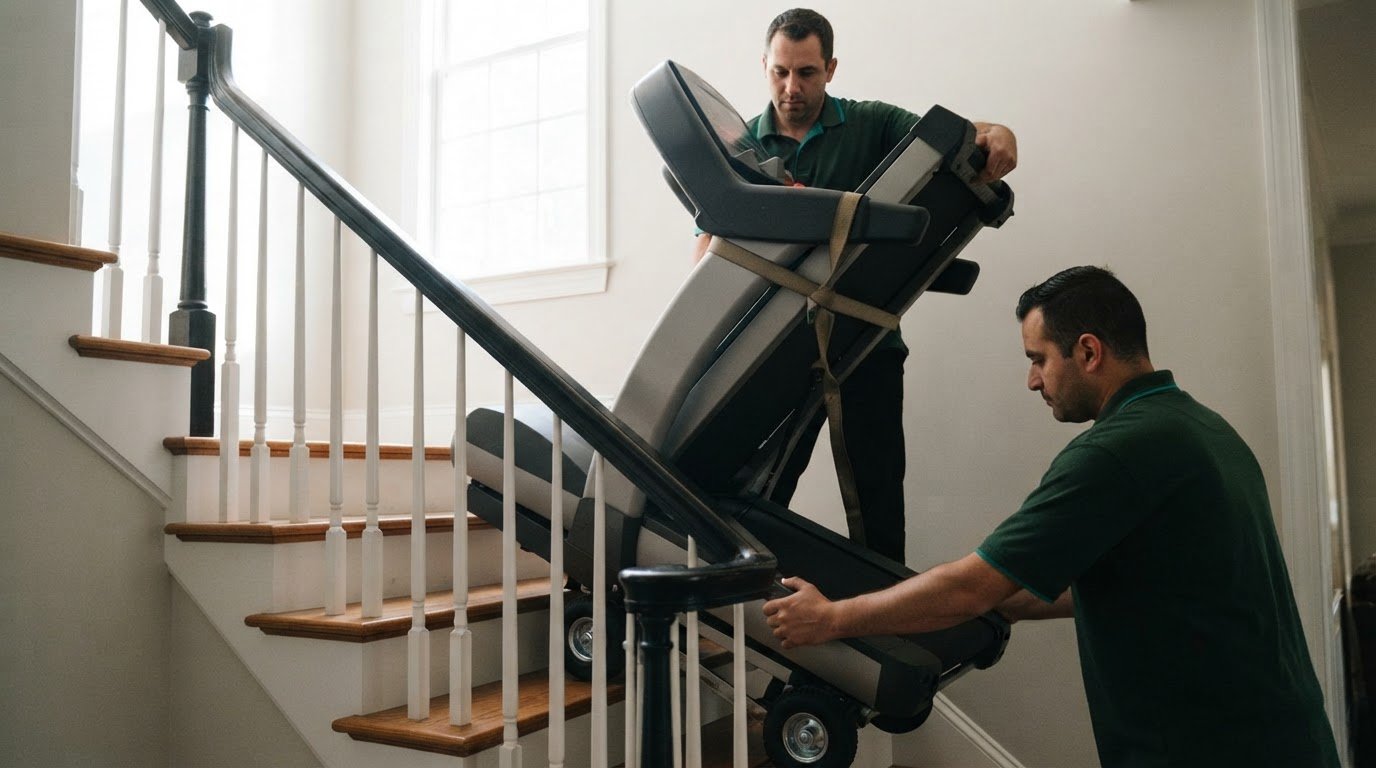
- Coordinate the stair team and pace. At least two people should move a treadmill on stairs, with one guiding from below and another stabilizing it from above. For an upstairs move, the stronger person should be above the treadmill. The team advances one step at a time, planting both feet before continuing and keeping the frame steady.
- Pause at landings and corners. Movers stop where the stair route changes direction, confirm each person has secure footing, and adjust the treadmill’s angle together. The person below controls the pace while the person above steadies the frame. For a difficult route, planned exercise equipment moving support can help manage the equipment through the home without rushing the turn.
Lifting and moving a treadmill upstairs
Manufacturers’ handling directions vary by model, so movers follow the treadmill’s manual and avoid lifting from points it does not approve.
-
How Movers Coordinate a Two-Person Lift
Assign positions at opposite ends and agree on commands before lifting. Movers coordinate the lift with a countdown and move only when both are ready. On stairs, the person below controls the pace while the person above steadies the frame. This keeps the treadmill moving as one load instead of letting either end drop or swing unexpectedly.
Two people are the minimum for moving treadmills upstairs, but that doesn’t make every two-person carry appropriate. Models weighing more than about 300 pounds should go upstairs with three or four people, or a professional crew. The team also considers the route, the frame’s balance, and each landing. If a person can’t maintain a firm hold, movers pause and reset instead of pushing through a difficult step.
-
Safe Lifting Techniques Used by Professional Movers
Set the grip and lifting positions before taking the treadmill’s weight. Movers bend their knees rather than their backs, keep the machine close, and lift together on a clear count. Moving straps can distribute weight across the torso and help stabilize a heavy treadmill. Fit and position them to keep the load controlled, not to lift beyond the team’s capacity.
Before the carry, movers unplug the treadmill and secure its power cord against the frame to prevent snags on the stairs. They consult the owner’s manual for handling guidance and protect vulnerable components. Moving blankets can shield the finish from scuffs during tight turns, but they should not interfere with a secure grip or strap placement. A controlled, coordinated lift matters more than speed.
-
Account for Moving Risks
Plan for both physical strain and potential damage to the home. A treadmill can shift, tip, or pull unevenly during lifting, increasing the risk of injury or a dropped load. Its frame or console can also strike a wall, doorway, railing, or stair edge. Movers check their footing and handholds before each step, then stop if the load tilts or anyone loses balance.
Clear the route to the home gym and protect exposed surfaces before the carry begins. Do not lift by the console, rails, or another component unless the manual identifies it as a suitable lifting point. On stairs, rushing, twisting under load, or changing direction without a shared signal can destabilize the machine. Movers pause at landings to reset their grip and agree on the next move.
Measuring treadmills and passageways before moving
Movers measure the treadmill and the entire route before transport. Comparing its position and dimensions with each passageway helps prevent last-minute changes.
How Movers Measure the Treadmill and Destination
- Record the treadmill’s dimensions in every moving position. Movers measure its height, width, and length while assembled, then repeat the measurements with the deck folded if the model folds. The folded shape may clear a doorway but still need extra room to turn at a landing. They also check the manual for folding instructions and identify parts that affect the machine’s profile.
- Compare the measurements with the destination. Movers measure the upstairs room’s entrance and the space where the treadmill will stand. They repeat the destination measurements to catch mistakes before lifting. A treadmill that fits through the doorway still needs room for its final position, access around the machine, and safe placement on a level surface.
- Include weight and removable parts in the plan. Some high-end treadmills weigh more than 300 pounds, so weight affects equipment choice and the moving plan. Movers note whether the manual allows parts to be removed to reduce the machine’s size. They keep the safety key separate and account for hardware and packing materials that travel with the treadmill.
How Movers Measure and Plan the Route
- Measure every passageway along the full route. Movers check doorway openings, hallway widths, stair widths, landing space, and ceiling height. Commercial gym passageways typically measure 3 feet wide, but a home route needs its own measurements. The team records tight turns and overhead limits, then compares each point with the treadmill’s folded or assembled dimensions.
- Map turns and changes in position. A straight measurement does not show whether movers can rotate the treadmill at a stair landing. They plan how the frame will approach each doorway, turn through each corner, and align with the stairs. For example, a narrow landing may call for a different approach angle or partial disassembly before transport begins.
- Match the equipment and sequence to the route. Movers use route measurements to determine where a machine dolly can travel and where the team must carry the treadmill. They plan where to pause, how to protect nearby surfaces, and how to pack and move detached pieces. If measurements show insufficient clearance, they revise the plan before lifting rather than forcing the machine through.
Moving treadmills with machine dollies and straps
For moving a heavy commercial-grade treadmill upstairs with moving straps in Haymarket, professionals pair a machine dolly with a coordinated crew. Most jobs are covered by two movers, while larger items may require three or four. The treadmill’s weight and the stair route guide the handling plan.
- Choose equipment for the treadmill, not just its wheels. Movers use a machine dolly rather than a standard platform dolly, which may not securely support the treadmill’s shape. Built-in transport wheels may roll poorly on thick carpet, so the dolly choice should account for the floor and route.
- Prepare the machine before loading. Movers unplug the treadmill, secure its power cord, and follow the manual when folding it. If the deck folds, they lock it upright before positioning the treadmill on the dolly. They protect the console and frame from contact while keeping blankets clear of the areas where straps need a firm hold.
- Center the treadmill on the dolly. Movers position the machine so its weight rests securely over the dolly’s support. They avoid lifting by the console or any part the manual does not identify as suitable. Before rolling, they check that the treadmill stays balanced and that no component can slide into the wheels or catch on a doorway.
- Strap the frame firmly before transport. Movers use tie-downs or moving straps to hold the treadmill against the dolly and limit shifting through the home. For team lifts over 200 pounds, moving or shoulder straps can distribute the load across movers’ torsos. Proper placement secures the frame without pressing on controls, exposed wiring, or fragile console parts.
- Switch to controlled stair handling. For moving a heavy commercial-grade treadmill upstairs with moving straps in Haymarket, movers secure the folded, locked deck to an appliance dolly and take the stairs one step at a time. At least one person stays below the load. The dolly helps control the machine, but it is not a reason to roll an unsecured treadmill over stair edges.
- Check stability after each change in surface. At a landing or floor transition, movers pause to inspect the straps, dolly position, and treadmill balance before continuing. Thick carpet, a narrow turn, or an uneven threshold can shift the load. They reset the equipment before moving again rather than pulling a tilted machine forward.
Get professional help moving exercise equipment when the treadmill, stairs, or dolly handling calls for a coordinated crew.
Heavy Furniture Moving
Heavy Furniture Moving helps with bulky equipment and difficult moves involving stairs, tight turns, or heavy treadmills. Its Exercise Equipment Moving and moving help support planning and handling, from assessing the route to positioning the machine. Share the treadmill’s model, whether it folds, and details about the stairs so the team can plan for the equipment and access.
Turn to professional help when the treadmill’s weight, shape, or route makes a controlled carry difficult. A clear plan matters, especially for commercial equipment that needs a dolly, straps, or careful maneuvering through the home. For help moving your treadmill, contact Heavy Furniture Moving.
Plan Your Treadmill Move With Confidence
For moving a heavy commercial-grade treadmill upstairs with moving straps in Haymarket, your next step is to turn the machine and route details into a clear moving plan. Gather the treadmill’s model information, note whether it folds, and describe the stairs, landings, and tight turns. Those details help the moving team understand the job before handling begins. If the route or machine feels beyond a manageable lift, choose experienced help rather than risking damage to the treadmill or home.
Heavy Furniture Moving offers Movers Near Me, Exercise Equipment Moving, and Sofa Hoisting. Its moving support helps with demanding equipment and bulky items that need careful handling through a home.
Contact Heavy Furniture Moving for help with planning your treadmill move. Share the equipment and access details, then take the next step with a clear plan and a capable team.
Frequently Asked Questions
How Heavy Is a Treadmill?
A treadmill’s exact weight depends on its frame, motor, deck, and added features. Check the model label or owner’s manual for the listed weight before planning transport. That figure helps determine the handling equipment and crew size, especially when the route includes stairs or a narrow landing.
What’s the easiest way to have a treadmill moved upstairs?
Have professional movers assess the treadmill and stair route, then choose the right handling plan. They can determine whether the machine should stay assembled, be partly disassembled, or be secured to a machine dolly. Share the model, its location, and details about tight turns or landings when arranging the move. These details help the crew prepare for the actual access challenges.
Can professional movers use a treadmill’s wheels during the move?
Yes, movers can use built-in transport wheels on suitable flat surfaces, but those wheels are not reliable on every floor. Thick carpet, thresholds, and tight turns can make rolling difficult or unstable. For example, a treadmill may roll across a smooth room but need a machine dolly to cross carpet. Wheels are not a substitute for a stair-carry plan, and movers choose how to handle each part of the route.
Do treadmills need time to settle after being moved?
A treadmill generally does not need a separate settling period after moving, but it should be used only after proper setup. Follow the owner’s manual for reassembly and placement. Check that the machine sits level and its parts are secure before use. If it was taken apart, a short, low-speed test can help identify belt-tracking problems or loose components before a full workout.
How Much Do Movers Cost on Average To Transport a Treadmill?
There is no dependable average price for every treadmill move, and a general figure could misrepresent the job. The cost depends on the treadmill’s size and weight, stairs, access, distance inside the home, and any disassembly or special handling. Heavy Furniture Moving provides an upfront quote before work begins. A single heavy item may have flat-rate pricing, while labor can be hourly with a two-hour minimum.
How much does it cost to move a commercial-grade treadmill upstairs in Haymarket, Virginia?
The price depends on the treadmill and stair route. Heavy Furniture Moving provides an upfront total before work begins, based on details such as the machine’s weight and dimensions, stair access, tight turns, and whether disassembly or special handling is needed. Share these details so the quote reflects the actual Haymarket move rather than a generic estimate.
Which Haymarket VA movers handle heavy commercial treadmills and stair carries?
Heavy Furniture Moving handles exercise equipment moves in Haymarket. Its team can help plan the treadmill’s route and move the equipment through residential spaces, including challenging access. When arranging the move, provide the treadmill’s model and details about the stairs or landings. This helps match the plan to the machine and home instead of treating a commercial treadmill like an ordinary household box.
Can moving straps safely be used to carry a commercial treadmill upstairs?
Moving straps can help support and stabilize a heavy treadmill, but they must be part of a coordinated carry. Position the straps to secure the frame without pressing on the console, controls, or parts that can shift. The team needs enough people to control the load and communicate through each step. Straps do not eliminate the need to assess the treadmill’s weight, stair layout, and safe lifting points.
Frequently Asked Questions
A treadmill’s exact weight depends on its frame, motor, deck, and added features. Check the model label or owner’s manual for the listed weight before planning transport. That figure helps determine the handling equipment and crew size, especially when the route includes stairs or a narrow landing.
Have professional movers assess the treadmill and stair route, then choose the right handling plan. They can determine whether the machine should stay assembled, be partly disassembled, or be secured to a machine dolly. Share the model, its location, and details about tight turns or landings when arranging the move. These details help the crew prepare for the actual access challenges.
Yes, movers can use built-in transport wheels on suitable flat surfaces, but those wheels are not reliable on every floor. Thick carpet, thresholds, and tight turns can make rolling difficult or unstable. For example, a treadmill may roll across a smooth room but need a machine dolly to cross carpet. Wheels are not a substitute for a stair-carry plan, and movers choose how to handle each part of the route.
A treadmill generally does not need a separate settling period after moving, but it should be used only after proper setup. Follow the owner’s manual for reassembly and placement. Check that the machine sits level and its parts are secure before use. If it was taken apart, a short, low-speed test can help identify belt-tracking problems or loose components before a full workout.
There is no dependable average price for every treadmill move, and a general figure could misrepresent the job. The cost depends on the treadmill’s size and weight, stairs, access, distance inside the home, and any disassembly or special handling. Heavy Furniture Moving provides an upfront quote before work begins. A single heavy item may have flat-rate pricing, while labor can be hourly with a two-hour minimum.
The price depends on the treadmill and stair route. Heavy Furniture Moving provides an upfront total before work begins, based on details such as the machine’s weight and dimensions, stair access, tight turns, and whether disassembly or special handling is needed. Share these details so the quote reflects the actual Haymarket move rather than a generic estimate.
Heavy Furniture Moving handles exercise equipment moves in Haymarket. Its team can help plan the treadmill’s route and move the equipment through residential spaces, including challenging access. When arranging the move, provide the treadmill’s model and details about the stairs or landings. This helps match the plan to the machine and home instead of treating a commercial treadmill like an ordinary household box.
Moving straps can help support and stabilize a heavy treadmill, but they must be part of a coordinated carry. Position the straps to secure the frame without pressing on the console, controls, or parts that can shift. The team needs enough people to control the load and communicate through each step. Straps do not eliminate the need to assess the treadmill’s weight, stair layout, and safe lifting points.