How to Move a 700 lb Gun Safe on Flagstone in Woodbridge and What It Costs
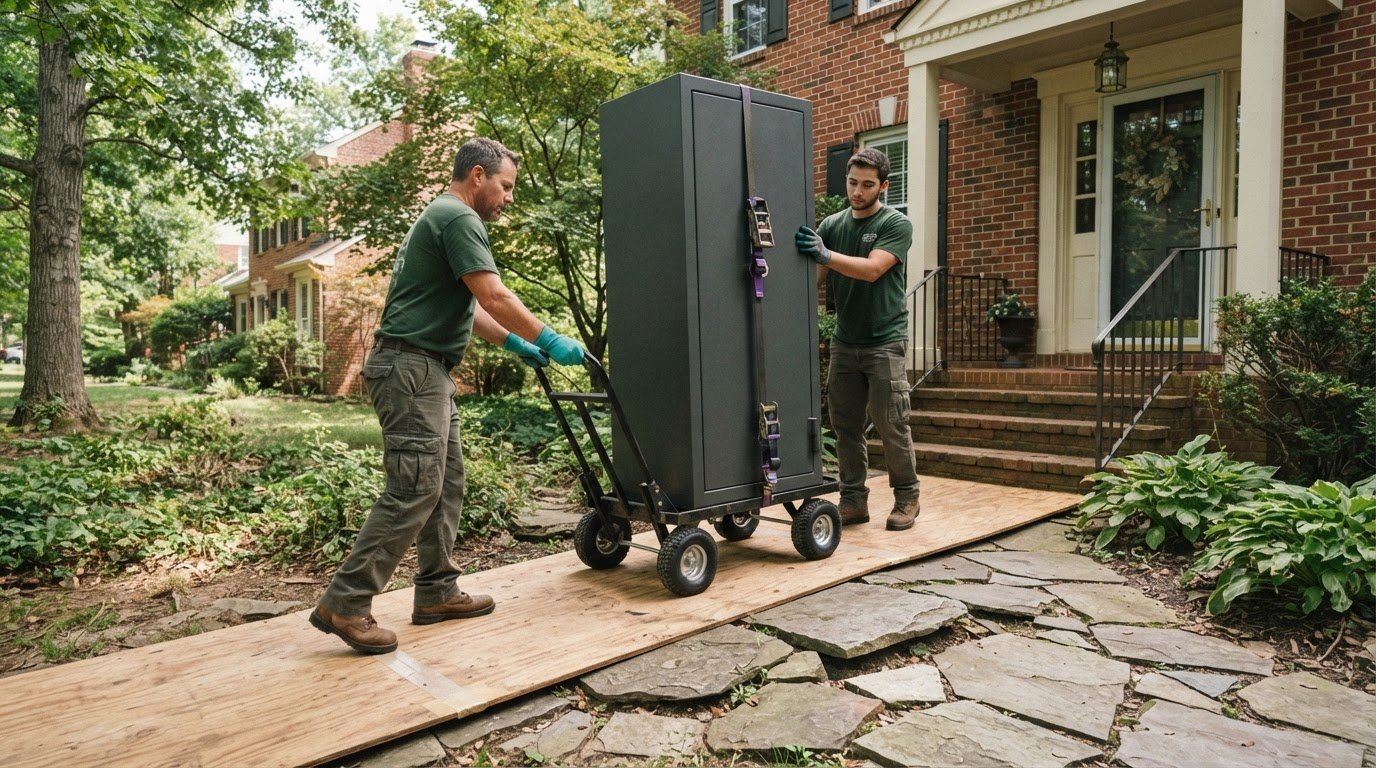
A 700 lb gun safe can put uneven pressure on flagstone, so the move needs controlled handling and a protected route. For anyone planning how to move a 700 lb gun safe across a flagstone walkway in Woodbridge, a professional crew typically uses a heavy-duty dolly rated for at least 1,000 pounds and plywood to spread the wheel load. The stones should be checked for rocking or loose pieces before the safe crosses them.
It makes sense to worry about cracked stone, a shifting load, or a narrow spot where the safe is hard to maneuver. This guide explains how professionals assess and protect the walkway, choose equipment, and decide whether controlled leverage can help at a difficult point. You’ll also learn what affects the cost of a professional move: travel distance, crew size, and the time the job takes. The goal is a clear plan for moving the safe without turning the walkway into another problem to solve.
Key Takeaways
- Prepare the safe for transport by clearing its contents and keeping it upright throughout the move.
- Learn how professional movers assess the route and adapt their handling plan to the condition of the flagstones.
- See when a controlled pivot and lever can help guide a heavy safe around a difficult spot.
- Understand which job details shape a professional moving quote, without relying on a one-size-fits-all estimate.
- Find out when Heavy Furniture Moving’s heavy-lifting help is a practical next step.
Heavy-duty dollies and moving equipment used by professional safe movers
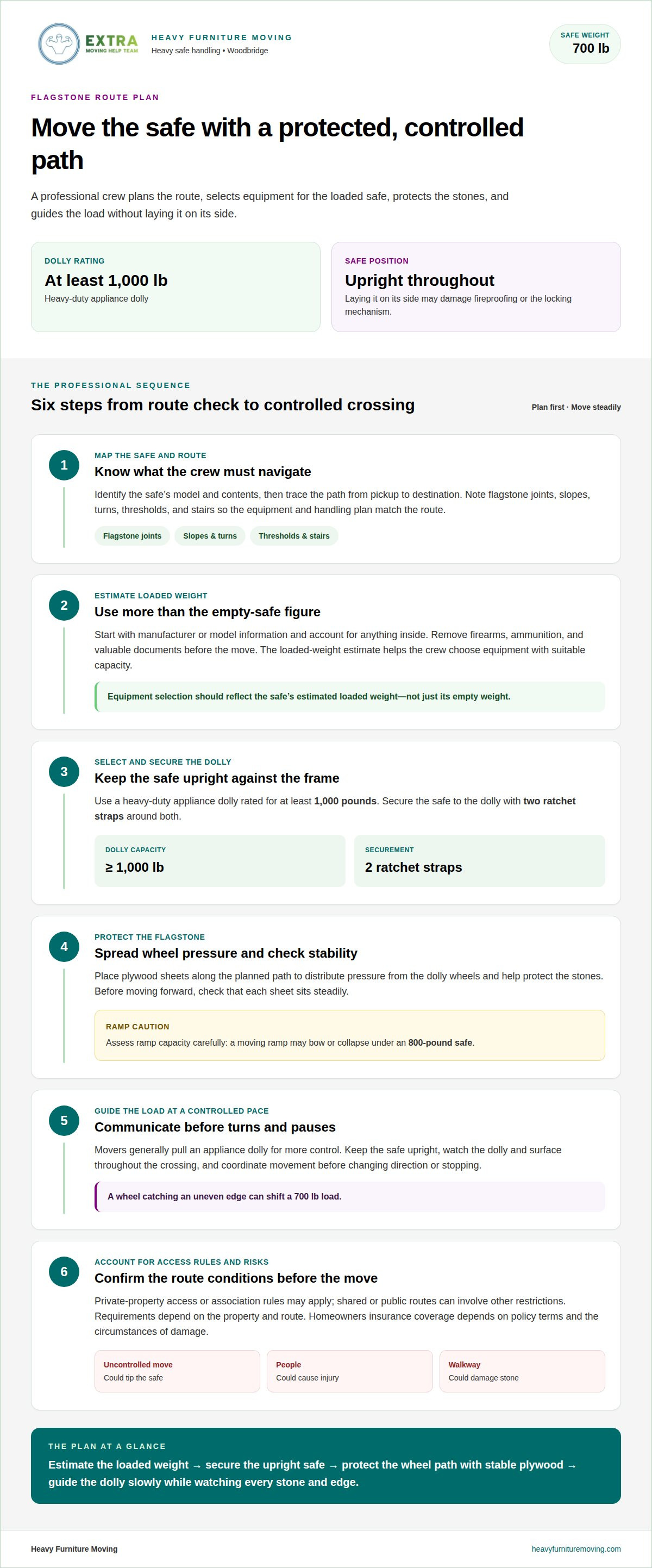
- Map the safe and route. Before choosing equipment, movers identify the safe’s model, its contents, and the path from pickup to destination. They note flagstone joints, slopes, turns, thresholds, and stairs. For anyone planning how to move a 700 lb gun safe across a flagstone walkway in Woodbridge, these details shape the equipment and handling plan.
- Estimate the loaded weight. Start with the safe’s manufacturer or model information, then account for anything inside. Remove firearms, ammunition, and valuable documents before the move. A reliable loaded-weight estimate helps the crew select equipment with suitable capacity, rather than relying on the safe’s empty weight alone.
- Select and secure a suitable dolly. A heavy-duty appliance dolly for a gun safe should be rated for at least 1,000 pounds. Movers keep the safe upright against the dolly frame and secure it with two ratchet straps around both.
- Protect the flagstone surface. Plywood sheets distribute pressure from dolly wheels and help protect the stones. Movers place them along the planned path and check that they sit steadily before advancing the load. A ramp also needs careful capacity assessment: a moving ramp may bow or collapse under an 800-pound safe.
- Guide the load at a controlled pace. Movers generally pull an appliance dolly for more control, communicating before turns and pauses. They keep the safe upright because laying it on its side may damage its fireproofing or locking mechanism. A 700 lb load can shift if a wheel catches an uneven edge, so the crew watches the dolly and surface throughout the crossing.
- Account for access rules and risks. For a private-property move, access or association rules may apply; routes using shared or public space can involve other restrictions. The specific rules depend on the property and route. Homeowners insurance coverage depends on policy terms and the circumstances of damage. Planning how to move a 700 lb gun safe across a flagstone walkway in Woodbridge also means recognizing that an uncontrolled move can tip the safe, injure someone, or damage stone.
Professional gun safe moving costs
- Request a quote based on the actual job. A 700 lb safe crossing a flagstone walkway can require different labor than one moving across a clear, level floor. The price depends on the case and is provided after a quote request. Movers weigh travel distance, the number of movers needed, and the time the route and handling require.
- Describe the full route before pricing. Include the pickup and delivery locations, flagstone sections, turns, slopes, doorways, and any stairs. A short distance can still involve extra handling if the path narrows or surfaces change. Clear route details help movers estimate labor and select suitable equipment instead of treating every safe move as the same job.
- Explain the stone and access conditions. Tell the crew whether the flagstones are loose, uneven, or part of a smooth, continuous path. The walkway’s material and condition affect how movers protect it and guide the load. A route with stable stones may allow a simpler rolling plan; loose or rocking pieces can call for slower handling and added protection.
- Ask how rollers fit the route. Movers may use rollers to guide a heavy safe across a suitable, prepared surface, but flagstone joints and uneven edges can interrupt smooth travel. The crew assesses whether rollers can stay aligned and controlled across the stones. If wheels or rollers could catch between slabs, movers can choose another method or protect the path with load-distributing material.
- Flag every stair section early. Moving a safe up or down stairs calls for careful control, specialized equipment, and a planned sequence. Stair count, shape, landings, and access affect crew size and time. Share photos or a clear description of each stair section with the route details. For a safe this heavy, professional movers are the practical choice over an improvised stair move.
- Compare the scope, not just the quote total. Check that the estimate reflects the same route, safe weight, stairs, protection needs, and handling time. A quote based on a ground-level path may not cover a staircase or a difficult flagstone approach. For a demanding lift, professional heavy-lifting help can make the move easier to plan.
When stairs are part of the route, arrange for professional help rather than attempting to move the gun safe yourself. Discuss the stair section with the movers before the job is scheduled, including whether the safe must go up or down. The page advises hiring professionals to move a gun safe up or down stairs. Treat that decision as part of the move plan, not as a detail to resolve after the safe is already in transit. A clear discussion lets you align the requested service with the actual route and handling involved.
Use that figure as general context when considering the expense, while requesting a quote for your specific move. In particular, make sure the estimate accounts for the stairs and the route you described, rather than assuming the job involves only a straightforward passage. Comparing estimates is most useful when they address the same work. Before choosing a mover, confirm that the quoted service includes professional handling of the stair section and the other route conditions you have disclosed.
How professional movers check flagstones for rocking and level
- Walk the route before loading. Inspect every flagstone from the pickup point to the destination, noting changes in height, gaps, and tight turns. Check the full wheel path, not just the middle of the walkway. A stone that appears level from one angle may still have an edge that catches a dolly wheel.
- Test for movement and rocking. Before the safe approaches, movers apply controlled pressure to suspect stones and watch for tilt or shifting. They pay close attention to small pieces, since flagstones under about 1 foot across tend to move. If a stone rocks, the crew adjusts the route or its protection plan rather than rolling the load across it.
- Check transitions for height changes. Look where flagstone meets a threshold, concrete, soil, or another surface. A raised edge can stop a wheel or jolt the safe, while a low spot can pull a dolly off line. Identify these points in advance and plan a controlled crossing that keeps the safe upright and balanced.
- Consider how the flagstones are set. Dry-set stones allow drainage and some flexibility, but individual pieces can shift and are generally easier to repair. Mortar-set flagstone is more permanent and less prone to shifting over time. The setting method helps determine where extra caution is needed, but each stone still needs a condition check.
- Protect the path where the load bears down. Plywood across the planned travel line can spread pressure from dolly wheels. Make sure sheets sit flat and do not rock. This can distribute the load, but it cannot stabilize a loose stone underneath, so assess both the plywood and the flagstone below it.
- Choose a steady route over a direct one. If uneven stone creates a tipping risk, redirect the safe around it or move in short, controlled stages. Keep the dolly aligned, pause at changes in level, and coordinate each turn before continuing. These steps help reduce the risk of cracked or shifted flagstones and a tipping safe.
How professional movers create a pivot point and use a lever
- Decide whether a lever is appropriate. A professional crew considers a lever when a 700 lb safe needs a small, controlled adjustment, such as aligning its base with a dolly or clearing an obstruction. A lever is not a substitute for equipment suited to the load. Movers assess the safe’s balance, the floor, and the flagstone route before choosing this method.
- Choose a stable point of support. A lever needs a secure fulcrum, or pivot point, that will not roll, crush a stone, or slide under pressure. Loose gravel or a small flagstone fragment is not a reliable support for a gun safe. Select a controlled setup for the load and surface, keeping the pivot away from vulnerable stone edges.
- Protect the contact areas. Before applying force, consider where the lever and safe will meet the surface. A protective pad or suitable load-spreading material can help prevent direct contact from damaging the floor or flagstone. The support must remain stable as pressure changes; a shifting pad can make the adjustment uncontrolled.
- Lift only enough to make the adjustment. A lever can multiply force, but it does not make the safe lighter. Raise one edge only as much as the planned repositioning requires, keeping the safe upright and controlled. Avoid lifting higher than needed, since extra movement can increase the risk of a shift or loss of balance.
- Coordinate the lift and placement. Before moving the lever, agree on who controls it, who steadies the safe, and who positions the next support. Use a clear signal to start and another to stop. Lower the safe onto a stable point before repositioning the lever. Never rely on hands or feet beneath the load.
- Return to the planned moving method. Once the safe clears the obstacle or aligns with its dolly, secure it again and continue along the assessed route. On flagstone, check that the next contact point is stable before rolling forward. Use a lever for a brief adjustment, not to drag the safe across the walkway or replace controlled transport equipment.
Hiring professional safe movers
- Choose a mover equipped for safe handling. For a Woodbridge move, look for a professional safe-moving service, not a general crew relying on improvised lifting. A 700 lb safe needs a planned route, suitable moving equipment, and a crew that coordinates each change in direction. Flagstone adds another factor: the movers must account for stone condition and wheel pressure, not just the distance between rooms.
- Describe the complete route. Share the safe’s location and destination, walkway surface, thresholds, tight turns, and any stairs. A short flagstone path followed by a narrow doorway, for example, may require careful positioning even if the distance is brief. Accurate details help the crew plan for the obstacles and estimate the labor required.
- Clarify who supplies specialized equipment. Safe-moving arrangements can differ on whether the moving service brings its equipment or the customer provides it. Make this responsibility clear in the written job scope. The plan should identify the dolly or other equipment, how the safe will be secured, and how movers will protect the walkway. Avoid assuming standard household moving gear suits a safe.
- Explain stair access before the move. Professional movers are the right choice for taking a gun safe up or down stairs. Stair shape, landings, turns, and the safe’s position affect equipment, coordination, and handling time. Describe each stair section and how it connects to the flagstone route so the crew can plan one continuous move.
- Review the cost factors together. The estimate depends on travel distance, crew size, and time required. Flagstone condition, route complexity, and stairs also shape the work. Compare the scope of each estimate, not just the total, and make sure it covers the same route and handling needs. A clear ground-floor route is different from one involving steps or uneven stone.
- Set expectations for the move day. Agree on the pickup and delivery points, access arrangements, and the planned route. Keep the path clear and make sure the crew can reach the safe without unrelated items blocking the way. For a 700 lb safe crossing stone, professional coordination helps protect both the load and the walkway. Arrange professional moving help for a demanding heavy-item move.
Ask the professional service to identify the protective materials it plans to use and include them in the written job scope. The listed equipment for moving a gun safe includes 15” or 20” Mover’s Wrap. Confirm whether 15” or 20” Mover’s Wrap is part of the arrangement and whether the crew or customer is responsible for supplying it. Keeping that detail explicit avoids relying on an assumption about what will arrive on move day.
Make sure everyone understands the handling plan and equipment before work begins. If the route or equipment needs to change, agree on the revised approach first. A shared understanding of the materials, responsibilities, and access conditions helps the crew coordinate the move and stick to the agreed scope.
Heavy Furniture Moving
Heavy Furniture Moving helps make demanding residential moves easier to plan, including jobs where a heavy item must cross a delicate walkway. Its moving help and heavy-lifting service can support a move that calls for careful route planning and controlled handling. Share the safe’s weight, the flagstone path, and any stairs or tight access points when discussing the job. Those details help shape a practical plan for the move.
If you’re arranging a challenging heavy-item move in Woodbridge, contact Heavy Furniture Moving to discuss your needs.
Plan the next move with confidence
The best next step is to turn the route details into a clear moving plan. Note where the safe begins and ends, describe the flagstone path, and include any stairs or tight access points. That gives the moving team a useful starting point for discussing the job. If you’re planning how to move a 700 lb gun safe across a flagstone walkway in Woodbridge, let experienced movers handle the heavy lifting and careful route coordination.
Heavy Furniture Moving also offers Movers Near Me, Exercise Equipment Moving, and Sofa Hoisting for other demanding residential moves. Share what needs moving and the access conditions, then discuss the practical next step with the team. Contact Heavy Furniture Moving to talk through your move. A thoughtful plan can make a difficult lift feel much more manageable.
Frequently Asked Questions
What equipment do professional safe movers use to move a 700 lb gun safe across a flagstone walkway?
Professional movers use a safe dolly, securing straps, and protective materials suited to the route. For a 700 lb safe, the dolly should have a capacity of at least 1,000 pounds. Movers may also use plywood to spread wheel pressure and Mover’s Wrap to protect the safe’s exterior. Before the move, sharing a photo of the walkway and any tight access points helps the crew plan equipment and positioning.
When should I hire professional safe movers in Woodbridge, and what do they charge?
Hire professional movers when the route includes flagstone, stairs, tight turns, or other obstacles that make a heavy safe difficult to control. In Woodbridge, the charge depends on travel distance, crew size, and time required. Heavy Furniture Moving provides an upfront quote before work begins. Its pricing is hourly with a 2-hour minimum, or flat-rate for most single heavy items, depending on the job.
Frequently Asked Questions
Professional movers use a safe dolly, securing straps, and protective materials suited to the route. For a 700 lb safe, the dolly should have a capacity of at least 1,000 pounds. Movers may also use plywood to spread wheel pressure and Mover’s Wrap to protect the safe’s exterior. Before the move, sharing a photo of the walkway and any tight access points helps the crew plan equipment and positioning.
Hire professional movers when the route includes flagstone, stairs, tight turns, or other obstacles that make a heavy safe difficult to control. In Woodbridge, the charge depends on travel distance, crew size, and time required. Heavy Furniture Moving provides an upfront quote before work begins. Its pricing is hourly with a 2-hour minimum, or flat-rate for most single heavy items, depending on the job.