How to Hoist a Sofa Through a Loft Window in McLean
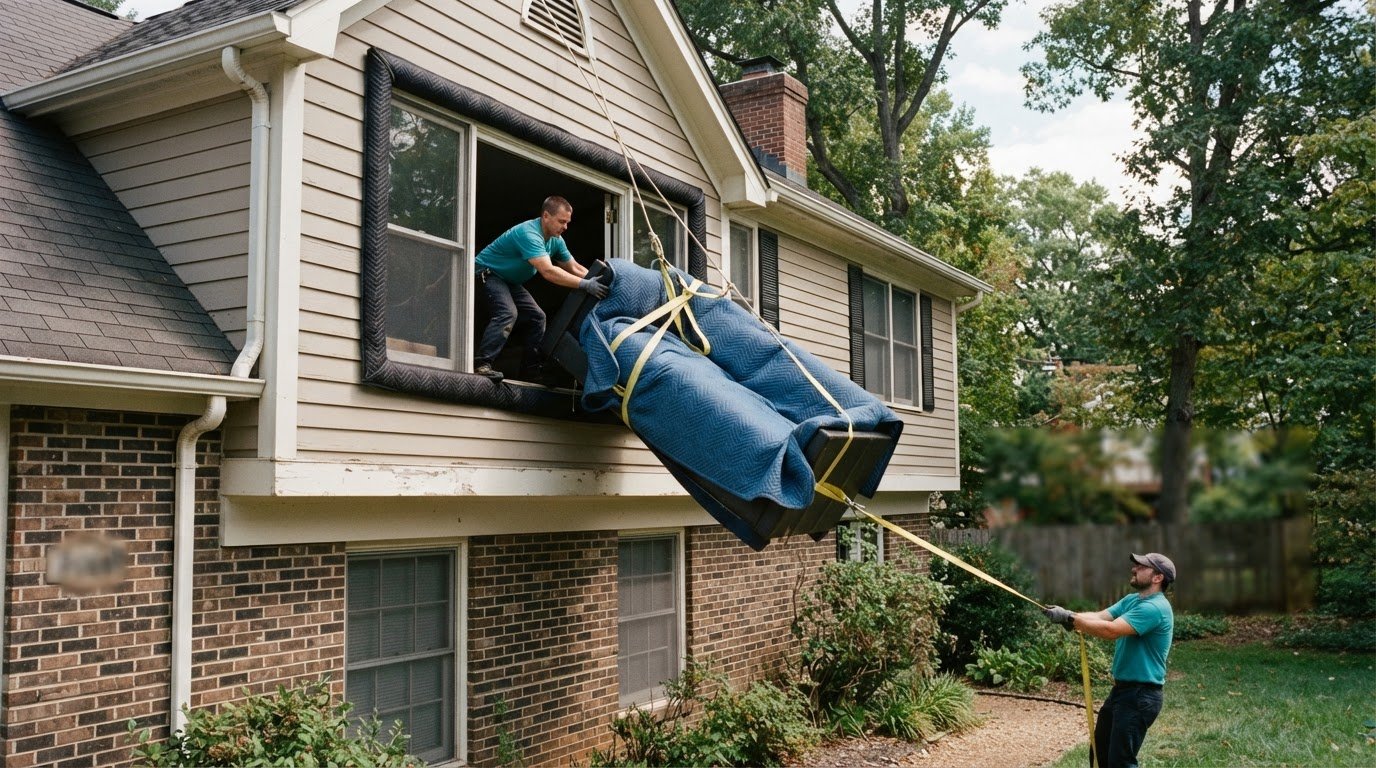
A sofa that won’t clear the stairs or doorway may need a different route out. For sofa hoisting through a third-story loft window in McLean in 2026, the window opening must leave a few inches of clearance on each side of the couch.
That can make a window a practical way to move a bulky sofa when the indoor path is too tight. Before a hoist, the key is to plan the setup rather than improvise: measure the sofa and opening, choose straps that can support and guide the load, and assign clear roles to the crew. This guide explains what to check, how the team works together, what can affect the move duration, and how truck capacity fits into the plan. You’ll have a clearer picture of the job before moving day, with the main decisions laid out in plain language.
Key Takeaways
- Measure the sofa and window opening, then plan enough room to guide the wrapped couch through without scraping the frame.
- Choose strap length to suit the window height and the full path from the opening to the ground.
- Give each crew member a clear role so the upstairs and ground teams can guide the sofa in a controlled way.
- Plan the hoist alongside the rest of the move, including the expected duration and the truck space needed for your belongings.
- Review building and HOA rules before arranging a window hoist, since requirements can vary by property.
Choosing and checking strap length
- Measure the route from the loft window to the landing area, including the sill and how far the sofa must be held from the building. A strap that reaches the ground straight down may not be long enough when the couch needs to hang away from the wall. Note the height, the distance from the wall, and where the crew will control the load.
- Measure the sofa after wrapping it. Moving blankets and shrink wrap or tape protect the upholstery, but they can change the load’s final shape. Check the wrapped sofa’s width, height, and depth, then compare those measurements with the window opening. Leave a few inches of clearance on each side, as the hoisted couch needs room to pass without catching the frame.
- Plan for the sofa’s orientation, not just its height. It may need to pass through the opening at an angle or turned sideways, so the route must allow that movement without twisting the straps around the frame. Sketch the window and landing area, noting which end enters first and where the crew can guide the lower edge.
- Treat the straps as a coordinated system. A primary strap secures the wrapped couch, and a second pull strap gives the crew another point of control during lowering. Check that both reach their intended positions and can be managed without excess slack. A strap that is too short can limit control, while loose material can snag.
- Inspect each strap before use. Lay it out and check for cuts, worn sections, damaged stitching, or knots. Confirm the attachment points and that the straps are intended for lifting furniture. Don’t rely on appearance alone or replace the planned setup with household rope or an improvised tie.
- Dry-run the route with the sofa still inside. Position the wrapped couch near the loft window, lay out both straps, and confirm that the primary strap stays in place as the sofa changes angle. Check that the pull strap reaches the ground control position. If either strap shifts or the planned path is blocked, revise the setup before lifting begins.
- Keep the measurements and route plan together for the crew. Note the window opening, landing point, strap arrangement, and the sofa’s intended orientation. For sofa hoisting through a third-story loft window in McLean in 2026, these checks help match strap reach to the actual building and furniture, rather than relying on a guessed length.
Crew size and roles during a hoist
In Virginia, responsibility for damage depends on its cause. Review the written service agreement and applicable insurance terms to understand coverage and claims.
Wind, rain, and slick surfaces can make a window hoist harder to control. Plan for workable conditions and leave room to pause if the weather changes.
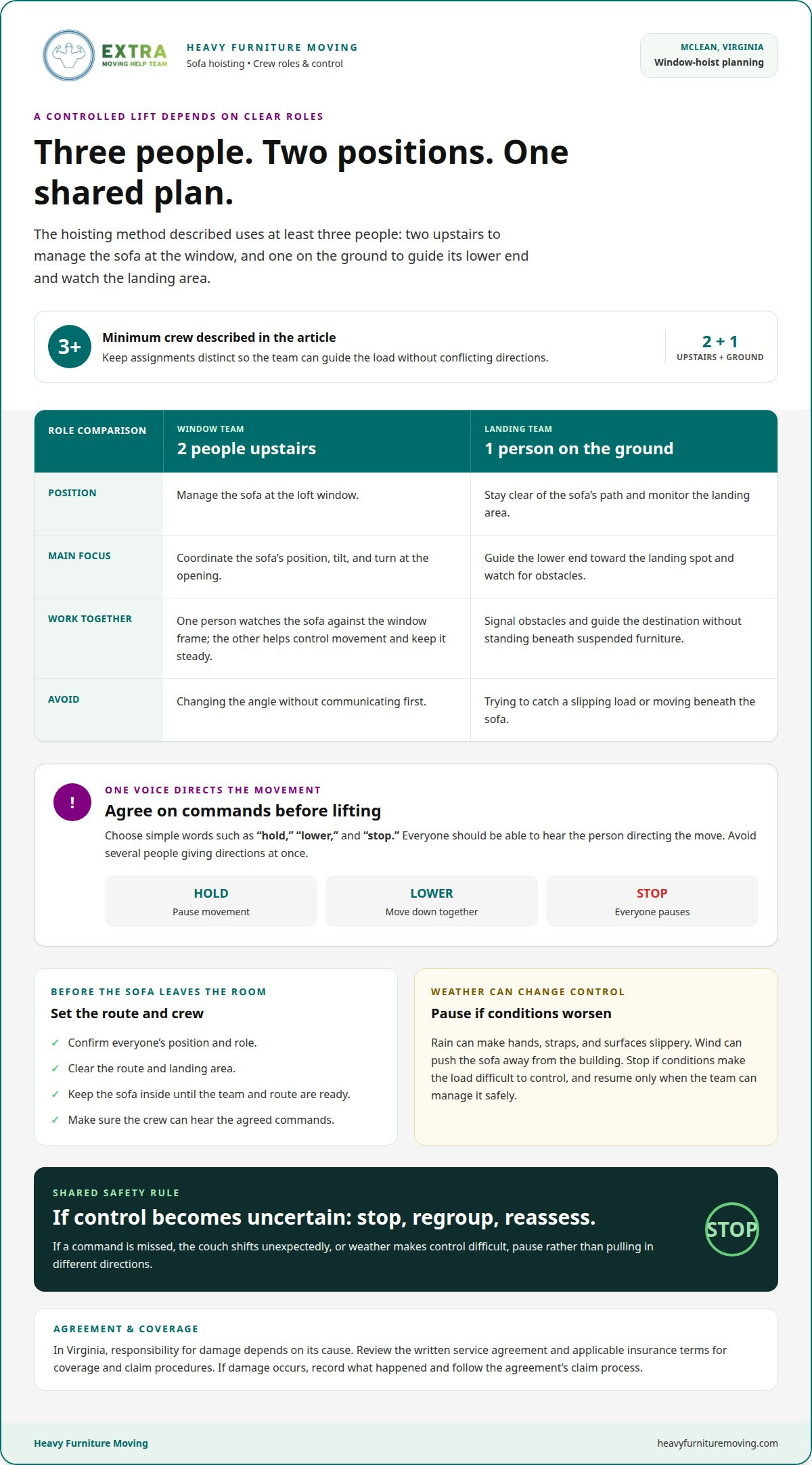
- Confirm the crew and each person’s role before moving the sofa. The hoisting method described here uses at least three people. Clear assignments help prevent conflicting instructions and keep attention on the lift.
- Assign two people upstairs and one person on the ground. The upstairs pair manages the sofa at the window, while the ground person guides its lower end and watches the landing area. Keep each role distinct.
- Name one person to give movement commands. Before lifting, agree on simple words such as “hold,” “lower,” and “stop.” Everyone repeats the command clearly, and the crew pauses whenever someone calls “stop.” Avoid several people issuing directions at once.
- The upstairs pair should coordinate every tilt and turn. One person watches the sofa’s position against the window frame while the other helps control its movement and keep it steady. Communicate before changing the angle, rather than reacting after the couch shifts.
- Keep the ground person out of the sofa’s path. They can monitor the lower edge, signal obstacles, and guide the couch toward its landing spot. They should not stand beneath suspended furniture or try to catch a slipping load.
- Agree on when to pause for weather before starting. Rain can make hands, straps, and surfaces slippery, while wind can push the sofa away from the building. Stop if conditions make control difficult, and resume only when the team can manage the load safely.
- Allow time for setup and changing conditions. Clear the landing area, position the crew, and leave room to pause if the weather shifts. Keep the sofa inside until the team and route are ready instead of leaving it exposed at the window.
- Keep the written agreement accessible during the move. If damage occurs, record what happened and follow the agreement’s claim process; coverage depends on the applicable terms. For a coordinated lift, planned sofa hoisting can keep the crew’s roles focused on the window move.
In Virginia, responsibility for damage during a hoist depends on what caused it. Review the service agreement and applicable insurance terms for coverage and claim procedures.
If the team uses two people upstairs and one on the ground, confirm that everyone understands their position and the agreed commands before lifting. Clear the route and landing area, and make sure everyone can hear the person directing the movement. If a command is missed or the couch shifts unexpectedly, pause and reassess instead of pulling in different directions.
Keep responsibilities consistent while the couch is suspended. The upstairs pair can coordinate its position at the window, while the ground person monitors its lower end and destination. If conditions or control become uncertain, stop and reassess before continuing. Clear communication and a shared pause signal help the team respond together without crowding the load or confusing its direction.
Move duration, crew size, and truck capacity
- Separate the window hoist from the full moving schedule. One recorded move took five hours in total, including the apartment move, not just the sofa lift. Treat that as a single example, not a guaranteed timetable for a McLean loft. Stairs, distance to the truck, furniture volume, and building access all affect the time required.
- Use the recorded crew size as context, not as a rule for every move. That job used three movers, matching the minimum crew described for the hoisting method. Each person still needs a defined task, including who handles the sofa, manages the route, and loads the truck.
- Compare the estimate with the completed move carefully. The job was estimated at seven hours and finished in five, two hours less than estimated. That example shows why an estimate is a planning tool, not a promise. Loft access, the number of items, and loading conditions can change the actual duration.
- Allow time for the window work within the larger schedule. Removing the window and hoisting the couch added about 30 minutes in that example. That figure describes one move, not every third-story lift. A narrow opening, difficult positioning, or extra preparation can affect how long the hoist takes.
- Match truck capacity to the full load, not the sofa alone. In the recorded move, the belongings filled a 16-foot truck. That example gives useful context, but it doesn’t establish the right truck size for a McLean move. Count the furniture and boxes, then consider how bulky pieces fit together inside the vehicle.
- Include the sofa’s orientation in the truck-loading plan. A couch transported upright or on its side uses space differently from one loaded flat. Plan its position alongside other large items before the truck arrives, rather than assuming it will fit after smaller pieces are loaded.
- Coordinate the crew’s work with the truck and loading area. A three-person team may divide tasks between the window, the ground, and the truck, but the stages need to be coordinated. Time can be lost if loading begins before the route is clear or the sofa has landed.
- Give the move plan realistic time and capacity checks. Record the sofa’s dimensions, the building access, the other belongings, and the truck size together. The five-hour move, 16-foot truck, and added 30 minutes for window work are reference points from one job. Use the details of the McLean property to shape its own plan.
Reasons a couch may need to be removed through a window
Consider a window route when the sofa cannot clear the indoor path. The process is to assess access, measure the sofa and opening, protect and secure the couch, then guide it through the window and past exterior ledges.
-
Assess the Need for Window Removal
Compare the couch’s size with the doorway, hall, stairs, and turns. A narrow stairwell or tight landing can block a sofa that fits the room easily. Removing the legs or a door may create more clearance. If the couch still cannot pass, consider a window route rather than forcing it around a corner.
-
Measure the Couch and Window Opening
Measure the sofa’s full width, height from the bottom of the legs to the top of the back, and diagonal height. Then measure the window’s clear opening and compare it with the couch’s likely tilted position. Include the frame and sill, not just the glass area, and allow room to maneuver.
-
Check the Drop Past Windows and Ledges
Trace the route from the loft window to the landing area. Look for lower windows, ledges, trim, or other projections that could obstruct the sofa. Clear the landing area and identify where the couch may need to turn or move away from the wall. Understand the full route before lowering it.
-
Wrap the Sofa Before Moving It Outside
Protect the couch with moving blankets and secure them with shrink wrap or tape. Cover exposed corners and upholstery to reduce the risk of scraping the window frame or building. Keep the covering snug, without bulky folds that alter the sofa’s shape or interfere with its position.
-
Secure the Couch with Straps
Place the primary strap around the wrapped couch, then attach a second pull strap to the primary strap. Check that both stay in position as the couch tilts. The second strap provides a separate point for guiding the load. Keep the planned strap arrangement clear of loose wrapping and exposed sofa parts.
-
Lower the Sofa Along the Planned Route
Bring the protected, strapped couch to the window only after the landing area and route are ready. Guide it through the opening with its measured orientation in mind, then lower it past windows and ledges without letting it swing into the building. Pause if the couch catches or shifts; correct its position before continuing toward the landing spot.
In Northampton, a couch was hoisted out of a third-floor apartment window during a move.
Permits and HOA rules for furniture hoisting in McLean VA
- Identify the hoisting setup at your McLean property. Note the loft window, building exterior, landing area, truck position, and any equipment placed outside. A lift contained within the property differs from one that uses a shared walkway or common area. These details help identify which property rules or local requirements to review.
- Ask the property manager for written move procedures before setting a date. Request rules for window access, shared spaces, loading areas, and scheduling. For example, an HOA may require a loading zone reservation or protection for a shared hallway. Keep the written instructions with the move plan.
- Treat building approval and permit questions separately. HOA or management approval covers property procedures; a permit question depends on the planned activity and location. Whether a permit applies can depend on whether equipment or a vehicle uses public space. Don’t assume a sofa-only lift automatically requires a permit or automatically avoids one.
- Describe the route clearly when seeking guidance. Provide the McLean building address, window location, landing point, and truck position. Explain whether the crew will use a shared courtyard, sidewalk, driveway, or loading area. A precise description helps the relevant property contact or office assess the arrangement.
- Check rules for common areas and exterior access. Review the HOA handbook, move-in instructions, or building notice for restrictions on windows, hallways, doors, and loading locations. Follow any stated process for advance approval, and keep a copy of the relevant instructions or written response.
- Plan for property protection and controlled access. Confirm how the crew will reach the loft, where people may wait, and which paths must remain clear. Include any building requirements for floor or wall protection in shared hallways. Keep residents and visitors away from the landing area during the lift.
- Resolve conflicting instructions before moving day. If an HOA notice, property manager, or local office gives different directions, describe the same setup to each contact and ask which rule applies. Record the response, date, and contact. Don’t begin the hoist while access or approval questions remain unresolved.
- Put the final permissions and instructions in one place. Include any written approval, relevant HOA directions, the truck location, and the planned window route. For a McLean loft move, arrange sofa hoisting around the building’s access plan and the approved setup.
Heavy Furniture Moving: Sofa Hoisting
Heavy Furniture Moving offers Sofa Hoisting when a couch cannot clear stairs, doorways, or indoor turns. For a McLean loft, the service provides a way to move a sofa through a suitable window opening instead of forcing it through a tight interior route.
When discussing the move, share the sofa’s dimensions, window opening, building access, and planned landing area. These details help shape the hoist and coordinate it with the rest of your furniture move. Heavy Furniture Moving also offers Exercise Equipment Moving if another heavy item needs careful handling.
Contact Heavy Furniture Moving to discuss sofa hoisting for your loft.
Make the window move part of your plan
Planning sofa hoisting through a third-story loft window in McLean in 2026 means choosing how the lift fits into your larger move. Treat it as one coordinated job, not a last-minute workaround. A clear plan helps you decide whether you need help with the sofa alone or support for other moving tasks, too.
Heavy Furniture Moving offers Sofa Hoisting, Exercise Equipment Moving, and Movers Near Me. Share what you’re moving and the kind of help you need to get the conversation started. You don’t need to have every detail figured out first.
Contact Heavy Furniture Moving to talk through your McLean move and take the next step with confidence.
Frequently Asked Questions
Why the Window?
A window can provide an alternate route when a sofa cannot pass through the building’s doors, halls, stairs, or elevator. It can also avoid forcing the couch around a tight turn, which may damage the furniture or walls. Compare the indoor route with the exterior path and landing area. A window hoist is suitable only when the opening and route can accommodate the sofa.
Can I arrange sofa hoisting through a third-story loft window in McLean?
Yes. Heavy Furniture Moving offers Sofa Hoisting for furniture that cannot fit through standard entryways or elevators. For a third-story loft, the window opening, exterior route, and landing area shape the plan. Describe the sofa and building access so the job can be discussed around the layout. The service is for awkward furniture moves, not for forcing a couch through an unsuitable opening.
How do I measure a loft window and access for sofa hoisting?
Measure the sofa’s width, height, and diagonal height, then measure the window’s clear opening at its narrowest usable points. Note the sill, nearby ledges, and route to the landing area. A sofa that fits straight-on may need more space when tilted. Include the protective wrapping when assessing its final dimensions.
sofa dimensions and weight limits for exterior furniture hoisting
Measure the wrapped sofa’s width, height, and depth, and allow room to maneuver through the window opening. The available information does not specify a weight limit for exterior furniture hoisting.
Frequently Asked Questions
A window can provide an alternate route when a sofa cannot pass through the building’s doors, halls, stairs, or elevator. It can also avoid forcing the couch around a tight turn, which may damage the furniture or walls. Compare the indoor route with the exterior path and landing area. A window hoist is suitable only when the opening and route can accommodate the sofa.
Yes. Heavy Furniture Moving offers Sofa Hoisting for furniture that cannot fit through standard entryways or elevators. For a third-story loft, the window opening, exterior route, and landing area shape the plan. Describe the sofa and building access so the job can be discussed around the layout. The service is for awkward furniture moves, not for forcing a couch through an unsuitable opening.
Measure the sofa’s width, height, and diagonal height, then measure the window’s clear opening at its narrowest usable points. Note the sill, nearby ledges, and route to the landing area. A sofa that fits straight-on may need more space when tilted. Include the protective wrapping when assessing its final dimensions.