How to Hoist a Sleeper Couch to an Aldie Loft
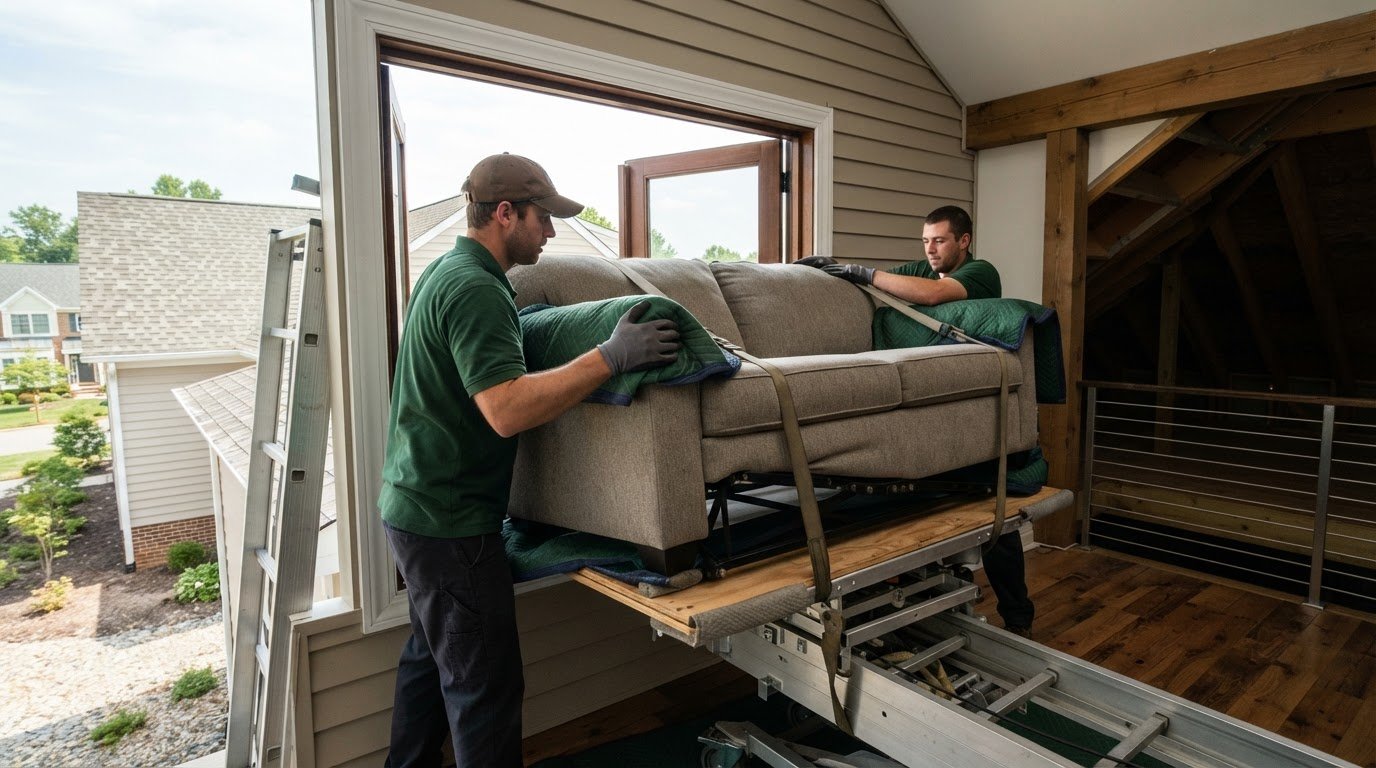
The stairs don’t have to be the route. To hoist a heavy sleeper couch into a second-story loft in Aldie, a professional can use an external furniture hoist to raise it beside the home and guide it through a suitable upper-level opening. The safest approach depends on the couch’s size and shape, the loft access, and the space available outside.
A sleeper couch is bulky, awkward to grip, and difficult to turn through tight stairways. A hoist can bypass those indoor obstacles, but careful planning is still essential to protect the furniture and home.
Learn how furniture hoists raise heavy couches, how an exterior setup works, and which access conditions can affect the job. We’ll cover what matters, from the loft opening and couch route to outdoor clearance and parking, so you can assess whether a hoist suits your Aldie home.
Key Takeaways
- A furniture hoist can move a sleeper couch outside the stairway, with the lift plan shaped by the couch and the loft’s access.
- Professionals assess the lifting path, exterior clearance, and parking access to determine whether an external hoist can work.
- Careful measurements of the sofa, entry, stairs, windows, and landing help identify tight points before moving day.
- Understanding how the hoist supports and guides a bulky couch helps explain why setup and coordination matter.
- When stairs or indoor turns make the move difficult, Heavy Furniture Moving’s Sofa Hoisting service can help get the couch to the loft.
Challenges of moving bulky furniture upstairs
A sleeper couch can be hard to turn through a narrow stairwell, even if it fits through the front door. To plan how to hoist a heavy sleeper couch into a second-story loft in Aldie, first identify the route’s tightest points.
Measuring the Sofa and Route
Professional movers compare the sleeper sofa’s dimensions with the loft entry, stairs, windows, and landings. This reveals where it may need to turn, tilt, or approach from outside. Share the sofa’s length, depth, and height, along with its bulky features and measurements of tight stairwell points and the intended opening. For example, a wide arm may clear a doorway head-on but catch during a turn at the landing.
Hoisting Risks and Liability
Hoisting risks include scraping the couch or home, losing control of the load, and injuring people nearby. A sofa can swing toward a window or wall if its path is not controlled. Responsibility for damage depends on the agreement and circumstances, so clarify the job scope and document existing damage before the lift. Keep people away from the lifting path.
Stairs present several distinct obstacles. A couch may clear the first flight but get stuck at a tight turn or low ceiling. A handrail reduces usable width, while a small landing may leave too little room to pivot. For example, a sofa that fits along a straight hallway may not turn between stair flights without hitting a wall.
Sleeper sofas have an awkward weight and shape. The folded mattress and internal frame can make one end heavier, while the broad body offers fewer easy handholds. If the frame shifts as the sofa tilts, its balance changes during the move. Movers account for the closed sleeper mechanism, protruding feet, and cushions that might slide or get in the way.
Loft entries and landings can restrict the final approach. A low sill, narrow window, or nearby railing may block the couch even if the opening seems wide enough. A crowded landing leaves less room to receive and turn the load. The lift needs to end in a controlled handoff, not simply reach the upper floor.
One original stairwell lift platform measured 3 by 3 feet. That example doesn’t establish a standard for every home, but it shows why platform dimensions matter. A sleeper couch may be too large for that platform, so movers assess the actual item and route rather than assume a familiar setup will fit.
If you’re considering how to hoist a heavy sleeper couch into a second-story loft in Aldie, the right approach depends on the layout and sofa dimensions. A tight stair turn, limited landing, or unsuitable opening may rule out an indoor carry. Identifying those pinch points early helps movers choose a workable route and avoid unnecessary contact with the couch, walls, and windows.
How do furniture hoists work?
A furniture hoist raises a bulky item along a planned path instead of carrying it through the stairwell. For an Aldie loft, it may help when stairs or turns restrict the couch’s movement.
Hoists as an Alternative to Stairs
A furniture hoist uses lifting equipment to move a secured couch upward while movers guide its path. This route avoids stair turns, narrow hallways, and interior landings that can obstruct a sleeper sofa. One forum member described using a 1,100-pound/500-pound electric hoist with an overhead track system. That example illustrates a setup, not a universal rating or design for every home.
Disassembly Versus Intact Hoisting
Disassembly means separating sofa parts before moving; intact hoisting lifts the assembled piece. Neither method is automatically cheaper or safer. Disassembly adds handling and reassembly, while intact lifting requires a suitable route and controlled movement. For example, removable legs may reduce the sofa’s profile, but taking them off will not solve an opening that is still too narrow.
A hoist supports the load as it travels upward. Movers secure the furniture, attach it to the lifting equipment, and coordinate its movement toward the upper opening. At the loft, the team guides the couch through the entry and receives it inside. Each transition matters: the sofa must remain supported as it moves from vertical travel to its final indoor position.
An overhead track can guide a load along a set path, while other setups raise it beside a building. The right arrangement depends on where the couch starts, where it needs to enter, and whether the route can be kept clear. A track-based electric hoist may suit one home, but that does not mean the same equipment works at every Aldie property.
Intact lifting avoids separating sofa components, but the full couch still has to fit through the loft opening. Disassembly may make individual pieces easier to handle, but those parts need protection and reassembly. Movers compare the sofa’s construction, access, and the work required at both ends to choose a practical approach.
Clear communication helps movers coordinate the load and its entry during a lift. The person guiding the couch watches its position relative to the opening while the lifting team controls its upward movement. The folded bed mechanism and loose cushions also affect how securely a sleeper sofa can be handled.
For a couch that cannot make the indoor route, professional sofa hoisting offers an alternative to forcing it through the stairs.
Hoist access for awkward spaces and restricted parking
Before a sofa hoist, clear the loft receiving area and outdoor lifting path, including space for the crew and equipment. Share parking restrictions and access limits in advance so the movers can plan for your home’s layout.
Access and Parking Constraints
Features around a home can restrict where lifting equipment and a couch can move. A clear loft opening is useful only if the crew can position equipment outside and keep the lifting path unobstructed. A narrow driveway, parked vehicle, low branch, or overhead obstruction may change the approach. Restricted parking can also limit space for staging the lift.
Preparing the Loft and Outdoor Area
Prepare by clearing the indoor receiving space and outdoor route before raising the couch. Movers need room near the loft entry to guide the sofa inside, and the exterior path must allow the crew and equipment to work safely. Move loose items away from the entry and point out gates, parked cars, or other access limits.
A tight side yard poses a different challenge from a narrow driveway. For example, a fence may block the direct route below a loft window, so the team must consider another position. Trees, roof edges, and nearby structures can also affect the couch’s path. There must be room for both the furniture and the people guiding it.
Parking affects more than convenience. A vehicle beside the home may prevent the equipment from reaching the planned lifting area. In a shared or narrow driveway, access for other residents can also limit where the crew can stage. Describe the approach, including gates, slopes, and usual obstructions, so movers can plan around them.
The loft needs a receiving area, not just an opening. Clear furniture and belongings from the spot where the sleeper sofa will enter and turn, and keep the route to its intended location open. For example, a couch may fit through a loft window but still be hard to guide past a desk or stored boxes just inside.
Outdoor preparation also means identifying overhead and ground-level obstacles along the intended route. A cable hoist once lifted a 3-horsepower Delta Unisaw to a second-floor wood shop. That example shows how a heavy item can reach an upper floor by an external path, but each home presents different access conditions.
Before moving day, share the best outdoor approach, parking restrictions, gate access, and the loft area you can clear. This lets movers plan for the actual Aldie property rather than assume the driveway is open or the window unobstructed. A clear receiving area and accessible exterior route help the team coordinate the lift and handoff.
How external furniture hoists work
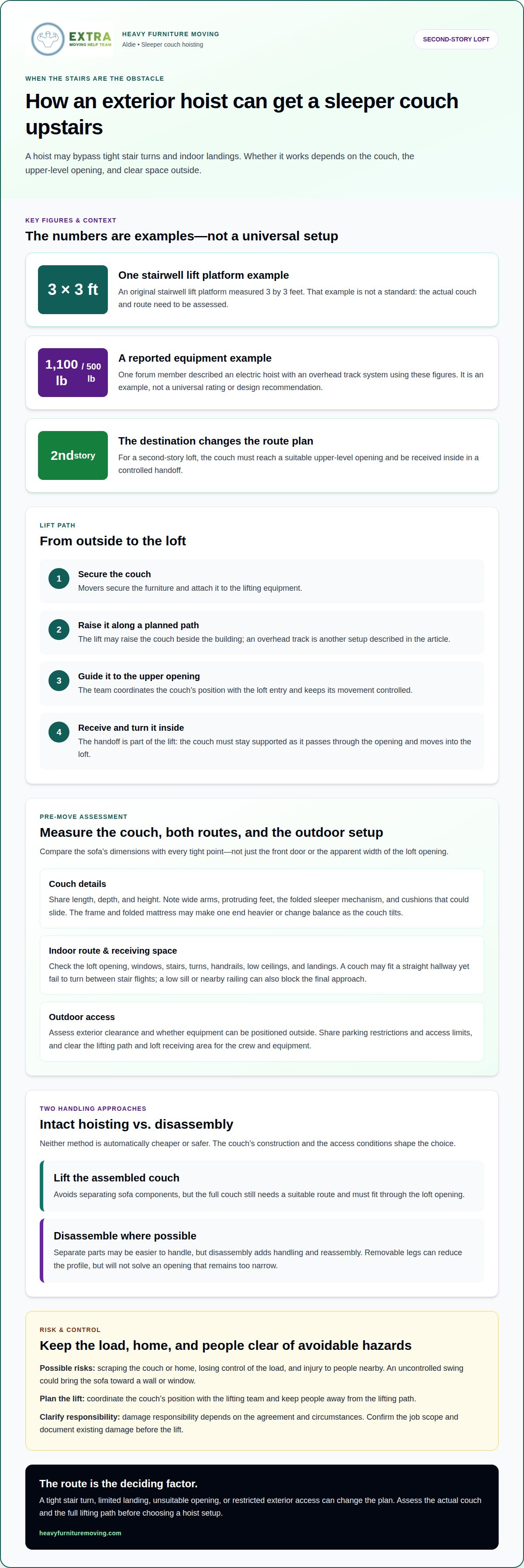
An exterior furniture hoist raises a sleeper sofa beside the home and guides it through an upper-level opening. In Aldie, the lift plan needs to suit the building, sofa, and access route.
Permission requirements for an Aldie home depend on the property and planned setup. HOA rules and local requirements may apply to different parts of the work, particularly when shared or public space is involved. Find out which rules apply to the address and lift plan before scheduling.
The process begins by positioning the lifting equipment outside the building. Movers identify the loft opening and a route that lets the couch rise without hitting the wall, roofline, or nearby obstacles. The starting position matters: if the sofa is raised too far from the entry, guiding it inside can be difficult.
Next, the crew secures the sleeper sofa and coordinates the lift. The couch needs support to keep it controlled as it leaves the ground and travels upward. Movers manage its orientation so the broad back, arms, and folded bed mechanism clear the building.
The handoff at the loft is a critical part of the lift. Movers guide the couch through the opening as the lifting team controls its upward travel. The receiving area must be ready for the furniture to move inside, not merely large enough for the sofa to reach the window.
External systems can use different arrangements. One reported attic setup used an 8-foot I-beam over floor joists and a 12-foot section of barn-door rail. Those dimensions describe one installation, not a standard design or a recommendation for another home. The equipment and support must suit the specific building and load.
That is why a rail or hoist cannot be chosen by length alone. The lifting path, attachment points, building structure, and couch movement all affect the setup. A sleeper sofa’s broad, uneven shape makes balance and clearance important throughout the lift.
Property access can shape the approach as much as the equipment. A narrow side yard may prevent the crew from placing a lift directly beneath the loft entry. A roof overhang or nearby structure can block a straight route, requiring a different position or making that exterior path unsuitable.
The practical takeaway is to share the sofa’s dimensions, loft opening, and exterior approach. Describe gates, overhead obstructions, and any shared areas involved, too. These details help the team plan the lift and identify property permissions before positioning equipment.
An exterior hoist is most useful when it provides a clear, controlled route to the loft. The setup must suit both the couch and the home, from equipment support to the final indoor handoff.
How to measure a sleeper sofa, loft entry, stairs, windows, and landing before moving?
Professional movers compare the sleeper sofa’s dimensions with each part of the planned route. This helps identify tight turns and blocked openings, and determine whether an indoor carry or exterior lift better suits the Aldie home.
They start with the sofa in its moving configuration. The team notes its overall length, depth, and height, including fixed arms, feet, and other features that affect its outer shape. Removable legs or cushions are noted separately. For example, the sofa body may fit through an opening while an attached foot or arm catches on the edge.
Next, movers assess the loft entry’s usable opening, not just the outer frame, and note the sill, nearby trim, and interior clearance. At a window, they consider the clear space the couch must pass through. The approach matters as well: the sofa may reach the window but still need room to turn toward its final position.
The stair route needs a close inspection. Movers assess the narrowest points, ceiling height, handrails, corners, and transitions between flights. A straight section may have plenty of room, while a landing turn restricts the couch’s angle. They also consider where the sleeper sofa can tilt without striking a wall or ceiling.
Landings and the receiving area complete the route assessment. Movers consider the space needed to pause, reposition, and guide the couch onward. A console or stored items on the landing can restrict movement even when the stairs are clear. The team maps the route from the loft entry to the sofa’s intended location.
Useful details to provide include:
- The sleeper sofa’s length, depth, and height in its moving configuration.
- Whether feet, cushions, or other removable parts change its dimensions.
- The narrowest stair points, turns, handrails, and landing conditions.
- The loft entry’s usable opening and any nearby sill, trim, or obstruction.
- The outdoor approach, if a window or other upper-level opening may be used.
Measurements need to be considered together. A wide window does not solve a restricted exterior approach, and a spacious stair flight does not make a tight landing passable. Movers compare the sofa’s shape with each transition and identify where its orientation may need to change. This review helps determine whether it can be moved intact or requires another plan.
Share your sofa and access details with Heavy Furniture Moving for a sofa-hoisting assessment before the move.
Heavy Furniture Moving: Sofa Hoisting
Heavy Furniture Moving provides Sofa Hoisting for bulky couches that cannot clear a tight stairway or loft entry. If measurements point to a difficult indoor route, the service offers a practical option when an exterior lift may fit the property.
Share the sleeper sofa’s dimensions, loft opening, and outdoor access details. This helps the moving team understand the challenges and plan how to handle the sofa in your home. If you also need help moving other furniture indoors, in-home furniture movers can assist with that part of the move.
For support with a sleeper couch move in Aldie, contact Heavy Furniture Moving.
Make the Next Move with a Clear Plan
Planning how to hoist a heavy sleeper couch into a second-story loft in Aldie starts with choosing a route that suits the home, rather than forcing the sofa through a difficult turn. Gather the measurements and access details, then discuss the layout with a professional to plan the next steps.
Heavy Furniture Moving offers Sofa Hoisting, Movers Near Me, and Exercise Equipment Moving. For a sleeper couch that needs an upper-level route, Sofa Hoisting is the service most directly suited to the job. Share the sofa’s dimensions and loft access details when you reach out.
Contact Heavy Furniture Moving to discuss your couch move. A thoughtful plan can turn a challenging lift into a manageable next step.
Frequently Asked Questions
Which furniture hoisting and rigging companies serve Aldie and Loudoun County, VA?
Heavy Furniture Moving offers Sofa Hoisting in Aldie and serves nearby Northern Virginia communities, including Ashburn, Fairfax, Woodbridge, Manassas, Manassas Park, McLean, Vienna, Reston, Centreville, Chantilly, Clifton, Dumfries, South Riding, Fairfax Station, Haymarket, and Gainesville. For a sleeper couch that needs an upper-floor route, its sofa-hoisting service addresses the move. The opening, exterior approach, and parking conditions help shape the plan.
Can a sleeper sofa be carried up the stairs or through windows and balconies?
Yes. A sleeper sofa can be carried upstairs if it clears every stair, turn, and landing. A window or balcony may offer another route if the opening and surrounding access suit the couch and lifting plan. For example, a broad sofa might fit through a window but lack a clear outdoor approach for a controlled lift. Movers compare the sofa and route before choosing a method.
What equipment do professional movers use to hoist a heavy sleeper sofa to a second-story loft?
Professional movers use lifting equipment suited to the building and planned route, which may include an electric hoist and overhead track. Straps secure the sofa, while moving blankets and protective materials help shield the furniture and nearby surfaces. Equipment depends on the couch’s shape, loft opening, and exterior setup. A system used for one home is not automatically right for another.
How do professional movers safely hoist furniture to an upper-floor loft?
Movers plan the route, secure the sofa, coordinate its upward movement, and guide it through the loft entry. They keep the receiving area clear so the couch can move indoors in a controlled handoff. The folded bed frame and shifting balance affect how a sleeper sofa is handled. The lifting arrangement must suit the specific building and load, not rely on a generic setup.
How to find insured furniture hoisting movers near Aldie, VA?
Choose a mover whose stated service covers furniture hoisting and whose plan addresses your sofa and property access. Heavy Furniture Moving offers Sofa Hoisting in Aldie. Insurance is separate from the ability to hoist furniture, so review written coverage terms before work begins. Share the sofa’s details and the loft access conditions when arranging the move. This helps clarify the job scope and the protections described for it.
Frequently Asked Questions
Heavy Furniture Moving offers Sofa Hoisting in Aldie and serves nearby Northern Virginia communities, including Ashburn, Fairfax, Woodbridge, Manassas, Manassas Park, McLean, Vienna, Reston, Centreville, Chantilly, Clifton, Dumfries, South Riding, Fairfax Station, Haymarket, and Gainesville. For a sleeper couch that needs an upper-floor route, its sofa-hoisting service addresses the move. The opening, exterior approach, and parking conditions help shape the plan.
Yes. A sleeper sofa can be carried upstairs if it clears every stair, turn, and landing. A window or balcony may offer another route if the opening and surrounding access suit the couch and lifting plan. For example, a broad sofa might fit through a window but lack a clear outdoor approach for a controlled lift. Movers compare the sofa and route before choosing a method.
Professional movers use lifting equipment suited to the building and planned route, which may include an electric hoist and overhead track. Straps secure the sofa, while moving blankets and protective materials help shield the furniture and nearby surfaces. Equipment depends on the couch’s shape, loft opening, and exterior setup. A system used for one home is not automatically right for another.
Movers plan the route, secure the sofa, coordinate its upward movement, and guide it through the loft entry. They keep the receiving area clear so the couch can move indoors in a controlled handoff. The folded bed frame and shifting balance affect how a sleeper sofa is handled. The lifting arrangement must suit the specific building and load, not rely on a generic setup.
Choose a mover whose stated service covers furniture hoisting and whose plan addresses your sofa and property access. Heavy Furniture Moving offers Sofa Hoisting in Aldie. Insurance is separate from the ability to hoist furniture, so review written coverage terms before work begins. Share the sofa’s details and the loft access conditions when arranging the move. This helps clarify the job scope and the protections described for it.