Getting Your Spouse on Board With Hiring Movers in South Riding

What if hiring movers doesn’t mean giving up control of your move? If you and your spouse disagree about handling everything yourselves, getting buy-in from spouse to hire movers South Riding starts with a calmer question: Which parts of the move feel manageable, and which could put too much strain on your time or energy? Cost, trust, and the wish to stay in charge are all fair concerns.
You don’t have to settle the full-service-versus-DIY debate all at once. Start by listing the difficult tasks, then compare the effort of doing them yourselves with getting help for specific jobs or more of the move. A focused conversation can account for both priorities: keeping the plan within your comfort zone and avoiding a moving day that leaves one person carrying too much.
This guide will help you discuss the trade-offs, choose a level of help that fits your household, and turn that decision into a practical South Riding moving plan. You’ll also see how local details, such as community rules for truck parking or moving times, can affect your preparations.
Key Takeaways
- Build agreement by treating the choice as a question of how much help you need, not who is right.
- Use a simple conversation to hear each person’s priorities, identify difficult tasks, and choose next steps together.
- Compare DIY, targeted moving labor, and broader residential support by who handles lifting, packing, transport, and coordination.
- Turn your shared decision into a South Riding plan with a task list, clear responsibilities, and a realistic scope of help.
- Getting buy-in from spouse to hire movers South Riding can start with one shared task list, including heavy items that may need specialized handling.
Why Hiring Movers in South Riding Can Be a Shared Decision, Not a Fight
One spouse may look at the heavy lifting, tight schedule, and long list of jobs ahead and think, “We need help.” The other may be focused on spending less, staying in control, or keeping unfamiliar people out of the home. Both perspectives deserve a fair hearing. Getting buy-in from spouse to hire movers South Riding isn’t about winning an argument. It’s about deciding which parts of the move you want to handle yourselves and where extra hands could make the work more manageable.
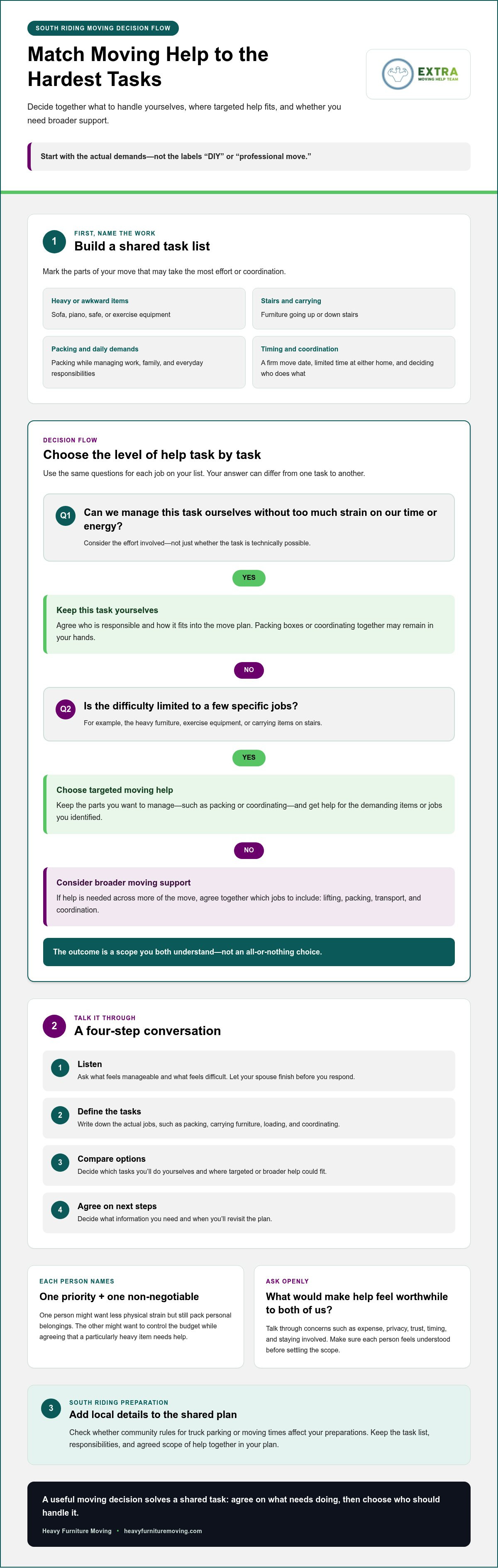
Start with the actual demands, not the labels “DIY” or “professional move.” Your pressure points might include:
- Moving a heavy sofa, piano, safe, or exercise equipment.
- Carrying furniture up or down stairs.
- Packing while keeping up with work, family, and everyday responsibilities.
- Working within a firm move date or limited time at either home.
- Coordinating who does what, when, and how belongings get from one place to the next.
Couples can make decisions more easily when they agree on the task first, then choose who should handle it. A difficult piano move, for example, is a clearer problem to solve than a broad debate about whether movers are worth it.
What might your spouse be worried about?
Ask what’s behind the hesitation rather than assuming your spouse is unwilling to help. The concern may be financial: keeping the move within a household budget or avoiding help that feels unnecessary. It may be about privacy or trust, such as having a crew work around personal belongings. Timing can matter too, especially if your spouse wants to stay involved in each step. Independence may be the heart of it: doing the move yourselves can feel like a practical, satisfying choice.
Try a specific, open question: “Which part worries you most, the expense, having people in the house, or letting someone else handle the furniture?” Listen before responding. Let your spouse explain what would make help feel acceptable, such as choosing which items are moved or keeping responsibility for packing. Moving is more than transporting boxes; personal relocation can also disrupt routines and bring new tasks to manage. Acknowledging that uncertainty makes the conversation more respectful.
Start with the move itself, not the sales pitch
Describe the situation plainly: “We’re moving from our South Riding home on this date. We can pack most of the boxes, but the stairs and large furniture are the parts I’m concerned about.” Then ask what feels hardest to your spouse. You may find the disagreement isn’t about whether help is useful, but whether you need support for the whole move or just a few demanding items.
Keep the first conversation focused on shared priorities, not booking. Agree on what matters most: controlling spending, avoiding strain, protecting certain belongings, or staying hands-on. Once you’ve named the tasks and priorities, you can compare levels of help without either person feeling pushed into a decision.
How to Discuss Hiring Movers in South Riding Without Pressuring Your Spouse
A productive conversation doesn’t start with “We have to hire movers.” It gives both people room to explain what matters. One spouse may want to reduce the physical work; the other may want to control spending or keep decision-making in their own hands. A shared task list gives you something concrete to discuss without exaggerating the work or turning the conversation into a contest.
Try this four-step approach:
- Listen. Ask what feels manageable and what feels difficult. Let your spouse finish before you respond.
- Define the tasks. Write down the actual jobs, such as packing, carrying furniture, loading, and coordinating the move.
- Compare options. Consider which tasks you’ll do yourselves and where targeted or broader moving help could fit.
- Agree on next steps. Decide what information you need and when you’ll revisit the plan.
Have each person name one priority and one non-negotiable. One spouse might prioritize reducing physical strain but want to pack personal belongings. The other might prioritize controlling the budget while agreeing that a particularly heavy item shouldn’t be moved without help. Those details turn broad preferences into practical boundaries.
A useful moving decision solves a shared task; a pressure-based pitch tries to win a yes before both people feel heard.
Use questions that invite a real discussion
Ask, “Which part of the move feels most manageable to you, and which feels least manageable?” Then ask, “What would make professional help feel worthwhile to both of us?” These questions invite specifics instead of a quick yes or no. If your spouse says they’re uneasy about cost or control, reflect it plainly: “You want us to stay within our budget and stay involved.” Make sure they feel understood before suggesting an answer.
Agree on the scope before discussing a service
Break the move into separate jobs. Packing is different from loading, and loading is different from transport. Handling a heavy or awkward item may be its own task, even if you plan to manage everything else yourselves. Mark each job as “we’ll do it,” “we need help,” or “we’re undecided.” This makes it easier to see where a limited amount of assistance could take pressure off without handing over the whole move.
For example, you might pack boxes and coordinate the schedule together, while bringing in help for heavy furniture or exercise equipment. That’s a decision about scope, not a commitment to give up control. To explore local residential moving help, review moving help in South Riding and use your agreed task list to guide the next step.
Getting buy-in from spouse to hire movers South Riding becomes more straightforward when both people can see what needs doing, what they want to protect, and where help would make a real difference. Keep the list visible and return to it together before deciding.
DIY vs. Hiring Movers in South Riding: Compare the Work, Not Just the Idea
“Do it ourselves” and “hire movers” can sound like all-or-nothing choices. They aren’t. Divide the move into jobs and decide who handles each one. Compare the work left for your household, not just the label attached to each option. The best fit depends on your belongings, schedule, physical comfort, and priorities. There’s no single right answer for every South Riding household.
| Task | DIY | Targeted moving labor | Broader residential moving support |
|---|---|---|---|
| Planning | Your household organizes the move and schedule. | Your household plans the move and identifies the specific tasks for hired help. | You coordinate the move with the moving team and agree on the work included. |
| Lifting and loading | You and your helpers handle the lifting and loading. | Movers handle the agreed lifting or loading tasks; you manage the rest. | Movers handle a wider share of the agreed physical work. |
| Packing | You pack the belongings yourselves. | Your household packs unless packing help is part of the agreed scope. | Packing support may be included in the moving plan. |
| Transport | You arrange and manage the vehicle and trip. | Your household arranges transport and coordinates it with the labor. | The moving arrangement covers transport as part of the broader move. |
| Coordination | You manage the timeline, helpers, and moving-day details. | You coordinate the hired help with the tasks you’re doing yourselves. | You coordinate the agreed plan with the moving team. |
Use the table as a conversation tool, not a promise that every move follows the same setup. The scope depends on the plan, so write down what you want handled and what you’ll keep in your own hands. Then compare your household budget with the work, time, and coordination each choice leaves for you. Getting buy-in from spouse to hire movers South Riding is easier when the trade-offs are visible and specific.
When DIY may fit your household
DIY may suit a move with manageable belongings, a flexible schedule, and willing helpers who can safely handle the planned tasks. Your household still takes responsibility for packing, organizing transport, coordinating help, and doing the lifting. Be realistic about everyone’s ability. If an item feels too heavy, awkward, or risky to move, leave it to capable professionals rather than trying to prove you can manage it.
When professional help may solve a specific problem
Pianos, safes, exercise equipment, and bulky furniture can call for careful planning and specialized handling. Heavy Furniture Moving supports residential moves in South Riding and handles these heavy items. If a sofa won’t fit through a standard entryway or elevator, sofa hoisting may be an option. Targeted help lets you keep control of packing and other tasks while assigning demanding physical work to movers.
Compare the actual tasks before choosing. You may find that the right plan is mostly DIY, with help for a few demanding items, or broader support for more of the move.
A South Riding Moving Plan You Can Both Say Yes To
Turn your shared priorities into a plan you can see and adjust. A written checklist helps prevent one person from carrying the whole mental load and gives you both a clear way to decide what to keep, delegate, or revisit. The goal isn’t to hand over control. You and your spouse still choose what moves, how belongings are handled, and which tasks you want help with.
Build the plan in five steps:
- Inventory the tasks. List packing, furniture moving, loading, unloading, transport, and moving-day coordination.
- Flag difficult items. Separate heavy or awkward belongings from ordinary boxes. Note pianos, safes, exercise equipment, and large furniture.
- Set priorities. Each person identifies what matters most, such as managing the budget, protecting belongings, reducing physical strain, or staying hands-on.
- Choose the scope. Decide which tasks you’ll handle yourselves and where help would make the biggest difference.
- Assign responsibilities. Give each task an owner, and write down any decisions you still need to make together.
Build a shared moving checklist
For each item or job, record who owns the decision and what help may be useful. Mark heavy and awkward pieces clearly so they don’t get lost in a list of boxes. Add practical details that affect handling: stairs, narrow doorways, elevators, and the room where each item needs to go. Before arranging help, agree on what your household will pack, organize, and manage on its own.
Keep the notes factual. “Large dresser needs to go upstairs” is more useful than “Everything is too hard.” If you’re unsure whether an item will fit through an opening, note the concern instead of assuming it will or won’t. A clear list makes planning easier without overstating the challenge.
Choose the smallest useful amount of support
Use your list to match help to the actual work. You might want support with heavy furniture only, or help with packing, loading, or unloading. If several tasks feel difficult to manage together, broader residential moving help may suit your plan better. A furniture-moving stress-free checklist can help you think through practical planning points as you settle on the scope.
Keep the final decision in your hands. You can choose the tasks, set boundaries around what movers handle, and remain responsible for the details that matter most to you. For a South Riding move with heavy furniture or other demanding items, get residential moving help that fits the task list you and your spouse agreed on. That’s how getting buy-in from spouse to hire movers South Riding becomes a concrete plan rather than a debate.
Make the Next Step Easy With Heavy Furniture Moving in South Riding
You’ve talked through your priorities, identified the difficult jobs, and agreed where help would make a difference. Now put that agreement to work. Heavy Furniture Moving provides residential moving help in South Riding, including support with heavy items, packing, unpacking, and sofa hoisting. You can stay in control of the move’s decisions while delegating the physical tasks you’ve chosen.
What moving support can help with
Use your task list to explain what kind of help fits. Perhaps you want assistance with selected furniture rather than the whole move. Maybe packing and unpacking are the main strain, or you need support with several parts of the move. A clear list helps you and your spouse describe the job in practical terms and decide together what you want handled.
Specialized handling can help with items that need careful planning, such as pianos, safes, and exercise equipment. Add them to the list separately from standard boxes so their needs are clear. For a sofa or other furniture that cannot pass through a standard entryway or elevator, sofa hoisting may provide a way to move it into or out of the home.
You don’t have to hand over every decision to get useful help. Agree on what movers will handle, what you’ll take care of yourselves, and which belongings need special attention. That keeps the arrangement tied to your household’s priorities rather than turning it into an all-or-nothing choice.
Turn your agreement into a clear first step
Before reaching out, review the shared task list together. Make sure you both agree on the items to delegate and note details that affect how they’re moved, such as stairs, narrow doorways, elevators, or the room where a piece needs to go. Keep the list specific: “move the safe from the lower level” gives a clearer picture than “help with the heavy stuff.”
Then share your South Riding move location and the tasks you’ve agreed to delegate. That gives the conversation a practical starting point and keeps both spouses involved in the decision. One person can describe the item while the other checks the task list, so you begin from a shared plan.
Getting buy-in from spouse to hire movers South Riding comes down to agreeing on the problem, choosing the right scope of support, and keeping decisions in both partners’ hands. You’ve already done the hard part: listening and identifying what needs doing. Take the next step together and talk with Heavy Furniture Moving about your South Riding move.
Take Your Shared Plan Into Moving Day
Let the next step be one you take together. Set aside a few minutes to review your task list, make sure you both agree on what to delegate, and decide who will share the details. Working from the same plan can help keep the move collaborative, even as you hand off demanding physical work.
For South Riding households, Heavy Furniture Moving offers residential support from a veteran-family owned and operated team. You can discuss help with the tasks you’ve chosen, including specialized handling for pianos, safes, and exercise equipment. If furniture won’t fit through a standard entryway or elevator, sofa hoisting may be a practical part of the plan.
Getting buy-in from spouse to hire movers South Riding doesn’t require one person to give in. It means turning both people’s priorities into a clear plan, then choosing help that fits. Review your list together and talk with Heavy Furniture Moving about your South Riding move. Heavy Furniture Moving serves households in Fairfax, Woodbridge, Manassas, Manassas Park, Aldie, Ashburn, Mclean, Vienna, Reston, Centreville, Chantilly, Clifton, Dumfries, South Riding, Fairfax Station, Haymarket, and Gainesville. Take the next step together with a plan that respects what matters to both of you.
Frequently Asked Questions
How do I convince my spouse to hire movers?
Rather than trying to win a yes, suggest deciding together what would make moving day feel manageable. Ask your spouse to name one concern and one condition that would make help feel acceptable. For example, they may be open to hiring help for one difficult task while keeping other decisions in the household’s hands. Agree on when to revisit the choice after considering that task and your shared priorities.
Is hiring movers worth it for a small move?
It can be, especially if a small move still involves a difficult item, a tight schedule, or limited help. A few belongings may take little space but still require careful handling or several trips. Consider the work behind the move, including packing, transport, and carrying items, rather than judging by the number of boxes alone. For getting buy-in from spouse to hire movers South Riding, compare the effort saved with the tasks you’d still manage yourselves.
What if my spouse thinks hiring movers costs too much?
Take the budget concern seriously and avoid treating it as resistance. Decide together what amount feels comfortable for moving help, then identify the single task that would be most valuable to delegate. Compare that choice with the time, equipment, transportation, and physical effort you’d take on yourselves. You can also separate essential help from optional tasks, so the decision stays focused on your household’s needs without assuming every part of the move requires outside support.
Can we hire movers just to handle heavy furniture?
Yes. Heavy Furniture Moving provides residential moving help for tasks such as moving selected furniture or other difficult household items. You can keep responsibility for packing and other parts of the move while assigning agreed lifting work to movers. Before arranging help, note which pieces need attention and where they’re going. This gives both spouses a clear picture of the task being delegated.
How can we decide between moving ourselves and hiring movers?
Compare your available time, transport arrangements, physical ability, and the help you can count on. Then consider what happens if a task takes longer than expected or a helper can’t take part. If your plan depends on moving a heavy item yourselves, be honest about whether everyone involved can handle it safely. Choose the approach that fits your actual resources, not the one that sounds easiest in theory.
What should I tell movers about a South Riding home?
Share the move location, the items involved, and details that may affect access or handling, such as stairs, elevators, narrow turns, or a long path to the truck. In South Riding, check whether your community has moving time windows or truck-parking rules, then include relevant details in your plan. Mention large or delicate belongings early, and note where each item should go at the destination.
Can movers hoist a sofa that will not fit through the door?
Yes. Heavy Furniture Moving offers sofa hoisting for furniture that can’t pass through a standard entryway or elevator. Before discussing the move, measure the sofa and the tightest doorway or passage, and note any turns or other access limits. These details help describe the challenge clearly. Hoisting can be a useful option when the usual route into or out of a home won’t work.
Frequently Asked Questions
Ask what’s behind the hesitation rather than assuming your spouse is unwilling to help. The concern may be financial: keeping the move within a household budget or avoiding help that feels unnecessary. It may be about privacy or trust, such as having a crew work around personal belongings. Timing can matter too, especially if your spouse wants to stay involved in each step. Independence may be the heart of it: doing the move yourselves can feel like a practical, satisfying choice. Try a specific, open question: “Which part worries you most, the expense, having people in the house, or letting someone else handle the furniture?” Listen before responding. Let your spouse explain what would make help feel acceptable, such as choosing which items are moved or keeping responsibility for packing. Moving is more than transporting boxes; personal relocation can also disrupt routines and bring new tasks to manage. Acknowledging that uncertainty makes the conversation more respectful.
Rather than trying to win a yes, suggest deciding together what would make moving day feel manageable. Ask your spouse to name one concern and one condition that would make help feel acceptable. For example, they may be open to hiring help for one difficult task while keeping other decisions in the household’s hands. Agree on when to revisit the choice after considering that task and your shared priorities.
It can be, especially if a small move still involves a difficult item, a tight schedule, or limited help. A few belongings may take little space but still require careful handling or several trips. Consider the work behind the move, including packing, transport, and carrying items, rather than judging by the number of boxes alone. For getting buy-in from spouse to hire movers South Riding, compare the effort saved with the tasks you’d still manage yourselves.
Take the budget concern seriously and avoid treating it as resistance. Decide together what amount feels comfortable for moving help, then identify the single task that would be most valuable to delegate. Compare that choice with the time, equipment, transportation, and physical effort you’d take on yourselves. You can also separate essential help from optional tasks, so the decision stays focused on your household’s needs without assuming every part of the move requires outside support.
Yes. Heavy Furniture Moving provides residential moving help for tasks such as moving selected furniture or other difficult household items. You can keep responsibility for packing and other parts of the move while assigning agreed lifting work to movers. Before arranging help, note which pieces need attention and where they’re going. This gives both spouses a clear picture of the task being delegated.
Compare your available time, transport arrangements, physical ability, and the help you can count on. Then consider what happens if a task takes longer than expected or a helper can’t take part. If your plan depends on moving a heavy item yourselves, be honest about whether everyone involved can handle it safely. Choose the approach that fits your actual resources, not the one that sounds easiest in theory.
Share the move location, the items involved, and details that may affect access or handling, such as stairs, elevators, narrow turns, or a long path to the truck. In South Riding, check whether your community has moving time windows or truck-parking rules, then include relevant details in your plan. Mention large or delicate belongings early, and note where each item should go at the destination.
Yes. Heavy Furniture Moving offers sofa hoisting for furniture that can’t pass through a standard entryway or elevator. Before discussing the move, measure the sofa and the tightest doorway or passage, and note any turns or other access limits. These details help describe the challenge clearly. Hoisting can be a useful option when the usual route into or out of a home won’t work.