Clifton Piano Movers for Difficult Access: Plan a Safer Move
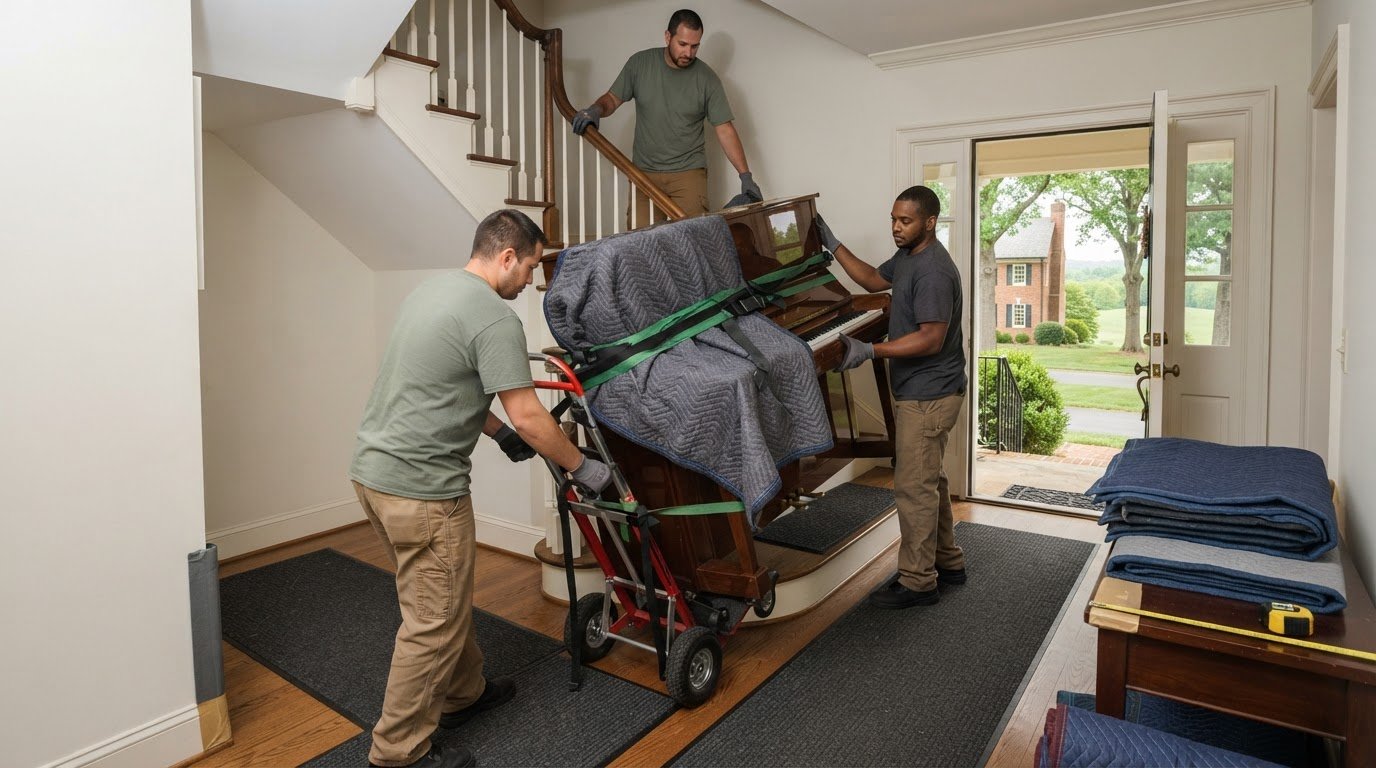
Can a piano make it safely through a tight turn, narrow stairway, or restricted entrance? The route matters as much as careful handling, and guessing can put the instrument and your home at risk. Clifton piano movers for difficult access need a clear picture of the piano’s path before planning the move.
When there isn’t a straightforward route, a few practical details can make the challenge easier to assess. This guide explains what movers consider, which measurements and access notes to prepare, and how Heavy Furniture Moving helps with piano and heavy-item moves in Clifton, Virginia.
You’ll learn how to describe stairs, hallways, doorways, turns, and entry restrictions, along with details about the piano that help shape a moving plan. Outlining the route and its obstacles gives you a clearer sense of what to expect and helps avoid last-minute surprises.
Key Takeaways
- Route planning matters as much as the distance between homes when stairs, narrow turns, or restricted entry complicate a piano move.
- Help Clifton piano movers for difficult access plan by sharing the piano type, route photos, measurements, floor locations, and entry details.
- Compare ordinary furniture-moving support with specialized piano handling to understand how the move’s complexity shapes its planning needs.
- Prepare the path by moving small, movable items out of the way, and leave heavy items untouched.
- Heavy Furniture Moving provides specialized piano and heavy-item moving help in Clifton, Virginia, with a plan tailored to the property and route.
Why Clifton piano moves become difficult when access is tight
A piano’s size and substantial weight can make even a short move feel daunting. Its parts also need careful handling, so a narrow doorway or awkward turn raises concerns about the instrument, walls, floors, and the people guiding it. An open route can make the job more straightforward; a restricted one needs careful planning before the piano is moved.
Distance between addresses doesn’t tell the whole story. A piano traveling across town may face an easier trip than one moving just a few rooms through a staircase, narrow hall, or restricted landing. Every home has its own layout, so one standard method won’t suit every move. Difficult-access piano moving means planning a piano’s route through spaces where width, height, turns, or footing limit easy passage.
For Clifton piano movers for difficult access, the first challenge is understanding the complete path, not just identifying the tightest doorway. Each transition from the piano’s current location to the exit can affect the plan.
Which access obstacles can complicate a Clifton piano move?
Stair width is only one part of the picture. Low ceilings can restrict clearance as the piano changes angle, while tight turns may leave little room to reposition it. A small landing between flights can make a turn harder to assess. Exterior steps, a sloped approach, or limited entry space can add another constraint before the piano reaches the vehicle.
Walk the route and note the narrowest doorway and hallway, stair width, ceiling clearance, landing size, and any changes in floor level. Take photos to show how these features connect, and measurements to show their scale. When possible, photograph turns from both ends and include the approach to the entrance. Together, these details give movers a clearer view than a single photo of the piano or doorway.
Why a piano move needs more than ordinary furniture planning
A piano is not just another bulky household item. Its substantial weight makes careful movement important, and its delicate construction calls for attention beyond simply clearing a path. The piano is a musical instrument played using a keyboard. Planning needs to account for the instrument as well as the space around it.
Moving a sofa or cabinet often centers on its outer dimensions and the route it must pass through. A piano move also calls for a plan suited to the instrument’s size, shape, and careful handling needs. Don’t assume a familiar furniture-moving approach will fit every piano or home. Share what you know about the piano and the full route so the plan reflects the actual conditions in your Clifton home. Accurate details give the move a more considered starting point.
How movers assess a difficult-access piano route
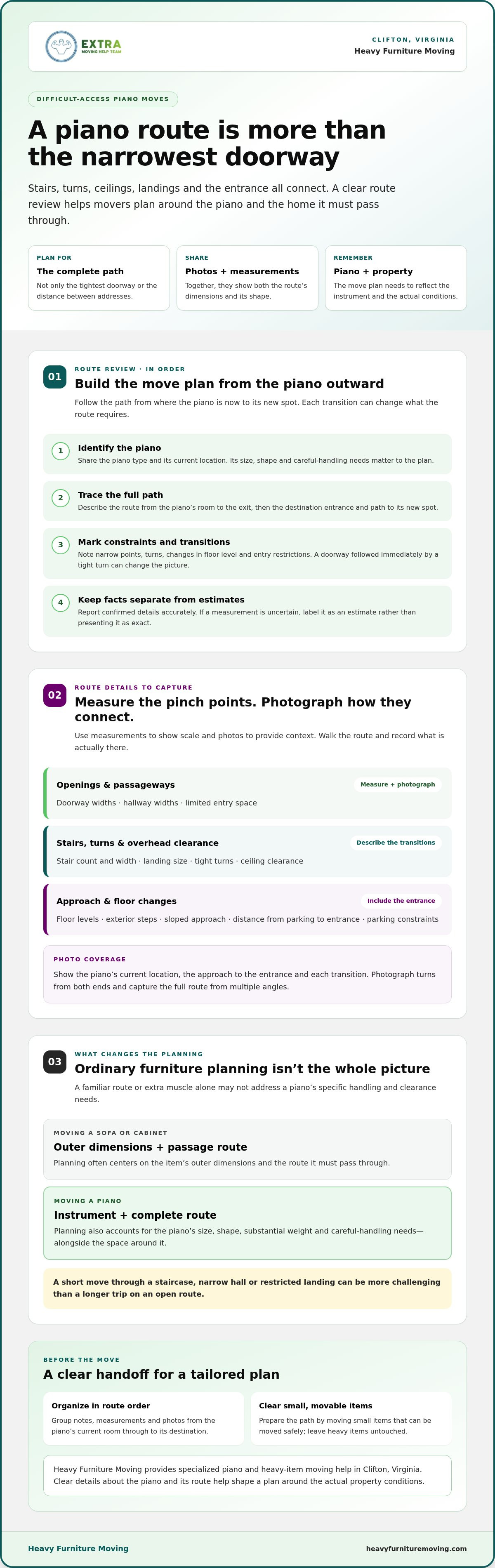
A useful route review follows a clear order: identify the piano, map its path out of the home, note obstacles, and plan around those details. Share the piano’s type and location, along with the route from its current room to the exit. At the destination, describe the entrance and the path to the piano’s new spot. This helps movers plan for the actual conditions instead of relying on guesswork.
Clear route details turn an uncertain move into a plan built around the piano and the home it must pass through. Photos and measurements help show how separate obstacles connect. A narrow doorway may be manageable on its own, but a tight turn immediately beyond it changes the picture.
What access details should you prepare before requesting piano-moving help?
Gather what you can measure or describe accurately. Include doorway and hallway widths, stair count, landing size, tight turns, floor levels, and any steps or sloped approaches. Note limited entry space, parking constraints, and the distance from the parking area to the entrance. Photos should show the full route from multiple angles, including the approach, each transition, and the piano’s current location.
Don’t guess. If a measurement is uncertain, label it as an estimate rather than presenting it as exact. A tape measure can clarify a doorway width, while a photo showing the full doorway adds context. Together, they describe both the dimensions and shape of the route.
How a route review helps set realistic expectations
A route review considers the piano and the complete path through the property, not just one doorway or staircase. It can identify pinch points early, such as a turn at the top of the stairs, a low ceiling, or an entrance that opens onto a narrow hall. Those details support a considered plan and help reduce last-minute surprises. The right approach depends on the piano and the route, so the plan should be based on those details.
Keep confirmed details separate from assumptions. For example, report the number of visible steps, but don’t assume a landing is wide enough based on appearance alone. For general background on safe handling practices, OSHA provides guidelines for safe material handling. A route review describes the layout of a specific move; it doesn’t replace safe handling practices.
Before arranging piano-moving help in Clifton, organize your notes, photos, and measurements in route order. Heavy Furniture Moving provides specialized piano and heavy-item moving help, and clear access details support a plan tailored to your home. Share the route and piano information through Heavy Furniture Moving to begin with a clear picture of the job.
Compare piano-moving options for stairs, tight turns, and restricted entry
A piano move through a clear, open entrance has different demands from one involving stairs, tight turns, or a narrow landing. The right kind of help depends on the piano and the route. Extra muscle alone doesn’t solve a clearance problem. The team needs to understand where the piano must turn, how the path changes, and what handling the move calls for.
Use this comparison as a starting point, not a promise of one fixed method. Ordinary furniture-moving support may suit household items on open routes. Specialized piano-moving support accounts for the added planning involved in moving a heavy instrument through a challenging home layout.
When is specialized piano-moving help the right fit?
Consider specialized support if the route includes a staircase, narrow doorway, tight turn, or limited entry space, especially when several constraints occur together. Physical strength matters, but it doesn’t replace planning and coordinated handling. The NIOSH Lifting Equation helps assess the risk of manual lifting tasks. It offers useful context for why a heavy, awkward move requires more thought than simply adding people.
Heavy Furniture Moving provides piano and heavy-item moving help for Clifton residents. Its piano service is suited to moves where the route calls for careful preparation as well as lifting.
What if the direct route appears blocked?
Pause before changing the plan. The home layout, piano, and safe, practical access determine whether another route is worth considering. A different doorway or path through the property may be an option if it suits the conditions. Not every alternative will work, so assess the full route before choosing one.
A restriction is a planning issue, not a reason to improvise. Don’t force the piano through a tight space or move it along an unassessed route. Share what seems blocked and describe the available alternatives to Clifton piano movers for difficult access, so the move can be considered with the full layout in view.
Prepare your Clifton home for a piano move with difficult access
A little preparation helps make the moving plan specific to your home. Gather the piano’s location, destination, floor levels, and route details, then note anything that could affect access. You don’t need to solve the tight spots yourself. Clear, accurate information gives Heavy Furniture Moving a useful starting point for piano-moving help in Clifton.
A practical pre-move access checklist
Before arranging help, collect the details you know. Mark estimates as estimates, and include photos that show how the spaces connect. Use this checklist:
- Piano and locations: Describe the piano and note its current room, destination room, and floor level at each location.
- Route: Map the path between them, including stairs, landings, turns, doorways, and hallway transitions.
- Measurements and photos: Measure narrow points where possible. Photograph entryways, stairways, landings, and tight turns from more than one angle.
- Property access: Note exterior steps, a sloped approach, limited parking, restricted building entry, or the distance from the parking area to the entrance.
- Surfaces and restrictions: Point out delicate flooring, fragile surfaces, or areas that need extra care, along with any access rules or time constraints that affect entry.
What to clear and what to leave to the moving team
Move small, loose belongings out of the planned path, such as shoes, toys, floor decorations, or lightweight side items. Keep hallways and landings as open as you reasonably can. Don’t shift heavy furniture to make room, and don’t try to tilt, dismantle, or relocate the piano yourself. Leave heavy lifting and piano handling to the moving team.
Before the move, check whether anything has changed. A delivery in the entrance, a newly restricted parking area, or a room that is no longer available can affect the route. Let the team know about changes so the plan reflects current conditions.
When arranging help, include the property location and a plain description of the access challenge. For example, explain whether the piano is upstairs, whether the entrance has steps, and where the narrowest part of the route is. These details help show the move as a whole and support a plan tailored to your home.
Once your notes and photos are ready, Get help with your Clifton piano move from Heavy Furniture Moving. Sharing the piano, route, property, and timing details is a practical first step toward a prepared move.
Choose Heavy Furniture Moving for difficult-access piano moves in Clifton
A challenging piano move needs more than a strong lift. The piano, property, and route all shape what a practical moving plan needs to address. Heavy Furniture Moving provides specialized handling for pianos and other heavy household items, including residential moves in Clifton, Virginia. The plan should account for the home in front of you, rather than assume every piano can follow the same path.
What Heavy Furniture Moving brings to a challenging piano move
Heavy Furniture Moving provides piano-moving help for the access conditions that can make a residential move more demanding. Stairs, tight entryways, and narrow turns can change how the route needs to be considered. Sharing those details supports a plan tailored to the specific piano and property instead of a one-size-fits-all approach.
Heavy Furniture Moving serves customers across Northern Virginia, including Fairfax, Woodbridge, Manassas, Manassas Park, Aldie, Ashburn, McLean, Vienna, Reston, Centreville, Chantilly, Clifton, Dumfries, South Riding, Fairfax Station, Haymarket, and Gainesville. A direct entrance calls for different planning than a route with several transitions between the piano and the outside. For broader local service context, see Reliable Movers Near Me in Fairfax and Northern VA.
How to take the next step for a Clifton piano move
Make your inquiry easier to plan by putting the key details together. Note where the piano is now, where it needs to go, and the floor level at each location. Include access photos, measurements you have taken, and known restrictions such as narrow doorways, stairs, limited parking, or building entry rules. Add your preferred timing so the move can be discussed with the property and route in mind.
Be clear about what you know and what still needs assessment. An accurate description is more useful than a confident guess, especially if the route includes a landing or turn that is hard to judge from one angle. If access conditions change before the move, share the update so the plan reflects the current route.
Heavy Furniture Moving’s piano and heavy-item service supports demanding household moves where the access route deserves careful attention. You don’t need to have every answer before making an inquiry. Start with the piano’s location and destination, describe the property, and share the clearest view you can of the path between them. That gives the move a practical starting point.
If you’re looking for Clifton piano movers for difficult access, take the next step with the details you have. Request help with your piano move and share the piano, route, property, and timing information so the moving plan can be shaped around your home.
Move forward with a plan that fits your home
A complicated route can make a piano move feel like a problem you have to solve alone. You don’t need to map every possibility before taking the next step. Explain what feels most challenging, whether it’s a staircase, limited entry space, or a turn you can’t picture the piano passing through. Mark uncertainties as such. Clear questions are useful, too.
For Clifton piano movers for difficult access, the goal is to make the first discussion useful and grounded in your home’s layout. Gather the details you already have, and let the remaining questions guide the conversation. Planning can then begin without relying on guesses or attempting a risky move yourself.
Heavy Furniture Moving helps customers plan piano moves in Clifton, Virginia. Request help with your Clifton piano move and take the first step toward a more considered plan. A difficult route is easier to address when you have support and a clear next step.
Frequently Asked Questions
Can piano movers handle a narrow staircase or tight turn in Clifton?
A narrow staircase or tight turn can be assessed as part of a planned piano move, but the route and instrument determine what’s practical. Note where the stairway changes direction, whether the landing has a door, and whether a handrail or low ceiling affects clearance. Clifton piano movers for difficult access can use those details to understand the challenge before moving day instead of relying on assumptions.
How do movers get a piano through a doorway that seems too small?
They need to consider the piano’s dimensions alongside the doorway’s clear opening and the space available to approach it. A doorway that looks too narrow may need a closer assessment, including the adjoining hall and any turn immediately beyond the threshold. Don’t try to force the piano through or remove parts yourself. Share measurements and photos so the route can be assessed before anyone attempts the passage.
What information should I give Clifton piano movers before moving day?
Share the piano’s type and current location, its destination, and the floor level at each end. Include photos of the full route, measurements at narrow points, and details such as stairs, landings, exterior steps, parking limits, or building entry rules. If you’re unsure of a measurement, say so. Mention changes, such as a blocked entrance, so the plan reflects current conditions.
Can piano movers relocate an upright piano from an upper floor?
Yes, an upright piano on an upper floor can be considered for a move, with the staircase and complete route included in the plan. The number and shape of stair flights, landing space, ceiling clearance, and the piano’s path to the exit all matter. Share which floor it’s on and whether there’s an elevator or another access restriction. Don’t attempt to carry or tilt it down the stairs yourself.
How much does it cost to move a piano with difficult access?
The cost depends on the specific move, so one amount won’t apply to every difficult-access piano job. Piano type, stairs, tight turns, entry restrictions, and the full route can affect the work involved. Give Heavy Furniture Moving an accurate description of both properties and the piano to support a project-specific assessment. Don’t rely on distance alone, since access conditions can change the scope of a move.
Should I move a piano myself if the route includes stairs?
No. A piano on stairs is a heavy, awkward load, and an uneven step or sudden shift can put people and property at risk. Don’t try to move it with household straps, sliders, or extra helpers. Keep the stair route clear of loose belongings and leave the instrument in place. Professional piano-moving help can assess the conditions and plan the move around the home and piano.
Does Heavy Furniture Moving serve Clifton, Virginia for piano moves?
Yes. Heavy Furniture Moving serves Clifton, Virginia, and provides piano moving as part of its specialized heavy-item services. For a home with stairs, a narrow entrance, or a challenging interior route, share the piano’s location and destination along with the access details you have. The team can use that information to plan for the specific property instead of assuming every Clifton home has the same layout.
Frequently Asked Questions
Stair width is only one part of the picture. Low ceilings can restrict clearance as the piano changes angle, while tight turns may leave little room to reposition it. A small landing between flights can make a turn harder to assess. Exterior steps, a sloped approach, or limited entry space can add another constraint before the piano reaches the vehicle. Walk the route and note the narrowest doorway and hallway, stair width, ceiling clearance, landing size, and any changes in floor level. Take photos to show how these features connect, and measurements to show their scale. When possible, photograph turns from both ends and include the approach to the entrance. Together, these details give movers a clearer view than a single photo of the piano or doorway.
Gather what you can measure or describe accurately. Include doorway and hallway widths, stair count, landing size, tight turns, floor levels, and any steps or sloped approaches. Note limited entry space, parking constraints, and the distance from the parking area to the entrance. Photos should show the full route from multiple angles, including the approach, each transition, and the piano’s current location. Don’t guess. If a measurement is uncertain, label it as an estimate rather than presenting it as exact. A tape measure can clarify a doorway width, while a photo showing the full doorway adds context. Together, they describe both the dimensions and shape of the route.
Consider specialized support if the route includes a staircase, narrow doorway, tight turn, or limited entry space, especially when several constraints occur together. Physical strength matters, but it doesn’t replace planning and coordinated handling. The NIOSH Lifting Equation helps assess the risk of manual lifting tasks. It offers useful context for why a heavy, awkward move requires more thought than simply adding people. Heavy Furniture Moving provides piano and heavy-item moving help for Clifton residents. Its piano service is suited to moves where the route calls for careful preparation as well as lifting.
Pause before changing the plan. The home layout, piano, and safe, practical access determine whether another route is worth considering. A different doorway or path through the property may be an option if it suits the conditions. Not every alternative will work, so assess the full route before choosing one. A restriction is a planning issue, not a reason to improvise. Don’t force the piano through a tight space or move it along an unassessed route. Share what seems blocked and describe the available alternatives to Clifton piano movers for difficult access, so the move can be considered with the full layout in view. A little preparation helps make the moving plan specific to your home. Gather the piano’s location, destination, floor levels, and route details, then note anything that could affect access. You don’t need to solve the tight spots yourself. Clear, accurate information gives Heavy Furniture Moving a useful starting point for piano-moving help in Clifton.
A narrow staircase or tight turn can be assessed as part of a planned piano move, but the route and instrument determine what’s practical. Note where the stairway changes direction, whether the landing has a door, and whether a handrail or low ceiling affects clearance. Clifton piano movers for difficult access can use those details to understand the challenge before moving day instead of relying on assumptions.
They need to consider the piano’s dimensions alongside the doorway’s clear opening and the space available to approach it. A doorway that looks too narrow may need a closer assessment, including the adjoining hall and any turn immediately beyond the threshold. Don’t try to force the piano through or remove parts yourself. Share measurements and photos so the route can be assessed before anyone attempts the passage.
Share the piano’s type and current location, its destination, and the floor level at each end. Include photos of the full route, measurements at narrow points, and details such as stairs, landings, exterior steps, parking limits, or building entry rules. If you’re unsure of a measurement, say so. Mention changes, such as a blocked entrance, so the plan reflects current conditions.
Yes, an upright piano on an upper floor can be considered for a move, with the staircase and complete route included in the plan. The number and shape of stair flights, landing space, ceiling clearance, and the piano’s path to the exit all matter. Share which floor it’s on and whether there’s an elevator or another access restriction. Don’t attempt to carry or tilt it down the stairs yourself.
The cost depends on the specific move, so one amount won’t apply to every difficult-access piano job. Piano type, stairs, tight turns, entry restrictions, and the full route can affect the work involved. Give Heavy Furniture Moving an accurate description of both properties and the piano to support a project-specific assessment. Don’t rely on distance alone, since access conditions can change the scope of a move.
No. A piano on stairs is a heavy, awkward load, and an uneven step or sudden shift can put people and property at risk. Don’t try to move it with household straps, sliders, or extra helpers. Keep the stair route clear of loose belongings and leave the instrument in place. Professional piano-moving help can assess the conditions and plan the move around the home and piano.
Yes. Heavy Furniture Moving serves Clifton, Virginia, and provides piano moving as part of its specialized heavy-item services. For a home with stairs, a narrow entrance, or a challenging interior route, share the piano’s location and destination along with the access details you have. The team can use that information to plan for the specific property instead of assuming every Clifton home has the same layout.