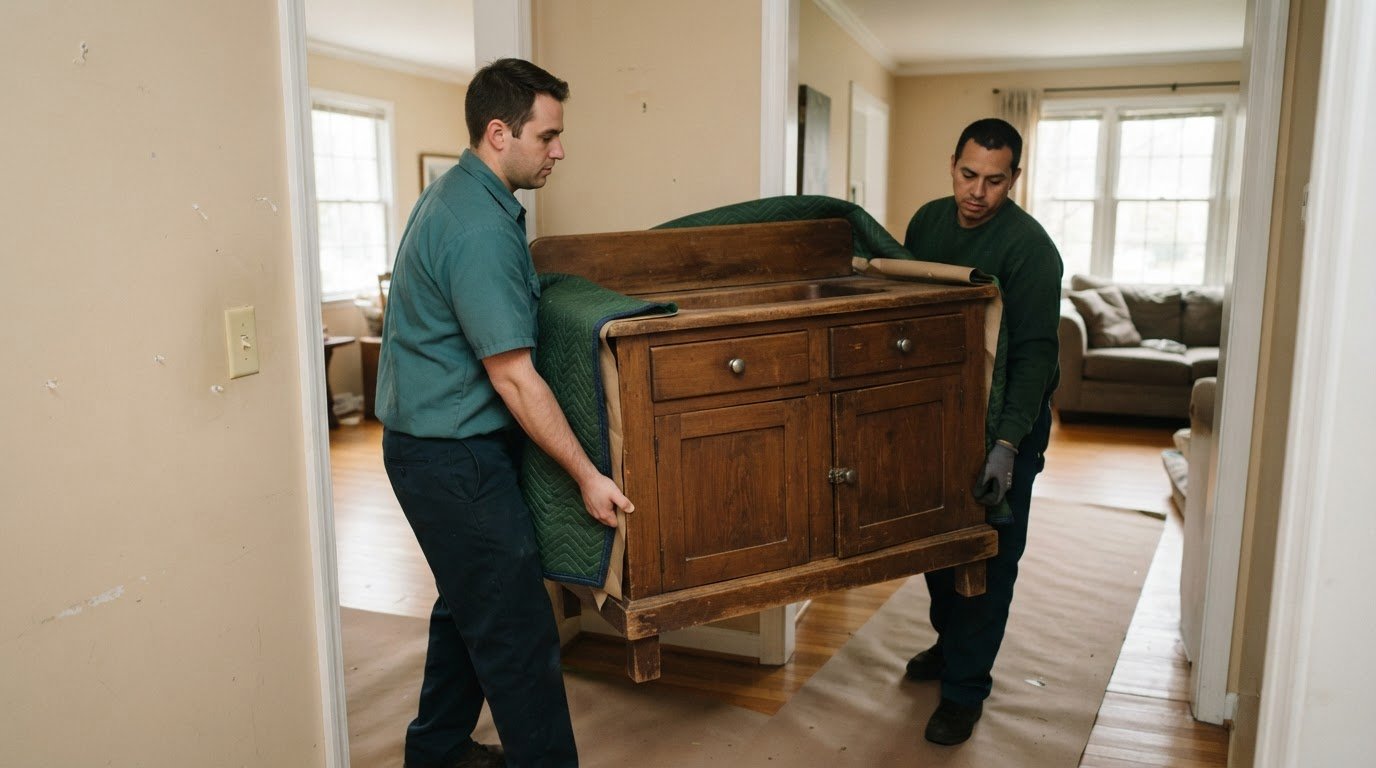
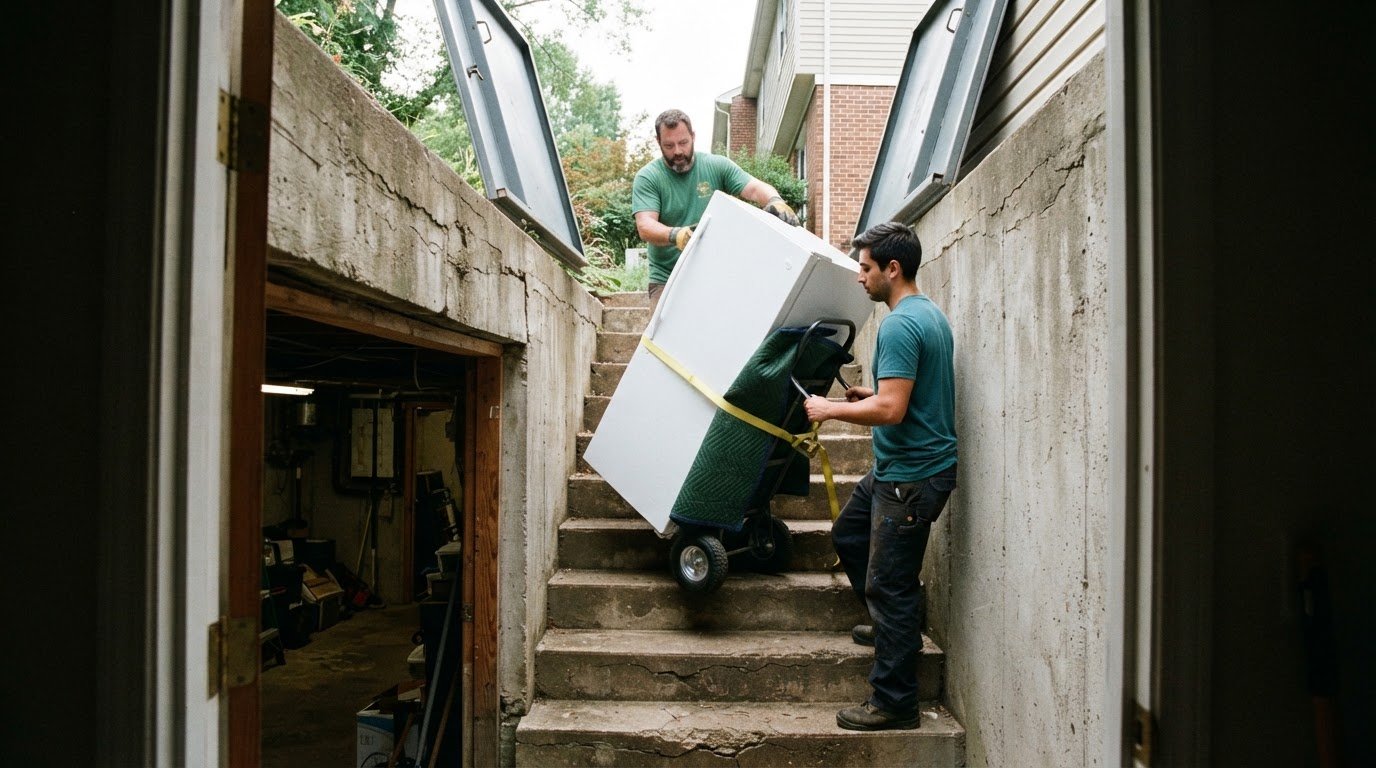
4 Ways to Get a Sectional Over a Railing in Fairfax Station
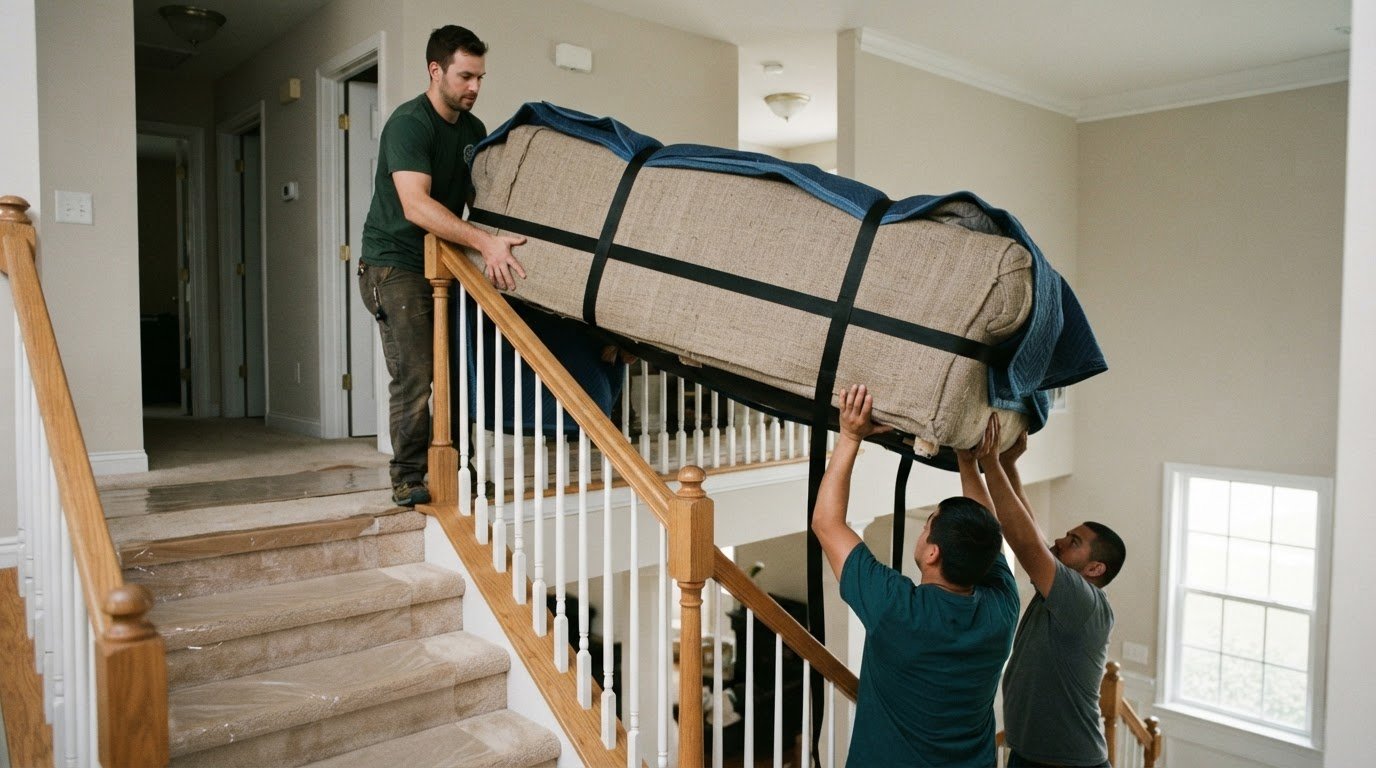
If a sectional gets stuck, stop rather than push harder. Learning how to hoist an oversized sectional sofa over a second-floor railing in Fairfax Station starts with checking whether each piece can clear the stairs, doors, and upper-level opening. If the sofa catches on a landing, ease it back down instead of forcing it around the turn.
It’s tempting to keep pushing when a heavy sofa is almost upstairs, but doing so can strain the furniture and damage nearby walls. Make a plan before lifting: measure each section, remove detachable parts, and protect the stairs and railing.
This guide covers four practical ways to handle the move, from checking clearances and preparing the home to hoisting through an upper-level opening. You’ll also learn what to do if a sectional gets stuck, and when sofa hoisting can help you avoid a difficult stairwell altogether.
Key Takeaways
- Measure each sectional piece and compare its dimensions with the tightest stair, doorway, and turn clearances before moving it.
- Remove detachable parts and protect upholstery, stair treads, railings, and drywall before lifting.
- If stairs won’t work, an upper-level window or deck door may offer another route, but the lift needs careful planning.
- If the sofa catches on a landing, ease it back down instead of forcing it through the turn.
- Check whether the sectional separates into smaller units, which may make the move easier to manage.
1. Hoisting a sofa through an upper-level window or deck door
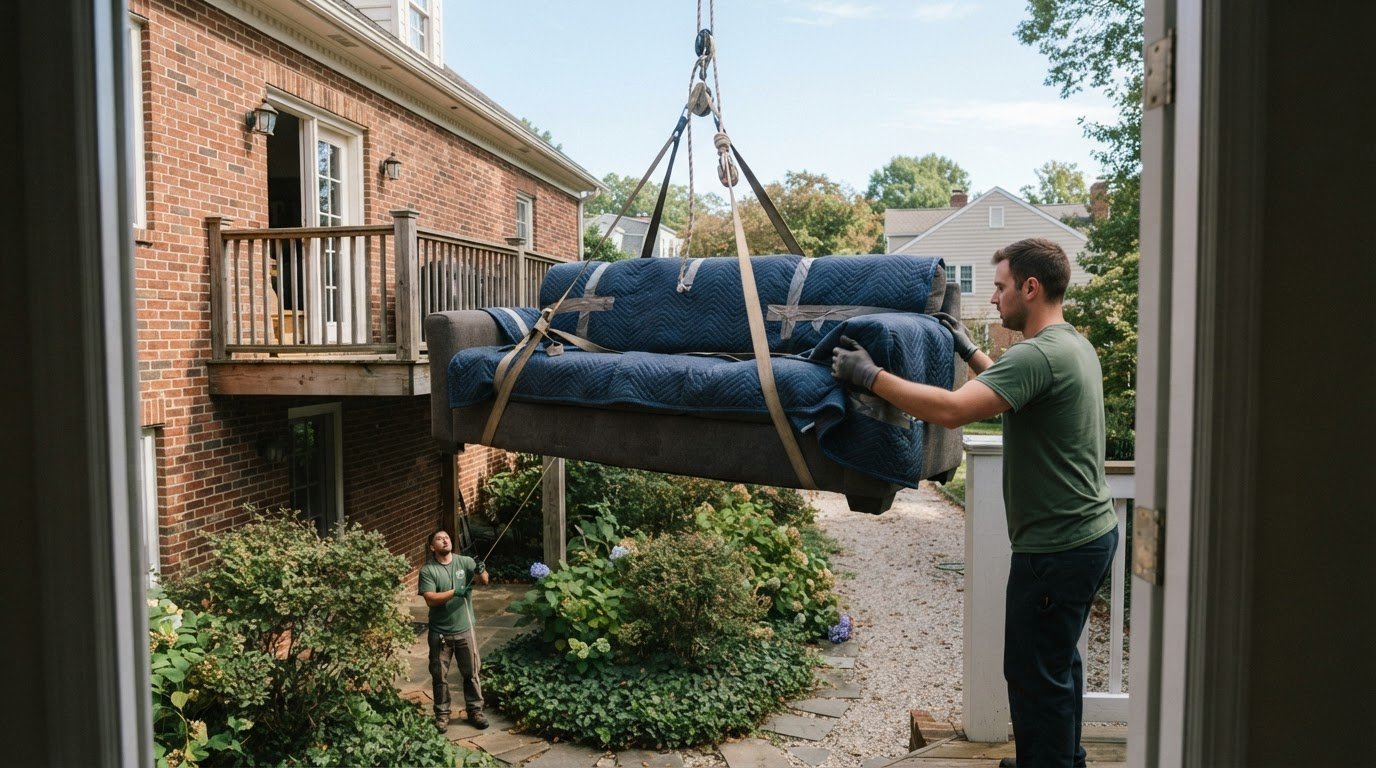
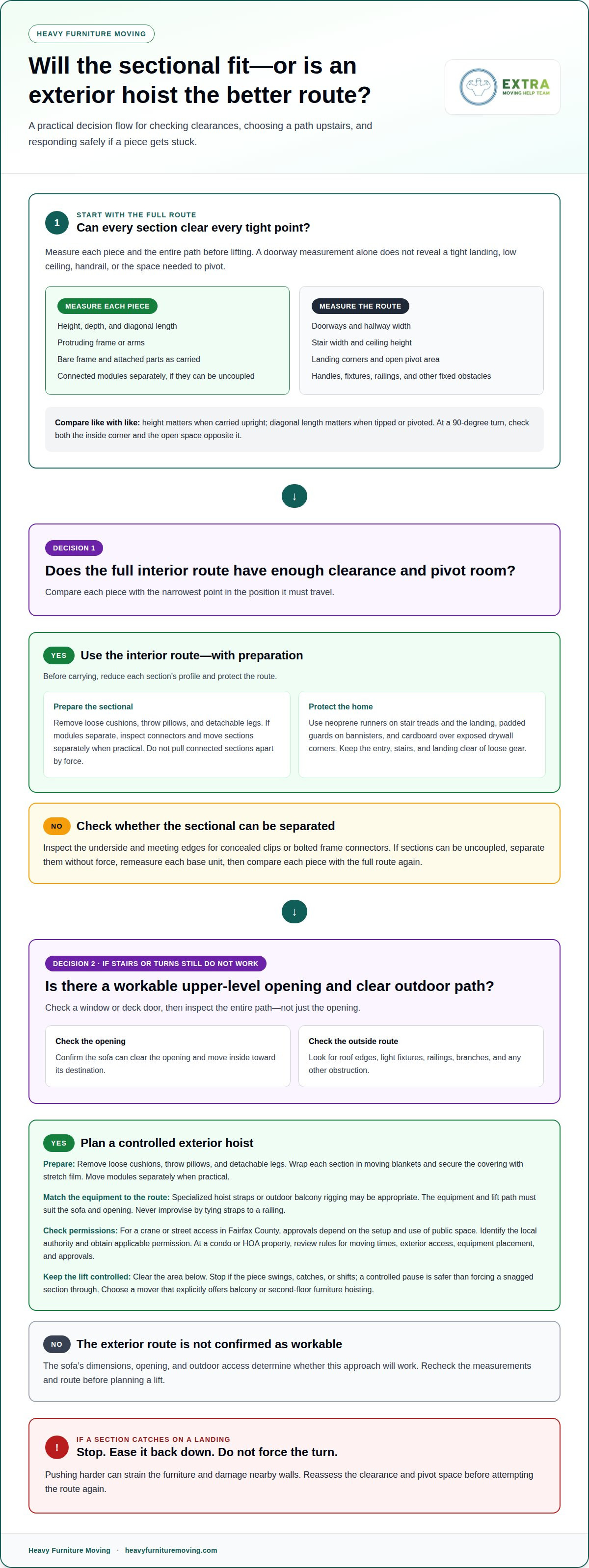
When stairs or tight turns block an oversized sectional, an upper-level window or deck door may offer another route. First check the opening and the entire outdoor path for roof edges, light fixtures, railings, branches, and other obstructions. The sofa needs room not only to clear the opening but also to move inside toward its destination.
Planning how to hoist an oversized sectional sofa over a second-floor railing in Fairfax Station starts with preparing the furniture. Remove loose cushions, throw pillows, and detachable legs to reduce each section’s profile. If the sectional separates into modules, identify the connectors and move sections separately when practical. Wrap each section in moving blankets and secure the covering with stretch film to help protect the fabric or leather.
Specialized hoist straps or outdoor balcony rigging may be appropriate when the stairwell won’t work. The equipment and lift path must suit the sofa and opening. Never improvise by tying straps to a railing. Keep the area below clear, and stop if the piece swings, catches, or shifts. A controlled pause is safer than forcing a snagged section through.
For a crane or street access in Fairfax County, required approvals depend on the setup and whether it uses public space. Find out which local authority manages the space and obtain any applicable permission before arranging the lift. Don’t assume a street, sidewalk, or driveway can be occupied without approval.
Before an exterior hoist at a condo or HOA property, review the rules for moving times, exterior access, equipment placement, and approvals. Ask the property manager which permissions apply and whether the planned lift location is restricted.
A crane or furniture hoist may be needed when a sectional cannot clear interior stairs, turns, or doorways and an upper-level opening offers a workable route. The sofa’s dimensions, the opening, and outdoor access determine whether this approach will work.
Choose a mover that explicitly offers balcony or second-floor furniture hoisting. To plan how to hoist an oversized sectional sofa over a second-floor railing in Fairfax Station, account for the sofa, opening, and route. Specialized hoist straps or outdoor balcony rigging may be used, but the setup must suit the planned path.
2. Measuring sectional pieces and stairwell clearances
Measure every sectional piece before choosing a route. Record its height, depth, and diagonal length, including any protruding frame or arm. Measure the bare frame and attached parts as they’ll be carried. A piece may fit through a doorway upright but fail when tilted toward a stair landing. Keep the measurements together so the crew can compare them with every narrow point.
Measure the full route, not just the front door. Check doorway openings, hallway width, stair width, ceiling height, and the space available at landings. For a 90-degree turn, note the inside corner and the open pivot area opposite it. A sectional needs room to rotate, not merely enough clearance to pass straight ahead. Include door handles, light fixtures, and other fixed obstacles in your route notes.
Use this sequence to build a useful clearance check:
- Measure each sofa section’s height, depth, and diagonal length.
- Record the narrowest doorway and stairwell points.
- Check the landing’s corner-pivot clearance at each turn.
- Compare the piece’s dimensions with the route in the position it must travel.
Compare like with like. The sofa’s height matters when it’s carried upright; its diagonal length matters when it’s tipped or pivoted. The stairwell’s narrowest point may be a handrail, low ceiling, or tight landing corner. A doorway measurement alone won’t reveal those restrictions. If a section only clears when tilted, make sure there’s enough landing space to turn it at that angle.
Measure connected sections separately if they can be uncoupled. Some modular sofas have concealed clips or bolted frame connectors, so inspect the underside and meeting edges before planning the lift. Don’t pull connected sections apart by force. Once separated, measure each base unit again, since feet, brackets, or connectors can affect its dimensions. Record which pieces attach together so they can be positioned correctly upstairs.
Write down the route from the entry point to the destination, marking every tight turn and the measurement that controls it. For example, a piece that clears the hallway may still fail where the staircase turns toward a wall. Resolve that pinch point before lifting; repeated trial-and-error can strain the sofa and scrape nearby surfaces. If measurements show the interior route won’t work, sofa hoisting support may offer another way upstairs.
3. Protecting stair treads, bannisters, and drywall
Prepare the route before carrying the sectional through the house. Use neoprene runners to cushion the stair treads as movers pass. Fit padded guards over the bannister where the frame or hands could make contact. Cover exposed drywall corners with cardboard, especially beside a narrow hallway or stair turn. Each measure protects a different contact point, so none replaces the others.
Start at the bottom of the stairs and work upward. Lay neoprene runners flat across the treads, making sure they stay in place without bunching at the edges. A curled runner can become a trip point or shift underfoot. Cover the full walking path, including the landing where the sectional may need to pause or change direction.
- Use neoprene runners on stair treads and the landing.
- Pad bannisters where the sofa could rub or bump them.
- Place cardboard over exposed drywall corners along the route.
- Keep the entry, stairs, and landing clear of loose gear.
Protect the bannister before the sofa reaches the first step. Attach padded guards along the exposed rail, including beside a landing turn. Make sure they cover likely contact points without blocking a secure handhold. A sectional’s arm or frame can press against the rail as movers pivot, even at a slow pace. Padding helps protect the finish, but the railing is not a lifting anchor.
Position cardboard over the drywall corner facing the moving route. For example, protect the outside corner beside a staircase where a long sofa piece may swing during a turn. Secure the cover without leaving loose flaps that could snag the upholstery. A small patch may not be enough if the sofa’s full height could brush a longer section of wall.
Before moving, walk the route from the entry to the upstairs room. Look for uncovered stair edges, gaps in railing padding, and exposed wall corners. Move décor, shoes, and small furniture out of the way. During the carry, watch the guards and runners; if one shifts, pause in a stable spot and reset it before continuing. A brief stop can prevent a scrape from becoming a larger repair.
Once the sectional is upstairs, lift the runners and guards rather than dragging them across finished surfaces. Check the stair treads, bannister, and protected corners for marks. This final check helps catch damage while the route is still clear.
4. Safe lifting and responding to a sofa stuck on a landing
Before lifting, clear the staircase and choose one person to call each move. High-grip work gloves can help movers hold the furniture, while steel-toe footwear protects feet from heavy pieces. Keep hands away from pinch points between the sectional, wall, and railing. Don’t rush a turn or carry a piece that blocks the movers’ view of the next step.
On stairs, the lower mover supports the sectional’s weight. The upper mover guides its angle and watches for contact with the wall. Agree on simple commands such as “stop,” “lower,” and “turn” before lifting. If either mover loses footing or grip, stop and place the piece in a stable position before continuing.
If the sectional gets stuck on a landing, ease it back down rather than forcing it farther into the turn. Forcing it can increase strain and press it harder against the wall or railing. Once it’s stable, reassess its angle and the available pivot space. Removing a door, bannister handrail, or screw-in furniture legs may provide extra clearance.
Risks during a stair carry or exterior hoist include a dropped or shifting load, strained muscles, trapped fingers, and damage to the sofa or home. Review written insurance terms to understand how they address injury, property damage, and furniture during lifting. Check whether the planned route and hoisting method fall within the stated coverage. Don’t assume a policy covers every part of a move.
- Stop immediately if a mover loses grip or balance.
- Keep other people clear of the stairs and landing.
- Use clear commands before changing the sofa’s angle.
- Set the piece down before changing its route or removing an obstruction.
At a 90-degree turn, don’t twist while supporting the full load. Pause on the landing, keep the sofa supported, and move it only after the crew agrees on the next direction. If the sectional can’t pivot without pressure against a wall, back it out carefully. Then reassess the route instead of repeating the same lift.
Once the piece is upstairs, check the sofa and nearby surfaces for fresh marks or damage. Record any issue promptly and keep the relevant written coverage details with the move information. A steady pace, clear roles, and a controlled reset make a difficult landing easier to manage safely.
5. How do professional movers hoist an oversized sectional sofa over a second-floor railing?
Professional movers plan the route around the sectional, railing, and landing. They identify which pieces separate, where each piece will travel, and how it will enter the second-floor opening. A modular sofa may have hidden locking clips or bolted frame connectors. Movers locate and uncouple those connectors before handling the sections separately.
Next, the crew agrees on the lift path and who will give directions. Each sectional piece needs a stable orientation that fits the opening without catching. Movers use lifting straps suited to the piece and guide it steadily toward the railing or deck-door opening. The railing is an obstacle to clear, not an assumed anchor point for lifting gear.
A careful hoist follows a clear sequence:
- Separate modular sections at their clips or bolted connectors, where those are designed to come apart.
- Prepare each piece by removing detachable legs and loose cushions.
- Position the crew so the lift lead can communicate with people guiding the piece above.
- Raise one piece in a controlled path, pausing if it shifts or catches.
- Guide it through the opening and set it down securely before moving another section.
Communication matters most at the railing, where the sofa changes direction. The lift lead should clearly call each movement, such as “raise,” “hold,” or “lower.” Crew members should avoid pulling in conflicting directions. If a sofa arm meets the opening or the piece begins to swing, stop and stabilize it before adjusting the angle.
At the second-floor opening, the upper guide focuses on clearance and positioning. The person handling the lower end maintains controlled movement without pushing the sofa into the railing. Once the piece crosses the threshold, the crew brings it fully inside before releasing support. A sectional that fits outside may still need careful turning indoors, so keep the destination area clear.
After each section is upstairs, movers can reconnect compatible pieces using their clips or bolts. They check that the sections meet correctly and that no connector is loose. This staged approach makes the lift about manageable pieces, not one awkward, joined sofa.
For a sectional that needs an exterior route, get help planning a controlled sofa hoist instead of improvising a lift over the railing.
Before choosing the lift arrangement, the crew can check whether the sectional separates into units instead of treating its full shape as fixed. Modular sectionals may have hidden locking clips or bolted frame connectors that can be uncoupled, allowing the sofa to move as individual base units. Finding those connections can change the plan from moving one joined object to handling its components in sequence. The crew should confirm that a connection is designed to come apart rather than force an uncertain joint. It can then assess each unit separately and decide how to orient it for the opening before lifting.
Keeping the units organized also helps avoid confusion upstairs. The crew can place them in reassembly order and check that compatible parts meet as intended. If a connection doesn’t release as expected, pause and reassess instead of pulling harder or letting the sofa shift. This keeps preparation focused on separating the sofa safely, not improvising at the railing.
Heavy Furniture Moving: Sofa Hoisting
Heavy Furniture Moving provides Sofa Hoisting for sectional moves that can’t use a practical stairway route. It can help when measurements show the sofa won’t clear an interior turn or when an upper-level opening offers a better path. Share the sectional’s configuration, the planned opening, and the access route so the hoisting can be planned around the move.
For a sectional with detachable sections, note how its pieces connect and which parts can be removed. This clarifies what needs to pass over the railing and into the room. If the sofa can move through the home without an exterior lift, in-home furniture moving help may be a better fit.
Contact Heavy Furniture Moving to discuss sofa hoisting for your sectional.
Set Up Your Sectional’s Next Move
Choose the route before the sofa reaches the staircase. A clear plan accounts for the sectional’s layout, the destination room, and whether an upper-level opening is more practical than an interior carry. If you’re deciding how to hoist an oversized sectional sofa over a second-floor railing in Fairfax Station, focus on what makes the move workable: the piece configuration, access point, and space needed to bring it safely inside.
Have those details ready when discussing the move. Note which sections connect, where the sofa needs to go, and which opening may serve as the lift route. This gives the conversation a practical starting point and helps turn uncertainty into a clear plan.
Contact Heavy Furniture Moving for help with planning your sectional move. Take the next step with a route that fits your home.
Frequently Asked Questions
What should I do if my sectional gets stuck on a staircase landing?
Stop the move and keep the sectional supported; don’t shove it deeper into the turn. Clear people from the stairs, then agree on a controlled way to ease the piece back to its last stable position. Check what is catching, such as an arm, frame, or connected section. If the landing still won’t allow a safe pivot, change the route or separate the sofa into manageable pieces.
How do I measure a sectional sofa, staircase, balcony, and railing before a hoist?
Measure each sofa piece, then record the usable width and height of the intended opening with doors or windows fully open. For stairs, note the narrowest passage and the turning space on each landing. For a balcony or railing, record the approach space and any obstructions above or beside the opening. Compare these measurements with the piece in the position it must travel, not just its upright dimensions.
How do I protect a sofa, railing, siding, windows, and landscaping during a hoist?
Wrap sofa pieces in moving blankets and secure the covering so it can’t slip during handling. Pad railing contact points, protect window trim, and keep glass clear of straps and furniture edges. Outside, move planters and loose items away from the lift path, and don’t drag gear across siding. Keep the area below the hoist clear, including garden beds where a dropped item could cause damage.
Can an oversized sectional be disassembled or moved through a window instead of over a railing?
Yes. A sectional may be separated at designed connectors, and an upper-level window or deck door can provide another route when the stairs won’t work. Check the sofa’s underside and meeting edges for clips or bolts before separating pieces. Then compare each section with the opening and indoor turning space. Remove detachable legs and loose cushions if they obstruct passage, but don’t force fixed parts apart.
Frequently Asked Questions
Stop the move and keep the sectional supported; don’t shove it deeper into the turn. Clear people from the stairs, then agree on a controlled way to ease the piece back to its last stable position. Check what is catching, such as an arm, frame, or connected section. If the landing still won’t allow a safe pivot, change the route or separate the sofa into manageable pieces.
Measure each sofa piece, then record the usable width and height of the intended opening with doors or windows fully open. For stairs, note the narrowest passage and the turning space on each landing. For a balcony or railing, record the approach space and any obstructions above or beside the opening. Compare these measurements with the piece in the position it must travel, not just its upright dimensions.
Wrap sofa pieces in moving blankets and secure the covering so it can’t slip during handling. Pad railing contact points, protect window trim, and keep glass clear of straps and furniture edges. Outside, move planters and loose items away from the lift path, and don’t drag gear across siding. Keep the area below the hoist clear, including garden beds where a dropped item could cause damage.
Yes. A sectional may be separated at designed connectors, and an upper-level window or deck door can provide another route when the stairs won’t work. Check the sofa’s underside and meeting edges for clips or bolts before separating pieces. Then compare each section with the opening and indoor turning space. Remove detachable legs and loose cushions if they obstruct passage, but don’t force fixed parts apart.