Window Hoisting a Sofa in McLean: Safety and Alternatives
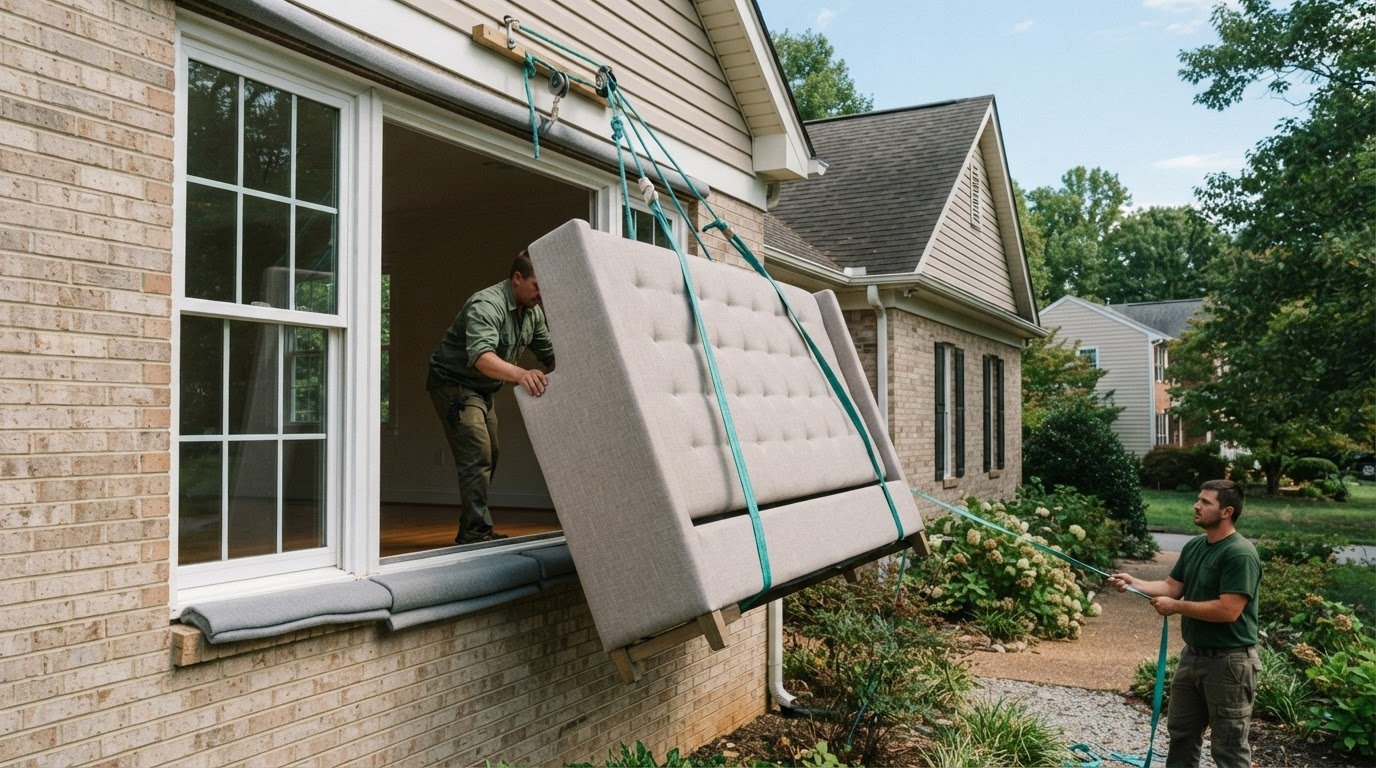
A third-story window hoist may work when a sofa cannot pass through the doors, stairs, hallways, or elevators in any position. To plan how to hoist a custom upholstery sofa through a third-story window frame in McLean, start by measuring the opening and sofa, then assess whether the exterior route allows a controlled lift. Above the first floor, have an experienced crew handle the lift rather than attempting it yourself.
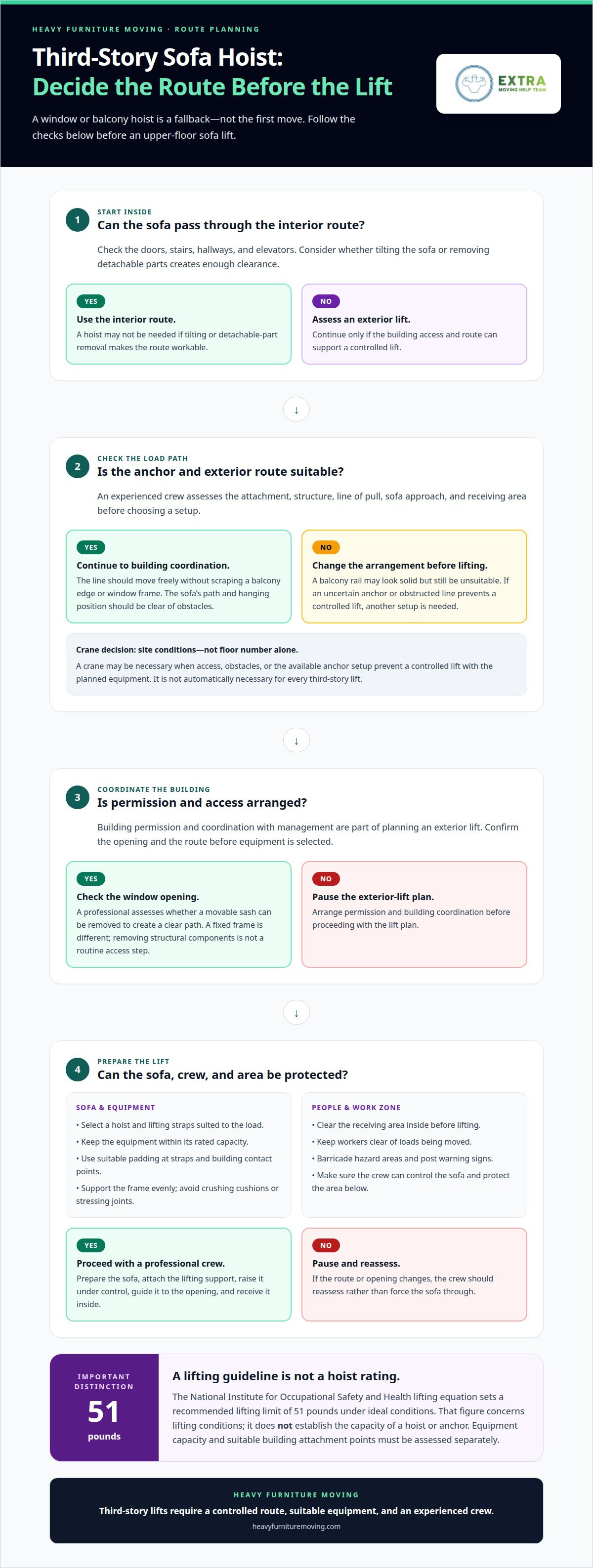
A tight fit doesn’t automatically mean the sofa has to go outside. Tilting it or removing detachable parts may make an interior route possible. A window or balcony hoist can be a fallback when those options do not work.
This guide explains the factors that shape a hoist plan, including access, the window or balcony area, building permission, and lift safety. It also covers when tilting or disassembly may work better, so you can assess the route and plan for your sofa move.
Key Takeaways
- Consider a window or balcony hoist only after the sofa cannot pass through interior routes in any position.
- Safe hoisting depends on suitable anchor points, a clear lift area, and the hoist staying within its lifting capacity.
- Building permission and coordination with management are part of planning an exterior lift.
- Tilting or removing sofa parts may make an interior route possible and avoid a window hoist.
- Heavy Furniture Moving’s sofa-hoisting service can help when an upper-floor lift is the right solution.
Assessing anchor points and balcony safety
A third-story sofa lift needs a secure load path, a clear work zone, and access suited to the building. The crew assesses the structure and route before selecting a hoisting setup.
Anchor Point Assessment
An anchor-point assessment checks whether the proposed attachment can support the planned lift without shifting or damaging the building. This matters because the anchor transfers the sofa’s load to the structure throughout the lift.
Professionals examine the attachment location, surrounding structure, and direction of the pull. A balcony rail may look solid but still be unsuitable for lifting; appearance alone does not establish its capacity. The crew also checks that the line can move freely without scraping a balcony edge or window frame.
The assessment covers the full route, not just the attachment point. The crew considers where the sofa will hang, how it will approach the opening, and whether walls, roof edges, trees, or other obstacles could interfere. A custom upholstery sofa may have a shape or delicate fabric that calls for a controlled, clear path. If the setup relies on an uncertain anchor or an obstructed line, another arrangement is needed.
Hoisting Risks and Crane Needs
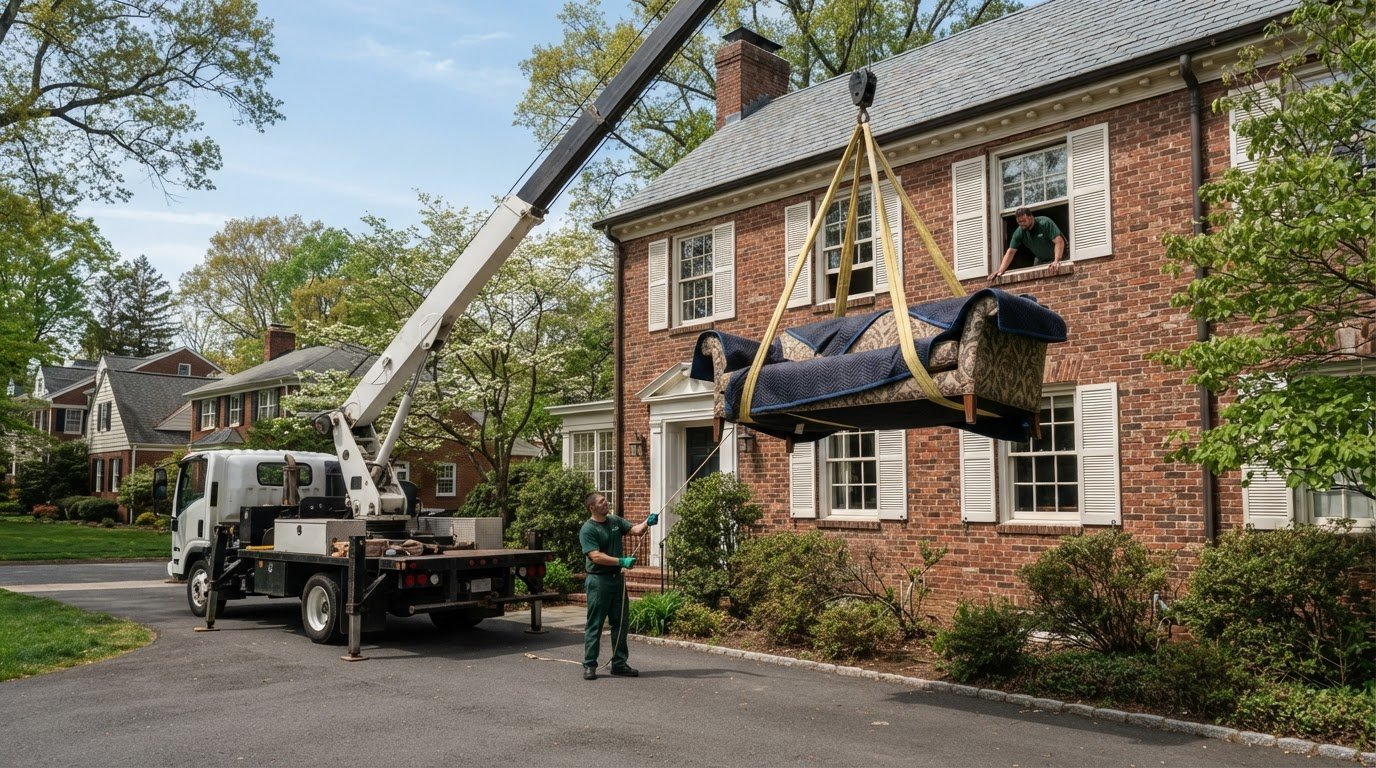
Third-story hoisting can expose people and property to a swinging or dropped sofa, impact against the building, and damage to a balcony or window frame. A crane becomes necessary when the building’s access, obstacles, or available anchor setup prevent a controlled lift with the planned equipment.
That decision depends on the site and load path, not the floor number alone. For example, a narrow balcony without a suitable attachment point may rule out a simple hoist, while exterior obstacles may call for equipment that can reach over them. The crew assesses these conditions before choosing a method. A crane is not automatically necessary for every third-story lift.
People below also need protection from a suspended load. OSHA construction guidance says workers should stay clear of loads being moved, barricade hazard areas, post warning signs, and keep the hoist within its lifting capacity. These precautions help control exposure around the lift, including at the entry point and below the exterior route.
Weight matters, but a lifting recommendation is not a hoist rating. The National Institute for Occupational Safety and Health lifting equation sets a recommended lifting limit of 51 pounds under ideal conditions. That figure concerns lifting conditions; it does not establish the capacity of a hoist or an anchor. The equipment’s rated capacity and the building’s suitable attachment points remain separate considerations.
Balcony access needs careful assessment, too. The crew needs room to handle the sofa without leaning over an unprotected edge or blocking the route. If workers cannot stay clear, control the suspended sofa, and protect the area below, the plan must change before the lift begins.
Planning an upper-floor window or balcony hoist
A planned lift coordinates the building, window opening, sofa, and crew before anything moves outside. For a third-story job, confirm permission and establish a workable route before choosing equipment.
Professional Window Sash or Frame Removal for Furniture Access
Window sash removal means taking out a movable section of a window to widen the furniture opening. It matters because a tight opening can snag upholstery or block the sofa even when the exterior route is clear.
Professionals assess how the sash opens, how it is secured, and whether removing it creates a clear path for the sofa. They protect the opening and nearby surfaces, then handle the sash carefully for reinstallation. A fixed frame differs from a removable sash; removing structural components is not a routine access step. The plan depends on the window’s construction and the clearance the sofa needs.
Equipment Professionals Use for Hoisting
Hoisting equipment supports, raises, guides, and receives the sofa at the window. Choosing a suitable setup matters because the sofa needs to stay controlled along the exterior route.
A professional crew selects a hoist and lifting straps suited to the load, along with protective padding for contact points. The equipment’s rated capacity must accommodate the planned lift. The team also considers the opening and attachment arrangement when choosing gear. A third-story window with limited approach space may call for a different setup from a balcony with a clear lifting path.
How Professionals Protect Upholstery and the Sofa Frame
Protection means securing the sofa’s fabric and frame at contact points before it leaves the ground. This matters especially with custom upholstery, since rubbing against a sill or balcony edge can damage the finish.
The crew uses suitable padding where straps or building edges could touch the sofa, positioning supports to avoid crushing cushions or putting pressure on delicate upholstery. They prevent the piece from scraping the window opening as it moves. The frame needs balanced support, too: uneven pressure can twist the sofa or strain its joints. The crew accounts for each contact point along the route.
The Professional Step-by-Step Hoisting Method
A professional hoisting method coordinates the preparation, raising, and receiving of the sofa. Each stage depends on the previous one being ready.
The crew reviews the route, opening, equipment, and building arrangements first. Before lifting, they prepare the sofa and clear the receiving area inside. They attach the lifting support, raise the sofa under control, and guide it toward the opening. At the window, workers receive the sofa and move it inside before removing the lifting gear. If the opening or route changes, the crew pauses to reassess rather than forcing the sofa through.
Before an exterior lift, occupants should arrange permission with building management and discuss insurance with the mover. Above the first floor, use an experienced crew rather than attempting a DIY lift. For a coordinated professional sofa hoist, those planning details help shape the work around the building and furniture.
When window hoisting is appropriate
A window hoist is a fallback when a sofa cannot pass through doors, stairs, hallways, or elevators in any position. For a third-story move, the decision follows an assessment of the route, not the sofa’s size alone. Consider how to hoist a custom upholstery sofa through a third-story window frame in McLean when an interior route has a tight turn or narrow landing.
The key test is whether the entire interior route works, from entry to destination. A sofa might clear the apartment door but fail at a stair landing, hallway turn, or elevator entrance. The crew considers each tight point, including room to rotate or tilt the piece. If an obstruction rules out every workable position, an exterior route may be practical.
Dimensions help explain why a direct carry may fail, but they do not determine the route by themselves. A custom sofa’s arms, back, legs, and overall shape affect how it can turn. The crew compares these features with doorway widths, ceiling height, landing space, and the final window opening. Measurements that seem adequate on paper may still leave too little room to angle the sofa safely.
Hoisting makes sense only when the outside route offers a controlled way to reach the opening. The crew considers whether the sofa can approach the window without striking the building or nearby obstacles. They also assess whether the receiving space inside can accommodate it. If the window, balcony, or landing leaves too little room to guide the sofa, the exterior route may not solve the access problem.
Before selecting a hoist, professionals compare it with simpler ways through the building. Removing sofa legs or detachable arms, or changing the angle, may provide enough clearance for an interior route. These options matter for custom upholstery because unnecessary handling outside increases exposure to contact with the building. The decision takes account of access, the sofa’s construction, and how well the piece can be protected.
A useful assessment follows the sofa from the building entrance to its final room. It identifies the exact obstruction, such as a stair turn that prevents rotation or a hallway too narrow for the sofa in any position. Then the crew checks whether a window route avoids that obstruction while allowing a controlled lift. If neither route works safely, the plan needs another approach, not a forced fit.
If you’re considering how to hoist a custom upholstery sofa through a third-story window frame in McLean, assess the complete route, not just the opening. The sofa’s shape, interior bottlenecks, and usable exterior access all matter. When the sofa cannot pass through any interior route in any position and the outside route can be managed safely, a window hoist may be suitable.
Alternatives to hoisting, including disassembly and tilting
Before choosing an exterior lift, professionals assess whether repositioning the sofa or removing parts will let it pass indoors. If repositioning or removing parts makes the interior route workable, an exterior move may not be needed. Compare the sofa’s largest dimensions with every tight point along the route, including doorways, hallway turns, stair landings, and the final room entrance.
Tilting changes which sofa dimension must clear an opening. For example, a sofa measuring 38 inches front to back and 34 inches tall may fit through a 36-by-48-inch window when stood on end with its arms removed. That example shows why a straight-on measurement can miss a workable angle. The crew must consider the sofa’s full shape and whether the route provides room to turn it.
Disassembly can provide more clearance when the sofa has parts designed to come off. Removable arms or legs may reduce its dimensions, and taking off cushions can make it easier to position. The crew considers how each part attaches and how to protect the upholstery during handling. Never force a fixed frame apart just to make the sofa fit.
- Measure the narrow point: Compare the sofa with the tightest doorway, turn, or landing.
- Consider the angle: Check whether standing the sofa on end changes the clearance needed.
- Identify removable parts: Account for detachable arms, legs, or cushions in the route plan.
- Reassess the opening: Compare the reduced or repositioned sofa with the window dimensions.
Every route involves more than one measurement. A sofa may clear a doorway but fail at the turn beyond it, where a wall limits rotation. A stair landing may also leave too little space to change the sofa’s angle. Removing a part might help at the doorway but still leave the landing as the deciding obstruction.
For custom upholstery, the alternative should protect both fabric and frame. Professionals plan the sofa’s position before moving it, helping avoid scraping a wall or pressing a finished surface against an edge. They also consider whether the sofa can be handled steadily after a part is removed. The goal is a workable path, not just a smaller measurement.
In McLean, compare the interior route and window opening as complete paths, not isolated openings. If tilting or safe disassembly provides clearance at every turn, moving the sofa indoors may be better. If it still cannot pass through any interior route in any position, hoisting remains a possible fallback. The route assessment determines which method suits the sofa and building.
How do professionals remove a window sash or frame safely for furniture access?
Professionals first determine whether the window has a removable sash or a fixed frame. This distinction matters because removing a movable section can widen the opening, while taking out a fixed frame may affect the surrounding construction. The crew plans access around the window’s design, not just the sofa’s dimensions.
Before handling a sash, the crew examines how it opens and what holds it in place. They look for nearby surfaces that need protection and decide where to place the removed section securely. If the sash does not release as expected, they stop rather than force it. A damaged window can create a new hazard and compromise the access route.
Window type affects the removal plan. A sliding sash, for example, may move differently from a hinged section. The crew identifies how the window operates and plans to clear the opening without putting pressure on glass or trim. If the design is fixed or removal could affect the frame, they do not treat it as a routine furniture-moving step.
Safe access also depends on the opening once the sash is removed. The team compares the usable clearance with the sofa’s width, height, and turning space. A sofa that fits the opening in one position may still need room to rotate as it enters. The crew accounts for that movement before deciding whether sash removal provides enough access.
Professionals keep the work area controlled while the window section is out. They protect the opening, keep loose components clear of the lift path, and coordinate the timing with the furniture movement. The sash should not be left where it could obstruct workers or the sofa. After the furniture is inside, the window section can be returned to its intended position if the removal plan allows.
Removing an entire frame is different. A frame may connect to the surrounding wall, so taking it out can involve work beyond opening a path for furniture. The moving plan should distinguish between a removable sash and building components that should stay in place. If the opening cannot be made suitable without altering fixed construction, reconsider the route rather than forcing that change.
For a custom sofa, the access plan needs to protect both the window and the upholstery. Professionals coordinate sash handling with the sofa’s approach so the opening is ready before the lift begins. They also account for reassembly and the space needed to restore the window afterward. This keeps furniture access from becoming a separate, improvised job.
Need a coordinated plan for a tight window opening? Arrange professional sofa-hoisting help for the move.
Heavy Furniture Moving: Sofa Hoisting
Heavy Furniture Moving provides Sofa Hoisting when a sofa cannot pass through a building’s interior route and an exterior lift is suitable. The service offers a professional way to plan access around the sofa, window, and building. Share the sofa’s dimensions, floor, and any tight turns or restricted openings you know about. These details help shape the moving plan and determine whether hoisting is more suitable than tilting or removing detachable parts. If an interior route works, a window lift may not be needed. If it doesn’t, professional sofa hoisting can address the access challenge. Contact Heavy Furniture Moving to discuss your sofa move.
Plan the next move with confidence
For a custom upholstery sofa moving through a third-story window frame in McLean, turn the access details into a clear moving plan. Gather the sofa’s dimensions and note any tight turns, limited openings, or building access arrangements. These details give the moving team useful context for discussing your route and the right approach for your home.
Heavy Furniture Moving offers Sofa Hoisting, Movers Near Me, and Exercise Equipment Moving. If you’re comparing an exterior lift with another way into the room, share details about your sofa and building so the conversation can focus on your move.
Contact Heavy Furniture Moving to discuss your sofa move and the access challenge. With a clear plan, you can take the next step toward getting your furniture where it belongs.
Frequently Asked Questions
Can you hoist furniture through a window on an upper floor?
Furniture can be hoisted through an upper-floor window when the route and opening suit the item and the lift can be controlled. For a sofa, the crew considers how it will enter the room and where it can be received. Building access matters too: shared entrances, loading areas, and move timing can affect how the lift is arranged.
What about permits?
Permit requirements depend on the property and planned setup, so there is no single answer for every McLean building. Ask building management about permission, access, and rules for shared areas. Discuss the proposed lift with the moving crew, especially if equipment may occupy a driveway, sidewalk, or other shared space. Coordinating these details helps identify requirements before moving day.
How do you price a sofa hoist?
Pricing depends on the job’s access, sofa, and required labor. Heavy Furniture Moving provides quotes upfront before work begins. Its pricing model uses hourly labor with a 2-hour minimum, while most single heavy items use flat-rate pricing. The route, stairs, and any added handling affect the quote. The applicable structure and total are provided before work starts, so the plan and price can be considered together.
Is hoisting safe for my balcony or railing?
Do not treat a balcony or railing as a lifting anchor just because it looks sturdy. The lift plan must account for how the load is supported and whether the balcony offers usable space for workers and furniture. A narrow balcony, for example, may leave little room to guide a sofa. The crew assesses the setup and changes the route if it cannot be controlled safely.
How do professionals measure a custom upholstery sofa and third-story window for hoisting?
Professionals measure the sofa’s width, height, and depth, then compare them with the window’s clear opening and the space needed to turn it. Planning how to hoist a custom upholstery sofa through a third-story window frame in McLean also means accounting for removable legs or arms, the sill, and the room inside. A photo can show the sofa’s shape and nearby obstacles, but it cannot replace measurements.
How much does furniture hoisting or a crane lift cost in McLean, Virginia?
The cost of a sofa hoist or crane lift in McLean depends on the sofa, access, labor, and whether the site requires crane equipment. Heavy Furniture Moving provides an upfront quote before work begins, based on the job details. Share the floor, sofa dimensions, and access constraints so the quote reflects the actual move rather than a generic figure.
Which McLean or Northern Virginia furniture movers provide window hoisting services?
Heavy Furniture Moving offers Sofa Hoisting for furniture that needs an exterior route. Its local service area includes McLean, Fairfax, Woodbridge, Manassas, Manassas Park, Aldie, Ashburn, Vienna, Reston, Centreville, Chantilly, Clifton, Dumfries, South Riding, Fairfax Station, Haymarket, and Gainesville. The service may suit a sofa that cannot travel through the home’s interior route when the building supports a planned lift.
How do I find a licensed and insured furniture hoisting company in McLean?
Look for written documentation identifying the business responsible for the lift, its licensing and insurance details, and the work those documents cover. Keep the service scope and relevant documentation together before work begins. If you’re considering how to hoist a custom upholstery sofa through a third-story window frame in McLean, these details can help clarify who is responsible for the work and how the move is arranged.
Frequently Asked Questions
Furniture can be hoisted through an upper-floor window when the route and opening suit the item and the lift can be controlled. For a sofa, the crew considers how it will enter the room and where it can be received. Building access matters too: shared entrances, loading areas, and move timing can affect how the lift is arranged.
Permit requirements depend on the property and planned setup, so there is no single answer for every McLean building. Ask building management about permission, access, and rules for shared areas. Discuss the proposed lift with the moving crew, especially if equipment may occupy a driveway, sidewalk, or other shared space. Coordinating these details helps identify requirements before moving day.
Pricing depends on the job’s access, sofa, and required labor. Heavy Furniture Moving provides quotes upfront before work begins. Its pricing model uses hourly labor with a 2-hour minimum, while most single heavy items use flat-rate pricing. The route, stairs, and any added handling affect the quote. The applicable structure and total are provided before work starts, so the plan and price can be considered together.
Do not treat a balcony or railing as a lifting anchor just because it looks sturdy. The lift plan must account for how the load is supported and whether the balcony offers usable space for workers and furniture. A narrow balcony, for example, may leave little room to guide a sofa. The crew assesses the setup and changes the route if it cannot be controlled safely.
Professionals measure the sofa’s width, height, and depth, then compare them with the window’s clear opening and the space needed to turn it. Planning how to hoist a custom upholstery sofa through a third-story window frame in McLean also means accounting for removable legs or arms, the sill, and the room inside. A photo can show the sofa’s shape and nearby obstacles, but it cannot replace measurements.
The cost of a sofa hoist or crane lift in McLean depends on the sofa, access, labor, and whether the site requires crane equipment. Heavy Furniture Moving provides an upfront quote before work begins, based on the job details. Share the floor, sofa dimensions, and access constraints so the quote reflects the actual move rather than a generic figure.
Heavy Furniture Moving offers Sofa Hoisting for furniture that needs an exterior route. Its local service area includes McLean, Fairfax, Woodbridge, Manassas, Manassas Park, Aldie, Ashburn, Vienna, Reston, Centreville, Chantilly, Clifton, Dumfries, South Riding, Fairfax Station, Haymarket, and Gainesville. The service may suit a sofa that cannot travel through the home’s interior route when the building supports a planned lift.
Look for written documentation identifying the business responsible for the lift, its licensing and insurance details, and the work those documents cover. Keep the service scope and relevant documentation together before work begins. If you’re considering how to hoist a custom upholstery sofa through a third-story window frame in McLean, these details can help clarify who is responsible for the work and how the move is arranged.