What Is a Certificate of Insurance for Movers in Gainesville, VA?

A mover’s certificate of insurance can help satisfy a building’s move-in rules, but it doesn’t promise that every loss will be covered. If you’re searching “what is a certificate of insurance for movers Gainesville,” the practical answer is that a COI summarizes selected insurance details for a recipient. It’s useful for coordinating paperwork, but it isn’t the insurance policy or a guarantee that a particular claim will be paid.
It’s reasonable to want proof of insurance before movers carry furniture through a lobby, hallway, or elevator. A certificate of insurance, often called a COI, is not the same as coverage for your belongings. Nor does it automatically guarantee payment if someone is injured or property is damaged.
This guide explains what a mover’s COI shows, what it doesn’t establish, and why a Gainesville building or property manager may request one. You’ll also learn how to coordinate the paperwork, which names and details to clarify with management, and how to plan for move-day requirements. Whether you’re arranging a full household move or moving bulky items, preparing the documents and access plan early can help prevent avoidable delays.
Key Takeaways
- Learn what a COI summarizes and why a Gainesville building or property manager may request one before move day.
- Review the key details on the document, including the named insured, insurer, policy dates, and limits.
- Understand what is a certificate of insurance for movers Gainesville, and why a COI doesn’t guarantee payment for a particular loss.
- Coordinate the paperwork by getting the building’s written requirements, sharing them with the mover, reviewing the certificate, and submitting it by the property’s deadline.
- Plan for item size, access routes, stairs, packing needs, and move scope alongside the paperwork.
What Is a Certificate of Insurance for Movers in Gainesville?
A certificate of insurance (COI) summarizes reported insurance information for a stated certificate holder. It can identify the insured business, insurer, policy type, and policy dates, but it isn’t the insurance policy itself. Think of it as a snapshot of selected coverage details, not a promise that a specific claim will be paid.
If you’re asking “what is a certificate of insurance for movers Gainesville,” think of it as a document that can help coordinate a move with a property manager. General proof of insurance can show that insurance information has been provided, but the underlying policy contains the terms that determine how coverage applies. The COI communicates key details without replacing those terms.
Why might a Gainesville building request a mover’s COI?
An apartment, condominium, or managed property in Gainesville, Virginia, may request a mover’s COI as part of its move-in paperwork. Management might need it when arranging building access, reviewing a move reservation, or preparing for activity in shared areas such as an elevator, hallway, or loading zone. These are property-specific procedures, not one citywide rule. Follow your building’s written instructions, including its submission process and deadline.
Who uses the certificate during a move?
The property manager may request the document, the mover provides the certificate, and the customer helps coordinate the request. The certificate holder is the party named on the document as the recipient. That party may be different from the person who requested it. Get the exact name and any required wording from management rather than assuming the resident should be listed as the holder.
For example, a resident might reserve an elevator and loading area for moving day. The building manager requests a COI and specifies which property entity must appear as the certificate holder. The resident passes those instructions to the mover, then submits the completed document to management. Each person has a clear role: management provides the requirements, the customer shares them and follows up, and the mover supplies the certificate.
Save the request and submitted certificate with your move-planning records. If the building asks for a revision, its instructions can help pinpoint the issue, such as an incorrect holder name or missing detail. Don’t treat the COI as a guarantee about damage to the building, injuries, or your belongings. Its purpose is to help everyone coordinate paperwork before the crew arrives and furniture starts moving through shared spaces.
How to Read a Mover’s Certificate of Insurance
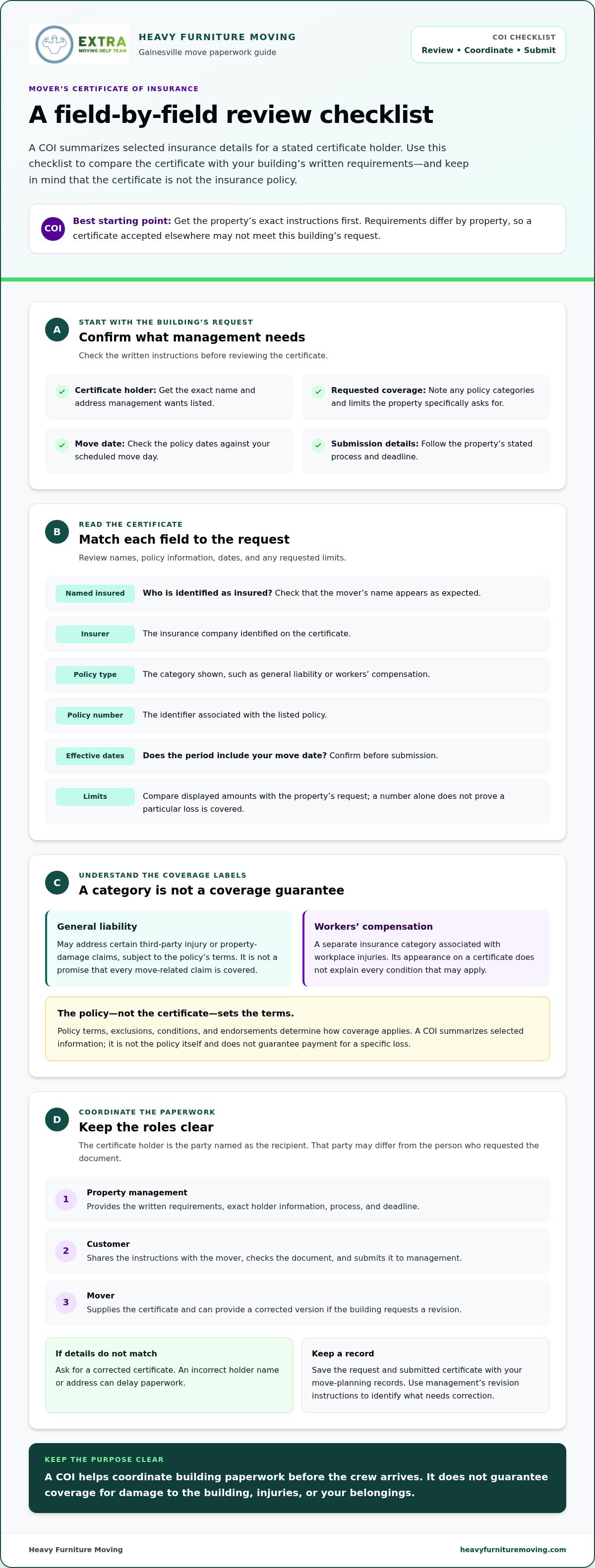
A COI can look dense, but you can review it field by field. Start with your building’s written requirements, then compare the names, dates, and coverage categories. A large limit on the page matters less than whether the document matches the property’s request. If you’re researching what is a certificate of insurance for movers Gainesville, remember that the certificate summarizes reported policy details. It doesn’t replace the policy wording that governs coverage.
Which certificate details should you compare with building instructions?
Check the certificate holder’s name and address against the exact information from property management. Confirm that the displayed policy dates include your planned move date. Then look for any coverage categories and limits the building specifically requested. Requirements can differ from one property to another, so don’t assume a certificate that worked elsewhere will meet your building’s instructions.
Use these fields as a practical reading guide:
- Named insured: The person or business identified as insured under the listed policy. Check that the mover’s name appears as expected.
- Insurer: The insurance company identified on the certificate.
- Policy type: The category of insurance shown, such as general liability or workers’ compensation.
- Policy number: The identifier associated with the listed policy. It distinguishes that policy from others.
- Effective dates: The period shown for the policy. Make sure it includes your scheduled move date.
- Limits: The amounts that may be displayed for a coverage category. Compare them with the property’s request, but don’t assume a number alone proves that a particular loss is covered.
Read the certificate-holder section carefully. A property manager may request the document, while the building owner or management entity is named as the holder. Those roles can differ. If the holder’s name or address doesn’t match the instructions, ask for a corrected certificate before submitting it. A mismatch can delay paperwork even when other requested details are present.
What do general liability and workers’ compensation refer to?
General liability is a policy category that may address certain third-party injury or property-damage claims, subject to the policy’s terms. It isn’t a blanket promise that every claim involving a building, resident, or move will be covered. Workers’ compensation is a separate insurance category associated with workplace injuries. Its appearance on a certificate doesn’t explain every condition that may apply.
Policy terms, exclusions, conditions, and endorsements determine how coverage applies; a COI only summarizes selected information. Endorsements are changes or additions to a policy, and a certificate’s brief wording may not show their full effect. Don’t assume a listed limit applies to every situation or that a building’s requirement has been met just because a figure appears. Compare the certificate with the property’s instructions and clarify any mismatch.
Clear paperwork is one part of a well-planned move. For practical help with the physical side, including bulky household items, explore Gainesville moving help.
What a COI Does Not Prove About Movers’ Insurance
A certificate of insurance does not guarantee that an insurer will pay for a particular loss. It reports selected policy information, but it doesn’t decide whether a claim is covered or how much may be paid. That distinction matters when a building requests a COI before move day: meeting a paperwork requirement is not the same as confirming protection for every possible accident or damaged item.
Coverage depends on the actual policy and the facts of a claim. Exclusions may rule out certain situations, conditions may set requirements that must be met, and policy dates determine when coverage applies. Endorsements can also change or add terms. A limit printed on a certificate is only one piece of information. By itself, it doesn’t show that a particular event falls within coverage.
Is a certificate the same as an insurance policy?
No. The policy contains the operative terms, while the certificate summarizes selected details. A certificate alone may not change the policy or create new rights. If the certificate appears to conflict with the property manager’s request or other policy information, seek clarification from the insurance professional who issued it. Don’t rely on a brief certificate entry to resolve a coverage question.
Keep these three moving-related documents and concepts distinct:
- The COI: Summarizes reported insurance details, often for a property or other certificate holder.
- The moving agreement: Sets out the terms of the customer’s arrangement with the mover, including applicable responsibilities for the move.
- Valuation or separate damage protection: Describes how responsibility for belongings or a separate protection arrangement is addressed. Its terms aren’t established by the building’s COI.
Review the moving agreement and any separate protection paperwork for the terms that apply to your belongings. Don’t assume that a building’s insurance-document requirement also settles what happens if a sofa, piano, or box is damaged. Those questions relate to your arrangement and the relevant written terms, not simply to whose name appears as certificate holder.
Does a COI guarantee coverage for damaged furniture?
No. Whether damage to furniture is covered depends on the applicable policy, the circumstances, relevant exclusions and conditions, and the claim review. A COI documents information but does not decide a future claim. A certificate submitted to support building access also doesn’t determine a customer’s rights under a moving agreement. Both issues may matter during the same move, but they are separate.
If you’re asking “what is a certificate of insurance for movers Gainesville,” keep the practical takeaway simple: use the COI to coordinate the property’s document requirements, then review the separate moving and protection terms for questions about your belongings. For help interpreting policy language or how it may apply to a specific loss, speak with a qualified insurance professional. This section explains general document differences, not the terms of any individual policy or a legal conclusion.
How to Coordinate a COI for a Gainesville Move
Paperwork is easier to manage when the property’s instructions reach the mover before the certificate is prepared. Apartments, condominiums, and managed communities in Gainesville can have different submission rules, reservation steps, and deadlines. Don’t rely on a general checklist or assume a nearby property follows the same process. Use your building’s written requirements and leave time to address corrections before moving day.
What information should you gather before requesting a certificate?
Before requesting a COI, collect the certificate-holder name and address exactly as the property provides them. Save any required wording, requested coverage categories or limits, submission instructions, and the name or department that should receive the document. Record your move date and relevant access details, such as an elevator or loading-area reservation. If the property hasn’t specified a limit, don’t guess or treat another building’s requirement as a standard.
Follow this sequence to make the request clear:
- Get the property’s written requirements. Ask management for its current COI instructions, deadline, and move-reservation steps. Keep the message or document handy.
- Share the full request with the mover. Pass along the exact holder name, address, wording, requested categories or limits, move date, and submission method. A complete request helps avoid follow-up over missing details.
- Review the certificate before sending it. Compare the holder’s name and address with the property’s instructions. Check that policy dates include the planned move date and that requested categories or limits appear as specified. Flag discrepancies rather than assuming they’ll be accepted.
- Submit it through the stated process. Follow the property’s instructions and keep a copy with your move records. Store the COI separately from your moving agreement and any paperwork about your belongings.
What should you do if the certificate is rejected?
Start with the property manager. Ask which specific item needs attention, such as a mismatched holder name, an incomplete address, a date that doesn’t cover the move, or a requested detail that isn’t shown. Send that feedback and the original written requirement to the mover so the party preparing the certificate can review it. Once corrected, resubmit it through the property’s stated process and save the updated copy. Don’t change policy details yourself or guess at wording.
If your building has a firm document deadline or requires approval before confirming a move reservation, work backward from that date. The practical answer to “what is a certificate of insurance for movers Gainesville” includes coordinating the paperwork with your own property’s instructions, not relying on an assumed citywide rule. For help planning the residential move around building access and household items, plan your Gainesville move with Heavy Furniture Moving.
Plan Your Gainesville Move with Heavy Furniture Moving
While the COI paperwork is being coordinated, plan the physical move. A residential move involves more than boxes: furniture size and weight, the route from the home to the truck, stairs, tight turns, packing needs, and the overall scope all affect the work. Share these details early to help shape a practical plan for your Gainesville move.
Which move details should you prepare?
Gather the basics before arranging moving help. Clear notes and photos of access points can make it easier to describe the job accurately.
- Origin and destination: Provide both addresses and note any building or community access instructions.
- Move date and scope: Identify the planned date and whether you need help with a full household move, selected items, packing, or another part of the job.
- Access details: Mention stairs, narrow hallways, tight entryways, elevator access, loading areas, or other features that could affect the route.
- Large or specialized items: Identify pianos, safes, exercise equipment, and other heavy or bulky pieces that need particular handling.
- Packing needs: Note which belongings need packing support and whether any furniture may need a different route into or out of the home.
Don’t overlook sofa access. A sofa may fit in a room but be difficult to move through a narrow doorway or staircase. Flag tight clearances before moving day so the plan can account for the item and its route. The same applies to heavy equipment: size, shape, and access all matter.
What is the next step for a Gainesville move?
Keep the COI in its proper role: follow your property’s specific instructions, and don’t treat the certificate as a guarantee that a loss will be covered. Then focus on the details that help plan the physical move, from access restrictions to bulky items and packing needs. If you’re asking “what is a certificate of insurance for movers Gainesville,” remember that the document is only one part of preparation; a clear move plan matters too.
Heavy Furniture Moving provides residential moving support in Gainesville, Virginia, including packing and unpacking and specialized handling for heavy household items such as pianos, safes, and exercise equipment. Share your addresses, access notes, move date, and item list to outline the moving work you need.
Ready to organize the physical side of your move? Plan your Gainesville move with Heavy Furniture Moving.
Turn Move-Day Paperwork Into a Practical Plan
Give the move itself the same attention as the paperwork. Map the route each large item will take, note access challenges, and decide where packing or lifting help would be useful. A clear plan makes the next steps easier to manage, especially when furniture needs careful handling.
If you came here wondering what is a certificate of insurance for movers Gainesville, keep the distinction in mind: the document helps coordinate property requirements, while your item list and access notes help shape the moving work. Heavy Furniture Moving provides residential moving support in Gainesville, Virginia, with specialized handling for heavy household items.
Gather your move details and take the next step with a local team. Plan your Gainesville move with Heavy Furniture Moving.
Frequently Asked Questions
What is a certificate of insurance for movers?
A mover’s certificate of insurance is a document that summarizes reported insurance details for a named recipient. For readers asking “what is a certificate of insurance for movers Gainesville,” it’s useful to think of the COI as move-related paperwork, not a claim decision. A property manager, for example, may use it to process a resident’s move request. The underlying policy, moving agreement, and any separate protection terms serve different purposes.
Is a certificate of insurance the same as proof that movers are insured?
A COI can serve as proof that insurance information has been reported, but it isn’t the policy itself. It generally identifies an insured party, an insurer, and policy details shown on the document. It doesn’t independently verify every policy term or guarantee that coverage applies to a future event. If you need to understand how a particular policy works, the certificate alone may not provide enough information.
Who requests a COI from movers for an apartment move?
The apartment’s management team usually tells the resident whether it needs a COI and how to submit it. The resident then coordinates the request with the mover, who arranges the certificate. For example, when you reserve an elevator for a move in Gainesville, management may request paperwork as part of that reservation. The requester and certificate holder may be different parties, so use the exact details management supplies.
What information should a mover’s certificate of insurance include?
Review the document for the mover’s named insured, insurer, policy type, policy number, and effective dates. It may also show limits and a certificate holder’s name and address. Compare those details with your building’s written instructions, including any specific coverage categories or wording it requests. If information is missing or doesn’t match, get clarification before submitting the certificate rather than filling gaps with assumptions.
Does a COI cover damage to my furniture during a move?
A COI by itself doesn’t establish that damage to your furniture will be covered. A claim depends on the applicable policy terms and circumstances, while responsibility for your belongings may also be addressed in the moving agreement or separate protection paperwork. A building may accept a certificate for its records, but that doesn’t settle how a damaged table or exercise machine is handled with the mover.
How far in advance should I request a mover’s COI?
There’s no single advance-request period that fits every property. Ask management for its document deadline as soon as you know your move date, and factor in any elevator, loading-area, or move-reservation steps. Then share the request with the mover promptly. This leaves time to correct a name, address, or date mismatch before the building’s deadline without relying on an assumed standard turnaround time.
What happens if my building rejects the mover’s COI?
Ask the property manager to identify the exact problem, such as a misspelled holder name, an incomplete address, or a date that doesn’t cover your move. Send the written requirement and rejection details to the mover so the certificate can be reviewed by the issuing party. Submit corrected paperwork through the building’s stated process, then keep a copy with your reservation and move records.
Does a Gainesville, Virginia building have one standard COI requirement for every move?
No. COI instructions can differ between Gainesville apartments, condominiums, and managed communities, so follow the rules for your own property. Heavy Furniture Moving serves Gainesville and nearby Northern Virginia communities, including Fairfax, Woodbridge, Manassas, Manassas Park, Aldie, Ashburn, McLean, Vienna, Reston, Centreville, Chantilly, Clifton, Dumfries, South Riding, Fairfax Station, and Haymarket.
Frequently Asked Questions
An apartment, condominium, or managed property in Gainesville, Virginia, may request a mover’s COI as part of its move-in paperwork. Management might need it when arranging building access, reviewing a move reservation, or preparing for activity in shared areas such as an elevator, hallway, or loading zone. These are property-specific procedures, not one citywide rule. Follow your building’s written instructions, including its submission process and deadline.
The property manager may request the document, the mover provides the certificate, and the customer helps coordinate the request. The certificate holder is the party named on the document as the recipient. That party may be different from the person who requested it. Get the exact name and any required wording from management rather than assuming the resident should be listed as the holder. For example, a resident might reserve an elevator and loading area for moving day. The building manager requests a COI and specifies which property entity must appear as the certificate holder. The resident passes those instructions to the mover, then submits the completed document to management. Each person has a clear role: management provides the requirements, the customer shares them and follows up, and the mover supplies the certificate. Save the request and submitted certificate with your move-planning records. If the building asks for a revision, its instructions can help pinpoint the issue, such as an incorrect holder name or missing detail. Don’t treat the COI as a guarantee about damage to the building, injuries, or your belongings. Its purpose is to help everyone coordinate paperwork before the crew arrives and furniture starts moving through shared spaces. A COI can look dense, but you can review it field by field. Start with your building’s written requirements, then compare the names, dates, and coverage categories. A large limit on the page matters less than whether the document matches the property’s request. If you’re researching what is a certificate of insurance for movers Gainesville, remember that the certificate summarizes reported policy details. It doesn’t replace the policy wording that governs coverage.
Check the certificate holder’s name and address against the exact information from property management. Confirm that the displayed policy dates include your planned move date. Then look for any coverage categories and limits the building specifically requested. Requirements can differ from one property to another, so don’t assume a certificate that worked elsewhere will meet your building’s instructions. Use these fields as a practical reading guide: Read the certificate-holder section carefully. A property manager may request the document, while the building owner or management entity is named as the holder. Those roles can differ. If the holder’s name or address doesn’t match the instructions, ask for a corrected certificate before submitting it. A mismatch can delay paperwork even when other requested details are present.
General liability is a policy category that may address certain third-party injury or property-damage claims, subject to the policy’s terms. It isn’t a blanket promise that every claim involving a building, resident, or move will be covered. Workers’ compensation is a separate insurance category associated with workplace injuries. Its appearance on a certificate doesn’t explain every condition that may apply. Policy terms, exclusions, conditions, and endorsements determine how coverage applies; a COI only summarizes selected information. Endorsements are changes or additions to a policy, and a certificate’s brief wording may not show their full effect. Don’t assume a listed limit applies to every situation or that a building’s requirement has been met just because a figure appears. Compare the certificate with the property’s instructions and clarify any mismatch. Clear paperwork is one part of a well-planned move. For practical help with the physical side, including bulky household items, explore Gainesville moving help. A certificate of insurance does not guarantee that an insurer will pay for a particular loss. It reports selected policy information, but it doesn’t decide whether a claim is covered or how much may be paid. That distinction matters when a building requests a COI before move day: meeting a paperwork requirement is not the same as confirming protection for every possible accident or damaged item. Coverage depends on the actual policy and the facts of a claim. Exclusions may rule out certain situations, conditions may set requirements that must be met, and policy dates determine when coverage applies. Endorsements can also change or add terms. A limit printed on a certificate is only one piece of information. By itself, it doesn’t show that a particular event falls within coverage.
No. The policy contains the operative terms, while the certificate summarizes selected details. A certificate alone may not change the policy or create new rights. If the certificate appears to conflict with the property manager’s request or other policy information, seek clarification from the insurance professional who issued it. Don’t rely on a brief certificate entry to resolve a coverage question. Keep these three moving-related documents and concepts distinct: Review the moving agreement and any separate protection paperwork for the terms that apply to your belongings. Don’t assume that a building’s insurance-document requirement also settles what happens if a sofa, piano, or box is damaged. Those questions relate to your arrangement and the relevant written terms, not simply to whose name appears as certificate holder.
No. Whether damage to furniture is covered depends on the applicable policy, the circumstances, relevant exclusions and conditions, and the claim review. A COI documents information but does not decide a future claim. A certificate submitted to support building access also doesn’t determine a customer’s rights under a moving agreement. Both issues may matter during the same move, but they are separate. If you’re asking “what is a certificate of insurance for movers Gainesville,” keep the practical takeaway simple: use the COI to coordinate the property’s document requirements, then review the separate moving and protection terms for questions about your belongings. For help interpreting policy language or how it may apply to a specific loss, speak with a qualified insurance professional. This section explains general document differences, not the terms of any individual policy or a legal conclusion. Paperwork is easier to manage when the property’s instructions reach the mover before the certificate is prepared. Apartments, condominiums, and managed communities in Gainesville can have different submission rules, reservation steps, and deadlines. Don’t rely on a general checklist or assume a nearby property follows the same process. Use your building’s written requirements and leave time to address corrections before moving day.
Before requesting a COI, collect the certificate-holder name and address exactly as the property provides them. Save any required wording, requested coverage categories or limits, submission instructions, and the name or department that should receive the document. Record your move date and relevant access details, such as an elevator or loading-area reservation. If the property hasn’t specified a limit, don’t guess or treat another building’s requirement as a standard. Follow this sequence to make the request clear:
Start with the property manager. Ask which specific item needs attention, such as a mismatched holder name, an incomplete address, a date that doesn’t cover the move, or a requested detail that isn’t shown. Send that feedback and the original written requirement to the mover so the party preparing the certificate can review it. Once corrected, resubmit it through the property’s stated process and save the updated copy. Don’t change policy details yourself or guess at wording. If your building has a firm document deadline or requires approval before confirming a move reservation, work backward from that date. The practical answer to “what is a certificate of insurance for movers Gainesville” includes coordinating the paperwork with your own property’s instructions, not relying on an assumed citywide rule. For help planning the residential move around building access and household items, plan your Gainesville move with Heavy Furniture Moving. While the COI paperwork is being coordinated, plan the physical move. A residential move involves more than boxes: furniture size and weight, the route from the home to the truck, stairs, tight turns, packing needs, and the overall scope all affect the work. Share these details early to help shape a practical plan for your Gainesville move.
Gather the basics before arranging moving help. Clear notes and photos of access points can make it easier to describe the job accurately. Don’t overlook sofa access. A sofa may fit in a room but be difficult to move through a narrow doorway or staircase. Flag tight clearances before moving day so the plan can account for the item and its route. The same applies to heavy equipment: size, shape, and access all matter.
Keep the COI in its proper role: follow your property’s specific instructions, and don’t treat the certificate as a guarantee that a loss will be covered. Then focus on the details that help plan the physical move, from access restrictions to bulky items and packing needs. If you’re asking “what is a certificate of insurance for movers Gainesville,” remember that the document is only one part of preparation; a clear move plan matters too. Heavy Furniture Moving provides residential moving support in Gainesville, Virginia, including packing and unpacking and specialized handling for heavy household items such as pianos, safes, and exercise equipment. Share your addresses, access notes, move date, and item list to outline the moving work you need. Ready to organize the physical side of your move? Plan your Gainesville move with Heavy Furniture Moving. Give the move itself the same attention as the paperwork. Map the route each large item will take, note access challenges, and decide where packing or lifting help would be useful. A clear plan makes the next steps easier to manage, especially when furniture needs careful handling. If you came here wondering what is a certificate of insurance for movers Gainesville, keep the distinction in mind: the document helps coordinate property requirements, while your item list and access notes help shape the moving work. Heavy Furniture Moving provides residential moving support in Gainesville, Virginia, with specialized handling for heavy household items. Gather your move details and take the next step with a local team. Plan your Gainesville move with Heavy Furniture Moving.
A mover’s certificate of insurance is a document that summarizes reported insurance details for a named recipient. For readers asking “what is a certificate of insurance for movers Gainesville,” it’s useful to think of the COI as move-related paperwork, not a claim decision. A property manager, for example, may use it to process a resident’s move request. The underlying policy, moving agreement, and any separate protection terms serve different purposes.
A COI can serve as proof that insurance information has been reported, but it isn’t the policy itself. It generally identifies an insured party, an insurer, and policy details shown on the document. It doesn’t independently verify every policy term or guarantee that coverage applies to a future event. If you need to understand how a particular policy works, the certificate alone may not provide enough information.
The apartment’s management team usually tells the resident whether it needs a COI and how to submit it. The resident then coordinates the request with the mover, who arranges the certificate. For example, when you reserve an elevator for a move in Gainesville, management may request paperwork as part of that reservation. The requester and certificate holder may be different parties, so use the exact details management supplies.
Review the document for the mover’s named insured, insurer, policy type, policy number, and effective dates. It may also show limits and a certificate holder’s name and address. Compare those details with your building’s written instructions, including any specific coverage categories or wording it requests. If information is missing or doesn’t match, get clarification before submitting the certificate rather than filling gaps with assumptions.
A COI by itself doesn’t establish that damage to your furniture will be covered. A claim depends on the applicable policy terms and circumstances, while responsibility for your belongings may also be addressed in the moving agreement or separate protection paperwork. A building may accept a certificate for its records, but that doesn’t settle how a damaged table or exercise machine is handled with the mover.
There’s no single advance-request period that fits every property. Ask management for its document deadline as soon as you know your move date, and factor in any elevator, loading-area, or move-reservation steps. Then share the request with the mover promptly. This leaves time to correct a name, address, or date mismatch before the building’s deadline without relying on an assumed standard turnaround time.
Ask the property manager to identify the exact problem, such as a misspelled holder name, an incomplete address, or a date that doesn’t cover your move. Send the written requirement and rejection details to the mover so the certificate can be reviewed by the issuing party. Submit corrected paperwork through the building’s stated process, then keep a copy with your reservation and move records.
No. COI instructions can differ between Gainesville apartments, condominiums, and managed communities, so follow the rules for your own property. Heavy Furniture Moving serves Gainesville and nearby Northern Virginia communities, including Fairfax, Woodbridge, Manassas, Manassas Park, Aldie, Ashburn, McLean, Vienna, Reston, Centreville, Chantilly, Clifton, Dumfries, South Riding, Fairfax Station, and Haymarket.