Getting a Large Couch Around a Tight Corner in Aldie, VA
What if the best way to get a couch around a tight corner is to stop pushing and start measuring? If you’re getting a large couch around a tight corner Aldie, forcing the turn can scrape walls, scuff floors, damage the couch, or strain the people carrying it. A quick assessment helps you decide whether the couch and the route can work together before anyone lifts.
Start by comparing the couch’s dimensions with the doorway, hallway, and corner. Then consider whether a different angle, removing parts designed to detach, or using another route could help. If the interior path won’t work, Heavy Furniture Moving offers professional help with bulky items, including sofa hoisting for couches that cannot fit through standard entryways or elevators. This guide explains what to measure, how to prepare the route, and what details to share when arranging local moving help in Aldie.
Key Takeaways
- A couch can fit through a doorway and still get stuck at the turn because the available pivoting space matters.
- Measure the couch and the full route, then use photos to plan before attempting a lift.
- Compare careful reorientation, removing detachable parts, and using another route. Stop if the couch catches or the move requires force.
- Clear the route and protect vulnerable surfaces to reduce obstacles and the risk of scrapes or damage.
- If the interior turn won’t work, professional heavy-item moving and sofa hoisting can provide another approach.
Why a Large Couch Gets Stuck at a Tight Corner in Aldie
A couch can clear the front doorway, then stop at the hallway turn. It may look as though more muscle will solve the problem, but a tight-corner move depends on clearance and turning space, not strength. Pushing harder can strain the people lifting and put the couch, walls, or floors at risk.
Several factors affect whether the turn is possible. A deep couch needs room to pivot. A long, rigid frame can catch on the inside corner while its far end swings toward the opposite wall. A sharp turn, low ceiling, stair railing, or nearby light fixture can further limit maneuvering space. Getting a large couch around a tight corner in Aldie means assessing the full route, not just the doorway.
A successful turn depends on both the couch’s dimensions and the usable space around the corner.
The geometry has a mathematical counterpart in the mathematical “moving sofa problem”, which explores how a two-dimensional shape can move around a right-angled corner. A real couch and home are more complex, but the basic idea applies: the couch has to rotate through the open space, not merely fit through one opening.
Which measurements matter before moving the couch?
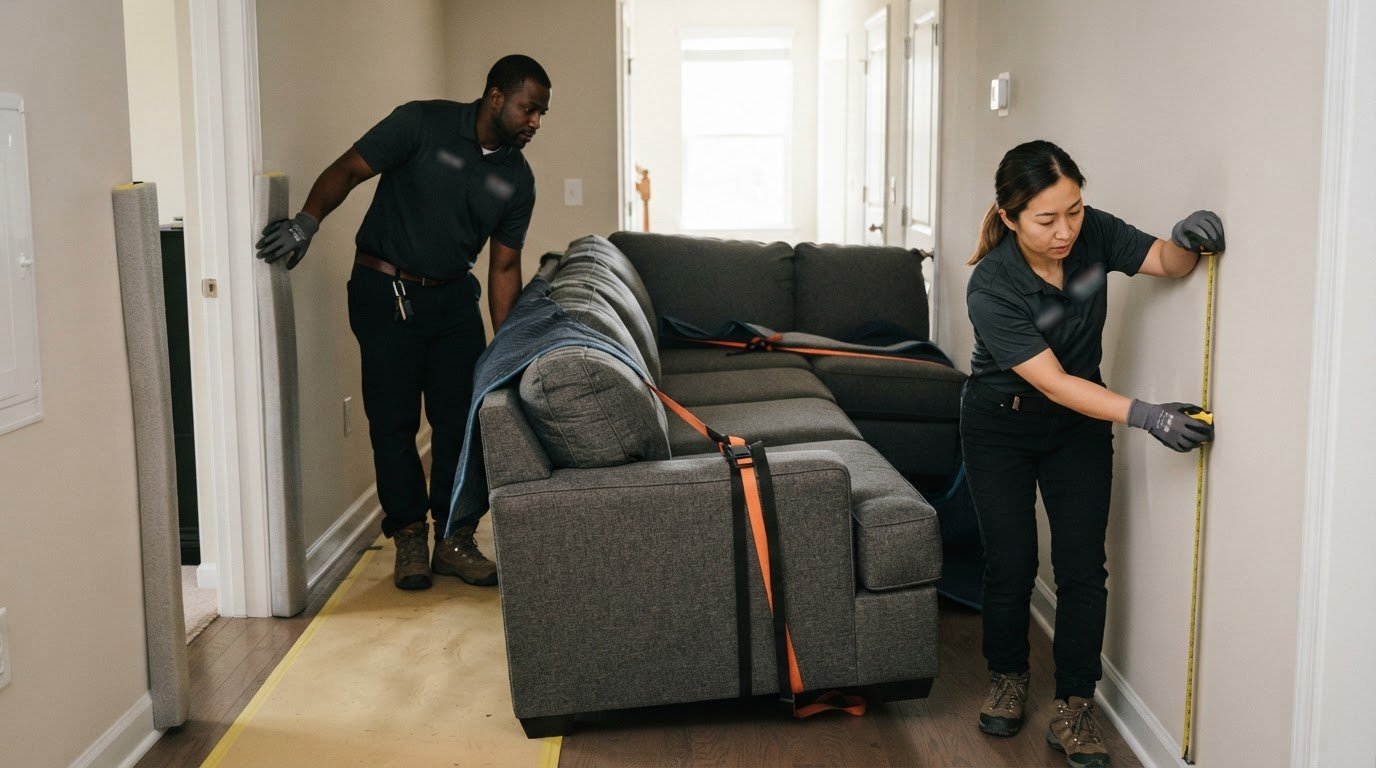
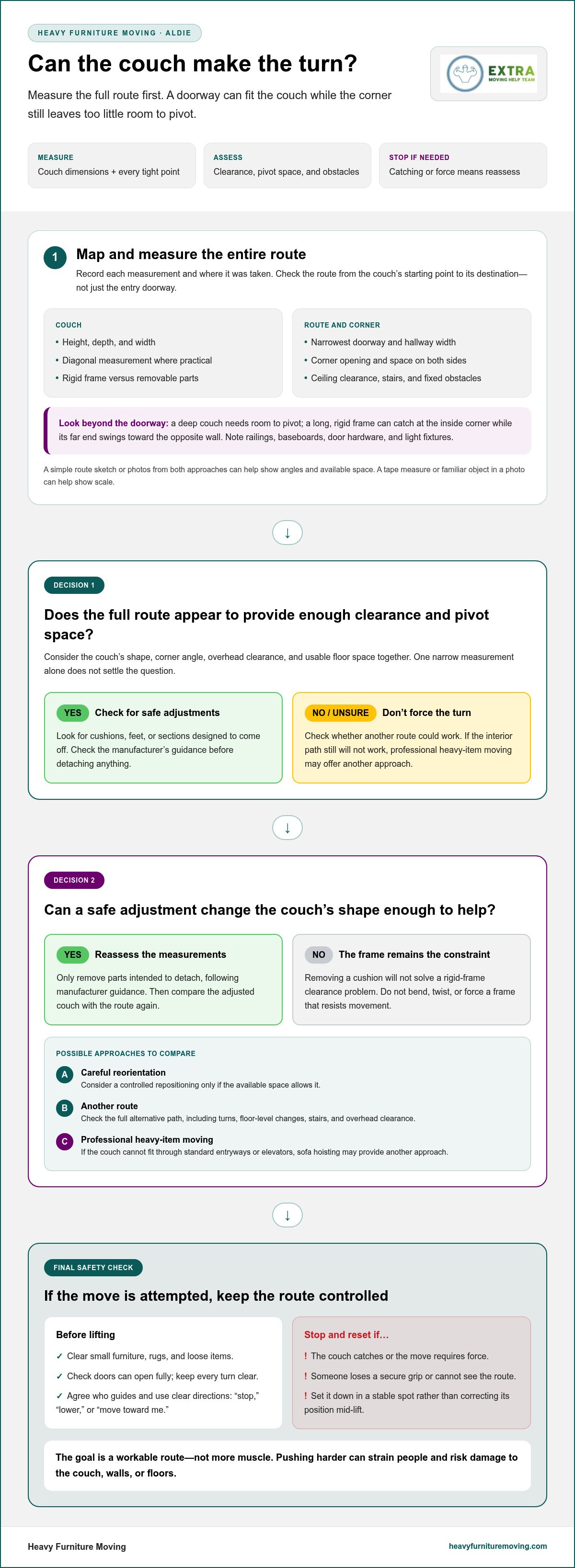
Measure before lifting. Write down each dimension and where you measured it. A simple sketch of the route can make it easier to compare the couch with the available space.
- Measure the couch: Record its height, depth, and width. Where practical, measure diagonally too, particularly if the back is tall or broad.
- Measure the route: Check the narrowest doorway and hallway width, the opening at the corner, and the ceiling clearance along the route.
- Note fixed obstacles: Include baseboards, railings, door hardware, light fixtures, and anything else that reduces clearance or could be struck.
Check the space on both sides of the corner. A landing may look open from one direction but leave little room for the couch’s far end to swing. Photos taken from each approach can reveal angles that measurements alone may not show.
Why a doorway measurement cannot settle the question
A doorway measurement describes only one part of the route. After passing through, the couch still has to change direction. That may require tilting, pivoting, or shifting it while keeping enough room for its length and depth to clear the walls and ceiling.
A rigid frame behaves differently from a cushion. Cushions may compress or come off, but the frame generally keeps its shape. Removing a cushion won’t solve a frame-clearance problem, and one narrow measurement alone doesn’t prove the whole move is impossible. Consider the couch’s shape, corner angle, overhead clearance, and available floor space together before choosing an approach.
How to Assess a Couch-and-Corner Turn Before Trying It
Walk the full route before attempting a lift. A doorway that looks wide enough doesn’t show how much room the couch needs to turn beyond it. When getting a large couch around a tight corner Aldie, checking the route first can prevent repeated lifting, sudden stops, and damage to the home or furniture.
- Clear the route. Move small furniture, rugs, and loose items. Check that doors can open fully and the path stays clear through every turn.
- Measure the tight points. Record the narrowest openings, hallway width, ceiling clearance, and space at each corner. Note where you took each measurement.
- Inspect the couch. Identify the rigid frame and any cushions, feet, or sections designed to come off. Check the manufacturer’s guidance before detaching anything.
- Choose an approach. Compare the couch and route dimensions. Consider a careful repositioning or safe adjustment only if the space allows it. Stop if the couch catches or the move requires force.
A route check helps you plan, but it can’t guarantee that the couch will fit.
Map the route through the home
Trace the route from the couch’s starting point to its destination, including every turn. Check door swing, hallway obstructions, changes in floor level, stairs, and overhead clearance. Sketch the route or take photos from both sides of the tightest corner. Including a tape measure or familiar object in a photo can help show scale.
Inspect the couch and identify safe adjustments
Look for cushions, feet, or sections designed to come off, but don’t assume a part is removable just because it looks separate. Check the manufacturer’s guidance before detaching components. Removing a cushion may change the couch’s shape, but it won’t change a rigid frame. Don’t bend, twist, or force a frame that resists movement.
Agree on how to communicate before anyone lifts. Decide who will guide the turn and use clear directions such as “stop,” “lower,” or “move toward me.” Keep hands and feet clear of pinch points, and don’t lift beyond what you can manage safely. If someone loses a secure grip or can’t see the route, pause and set the couch down in a stable spot instead of trying to correct its position mid-lift.
For additional handling ideas, U-Haul outlines techniques for moving large furniture, including ways to approach tight spaces. Use a method only if it suits the couch and the route. If your assessment suggests the turn is unsuitable, Aldie couch-moving help is available for a bulky item that needs careful handling.
Compare Your Options for Getting the Couch Around an Aldie Corner
Choose an option based on the actual obstacle. A controlled turn may work if there is room to pivot. If the frame would still catch, extra force is not a solution. When getting a large couch around a tight corner Aldie, compare feasibility and risk before moving, and stop if the couch or route doesn’t respond as expected.
| Option | Feasibility | Main risk | Best suited to |
|---|---|---|---|
| Careful reorientation | Possible when measurements leave room to change the couch’s angle. | Scraping walls or losing a secure grip during the turn. | A route with clear floor space and enough clearance to pivot slowly. |
| Remove detachable parts | Useful only if the removed part affects the tight dimension. | Damaging a component or making the couch unstable. | Couches with parts designed to come off, following manufacturer guidance. |
| Choose another route | Can work if the alternate path is clear and suitable all the way through. | Meeting another tight opening, stair, or obstruction along the way. | A second doorway or exit with a better overall path. |
| Professional moving or sofa hoisting | Worth considering when the turn or standard entry route is unsuitable. | Trying an unplanned maneuver or access method without assessing the site. | A bulky couch that needs specialized handling or an alternate way inside. |
When repositioning or removing parts may help
Reorientation means making small, controlled changes to the couch’s angle as it approaches and passes the corner. Try it only if your measurements suggest there is room to move without binding against the walls, ceiling, or railing. Agree on directions beforehand, move gradually, and check clearance at both ends as you go.
Removing feet or a detachable section may help if that part makes the couch too tall, wide, or deep for the route. It won’t solve a tight turn if the frame itself is the limiting shape. Stop if the couch catches, the frame flexes, or the move requires an awkward or unsafe lift. Don’t force a rigid frame to bend or twist.
When another route or sofa hoisting makes more sense
Consider another doorway or exit only after tracing that entire route, including its corners, floor changes, and overhead clearance. An alternate opening isn’t automatically easier just because it looks wider. Don’t improvise rigging or alter walls, railings, or other parts of the home as a shortcut.
If standard entryways or elevators can’t accommodate the couch, sofa hoisting may offer another solution. Heavy Furniture Moving provides residential help with bulky items and sofa hoisting in Aldie. Whether exterior access can work depends on the property and site conditions, so treat it as a specific moving plan rather than assuming it suits every home.
How to Prepare the Couch, Corner, and Home for a Safe Move
A clear route makes a move easier to manage, but preparation can’t remove every risk. Before lifting, organize the space, protect vulnerable surfaces with materials suited to them, and make sure everyone knows where to stand and when to pause. If the couch shifts unexpectedly or someone feels unable to manage the lift, stop and reassess rather than pushing through.
Clear and protect the route
Prepare the path and the spots where the couch may need to pause. Even a small obstacle near the corner can affect footing or force a last-second change in direction. Keep children and pets away from the moving path throughout the job.
- Move small furniture, rugs, decorations, and loose items out of the route. Check for cords and other trip hazards near the floor.
- Use suitable corner guards or padding on exposed walls, and choose floor protection appropriate for the surface. Secure it so it doesn’t slide or create a new hazard.
- Clear the staging area at both ends. Leave room for the people carrying the couch to pause, set it down safely, and adjust their grip.
- Open doors as needed, and make sure the route stays clear before the lift begins.
Protection can reduce the chance of scrapes, but it can’t guarantee that nothing will be damaged. Watch the couch, the people carrying it, and nearby surfaces as the move progresses. If the frame catches, someone loses a secure hold, or a wall or floor is at risk, stop and reset the plan.
Prepare useful information for a local moving team
If your assessment suggests the turn may be unsuitable, clear details help the moving team understand the challenge. Describe the tightest point rather than calling the route simply “small.” When getting a large couch around a tight corner Aldie, accurate details help explain the access problem.
- Couch details: Share its height, width, and depth, along with clear photos. Mention any feet, cushions, or sections that detach safely.
- Route details: Identify the narrowest point and describe hallway turns, stairs, ceiling clearance, and access restrictions. Photos from both sides of the difficult corner show how the space opens up.
- Move details: Explain where the couch starts and where it needs to go. Say whether it’s moving between rooms, through a standard entryway, or to another level of the home.
Heavy Furniture Moving provides residential help with bulky items in Aldie, including sofa hoisting when a couch can’t pass through standard entryways or elevators. If the interior route appears unsuitable, request couch-moving help in Aldie and share your measurements, photos, and access details.
Get Professional Couch-Moving Help in Aldie When the Turn Will Not Work
A difficult couch move doesn’t have to become a whole-house move to warrant professional help. When access is limited, a single bulky item may need careful handling and a different plan from a standard doorway turn. If your measurements suggest the couch can’t clear the corner safely, stop before repeated attempts put the frame, walls, flooring, or people at risk.
Heavy Furniture Moving provides residential help with heavy and bulky items in Aldie and other Northern Virginia communities. When a couch can’t pass through a standard entryway or elevator, sofa hoisting may provide an alternate way inside. The right approach depends on the couch and the home’s access conditions. Share the route details so the moving challenge is clear from the start.
Signs it is time to stop attempting the turn
Pay attention to what happens during an attempt. If the couch repeatedly catches in the same place, pushing or changing angles without a clear plan is unlikely to help. Stop if the frame appears to flex under pressure. A rigid frame isn’t meant to bend around a corner, and forcing it can damage the couch.
Safety matters as much as fit. Pause if anyone has unstable footing, needs to lift from an awkward position, or can’t communicate clearly with the other person. A blocked view or conflicting directions can make a tight turn harder to control. If your measurements suggest the route is too restrictive, professional couch movers can help plan another approach rather than relying on repeated attempts.
What to share when requesting couch-moving help
Give the moving team a clear picture of the job. Include the couch’s approximate height, width, and depth, along with its construction, such as whether it has a rigid frame or detachable sections. Mention which parts can be removed safely and whether you have manufacturer instructions.
Clear photos make the route easier to understand. Show the couch from more than one angle, the tight corner from both approaches, the entry route, and any alternate access you’re considering. Include relevant details such as stairs, hallway turns, low overhead clearance, or access restrictions. Explain where the couch is now and where it needs to go, including whether it’s moving between rooms or entering the home from outside.
With those details, Heavy Furniture Moving can help with bulky-item moving or sofa hoisting when the standard route won’t work. Avoid another strained lift or a damaged couch. Get help moving your couch in Aldie.
Make a Confident Plan for the Couch’s Next Move
Plan beyond the corner. Decide where the couch will land, leave enough room to set it down, and make sure the final spot won’t require another tight maneuver. Planning the destination helps prevent the last few feet from becoming a new obstacle.
If your measurements and route check still leave you unsure about getting a large couch around a tight corner Aldie, don’t let uncertainty turn into a risky lift. A couch that catches or needs to be forced is a reason to pause and choose a safer plan. You don’t have to solve a difficult access problem through trial and error.
Heavy Furniture Moving helps with residential moves involving bulky household items and offers sofa hoisting when a couch won’t fit through standard entryways or elevators. Share what you know about the couch and its route to plan the next step.
Get help moving your couch in Aldie.
Frequently Asked Questions
Can I remove a door to get a couch around a tight corner?
Removing an interior door may create extra clearance, but it won’t change the corner’s shape or provide more turning room beyond the opening. Consider the door’s weight, hinge type, and nearby paint, trim, or flooring before taking it off. Get help handling a heavy door, keep its hardware together, and reinstall it safely before moving the couch. Don’t remove or alter structural elements to make more space.
Should I take the legs off my couch before moving it?
Removing couch legs can reduce its height or width, but may not make a tight turn possible. Check how each leg attaches and follow the manufacturer’s instructions to avoid damaging the fitting or frame. If a leg resists, don’t force it. Keep the couch stable while parts are off, and measure the route and couch again after any safe, reversible adjustment.
Can a couch frame be bent to get it around a corner?
No. Don’t bend or twist a couch frame to squeeze it through. That pressure can damage the frame, joints, or upholstery, scrape the home, or cause an injury while lifting. Controlled repositioning means changing the couch’s angle without forcing its structure. If you’re getting a large couch around a tight corner Aldie and it resists movement, set it down safely and reassess the route or arrange professional moving help.
Does a sectional couch need to be separated before moving it?
Not always. Some sectionals have separate modules, while others are built to move as one unit. Check the manufacturer’s instructions and visible connectors before separating pieces. A detached section may be easier to carry, but each part still needs a clear route and safe handling. Don’t pull on upholstery or tug at hidden connections. If a connector won’t release as expected, stop rather than risk breaking it.
What photos should I take before asking for couch-moving help in Aldie?
Take clear photos of the full couch, any label or visible construction details, and the tightest corner from both sides. Show the entry route, nearby doorways, stairs, overhead clearance concerns, and possible alternate access. Add approximate couch and opening measurements, noting where each was taken. A wide view shows how spaces connect, while closer shots reveal narrow points that can be hard to explain in a message.
Can professional movers help with just one couch in Aldie?
Yes. Heavy Furniture Moving handles bulky household items, including couch moves, and offers sofa hoisting when a couch can’t fit through standard entryways or elevators. Hoisting depends on the home’s access conditions, so it won’t suit every route. Share approximate couch dimensions and photos of the entry and corner to describe the job. The team serves Fairfax, Woodbridge, Manassas, Manassas Park, Aldie, Ashburn, McLean, Vienna, Reston, Centreville, Chantilly, Clifton, Dumfries, South Riding, Fairfax Station, Haymarket, and Gainesville. Get help moving your couch.
Frequently Asked Questions
Measure before lifting. Write down each dimension and where you measured it. A simple sketch of the route can make it easier to compare the couch with the available space. Check the space on both sides of the corner. A landing may look open from one direction but leave little room for the couch’s far end to swing. Photos taken from each approach can reveal angles that measurements alone may not show.
Removing an interior door may create extra clearance, but it won’t change the corner’s shape or provide more turning room beyond the opening. Consider the door’s weight, hinge type, and nearby paint, trim, or flooring before taking it off. Get help handling a heavy door, keep its hardware together, and reinstall it safely before moving the couch. Don’t remove or alter structural elements to make more space.
Removing couch legs can reduce its height or width, but may not make a tight turn possible. Check how each leg attaches and follow the manufacturer’s instructions to avoid damaging the fitting or frame. If a leg resists, don’t force it. Keep the couch stable while parts are off, and measure the route and couch again after any safe, reversible adjustment.
No. Don’t bend or twist a couch frame to squeeze it through. That pressure can damage the frame, joints, or upholstery, scrape the home, or cause an injury while lifting. Controlled repositioning means changing the couch’s angle without forcing its structure. If you’re getting a large couch around a tight corner Aldie and it resists movement, set it down safely and reassess the route or arrange professional moving help.
Not always. Some sectionals have separate modules, while others are built to move as one unit. Check the manufacturer’s instructions and visible connectors before separating pieces. A detached section may be easier to carry, but each part still needs a clear route and safe handling. Don’t pull on upholstery or tug at hidden connections. If a connector won’t release as expected, stop rather than risk breaking it.
Take clear photos of the full couch, any label or visible construction details, and the tightest corner from both sides. Show the entry route, nearby doorways, stairs, overhead clearance concerns, and possible alternate access. Add approximate couch and opening measurements, noting where each was taken. A wide view shows how spaces connect, while closer shots reveal narrow points that can be hard to explain in a message.
Yes. Heavy Furniture Moving handles bulky household items, including couch moves, and offers sofa hoisting when a couch can’t fit through standard entryways or elevators. Hoisting depends on the home’s access conditions, so it won’t suit every route. Share approximate couch dimensions and photos of the entry and corner to describe the job. The team serves Fairfax, Woodbridge, Manassas, Manassas Park, Aldie, Ashburn, McLean, Vienna, Reston, Centreville, Chantilly, Clifton, Dumfries, South Riding, Fairfax Station, Haymarket, and Gainesville. Get help moving your couch.