Moving Insurance Explained for High-Value Items in Fairfax Station
What if the value you declare for a treasured antique still doesn’t determine what you’ll be reimbursed? It’s an easy assumption to make. Moving insurance explained for high value items Fairfax Station starts with one key distinction: mover valuation protection and a separate insurance policy are not the same thing, and neither automatically protects every item in every situation.
Before your move, find out what the written terms cover, how a loss or damage is valued, and which exclusions or documentation rules apply. A number on a form does not automatically mean replacement-cost reimbursement. Understanding the terms can help you plan for artwork, antiques, safes, pianos, and specialty furniture.
This guide explains the main coverage options, the terms to read closely, and the records to prepare before moving day, including photos, receipts, and appraisals where useful. It also explains why a local Virginia move may follow different rules from an interstate move. If you’re moving heavy or unusually valuable belongings in Fairfax Station, clear item descriptions and early planning can help keep the move organized.
Key Takeaways
- Moving insurance explained for high value items Fairfax Station starts with distinguishing a mover’s valuation protection from a separate insurance policy.
- The rules and coverage terms to review can depend on whether your move stays within Virginia or crosses state lines.
- Compare who provides the protection, which written documents control, and what exclusions may affect antiques, artwork, pianos, or safes.
- Create a useful record for each valuable item with photos, clear descriptions, and supporting documents you already have.
- Plan for bulky or specialty belongings early so your moving arrangements reflect what needs to be moved.
Moving insurance for high-value items in Fairfax Station: what it really means
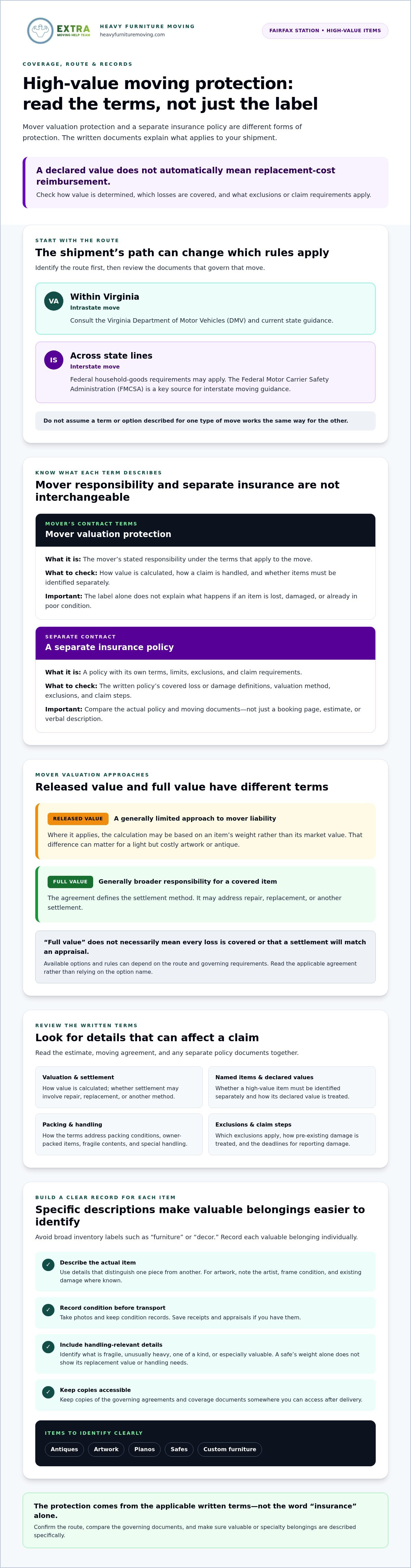
“Moving insurance” can refer to different types of protection. Mover valuation protection describes a mover’s responsibility under the terms that apply to a move. A separate insurance policy is a product with its own contract, limits, exclusions, and claim requirements. The label alone does not tell you what happens if an item is damaged, lost, or already in poor condition.
This distinction matters for antiques, artwork, pianos, safes, and custom furniture. An inventory that lists only “furniture” or “decor” may not identify which piece is fragile, unusually heavy, one of a kind, or especially valuable. A safe’s weight, for example, does not show its replacement value or explain its handling needs. Specific descriptions help connect each item to the written documents that govern its protection.
Is moving insurance the same as mover valuation protection?
No. Valuation is the mover’s stated responsibility under the applicable contract terms. A separate insurance policy is issued under its own terms. Compare the actual written documents, not just a booking page, estimate, or verbal description. Check how each document defines covered loss or damage, how value is determined, and which exclusions or claim steps apply.
A moving company may provide a range of household moving services, but that general description does not establish what protection applies to a particular shipment. Find the agreement and any coverage documents that govern your move. Pay attention to named items, declared values, packing conditions, and deadlines for reporting damage. Keep copies somewhere you can access after delivery.
Why high-value belongings need specific attention
Broad inventory descriptions can hide important differences. “Painting” does not identify the artist, frame condition, or existing damage. “Piano” does not describe its type or condition. “Furniture” may refer to a custom-built piece that needs careful handling. Record valuable belongings individually, with descriptions specific enough to distinguish one item from another.
Coverage depends on the written terms and circumstances of the move, not on the word “insurance” alone. Check whether the documents treat fragile contents, owner-packed items, pre-existing damage, or items requiring special handling differently. Keep receipts, appraisals, and condition records if you have them. These can help identify an item and document its condition before transport.
The route matters, too. A move that stays within Virginia and one that crosses state lines may follow different requirements and terminology. Do not assume a protection term used for one type of move applies to the other. Identify your route, then review the documents that govern the shipment. For a Fairfax Station move with bulky or specialty belongings, share accurate item descriptions while arranging residential moving help so the handling plan starts with useful details.
How moving coverage works for Fairfax Station moves
Start by identifying where the shipment travels. A move that stays within Virginia is generally an intrastate move; one that crosses state lines is interstate. The route can affect which rules and coverage terms apply, so do not assume an option described for one type of move works the same way for another. For moving insurance explained for high value items Fairfax Station, identify the route first, then read the documents governing the shipment.
What do released value and full value mean?
These terms describe different approaches to a mover’s responsibility, where they apply. Released-value protection generally limits the mover’s liability under the applicable terms, and the calculation may be based on an item’s weight rather than its market value. That difference can matter for a light but costly artwork or antique. Full-value protection generally provides broader responsibility for a covered item, with the settlement method defined in the agreement. The terms may address repair, replacement, or another settlement.
Do not rely on the label alone. Available options and their rules can depend on the route and governing requirements. Review how value is calculated, how a claim is handled, and whether an item must be identified separately. “Full value” does not necessarily mean every loss is covered or that a settlement will match an appraisal.
Why local and interstate moves may follow different rules
An intrastate move remains within Virginia. An interstate move crosses state lines, which may bring federal household-goods requirements into play. The Federal Motor Carrier Safety Administration (FMCSA) is a key source for interstate moving guidance. For moves within Virginia, consult the Virginia Department of Motor Vehicles (DMV) and current state guidance. Use the rules that apply to your specific route rather than relying on a general explanation.
This distinction matters when you compare forms or select an option. A term used in a federal document may not explain every requirement for a Virginia-only move, and state terminology may not describe an interstate shipment. Identify which contract and rules govern before interpreting a coverage summary.
Which written terms should you review?
Read the estimate, moving agreement, and any separate policy documents together. Focus on details that can affect how a loss is handled:
- How the selected protection calculates the item’s value or the mover’s responsibility.
- Whether the settlement method is repair, replacement, or another stated option.
- Exclusions, deductibles, and special rules for fragile, unusually valuable, or owner-packed items.
- How and when to report damage, and what records a claim requires.
Keep signed copies and note any special terms tied to a piano, safe, or other bulky item. Clear handling plans and item descriptions help organize the move, though they do not change the written coverage. For residential moving help with heavy belongings in Fairfax Station, plan your bulky-item move with the item details ready.
Compare coverage options for antiques, artwork, pianos, and safes
Start by comparing the mover’s valuation terms, a separate transit policy, and your existing homeowners or renters policy. These options are not interchangeable, and none should be assumed to cover every item or situation. For moving insurance explained for high value items Fairfax Station, match each valuable belonging to the written document that governs its protection.
| Option | Who provides it and what governs it | What to inspect |
|---|---|---|
| Mover valuation | The mover’s stated responsibility is set out in the moving agreement and related valuation documents. | Review how item value or responsibility is calculated, any stated limits, exclusions, claim deadlines, and whether repair, replacement, or another settlement method applies. |
| Separate transit coverage | An insurance provider issues a separate policy, governed by its policy wording and any endorsements. | Check covered events, limits for individual items, deductibles, exclusions, documentation rules, and the process and deadline for submitting a claim. |
| Homeowners or renters policy | Your existing insurer’s policy and any applicable endorsements control. | Look for moving-related conditions, exclusions, limits for specific property types, and language about belongings while they’re being transported or handled by a mover. |
What should you compare in each written option?
Read the controlling document before signing. Compare limits, deductibles, exclusions, claim deadlines, and how value is determined. Then find the settlement language: does it describe repair, replacement, or cash payment, and under what conditions? A stated value or item category does not promise that amount will be paid. Keep the documents together so you can see which terms apply to each option.
Compare the terms against individual belongings. An antique cabinet may need records of its age, craftsmanship, and condition. Artwork may have a frame or existing damage worth documenting. A piano or safe may need special handling because of its size or weight, but those characteristics do not automatically establish its covered value. Sentimental importance matters to you, but it does not by itself set a settlement amount. Identify each item clearly and note any special terms that apply.
How homeowners and renters policies may fit in
Your existing policy may address belongings during some parts of a move, but conditions, exclusions, and limits vary. Do not assume it covers a valuable item while a mover transports or handles it. Read the policy wording, including endorsements and property-specific limits, and seek clarification from your insurer about how the terms apply to your planned move.
Keep the answer in writing with the policy documents. If an item appears under more than one option, compare how the documents coordinate and which claim steps or deadlines apply. This gives you a clearer picture before moving day, especially for antiques, artwork, pianos, safes, and specialty furniture.
Prepare high-value items for a Fairfax Station move: a documentation checklist
A clear record gives you a useful reference before items are packed and after they arrive. Make one entry for each valuable belonging rather than grouping everything under broad labels such as “art” or “furniture.” Individual records help distinguish pieces, describe their condition, and capture handling details. Complete them before moving day, while there is time to review and update the information.
Build an item record before moving day
Use this checklist for each antique, artwork, piano, safe, or specialty piece. Store the records together so you can access them during the move.
- Describe the item. Record its type, maker or artist if known, identifying marks, approximate age, and distinguishing features. Include dimensions or other details that separate it from similar belongings.
- Record its condition. Note visible wear, chips, scratches, loose parts, or previous repairs. Be specific, such as “small chip on the rear left corner,” rather than writing only “used condition.”
- Photograph it clearly. Take pictures from several angles, including close-ups of labels, identifying details, and existing damage. Use enough light to show the surface and keep the original files.
- Gather supporting documents. Keep purchase receipts, appraisals, provenance records, and existing condition reports if available. These records can help identify the item and document its history or condition.
- Note handling needs. Record relevant requirements, such as delicate components, unusual dimensions, or access constraints. Identify specialty and bulky items early, and share those details in writing as you plan the move.
- Save a complete copy. Keep the inventory, photographs, supporting records, signed move documents, and related communications in one digital folder. Back it up and keep it accessible during the move.
Use consistent filenames, such as the item name and date, so photos and records are easy to match. Keep item descriptions and handling notes with your moving paperwork. Written communication records what was discussed, while signed documents show the terms and information recorded for the move. Save updated copies if details change.
What to do if an item is damaged or missing
Inspect valuable belongings after delivery and record any concern promptly. Photograph the item and affected area, then note what you observed and when. Follow the reporting instructions and deadlines in the applicable signed documents. Keep inventory entries, receipts, appraisals, estimates, and communications together. An organized record makes it easier to refer to consistent details throughout the claims process.
For a Fairfax Station move involving pianos, safes, or other heavy specialty items, plan your high-value item move with clear descriptions and handling notes ready.
Plan a high-value item move in Fairfax Station with less uncertainty
A practical plan starts with four steps: identify belongings that need extra care, review the written terms that apply to the move, record each item’s condition, and plan how it will be handled. Keep these steps connected. An inventory is more useful when its descriptions match your move documents and the moving team knows each item’s size, access needs, and destination.
Coordinate the move around the items that need extra care
List pianos, safes, exercise equipment, antiques, and oversized furniture early when arranging residential moving help. Share dimensions and unusual features when you know them. Mention stairs, narrow doorways, tight turns, elevators, or other access conditions at both addresses. These details help shape a practical handling plan instead of leaving important logistics until moving day.
For a Fairfax Station move, keep your inventory and written move details accessible. If plans change, record the update and retain revised documents or communications. This helps everyone work from the same information, especially when a specialty item needs a specific route through the home or a clear space at the destination.
Choose a clear next step for your Fairfax Station move
Moving coverage depends on the documents and circumstances that apply to your shipment. This article offers general information, not legal or insurance advice. Read the applicable agreements and policy wording for your situation, and direct coverage questions to the relevant insurer or authority.
Then plan the physical move. Heavy Furniture Moving provides residential moving and specialized handling for bulky belongings, including pianos and safes. The company serves Fairfax Station and nearby Northern Virginia communities, including Fairfax, Woodbridge, Manassas, Manassas Park, Aldie, Ashburn, McLean, Vienna, Reston, Centreville, Chantilly, Clifton, Dumfries, South Riding, Haymarket, and Gainesville. Share what needs to move, where access may be tight, and any handling details that matter. Explore reliable movers in Fairfax and Northern VA and have your item list ready for a straightforward planning conversation.
For moving insurance explained for high value items Fairfax Station, the practical takeaway is simple: organize the item details, written terms, and handling plan before moving day. That preparation can reduce uncertainty and help the move begin with a clear picture of what needs extra care.
Make your next move feel more manageable
Give yourself time to make decisions before moving day gets busy. Review the documents that apply to your belongings, gather questions for your insurer, and share handling details while the move is being planned. This pause can help you organize the next steps and focus on the parts that need careful coordination.
Keep moving insurance explained for high value items Fairfax Station in perspective: clear paperwork and thoughtful planning help you understand your options, but the written terms determine what protection applies. For coverage questions, rely on the relevant policy documents and insurer. For the physical move, Heavy Furniture Moving is a veteran-family owned and operated team serving Fairfax Station and nearby Northern Virginia communities.
Ready to put your plans in motion? Plan your Fairfax Station move with Heavy Furniture Moving, including logistics for pianos, safes, exercise equipment, and other bulky belongings. Share your item list and access details to start planning your move.
Frequently Asked Questions
Is moving insurance the same as full value protection?
No. Full value protection is a mover’s valuation option, while moving insurance usually refers to a separate policy issued by an insurer. The terms may sound similar, but they do not mean the same contract or claim process. For moving insurance explained for high value items Fairfax Station, compare the document governing each option and note how it defines covered damage, item value, and settlement before choosing.
Does homeowners insurance cover high-value items during a move?
It might provide some protection, but do not assume your homeowners or renters policy covers an item while a mover transports or handles it. Coverage can depend on policy wording, endorsements, the type of loss, and when it occurs. For example, damage to a framed painting during loading may be treated differently from damage at home. Describe the moving situation to your insurer and request clarification in writing.
How do I document antiques or artwork before a household move?
Make a separate record for each piece. Note the artist or maker, identifying marks, approximate age, dimensions, and visible condition. Photograph the front, back, frame, labels, and any existing chips or scratches. Keep purchase receipts, appraisals, and provenance documents with the record if available. For a matched set, photograph the pieces together and individually so the inventory shows exactly what is being moved.
Can a mover limit responsibility for a piano or safe?
A mover’s responsibility can be defined or limited by the applicable rules and signed move documents, so do not assume the item’s size or value sets the amount. For a piano or safe, provide an accurate description and identify special handling needs. Review the written terms for applicable limits, exclusions, packing conditions, and claim steps. The agreement and rules for your route control, not a verbal description alone.
What happens if a valuable item is damaged during a move?
Record the damage promptly. Take clear photographs, note when and where you found it, and keep the item and related records available for inspection. Then follow the reporting process and deadlines in the documents that apply to your move or policy. Save any repair estimate and related messages. If an item is missing, compare your delivery inventory with your pre-move record and report the discrepancy through the stated process.
Do Virginia moving rules differ from interstate moving rules?
Yes, the route can change which requirements and terms apply. A move that remains within Virginia is intrastate; one that crosses state lines is interstate. For current interstate household-goods guidance, consult the Federal Motor Carrier Safety Administration. For an in-state move, check current Virginia Department of Motor Vehicles guidance. Use the rules that match your shipment rather than applying a form or explanation from another move type.
Should I get an appraisal before moving a high-value item?
An appraisal can be useful if you need a professional record of an item’s value, especially for artwork, antiques, or a distinctive instrument. It will not automatically determine what a mover or insurer will pay. Check whether the applicable documents require a particular form of valuation or appraisal, and keep the report with receipts and condition records. If the item has changed since its last appraisal, ask the appraiser about updating it.
Frequently Asked Questions
No. Valuation is the mover’s stated responsibility under the applicable contract terms. A separate insurance policy is issued under its own terms. Compare the actual written documents, not just a booking page, estimate, or verbal description. Check how each document defines covered loss or damage, how value is determined, and which exclusions or claim steps apply. A moving company may provide a range of household moving services, but that general description does not establish what protection applies to a particular shipment. Find the agreement and any coverage documents that govern your move. Pay attention to named items, declared values, packing conditions, and deadlines for reporting damage. Keep copies somewhere you can access after delivery.
These terms describe different approaches to a mover’s responsibility, where they apply. Released-value protection generally limits the mover’s liability under the applicable terms, and the calculation may be based on an item’s weight rather than its market value. That difference can matter for a light but costly artwork or antique. Full-value protection generally provides broader responsibility for a covered item, with the settlement method defined in the agreement. The terms may address repair, replacement, or another settlement. Do not rely on the label alone. Available options and their rules can depend on the route and governing requirements. Review how value is calculated, how a claim is handled, and whether an item must be identified separately. “Full value” does not necessarily mean every loss is covered or that a settlement will match an appraisal.
Read the estimate, moving agreement, and any separate policy documents together. Focus on details that can affect how a loss is handled: Keep signed copies and note any special terms tied to a piano, safe, or other bulky item. Clear handling plans and item descriptions help organize the move, though they do not change the written coverage. For residential moving help with heavy belongings in Fairfax Station, plan your bulky-item move with the item details ready. Start by comparing the mover’s valuation terms, a separate transit policy, and your existing homeowners or renters policy. These options are not interchangeable, and none should be assumed to cover every item or situation. For moving insurance explained for high value items Fairfax Station, match each valuable belonging to the written document that governs its protection.
Read the controlling document before signing. Compare limits, deductibles, exclusions, claim deadlines, and how value is determined. Then find the settlement language: does it describe repair, replacement, or cash payment, and under what conditions? A stated value or item category does not promise that amount will be paid. Keep the documents together so you can see which terms apply to each option. Compare the terms against individual belongings. An antique cabinet may need records of its age, craftsmanship, and condition. Artwork may have a frame or existing damage worth documenting. A piano or safe may need special handling because of its size or weight, but those characteristics do not automatically establish its covered value. Sentimental importance matters to you, but it does not by itself set a settlement amount. Identify each item clearly and note any special terms that apply.
No. Full value protection is a mover’s valuation option, while moving insurance usually refers to a separate policy issued by an insurer. The terms may sound similar, but they do not mean the same contract or claim process. For moving insurance explained for high value items Fairfax Station, compare the document governing each option and note how it defines covered damage, item value, and settlement before choosing.
It might provide some protection, but do not assume your homeowners or renters policy covers an item while a mover transports or handles it. Coverage can depend on policy wording, endorsements, the type of loss, and when it occurs. For example, damage to a framed painting during loading may be treated differently from damage at home. Describe the moving situation to your insurer and request clarification in writing.
Make a separate record for each piece. Note the artist or maker, identifying marks, approximate age, dimensions, and visible condition. Photograph the front, back, frame, labels, and any existing chips or scratches. Keep purchase receipts, appraisals, and provenance documents with the record if available. For a matched set, photograph the pieces together and individually so the inventory shows exactly what is being moved.
A mover’s responsibility can be defined or limited by the applicable rules and signed move documents, so do not assume the item’s size or value sets the amount. For a piano or safe, provide an accurate description and identify special handling needs. Review the written terms for applicable limits, exclusions, packing conditions, and claim steps. The agreement and rules for your route control, not a verbal description alone.
Record the damage promptly. Take clear photographs, note when and where you found it, and keep the item and related records available for inspection. Then follow the reporting process and deadlines in the documents that apply to your move or policy. Save any repair estimate and related messages. If an item is missing, compare your delivery inventory with your pre-move record and report the discrepancy through the stated process.
Yes, the route can change which requirements and terms apply. A move that remains within Virginia is intrastate; one that crosses state lines is interstate. For current interstate household-goods guidance, consult the Federal Motor Carrier Safety Administration. For an in-state move, check current Virginia Department of Motor Vehicles guidance. Use the rules that match your shipment rather than applying a form or explanation from another move type.
An appraisal can be useful if you need a professional record of an item’s value, especially for artwork, antiques, or a distinctive instrument. It will not automatically determine what a mover or insurer will pay. Check whether the applicable documents require a particular form of valuation or appraisal, and keep the report with receipts and condition records. If the item has changed since its last appraisal, ask the appraiser about updating it.