Moving Heavy Iron Patio Sets in Dumfries for Winter Storage
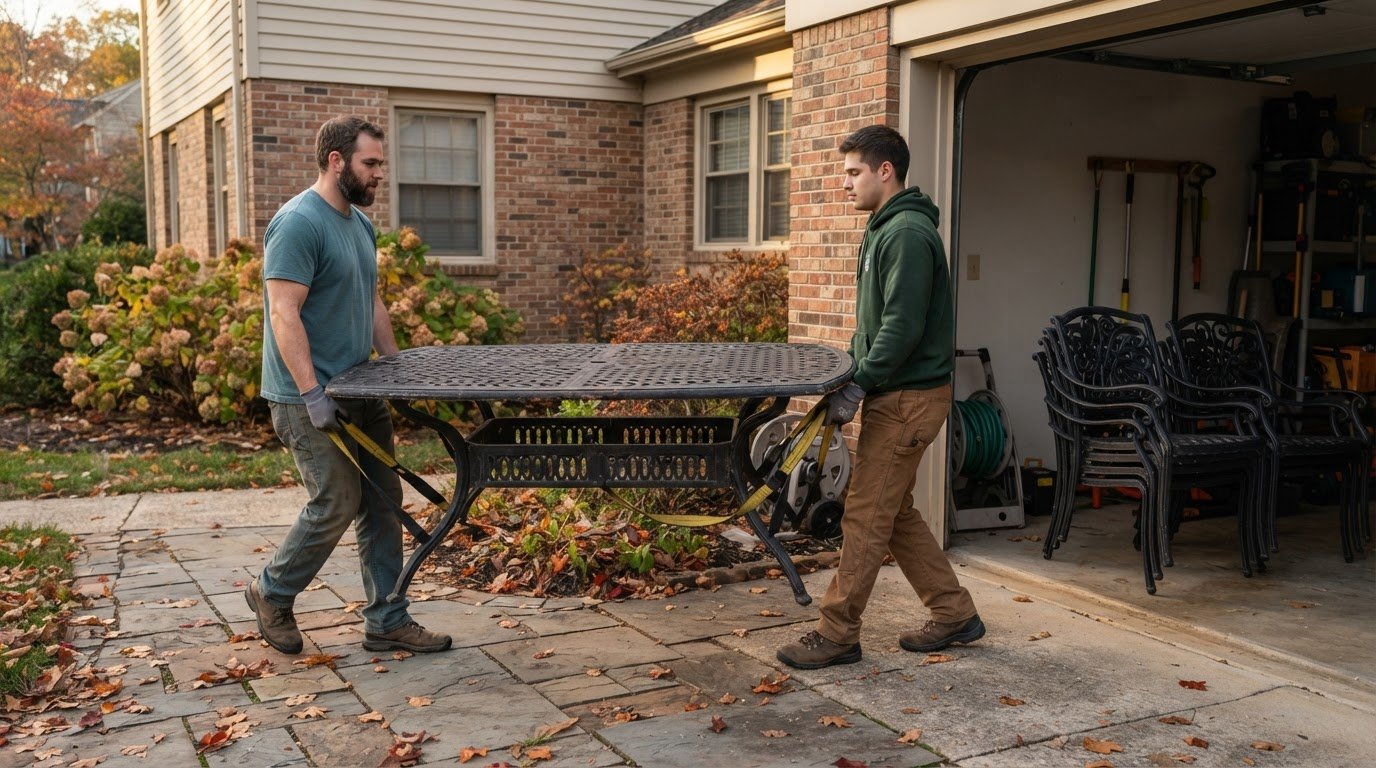
For moving a heavy iron patio dining set to winter storage in Dumfries, arrange professional help to move it from your patio to the storage space you’ve chosen. The key is planning around the set’s weight, the route out of your home, and where it needs to go.
Iron furniture can be awkward to maneuver, especially when a table and chairs must pass through tight spaces or across a long path. Outdoor garden centers and patio and outdoor living services can help you plan for the seasonal transition, while a professional mover handles the heavy lifting. This article explains what affects the move, what to consider about access and storage, and how to make the process smoother from patio to winter storage.
Key Takeaways
- Set weight depends on its design and pieces, so a professional assessment helps plan the move.
- The crew size depends on the furniture and the route from the patio to storage.
- Movers choose handling equipment to suit the set and the spaces it must pass through.
- Protective coverings and careful handling help reduce the risk of damage to furniture, floors, and pavers.
- Heavy Furniture Moving can help with heavy lifting when you’re ready to move the set indoors for winter storage.
How heavy is a typical iron patio dining set?
There is no single dependable weight for every iron patio dining set. A round table with lightweight chairs differs from a broad table with substantial legs and solid chairs. The word “iron” alone does not show how heavy each piece is or how difficult it will be to handle.
Movers assess each piece, not just the set as a whole. A table can pose a different lifting challenge from a chair because its top, base, and shape affect balance. A set with several matching chairs also includes more separate items than a compact table-and-chair arrangement.
Construction matters. A chair with thick sections may handle differently from one with narrow, openwork elements. A table with a broad top can be awkward to carry even when its weight is manageable. Its design determines both the load and the available grip points.
Shape matters, too. Curved arms, decorative backs, and projecting feet can make a chair harder to hold close to the body. A pedestal table may need a different grip and balance assessment than a four-legged table. Movers consider these details before planning each lift.
The set’s condition also matters. Loose joints, rusted connections, or a wobbly table can affect how securely a piece can be handled. A mover should assess its current stability rather than assume every iron set is firm and intact.
Movers also assess the route from the patio to storage. A heavy table may be easy to move across an open patio but harder to maneuver through a narrow doorway. Steps, tight turns, and changes in surface can alter the handling plan.
For moving a heavy iron patio dining set to winter storage in Dumfries, a useful estimate starts with the actual pieces and route. A professional can review the table and chairs, identify awkward shapes, and plan for access. That is more useful than relying on a generic weight for an “iron set.”
Before the move, describe the set and route so the mover can understand the job. Useful details include:
- Whether the set has a round, square, or rectangular table.
- How many chairs move with the table.
- Whether the chairs have arms or high decorative backs.
- Where the set sits and where it needs to go.
- Whether the route includes steps, narrow doors, or tight turns.
These details do not replace an assessment, but they help shape the plan. A broad tabletop, for example, may require a different carrying position from a small side table. A chair with curved arms may need more doorway clearance than a straight-backed design.
Weight also affects how the work is organized. When the design allows, Heavy Furniture Moving specialists may separate the pieces and plan a controlled carry for each one. They consider where they can grip securely and whether each piece can pass without scraping walls or catching on a doorway.
Treat the set as several distinct loads, not one uniform object. The table, each chair, the construction, the condition, and the route all shape the moving plan. A professional assessment can turn those details into a practical plan for your set.
A table requires a different handling position than a chair, since the tabletop, base, and available grip points shape how it is carried. A clear description of the patio-to-storage route also helps frame the assessment: the same piece can call for attention to balance as well as access. Timber garden furniture typically lasts 5-10 years, even with regular treatment. That lifespan statement concerns timber, not iron, and does not provide a weight estimate for an iron table or chair. For an iron set, the practical question remains how each item is built, whether it is stable, and how it can be moved along the route.
How many professional movers are needed to move a heavy wrought-iron patio set safely?
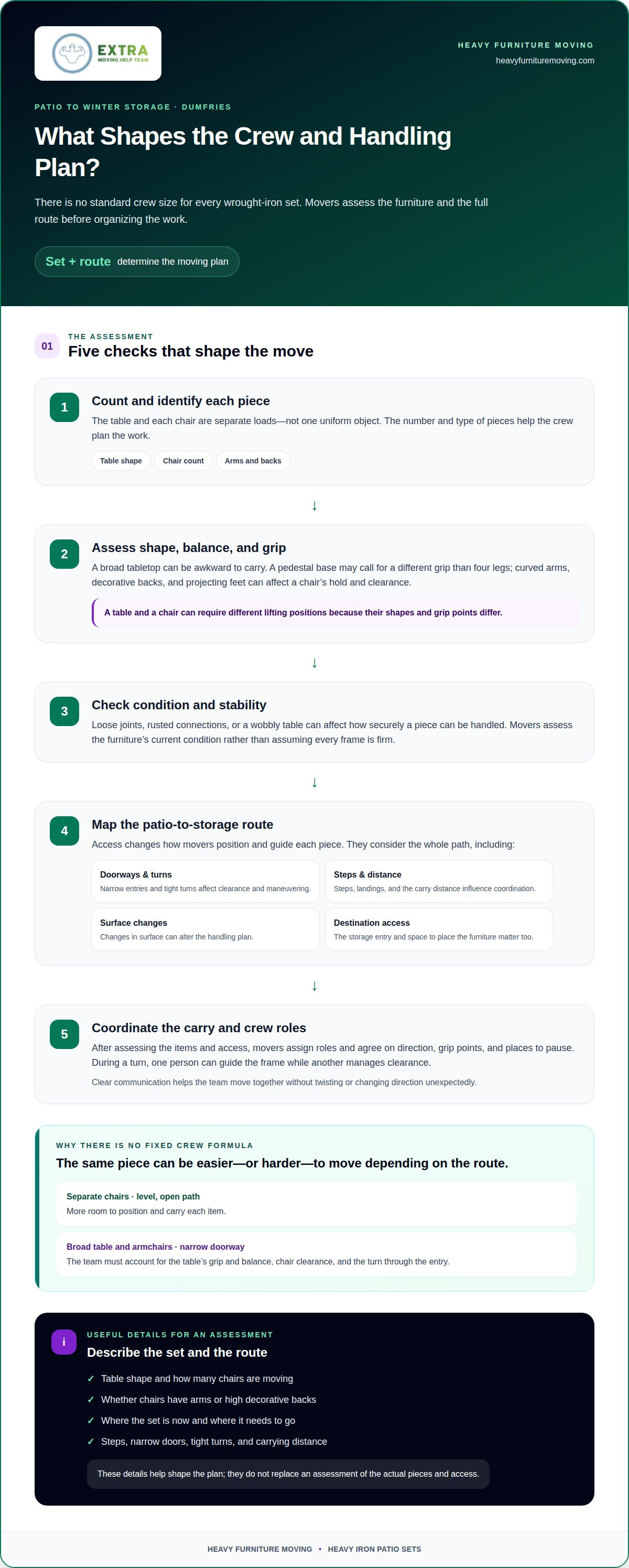
There is no single crew size for every wrought-iron patio set. The team assesses the table, chairs, access, and handling needs before organizing the work. Carrying a compact chair across an open patio is different from moving a broad table through a tight doorway.
The table often shapes the plan. Its top and base affect how movers can hold and guide it, while the route determines whether they can carry it under control. A clear, level passage calls for a different approach from a narrow entry that requires a turn.
Movers assess each chair individually, too. Curved arms, decorative backs, and projecting feet affect grip and clearance. A chair may be easier to handle alone than alongside another piece, but movers still need room to steady it and avoid catching the frame on walls or door trim.
Access can affect how the crew organizes the move. Movers consider steps, narrow doorways, turns, and the distance from the patio to storage. A short, unobstructed path allows more room to position and carry furniture. A stair landing or tight turn calls for careful coordination and positioning.
The set’s condition is another consideration. A loose joint or unstable table can change how a piece should be supported. The team plans for those details instead of treating every iron frame as equally secure. The assessment helps determine who handles each side and how the piece travels.
Coordination matters as much as strength. Before lifting, movers agree on the direction of travel, grip points, and places to pause. During a turn, one person can guide the frame while another manages clearance. Clear communication helps the team move together without twisting or changing direction unexpectedly.
A set with a broad table and armchairs moving through a narrow doorway, for example, calls for a different plan from separate chairs traveling along a level path. The team assesses each item and the full route, then assigns roles to keep the furniture controlled from pickup to placement.
The number of movers depends on the specific set and route, not a standard formula. Professionals consider:
- The table’s shape, base, and available grip points.
- The chairs’ frames, arms, and decorative details.
- Doorway width, steps, turns, and carrying distance.
- The furniture’s stability and the destination’s access.
- How the team can coordinate a controlled lift and carry.
Share details about the table, chairs, patio entrance, and storage route when arranging the move. Those examples help the movers plan the right crew and handling approach. For a set that needs hands-on heavy lifting, professional heavy lifting help can make the move more manageable.
Equipment for Moving Heavy Patio Furniture
Movers choose equipment based on the furniture and route rather than relying on one tool. A wrought-iron table with a broad top needs different handling from a chair with curved arms. Doorways, steps, and patio surfaces also affect which equipment is suitable.
A furniture dolly can support a table or grouped pieces on a suitable, level surface. Movers position the load so it stays balanced and can be guided along the route. A dolly may not fit every table base or doorway, so the team checks clearances before using one.
For a chair or table crossing a floor, furniture sliders may help reduce dragging. Movers choose sliders suited to the surface and the item’s contact points. A small chair leg and a broad table base need different placement. Sliders are not suitable for steps or uneven ground.
Moving straps can help movers hold and control an awkward piece. They position straps around suitable parts of the furniture, avoiding decorative details and weak joints. For instance, a strap should not press against a delicate curved back if a sturdier frame section provides a better support point.
Moving blankets and padding protect iron surfaces during handling. Movers can place padding between parts that might rub, such as stacked chairs or a chair frame near a tabletop. This helps prevent hard edges from knocking together as the pieces pass through a doorway or are repositioned.
Gloves can help movers grip smooth or cold metal and handle frame edges without relying on bare hands. They do not replace a secure hold, so movers still assess the piece’s balance and choose grip points before lifting.
For a route with a step or raised threshold, movers may use a ramp if it suits the access and equipment plan. A ramp creates a sloped path for compatible moving equipment, but it must be positioned and managed carefully. A narrow turn or unstable surface may make another approach more suitable.
Common equipment choices include:
- Furniture dollies for supported movement across suitable level areas.
- Furniture sliders for controlled movement over compatible flooring.
- Moving straps to help guide awkward pieces with secure support.
- Moving blankets to cushion iron surfaces and prevent pieces rubbing together.
- Gloves for a firmer grip while handling metal frames.
- Ramps for access changes where a sloped path works with the route.
Equipment supports a plan, but it does not replace assessing the furniture. A dolly that rolls well on a smooth path may not suit loose pavers. Sliders that work on an indoor floor may not suit an outdoor surface. Movers match each tool to the table, chairs, and actual route.
For a winter-storage move, movers also consider where each item will go. A dolly can help on a clear route into storage, while padding protects surfaces during final placement. The right combination depends on the set’s design and access, so furniture is not forced onto unsuitable equipment.
How do professional movers protect floors, pavers, and the furniture while moving an iron patio set?
Movers plan protection for each surface along the route. An iron chair crossing indoor flooring needs different care from a table moving over patio pavers. The team assesses the path, identifies tight turns, and chooses coverings and handling methods suited to the surfaces.
Inside, floor runners or protective coverings can create a barrier along the route. Movers may place them at an entry, in a hallway, or near a storage room. A narrow hallway, for example, may need coverage where furniture turns, since a frame could brush a wall or floor there.
On pavers, the team considers joints, uneven edges, and the path moving equipment will take. A dolly can roll across a suitable surface, but its wheels may not suit every patio. Movers decide whether to carry a piece or use equipment based on the pavers and the furniture’s balance.
Dragging an iron table across concrete or pavers can scrape the surface and put stress on the furniture’s feet. Movers instead lift or guide pieces using stable grip points. If sliders suit the surface, the team positions them to support the item rather than letting a metal leg grind against the ground.
Protect furniture at its contact points. Moving blankets or padding can cover a tabletop, chair back, or projecting feet. Movers may also pad between separate pieces, such as stacked chairs, to reduce rubbing and knocks during a turn or transfer.
Iron frames may have decorative curls, narrow rails, and curved arms that can catch on door trim or touch another piece. Movers control the angle through a doorway, keeping decorative sections clear rather than forcing a chair through sideways without enough room.
Before moving a table, professionals look for loose parts or unstable joints that could shift during handling. They choose secure support points and keep the load controlled as it travels. A wobbly table, for example, may need a different grip from a rigid frame with a stable base.
Movers protect the placement area at the destination, too. They can use padding where the table or chairs will be set down, then lower each item under control. This helps avoid a hard impact against the storage-room floor or contact between iron legs and nearby furniture.
Surface protection also depends on transitions along the route. A doorway from a patio to a tiled entry involves outdoor pavers, a threshold, and indoor flooring. Movers plan how to cross without scraping the sill or letting a wheel catch on the edge.
For a moving heavy iron patio dining set to winter storage in Dumfries, the protection plan should account for both the ironwork and every surface along the way. Share details about pavers, indoor flooring, tight turns, and the storage entrance. Arrange professional heavy lifting help for a controlled move from patio to storage.
Heavy Furniture Moving
Heavy Furniture Moving helps with heavy lifting and furniture moves, including awkward pieces that need a planned route through a home or entryway. The team can assist when an iron patio set needs careful handling on its way to winter storage.
Share what the set includes, where it is, and where it needs to go. Details such as a broad tabletop, decorative chair frames, steps, or tight turns help shape the moving plan. Professional help can ease the physical work and keep the move organized from pickup to placement.
Contact Heavy Furniture Moving to arrange help with your patio set.
Plan Your Patio’s Winter Transition
Use the seasonal change to plan how you want the patio arranged when warm weather returns. Note which pieces need to move, where each should go, and whether the route to storage is clear. Planning the destination helps the move fit your space instead of simply getting the furniture out of the way.
If you’re moving a heavy iron patio dining set to winter storage in Dumfries, consider more than the lift itself. Think about how the set will enter the storage area and where it can sit without blocking access to other belongings. Clear decisions make it easier to describe the job and plan the move.
Heavy Furniture Moving can help with the physical work involved in moving bulky furniture. Take the next step when you’re ready, and share the set and route details with the team. Contact Heavy Furniture Moving to discuss your move and get your patio ready for the season ahead.