Moving Heavy Cycles and Rowers Safely in South Riding

The machine’s weight isn’t the only thing that shapes a safe move. For moving a heavy commercial-grade indoor cycle and rower in South Riding, start by considering the rower’s size and weight: most indoor rowers weigh 30 to 60 kg, and disassembly is worth considering for rowers over 50 kg.
Commercial fitness equipment can be awkward to handle, and a tight doorway or cluttered route can complicate a move. Before disassembling a rower, consult the owner’s manual and plan how each piece will pass through the home without dragging equipment across the floor.
This guide covers key checks before moving a rowing machine: whether disassembly makes sense, how to assess doorway clearance, how to plan the route, and how to protect floors during transport. A clear plan makes moving a commercial indoor cycle and rower more manageable from pickup to placement.
Key Takeaways
- Disassembly depends on the equipment’s design, its weight, and the space along the moving route.
- Professional movers assess an indoor rower’s stable lifting points and moving components before handling it.
- Doorway measurements and a clear route help prevent last-minute obstacles during the move.
- Floor protection starts with lifting equipment over thresholds and uneven surfaces instead of dragging it.
- Moving costs depend on the equipment and the work involved, so share details about the items and access points when requesting a quote.
How professional movers decide whether to disassemble the machine
Movers can check for detachable or moving parts before handling an indoor cycle. They use the machine’s design and owner’s manual to guide preparation, without forcing or altering components.
For a rowing machine, movers consult its owner’s manual before disassembly. They remove only the parts needed for safe handling or clearance, then protect the detached components and main frame for transport.
Disassembly is a decision, not an automatic first step. A rower’s weight, shape, construction, and route all matter. If it fits through the available doorway intact, moving it assembled may be safer. A heavier rower or a frame that cannot clear the route may call for partial disassembly.
- Check the rower’s weight. Most rowing machines weigh between 30 and 60 kg, and disassembly is worth considering for rowers over 50 kg because reducing the load can make handling more manageable.
- Review the owner’s manual. Movers use the manufacturer’s instructions to identify intended removal points and avoid taking apart parts that should stay connected.
- Compare the assembled machine with the route. Doorway clearance, turns, and steps can determine whether an intact rower can pass safely or needs to be reduced in size.
- Identify components that can move or catch. A sliding seat, handle, or rail can shift during handling, so movers account for those parts before lifting.
- Protect removed pieces as a group. Keeping detached parts together with the machine helps prevent loss and makes reassembly more orderly.
Time also affects the plan. Disassembling and reassembling a rowing machine may take 20 to 30 minutes each. That work can make sense when it improves clearance or control, but it adds handling steps. Movers weigh that trade-off against carrying the machine assembled, considering both the route and the equipment’s construction.
Before moving an indoor cycle, movers check whether its frame and flywheel can be handled as one unit. If the shape makes a tight turn difficult, removing an appropriate detachable part may help. Secure the flywheel during movement, and protect pedals, handles, and other loose parts from knocks.
A clear reassembly plan matters for both machines. Movers protect removed parts and use the manual to guide reassembly after transport. This keeps the rower’s frame, cycle components, and moving parts organized from pickup through placement.
Indoor rowers
Movers choose protective padding, straps, and moving aids based on the rower’s frame, weight, and route. Crew size depends on the load and available space, so the plan must keep the machine controlled through turns and over thresholds.
A rowing machine has parts that can shift or flex during transport. Many models use a chain, linkage, or cable drive train, so movers avoid putting pressure on those mechanisms. They also secure the handle and seat to prevent unexpected swinging or sliding while carrying the frame.
Before lifting, movers identify strong frame sections that can support the machine. They avoid gripping moving parts or attachments that could shift under pressure. A rail or frame member offers a more stable hold than a seat, handle, or exposed drive component.
- Inspect the frame. Check for loose fasteners, visible damage, or a part that moves unexpectedly before lifting.
- Control the seat and handle. Keep sliding or hanging parts from swinging into walls, door trim, or the rower’s frame.
- Protect the drive system. Keep straps and padding from pressing on a chain, cable, or linkage.
- Coordinate each lift. Movers communicate before raising, turning, or setting down the machine to keep their movements steady.
- Match the moving aid to the route. A clear, level passage may allow a different approach than stairs or a tight turn.
Movers consider how the rower’s length affects balance. One end may extend beyond the person carrying it, so turns through narrow halls require deliberate coordination. Keeping the machine level helps prevent the long rail from striking a wall or catching on a doorway.
After transport, a condition check can reveal whether anything shifted. Movers inspect the frame, seat, handle, and drive system before positioning the machine for use. During regular equipment care, inspect fasteners and the drive system weekly, since wear or looseness can affect how the rower moves.
The console deserves care, too. Pace per 500 meters is a core rowing metric, and the display should be protected from knocks during handling. Movers keep loose items away from the screen and avoid placing pressure on the console when repositioning the machine.
For moving a commercial indoor cycle and rower in South Riding, the safest plan accounts for each machine’s shape and moving parts. Movers choose equipment and lifting methods based on the rower’s structure, the route, and the need to maintain control from pickup to placement.
Maintain a steady grip on stable structural points, not moving parts or attachments. Tricycle and quadracycle rowing-cycle designs are usually heavier than two-wheeled designs, but avoid the balancing challenge of rowing on two wheels.
How professional movers measure doorways and clear a route
Most indoor rowing machines weigh 30 to 60 kg. Commercial indoor-cycle dimensions and weights vary by model, so movers assess each actual machine before planning its route.
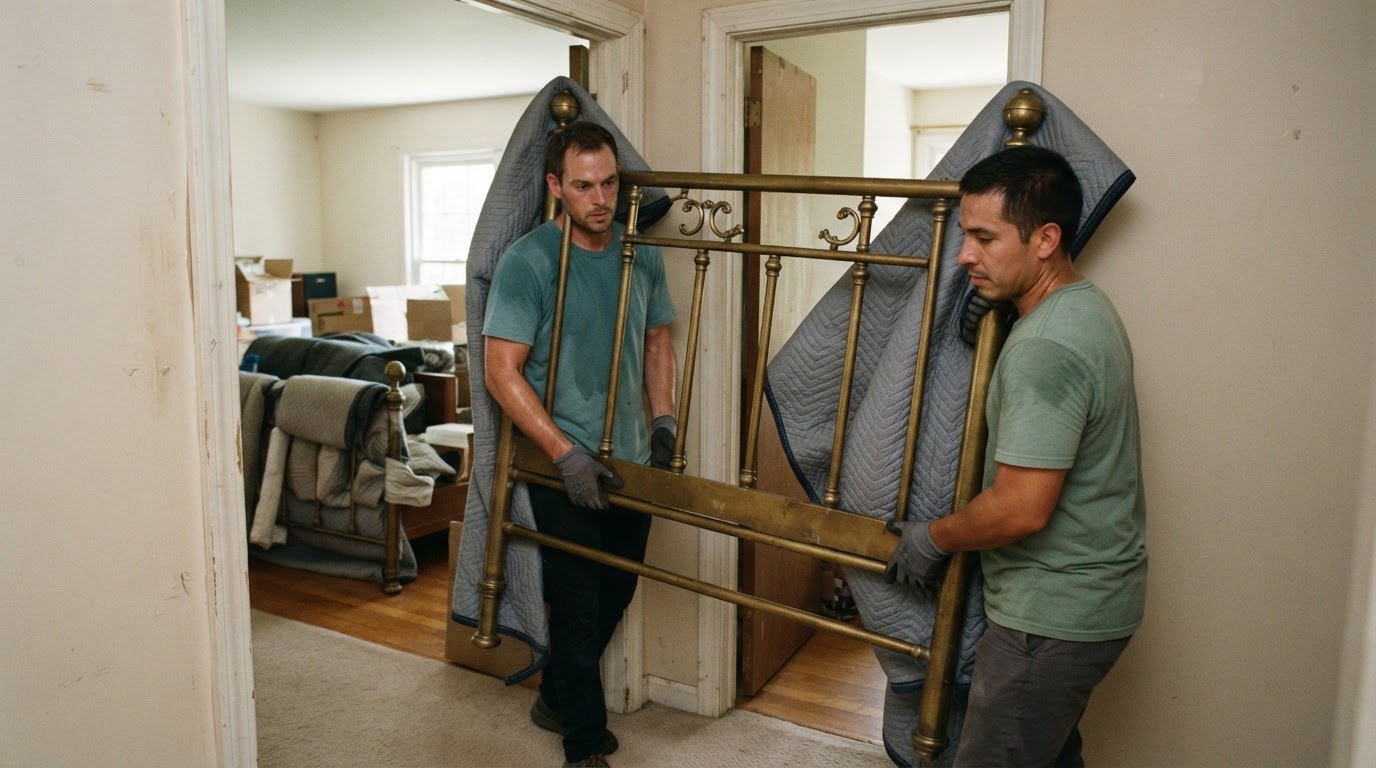
Measure each doorway the rower or cycle must pass through. Account for usable width and height, not just the door panel. A door that swings into a hallway can reduce clearance, while trim or a nearby fixture can narrow the passage further.
The machine’s widest and tallest points matter, including parts that protrude from its frame. A rower’s long rail can make a turn harder than a straight doorway crossing. On an indoor cycle, pedals or handlebars may affect clearance even when the main frame appears to fit.
- Measure the equipment. Record the machine’s full length, width, and height in its moving position.
- Measure each opening. Check doorways along the route, including the starting room and destination.
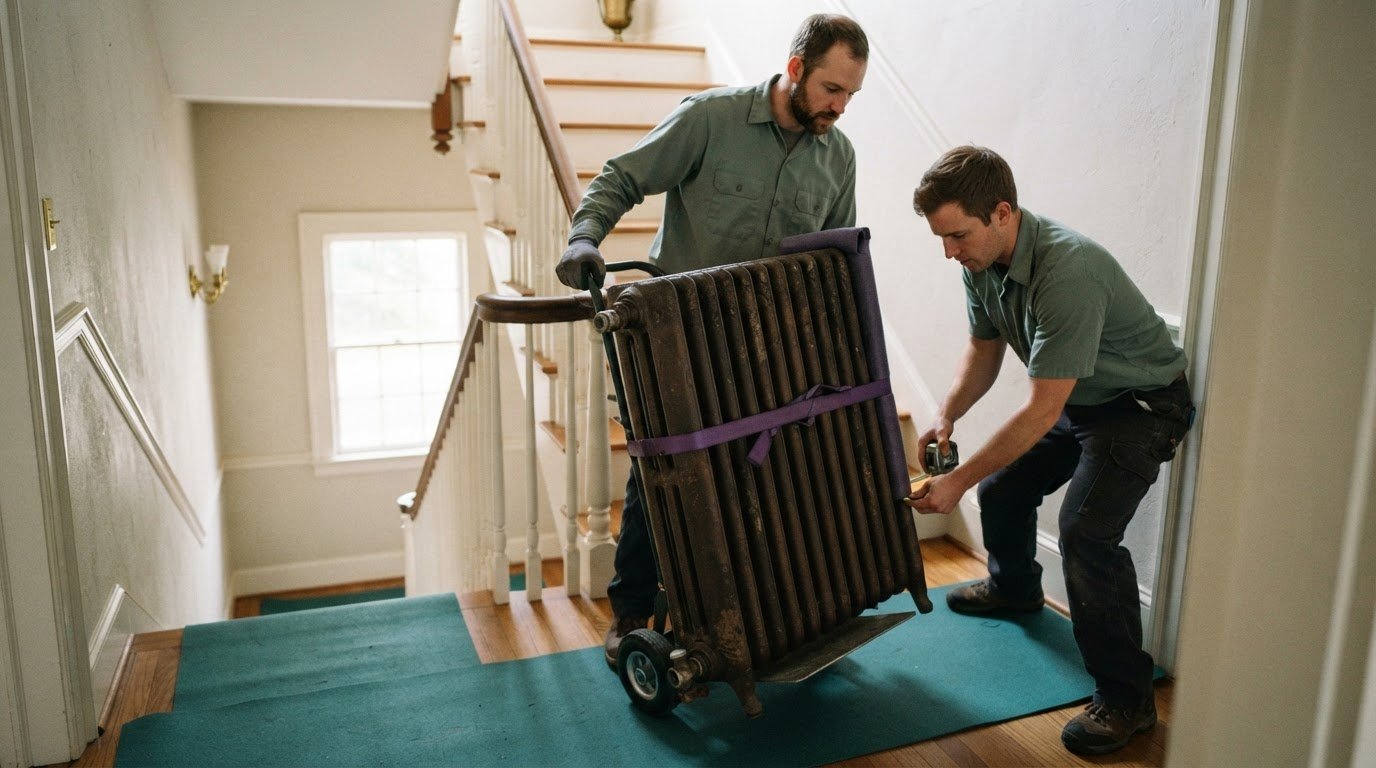
- Assess turns and landings. Compare the machine’s shape with the room available to pivot at corners and stair landings.
- Look for obstacles. Identify rugs, furniture, and items near the route that could obstruct movement or create a trip hazard.
- Plan for the machine’s orientation. A rower may need a different angle through a doorway than an indoor cycle.
A measurement is useful only when it reflects the actual path. Consider the approach to each doorway, not just the opening. A machine may fit through a wide entrance but still be difficult to turn in the narrow hall just beyond it.
Walk the full route from pickup point to final placement. Check each passage, threshold, stair section, and turn in sequence. A clear route helps movers maintain control instead of stopping with a heavy machine partway through a tight space.
Clear rugs and movable furniture from the path before carrying begins. Identify spots where a rower’s rail or cycle handlebars could catch on a doorframe. Planning ahead helps prevent sudden adjustments during the move.
Share the model name, equipment dimensions, and unusual access details before the move. A photo of a tight doorway or turn can help movers assess the route. For moving heavy commercial-grade indoor cycles and rowers in South Riding, accurate measurements and a clear path help determine whether the equipment can travel assembled or needs another plan.

How professional movers protect floors during transport
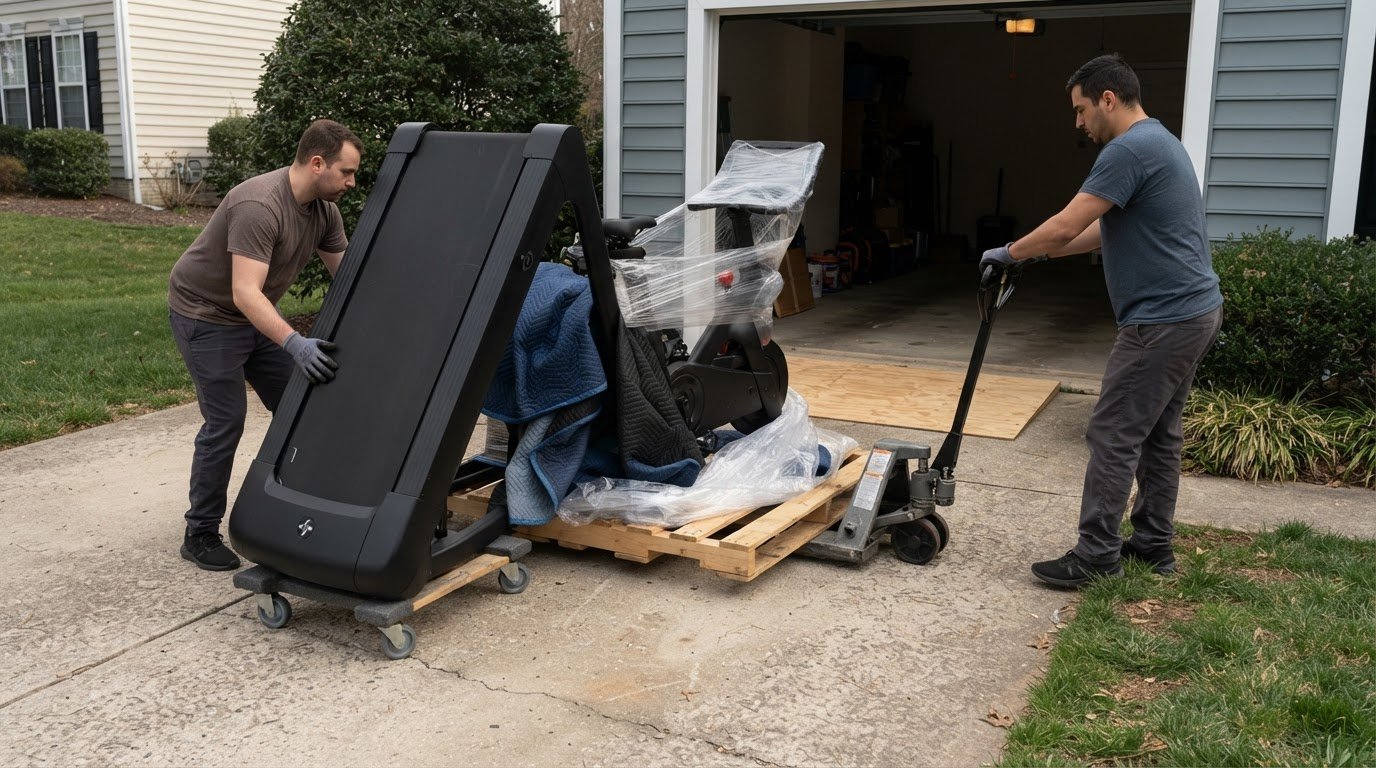
For an indoor cycle or rower, floor protection starts with controlled lifting. Movers lift the machine rather than dragging it, especially over thresholds or uneven surfaces, where feet or rails can scrape or catch.
Insurance and liability coverage depend on the mover’s written agreement and applicable policy terms. Review those terms before transport to understand how damage claims, exclusions, and the equipment’s value are handled.
Before carrying begins, assess the floor along the full route. Hardwood, tile, carpet, and transitions between surfaces all call for careful handling. A threshold between rooms, for example, can catch a rower’s long rail if the crew lowers it too soon.
- Protect the route. Movers use suitable floor coverings where the surface could be exposed to scuffs, dirt, or contact from equipment.
- Lift over transitions. The machine is carried across door thresholds and uneven spots instead of being pulled over them.
- Keep the load controlled. Movers coordinate their grip and pace so the cycle’s feet or rower’s rail don’t strike the floor.
- Watch turns and narrow areas. A handlebar or rail can swing into flooring or trim when the crew pivots.
- Set down with care. Movers lower the equipment deliberately, keeping its contact points from dropping onto the surface.
A commercial indoor cycle can pose floor risks even when its frame stays upright. Pedals or stabilizing feet may catch on a rug edge, while a sudden shift can bring the frame into contact with a wall or floor. Movers control the cycle’s position and keep protruding parts clear during turns.
A rower presents a different challenge. Its long rail may extend beyond the crew’s immediate reach, and its seat can slide if the machine tilts. Movers support the frame and prevent the rail from scraping a threshold or floor. They also secure detached parts so they do not fall or scatter along the route.
Floor coverings work best when flat and stable. A loose edge can become a trip hazard during a carry, so keep the walking path clear and reposition protection as needed. Avoid setting equipment down where it blocks the route for the next lift.
Damage can come from dragging, a dropped edge, a shifting component, or an obstructed path. Professional movers reduce those risks with controlled lifts, clear communication, and planned set-down points. For heavy cycles and rowers in South Riding, protecting both the machine and the home means treating each threshold, turn, and floor transition as part of the move.
Do South Riding movers charge extra for heavy or specialty fitness equipment?
There is no single standard price for every heavy or specialty fitness machine. Heavy Furniture Moving provides an upfront quote before work begins, with pricing based on the equipment and the job. Share the machine’s weight and size, preparation needs, and pickup and delivery access conditions to get a quote that reflects the move.
A commercial indoor cycle and a rowing machine can require different handling plans. A cycle may have protruding pedals or handlebars; a rower may have a long rail or need partial disassembly. These details affect how movers plan the carry and protect the equipment. A clear description helps the quote reflect the actual job rather than a generic item label.
Access can shape the work as much as the machine itself. Movers consider stairs, narrow passages, tight turns, thresholds, and the distance from the entrance to the room. Carrying a rower through several turns, for example, calls for more coordination than moving it along a direct, open route. If disassembly is needed, the plan must also account for preparation and reassembly.
- Describe each machine. Share whether it is an indoor cycle, rower, or both, plus the model or available dimensions.
- Explain access at both addresses. Mention stairs, narrow doorways, tight turns, and the equipment’s starting and destination rooms.
- Note preparation needs. Identify whether the rower may need disassembly or the cycle has parts that need securing.
- Include additional handling details. Share relevant information about thresholds, long carries, or limited space around the equipment.
- Request a quote based on the full job. A complete description helps account for equipment and access together.
Weight alone does not describe the effort required. A lighter machine can still be awkward to carry if its frame is long or difficult to turn. A heavier cycle may be easier to handle on a direct route when movers can keep it stable. The plan depends on the combination of load, shape, access, and preparation.
Ask for the quote to reflect the specific equipment and moving conditions. Keep model details and access notes together, so the information is easy to share. For exercise equipment moving, a clear job description helps connect the estimate with the handling the machines need.
For equipment covered by Florida Statutes section 316.170, railroad-crossing requirements apply to specified equipment operating at 10 miles per hour or less. The requirements also apply to equipment with vertical body or load clearance below 1/2 inch per foot between adjacent axles, or below 9 inches in any event. Equipment subject to the section must have at least 9 inches of vertical body or load clearance above a level roadway surface if the axle-based clearance threshold would otherwise be lower.
Heavy Furniture Moving
Heavy Furniture Moving helps plan moves that require careful handling of a commercial indoor cycle or rower through a home. Its Exercise Equipment Moving service addresses the central challenge: transporting bulky fitness equipment while accounting for the machine, access route, and placement needs.
Turn to Heavy Furniture Moving when the equipment is too awkward to manage alone, the route includes tight spaces, or you want professional help coordinating the move. Share the machine type and access details so the moving plan reflects the actual job. The team also provides Movers Near Me for local moving needs.
For help moving a cycle or rower in South Riding, contact Heavy Furniture Moving to discuss your move.
Plan the next move with confidence
Before arranging a move for heavy commercial-grade indoor cycles and rowers in South Riding, gather the details that shape the job: the equipment type, its current location, and any access challenges. This gives the moving team a useful starting point for planning transport and placement.
Heavy Furniture Moving offers Movers Near Me, Exercise Equipment Moving, and Sofa Hoisting. For a cycle or rower move, Exercise Equipment Moving is the relevant service; Sofa Hoisting addresses a different bulky-item access challenge.
Share what you’re moving and where it needs to go, then discuss the handling it requires. A clear conversation helps you decide on the next step without adding guesswork to a demanding move.
Contact Heavy Furniture Moving to discuss moving your indoor cycle or rower. With a clear plan and the right help, you can move forward with confidence.
Frequently Asked Questions
What should professional movers consider before moving a rowing machine?
Account for the rower’s condition, loose accessories, and destination placement. A console cord, water bottle holder, or removable foot strap can snag or become separated during handling. Movers can note these parts before loading and keep detached accessories together. Tell the crew about delicate or previously damaged areas so they can take them into account while handling and placing the machine.
What movers in South Riding, VA handle heavy commercial-grade indoor cycles and rowing machines?
Heavy Furniture Moving handles exercise equipment moves in South Riding, including commercial-grade indoor cycles and rowing machines. Share the equipment type, pickup and delivery addresses, and any details that could affect access. For example, mention whether the machine is located in a basement or needs to reach an upstairs room. Those details help the moving team understand the job and plan the right handling approach.
Do movers in Loudoun County provide packing, stairs, and in-home placement for fitness equipment?
Heavy Furniture Moving offers residential packing and unpacking support, along with equipment moving for bulky fitness machines. Include stairs and the intended room in your move details, especially if the equipment must go beyond the entryway. Placement matters: a rower needs room for its rail, while a cycle needs a suitable spot for its frame and handlebars.
Can the indoor cycle and rower fit through typical South Riding home doorways, stairs, and elevators?
There is no single answer for every home because machine models and access layouts differ. A rower’s length can make a stair landing or elevator turn the deciding factor, even if the doorway seems wide enough. The moving plan should account for the equipment’s actual dimensions and the narrowest passage along the route. For elevators, check both the opening and usable interior space.
How do local moving companies compare for reviews, availability, and specialty-equipment experience?
Compare relevant experience, recent customer feedback, and how clearly a mover discusses the equipment and access plan. Heavy Furniture Moving handles exercise equipment, and its website reports 500+ verified five-star Google reviews with a 4.9/5 overall rating. Same-day crews are often available when a slot is open. Ask for the move plan to reflect your specific cycle or rower, rather than relying only on general moving experience.
Frequently Asked Questions
Account for the rower’s condition, loose accessories, and destination placement. A console cord, water bottle holder, or removable foot strap can snag or become separated during handling. Movers can note these parts before loading and keep detached accessories together. Tell the crew about delicate or previously damaged areas so they can take them into account while handling and placing the machine.
Heavy Furniture Moving handles exercise equipment moves in South Riding, including commercial-grade indoor cycles and rowing machines. Share the equipment type, pickup and delivery addresses, and any details that could affect access. For example, mention whether the machine is located in a basement or needs to reach an upstairs room. Those details help the moving team understand the job and plan the right handling approach.
Heavy Furniture Moving offers residential packing and unpacking support, along with equipment moving for bulky fitness machines. Include stairs and the intended room in your move details, especially if the equipment must go beyond the entryway. Placement matters: a rower needs room for its rail, while a cycle needs a suitable spot for its frame and handlebars.
There is no single answer for every home because machine models and access layouts differ. A rower’s length can make a stair landing or elevator turn the deciding factor, even if the doorway seems wide enough. The moving plan should account for the equipment’s actual dimensions and the narrowest passage along the route. For elevators, check both the opening and usable interior space.
Compare relevant experience, recent customer feedback, and how clearly a mover discusses the equipment and access plan. Heavy Furniture Moving handles exercise equipment, and its website reports 500+ verified five-star Google reviews with a 4.9/5 overall rating. Same-day crews are often available when a slot is open. Ask for the move plan to reflect your specific cycle or rower, rather than relying only on general moving experience.