
Moving Day Plan for Families in Centreville: Your 2026 Checklist

A family move can go sideways before the first box leaves the house. A moving day plan for families in Centreville needs to account for more than boxes: children, pets, helpers, heavy items, and access all have to fall into place. One delay can affect the rest of the day, so it helps to decide in advance what can change and what needs to stay on track.
The solution is a clear sequence, not trying to handle everything at once. This checklist will help you organize the morning, keep children and pets settled, and prepare for parking, entryways, and move-in access. It also helps you decide which jobs your household can manage and where extra help may make heavy lifting or awkward furniture easier.
Start by setting aside essentials and assigning simple roles. Then confirm access details, choose a safe place for children and pets, and work through the home in a steady order. A plan for people, belongings, and difficult items can leave your family more time to get settled.
Key Takeaways
- Build a timeline for the weeks before, the night before, and the morning of the move to reduce last-minute decisions.
- Keep family essentials separate from packed boxes, and arrange a calm, supervised place for children and pets during loading.
- Use a flexible loading sequence that prioritizes essential belongings and rooms while leaving room to adjust if delays arise.
- Choose DIY, partial help, or broader moving support based on your household’s capacity, heavy items, and access challenges.
- Use this moving day plan for families in Centreville to prepare a final checklist and confirm the address, access, priorities, and special handling needs with any moving team.
Start your Centreville family moving day plan with a clear timeline
A short, ordered plan can reduce pressure on the whole household. Set the main checkpoints before boxes start moving, so you aren’t making every decision in the middle of the work. A moving day plan for families in Centreville should account for home access, travel, school or childcare schedules, and the people who’ll be helping.
Moving also means adjusting to a major family transition. Wikipedia’s overview of the process of leaving one's dwelling notes the personal side of relocation, a reminder to plan for family needs alongside practical tasks.
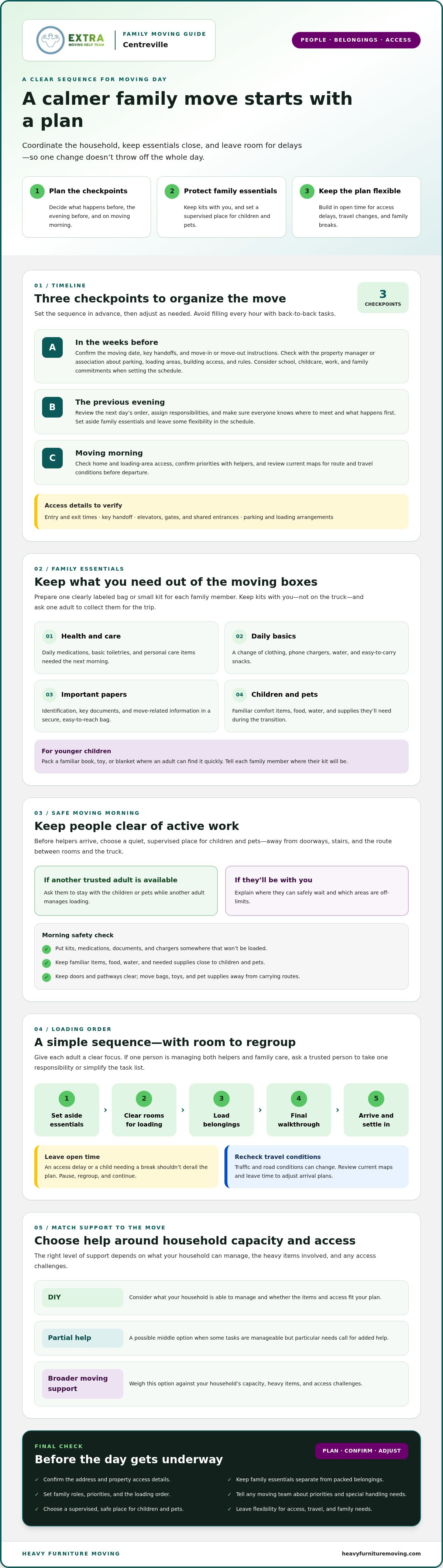
Build your checklist around three checkpoints:
- In the weeks before: Confirm the moving date, key handoffs, and move-in or move-out instructions. Ask the property manager or relevant association about parking, loading areas, building access, and rules that may affect the plan. Check school, childcare, work, and family commitments before setting the schedule.
- The previous evening: Review the next day’s sequence and assign each person a responsibility. Make sure everyone knows where to meet and what happens first. Leave some flexibility instead of booking every hour tightly.
- The morning of the move: Check that the home and loading area are accessible, confirm priorities with your helpers, and review current maps for the planned route and travel conditions.
What to confirm before setting your moving schedule
Confirm when you can enter or leave each property, how keys will be handed off, and whether there are instructions for elevators, gates, or shared entrances. Verify parking and loading arrangements directly with the property manager or association. On moving day, check current maps before departure. Traffic and road conditions can change, so leave time to adjust your arrival plan.
How to set family roles and a realistic task order
Give each adult a clear focus. If possible, have one person coordinate helpers and access while another manages children or pets. If you’re handling both roles yourself, ask a trusted person to take one responsibility or simplify the task list.
Keep the order easy to follow: set aside essentials, clear rooms for loading, load belongings, complete a final walkthrough, then focus on arrival and settling in. Avoid scheduling every step back-to-back. An access delay or a child needing a break shouldn’t derail the plan. Open time gives your family room to regroup and continue.
Prepare children, pets, and essentials before moving day
A calmer move starts with separating what your family needs from what’s going on the truck. Keep essentials close and decide where children and pets will be before the carrying begins. This part of your moving day plan for families in Centreville can prevent you from searching packed boxes for a charger, medication, or favorite toy.
The evening before: pack and set aside essentials
Pack one clearly labeled bag or small kit for each family member. Keep the kits with you, not on the moving truck. Assign one adult to collect them for the trip so they don’t get mixed in with household boxes.
- Health and care: Daily medications, basic toiletries, and personal care items needed the next morning.
- Daily basics: A change of clothing, phone chargers, water, and easy-to-carry snacks.
- Important papers: Identification, key documents, and move-related information in a secure, easy-to-reach bag.
- Children and pets: Familiar comfort items, food, water, and supplies they’ll need during the transition.
Tell each family member where their kit will be. For younger children, pack a familiar book, toy, or blanket where an adult can find it quickly. The Child Mind Institute offers practical advice on helping children adjust to a move, including ways to support them through the change.
Moving morning: keep people clear of active work
Before helpers arrive, choose a quiet, supervised place for children and pets away from doorways, stairs, and the path between rooms and the truck. If possible, ask a trusted adult to stay with them while another adult manages loading. If they’ll be with you, explain where they can safely wait and which areas are off-limits.
Use this quick morning check:
- Put essentials kits, medications, documents, and chargers in the family vehicle or another spot that won’t be loaded.
- Keep familiar items, food, water, and needed supplies close to children and pets.
- Keep doors and pathways clear. Don’t leave bags, toys, or pet supplies where furniture and boxes are being carried.
- Before leaving, check the rooms and the designated quiet space so personal essentials aren’t left behind.
If packing or carrying is adding too much to your family’s workload, extra help is an option. You can ask about residential moving support and confirm whether help is available for your Centreville address and needs.
Choose a family-friendly moving-day schedule that can absorb delays
A useful schedule gives your family direction, not a deadline for every task. In a moving day plan for families in Centreville, organize the day around a few checkpoints. That way, a slow loading stretch, an access issue, or a child needing a break won’t automatically throw off the whole plan.
A moving-day buffer is unassigned time reserved for unexpected delays. Leave space between major steps instead of booking them back-to-back. Use this flexible sequence as a guide, then adjust it to your move:
- Before loading: Set aside anything not going with the movers, secure family essentials, and clear the carrying path.
- During loading: Prioritize large furniture and items needing special handling, then work through rooms in a consistent order. Keep must-have belongings with the family rather than buried among boxes.
- At the departure check-in: Once loading is complete, confirm everyone is ready, finish the walkthrough, and check that keys and documents are accounted for before leaving.
- On arrival: Set up a clear essentials area first. Then direct boxes and furniture to their intended rooms as access allows, keeping family needs and clear pathways in view.
Check in at transitions rather than constantly. If loading takes longer than expected, decide what can wait, such as unpacking nonessential items, and protect the next priority: a safe departure, manageable travel, or settling children and pets.
What to do before movers or helpers arrive
Walk through each room and identify belongings that aren’t moving. Keep children, pets, and personal essentials away from loading areas, and clear the routes people will use to carry items. Before work begins, review priority belongings, access details, and special handling needs with the team. Clear directions at the start can help avoid unnecessary stops later.
How to close out the old home and settle into the new one
Use a room-by-room walkthrough rather than relying on one last glance. Check closets, cabinets, and storage areas you used, then gather keys and documents before the final handoff. At the new home, choose a clear spot for essentials and family bags before boxes spread through the rooms. Unpack what the household needs first. The rest can wait until everyone is settled.
Compare DIY and moving help for Centreville homes and access needs
The right choice depends on your household’s capacity, not on whether you can do everything alone. A DIY move may suit a smaller load and a family with enough time, safe lifting ability, transport, and reliable helpers. Partial assistance can cover the hardest tasks, such as packing or heavy lifting, while you manage the rest. Broader support may be worth considering if coordinating transport, packing, and carrying would stretch your family too thin. Match the level of help to the work you actually need done.
When a do-it-yourself move may fit your family
Before choosing DIY, check the full workload. Can your household manage packing, lifting, and transport without relying on someone who needs to supervise children or pets? Do you have suitable vehicle access, enough helpers, and time for loading, driving, and unloading? Set manageable boxes apart from items that may need special handling or equipment. If a piano, safe, or exercise machine is on the list, don’t assume it can be moved like an ordinary box or chair.
When to consider professional help with the move
Extra help can make sense if your schedule is tight, transport is difficult, packing is unfinished, or heavy items are beyond what your household can safely handle. You don’t have to hand over the entire move. Ask about the specific support you need, such as packing assistance, heavy-item moving, or exercise equipment moving. For an item such as a treadmill, share its location and any access challenges when discussing the job.
Before settling on a plan, verify logistics at both homes. Check parking and loading arrangements, stairs, elevator access, narrow entryways, and property rules with the property manager or relevant association. Measure tight turns and doorways or describe them clearly, and flag items that may need special handling. These details help you compare options based on the actual conditions, not just the number of boxes.
If you’re comparing providers, request written service details. Review what each option includes, what tasks remain yours, and how access or special items will be handled. Confirm that the provider can serve your Centreville address before making plans.
Need help with heavy lifting or packing? Ask about moving support for your Centreville home and confirm whether the service fits your address and needs.
Finish your Centreville moving day plan with clear next steps
You’ve mapped the day. Now make the final check easy to scan, so family members and any moving team know what happens next. This last pass turns your moving day plan for families in Centreville into a practical handoff: the right people have the right details, and essentials stay within reach.
A final checklist for the night before and moving morning
Keep one short checklist where the adults can find it. Review it the night before, then check the essentials again before leaving in the morning.
- Confirm the move details: Recheck contact information, arrival instructions, both addresses, access arrangements, and parking or loading directions.
- Set aside what travels with you: Keep keys, important documents, medications, chargers, and first-day essentials out of boxes and away from the loading area.
- Confirm family roles: Make sure each adult knows who is coordinating the move and who is supervising children or pets. Confirm where they’ll stay while items are being carried.
- Review priorities: Identify belongings needing careful attention and tasks that can wait until after arrival.
A quick morning check catches changes before they become a scramble. If an access instruction or parking arrangement has changed, share the update before loading starts.
How to request help that matches your family's move
If you’re considering help, describe the move clearly rather than asking only for a general estimate. Share the Centreville address, preferred timing, type of support you’re seeking, and any stairs, narrow entryways, parking limits, or property instructions. List heavy or difficult items, such as a piano, safe, exercise equipment, or a sofa that may not fit through a standard entryway.
Heavy Furniture Moving provides residential moving support and specialized handling for pianos, safes, and exercise equipment. Sofa hoisting is available for furniture that cannot pass through standard access points. Ask which requested tasks are available for your address, and confirm the service details directly before making arrangements.
Heavy Furniture Moving’s listed local locations include Fairfax, Woodbridge, Manassas, Manassas Park, Aldie, Ashburn, Mclean, Vienna, Reston, Centreville, Chantilly, Clifton, Dumfries, South Riding, Fairfax Station, Haymarket, and Gainesville. Confirm the available support for your specific address and requested tasks.
With clear details, you can decide whether you need help with the full move or only the most demanding tasks. If you’d like to talk through your Centreville move, contact Heavy Furniture Moving about your moving needs.
Make your family’s next move feel more manageable
A steady move doesn’t require a perfect day. It takes a clear order of tasks, essentials kept close, and enough flexibility to adapt when plans shift. Your moving day plan for families in Centreville can help everyone understand their role and keep the focus on getting settled, not scrambling.
Choose the level of help that fits your household. Heavy Furniture Moving is veteran-family owned and operated, with residential moving and packing support and specialized handling for pianos, safes, and exercise equipment. Share your needs and confirm the details for your Centreville address directly.
Tell us about your Centreville move and ask about support for your next steps.
Frequently Asked Questions
How early should a family start planning moving day?
Start planning as soon as your moving date is known. Early preparation gives you time to confirm home access, parking, key handoffs, school or childcare commitments, and the help your household may need. Build a simple timeline for the weeks before, the evening before, and moving morning. Leave room for changes instead of assigning every task a rigid time.
What should a family pack in a moving-day essentials bag?
Pack medications, chargers, toiletries, water, snacks, a change of clothes, important documents, and keys. Add child-care or pet supplies your household will need during the transition, plus a familiar comfort item for younger children. Keep the bag with you rather than loading it onto the truck. Label it clearly and decide who is responsible for bringing it, so no one has to search through boxes after arrival.
How can parents keep children safe during a move?
Arrange for a trusted adult to supervise children or set up a quiet, supervised space away from stairs, doorways, and carrying routes. Explain where they can stay and which areas are off-limits while furniture and boxes are moving. Keep snacks, water, and familiar activities nearby. If the family’s plan changes, pause and make sure children are safely accounted for before loading continues.
What is the best way to manage pets on moving day?
Keep pets in a secure, quiet space away from open doors and active loading paths, or arrange for a trusted person to care for them during the busiest part of the move. Set aside their food, water, familiar bedding, and any supplies they’ll need. Tell helpers where the pet is before carrying begins, and check that the animal is safely contained before doors are opened.
How do I plan for parking and home access in Centreville?
Ask your property manager or relevant association about parking, loading areas, building access, and move-related instructions. Check stairs, elevators, gates, and narrow entryways at both homes, and share any restrictions with your moving team ahead of time. Confirm key handoffs and arrival instructions, then review current maps on moving day for route and travel conditions. Don’t assume access arrangements are the same at both addresses.
Should I hire movers or handle a family move myself?
Choose based on your household’s available time, helpers, transport, and ability to lift safely. DIY may suit a manageable load when family members can handle the tasks without neglecting childcare or other commitments. Partial help can cover demanding work, while broader residential moving support may suit a more involved move. Compare written service details, confirm what tasks are included, and check that the provider serves your address.
Can movers help with heavy furniture or exercise equipment?
Some moving providers handle heavy furniture and exercise equipment, but confirm the specific item and service directly before making arrangements. Heavy Furniture Moving offers specialized handling for exercise equipment, pianos, and safes, as well as sofa hoisting for furniture that cannot pass through standard access points. Share the item’s location and any stairs, tight turns, or narrow entrances so the team can confirm whether it can help.
Frequently Asked Questions
Start planning as soon as your moving date is known. Early preparation gives you time to confirm home access, parking, key handoffs, school or childcare commitments, and the help your household may need. Build a simple timeline for the weeks before, the evening before, and moving morning. Leave room for changes instead of assigning every task a rigid time.
Pack medications, chargers, toiletries, water, snacks, a change of clothes, important documents, and keys. Add child-care or pet supplies your household will need during the transition, plus a familiar comfort item for younger children. Keep the bag with you rather than loading it onto the truck. Label it clearly and decide who is responsible for bringing it, so no one has to search through boxes after arrival.
Arrange for a trusted adult to supervise children or set up a quiet, supervised space away from stairs, doorways, and carrying routes. Explain where they can stay and which areas are off-limits while furniture and boxes are moving. Keep snacks, water, and familiar activities nearby. If the family’s plan changes, pause and make sure children are safely accounted for before loading continues.
Keep pets in a secure, quiet space away from open doors and active loading paths, or arrange for a trusted person to care for them during the busiest part of the move. Set aside their food, water, familiar bedding, and any supplies they’ll need. Tell helpers where the pet is before carrying begins, and check that the animal is safely contained before doors are opened.
Ask your property manager or relevant association about parking, loading areas, building access, and move-related instructions. Check stairs, elevators, gates, and narrow entryways at both homes, and share any restrictions with your moving team ahead of time. Confirm key handoffs and arrival instructions, then review current maps on moving day for route and travel conditions. Don’t assume access arrangements are the same at both addresses.
Choose based on your household’s available time, helpers, transport, and ability to lift safely. DIY may suit a manageable load when family members can handle the tasks without neglecting childcare or other commitments. Partial help can cover demanding work, while broader residential moving support may suit a more involved move. Compare written service details, confirm what tasks are included, and check that the provider serves your address.
Some moving providers handle heavy furniture and exercise equipment, but confirm the specific item and service directly before making arrangements. Heavy Furniture Moving offers specialized handling for exercise equipment, pianos, and safes, as well as sofa hoisting for furniture that cannot pass through standard access points. Share the item’s location and any stairs, tight turns, or narrow entrances so the team can confirm whether it can help.


