Jewelry Safe Moving and Anchoring in Ashburn
Empty the safe before moving day, and carry jewelry and other valuables with you. Safe movers to unbolt and relocate a jewelry safe in Ashburn can then focus on moving the heavy unit safely. Safes over 500 pounds require specialized equipment, so the route, access points, and final placement all matter.
It’s natural to worry about the safe’s contents, floors, and doorways during a move. This guide explains what to remove, how movers protect the safe and surrounding property, and what to expect when the safe is unbolted, relocated, and anchored at its new spot.
You’ll also learn how the safe’s weight and the destination floor shape the plan. Use these details to prepare the space and understand how careful handling and suitable equipment help keep the move controlled.
Key Takeaways
- Map the route from the safe to the exit, including tight turns, thresholds, and the final position, before moving day.
- Protect floors and nearby surfaces with a plan matched to the safe’s weight and the home’s layout.
- Remove jewelry and other valuables from the safe and transport them separately.
- Match the anchoring method to the destination floor, since concrete and wood subfloors call for different hardware.
- Learn what specialized moving equipment can do to keep a heavy safe controlled through the move.
Protecting floors, entryways, and surrounding property
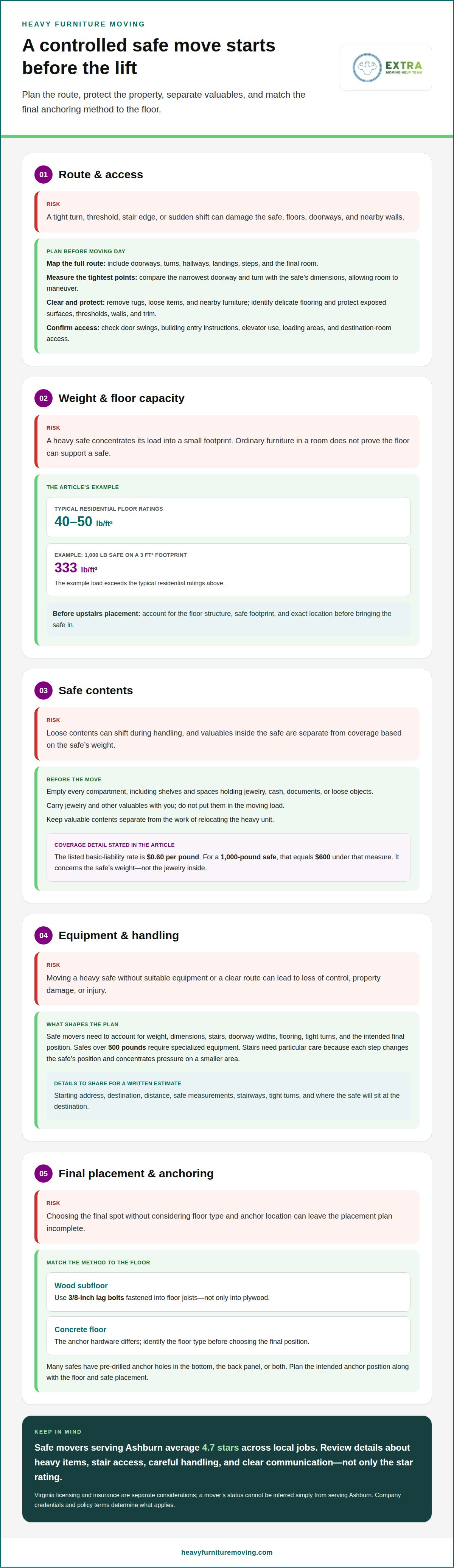
That load can damage flooring, thresholds, stair edges, or wall corners if it shifts during handling. Before moving day, map the route from the safe’s current position to the exit, including every doorway, turn, landing, and step. Measure the narrowest point and compare it with the safe’s dimensions. A clear route helps the moving team plan each turn before loading begins.
Upstairs placement needs special attention. Typical residential floor ratings are 40 to 50 pounds per square foot, but a safe concentrates weight into a small footprint. For example, a 1,000-pound safe resting on a 3-square-foot footprint exerts 333 pounds per square foot, exceeding those typical ratings. Don’t assume a room can support the load because it holds ordinary furniture. The floor structure, safe footprint, and exact placement all matter. If you’re looking at an upstairs location, account for the floor’s capacity before the safe is brought in.
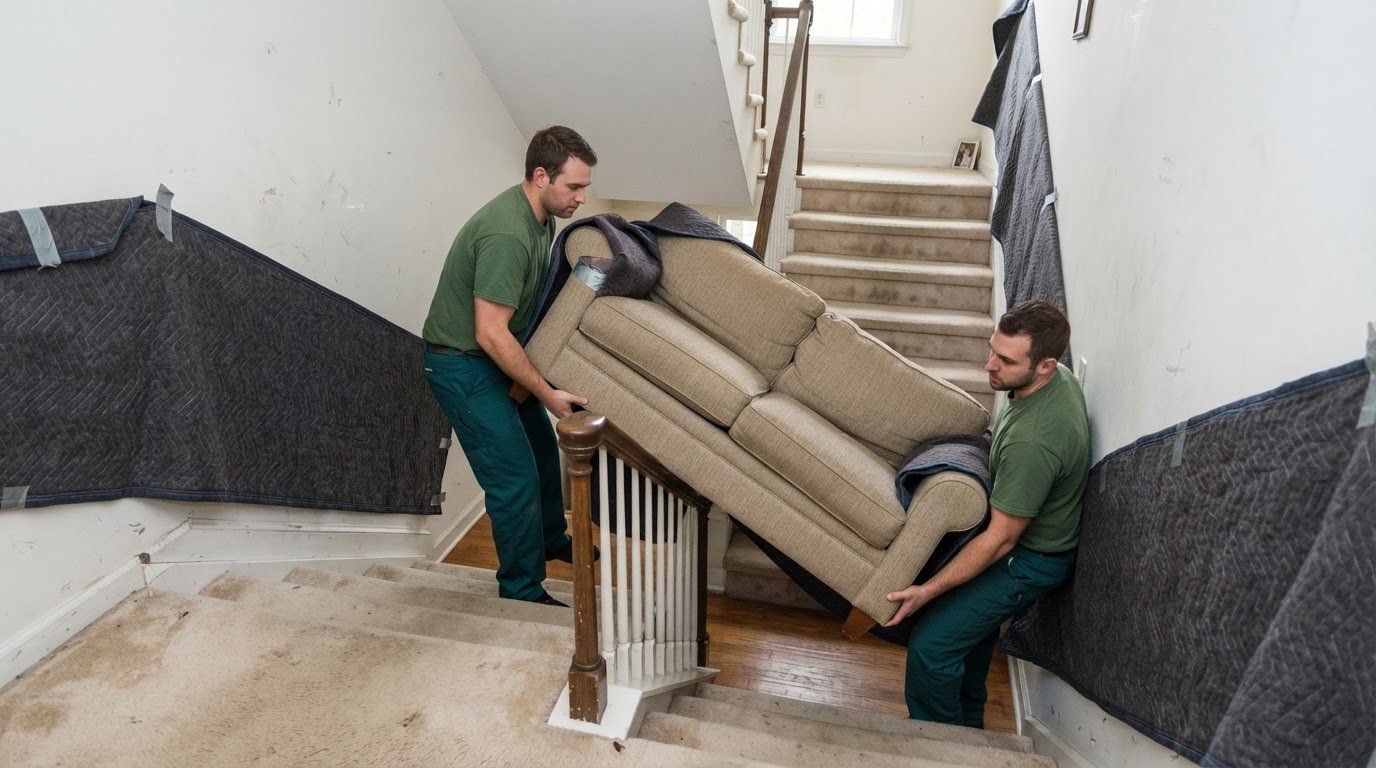
Protect floors and thresholds along the full route, not only where the safe starts and ends. Identify delicate flooring, raised doorway strips, stair nosings, and tight corners before lifting. Clear rugs, loose items, and nearby furniture from the path. Protective coverings can shield exposed surfaces, while a planned route helps prevent the safe from scraping walls or striking door frames. Stairs need particular care because each step changes the safe’s position and concentrates pressure on a smaller area.
Keep the route clear and make sure doors can open fully before moving begins. Note narrow entryways and sharp turns where the safe may need to change direction, and protect nearby walls and trim at those pinch points. The team should move deliberately rather than rush across floors or thresholds. A sudden stop or sideways shift can push a heavy safe into a wall or floor edge. Keep people and pets away from the route.
Anchoring also affects the floor plan. Most safes have pre-drilled anchor holes in the bottom, the back panel, or both. On a wood subfloor, use 3/8-inch lag bolts fastened into floor joists rather than only into plywood. The intended anchor position should be considered before placement, since the safe needs to sit where the floor and anchoring method can support it. On concrete, the anchor hardware differs, so identify the floor type before choosing the final position.
- Measure doorway widths, turns, and landings before moving.
- Clear rugs, furniture, and other obstacles from the route.
- Consider floor capacity before placing a heavy safe upstairs.
- Plan the final position around the floor type and anchor location.
Do I need to empty my safe before moving it?
Yes. Empty the safe before the move and carry jewelry and other valuables with you. Removing the contents reduces the chance of objects shifting inside during transport and keeps valuables separate from the heavy unit. The safe’s weight, dimensions, route, and destination placement also shape the moving plan.
A site assessment should consider the safe’s weight and dimensions, stairs, doorway widths, flooring, and its final location. These details help produce a written estimate based on the actual move rather than a guess. Share the starting address, destination, distance, safe measurements, and any stairways or tight turns. The unloading plan should identify where the safe will sit before it leaves its current position.
Measure the narrowest doorway and tightest turn along the route. Include hallways, landings, elevator openings, and the destination room’s entrance. Compare each measurement with the safe’s dimensions, allowing room to maneuver rather than relying on a straight-line fit. Note door swings and obstacles such as built-in shelves. A measured route helps the team plan access and handling at both addresses.
Building access can affect the schedule and route. For an apartment or secured property, arrange entry instructions, elevator use, loading areas, and any building requirements before moving day. Confirm which entrance the team should use and whether the safe will pass through shared hallways. At the destination, make sure the room is accessible and clear. These steps help loading and unloading go smoothly.
Virginia licensing and insurance are separate considerations. A mover’s status can’t be inferred simply from serving Ashburn; the company’s credentials and policy terms determine what applies. For basic liability, the listed rate is $0.60 per pound. A 1,000-pound safe would therefore have $600 in coverage under that measure. That figure concerns the safe’s weight, not the jewelry inside, so carry valuables personally.
Moving a jewelry safe without suitable equipment or a clear route can lead to loss of control, damaged property, or injury. Weight, stairs, turns, and doorway clearance all affect how the safe can be handled. Movers serving Ashburn average 4.7 stars across local jobs. Look for review details about heavy items, stair access, careful handling, and clear communication, rather than relying only on a star rating.
- Remove the safe’s contents and carry valuables separately.
- Provide measurements, access details, and the intended destination for a written estimate.
- Coordinate building entry and loading access before moving day.
If you need help planning the heavy-item portion of a move, explore local moving help for support with access and handling logistics.
Protecting safe contents during a move
Separate the safe’s contents from the heavy unit before moving day. A clear handoff plan keeps valuables and access items under your control throughout the move.
Safe Preparation and Contents Handling
Remove everything, including jewelry, cash, documents, and loose objects on shelves. Check every compartment so nothing remains inside to shift during handling. Carry valuables yourself rather than packing them with household goods or placing them in the moving load. This keeps the contents separate from the work of relocating the safe.
Make a simple checklist before emptying the safe. Note which compartments you’ve cleared, then check inside once more. Keep jewelry and documents in containers you can carry and control. For example, put small pieces in a closed case rather than loose in a bag. Don’t leave valuables beside the safe during loading.
Leave removable shelves or trays in place if they sit securely. If a part is loose, remove it and carry it separately so it won’t move inside the safe. Don’t add household items to the safe to “steady” it. Keep the interior empty to avoid extra weight or objects shifting during transport.
Contents and Key Custody
Keep the safe’s keys with you before, during, and after the move. Don’t pack them inside the safe or in a box loaded onto a truck. If access depends on a combination or keypad code, keep that information private and under your control. The movers can handle the empty unit without taking custody of valuables or access details.
Treat the transfer as two separate responsibilities: the moving team handles the empty safe, and you transport its contents and keys. Keep those items with you during loading, travel, and unloading. If another household member will carry them, agree on that handoff before moving day, not while the safe is in transit.
At the destination, keep the keys while the safe is positioned and anchored. Once it is in place, you can access it and return your valuables yourself. This avoids leaving contents in an unattended room or among moving boxes. Keep the key in a secure personal place until the safe is ready to use.
- Clear and inspect every compartment before moving.
- Carry jewelry, documents, and keys personally.
- Keep combination or keypad details private.
- Return contents only after the safe reaches its destination.
Bolting a safe down at its new location
Safe movers in Ashburn can unbolt and relocate a jewelry safe, then position it at the destination. The right approach depends on the safe’s anchor points, weight, and the floor beneath it.
Before securing the safe, identify whether the destination has a concrete slab or wood subfloor. Many safes have pre-drilled anchor holes in the bottom, the back panel, or both. Their position helps determine how the safe can sit against a wall or on the floor. Plan the final placement so the holes remain accessible and the safe doesn’t block a doorway, storage area, or frequently used furniture.
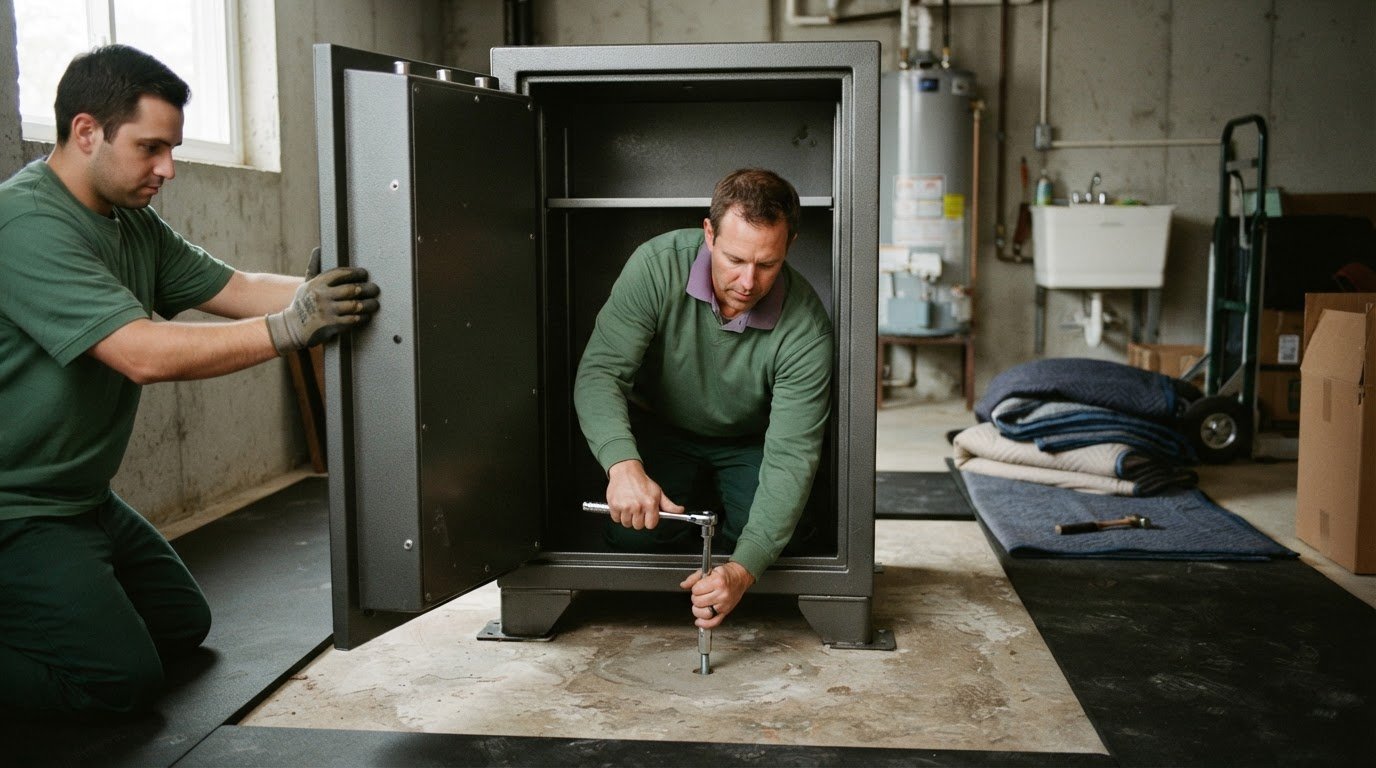
Concrete and wood require different anchoring hardware. For a safe on a concrete slab, use 3/8-inch concrete wedge anchors. For a wood subfloor, use 3/8-inch lag bolts fastened into floor joists rather than only into plywood. The anchor must match the floor type; choosing hardware based only on the safe’s weight misses the structure receiving the load.
Unbolting begins with access to the existing fasteners. Position the safe so its anchor points can be reached, then remove the fasteners before relocation. At the destination, place the safe in its planned position and align its pre-drilled holes with the selected anchoring points. The floor construction and layout guide the method in both homes and businesses.
Don’t leave anchoring as an automatic last step after unloading. Decide on the destination before the safe arrives, including its orientation and distance from walls or nearby furniture. A safe positioned too close to a wall may make back-panel holes difficult to reach. On a wood floor, the position of joists can also affect fastener placement. Plan the safe’s position and anchoring together.
After positioning the safe, secure it through appropriate pre-drilled holes with matching hardware. Keep the safe steady and avoid shifting it across the floor once fastening begins. If the intended placement changes, realign the unit before anchoring. The aim is a stable installation suited to the floor, safe, and room layout.
- Identify the floor type before selecting anchors.
- Use 3/8-inch wedge anchors for concrete slabs.
- Use 3/8-inch lag bolts into floor joists for wood subfloors.
- Plan safe orientation around anchor access and room use.
Specialized equipment for heavy safes
A safe’s weight changes how a moving team must control it through each stage. Specialized equipment is required for safes over 500 pounds. The key takeaway: match the equipment to the safe’s weight and the route, not just its size.
A dolly supports controlled movement across suitable surfaces, but it isn’t a complete moving plan. The team must also account for doorways, turns, stairs, thresholds, and the distance to the loading point. A route across a level hallway may require a different approach at a stair landing. Equipment selection should follow the route assessment, not replace it.
Before relocation, the team needs the safe’s weight and dimensions, plus details about the route out of and into the home. This helps determine whether the equipment suits the load and whether the route allows controlled movement. The safe’s weight must guide the equipment choice.
Protective packing serves a different purpose from lifting equipment. Covers and padding can help shield the safe’s exterior and nearby surfaces from scuffs during handling. They don’t reduce the safe’s weight or make an unsuitable dolly adequate. Keep the move sequence clear: secure the safe for handling, protect contact points, and use equipment suited to the load and route.
Stairs need special planning because the safe must remain controlled at every step and landing. Don’t treat a stairway as a flat path or assume a dolly’s capacity settles the question. The team must assess stair access, turns, and available space along with the safe’s weight. If the route won’t allow controlled movement, account for that before loading begins.
These equipment principles apply whether the job is a residential move or part of broader relocation services. In Ashburn, access conditions still matter; equipment must suit the home’s specific route. Share the safe’s weight, dimensions, stairs, and loading access so the plan can be built around the actual move. For demanding heavy-item work, get help with heavy lifting and plan the move around the load and access route.
- Use specialized equipment for safes over 500 pounds.
- Match the dolly’s 1,000-to-2,000-pound rating to the safe’s weight.
- Assess stairs, turns, thresholds, and loading access before moving.
- Use packing to protect surfaces, not as a substitute for proper equipment.
Heavy Furniture Moving
Heavy Furniture Moving helps with residential moves involving heavy, bulky items, including safe relocation. Turn to the team when stairs, tight access, or a heavy load make the safe difficult to move alone. The team also handles other large household items, including exercise equipment and furniture.
When describing the move, share the safe’s location, access route, and intended destination. These details help the team plan how to handle the heavy item, whether it’s moving by itself or as part of a household move. Contact Heavy Furniture Moving to arrange help with your relocation.
Set Your Safe Move in Motion
Before moving day, decide who will carry the safe’s contents and keys, and where the safe will go in its new home. Clear information about access, the route, and placement gives the move a practical starting point. If you need safe movers in Ashburn to unbolt and relocate a jewelry safe, choose a plan that accounts for the heavy unit and your home’s layout.
Heavy Furniture Moving can help with heavy-item moving needs as part of a residential move. Share the basic details of your move and the kind of help you need to take the next step. Contact Heavy Furniture Moving to discuss your move and move forward with confidence.
Frequently Asked Questions
Can safes be moved without damaging floors?
Yes, careful planning and protective materials can help prevent floor damage. Heavy Furniture Moving measures doorways, stairs, and item dimensions before lifting, and uses floor and corner protection such as runners, masonite, and door-jamb covers. Wrap, blankets, and straps are included on every job. If your home has hardwood floors, point out transitions between rooms so the route and protection can be planned around them.
How should customers prepare before safe relocation?
Empty the safe and carry jewelry, documents, and keys separately. Take photos of the safe and stairs, then share them with Heavy Furniture Moving along with the safe’s dimensions and location. Clear loose items from hallways and identify the intended destination. If the safe is upstairs, include the stairway and landing so the access route is clear before moving day.
Is internal repositioning available for heavy safes?
Heavy Furniture Moving handles residential moves involving safes and other heavy items, including moves within a home. Describe the current and intended locations, such as moving a safe from a bedroom to a ground-floor study. Doorway widths, turns, stairs, and safe dimensions help determine the route. A clear destination also helps the team plan how to position the safe.
What types of safes can be relocated?
The move plan depends on the safe’s weight, dimensions, and access route, not its label alone. Share the safe’s type and identifying details when describing the job. A compact home safe and a large jewelry safe, for example, may need different handling plans even if they use the same doorway.
Which safe movers in Ashburn, VA, relocate jewelry safes?
Heavy Furniture Moving provides local moving help in Ashburn and specialized handling for heavy items, including safes. When describing a jewelry safe move, include its approximate weight, dimensions, current location, stairs, and destination. These details help shape a plan for the specific home and route, whether the safe is moving across town or within the residence.
How much do jewelry safes weigh, and what equipment is needed to move them?
Share the model or weight information so the equipment and plan suit the load and route.
Can safe movers move a bolted-down safe without damaging floors or walls?
Yes, movers can plan to remove existing anchors and protect nearby surfaces during handling. Heavy Furniture Moving measures access points and uses floor and corner protection, including runners and door-jamb covers. The team must account for where the bolts meet the floor and how the safe can move away from the wall. A narrow alcove, for example, may require a different exit angle than an open room.
How are safes secured and re-anchored after relocation?
Re-anchoring depends on the safe’s pre-drilled holes and the destination floor. On a concrete slab, the stated method uses 3/8-inch concrete wedge anchors. On a wood subfloor, 3/8-inch lag bolts should fasten into floor joists, not only plywood. Set the safe in its final position before anchoring, with access to the holes and enough clearance for the door to open.
Frequently Asked Questions
Yes, careful planning and protective materials can help prevent floor damage. Heavy Furniture Moving measures doorways, stairs, and item dimensions before lifting, and uses floor and corner protection such as runners, masonite, and door-jamb covers. Wrap, blankets, and straps are included on every job. If your home has hardwood floors, point out transitions between rooms so the route and protection can be planned around them.
Empty the safe and carry jewelry, documents, and keys separately. Take photos of the safe and stairs, then share them with Heavy Furniture Moving along with the safe’s dimensions and location. Clear loose items from hallways and identify the intended destination. If the safe is upstairs, include the stairway and landing so the access route is clear before moving day.
Heavy Furniture Moving handles residential moves involving safes and other heavy items, including moves within a home. Describe the current and intended locations, such as moving a safe from a bedroom to a ground-floor study. Doorway widths, turns, stairs, and safe dimensions help determine the route. A clear destination also helps the team plan how to position the safe.
The move plan depends on the safe’s weight, dimensions, and access route, not its label alone. Share the safe’s type and identifying details when describing the job. A compact home safe and a large jewelry safe, for example, may need different handling plans even if they use the same doorway.
Heavy Furniture Moving provides local moving help in Ashburn and specialized handling for heavy items, including safes. When describing a jewelry safe move, include its approximate weight, dimensions, current location, stairs, and destination. These details help shape a plan for the specific home and route, whether the safe is moving across town or within the residence.
Share the model or weight information so the equipment and plan suit the load and route.
Yes, movers can plan to remove existing anchors and protect nearby surfaces during handling. Heavy Furniture Moving measures access points and uses floor and corner protection, including runners and door-jamb covers. The team must account for where the bolts meet the floor and how the safe can move away from the wall. A narrow alcove, for example, may require a different exit angle than an open room.
Re-anchoring depends on the safe’s pre-drilled holes and the destination floor. On a concrete slab, the stated method uses 3/8-inch concrete wedge anchors. On a wood subfloor, 3/8-inch lag bolts should fasten into floor joists, not only plywood. Set the safe in its final position before anchoring, with access to the holes and enough clearance for the door to open.