How to Trust Your Moving Company With Valuables: A Practical Checklist

A mover’s confident promise isn’t proof that your valuables are in good hands. If you’re wondering how to trust your moving company with valuables, look for safeguards you can verify, clear answers about coverage, and a written plan for handling delicate or heavy items.
It’s reasonable to worry about damage, loss, or confusing liability terms. You don’t have to rely on a polished website or take someone’s word for it. Ask direct questions, check the company’s credentials, and understand what its valuation options do and don’t cover before you book.
This practical checklist will help you compare a mover’s claims with verifiable details, document valuable belongings, and agree on handling expectations before moving day. You’ll also learn what to check in your paperwork and what to do if an item arrives damaged or goes missing. If a valuable item is bulky or difficult to move, ask about the mover’s relevant experience and proposed handling plan.
Key Takeaways
- Learn how to trust your moving company with valuables by checking verifiable details instead of relying on confident promises.
- Ask for clear written explanations of coverage, exclusions, limits, and claim deadlines before agreeing to a move.
- Create a record of priority items with photos and identifying details, and share any special handling needs.
- Before loading begins, review item condition and handling notes with the crew lead.
- Match the mover’s experience to your valuable item and the challenges involved in moving it.
How to Trust a Moving Company With Valuables: Start With Verifiable Checks
Handing over a fragile heirloom, expensive equipment, or belongings with deep sentimental value can feel like a big leap. Trust shouldn’t depend on a reassuring sales pitch. Build it from details you can check, expectations you can read, and a clear process for raising concerns if something goes wrong. A neutral moving industry overview can explain the range of services movers may provide, but it won’t verify a specific company or its promises.
Start with this checklist:
- Confirm the business identity and contact details.
- Get the move’s scope and key terms in writing.
- Ask for a written explanation of coverage and claims steps.
- List and photograph valuable items, noting special handling needs.
These checks give you a stronger basis for deciding how to trust your moving company with valuables. Reviews can help you identify useful questions, but they can’t replace current documents, written terms, or direct answers about your move.
Which moving-company details should you verify?
Compare the business name and contact details on the estimate, contract, and company communications. If they don’t match, ask who you’re hiring and who will perform the move. Confirm whom to contact with service concerns, too. Get those answers before moving day.
For an interstate move, check the company’s USDOT details through the Federal Motor Carrier Safety Administration’s SAFER database. Review the listing and operating status, and ask the mover to explain anything that doesn’t match your paperwork. For an in-state move, check which state agency or official resource handles mover verification. Requirements and records can differ, so confirm what applies to your move.
How should you assess reviews and recommendations?
Look across multiple sources for specific accounts of communication, careful handling, and how problems were addressed. A detailed review about a damaged item can suggest questions about how claims are documented. Praise for careful work can prompt you to ask how similar items were protected. Neither guarantees the same outcome for your move.
Notice repeated patterns, then follow up rather than treating them as proof. Ask whether the mover can share references or examples involving comparable items, such as a piano, safe, or exercise equipment, when available. Listen for clear, practical answers about crew preparation and handling. If the responses stay vague, pause before booking and request the relevant details in writing.
What to Ask About Moving Coverage, Valuation, and Claims
Don’t assume a mover’s coverage protects every item for its full replacement value. Terms, limits, exclusions, and claims processes can vary. Ask for the details in writing and read them before you book. If an answer is vague, verbal-only, or paired with pressure to sign quickly, pause and request clarification.
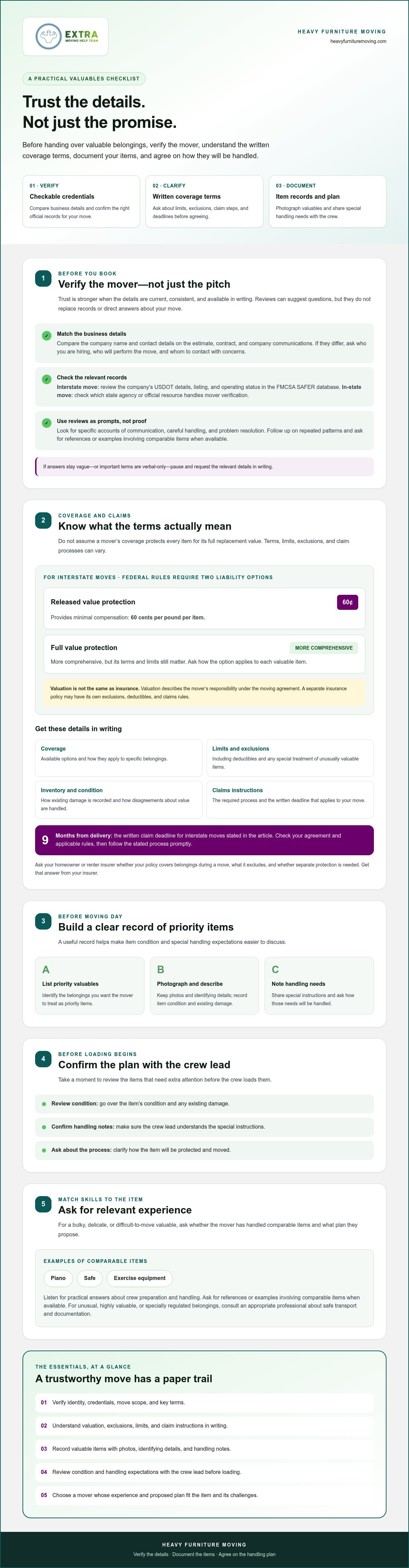
For interstate moves, federal rules require movers to offer two liability options: released value protection and full value protection. Released value protection provides minimal compensation, at 60 cents per pound per item. Full value protection is more comprehensive, but its terms and limits still matter. These moving-company valuation options aren’t the same as a separate insurance policy. Check the FMCSA’s Protect Your Move resource, and confirm which state or federal requirements apply to your move.
What is the difference between valuation and insurance?
Valuation describes the mover’s responsibility for items under the moving agreement. A separate insurance policy may work differently and can have its own exclusions, deductibles, and claims rules. Ask the mover to explain each available option in plain language, including whether special or unusually valuable belongings are treated differently. Don’t rely on a label alone. Find out what the terms mean for a specific item.
What should you get in writing before booking?
Request the estimate, service scope, inventory process, valuation terms, exclusions, deductibles, limits, and claims instructions. Confirm how the mover records existing damage and handles a disagreement about an item’s value. For interstate moves, the written claim deadline is nine months from delivery. Check your agreement and applicable rules, and follow the stated process promptly.
Ask your homeowner or renter insurer whether your policy covers belongings during a move, what it excludes, and whether you need separate protection. Get the answer from your insurer, not just the mover. For unusual, highly valuable, or specially regulated items, consult an appropriate professional about safe transport and documentation before scheduling.
- Ask: What coverage options apply to my move and these specific items?
- Confirm: What are the exclusions, deductibles, limits, and written claim deadline?
- Keep: A copy of the signed agreement and all claims instructions.
Clear paperwork is part of deciding how to trust your moving company with valuables. If you’re arranging bulky-item handling, discuss the item and your expectations with Heavy Furniture Moving before scheduling.
How to Document Valuables Before Moving Day
A clear record helps you explain what’s being moved, its condition, and how it needs to be handled. It’s also a useful reference if you need to discuss damage or a missing item later. Records can support communication and a claims review, but they don’t guarantee reimbursement.
Build your inventory before items are packed or wrapped. Keep a copy somewhere secure, and share only the handling notes the mover needs. The American Trucking Associations offers reputable mover selection tips. For your own move, pair careful preparation with a direct conversation about how the company uses inventory records.
How do you create a useful valuables inventory?
Keep it simple and specific. For each item, record its name, identifying details, visible condition, and handling needs. Photograph it from several angles, including any existing marks or damage. Add serial numbers, receipts, appraisals, or provenance records when available and appropriate.
- Identify: Describe the item clearly, such as “upright piano” or “glass-front cabinet.”
- Photograph: Capture the whole item and close-ups of existing wear.
- Record: Note serial numbers and supporting paperwork, if available.
- Share: Give the mover relevant handling instructions and ask how inventory details relate to the estimate and claims process.
Keep original documents and a separate copy of your inventory. Before packing, check that your photos show the item’s condition clearly. For a sentimental object, add a brief note about delicate parts or areas that need extra care.
Which valuables should you keep with you?
Some small, irreplaceable essentials may be safer in your personal possession. Consider carrying cash, jewelry, sensitive documents, medication, and items you couldn’t replace. Check the mover’s written prohibited or restricted-item list before packing anything for the crew. Don’t assume a company will accept every item.
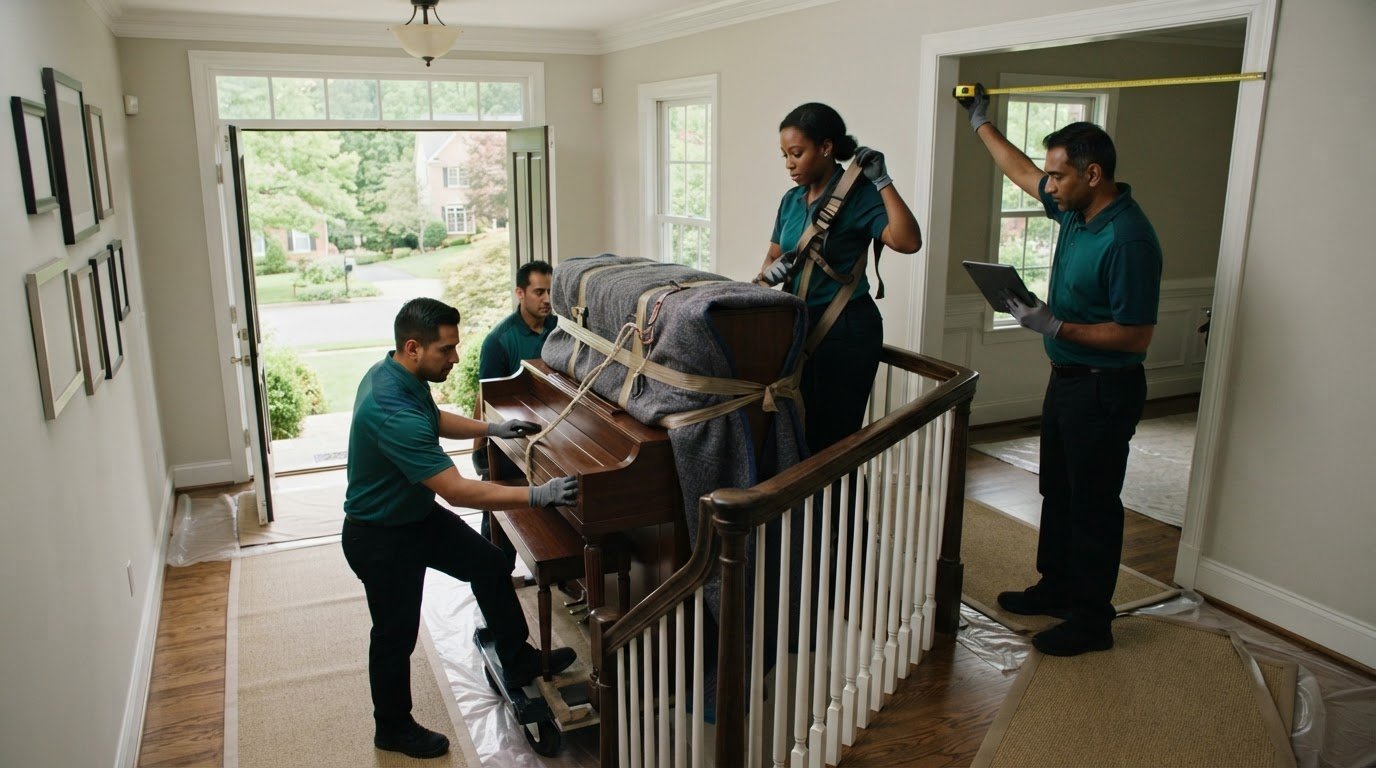
Large valuables need a different plan. If you’re moving a safe, piano, or piece of exercise equipment, tell the mover what it is and share the known weight, access limits, stairs, narrow turns, or other obstacles. These details help the company assess the handling requirements. Heavy Furniture Moving lists specialized handling for pianos, safes, and exercise equipment, but confirm current availability for your location and item before scheduling.
Good documentation is one practical part of how to trust your moving company with valuables. Keep the record current, share the details that affect handling, and retain your own copy throughout the move.
Moving-Day Checklist: Confirm Handling Before the Crew Loads
Before the first item goes onto the truck, take a few minutes to review the plan with the crew lead. Choose one person in your household to answer questions and approve changes. Walk through priority belongings together, then compare their visible condition with your inventory or photos. If you spot an unrecorded mark, note it before loading and make sure the right person knows about it.
Access details matter, especially in homes with tight turns or shared entrances. Confirm parking arrangements, stairs, elevators, building entry rules, and any limits on when or where the crew can work. Point out narrow hallways, low ceilings, and other obstacles that could affect a large or fragile item. Raise these details before the crew starts carrying.
What should you confirm with the crew lead?
Review where each priority item is located and explain fragile parts, disassembly needs, and any special handling already agreed upon. Confirm who can make decisions if the plan needs to change. If the crew’s approach differs from the written expectations, pause and ask for clarification before work continues. For example, if a piano can’t follow the planned route, agree on the next step rather than leaving the decision unclear.
- Walk through priority items and their handling notes.
- Confirm who can approve changes or answer questions.
- Point out access restrictions and compare item condition records.
- Ask whom to contact if an item can’t be moved as planned.
What should you do if something is damaged or missing?
Act promptly. Photograph visible damage from several angles, record the item and the date you discovered the issue, and keep relevant inventory or condition notes. If an item appears to be missing, check your inventory and contact the mover using the reporting process in your written documents. Keep copies of emails, forms, and other communications.
Ask the company to confirm receipt and identify the next documented step. Don’t rely on a verbal assurance or assume you know how the issue will be resolved. Follow the written claims instructions and keep a record of each update.
A clear moving-day routine puts your earlier checks into practice. If your move includes a heavy item with access challenges, discuss heavy-item handling requirements with Heavy Furniture Moving before scheduling. Confirm current availability for your location and item. These direct conversations are a practical part of how to trust your moving company with valuables.
Choose a Mover Whose Experience Matches Your Valuables
A mover may be experienced with everyday household furniture but have limited experience with a piano, safe, or oversized exercise machine. Match the provider’s demonstrated experience to the item, the route through your home, and the service you need. Weight, shape, fragile parts, stairs, and narrow doorways can all affect how an item can be handled. Ask for a practical explanation of the planned approach and crew preparation, not a broad promise that everything will be fine.
Be specific. Describe the item, where it is now, where it needs to go, and any access challenges. Ask whether the provider has handled comparable items and what information it needs to assess the job. A clear answer should address your actual item and layout. If the plan or service scope is unclear, get clarification in writing before booking.
When does specialized moving experience matter?
Special handling can matter when an item is bulky, delicate, unusually shaped, or difficult to maneuver through a home. A piano may need a different plan than a standard cabinet. A safe’s weight and location can affect access and crew preparation. General residential moving, packing, heavy-item handling, sofa hoisting, and shipment logistics are distinct needs. Confirm which specific service the provider will perform rather than assuming it’s included.
Heavy Furniture Moving lists handling for pianos, safes, and exercise equipment, as well as sofa hoisting. That information can help you decide what to ask, but it doesn’t confirm that a particular request is suitable or currently available. Describe your item, access conditions, and expectations, then ask how the work would be handled. Don’t treat experience as a guarantee of a specific outcome.
How can Northern Virginia customers take the next step?
If you’re in Fairfax, Woodbridge, Manassas, or a nearby Northern Virginia community, confirm current service availability for your location and item. Share details such as the item’s approximate dimensions or weight, if known, stairs, tight turns, elevator or entry restrictions, and the destination inside the home. Ask who will perform the work and make sure the agreed service and handling expectations appear in your written terms.
Use the same careful approach to compare local providers. For another local screening resource, look for Reliable Movers Near Me in Fairfax and Northern VA. A good fit is one whose experience matches the job and whose answers are specific, clear, and consistent with the paperwork. That’s a practical way to decide how to trust your moving company with valuables, without relying on confident claims alone.
Make Your Next Move With Clear Expectations
Confidence comes from facts you can check and plans you can review. Verify the mover, understand the written coverage and claims terms, and record your valuables before the crew arrives. Then match the provider’s experience to the item and the access challenges in your home. Those steps make it easier to decide how to trust your moving company with valuables.
Heavy Furniture Moving is veteran-family owned and operated, with specialized residential handling for pianos, safes, and exercise equipment. Its stated service area includes Fairfax, Woodbridge, Manassas, and nearby Northern Virginia communities. Confirm current availability for your location and the item you need moved, and discuss handling expectations before booking.
Discuss your move and handling needs with Heavy Furniture Moving. Bring your questions and item details. A clear conversation is a solid first step toward a more prepared move.
Frequently Asked Questions About Moving Valuables
How can I tell if a moving company is trustworthy?
Look for matching business details, clear written terms, relevant experience, and a documented process for questions or claims. To assess how to trust your moving company with valuables, ask who will perform the move, what handling is included, and how the crew records an item’s condition. Read current reviews for specific patterns, then verify important details directly. Treat confident promises as reasons to ask follow-up questions, not as proof.
Should I buy moving insurance for valuables?
Decide only after you understand what protection applies to your move and belongings. Ask the mover to explain valuation options, exclusions, limits, deductibles, and claims steps in writing. Moving-company valuation and separate insurance policies can work differently. Review your homeowner or renter policy and contact your insurer about specific items, such as an antique or artwork. For unusually valuable belongings, consider seeking qualified guidance before the move.
What happens if a valuable item is damaged during a move?
Document the damage and notify the moving company promptly through its written reporting process. Photograph the item, note when you discovered the problem, and keep your inventory, estimate, contract, and related messages together. Ask what records the company needs and what the next documented step is. Deadlines and available remedies may depend on your agreement and applicable rules, so follow the instructions for your move rather than assuming one process fits every situation.
Can I ask movers to handle antiques, artwork, or a safe?
Yes. Ask before booking and describe the item, its condition, approximate size, access route, and any handling concerns. Confirm that the mover accepts the work, what preparation is needed, and what handling is included. Heavy Furniture Moving lists specialized handling for safes, pianos, and exercise equipment, plus sofa hoisting. Don’t assume that covers antiques or artwork. For an unusually specialized item, ask whether another provider may be more suitable and get the agreed scope in writing.
Should I move jewelry and important documents myself?
Keeping small, irreplaceable essentials with you can help keep them accessible. Consider carrying jewelry, cash, medication, and sensitive documents rather than packing them with household goods. Check the mover’s written restricted-item list first. If an item must travel with the move, ask how to declare, inventory, pack, and document it, and what protection applies. Keep copies of important records separately, and plan so essential paperwork won’t be inaccessible during transit.
How do I verify a mover for an interstate move?
Ask for the company’s legal identity and registration details, then check them through the Federal Motor Carrier Safety Administration’s official resources. Make sure the company named in the estimate and contract matches the provider you’re hiring. Heavy Furniture Moving lists service coverage in Fairfax, Woodbridge, Manassas, Manassas Park, Aldie, Ashburn, McLean, Vienna, Reston, Centreville, Chantilly, Clifton, Dumfries, South Riding, Fairfax Station, Haymarket, and Gainesville. Confirm current availability and the checks that apply to your move.
What should I photograph before movers arrive?
Take clear photos of each valuable from several angles, including existing wear, distinctive features, and identifying marks. Capture serial numbers where relevant, and keep receipts, appraisals, or provenance records if available. Make a dated inventory and store copies securely. Share relevant handling notes with the mover. Photos can help explain an item’s condition, but they don’t replace written coverage terms or the company’s inventory process, so ask how to provide and retain records.
Frequently Asked Questions
Compare the business name and contact details on the estimate, contract, and company communications. If they don’t match, ask who you’re hiring and who will perform the move. Confirm whom to contact with service concerns, too. Get those answers before moving day. For an interstate move, check the company’s USDOT details through the Federal Motor Carrier Safety Administration’s SAFER database. Review the listing and operating status, and ask the mover to explain anything that doesn’t match your paperwork. For an in-state move, check which state agency or official resource handles mover verification. Requirements and records can differ, so confirm what applies to your move.
Look across multiple sources for specific accounts of communication, careful handling, and how problems were addressed. A detailed review about a damaged item can suggest questions about how claims are documented. Praise for careful work can prompt you to ask how similar items were protected. Neither guarantees the same outcome for your move. Notice repeated patterns, then follow up rather than treating them as proof. Ask whether the mover can share references or examples involving comparable items, such as a piano, safe, or exercise equipment, when available. Listen for clear, practical answers about crew preparation and handling. If the responses stay vague, pause before booking and request the relevant details in writing. Don’t assume a mover’s coverage protects every item for its full replacement value. Terms, limits, exclusions, and claims processes can vary. Ask for the details in writing and read them before you book. If an answer is vague, verbal-only, or paired with pressure to sign quickly, pause and request clarification. For interstate moves, federal rules require movers to offer two liability options: released value protection and full value protection. Released value protection provides minimal compensation, at 60 cents per pound per item. Full value protection is more comprehensive, but its terms and limits still matter. These moving-company valuation options aren’t the same as a separate insurance policy. Check the FMCSA’s Protect Your Move resource, and confirm which state or federal requirements apply to your move.
Valuation describes the mover’s responsibility for items under the moving agreement. A separate insurance policy may work differently and can have its own exclusions, deductibles, and claims rules. Ask the mover to explain each available option in plain language, including whether special or unusually valuable belongings are treated differently. Don’t rely on a label alone. Find out what the terms mean for a specific item.
Request the estimate, service scope, inventory process, valuation terms, exclusions, deductibles, limits, and claims instructions. Confirm how the mover records existing damage and handles a disagreement about an item’s value. For interstate moves, the written claim deadline is nine months from delivery. Check your agreement and applicable rules, and follow the stated process promptly. Ask your homeowner or renter insurer whether your policy covers belongings during a move, what it excludes, and whether you need separate protection. Get the answer from your insurer, not just the mover. For unusual, highly valuable, or specially regulated items, consult an appropriate professional about safe transport and documentation before scheduling. Clear paperwork is part of deciding how to trust your moving company with valuables. If you’re arranging bulky-item handling, discuss the item and your expectations with Heavy Furniture Moving before scheduling. A clear record helps you explain what’s being moved, its condition, and how it needs to be handled. It’s also a useful reference if you need to discuss damage or a missing item later. Records can support communication and a claims review, but they don’t guarantee reimbursement. Build your inventory before items are packed or wrapped. Keep a copy somewhere secure, and share only the handling notes the mover needs. The American Trucking Associations offers reputable mover selection tips. For your own move, pair careful preparation with a direct conversation about how the company uses inventory records.
Keep it simple and specific. For each item, record its name, identifying details, visible condition, and handling needs. Photograph it from several angles, including any existing marks or damage. Add serial numbers, receipts, appraisals, or provenance records when available and appropriate. Keep original documents and a separate copy of your inventory. Before packing, check that your photos show the item’s condition clearly. For a sentimental object, add a brief note about delicate parts or areas that need extra care.
Some small, irreplaceable essentials may be safer in your personal possession. Consider carrying cash, jewelry, sensitive documents, medication, and items you couldn’t replace. Check the mover’s written prohibited or restricted-item list before packing anything for the crew. Don’t assume a company will accept every item. Large valuables need a different plan. If you’re moving a safe, piano, or piece of exercise equipment, tell the mover what it is and share the known weight, access limits, stairs, narrow turns, or other obstacles. These details help the company assess the handling requirements. Heavy Furniture Moving lists specialized handling for pianos, safes, and exercise equipment, but confirm current availability for your location and item before scheduling. Good documentation is one practical part of how to trust your moving company with valuables. Keep the record current, share the details that affect handling, and retain your own copy throughout the move. Before the first item goes onto the truck, take a few minutes to review the plan with the crew lead. Choose one person in your household to answer questions and approve changes. Walk through priority belongings together, then compare their visible condition with your inventory or photos. If you spot an unrecorded mark, note it before loading and make sure the right person knows about it. Access details matter, especially in homes with tight turns or shared entrances. Confirm parking arrangements, stairs, elevators, building entry rules, and any limits on when or where the crew can work. Point out narrow hallways, low ceilings, and other obstacles that could affect a large or fragile item. Raise these details before the crew starts carrying.
Review where each priority item is located and explain fragile parts, disassembly needs, and any special handling already agreed upon. Confirm who can make decisions if the plan needs to change. If the crew’s approach differs from the written expectations, pause and ask for clarification before work continues. For example, if a piano can’t follow the planned route, agree on the next step rather than leaving the decision unclear.
Act promptly. Photograph visible damage from several angles, record the item and the date you discovered the issue, and keep relevant inventory or condition notes. If an item appears to be missing, check your inventory and contact the mover using the reporting process in your written documents. Keep copies of emails, forms, and other communications. Ask the company to confirm receipt and identify the next documented step. Don’t rely on a verbal assurance or assume you know how the issue will be resolved. Follow the written claims instructions and keep a record of each update. A clear moving-day routine puts your earlier checks into practice. If your move includes a heavy item with access challenges, discuss heavy-item handling requirements with Heavy Furniture Moving before scheduling. Confirm current availability for your location and item. These direct conversations are a practical part of how to trust your moving company with valuables. A mover may be experienced with everyday household furniture but have limited experience with a piano, safe, or oversized exercise machine. Match the provider’s demonstrated experience to the item, the route through your home, and the service you need. Weight, shape, fragile parts, stairs, and narrow doorways can all affect how an item can be handled. Ask for a practical explanation of the planned approach and crew preparation, not a broad promise that everything will be fine. Be specific. Describe the item, where it is now, where it needs to go, and any access challenges. Ask whether the provider has handled comparable items and what information it needs to assess the job. A clear answer should address your actual item and layout. If the plan or service scope is unclear, get clarification in writing before booking.
Special handling can matter when an item is bulky, delicate, unusually shaped, or difficult to maneuver through a home. A piano may need a different plan than a standard cabinet. A safe’s weight and location can affect access and crew preparation. General residential moving, packing, heavy-item handling, sofa hoisting, and shipment logistics are distinct needs. Confirm which specific service the provider will perform rather than assuming it’s included. Heavy Furniture Moving lists handling for pianos, safes, and exercise equipment, as well as sofa hoisting. That information can help you decide what to ask, but it doesn’t confirm that a particular request is suitable or currently available. Describe your item, access conditions, and expectations, then ask how the work would be handled. Don’t treat experience as a guarantee of a specific outcome.
If you’re in Fairfax, Woodbridge, Manassas, or a nearby Northern Virginia community, confirm current service availability for your location and item. Share details such as the item’s approximate dimensions or weight, if known, stairs, tight turns, elevator or entry restrictions, and the destination inside the home. Ask who will perform the work and make sure the agreed service and handling expectations appear in your written terms. Use the same careful approach to compare local providers. For another local screening resource, look for Reliable Movers Near Me in Fairfax and Northern VA. A good fit is one whose experience matches the job and whose answers are specific, clear, and consistent with the paperwork. That’s a practical way to decide how to trust your moving company with valuables, without relying on confident claims alone. Confidence comes from facts you can check and plans you can review. Verify the mover, understand the written coverage and claims terms, and record your valuables before the crew arrives. Then match the provider’s experience to the item and the access challenges in your home. Those steps make it easier to decide how to trust your moving company with valuables. Heavy Furniture Moving is veteran-family owned and operated, with specialized residential handling for pianos, safes, and exercise equipment. Its stated service area includes Fairfax, Woodbridge, Manassas, and nearby Northern Virginia communities. Confirm current availability for your location and the item you need moved, and discuss handling expectations before booking. Discuss your move and handling needs with Heavy Furniture Moving. Bring your questions and item details. A clear conversation is a solid first step toward a more prepared move.
Look for matching business details, clear written terms, relevant experience, and a documented process for questions or claims. To assess how to trust your moving company with valuables, ask who will perform the move, what handling is included, and how the crew records an item’s condition. Read current reviews for specific patterns, then verify important details directly. Treat confident promises as reasons to ask follow-up questions, not as proof.
Decide only after you understand what protection applies to your move and belongings. Ask the mover to explain valuation options, exclusions, limits, deductibles, and claims steps in writing. Moving-company valuation and separate insurance policies can work differently. Review your homeowner or renter policy and contact your insurer about specific items, such as an antique or artwork. For unusually valuable belongings, consider seeking qualified guidance before the move.
Document the damage and notify the moving company promptly through its written reporting process. Photograph the item, note when you discovered the problem, and keep your inventory, estimate, contract, and related messages together. Ask what records the company needs and what the next documented step is. Deadlines and available remedies may depend on your agreement and applicable rules, so follow the instructions for your move rather than assuming one process fits every situation.
Yes. Ask before booking and describe the item, its condition, approximate size, access route, and any handling concerns. Confirm that the mover accepts the work, what preparation is needed, and what handling is included. Heavy Furniture Moving lists specialized handling for safes, pianos, and exercise equipment, plus sofa hoisting. Don’t assume that covers antiques or artwork. For an unusually specialized item, ask whether another provider may be more suitable and get the agreed scope in writing.
Keeping small, irreplaceable essentials with you can help keep them accessible. Consider carrying jewelry, cash, medication, and sensitive documents rather than packing them with household goods. Check the mover’s written restricted-item list first. If an item must travel with the move, ask how to declare, inventory, pack, and document it, and what protection applies. Keep copies of important records separately, and plan so essential paperwork won’t be inaccessible during transit.
Ask for the company’s legal identity and registration details, then check them through the Federal Motor Carrier Safety Administration’s official resources. Make sure the company named in the estimate and contract matches the provider you’re hiring. Heavy Furniture Moving lists service coverage in Fairfax, Woodbridge, Manassas, Manassas Park, Aldie, Ashburn, McLean, Vienna, Reston, Centreville, Chantilly, Clifton, Dumfries, South Riding, Fairfax Station, Haymarket, and Gainesville. Confirm current availability and the checks that apply to your move.
Take clear photos of each valuable from several angles, including existing wear, distinctive features, and identifying marks. Capture serial numbers where relevant, and keep receipts, appraisals, or provenance records if available. Make a dated inventory and store copies securely. Share relevant handling notes with the mover. Photos can help explain an item’s condition, but they don’t replace written coverage terms or the company’s inventory process, so ask how to provide and retain records.