How to Move Heavy Lateral Filing Cabinets in Reston Safely
Empty every drawer before moving a full lateral filing cabinet, and keep the cabinet upright during transport. A packed drawer can weigh 40 to 60 pounds, so moving heavy lateral filing cabinets filled with paper in Reston can quickly become a difficult, unstable lift. Use suitable moving equipment and protect the route before you start.
It makes sense to want to leave the files in place and save time. But shifting a loaded cabinet can strain the people moving it and put floors, walls, and the cabinet’s finish at risk. This guide explains when drawers can stay put, when to empty them, and how to choose and use equipment such as a hand truck, moving straps, blankets, and floor protection. You’ll also learn how to plan the route and secure the cabinet for transport, so you can make a safer decision before the heavy lifting begins.
Key Takeaways
- Decide whether the cabinet needs to be emptied based on the move, not just the distance across the room.
- Plan doorway and stairway turns before moving day to avoid getting stuck with a heavy cabinet in a tight spot.
- Choose moving equipment that suits the cabinet’s shape, weight, and route.
- Protect floors, walls, and cabinet surfaces before shifting the load.
- Learn when a furniture dolly or appliance dolly makes the move easier, and when another approach may fit better.
Do you have to empty a filing cabinet before moving it?
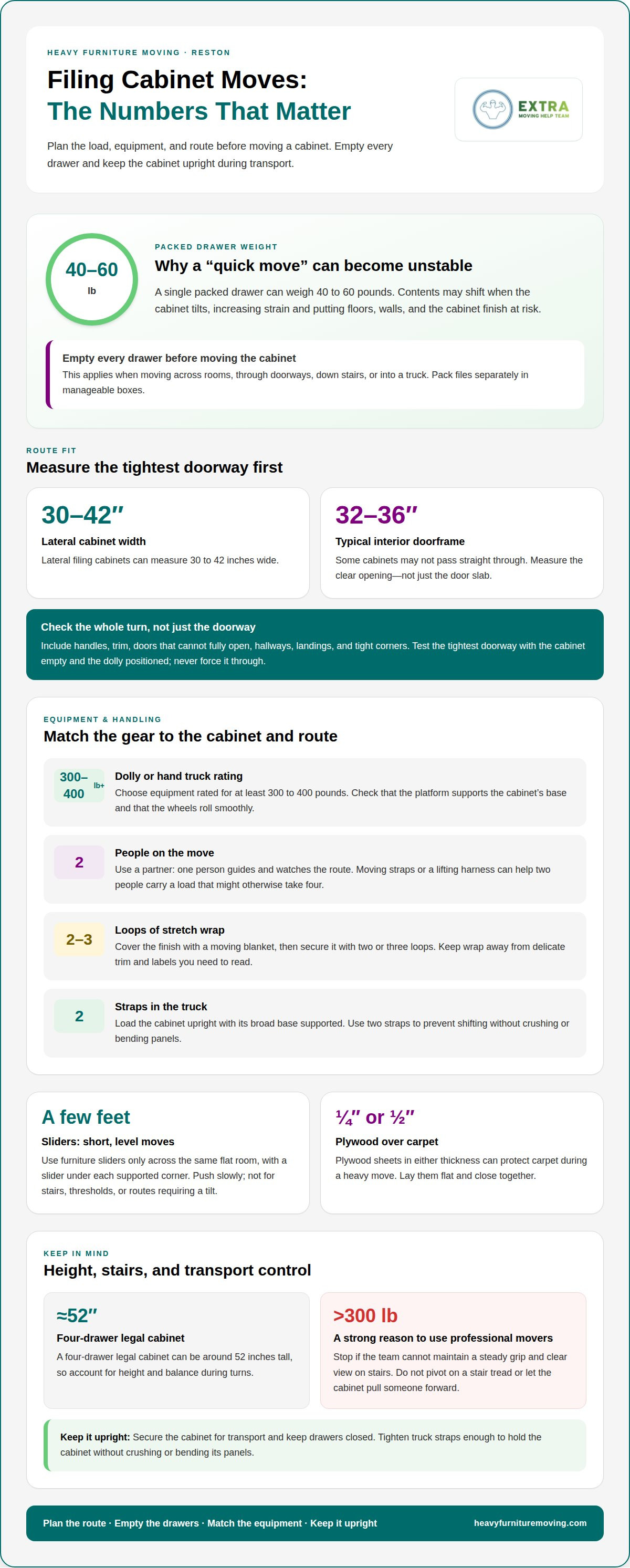
Yes. Empty every drawer before moving a filing cabinet across rooms, through doorways, down stairs, or into a truck. A packed drawer can weigh 40 to 60 pounds, and its contents can shift when the cabinet tilts. For a Reston apartment move, follow the building’s move procedures for elevator access, shared-route protection, and loading arrangements.
A move alone doesn’t establish whether a cabinet’s warranty or fireproof rating remains valid. Impacts, disassembly, or damaged seals can affect performance or warranty terms, so preserve labels and avoid altering the cabinet.
- Remove the files first. Empty drawers completely, then pack the papers separately in manageable boxes. This reduces the load and keeps loose files from sliding forward. If the cabinet has a lock, secure it after emptying. Don’t rely on a closed drawer to hold paper in place while the cabinet moves.
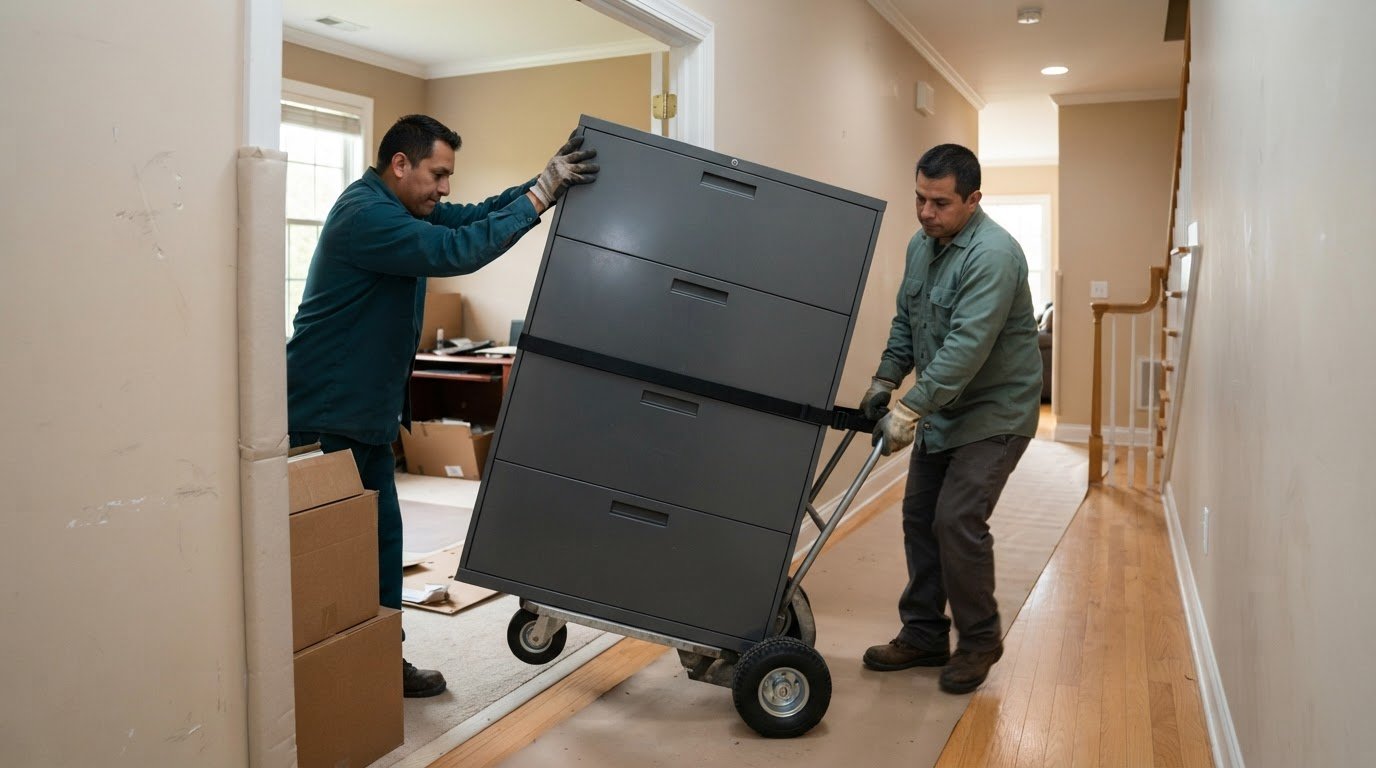
- Pick equipment for the load. Use a hand truck or furniture dolly rated for at least 300 to 400 pounds. Check that its platform supports the cabinet’s base and that its wheels roll smoothly. A narrow hand truck can suit a vertical cabinet, while a stable furniture dolly can support a wider lateral cabinet.
- Use straps with a partner. Keep two people on the move, with one guiding and watching the route. Moving straps or a lifting harness can help two people carry a load that might otherwise take four. Fit straps securely, keep the cabinet balanced, and lift together rather than twisting around corners.
- Use sliders only on a short, level route. Furniture sliders can help shift a cabinet a few feet across the same flat room without tipping or changing levels. Put a slider under each supported corner, then push slowly. Don’t use this method for stairs, thresholds, or a route that requires tilting.
- Wrap the cabinet before loading. Cover its finish with a moving blanket and secure the blanket with two or three loops of stretch wrap. Keep wrap away from delicate trim and avoid covering labels you need to read. Load the cabinet upright, with its broad base supported, and keep the path clear.
- Secure it upright in the truck. Position a tall cabinet against a stable surface and use two straps to prevent it shifting during transport. Tighten the straps enough to hold it without crushing or bending panels. Keep the drawers closed and the cabinet upright until it reaches its destination.
Can You Move a Full Filing Cabinet?
A full cabinet may be movable, but its weight and wide profile make the route decisive. Moving heavy lateral filing cabinets filled with paper in Reston starts with emptying the drawers and planning every turn, doorway, and stair before lifting.
-
Measure the Route
Measure the cabinet’s width, depth, and height, then compare them with every doorway. Lateral cabinets can measure 30 to 42 inches wide. Standard interior doorframes are typically 32 to 36 inches wide, so some cabinets may not pass straight through. Measure the clear opening, not just the door slab. Include handles, trim, and doors that cannot open fully. Check hallways, landings, and tight corners, too. Mark the route and remove small obstacles before moving.
-
Move Through Doorways and Stairs
Choose a route without stairs whenever a safe alternative exists. A doorway that looks wide enough can still be difficult at a corner, where the cabinet needs room to turn. Keep it controlled and move slowly through each change of direction. On stairs, stop if the team cannot maintain a steady grip and clear view. Don’t pivot on a stair tread or let the cabinet’s weight pull someone forward. Clear people and loose items from the route first.
-
Choose a Suitable Dolly
Match the dolly to the cabinet’s shape and the route. A furniture dolly supports the base, but its platform must fit securely beneath the cabinet. A hand truck can help guide a load through a straight route, but it requires careful balance. Choose equipment rated for at least 300 to 400 pounds. Keep the cabinet centered, and don’t let it overhang enough to tip. A four-drawer legal cabinet can be around 52 inches tall, so height and balance matter during turns.
- Test the tightest doorway before committing to the full route. With the cabinet empty and the dolly positioned, approach slowly and check clearance at the top, sides, and base. Don’t force it through by scraping the frame or twisting the dolly. If it fits only at an angle, make sure you can use that angle without striking a wall or blocking the path. Reconsider the route if a corner leaves no room to turn.
- Assign one person to guide the route and another to control the cabinet. Keep instructions short, such as “stop,” “hold,” or “turn,” so both people move together. For moving heavy lateral filing cabinets filled with paper in Reston, stop if the load can’t stay controlled throughout a stair route. A filing cabinet weighing over 300 pounds is a strong reason to use professional movers. Review the route again if furniture, doors, or obstacles have changed.
Protecting floors, walls, and cabinet surfaces
Prepare the cabinet and route before moving day. A few deliberate steps can help prevent scratches, dents, and floor marks.
- Clear and inspect the path. Walk the planned route before bringing out the cabinet. Move chairs, wastebaskets, and loose rugs that could catch a dolly wheel. Check door edges, hallway corners, and thresholds for tight spots. Note existing marks on walls or floors so they aren’t mistaken for moving damage. Keep the route clear from the cabinet’s starting point to its final position.
- Shield carpet with a firm track. Place plywood sheets over carpet where the cabinet and moving equipment will roll. Sheets 1/4 or 1/2 inch thick can protect carpet during a heavy move. Lay them flat and close together, with no raised edges for wheels to catch. Move each sheet forward only after the cabinet and dolly have cleared it.
- Protect hard floors from wheel marks. Check the dolly wheels for grit, chips, or embedded debris before they touch hardwood or tile. Sweep the route, then use a floor covering that lies flat and won’t slide under pressure. Avoid dragging a metal cabinet across the floor. If a wheel catches at a threshold, stop and reposition the equipment instead of forcing it.
- Cover exposed corners and surfaces. Use a moving blanket or padded material on the cabinet’s sides, top, and corners. Secure it so the fabric won’t fall into the wheels or obscure the person guiding the move. Keep abrasive straps, buckles, and dolly edges away from painted or finished panels. In a narrow hallway, pad the wall-side corners where contact is most likely.
- Guard walls and doorframes at pinch points. Place protective padding on vulnerable corners along the route, especially near a doorway where the cabinet must turn. Keep hands clear of the gap between the cabinet and the wall. One person should watch the nearest surface while another controls the movement. Pause before each turn, then adjust the angle in small, controlled movements.
- Check protection as you go. Stop after each doorway or change in flooring. Look for shifted plywood, folded floor covering, loose padding, or marks on the cabinet. Reset the protection before continuing. At the destination, carefully remove the cabinet from the dolly and inspect the floor beneath it. Pick up protective materials only after the equipment and cabinet have cleared the route.
Equipment for moving filing cabinets
- Match the dolly to the cabinet’s base. Choose a furniture dolly with a platform that securely supports the cabinet. Check that its wheels turn freely and its frame is undamaged. Center the cabinet before moving, since an uneven load can shift during a turn. A hand truck offers more control on a straight route, but keep the cabinet balanced against its frame.
- Use lifting straps for controlled handling. Fit moving straps or a lifting harness according to the equipment’s instructions. Keep the straps clear of sharp cabinet edges and drawer handles. The people lifting should coordinate their movements and keep the cabinet level. Straps can improve grip, but they don’t replace a clear route or careful control at corners.
- Bring protective material for the cabinet. Cover exposed panels and corners with a moving blanket before positioning the dolly. Secure it so it can’t slip into a wheel or hide the person guiding the load. Keep buckles and metal edges away from the cabinet’s finish. Check the cover again after loading, especially if the cabinet shifts against the truck.
- Set up sliders for a short, flat shift. Place furniture sliders beneath the cabinet’s supported corners when moving it across a level room. Push slowly and watch each slider as it travels. Sliders are suitable for short repositioning, not stairs or changes in floor level. Stop if one catches, folds, or moves out of place, then reset it before continuing.
- Consider rollers for a low-profile cabinet. The roller method uses two or three rods positioned perpendicular to the direction of travel. Metal pipes or PVC rods with a diameter of 1 to 2 inches are suggested for this method. Set the rods evenly beneath the cabinet, move it a short distance, then bring the rear rod forward. Keep hands clear of pinch points.
- Prepare the truck-loading gear before lifting. Keep straps, blankets, and the dolly within reach at the loading area. Use the dolly to bring the cabinet to the truck, then position it upright and secure it against movement. Check that the tie-downs hold the cabinet without pressing hard enough to bend its panels. Don’t leave loose equipment where it can slide into the load.
- Inspect every tool before use. Check the dolly platform, wheels, straps, sliders, and rods for damage or debris. Remove anything that could snag the cabinet or interrupt a smooth roll. Set aside any tool that wobbles, slips, or won’t support the cabinet steadily. Choosing equipment that suits the cabinet and route matters more than using every tool available.
Can you move a lateral filing cabinet with a furniture dolly or appliance dolly?
Yes, either dolly may work if it supports the cabinet and suits the route. Before loading, check the cabinet’s base, balance, wheel path, and handling needs.
- Check the cabinet’s footprint. Lateral filing cabinets can be 30 to 42 inches wide, so compare the base with the dolly platform. A furniture dolly should support the cabinet evenly, not just one narrow edge. Look for overhang on every side and make sure the load won’t rock when pushed. If the platform is too small, choose different equipment rather than balancing the cabinet precariously.
- Confirm the equipment’s weight rating. Select a furniture dolly or hand truck rated for at least 300 to 400 pounds. That rating is a minimum guide, not a reason to ignore the cabinet’s actual load. A file cabinet over 300 pounds is a sensible point to consider professional movers. Keep the cabinet centered and check the wheels before starting.
- Use an appliance dolly only when its shape fits. Its upright frame and securing straps can help control a tall cabinet on a straight route. Check where the frame contacts the cabinet and make sure the straps won’t press against drawer pulls or fragile trim. A wide lateral cabinet may be awkward on a narrow appliance dolly. Don’t tilt it unless the load stays balanced and controlled.
- Choose a furniture dolly for level travel. A four-wheel furniture dolly can carry the cabinet’s base across a flat floor. Before pushing, confirm that all contact points sit securely on the platform. Move slowly over thresholds and stop if a wheel catches. An appliance dolly may offer better control on a route that requires a controlled tilt, while a furniture dolly can suit level movement.
- Test the setup before committing. With help, place the cabinet on the dolly, then check its balance and wheel clearance. Push it a short distance across a clear, level floor. Watch for shifting, dragging, or a wheel lifting off the ground. Stop and reposition the load if anything feels unstable. Don’t use a test push to force a poor fit through a doorway.
- Match the method to the full route. A dolly that works in an open room may not suit a tight corner, stairway, or narrow doorway. Measure the route, allow room to turn, and keep someone positioned to guide the cabinet. If the cabinet is too wide or heavy for steady control, arrange in-home furniture moving help for the difficult lift.
Heavy Furniture Moving: Movers Near Me
Heavy Furniture Moving helps with lateral filing cabinets that are too heavy, awkward, or difficult to move through a home. Its in-home furniture movers handle bulky furniture and challenging indoor routes. Turn to the team when a narrow doorway, tight corner, or stairway makes a do-it-yourself move hard to control. Heavy Furniture Moving also provides local moving help in Reston. Share the cabinet’s size, route, and any stairs when arranging the move. If you’re moving several heavy pieces, describe them together. For help with a difficult cabinet move, contact Heavy Furniture Moving.
Set Up the Cabinet’s Next Home
Before moving day, prepare the cabinet’s destination as carefully as its route. Clear the space, make room for doors and drawers to open, and keep files organized for reloading. Once the cabinet is in position, reinstall drawers from the bottom upward to help maintain stability. This final setup turns a demanding move into a usable workspace again.
For moving heavy lateral filing cabinets filled with paper in Reston, a clear plan matters most when the cabinet is bulky or the route is difficult. Heavy Furniture Moving offers local moving help, along with Exercise Equipment Moving and Sofa Hoisting for other heavy-item needs. Share the cabinet’s destination and any access challenges when you reach out. Contact Heavy Furniture Moving to discuss your move, and take the next step with a plan that fits your home.
Frequently Asked Questions
Do movers require lateral filing cabinets to be emptied before moving?
Empty the paper drawers before transport, even if a mover can handle other furniture while loaded. Files can shift when the cabinet tilts, changing its balance during a turn or lift. A packed drawer can weigh 40 to 60 pounds, so removing its contents also makes handling more manageable. Pack the files separately and label each box by drawer or category for easier setup.
How heavy is a fully loaded lateral filing cabinet?
A loaded legal-size filing cabinet can weigh 200 to 300 pounds, while fully loaded four- or five-drawer legal cabinets commonly exceed 300 to 400 pounds. The actual weight depends on cabinet size, material, drawer count, and how tightly paper fills each drawer. A wide lateral cabinet can also be awkward to balance, so don’t judge the lifting challenge by weight alone.
How do you safely move a heavy lateral filing cabinet down stairs or through a narrow doorway?
Measure the cabinet and the narrowest doorway, then plan each turn before moving. Clear the stairway and landing, and assign one person to guide while the others control the load. Keep hands away from pinch points and pause if the cabinet blocks the guide’s view. Don’t attempt stairs if the team can’t maintain controlled movement at every step.
What equipment do professional movers use for heavy filing cabinets?
Movers may use a hand truck or furniture dolly, lifting straps, moving blankets, and tie-down straps. Heavy Furniture Moving includes wrap, blankets, and straps on every job. Choose the setup based on the cabinet’s base and the route. For example, a broad furniture dolly may support a lateral cabinet well across a level floor, while a hand truck can help control a straight approach.
How do you secure drawers and prevent a lateral filing cabinet from tipping during a move?
Empty the drawers, close them fully, and secure them so they can’t slide open during handling. Protect the cabinet’s finish by keeping adhesive away from its surface. Reinstall removed drawers from the bottom upward to help keep the cabinet stable. Keep the cabinet upright while moving, and don’t lean on an open drawer or use it as a handle.
Are there Reston, VA movers specializing in office furniture and filing cabinets?
Heavy Furniture Moving serves Reston with local moving help focused on residential moves and heavy, bulky items. Its offerings include Movers Near Me and Exercise Equipment Moving. For a home filing cabinet, describe the cabinet and access route when arranging help. The company’s services focus on residential moving, not commercial office relocation, so keep the request to a residential move.
Should filing cabinets be moved by professional movers or emptied and moved yourself?
Move it yourself only when the cabinet is empty, the route is simple, and you can control it with suitable equipment and help. Consider professional movers for a cabinet over 300 pounds, stairs, tight turns, or a route where the load can’t stay balanced. A clear floor plan and accurate cabinet measurements help determine whether a do-it-yourself move is manageable.
How do you protect floors and walls when moving a heavy filing cabinet?
Lay protective material along the route and shield exposed wall corners near tight turns. Plywood sheets 1/4 or 1/2 inch thick can protect carpet from a heavy cabinet move. Sweep grit from hard floors before rolling equipment, since debris can scratch the surface. Check the floor covering after each doorway, and reset it if it bunches or shifts beneath a wheel.
Frequently Asked Questions
Empty the paper drawers before transport, even if a mover can handle other furniture while loaded. Files can shift when the cabinet tilts, changing its balance during a turn or lift. A packed drawer can weigh 40 to 60 pounds, so removing its contents also makes handling more manageable. Pack the files separately and label each box by drawer or category for easier setup.
A loaded legal-size filing cabinet can weigh 200 to 300 pounds, while fully loaded four- or five-drawer legal cabinets commonly exceed 300 to 400 pounds. The actual weight depends on cabinet size, material, drawer count, and how tightly paper fills each drawer. A wide lateral cabinet can also be awkward to balance, so don’t judge the lifting challenge by weight alone.
Measure the cabinet and the narrowest doorway, then plan each turn before moving. Clear the stairway and landing, and assign one person to guide while the others control the load. Keep hands away from pinch points and pause if the cabinet blocks the guide’s view. Don’t attempt stairs if the team can’t maintain controlled movement at every step.
Movers may use a hand truck or furniture dolly, lifting straps, moving blankets, and tie-down straps. Heavy Furniture Moving includes wrap, blankets, and straps on every job. Choose the setup based on the cabinet’s base and the route. For example, a broad furniture dolly may support a lateral cabinet well across a level floor, while a hand truck can help control a straight approach.
Empty the drawers, close them fully, and secure them so they can’t slide open during handling. Protect the cabinet’s finish by keeping adhesive away from its surface. Reinstall removed drawers from the bottom upward to help keep the cabinet stable. Keep the cabinet upright while moving, and don’t lean on an open drawer or use it as a handle.
Heavy Furniture Moving serves Reston with local moving help focused on residential moves and heavy, bulky items. Its offerings include Movers Near Me and Exercise Equipment Moving. For a home filing cabinet, describe the cabinet and access route when arranging help. The company’s services focus on residential moving, not commercial office relocation, so keep the request to a residential move.
Move it yourself only when the cabinet is empty, the route is simple, and you can control it with suitable equipment and help. Consider professional movers for a cabinet over 300 pounds, stairs, tight turns, or a route where the load can’t stay balanced. A clear floor plan and accurate cabinet measurements help determine whether a do-it-yourself move is manageable.
Lay protective material along the route and shield exposed wall corners near tight turns. Plywood sheets 1/4 or 1/2 inch thick can protect carpet from a heavy cabinet move. Sweep grit from hard floors before rolling equipment, since debris can scratch the surface. Check the floor covering after each doorway, and reset it if it bunches or shifts beneath a wheel.