How to Move a Split Queen Adjustable Bed Without Damaging Its Motors
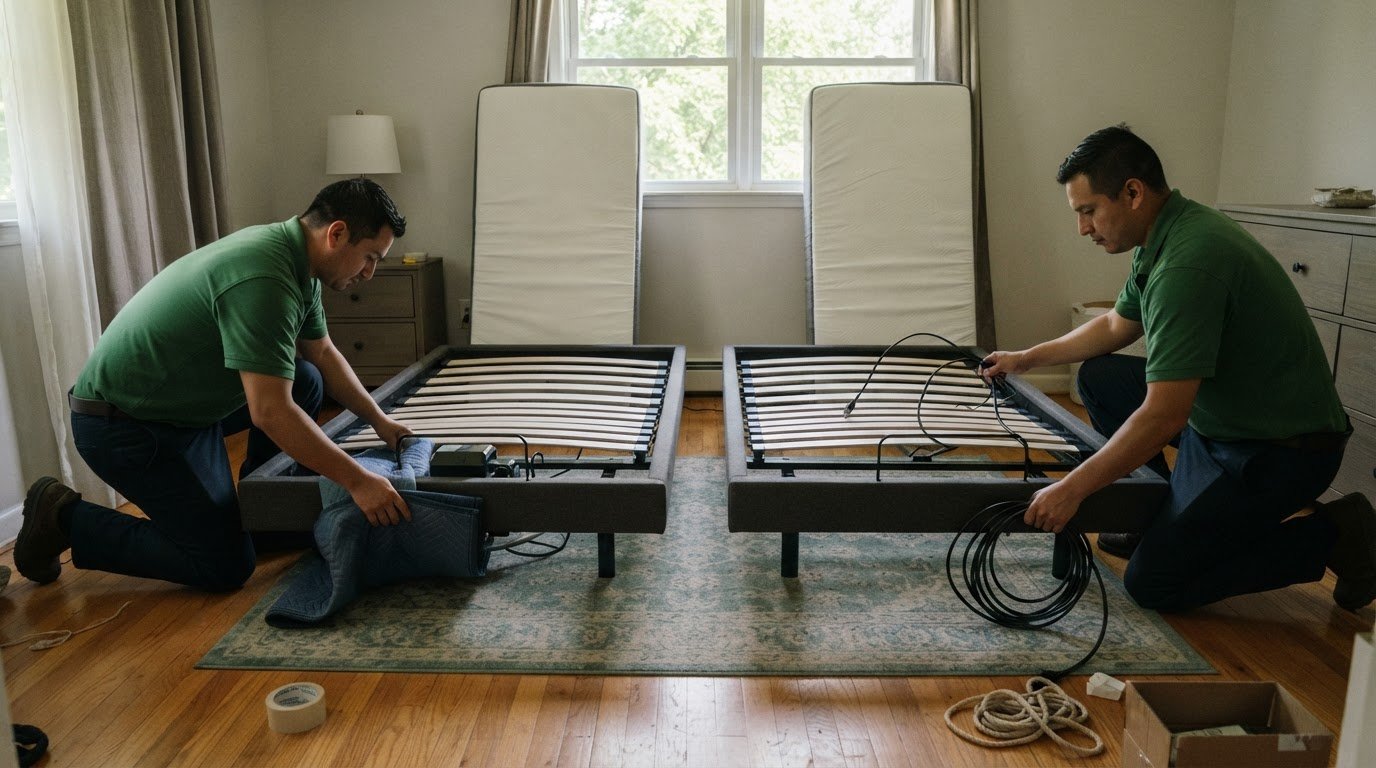
To learn how to move an adjustable split queen bed without damaging its mechanical motors in Fairfax Station, return the base to its fully flat position, unplug it, and follow the model’s manual before disconnecting or separating parts. Some adjustable bases can be divided into two pieces, but whether yours can depends on its design. Don’t force a frame apart or lift it by its motors or cables.
Taking the bed apart may seem like the easiest way to manage a heavy base, but it can create extra work if wires, controls, or hardware aren’t labeled and protected. A few careful steps can simplify the move and keep the mechanical parts organized.
This guide explains how to identify the base and its connections, prepare it for transport, and decide whether disassembly makes sense. You’ll also learn when to get help with the heavy lifting, so you can plan the move without taking unnecessary risks with the bed’s moving parts.
Key Takeaways
- Use your bed’s manual and detachable parts to decide whether the frame should travel assembled or in sections.
- Photograph and label connections before separating cables or hardware to make reassembly easier.
- Keep motors, wiring, and control boxes protected and avoid putting weight on delicate components.
- Plan the route and lifting help before moving day, especially if the base is awkward to carry.
- Reassemble carefully and test the bed’s movement before putting the mattress back in place.
Should I disassemble my adjustable bed before moving house?
Disassemble only the components the manual identifies as removable. Some bases separate into two sections. To prepare safely, flatten and unplug the bed, document its connections, and keep every part and fastener organized for reassembly.
- Gather the manual, tools, and an inventory. Before taking anything apart, find the model’s instructions and gather the screwdrivers or wrench set they specify. List the frame sections, cables, controls, and hardware you’ll move. Instructions vary between single-motor, dual-motor, and height-adjustable frames, so follow your model’s directions rather than assuming another bed assembles the same way.
- Record the setup before disconnecting parts. Photograph the cable connections and frame arrangement, then label each cable and loose part. Put screws and other hardware in labeled bags to keep fasteners from separate connections from getting mixed. If the manual allows detachable sections, remove only those parts. Don’t pull on cables or force a joint that doesn’t release as directed.
-
Plan Disassembly and Reassembly
Choose a clear place for each frame section and keep its labeled hardware together. Use your photos as a reference when reconnecting cables and matching parts after the move. Follow the manual’s specified order for disassembly and assembly. This record makes it easier to spot a missing screw or misplaced connector before testing the bed.
-
Reassemble and Level the Bed
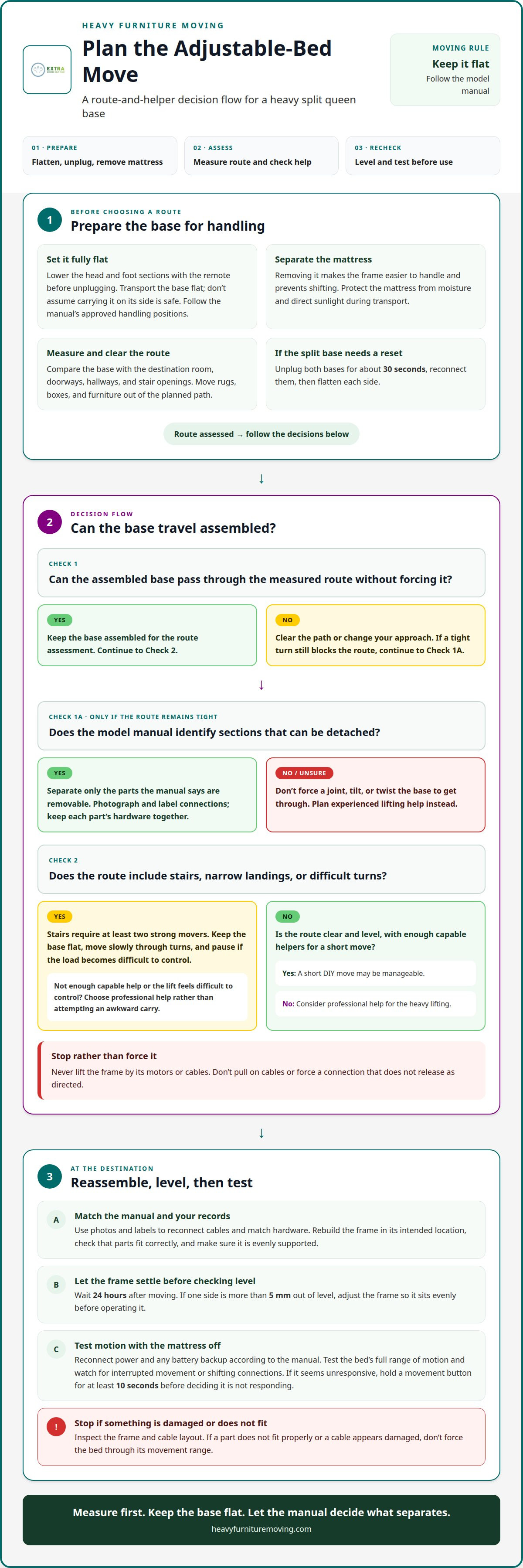
Rebuild the frame on its intended floor location, matching each section and fastener to your inventory. Check that the pieces fit correctly and that the frame is supported evenly. Let the frame settle for 24 hours after moving before checking its level. If one side is more than 5 mm out of level, adjust the frame so it sits evenly before operating it.
- Reconnect power and test motion before replacing the mattress. Follow the manual when reconnecting cables and any battery backup. Test the bed’s full range of motion while the mattress is off, watching for interrupted movement or a connection that shifts. If the base seems unresponsive after reconnection, hold a movement button for at least 10 seconds before deciding it isn’t responding.
- Inspect the finished assembly before use. Check the frame for transport damage and make sure each part is seated and secure. Compare the cable layout with your photos, and keep the labeled hardware inventory with the manual. If the frame doesn’t fit together properly or a cable appears damaged, stop rather than forcing the bed through its movement range.
Returning the bed to a flat position before moving
Set the adjustable base fully flat before moving it, and transport it flat rather than partially reclined. Don’t assume it’s safe to carry on its side. Follow the model’s manual for approved handling positions.
- Return the base to its flat position. Use the remote to lower the head and foot sections completely before unplugging the bed. A partially raised frame can put extra strain on its motor and hinge points during handling. If the split base needs a reset, unplug both bases for about 30 seconds, then reconnect them and flatten each side.
- Separate the mattress from the moving base. Removing it makes the frame easier to handle and prevents the mattress from shifting as you maneuver through a doorway. Protect the mattress from moisture and direct sunlight during transport. If it was rolled or compressed, allow a day or two to settle after arrival before judging its shape.
- Measure the route before moving day. Compare the frame’s dimensions with the destination room, doorways, hallways, and stair openings. Clear rugs, boxes, and furniture from the planned path. A tight turn may require changing your approach or separating removable frame sections, but don’t tilt or twist the base to force it through.
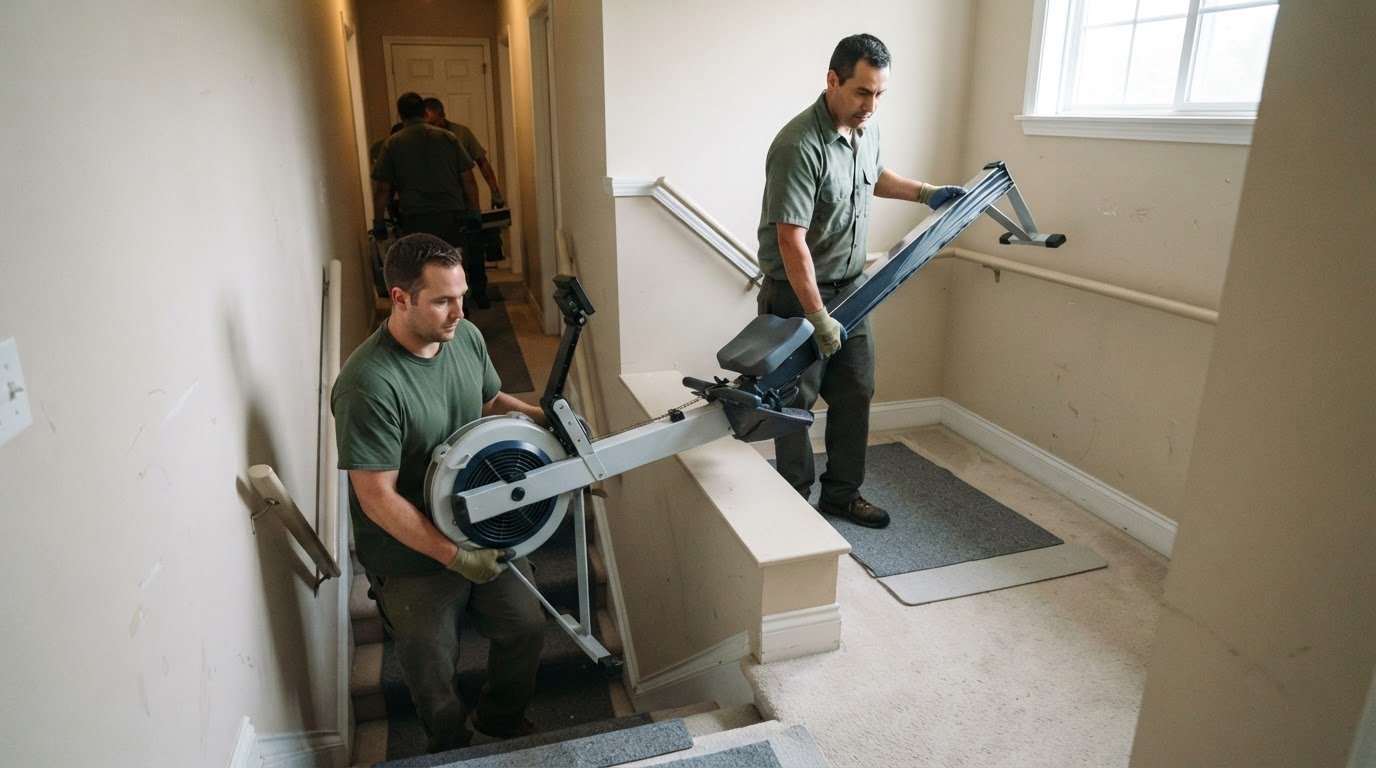
- Plan stair and doorway handling. Use at least two strong movers when carrying an adjustable base on stairs. Keep the frame flat, move slowly through turns, and pause if the load becomes difficult to control.
- Choose between a DIY move and professional help. With a clear, level route and enough capable helpers, you may be able to manage a short move. Stairs, narrow landings, and a heavy split base make the lift more challenging. DIY movers bear responsibility for damage; professional movers may provide insurance coverage, and experienced handling can reduce the risk of personal injury.
- Match the help to the hardest part of the route. Identify whether the main challenge is carrying the base, negotiating stairs, or clearing a tight doorway. If the heavy lifting is the sticking point, consider help moving heavy furniture instead of attempting an awkward carry without enough assistance.
Identifying adjustable-bed components and features
First, identify whether your split queen has two separate bases or one connected frame. Unplug the base before inspecting its cables, control box, motors, or connectors.
To separate two bases, follow the model’s manual and disconnect any physical sync cable as directed. Gather the manual, screwdrivers or wrench set, labels, bags, and protective padding before removing parts.
- Map the components before disassembly. Locate the remote, power cable, control box, motors, and any visible sync cable. Photograph each connection and label both ends before unplugging anything. Some dual-base setups use a physical sync cable to share commands. Don’t mistake it for a power lead or pull it free without following the manual.
- Separate only parts the manual identifies as removable. Unplug the base before inspecting underneath or touching visible wiring. Follow the model-specific sequence to detach the two bases, if the design allows it. A split setup may connect the sides with a sync cable; disconnect it carefully and clearly identify both sides and their controls.
- Gather tools and protective supplies. Use the screwdrivers, wrench set, or Allen wrenches specified in the bed’s instructions. Keep labeled bags ready for screws and small hardware. Add soft padding or protective coverings for delicate components, and use a dolly or hand truck for heavier pieces. Don’t improvise with a tool that could damage a fastener or housing.
- Protect motors and cables for transport. Wrap motor units separately in soft padding and carry them upright, not flat or tilted. Coil cables loosely without sharp bends, then secure them so they can’t snag on the frame. Protect the control box and connectors from impacts, and don’t stack other items on these components in the vehicle.
- Inspect for damage before deciding what to reuse. Look for cracked housings, bent connectors, frayed cables, or loose parts. Don’t reconnect a visibly damaged component or force a connector into place. Compare questionable parts with your photos and the manual’s diagrams. Any part that doesn’t fit or connect properly needs attention before you operate the base.
- Secure every piece for the trip. Place labeled hardware bags with the matching base section, then cushion the frame so it can’t shift against motor housings or cables. Make sure the vehicle has enough room for the pieces to lie securely. Keep the remote with the correct side so you can identify each control during reassembly.
Can I Take My Mechanical Bed Frame Apart to Avoid Lifting The Adjustable Base?
Detach parts only when the bed’s manual allows it. Unplug the base before inspecting or disconnecting motors, cables, or control boxes.
-
Disconnect Motors and Electrical Cables
Unplug the adjustable base from the wall, then use the manual’s wiring diagram to identify each connection. Label control-box and wiring connections before disconnecting them so each plug returns to its original port. If a sync cable joins dual bases, disconnect it only as instructed. Never pull a cable by its wire or force a connector loose.
Keep the remote separate from loose cables, and note which side it controls. This helps prevent confusion when reconnecting the bed after transport.
-
Protect Motors, Actuators, and Wiring
Remove motor units only if the model’s instructions permit it. Protect each unit from impact with soft padding, and keep electronic components dry during transport and storage. Coil cables loosely without sharp bends, then secure them so they can’t catch on furniture or frame edges. Don’t stack heavy items on motors, actuators, or the control box.
Leave attached components in place if removing them would require force. The goal is to reduce strain on connections, not dismantle every moving part.
-
Inspect Motor and Control-Box Connections
Before moving the frame, inspect visible plugs for loose fits, bent ends, or damaged insulation. Check where wires meet the control box and motor housings, then compare each connection with your labels. Adjustable-bed rails may attach with two or three screws per side. Remove them only if the manual identifies the rail as detachable.
After transport, inspect the same connection points before restoring power. A cable trapped beneath the frame or pinched against a rail can interfere with proper operation.
- Reconnect app controls after a Wi-Fi change. If your bed uses app controls and the home Wi-Fi network has changed, reconnect the base according to its model-specific instructions. Restore power only after assembling the frame and wiring. Then follow the manual’s pairing steps rather than assuming the previous network settings will still work. Keep the remote nearby while testing in case the app needs setup.
Getting help to move a heavy adjustable bed
Plan the route, transport, and lifting help before moving day, especially if stairs or narrow turns are involved.
- Decide which parts need lifting and who will handle them. List the base sections, mattress, headboard, and detachable hardware separately. A split setup may let you move each base section individually, but the frame still needs controlled handling. Assign one person to guide the route and keep cables clear while the others carry. Start only when everyone knows where to grip and where to keep their hands clear.
- Match the moving plan to the home’s hardest obstacle. For stairs, plan on at least two strong movers for the adjustable-base move. Walk the route first and identify landings, tight turns, and doorways that could interrupt a steady carry. Keep the path clear and decide where the team can pause safely. A narrow stair turn can make the route more demanding than a longer, open hallway.
- Use equipment for controlled movement. A dolly or hand truck can help move suitable components along a level route. Choose a vehicle with enough room to transport the frame without stacking heavy items on its motors, cables, or control box. Secure each section so it can’t slide during transport. Keep the adjustable base flat, and don’t use a dolly if the route makes the load difficult to control.
- Bring in professional help for a complex carry. Professional movers experienced with adjustable or motorized furniture may be a good fit for a heavy dual-adjustable or premium frame with multiple motors, particularly on a long-distance move. This is especially relevant when the route includes stairs, the base can’t be separated, or you don’t have enough capable helpers. Tell the moving team which pieces have motors and which connections need protection.
- Keep lifting and setup tasks organized. Have one person track labeled hardware and another keep the remote and cables with the correct base. Once the frames reach the room, position them where reassembly won’t block the doorway. Reconnect only after assembling the frame and putting its connections in place. A clear handoff between carrying and setup helps prevent lost parts and rushed reconnection.
- Get help with the heavy carry. If the base’s weight, stairs, or route make a solo lift impractical, arrange a heavy lifting moving service for the physical move. Keep the manual and labeled parts ready for reassembly at the destination.
Heavy Furniture Moving: Movers Near Me
Heavy Furniture Moving helps move bulky household items that are difficult to carry alone. If your adjustable bed’s base is heavy, the route includes stairs, or you need help handling large components, the team can take care of the physical lifting. It’s a practical option when you’ve prepared the bed but don’t want to manage the carry yourself. Heavy Furniture Moving also offers Exercise Equipment Moving and Sofa Hoisting for other challenging items around the home. Wrap, blankets, and straps are included on every job. Share the bed’s layout, access route, and lifting needs when discussing your move. Contact Heavy Furniture Moving to plan the move.
Make the Next Move With a Clear Plan
To move an adjustable split queen bed without damaging its mechanical motors in Fairfax Station, decide who will handle the lift and who will manage setup. Matching help to the most challenging part keeps the work organized, whether you need support carrying bulky sections or maneuvering through a tight entry.
Heavy Furniture Moving helps move heavy household items in Fairfax Station and nearby communities. Keep the manual and labeled parts ready so the handoff from carrying to setup stays straightforward.
Contact Heavy Furniture Moving for moving help and take the next step with a plan that fits your home. You’re ready to move forward with confidence.
Frequently Asked Questions
Does moving an adjustable bed void the warranty?
Moving an adjustable bed doesn’t automatically void its warranty, but coverage may exclude damage caused by improper disassembly or transport. Before packing, save the warranty terms and note the model and serial label, often attached to the frame. Photograph the bed’s condition and any existing faults. This gives you a clear record if a motor or control issue appears after the move.
What’s the most fragile part of an adjustable bed during a move?
Exposed cables, plug ends, motor housings, and actuator connections are vulnerable to impact or pinching. Check where wires pass close to frame joints, since they can catch during lifting. Protect connectors as well as motor units; a plug can be damaged even when its housing looks intact. Keep loose components cushioned and separate from heavier frame pieces.
How do I lock or secure adjustable bed frames and moving parts for transport?
Use the model’s manual to learn whether the remote has a lock mode; some remotes toggle it when a lock button is held for 5 to 7 seconds, but the procedure varies. Unplug the base before securing it. Keep the frame flat, and fasten transport straps around sturdy frame sections, never across cables, actuators, or the control box.
How many people are needed to move a split queen adjustable bed, and how heavy are the components?
Don’t plan a solo lift based on the split design alone. For stairs, use at least two strong movers and assign one person to guide turns and watch the route. Check the manual or product label for your model’s component weights.
What are common risks and mistakes when moving adjustable bed motors and frames?
Common problems include carrying a partially raised frame, pulling on wiring, pinching cables beneath a section, and mixing up connectors during reassembly. Rushing a tight turn can also cause impacts to a motor housing or frame joint. Don’t lift by cables or motor units. Keep small hardware with its matching section, and stop if a connection looks bent or damaged.
Which Fairfax Station, VA, moving companies handle adjustable beds and specialty furniture?
Heavy Furniture Moving serves Fairfax Station and nearby communities, including Fairfax, Woodbridge, Manassas, Manassas Park, Aldie, Ashburn, McLean, Vienna, Reston, Centreville, Chantilly, Clifton, Dumfries, South Riding, Haymarket, and Gainesville. Services include Movers Near Me and in-home furniture moving, plus Exercise Equipment Moving and Sofa Hoisting. Wrap, blankets, and straps are included on every job.
How do I reassemble and test a split adjustable bed after moving?
Reconnect the controls according to the model’s instructions, then test one side at a time with the mattress off. Raise and lower the head and foot sections, listening for unusual sounds and watching for cables that shift or catch. Test both sides separately if they operate independently. This can reveal a swapped connection or obstruction before the mattress adds weight.
What manufacturer instructions and warranty rules should I follow when moving adjustable bed bases?
Use the manual for your exact model because disassembly steps vary between single-motor, dual-motor, and height-adjustable frames. Follow its instructions for disconnecting cables and any battery backup. Review the warranty terms before removing parts; coverage may exclude damage caused by improper disassembly or transport. Don’t substitute another model’s directions, even if the frames look similar.
Frequently Asked Questions
Moving an adjustable bed doesn’t automatically void its warranty, but coverage may exclude damage caused by improper disassembly or transport. Before packing, save the warranty terms and note the model and serial label, often attached to the frame. Photograph the bed’s condition and any existing faults. This gives you a clear record if a motor or control issue appears after the move.
Exposed cables, plug ends, motor housings, and actuator connections are vulnerable to impact or pinching. Check where wires pass close to frame joints, since they can catch during lifting. Protect connectors as well as motor units; a plug can be damaged even when its housing looks intact. Keep loose components cushioned and separate from heavier frame pieces.
Use the model’s manual to learn whether the remote has a lock mode; some remotes toggle it when a lock button is held for 5 to 7 seconds, but the procedure varies. Unplug the base before securing it. Keep the frame flat, and fasten transport straps around sturdy frame sections, never across cables, actuators, or the control box.
Don’t plan a solo lift based on the split design alone. For stairs, use at least two strong movers and assign one person to guide turns and watch the route. Check the manual or product label for your model’s component weights.
Common problems include carrying a partially raised frame, pulling on wiring, pinching cables beneath a section, and mixing up connectors during reassembly. Rushing a tight turn can also cause impacts to a motor housing or frame joint. Don’t lift by cables or motor units. Keep small hardware with its matching section, and stop if a connection looks bent or damaged.
Heavy Furniture Moving serves Fairfax Station and nearby communities, including Fairfax, Woodbridge, Manassas, Manassas Park, Aldie, Ashburn, McLean, Vienna, Reston, Centreville, Chantilly, Clifton, Dumfries, South Riding, Haymarket, and Gainesville. Services include Movers Near Me and in-home furniture moving, plus Exercise Equipment Moving and Sofa Hoisting. Wrap, blankets, and straps are included on every job.
Reconnect the controls according to the model’s instructions, then test one side at a time with the mattress off. Raise and lower the head and foot sections, listening for unusual sounds and watching for cables that shift or catch. Test both sides separately if they operate independently. This can reveal a swapped connection or obstruction before the mattress adds weight.
Use the manual for your exact model because disassembly steps vary between single-motor, dual-motor, and height-adjustable frames. Follow its instructions for disconnecting cables and any battery backup. Review the warranty terms before removing parts; coverage may exclude damage caused by improper disassembly or transport. Don’t substitute another model’s directions, even if the frames look similar.