Moving a Heavy Rowing Machine Upstairs to a Chantilly Condo
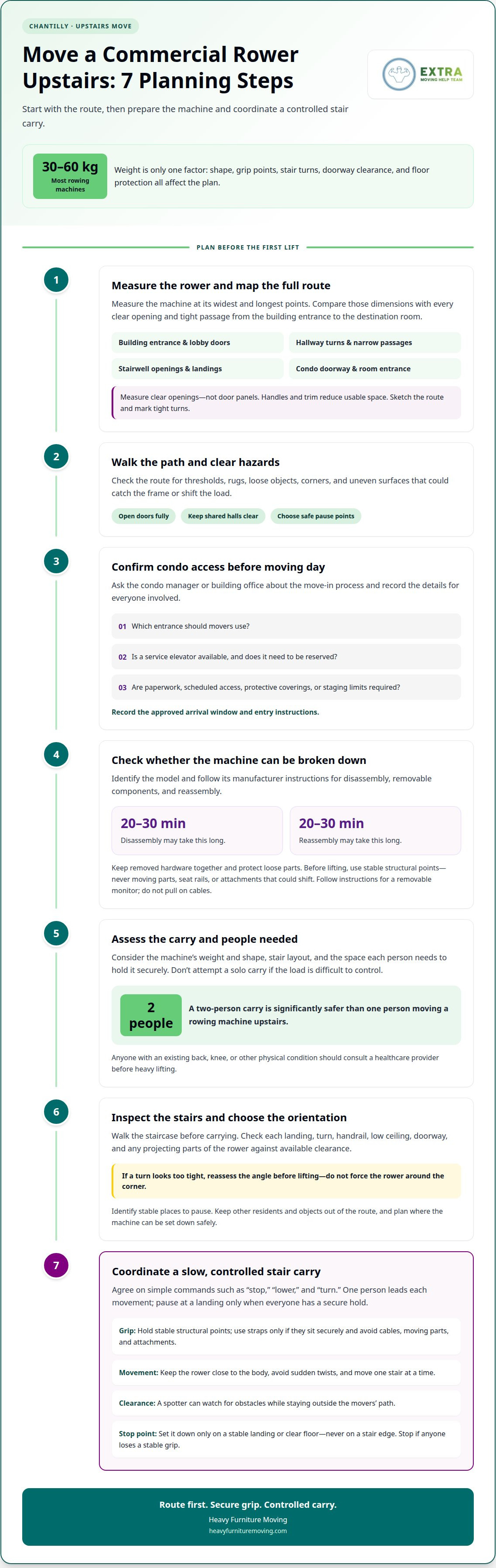
A safe upstairs move starts with the route, not the lift. Most rowing machines weigh 30-60 kg, so moving a heavy commercial rowing machine into an upper-level condo in Chantilly means assessing the machine’s weight, stair turns, doorway clearance, and floor protection before carrying it. Check how the machine comes apart, where movers can grip it securely, and which building access details or paperwork apply.
Moving a heavy commercial rowing machine into an upper-level condo in Chantilly takes planning, especially when stairs, shared hallways, and finished floors are involved. Measure the machine and route before moving day to reduce the risk of damage, an unstable carry, or a delay.
This guide walks through what to measure, how to protect floors, and how to prepare the route and building arrangements. You’ll also see when a two-person carry and careful handling make more sense than trying to muscle the machine upstairs alone.
Key Takeaways
- Measure the rowing machine and the full path upstairs, including doorways, turns, and tight shared spaces.
- Plan the carry around the machine’s weight and shape; lifting with help is safer than dragging it over thresholds.
- Use floor protection suited to each surface, and secure it so it won’t shift underfoot.
- Gather the condo’s access instructions and move-in paperwork early so building requirements don’t disrupt the move.
- For a difficult upstairs carry, Heavy Furniture Moving’s Exercise Equipment Moving service can handle the heavy lifting.
What should you consider before moving a rowing machine?
Start with the rower and the route, then plan how each doorway, turn, and building entrance will work. Most rowing machines weigh 30 to 60 kilograms, so their shape and handling points matter alongside their weight.
-
Measure Doorways and Map the Route
Measure the rower at its widest and longest points, then compare those dimensions with each doorway and narrow passage. Include the building entrance, hallway turns, stairwell openings, and condo room entrance. Measure clear openings rather than door panels, since handles and trim reduce usable space. Sketch the route and mark tight turns before moving anything.
Walk the route from the Chantilly building entrance to the destination room. Look for thresholds, rugs, loose objects, and corners that could catch the frame. Open doors fully and plan where the rower can pause without blocking a shared hallway. Keep the path clear on moving day, even if it looked accessible during planning.
-
Plan Apartment and Condo Access
Ask the condo manager or building office about the move-in process. Find out which entrance movers should use, how to reserve a service elevator if the building has one, and whether paperwork or scheduled access is required. Record the approved arrival window and entry instructions to avoid reaching a locked door or unavailable elevator.
Check the full path from the loading area to the unit, including lobby doors and common-area turns. Note any required protective coverings or limits on staging items. Share the unit location and access instructions with everyone involved, and keep hallways and exits clear while the rower passes through.
- Identify the model and decide whether it can be safely broken down. Some rowing machines separate into components; follow the manufacturer’s instructions for the specific model. Disassembly and reassembly may take 20 to 30 minutes each. Keep removed hardware together and protect loose parts so they don’t disappear during the move.
Before lifting, identify stable structural points on the frame. Avoid gripping moving parts, seat rails, or attachments that could shift or detach. If the rower has a removable monitor or other component, follow its instructions instead of pulling on cables. A secure grip helps movers control the machine through tight turns.
- Assess the lifting plan before moving the rower from its current position. Consider its weight and shape, the stair layout, and the space each person needs for a secure grip. Don’t attempt a solo carry if the load is difficult to control. Anyone with an existing back, knee, or other physical condition should consult a healthcare provider before heavy lifting.
Clear the route before lifting begins. Agree where to pause, how to communicate through stair turns, and who will guide the path. Lift rather than drag the rower, especially over thresholds or uneven surfaces. Keep it close to the body to maintain control and reduce back strain.
Moving heavy furniture up stairs
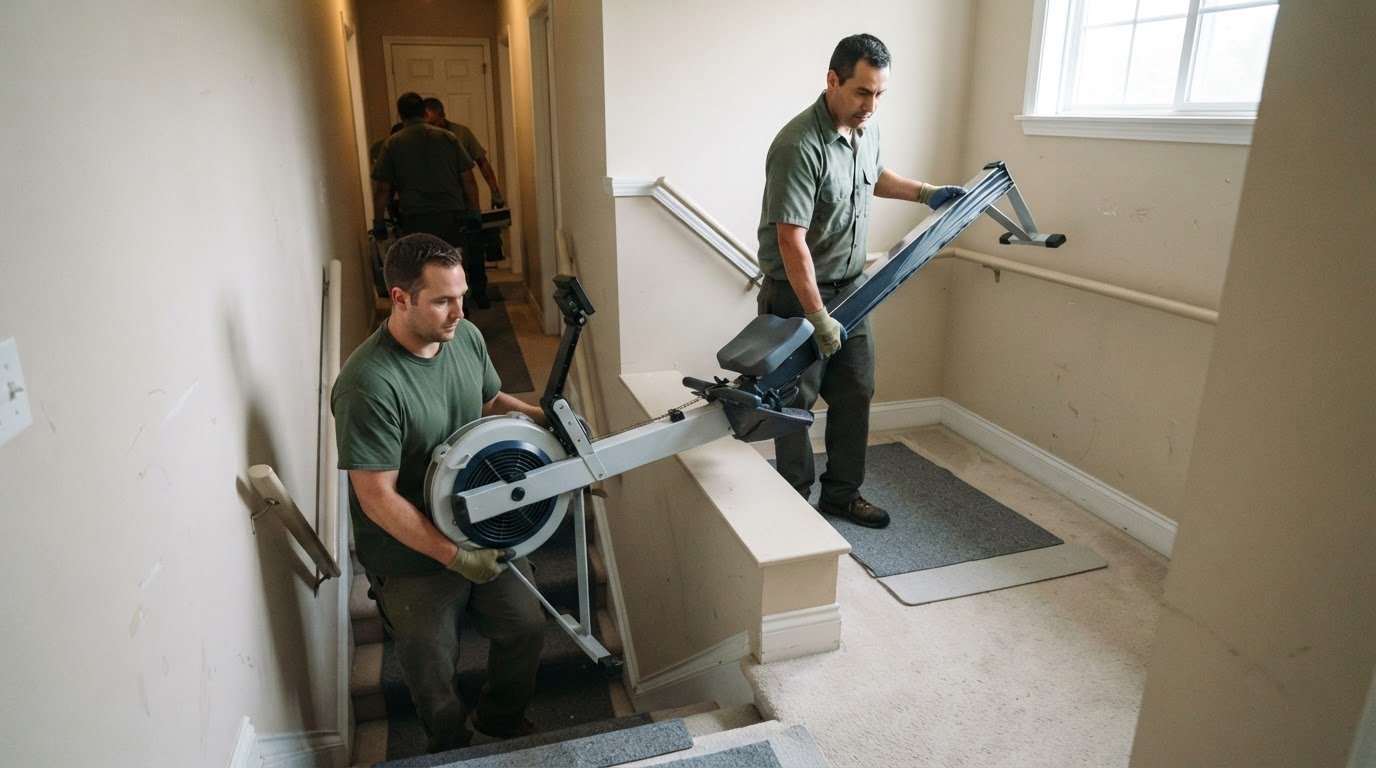
Plan the stair carry around the rower’s weight, shape, and the people guiding it. Two people are significantly safer than one for moving a rowing machine upstairs.
-
Assess Stairway Challenges
Walk the staircase before carrying the machine. Check each landing, turn, handrail, low ceiling, and doorway for clearance. Measure tight points against the rower’s dimensions, including any parts that project outward. Identify places where movers can pause without blocking the stairs.
Look for uneven steps, loose rugs, and thresholds at the top or bottom of the stairs. These can shift the load or catch the frame. Keep other residents and objects out of the route. If a turn looks too tight, reassess the rower’s orientation before lifting rather than forcing it around the corner.
-
Arrange Equipment and Movers
Use a two-person carry as the baseline, with one person controlling each end and clear communication throughout. The right equipment depends on the rower’s frame and stair layout. Moving straps can help only when they sit securely and don’t press against cables, moving parts, or attachments. Don’t use a strap or grip point that shifts under load.
Rowing machines over 50 kilograms are often easier and safer to move after separating them into lighter components. Follow the model’s instructions and keep removed parts together. If the machine stays assembled, check that both movers can hold stable structural points without reaching across one another.
- Agree on commands before lifting. Use simple directions such as “stop,” “lower,” and “turn,” and have one person lead each movement. At a landing, pause only when everyone has a secure hold. Avoid sudden twists or direction changes while someone is repositioning.
Keep the rower close to the body for control and to reduce back strain. Lift it over thresholds or uneven surfaces instead of dragging it. Move one stair at a time, with the person below watching the next step and the person above guiding the frame. Stop if anyone loses a stable grip.
- Choose the rower’s orientation before entering the stairwell. Carrying it lengthwise may work on a straight flight, while a landing turn may require a different angle. Keep the frame from swinging into walls or railings. A spotter can watch clearances and call out obstacles while staying outside the movers’ path.
Set the rower down only on a stable landing or clear floor, never on a stair edge. Reposition hands before lifting again. For a carry that needs extra help, get support with heavy stair moves. Keep the pace controlled from the first step to the condo doorway.
Protecting floors with sliders, blankets, and runners
Plan protection for each surface along the route, from the entryway to the condo room. Sliders, moving blankets, and floor runners have different uses and need to be placed securely.
- Identify the floor surfaces the rower will cross, such as hardwood, tile, carpet, or a shared hallway finish. Choose a clean floor runner for the walking route and make sure it lies flat before the carry. A curled edge can catch a shoe or equipment foot. Keep the runner clear of doors and stair landings where it could bunch.
Check the runner as the move progresses. If it shifts, stop and reset it before continuing. Don’t leave loose protective material across a doorway or active path. In a condo hallway, leave enough clear space for residents to pass without stepping over coverings.
- Use sliders only when the rower’s contact points fit securely and the machine can be moved in a controlled way. Sliders are for guiding equipment across a level floor, not carrying it upstairs. Check that each slider sits flat beneath a stable foot or support point. If a narrow foot slips off, stop and choose another protection method.
Don’t push the rower across a threshold or uneven floor seam on sliders. Lift it over the change in floor height instead. A slider that catches at a doorway can tilt the frame or shift its support. Keep hands on stable parts while positioning sliders, and avoid gripping rails or moving attachments.
- Cover exposed frame areas with moving blankets where contact with a wall, door casing, or banister is possible. Secure each blanket so it can’t trail underfoot or block a mover’s grip. For example, protect a protruding frame end before turning past a painted hallway corner. Keep the monitor and cables accessible rather than trapping them under tight fabric.
Blankets cushion contact but don’t replace careful handling. Keep the rower supported while adjusting a blanket, and don’t let fabric bunch beneath a foot. At a stair landing, move blankets out of the walking line before setting the machine down. This helps prevent slips and trips.
- Inspect each protected section before moving the rower over it. Look for grit beneath a runner, a folded corner, or a slider that has shifted. Small debris can scratch a hard floor under pressure. Sweep the route and reposition coverings before the carry, not while movers are balancing the machine.
After the rower reaches its room, remove runners and sliders carefully. Lift coverings instead of dragging them across the floor. Check the entryway, condo hallway, and destination area for marks or debris. Keep blankets nearby until the machine is settled so they can protect nearby walls during final positioning.
Access details for moving estimates
When arranging moving a heavy commercial rowing machine into an upper-level condo in Chantilly, describe the full route from pickup to placement. Clear access details help define the handling and preparation the move requires.
- Share the rowing machine’s make and model, if available, along with its assembled dimensions and approximate weight. Note whether it can be separated into parts and whether it has a monitor, cables, or attachments that need careful handling. A commercial rower with a long frame may need a different plan from a compact home model, even if both fit through the same doorway.
Describe the pickup and delivery locations separately. For example, note whether the rower starts in a garage, basement, or upstairs room. Identify the condo floor and destination room. These details distinguish a ground-level pickup from a move involving stairs at both ends.
- List each access point along the route, including exterior doors, lobby entrances, hallways, and stairwells. Describe tight turns, narrow landings, low ceilings, or handrails that reduce clearance. If the condo has a service elevator, include its location and access instructions. Note if the rower must travel by stairs instead.
Share measured clearances where possible, especially at the narrowest doorway and stair turn. Explain how you measured, such as across the open doorway between the trim. If you have photos, label each by location, such as “lobby entrance” or “upper landing.” Clear labels make access details easier to understand.
- Explain where a moving vehicle can stop and where the rower can enter the building. In a Chantilly condo complex, give the building entrance or unit location and directions that distinguish it from other entrances. Describe the path from the loading area to the lobby, including gates, steps, or a long outdoor walk.
Include building arrangements that could affect access. State whether the condo manager requires a move-in reservation, a specific entrance, or an elevator booking. Share the approved time window and entry instructions to help prevent delays caused by locked access or a reserved elevator.
- List preparation details that affect how the rower will be handled. Say whether it is assembled, whether the manufacturer’s instructions are available, and whether any parts have already been removed. Mention floor types along the route, such as lobby tile and hardwood inside the unit. Identify walls, doorframes, or banisters that need protection.
A plan for moving a heavy commercial rowing machine into an upper-level condo in Chantilly should cover the route from start to finish. Before sharing the details, include anything that changes the carry, such as stairs, a narrow landing, or a second entrance. A complete description gives the moving team a practical picture of the work, not just the machine.
Building move-in fees and paperwork
Before booking movers, get the condo’s written move-in requirements and ask about the mover’s insurance and liability details. Find out whether the building requires approval, proof of coverage, a reservation, or a fee, and record its stated process.
- Request the condo’s move-in policy from its manager or building office. Look for rules covering move dates, approved entrances, elevator reservations, protective coverings, and paperwork. Keep building requirements separate from the mover’s documents. An elevator booking and proof of coverage, for example, are separate items, even if both affect move-day access.
Ask the office how to submit forms and who must approve them. Save the policy and written instructions together. If the building requires a particular form, note its due date and submission method. Don’t assume a resident’s usual entry access also covers a scheduled move.
- Ask about each building fee connected to the move. Find out what triggers the charge, who collects it, when payment is due, and whether a deposit has separate return conditions. Request the amount and terms directly from the condo office, then keep its written response with your move records.
Keep building charges separate from moving-service charges. A fee for reserving an elevator, for example, is part of the building’s process, not the mover’s service price. Note each amount and recipient clearly so separate charges don’t get confused later.
- Ask Heavy Furniture Moving for written details about applicable insurance and liability coverage before booking. Clarify what coverage applies while the rower is being carried and how damage to the machine or building is handled. Ask about relevant limits or exclusions in plain language, then save the response with your move paperwork.
Give the condo office the documents it requests, such as proof of coverage or a completed approval form. Don’t describe a document as a building requirement unless the office has stated that it is required. Keep copies of submitted forms and written approval in one place.
- Create a move-day record with the approved date, arrival instructions, access arrangements, and building-office contact details. Include any elevator reservation time and instructions for the designated entrance. Share the same information with the moving team so arrival and access plans match.
Before moving day, compare the written policy with your plan for the rower. Confirm that the approved route, entry point, and scheduled access still work. If the building changes its instructions, update the team and replace outdated paperwork in your records.
Heavy Furniture Moving: Exercise Equipment Moving
Heavy Furniture Moving provides Exercise Equipment Moving for challenging residential moves, including rowing machines headed to upper-level condos. Use the service when stairs, tight landings, a heavy frame, or building access make the carry difficult to manage alone. Share the rower’s model and condition, pickup and destination locations, and access details. To discuss your Chantilly move, contact Heavy Furniture Moving with the route information and a photo of the machine and stairs.
Set Up the Move With Confidence
When moving a heavy commercial rowing machine into an upper-level condo in Chantilly, decide where it will sit before moving day. Keep the route to that spot clear. A planned destination helps the moving team place the rower without unnecessary handling after it reaches the condo.
If the stair carry feels beyond your comfort or the equipment is awkward to control, get experienced help. Heavy Furniture Moving offers Movers Near Me and Exercise Equipment Moving for demanding lifting and moving needs, as well as Sofa Hoisting for furniture that cannot fit through standard entryways or elevators. Share the rower’s details and building access information so the move can be planned around the job.
Ready to talk through your rowing machine move? Contact Heavy Furniture Moving for help. Take the next step with a clear plan and a capable team behind the lift.
Frequently Asked Questions
What is the weight and assembled size of the commercial rowing machine being moved?
It depends on the make and model. Most rowing machines weigh 30 to 60 kilograms, but that range can’t identify a specific commercial unit’s weight or assembled size. Use the manufacturer’s manual or model label for exact specifications. If those details aren’t available, record the machine’s full length, width, and height as it stands assembled, including any part that extends beyond the frame.
Which Chantilly movers specialize in moving commercial gym equipment upstairs?
Heavy Furniture Moving provides Exercise Equipment Moving for residential equipment, including commercial rowing machines, and Movers Near Me for local moving needs. For an upstairs move, share the rower’s model and condition and whether stairs are required. These details help the team plan the handling around the equipment and building access.
Can a commercial rowing machine be disassembled for moving, and how should it be prepared?
Some commercial rowing machines can be disassembled, but the correct method depends on the model. Follow the manufacturer’s instructions and don’t force parts apart. Before disassembly, photograph cable connections and component positions. Put fasteners in a labeled bag and keep it with the machine. Protect detached screens and cables separately, then consult the manual before reassembly.
What stairway, doorway, elevator, and landing dimensions are needed to move the rower into an upper-level condo?
Measure the rower in its planned carrying position and compare it with the narrowest clearance at each access point. Record doorway openings, stair width, landing depth, elevator door opening, and elevator interior space. A rower that passes through a straight doorway may still be difficult to turn on a landing. Include handrails and other fixed features that reduce usable clearance.
Do Chantilly condo or HOA rules restrict move-in hours, elevator use, insurance, or stairwell access?
Move-in rules depend on the individual condo or HOA. Ask the property manager for written instructions covering permitted hours, elevator reservations, stairwell use, and any insurance documents required by the building. Also ask whether approval applies to a single large item, not just a full household move. Keep the instructions available so the move follows the property’s process.
Does the condo building have an elevator, and can it accommodate the rowing machine's dimensions and weight?
Elevator availability and capacity vary by building, so check the specific condo’s elevator details. Compare its posted weight limit with the rower’s documented weight, then compare the machine’s dimensions with the elevator door and interior. Account for the space needed to position and control it. If the rower won’t fit safely, plan another access route before moving day.
What are the risks of damaging stairs, walls, floors, or the rowing machine during an upstairs move?
A poorly controlled carry can scrape a wall, chip a stair edge, mark a floor, or damage the rower’s screen, cables, or frame. Risk increases if the machine swings around a tight turn or rests against a fragile component. Protect the monitor and loose attachments, and stop if the load shifts. Don’t force a turn without enough clearance.
Frequently Asked Questions
It depends on the make and model. Most rowing machines weigh 30 to 60 kilograms, but that range can’t identify a specific commercial unit’s weight or assembled size. Use the manufacturer’s manual or model label for exact specifications. If those details aren’t available, record the machine’s full length, width, and height as it stands assembled, including any part that extends beyond the frame.
Heavy Furniture Moving provides Exercise Equipment Moving for residential equipment, including commercial rowing machines, and Movers Near Me for local moving needs. For an upstairs move, share the rower’s model and condition and whether stairs are required. These details help the team plan the handling around the equipment and building access.
Some commercial rowing machines can be disassembled, but the correct method depends on the model. Follow the manufacturer’s instructions and don’t force parts apart. Before disassembly, photograph cable connections and component positions. Put fasteners in a labeled bag and keep it with the machine. Protect detached screens and cables separately, then consult the manual before reassembly.
Measure the rower in its planned carrying position and compare it with the narrowest clearance at each access point. Record doorway openings, stair width, landing depth, elevator door opening, and elevator interior space. A rower that passes through a straight doorway may still be difficult to turn on a landing. Include handrails and other fixed features that reduce usable clearance.
Move-in rules depend on the individual condo or HOA. Ask the property manager for written instructions covering permitted hours, elevator reservations, stairwell use, and any insurance documents required by the building. Also ask whether approval applies to a single large item, not just a full household move. Keep the instructions available so the move follows the property’s process.
Elevator availability and capacity vary by building, so check the specific condo’s elevator details. Compare its posted weight limit with the rower’s documented weight, then compare the machine’s dimensions with the elevator door and interior. Account for the space needed to position and control it. If the rower won’t fit safely, plan another access route before moving day.
A poorly controlled carry can scrape a wall, chip a stair edge, mark a floor, or damage the rower’s screen, cables, or frame. Risk increases if the machine swings around a tight turn or rests against a fragile component. Protect the monitor and loose attachments, and stop if the load shifts. Don’t force a turn without enough clearance.