How to Move a Massive Concrete Patio Table in Gainesville Without Twisting It
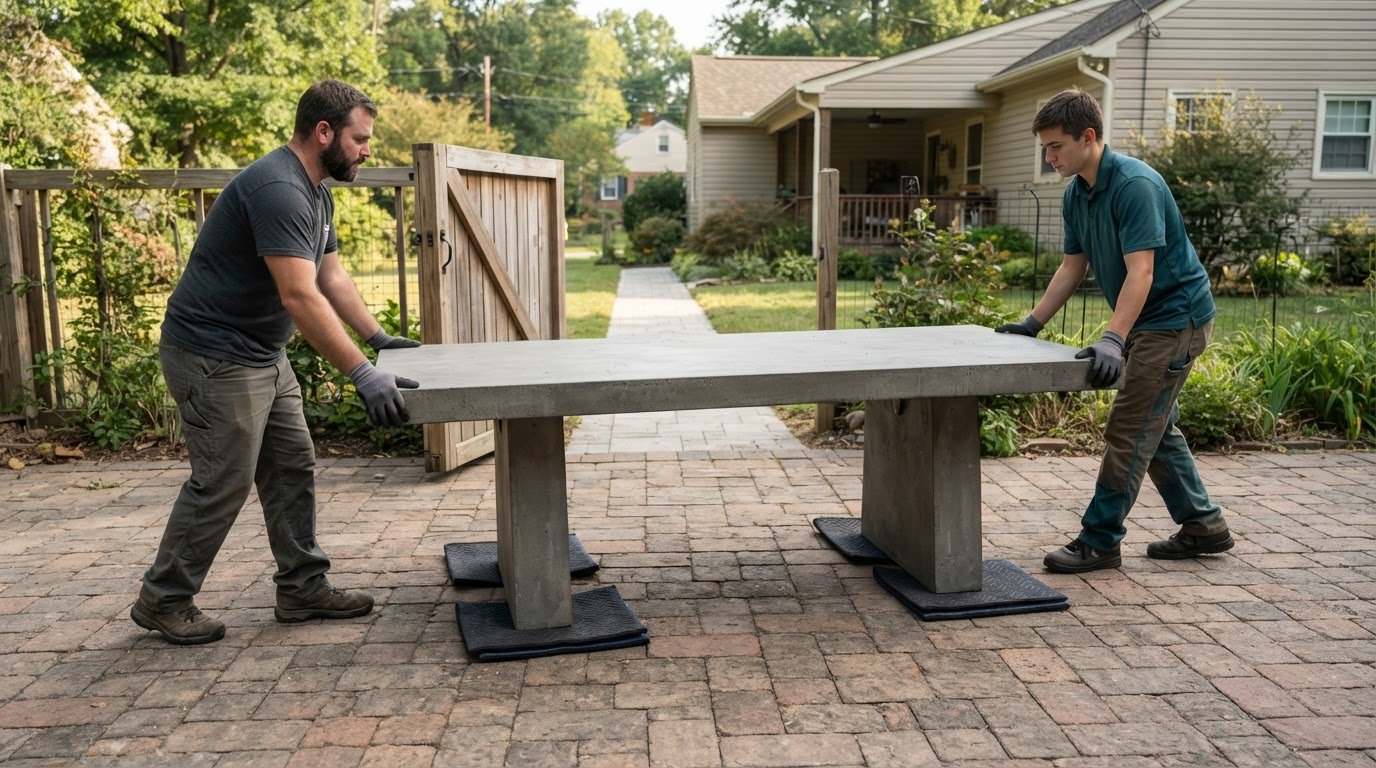
Move a concrete patio table without twisting it by supporting its base evenly, keeping its weight centered, and taking small, controlled steps. If you’re deciding how to move a massive concrete patio dining table in Gainesville, first clear the route and check that the table can stay level over the ground. Stop and reassess if it shifts, tilts, or resists a steady slide.
It’s reasonable to worry about a heavy table cracking, scraping the patio, or straining the people moving it. Avoid pulling one end ahead of the other: keep the support balanced and move the table evenly. This guide covers how to prepare the route, position helpers or moving aids, and keep the table centered as you slide it. It also explains when sliding is unsafe and another method is a better choice for the table and the people handling it.
Key Takeaways
- Keep the table’s weight balanced as it moves so one side doesn’t pull ahead and twist the load.
- Use the table’s shape, base, and path conditions to decide whether sliding is practical or another method is safer.
- Estimate the table’s weight from its construction and dimensions before choosing how to handle it.
- Measure the table and the full route, including gates and doorways, to spot tight clearances before moving day.
- Choose moving aids and lifting positions that support the table evenly and reduce direct lifting.
Keeping a heavy load centered while sliding
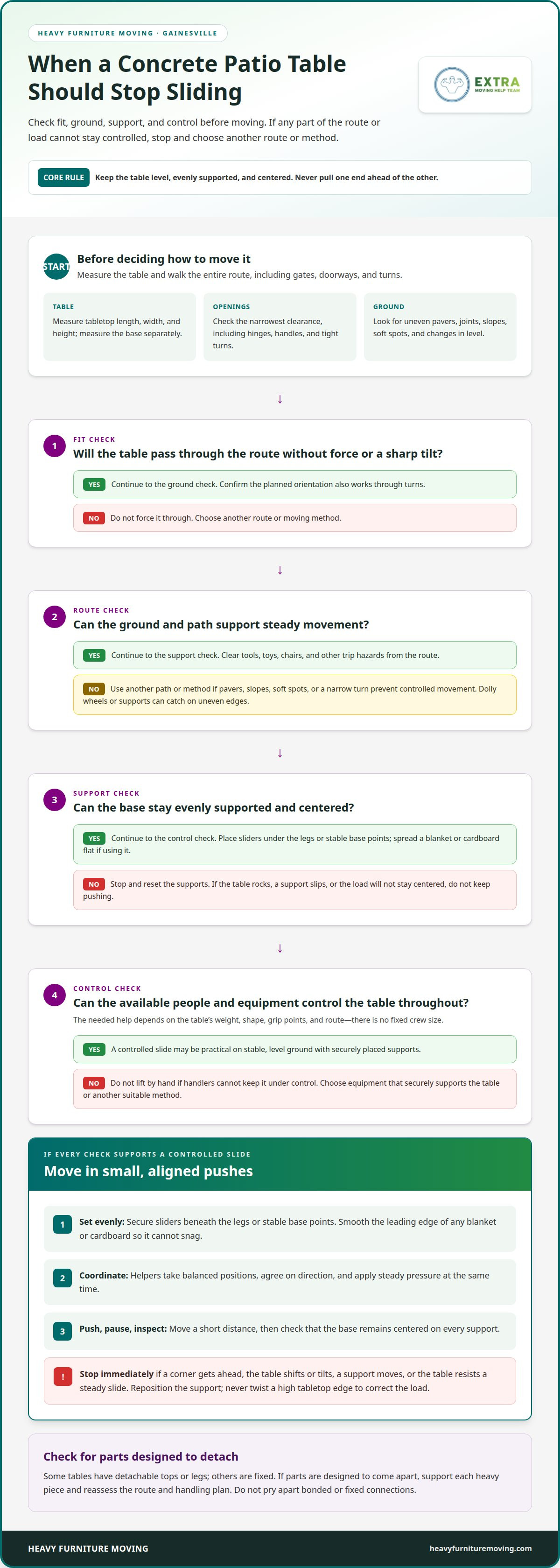
For a controlled slide, place furniture sliders under the table’s legs or stable base points. A moving blanket or cardboard can help it glide. Clear the route first, then move the table in small, even increments while keeping its center of weight supported.
- Clear and map the route. Remove garden tools, toys, chairs, and other trip hazards from the patio path. Check for cracks, joints, soft spots, or changes in ground level that could catch a slider. Measure the patio and destination area, leaving room for chairs and an umbrella. A clear, planned route lets helpers focus on balancing the table instead of steering around obstacles.
- Set the supports evenly. Place sliders beneath the table’s legs or stable base points so the load rests evenly instead of leaning to one side. If using a blanket or cardboard, spread it flat along the planned route. Smooth its leading edge, because a folded corner can snag under the base and pull one end forward. Don’t push until every support is securely in place.
- Choose matching positions around the table. Have helpers stand at balanced points, such as opposite sides of a rectangular tabletop. Agree on one person’s direction before starting. Everyone should apply steady pressure at the same time, rather than having one person pull a corner while another pushes the opposite edge. Coordinated force helps the table travel straight and limits sideways rotation.
- Move in short, aligned pushes. Push the table a short distance, then pause and check that the base remains centered on its sliders or blanket. Look at every side, not just the leading edge. If one corner moves farther ahead, stop and realign the supports before continuing. Avoid jerking or dragging one end, which can twist the table or shift its weight off the support.
- Keep the load low and controlled. Don’t try to correct a shifting table by grabbing a high tabletop edge and twisting it back. Stop, steady the load, and reposition the support beneath the side that has moved. Keep hands clear of pinch points between the base and patio. If the table rocks or a support slides out, reset it before pushing again.
- Use a careful solo method only for a manageable move. Lift one side slightly, move it forward, then repeat on the other side in small increments. Keep each lift controlled and watch that the table stays level. If one side is difficult to raise or the base won’t stay centered, stop instead of forcing the slide. A concrete table that shifts unpredictably needs a different moving method.
Place furniture sliders securely beneath the legs or stable base points, and spread a moving blanket or cardboard flat along the route. Keep the supports even and use short, controlled pushes to reduce shifting or twisting.
When to use a different moving method
If you’re deciding how to move a massive concrete patio dining table in Gainesville, change methods if you can’t keep the load supported, balanced, and clear of obstacles.
-
Measure the Table and Moving Openings
Measure the tabletop’s length, width, and height, then measure its base separately. Compare these dimensions with the narrowest gate, doorway, and turn along the route. Include hinges, handles, and other obstacles that reduce usable clearance. A straight gate may fit the tabletop, while a tight turn still blocks it. Check the planned orientation before moving. If the table won’t pass without force or a sharp tilt, choose another route or method.
-
Check Whether the Table Can Be Disassembled
Inspect the table for a detachable top, removable legs, or visible connections before planning a lift. Consult the assembly instructions if available, and identify how each part is supported. Don’t pry apart a bonded or fixed connection. For reassembly, place heavy parts near their attachment points and support them before connecting them. Separating only parts designed to detach can make each piece easier to handle.
Can a concrete patio table be disassembled for moving? Some tables have detachable tops or legs, while others are fixed. Separate only parts designed to come apart, and support heavy pieces throughout.
-
Assess the Moving Route and Its Risks
Walk the full route and inspect pavers, joints, slopes, and gate clearance. Dolly wheels can catch on uneven paver edges, jolting or shifting the load. A narrow gate can scrape corners and limit control during a turn. Don’t force the table through a tight opening or over unstable ground. How to move a massive concrete patio dining table in Gainesville depends partly on whether the route allows steady movement without tilting or scraping.
Uneven pavers can catch supports, while narrow gates restrict turning space. Choose another path or method if either condition prevents controlled movement.
-
Determine the People and Equipment Needed
Match the handling plan to the table’s weight, shape, and available grip points. No single crew size suits every concrete table; the number of helpers depends on whether they can control its balance throughout the lift. A dolly or hand truck can reduce direct lifting, while sliders suit stable, level ground. In Gainesville, Virginia, equipment-rental businesses may rent moving gear. Choose equipment that securely supports the table.
How many people are needed to lift a massive concrete table safely? There’s no fixed number: the table’s weight, shape, grip points, and route determine how much help is needed. If handlers can’t keep it under control, don’t lift it by hand.
Where can you rent a furniture dolly or moving equipment in Gainesville? Look for equipment-rental businesses in Gainesville, Virginia. Choose gear suited to the table’s shape and support points.
How much does a massive concrete patio dining table weigh?
- Look for the table’s listed weight. Check the manufacturer’s label, assembly instructions, or product paperwork first. A listed weight is a better starting point than appearance alone. Make sure the information matches the exact table, since a similar model may have different dimensions or construction. If the paperwork lists separate weights for the top and base, keep those figures distinct when planning each lift.
- Identify which parts are solid. A thick concrete tabletop and solid pedestal contain more material than thin or hollow sections of similar size. Inspect the underside and base for openings, cavities, or separate components. Don’t assume the entire table is solid concrete just because its surface looks that way. Construction affects how much material the table contains, its weight, and how it should be supported.
- Measure the concrete portions. Record the tabletop’s length, width, and thickness, then note the base’s shape and dimensions. These measurements help estimate how much concrete the table contains. For a rectangular top, length, width, and thickness describe its overall volume; assess a shaped or hollow base separately. Volume can help compare pieces, but it cannot give an exact weight without reliable information about the material.
- Separate the estimate by component. Treat a detachable top, pedestal, and legs as individual pieces only if they are designed to come apart. A broad tabletop may be heavy even when its base is compact, while a substantial pedestal can carry much of the table’s weight. Breaking the estimate down helps identify which part needs the most support. It also avoids a misleading estimate based only on the table’s overall dimensions.
- Use material information for a closer estimate. Weight depends on the concrete’s density and the volume of each solid part. If the manufacturer provides material and component details, use them together instead of relying on a generic concrete estimate. Concrete mixes and table construction vary, so another table may not provide a useful comparison. Don’t turn appearance into a precise weight estimate.
- Plan around the heaviest individual piece. Use the listed or carefully estimated component weight to choose lifting support, equipment, and a route. If the table’s weight is uncertain, treat it as a heavy, awkward load rather than testing it with an unplanned lift. A solid rectangular top and a hollow pedestal need different handling plans. Account for both the table’s total weight and how that weight is distributed.
How to measure a concrete patio table for moving through gates and doorways?
- Measure every part that must pass through. Record the tabletop’s length, width, and thickness. Measure the base, pedestal, and legs separately. Include handles, trim, or other projections that affect the widest point. If the tabletop detaches, measure it separately from the base. These measurements show the shape you’ll need to guide through each opening, not just the table’s footprint when assembled.
- Measure the narrowest usable opening. Check each gate and doorway where the table will pass. Account for hinges, handles, latches, and doorstops that reduce clear space. A gate’s frame may be narrower than the visible opening. Measure between obstructions, not just between the outer edges. Compare that usable width with the table’s dimensions in the orientation you plan to carry or slide it.
- Plan the table’s orientation before reaching the gate. A rectangular tabletop may fit through an opening when turned edge-on, but the base can change the clearance required. Consider the table’s height, thickness, and shape as you plan the turn. Check that there’s room to rotate before the opening, not just enough width to pass through. Don’t count on tipping a heavy concrete top to gain clearance.
- Check the full route, including turns. Measure the space before and after each gate, doorway, and corner. The table may clear an opening but still be unable to turn into a narrow path. Look for fences, walls, steps, and patio furniture that limit movement. Mark the intended path mentally or with removable markers. The tightest turn can matter as much as the narrowest doorway.
- Include the moving equipment in your measurements. A dolly, hand truck, or protective padding can increase the load’s width or height. Measure the table in its supported position, including any straps or padding that will remain in place. Check thresholds and changes in ground level along the route. A setup that clears a doorway while stationary may not leave handlers enough room to steer safely.
- Compare measurements and choose the route before moving. Compare each table dimension with every opening and turning space, then identify potential pinch points. If clearance depends on forcing, scraping, or sharply tilting the table, stop and reconsider. A different route or removal of a detachable tabletop may solve the problem. Decide on the orientation at each gate before starting, so nobody has to improvise while holding the load.
Before moving a patio table, clear the route of garden tools, toys, and other trip hazards. An open path makes it easier to guide the table through the measured spaces.
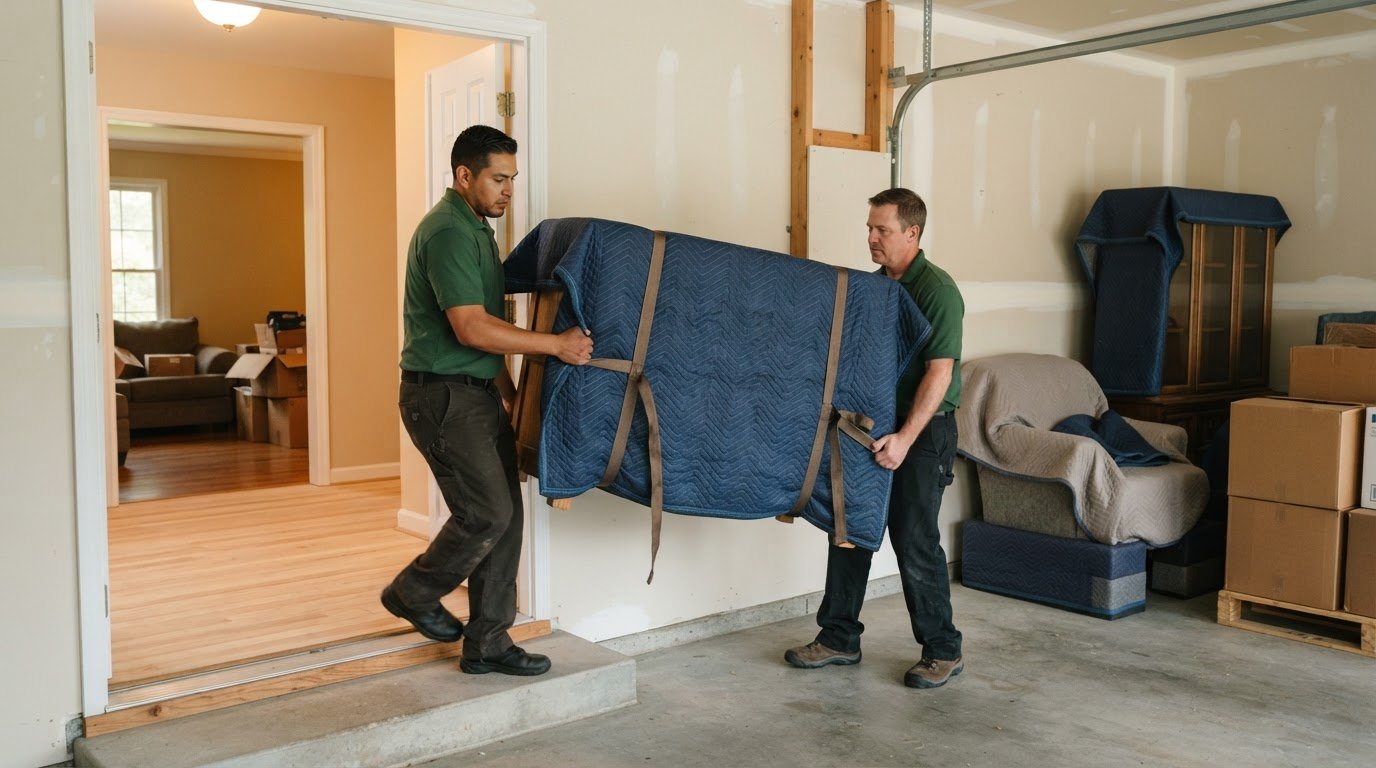
A thick moving blanket can help prevent scratches and make a heavy table easier to slide across a concrete patio. If the blanket will stay on during the move, leave it in place when checking the table’s dimensions.
If moving the table alone, lift one side slightly, move it forward, and repeat on the other side. Use this method only if the route leaves room to reposition the table safely.
How to move a heavy concrete table safely with a furniture dolly or lifting straps?
- Clear the route before setting up. Remove garden tools, toys, chairs, and loose items from the patio. Check the path from the table to its destination, including gates, thresholds, and turns. Concrete tables are difficult to steer around obstacles once lifted or supported. Clear space gives everyone room to move without stepping backward over clutter. Keep the dolly’s route open from start to finish.
- Separate only parts designed to detach. A removable tabletop can make individual pieces easier to handle. Check the assembly instructions and connections before trying to separate anything. Don’t force a fixed joint or pry against a concrete edge. Set removed parts near where they will be handled, and support heavy sections before loosening connections. Keep the top stable so it cannot tip or slide during preparation.
- Choose a dolly for a stable, suitable route. A dolly or hand truck can reduce the need to lift the table directly. Position its support beneath a solid, balanced part of the base, not under a fragile edge. Secure the load against rolling or shifting. Check that the wheels travel smoothly over the actual surface. If pavers, joints, or thresholds interrupt the route, a loaded dolly may jolt or catch.
- Use lifting straps only with controlled support. Position straps to support the table without pressing on a weak edge or unstable joint. Coordinate the lift so everyone raises and lowers the load together. Keep the table close to the body, bend at the knees rather than the back, and avoid twisting while carrying. Stop if a strap slips, the load tilts, or anyone loses a secure grip.
- Test the setup before traveling the route. Raise or shift the table only enough to confirm the dolly or straps hold it evenly. Check for movement at the tabletop, base, and support points. If the table leans, settles unevenly, or puts a handler in an awkward position, lower it and adjust the setup. Don’t start moving until the load feels controlled and the route is clear.
- Move steadily and pause at obstacles. Keep the table level and move at a controlled pace. Stop before a threshold, turn, or change in surface to reassess the support and next movement. Don’t pull one end ahead or twist the table to clear a tight spot. If the dolly cannot cross safely, set the load down and choose another method.
If the table needs careful lifting and balanced support, get help with heavy furniture moving.
Heavy Furniture Moving
Heavy Furniture Moving helps with bulky furniture when a concrete patio table is too awkward to move safely on your own. If its weight, shape, or route makes sliding or lifting difficult, professional moving help can handle the demands of the move. The team also moves exercise equipment and furniture within the home. Share the table’s dimensions, whether it separates into parts, and any tight gates or turns along the route. These details help describe the challenge and the support needed. If you’d rather not manage the move yourself, contact Heavy Furniture Moving to discuss your moving help.
Set Up Your Move With Confidence
Planning how to move a massive concrete patio dining table in Gainesville is also a chance to decide how much of the job you want to handle yourself. Before moving day, turn your measurements and route observations into a simple plan: identify the destination, note difficult access points, and decide whether you can manage the handling safely. If lifting or maneuvering the table feels beyond your capacity, bring in help rather than forcing the move.
Heavy furniture moves take coordination as well as strength. A clear plan helps everyone understand the route and the intended approach before the table shifts. You can take the next step with Heavy Furniture Moving and discuss help for your move. Reach out when you’re ready to make a practical plan, and move forward with confidence.
Frequently Asked Questions
Should I hire Gainesville VA movers to move a heavy concrete patio table?
Get moving help if you can’t control the table’s balance, grip, or direction throughout the move. A narrow passage, awkward base, or heavy one-piece top can make a do-it-yourself lift difficult to manage. Heavy Furniture Moving provides residential moving help in Gainesville, Virginia. Share where the table is and describe access challenges so the moving plan can account for the job.
What do Gainesville VA moving companies charge to move a heavy patio table?
The price depends on the job and is provided after a quote request. Factors include the table’s size and weight, whether it separates into parts, the distance it must move, and access challenges such as stairs or tight turns. For a Gainesville move, describe the table and its route when requesting a quote. These details help the team assess the work and provide job-specific pricing.
How to protect concrete table legs and surfaces during transport?
Place furniture sliders under the legs or stable base points, and use a flat moving blanket or cardboard to help prevent scratches. Keep the table evenly supported and move it in short, controlled pushes to avoid scraping or shifting.
Frequently Asked Questions
Get moving help if you can’t control the table’s balance, grip, or direction throughout the move. A narrow passage, awkward base, or heavy one-piece top can make a do-it-yourself lift difficult to manage. Heavy Furniture Moving provides residential moving help in Gainesville, Virginia. Share where the table is and describe access challenges so the moving plan can account for the job.
The price depends on the job and is provided after a quote request. Factors include the table’s size and weight, whether it separates into parts, the distance it must move, and access challenges such as stairs or tight turns. For a Gainesville move, describe the table and its route when requesting a quote. These details help the team assess the work and provide job-specific pricing.
Place furniture sliders under the legs or stable base points, and use a flat moving blanket or cardboard to help prevent scratches. Keep the table evenly supported and move it in short, controlled pushes to avoid scraping or shifting.