How to Get a King Mattress Up Aldie Switchback Stairs
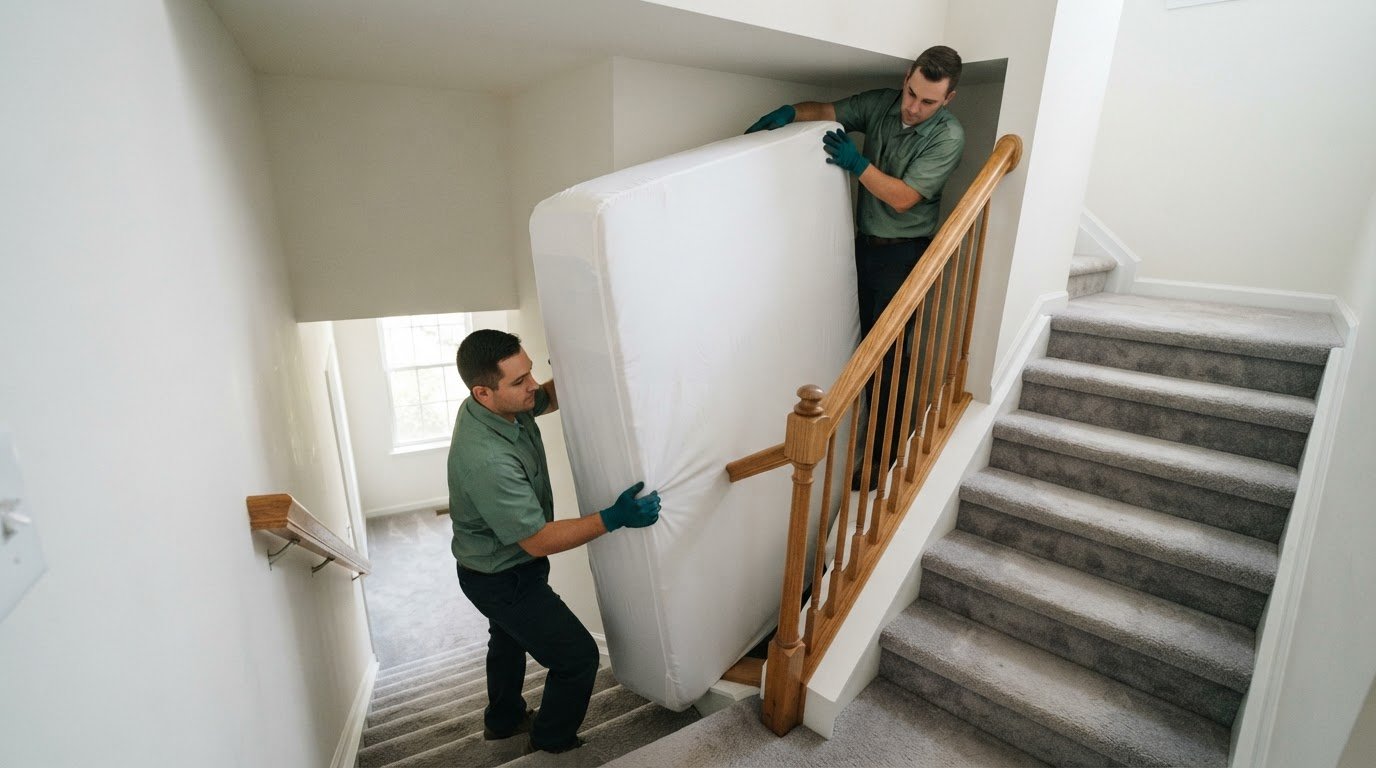
A switchback turn is the moment to plan, not push. A standard king mattress measures 183 × 203 cm, so measure the stair width, ceiling clearance, and landing before lifting. This guide explains how to navigate switchback townhome stairs with an oversized king mattress in Aldie: carry it upright and plan each turn before moving.
It’s easy to assume the mattress only needs to fit along the straight stair run. The landing and corner clearance can be the real challenge, especially when the stairwell turns back on itself. To navigate switchback townhome stairs with an oversized king mattress in Aldie, measure the route, plan a controlled carry, and pause before tight pivots. Assess the move before lifting.
Key Takeaways
- Measure the stairwell, ceiling, and landing so you can spot tight points before lifting.
- Plan the carry with enough helpers and a clear route before moving the mattress upstairs.
- Keep the mattress upright on its long edge to make tight turns easier to manage.
- Use controlled, small adjustments at switchback corners instead of forcing the mattress through.
- Know when to pause and reset, or bring in moving help for a difficult carry.
Measuring stairwell width, ceiling height, and corner clearance
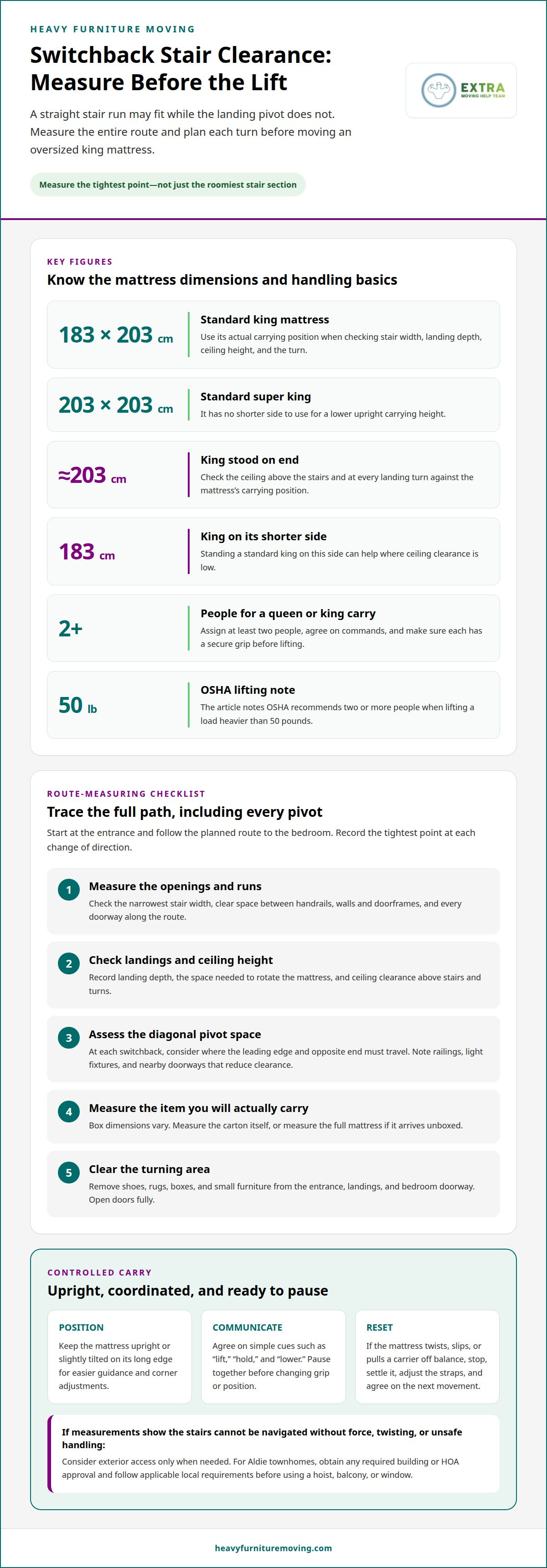
Measure the full route before lifting, including straight stair runs, landings, and switchback corners. A standard king mattress measures 183 × 203 cm, so check the space against its actual carrying position.
Measure Stairwell and Landing Clearance
Measure the narrowest stairwell width and each landing, including the clear space between handrails, walls, and doorframes. Record the landing depth and the room needed to rotate the mattress. For example, a 183 × 203 cm king carried upright presents different dimensions across the stairwell than when carried flat. Check doorways along the route, too, and note anything that narrows the opening.
Check Ceiling Height and Corner Clearance
Measure ceiling height above the stairs and at each turn, then compare it with the mattress’s carrying position. A king stood on end is about 203 cm tall; standing it on its 183 cm side can help where ceiling clearance is low. Measure diagonal corner clearance at each landing, since a mattress may fit along a straight run but fail to pivot at the turn.
- Map the complete route. Start at the entrance and follow the planned path to the bedroom. Measure stair width, landing depth, ceiling height, door openings, and corner clearance at every change of direction. Write down the tightest point, not just the roomiest part of the staircase.
- Compare measurements with mattress orientation. Use the mattress’s 183 × 203 cm footprint to consider how it will pass each opening. A king can stand on its 183 cm side to reduce its upright height. If the mattress is an oversized 203 × 203 cm super king, it has no shorter side to use.
- Check the pivot space. At each switchback, identify where the mattress’s leading edge will move and where its opposite end must travel. Measure the diagonal clearance across the landing and note obstructions such as railings, light fixtures, or a nearby doorway. A clear straight stair run alone doesn’t prove the turn will work.
- Clear the moving path. Remove shoes, rugs, boxes, and small furniture from the entrance, landings, and bedroom doorway. Open doors fully and keep the measured turning area clear. This gives carriers room to reposition the mattress without stopping against clutter or striking nearby items.
- Choose exterior access only when needed. Consider a hoist, balcony, or window if the measurements show the mattress cannot pass the stairs without force, twisting, or unsafe handling. For Aldie townhomes, obtain any required building or HOA approval and follow applicable local requirements before using exterior access. Don’t assume a window or balcony is an approved loading point.
How do you get a king-size mattress up a narrow staircase?
Use a planned carry with enough helpers, secure handholds, and a clear pace. Decide how to navigate switchback townhome stairs with an oversized king mattress in Aldie by planning each lift and turn before starting.
-
Check Mattress and Box Dimensions
Identify the mattress size and measure the package separately. A standard king mattress measures 183 × 203 cm; a standard super king measures 203 × 203 cm. Box dimensions vary with the mattress and packaging, so use the carton’s actual measurements rather than assuming it matches the mattress. If the mattress arrives unboxed, measure its full width and length before carrying it.
-
Position Helpers and Moving Straps
Assign at least two people to carry a queen or king mattress upstairs, and agree on commands before lifting. OSHA recommends two or more people when lifting a load heavier than 50 pounds. Fit moving straps as directed and make sure each carrier has a secure grip before lifting.
-
Move the Mattress Along the Stairs
Keep the mattress upright or slightly tilted, and climb in short, coordinated movements. Going upstairs, position the stronger carrier below to lift and guide the mattress upward, keeping its heavier end lower. Going downstairs, the stronger carrier stays below to anchor it while the upper carrier guides and controls its movement. Pause together before changing grip or position.
- Use straps as handling aids, not as a reason to rush. A shoulder-dolly system can help carriers manage a bulky load, but both people still need control of the mattress. A strap system’s rating describes the system, not the mattress or the carriers’ ability to maneuver a tight staircase. Keep hands clear of pinch points and communicate before each step.
- Reset if the mattress shifts. Stop if it starts twisting, slipping, or pulling one carrier off balance. Settle it in a stable position, adjust the straps, and agree on the next movement before continuing. If you’re planning how to navigate switchback townhome stairs with an oversized king mattress in Aldie, build in pauses to reset safely. For a difficult carry, professional moving help can take on the heavy lifting while keeping the route and coordinated handling in focus.
Carrying a mattress vertically on its long edge
Keep the mattress upright or slightly tilted so it’s easier to guide and reposition. Move steadily, and stop if its shape shifts unexpectedly.
- Set the long edge upright. Stand the mattress on its long edge before entering the stairwell, then keep it upright or slightly tilted as you move. This position gives the carriers leverage and makes corner adjustments easier than carrying it flat. Grip opposite sides securely, and keep the mattress centered between you. Avoid letting one end swing freely toward a railing or wall.
- Agree on movement commands. Before lifting, choose simple cues such as “lift,” “hold,” and “lower.” The person guiding the leading end should call each pause, especially before a landing or change in direction. Move a small distance at a time, then settle the mattress before adjusting hands. Clear commands help prevent one carrier from turning while the other continues forward.
- Keep the edge controlled through each turn. At a corner, pause and shift the mattress gradually rather than forcing the top or bottom around first. One carrier can guide the leading end while the other controls the trailing end. Keep the mattress upright or slightly tilted, and make sure both ends have room to move. If it starts twisting or bending, stop and reset.
- Match the handling to the mattress construction. All-foam and latex mattresses can tolerate a gentle curve when a doorway or tight pivot requires it. Keep that curve controlled, and avoid folding the mattress sharply. Coiled and hybrid mattresses should not be folded. For latex, maintain a flat or vertical position during the move instead of bending or folding it.
- Protect the mattress while repositioning. Keep hands on its edges or designated handles, if present, and avoid pulling hard on fabric or seams. At a landing, lower the mattress enough to rest securely before changing grips. Check that no bedding, strap, or loose fabric catches against the stair rail. Then lift together and continue only when both carriers are ready.
- Stop when control becomes difficult. If the mattress begins to twist, sag, or slip, pause and return it to a stable position. Don’t push through a tight turn while either carrier lacks a firm grip. Reassess the angle and hand positions, then try a controlled adjustment. A steady upright carry protects the mattress better than a rushed pivot or forced bend.
Using walls for stability while pivoting
Use the wall as a visual guide, not to support the mattress’s weight. At each landing, pause and make small, coordinated adjustments rather than forcing the turn.
- Protect the contact points. Before lifting, cover exposed mattress edges with a moving blanket or other clean padding. Keep padding secured so it won’t slide between the mattress and a wall. This soft buffer helps reduce scuffs if an edge brushes drywall during a turn. Don’t rely on padding to make a tight opening fit.
- Keep carriers in control. Assign one person to guide the leading end and another to control the trailing end. Agree on simple commands, such as “hold” and “turn,” before approaching the corner. Keep both carriers’ hands on stable parts of the mattress. Don’t brace your body against a wall while carrying its weight.
- Pause before the pivot. Stop with the mattress fully supported and both carriers balanced before changing direction. Check where the top and bottom edges will move, then choose which end needs to shift first. For example, move the leading end toward the open side of the landing while the second carrier keeps the rear edge clear.
- Use gentle wall contact only as a guide. If a padded edge lightly touches a clear wall, use that contact to judge position. Don’t push the mattress against drywall, a handrail, or a doorframe to lever it around. Keep the opposite edge away from fixtures, and adjust the angle with small movements from both carriers.
- Make one adjustment at a time. At a tight switchback, turn the mattress gradually rather than twisting both ends in opposite directions. A carrier can call a brief pause while the other repositions their grip. Keep the mattress’s broad face controlled, and watch the upper corner near the ceiling as the lower edge moves across the landing.
- Stop if the mattress twists or catches. Settle it in a stable position before changing handholds or padding. Check whether the snag comes from a wall corner, railing, light fixture, or doorway, then clear the obstruction if possible. If the turn still requires force, back out carefully and reset the approach instead of pushing harder.
Navigating U-shaped or switchback staircases
A switchback staircase has two turns, so handle each stair section separately. Control the mattress through the first landing before setting up for the next turn.
- Approach the first turn upright. Keep the mattress vertical or slightly tilted as you reach the landing. Pause before its leading edge enters the corner. Check the mattress’s top and bottom against the open space, then agree which end moves first. This prevents both carriers from turning in opposite directions at once.
- Check the diagonal turning space. A stairwell turn with diagonal clearance under about 80 inches may require pivoting a king mattress vertically. Use the landing’s open diagonal as the turning path, not just its wall-to-wall width. Watch the mattress’s upper edge near the ceiling while its lower edge crosses the landing.
- Angle the mattress gradually. For a tight corner, angle the mattress about 45° and adjust its position in small movements. One carrier guides the leading end toward the next flight; the other controls the trailing end. Pause between adjustments so neither edge catches the railing, wall corner, or stair trim.
- Finish the first section before resetting. Once the mattress clears the first turn, bring it into a stable position on the next flight. Don’t begin the second pivot while one end remains over the landing. Reposition hands and footing first, then face the next turn with both carriers ready to move together.
- Take the second turn as a separate maneuver. A U-shaped stairwell requires two turns, handled one section at a time. At the second landing, stop, assess the available angle, and repeat the controlled pivot. If the mattress twists or bends, lower it to a stable position and reset before continuing.
- Set a limit on repeated attempts. If the mattress cannot pass a specific corner after two or three attempts, stop rather than forcing it. Recheck its orientation and the clear path through that turn. If the same obstruction remains, choose another access plan instead of risking damage to the mattress, stairwell, or carriers.
If a tight switchback needs experienced hands, get help with the heavy lift.
Treat the route as two distinct turns, completing one section before moving on. Keeping the turns separate creates a clear sequence through the U-shaped or switchback staircase.
Heavy Furniture Moving
Heavy Furniture Moving can help when a king mattress feels too awkward to carry through a tight townhome stairwell. Consider its heavy lifting and in-home furniture moving help when the landing leaves little room to pivot, the mattress keeps catching, or coordinating the carry feels difficult. A planned team lift helps keep the load controlled through narrow passages and switchback turns.
If you’ve measured the route and still can’t see a clear way through, don’t force the mattress around the corner. Contact Heavy Furniture Moving to discuss help with the move.
Make a Clear Plan for the Move
Knowing how to navigate switchback townhome stairs with an oversized king mattress in Aldie starts with a practical decision: proceed only if the route and carry feel manageable. If a turn feels too tight, don’t force the mattress through. Choose a safer plan and keep the move controlled from the first lift to the bedroom.
Heavy Furniture Moving offers Movers Near Me, Exercise Equipment Moving, and Sofa Hoisting. For a king mattress that needs careful handling through a difficult home layout, moving help can ease the carry and help you move forward with a plan.
Talk with Heavy Furniture Moving about your mattress move. Take the next step with a clear route and capable hands.
Frequently Asked Questions
How do I avoid hurting my back during the move?
Get help with the lift, keep the mattress close, and move your feet instead of twisting your torso. OSHA recommends using two or more people when lifting a load heavier than 50 pounds. Before starting, clear the route and agree on commands so nobody makes a sudden turn under load. Pause if your grip slips or your balance changes, then set the mattress down before resetting.
What’s the best tool for moving a mattress upstairs?
Moving straps or a shoulder dolly can help carriers hold and control a bulky mattress, especially on a straight stair run. The right choice depends on the mattress, stair layout, and each carrier’s ability to keep it steady. Fit straps according to their instructions, and keep hands free for balance and steering. A dolly generally isn’t practical on stairs, so don’t try to roll one up a flight.
What is the minimum stairway width and ceiling clearance needed to move an oversized king mattress?
There isn’t one stairway width that guarantees an oversized king will fit, because the mattress must also clear doorways and rotate at landings. Measure the mattress and the narrowest point in its planned carrying position. A standard king measures 183 × 203 cm; standing it on end needs about 203 cm of ceiling clearance, or 183 cm on its shorter side. Angling can change the clearance needed.
How can you measure switchback townhouse stairs, landings, and turns before moving a mattress?
Measure the narrowest clear width on every flight, then record the landing depth, ceiling height, door openings, and diagonal clearance across each corner. Include handrails and fixed fixtures. Sketch the route from the entrance to the bedroom and mark where the mattress must rotate. In an Aldie townhouse, assess both turns separately because the second landing may have a different shape or obstruction.
What techniques help maneuver a king mattress around a tight switchback stair landing?
Carry the mattress upright, stop fully on the landing, and rotate it in small, coordinated movements. One person guides the leading end while the other controls the trailing end. Agree on a direction before moving, and keep the upper edge clear of the ceiling and fixtures. If the mattress catches, don’t push harder. Return it to a stable position, then adjust the angle or hand placement.
Can an oversized king mattress be bent or folded safely during a stair move?
Don’t fold an oversized king mattress just to force it around a switchback. A gentle curve may help some all-foam or latex mattresses pass through a doorway, but coiled and hybrid designs shouldn’t be folded. The mattress’s construction matters more than size alone. Keep it supported, avoid sharp bends, and stop if it starts to twist or buckle during a turn.
How do mattress type and construction affect bending, rolling, or stair transport?
Foam and latex construction affect how much a mattress can tolerate a gentle curve, while folding can damage coils and hybrid layers. Keep latex flat or vertical during transport rather than rolling or folding it. Check the mattress’s care instructions for handling limits, especially if you’re unfamiliar with its construction. On a narrow staircase, carrying it upright avoids the need to roll it.
What equipment or mattress bags help protect a mattress on narrow stairs?
A mattress bag can shield fabric from dirt and light scuffs, while moving blankets can cushion contact with a wall or railing. Secure coverings so they don’t bunch under a carrier’s hands or hide the mattress edges. Position straps to hold the load without applying uneven pressure. Padding protects surfaces at tight turns, but it won’t make a mattress fit through an opening that’s too narrow.
Frequently Asked Questions
Get help with the lift, keep the mattress close, and move your feet instead of twisting your torso. OSHA recommends using two or more people when lifting a load heavier than 50 pounds. Before starting, clear the route and agree on commands so nobody makes a sudden turn under load. Pause if your grip slips or your balance changes, then set the mattress down before resetting.
Moving straps or a shoulder dolly can help carriers hold and control a bulky mattress, especially on a straight stair run. The right choice depends on the mattress, stair layout, and each carrier’s ability to keep it steady. Fit straps according to their instructions, and keep hands free for balance and steering. A dolly generally isn’t practical on stairs, so don’t try to roll one up a flight.
There isn’t one stairway width that guarantees an oversized king will fit, because the mattress must also clear doorways and rotate at landings. Measure the mattress and the narrowest point in its planned carrying position. A standard king measures 183 × 203 cm; standing it on end needs about 203 cm of ceiling clearance, or 183 cm on its shorter side. Angling can change the clearance needed.
Measure the narrowest clear width on every flight, then record the landing depth, ceiling height, door openings, and diagonal clearance across each corner. Include handrails and fixed fixtures. Sketch the route from the entrance to the bedroom and mark where the mattress must rotate. In an Aldie townhouse, assess both turns separately because the second landing may have a different shape or obstruction.
Carry the mattress upright, stop fully on the landing, and rotate it in small, coordinated movements. One person guides the leading end while the other controls the trailing end. Agree on a direction before moving, and keep the upper edge clear of the ceiling and fixtures. If the mattress catches, don’t push harder. Return it to a stable position, then adjust the angle or hand placement.
Don’t fold an oversized king mattress just to force it around a switchback. A gentle curve may help some all-foam or latex mattresses pass through a doorway, but coiled and hybrid designs shouldn’t be folded. The mattress’s construction matters more than size alone. Keep it supported, avoid sharp bends, and stop if it starts to twist or buckle during a turn.
Foam and latex construction affect how much a mattress can tolerate a gentle curve, while folding can damage coils and hybrid layers. Keep latex flat or vertical during transport rather than rolling or folding it. Check the mattress’s care instructions for handling limits, especially if you’re unfamiliar with its construction. On a narrow staircase, carrying it upright avoids the need to roll it.
A mattress bag can shield fabric from dirt and light scuffs, while moving blankets can cushion contact with a wall or railing. Secure coverings so they don’t bunch under a carrier’s hands or hide the mattress edges. Position straps to hold the load without applying uneven pressure. Padding protects surfaces at tight turns, but it won’t make a mattress fit through an opening that’s too narrow.