How to Move a Heavy Treadmill Through a Narrow Hallway Turn
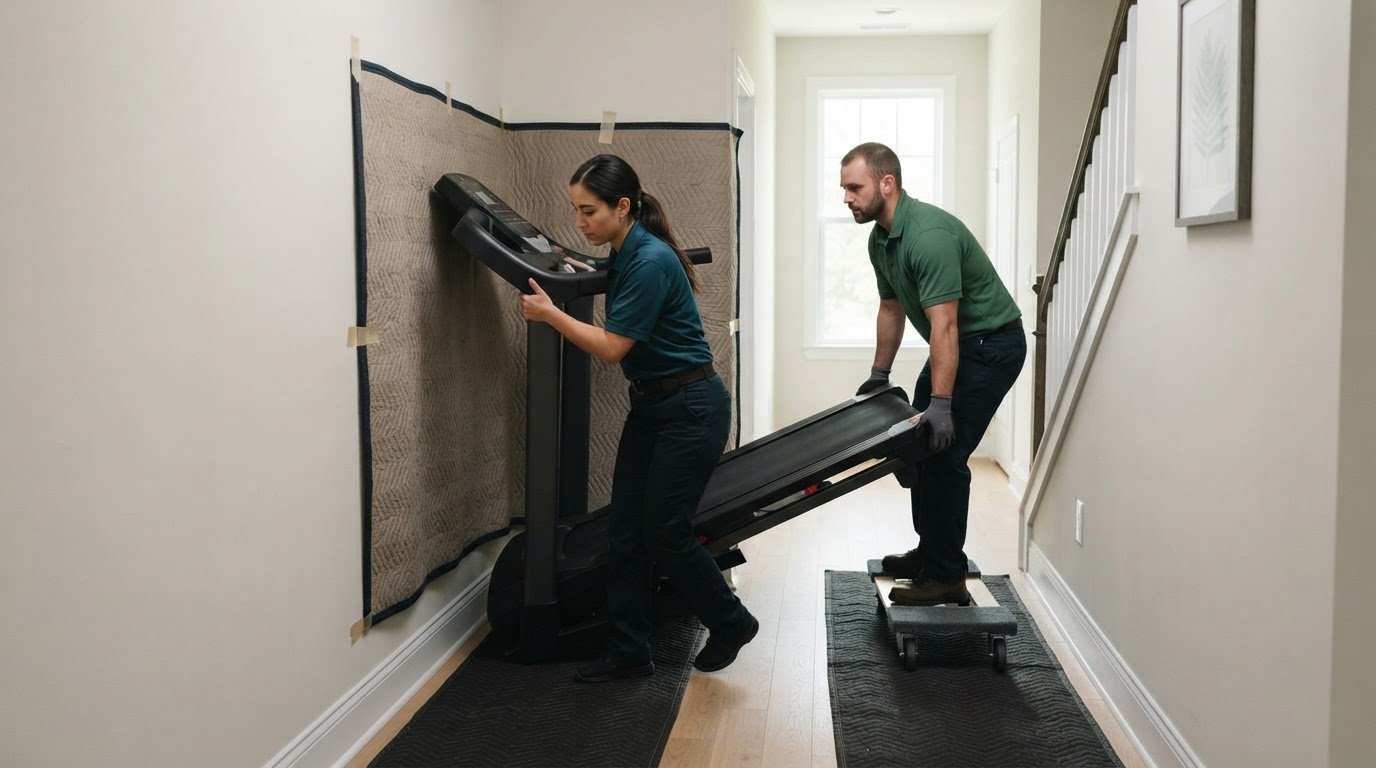
A heavy treadmill is a poor one-person move, especially around a tight hallway turn. Moving a heavy NordicTrack treadmill through a narrow hallway turn in Dumfries is safer with another capable helper, a clear path, and controlled steps rather than a rushed lift. If the frame won’t clear the corner, removing parts may make the move easier.
That turn can feel like the hardest part: the treadmill is bulky, the walls are close, and a wrong angle can leave you stuck or cause damage. You’ll learn when one person can manage a small part of the move, when to disassemble the treadmill, and how to pivot it through the hallway without forcing the frame.
This guide also covers protecting floors and walls, keeping small parts together, and preparing the treadmill for transport. Start by identifying the model and checking the route. A little preparation can make the move more controlled and less stressful.
Key Takeaways
- Identify your treadmill’s folding design and detachable parts before lifting so you can plan the safest route.
- A dolly can help across flat areas, but a narrow turn may call for more than one person to guide and steady the machine.
- Disassemble only the parts needed to clear the route, and keep removed hardware and small components labeled together.
- Measure the hallway turn and doorway, then protect floors, walls, and treadmill surfaces before maneuvering through the tightest point.
- Secure the treadmill for transport so it stays stable and protected during the trip.
Checking treadmill type before lifting
NordicTrack treadmill weight varies by model, so there is no single weight for every unit. Find the model name on the frame, then check the owner’s manual for its weight before planning the lift.
- Identify the model before moving anything. Find the model label on the frame and record its name and number. Match those details to the owner’s manual. The brand alone does not tell you the treadmill’s weight, folding design, or approved moving position. Keep the manual nearby, especially if the console, rails, or base differ from other NordicTrack machines.
- Check how the frame folds. Inspect the deck hinge and folding latch without forcing either part. Some treadmills fold the walking deck toward the console; others remain extended. Follow the instructions for your exact model. A locked deck changes the machine’s shape, while an unsecured deck can swing during handling. Do not assume similar-looking hinges work the same way across models.
- Inspect the treadmill’s main sections. Identify the walking deck, upright supports, handrails, and console. Note which parts connect with visible bolts or knobs. This helps you judge whether the assembled treadmill can clear the hallway turn or needs partial disassembly. A console that extends beyond the rails, for example, may catch on a doorway even if the deck fits.
- Measure the machine at its widest points. Measure across the handrails, console, and base, then note the longest dimension. Measure the hallway entrance and tight turn separately. Compare the measurements before lifting. The narrow deck may fit through a doorway while the wider console or rails hit the frame during a pivot.
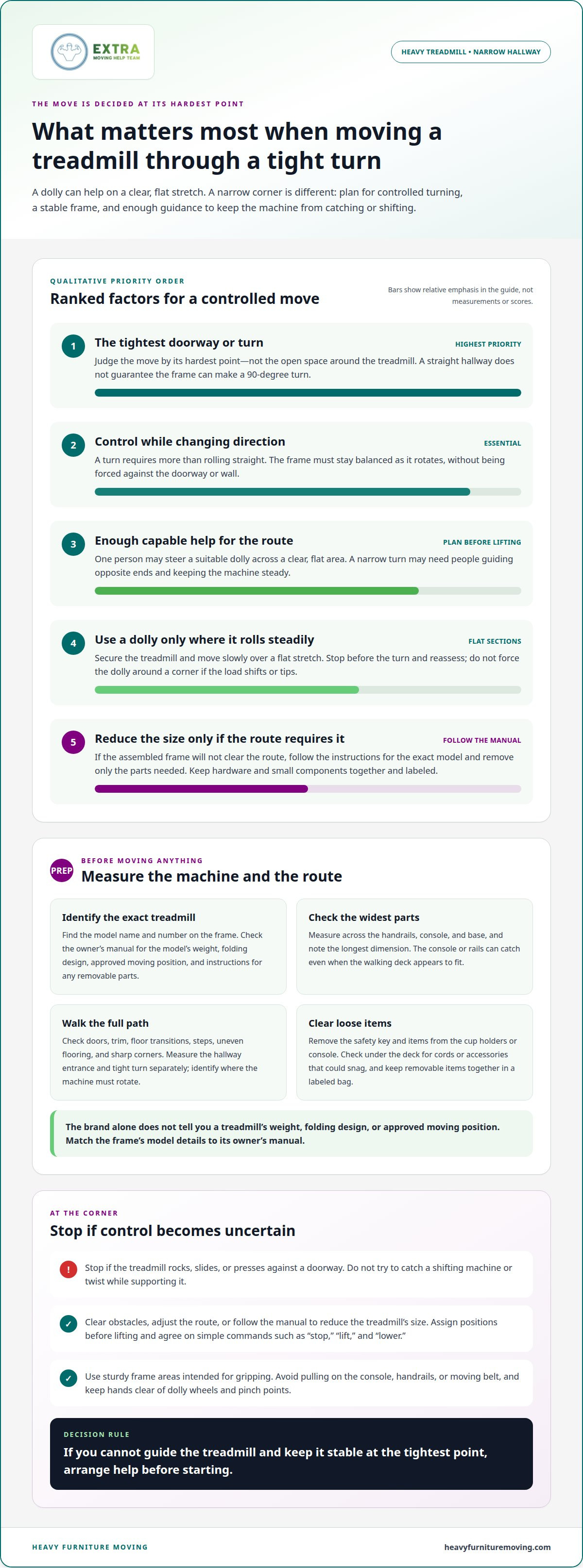
- Inspect the route and the machine together. Walk from the treadmill to the exit and check doors, trim, floor transitions, and sharp corners. Identify the tightest point and consider whether the treadmill can rotate there without hitting a wall. A clear, straight hallway does not guarantee the machine can make a ninety-degree turn.
- Check for accessories and loose items. Remove the safety key, items in the cup holders, and anything resting on the console. Check beneath the deck for cords or accessories that could snag. Keep removable items together in a labeled bag. A dangling cord can catch on a doorway, and loose items can shift when the frame tilts.
- Plan the lift around the treadmill’s construction. Identify sturdy frame areas intended for gripping, and avoid pulling on the console, handrails, or moving belt. Note the model’s weight and the narrowest route measurement before deciding how to proceed. If the assembled frame cannot turn cleanly, follow the manual’s instructions for removing parts before lifting.
NordicTrack treadmill weight depends on the specific model. Match the model details on the frame to the owner’s manual to find the applicable weight.
Can one person move a treadmill?
- Separate guiding from lifting. One person may be able to steer a treadmill across a clear, flat area using a suitable furniture or appliance dolly. A dolly helps roll the machine instead of carrying its full weight, but it does not make a solo move through a narrow turn a sound plan. A corner requires controlling the frame as its direction changes, not simply rolling straight.
- Assess the route before choosing who moves it. Walk the full path from the treadmill’s room to the exit. Note each doorway, floor transition, and tight corner. A straight hallway may suit a dolly, while a sharp turn may require people guiding opposite ends. Account for steps, uneven flooring, and doors that must remain open.
- Decide whether the treadmill can stay assembled. Compare its widest parts with the narrowest doorway and hallway turn. The console or handrails can catch even when the walking deck appears to fit. If the machine needs to tilt or rotate, one person may struggle to balance it and protect nearby walls. Arrange help before moving it into the passage.
- Choose helpers who can follow a clear plan. Assign positions before lifting and agree on simple commands such as “stop,” “lift,” and “lower.” Clear rugs, boxes, and cords from the route. If a helper cannot keep a firm grip or follow the commands, revise the plan before the treadmill leaves its room.
- Use a dolly only where it rolls steadily. Secure the treadmill on the dolly, then move it slowly across a flat section. Keep hands clear of wheels and pinch points. Stop before the hallway turn and reassess how the machine must rotate. Do not force the dolly around a corner if the load shifts, tips, or prevents a controlled change in direction.
- Skip a solo move if control is uncertain. Stop if the treadmill rocks, slides, or presses against a doorway. Do not try to catch a shifting machine or twist while supporting it. Clear obstacles, adjust the route, or reduce the treadmill’s size by following its manual. When moving a heavy NordicTrack treadmill through a narrow hallway turn in Dumfries, prioritize control over speed.
- Make the final decision based on the hardest point. Judge the move by its tightest doorway, turn, or floor transition, not the open space around the treadmill. If you cannot guide the machine and keep it stable at that point, arrange help before starting. A plan for moving a heavy NordicTrack treadmill through a narrow hallway turn in Dumfries should account for every handoff and change in direction.
Do you have to disassemble a treadmill before moving it?
No. Disassemble a NordicTrack treadmill only if its folded or assembled shape will not clear the route. Dimensions vary by model, so consult its manual and measure each section after disassembly.
-
Disassemble the Treadmill
Follow the owner’s manual for your exact NordicTrack model. Start with the parts the manual identifies as removable, such as the console, handrails, or uprights. You may need a screwdriver or socket wrench for the fasteners. Do not pull parts free or loosen connections simply because they appear removable. Keep the treadmill supported and stable as you work.
-
Check Folded or Disassembled Dimensions
Measure the treadmill after folding it, then measure each section if you disassemble it. Compare those measurements with the doorway and hallway turn. Check width, height, and length, including any protruding parts. A deck may fit straight through but still need more room to rotate. Do not assume a folded frame will clear a tight corner.
- Disconnect power and clear accessories. Unplug the treadmill before handling the console or cord. Remove the safety key and loose items from the cup holders or console area. Keep the cord from dragging or catching as you move the frame. Set small accessories aside together so they do not get lost among the removed parts.
- Prepare tools and a place for hardware. Set out the screwdriver or socket wrench specified in the manual before removing fasteners. Put bolts, washers, and other small pieces in labeled bags, marked by the part they came from, such as “console” or “handrail.” Sorting hardware makes it easier to match each piece to its original connection during reassembly.
- Remove parts in a controlled order. Follow the sequence in the manual rather than loosening several connections at once. Have a helper support a component as its fasteners come free. Keep removed pieces together and out of the walking path. Stop if a part resists removal or the frame shifts; forcing a stuck connection can cause damage.
- Protect detached components. Set the console and rails on a stable surface. Keep cords, connectors, and exposed ends off the floor and out of the walking path. Wrap parts separately to prevent them scraping against one another. Keep labeled bags with their matching components instead of leaving hardware loose on the deck.
- Make reassembly easier. Take a photo before removing a connection if it will help you remember cable or part placement. Follow the model’s manual when reassembling the treadmill. Match each labeled bag to its component, and do not substitute a bolt or washer from another connection. A clear record helps prevent confusion after the move.
Getting a treadmill through doorways and tight turns
Protect the treadmill with moving blankets, and cover the route with floor runners or cardboard. These materials help shield the console, rails, walls, trim, and floors from scratches, dents, drag marks, and dirt.
- Clear the doorway and landing. Open the door fully and move nearby furniture, rugs, and loose items out of the way. Check both sides of the doorway, including the trim and handle. A clear landing gives everyone room to adjust their grip before guiding the treadmill through.
- Cover vulnerable surfaces before moving. Wrap the console and rails in moving blankets, securing them so they do not slip over the controls. Place floor runners or cardboard over hardwood, tile, or carpet. Cover the wall and trim beside the tight corner, where the frame may pass close during a turn.
- Approach the corner slowly and squarely. Stop before the treadmill reaches the turn. Check which end projects furthest, including the console, rails, and deck. Agree on who will guide each end, then move only when everyone has a secure grip and clear path. Keep the frame from scraping the doorway as it advances.
- Pivot in small, controlled movements. At the hallway turn, pause and angle one end toward the opening as the other follows. Make a small adjustment, check the console and rails against the wall, then continue. Do not twist quickly or push through resistance. If the frame catches, back it out carefully and try a different angle.
- Support the frame as its angle changes. Hold the treadmill at stable frame points, not the console or moving belt. Coordinate each shift with a clear instruction such as “stop” or “turn.” Keep hands away from pinch points between the treadmill and wall. If the frame tilts unexpectedly, stop and reset rather than trying to catch it mid-move.
- Check the far side before completing the turn. One person should watch the leading end while another watches the trailing end. The front may clear the corner while the rear strikes the opposite wall. Move in short increments, checking both ends and the protective coverings as you go.
- Reposition protection if it shifts. Stop if a moving blanket slips off the console or cardboard bunches beneath the frame. Reset the covering before continuing. Dragging a treadmill over exposed flooring can leave marks, and loose fabric can obstruct a grip. Keep the route clear until the machine has passed the final doorway.
Loading and transporting a treadmill
Prepare the loading path and transport space before moving the treadmill. Secure loose parts, protect contact points, and prevent the frame from shifting during the trip.
- Clear the path to the vehicle. Move boxes, cords, and loose items away from the exit and loading area. Check the full route, including steps and uneven surfaces. Keep the path open so helpers do not have to turn around while supporting the treadmill.
- Prepare the transport space. Remove loose cargo from the space where the treadmill will sit. Make sure it can fit in an orientation allowed by its manual. Do not guess whether the frame can travel on its side or folded. Follow the model’s instructions to protect the deck, console, and moving parts.
- Wrap exposed areas before loading. Cover the console and rails with moving blankets and secure them so they do not slip. Keep the belt and electrical cord from catching on edges. Check the wrap as the treadmill moves; a loose blanket can slide and leave the console exposed to bumps or scratches.
- Coordinate the lift and loading movement. Assign each helper a position before lifting and agree on commands such as “lift,” “lower,” and “stop.” Keep the treadmill steady as it moves toward the vehicle, and pause if anyone loses a secure hold. Avoid sudden turns that could shift the frame or make it strike the loading area.
- Use moving straps only with controlled handling. Properly used moving straps can help with control during short carries and stair moves. Position them to support the frame, not the console or belt. Keep the treadmill balanced, and do not let a strap pull one end higher than the other. Stop and adjust if a strap slips.
- Secure the treadmill after loading. Position it so it cannot slide, tip, or press against loose cargo. Use suitable restraints to hold the frame without tightening them across delicate controls or exposed cables. Secure detached parts and labeled hardware bags separately.
- Recheck the load before travel. Check the blankets, straps, cord, and surrounding cargo. Make sure nothing can roll into the treadmill or rub against its console. If the treadmill shifts when gently tested, reposition it and secure it again before setting off.
- Plan loading help for a moving pod. If your treadmill is going into a pod, arrange pod loading service to help manage the loading work. Keep the treadmill protected and stable while other items are placed around it.
Heavy Furniture Moving: Movers Near Me
Heavy Furniture Moving provides Exercise Equipment Moving for treadmills that are difficult to handle because of their weight, a tight hallway turn, or the loading plan. You now know how to assess the route, decide whether to disassemble the treadmill, protect surfaces, and prepare it for transport. If you would rather leave the lifting and maneuvering to experienced movers, Heavy Furniture Moving can help. The team also moves heavy household items, including furniture that needs careful handling inside the home. For a demanding treadmill move in Dumfries, contact Heavy Furniture Moving or visit heavyfurnituremoving.com to discuss your move.
Make Your Next Move With Confidence
A tight hallway turn can change the whole moving plan. Treat it as a decision point, not a place to push harder. When moving a heavy NordicTrack treadmill through a narrow hallway turn in Dumfries, choose an approach that keeps the machine controlled and protects your home. A clear plan also helps you decide whether to handle the move yourself or get help with the lifting.
Heavy Furniture Moving offers Movers Near Me and Sofa Hoisting alongside help with exercise equipment. If the treadmill’s size, route, or loading demands feel like too much to manage, let a moving team take on the challenging handling. You can contact Heavy Furniture Moving for help and discuss the move.
Take the next step at your own pace. With a sound plan and the right support, you can move forward with less strain and more confidence.
Frequently Asked Questions
Can a NordicTrack treadmill be disassembled for moving through a narrow hallway?
Yes, a NordicTrack treadmill can be disassembled when the model’s instructions allow it. Folding the deck is different from removing components, so use the manual to identify the right sequence and fasteners. If the console projects into a tight turn, removing it may reduce the machine’s awkward profile. Label bolts and washers by component, and photograph cable connections before separating them.
How to measure a narrow hallway and turn before moving a treadmill?
Measure the clear doorway opening, hallway width, and space at the turn. Also measure the treadmill at its widest and longest points, including the console and rails. Check the room needed to angle the machine, not just the straight-line opening. For example, the deck may fit through a doorway while the console strikes the opposite wall during the pivot.
What equipment is needed to move a heavy treadmill around a tight corner?
For a flat stretch, a furniture or appliance dolly can help roll the treadmill instead of carrying its full weight. Moving blankets protect the console and rails, while floor runners or cardboard help shield floors. Moving straps can improve control during short carries when used correctly. If you disassemble the treadmill, keep its manual and the specified screwdriver or socket wrench nearby.
How many people are needed to move a NordicTrack treadmill safely?
Heavy Furniture Moving lists treadmill moves at 150-400 lb with two movers. The treadmill’s size, route, and any stairs also affect how it can be handled. One person may guide a dolly across an open, flat area, but a tight turn requires coordinated control at both ends. Don’t start a solo carry if you can’t keep the frame steady and change its direction safely.
What are the risks of moving a treadmill up or down stairs or through a tight turn?
The main risks include losing control of the frame, straining yourself, pinching fingers, and striking walls or trim. On stairs, a shifting load can affect everyone carrying it. At a tight turn, the console or rails may catch even when the deck appears clear. Stop if the treadmill slips, tilts unexpectedly, or becomes difficult to guide, then reset the route and grip.
How much do professional treadmill movers charge in Dumfries, Virginia?
The cost depends on the job. Heavy Furniture Moving offers hourly labor with a two-hour minimum and flat-rate pricing for most single heavy items. Stairs and landings are priced before the crew arrives, and labor-only service is available when you provide the truck or container. For a quote, send a photo of the treadmill and stairs and describe the access points, including any tight hallway turn in Dumfries.
Which moving companies in Dumfries, Virginia handle heavy fitness equipment?
Heavy Furniture Moving handles exercise equipment moves in Dumfries, Virginia. The service can help when a treadmill move involves heavy lifting, a narrow indoor route, or loading support. Heavy Furniture Moving also provides Movers Near Me and sofa hoisting. When discussing your treadmill move, describe the model, hallway turn, stairs, and destination so the team can plan for the full route. Wrap, blankets, and straps are included on every job.
Frequently Asked Questions
Yes, a NordicTrack treadmill can be disassembled when the model’s instructions allow it. Folding the deck is different from removing components, so use the manual to identify the right sequence and fasteners. If the console projects into a tight turn, removing it may reduce the machine’s awkward profile. Label bolts and washers by component, and photograph cable connections before separating them.
Measure the clear doorway opening, hallway width, and space at the turn. Also measure the treadmill at its widest and longest points, including the console and rails. Check the room needed to angle the machine, not just the straight-line opening. For example, the deck may fit through a doorway while the console strikes the opposite wall during the pivot.
For a flat stretch, a furniture or appliance dolly can help roll the treadmill instead of carrying its full weight. Moving blankets protect the console and rails, while floor runners or cardboard help shield floors. Moving straps can improve control during short carries when used correctly. If you disassemble the treadmill, keep its manual and the specified screwdriver or socket wrench nearby.
Heavy Furniture Moving lists treadmill moves at 150-400 lb with two movers. The treadmill’s size, route, and any stairs also affect how it can be handled. One person may guide a dolly across an open, flat area, but a tight turn requires coordinated control at both ends. Don’t start a solo carry if you can’t keep the frame steady and change its direction safely.
The main risks include losing control of the frame, straining yourself, pinching fingers, and striking walls or trim. On stairs, a shifting load can affect everyone carrying it. At a tight turn, the console or rails may catch even when the deck appears clear. Stop if the treadmill slips, tilts unexpectedly, or becomes difficult to guide, then reset the route and grip.
The cost depends on the job. Heavy Furniture Moving offers hourly labor with a two-hour minimum and flat-rate pricing for most single heavy items. Stairs and landings are priced before the crew arrives, and labor-only service is available when you provide the truck or container. For a quote, send a photo of the treadmill and stairs and describe the access points, including any tight hallway turn in Dumfries.
Heavy Furniture Moving handles exercise equipment moves in Dumfries, Virginia. The service can help when a treadmill move involves heavy lifting, a narrow indoor route, or loading support. Heavy Furniture Moving also provides Movers Near Me and sofa hoisting. When discussing your treadmill move, describe the model, hallway turn, stairs, and destination so the team can plan for the full route. Wrap, blankets, and straps are included on every job.