How to Move a Heavy Leg Press in Clifton Without Joist Damage
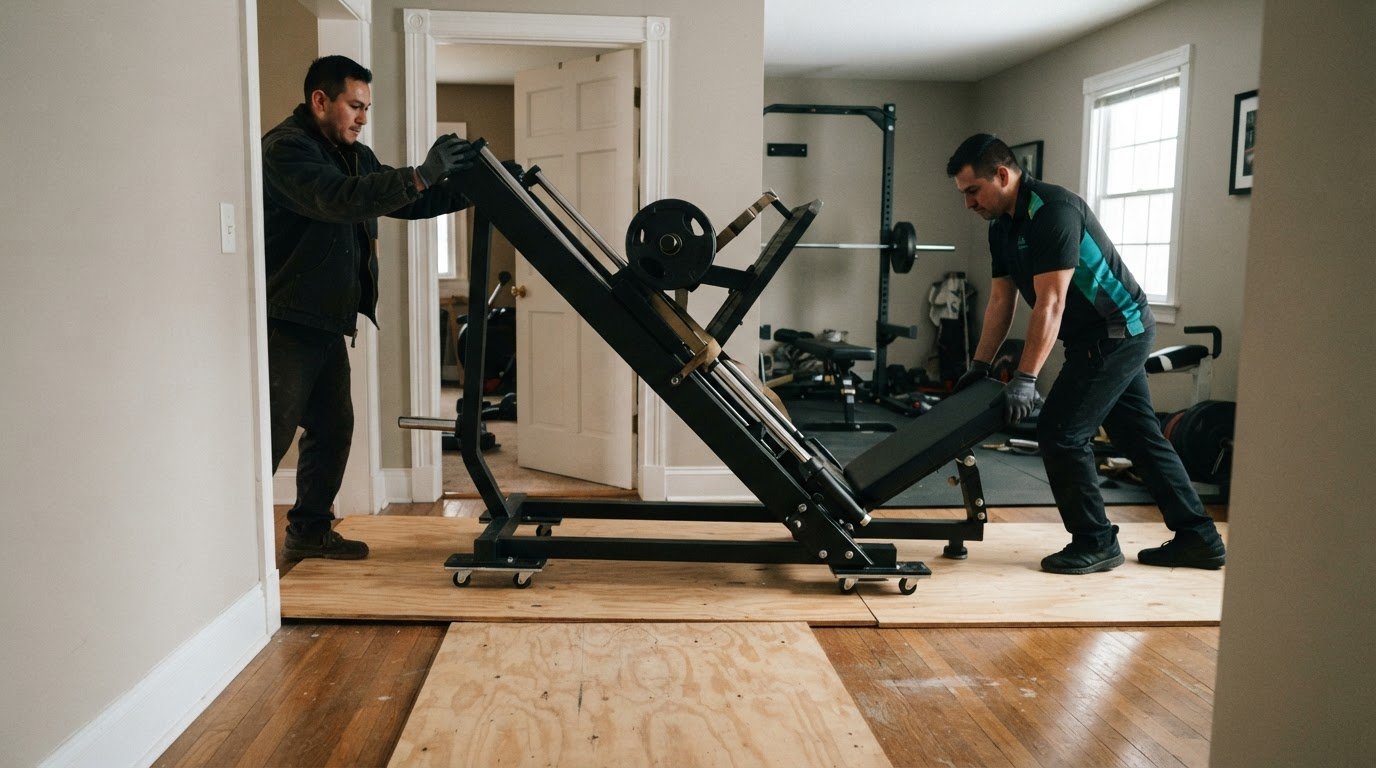
A 1,000 lb leg press shouldn’t be lifted by hand or pushed across a floor on unsuitable sliders. To move a heavy leg press machine in Clifton without damaging floor joists, remove parts that can be safely detached, secure the sled, and use heavy-duty dollies or machinery skates that suit the machine and route. Spread the load across protected surfaces, and don’t improvise when stairs, thresholds, or tight turns are involved.
It’s reasonable to worry about more than the machine itself: floors, doorways, elevator edges, and the structure beneath them all matter. This guide shows you how to check the machine’s dimensions and weight, choose sliders for the floor type, and plan each transition before moving. You’ll also learn what to protect along the route and how to make a careful post-move check before using the leg press again.
Key Takeaways
- Measure the leg press and the full route, including doorways, turns, stairs, and elevator thresholds, before moving day.
- Remove parts that can be safely detached and secure the sled before moving the machine.
- Choose sliders and floor coverings to match each surface, and avoid dragging heavy equipment across tile or hardwood.
- Move a 1,000 lb leg press with suitable heavy-duty dollies or machinery skates, not by hand or on an improvised ramp.
- When stairs, tight turns, or thresholds make the route difficult, Exercise Equipment Moving can help handle the heavy lift.
Protecting floors, thresholds, and elevator surfaces
Plan floor coverings and transitions before moving. A leg press can damage surfaces if its weight shifts or concentrates on a small area.
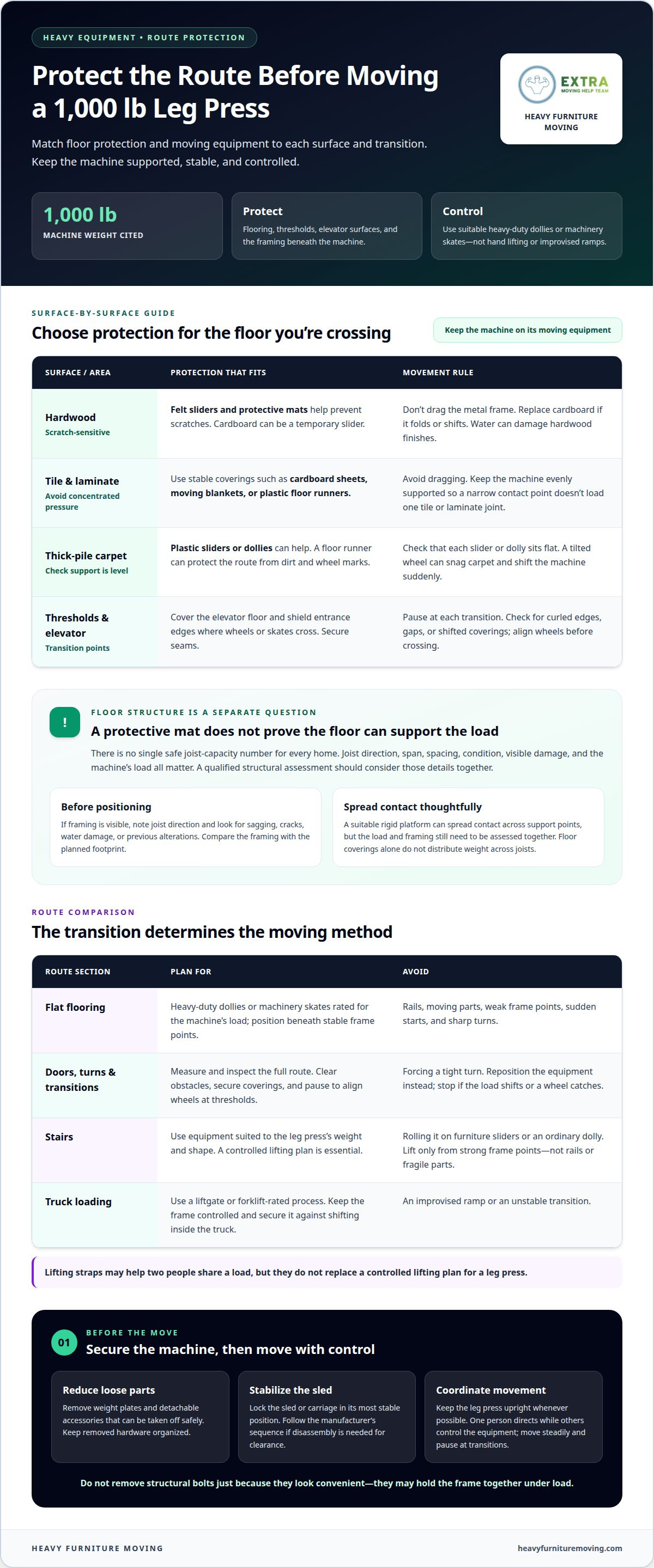
There is no single safe joist-capacity number for every home. Joist direction, span, spacing, condition, visible damage, and the machine’s load all matter. A qualified structural assessment should consider those details together.
To spread the leg press’s load across joists, identify their direction and use a suitable load-spreading platform so the machine’s support points do not concentrate on one joist. Floor coverings or a broad-looking base do not establish the floor’s structural capacity.
-
Assess Residential Floor Joists
Check the floor framing before positioning the machine. If joists are visible from a basement or unfinished area, note their direction and look for sagging, cracks, water damage, or previous alterations. Compare the framing with the equipment’s planned footprint. A surface mat protects flooring, but does not show whether the framing below can support the load.
-
Distribute Machine Weight Across Joists
Plan the final position around the joist direction, not just the room layout. A suitable rigid platform can spread contact across the machine’s support points, but the load and framing still need to be assessed together. Avoid placing the full load over visibly damaged framing, and don’t assume floor coverings distribute weight across joists.
- Cover hardwood before moving. Felt sliders and protective mats help prevent scratches, while water can damage hardwood finishes. Keep the machine on its moving equipment instead of dragging its metal frame. Cardboard can work as a temporary slider on hardwood, but replace it if it folds or shifts under the load.
- Protect tile and laminate with stable coverings such as cardboard sheets, moving blankets, or plastic floor runners. Avoid dragging the machine across tile, where friction and concentrated pressure can cause damage. Keep it evenly supported as it moves; a narrow contact point can put force on a single tile or laminate joint.
- Match carpet protection to the pile. Plastic sliders or dollies can help move equipment across thick-pile carpet, while a floor runner can protect the route from dirt and wheel marks. Check that each slider or dolly sits flat. A tilted wheel can snag carpet and shift the machine suddenly.
- Cover thresholds and elevator surfaces before loading. Lay protective material flat across the elevator floor, then shield the entrance edges where wheels or skates cross. Secure seams and keep them clear of the moving path. At each transition, pause to check for curled edges, gaps, or shifted coverings before continuing.
What is the Proper Procedure for Moving a 1,000 Lb Leg Press Machine?
Move a 1,000 lb leg press with controlled equipment, not by hand. Plan the route first, then secure the machine and use suitable dollies or machinery skates.
-
Select Moving and Lifting Equipment
Choose heavy-duty dollies or machinery skates rated for the machine’s load, and position them beneath stable frame points, not rails or moving parts. Furniture dollies suit flat surfaces, and soft wheels can help protect hardwood. A hand truck is not a substitute unless it supports the machine securely. For stairs, lifting straps can help two people share the load, but they do not replace a controlled lifting plan. In Clifton, building procedures can vary, so plan for property rules on elevator use, loading access, and shared spaces. If the move would occupy public space, determine applicable local permit requirements beforehand.
-
Decide Whether to Disassemble the Machine
Remove weight plates and detachable accessories that can be taken off safely. Lock the sled or carriage in its most stable position before moving. If disassembly is needed for clearance, follow the manufacturer’s sequence and keep the hardware organized. Don’t remove structural bolts just because they look convenient; they may hold the frame together under load.
- Check the route before loading the machine onto dollies. Clear obstacles, secure floor coverings, and inspect every doorway, turn, and transition. A tight turn may require repositioning the equipment instead of forcing it around a corner. Keep the leg press upright whenever possible, and stop if its load shifts or a wheel catches.
- Move across flat flooring with steady, coordinated pressure. Keep the machine balanced on the dollies or skates, and avoid sudden starts, sharp turns, or pulling from a weak frame point. One person should direct the movement while others control the equipment. Pause at thresholds and elevator entrances to align the wheels before crossing.
- Use a liftgate or a forklift-rated process to load the leg press into a truck. Don’t use an improvised ramp; the machine’s weight can make an unstable transition dangerous. Keep the frame controlled as it moves onto the platform, then secure it against shifting inside the truck.
- For stairs, don’t attempt to roll the machine on furniture sliders or an ordinary dolly. Lifting straps can help two people share furniture loads, but a leg press needs equipment suited to its weight and shape. Lift only from strong frame points, never rails, weak corners, or fragile parts. For heavy lifting moving help, use experienced equipment movers for difficult transitions.
Checking the leg press model, weight, and dimensions
Record the machine’s actual setup before planning the move. Its model, attachments, and the route dimensions affect equipment choice, clearances, and where the load will sit.
- Identify the manufacturer and model from the machine’s label or paperwork. Use those details to find its configuration and any manufacturer-provided moving instructions. A 45-degree leg press differs from other designs in footprint, center of gravity, and disassembly points. Don’t plan its movement based on another machine’s shape.
- Record the weight for the machine as it stands, including installed accessories and attachments. Some commercial leg press units approach or exceed 1,000 lb when packaging, attachments, or installed accessories are included. Separate the machine’s listed weight from anything added for its current setup. This gives movers a clearer basis for planning equipment and handling.
- Measure the leg press at its widest, tallest, and longest points. Include protruding handles, rails, and the sled in the measurements. For a 45-degree leg press, account for the angled frame and sliding foot platform. Write down the figures together, so the route can be compared against the machine’s actual dimensions.
- Measure every tight point along the route, not just the room doorway. Check door openings, hallways, staircases, corners, elevator entrances, and thresholds. Compare each opening with the machine’s width and height in its planned orientation. A hallway turn may need more clearance than a straight doorway because the frame must pivot.
- Sketch the movement from the machine’s current position to its destination. Mark where the route narrows, changes level, or requires a turn. Note whether the machine can stay upright throughout. For a 45-degree model, the angled rails and center of gravity can affect how it pivots, so don’t assume it will fit by rotating it casually.
- Use your measurements to decide whether the full machine can pass safely or needs manufacturer-directed disassembly. Compare dimensions before choosing machinery skates or dollies, and account for how they change the machine’s height. Don’t remove structural bolts for extra clearance. If disassembly is needed, follow the manufacturer’s sequence and organize removed hardware by part.
- Share the model, weight, dimensions, attachment details, and a route sketch with the people handling the move. Include obstacles such as a narrow staircase or elevator threshold. These details help movers plan equipment and positioning before work starts, rather than discovering a clearance problem while maneuvering the leg press.
Furniture sliders and surface compatibility
Match each slider to the surface and choose moving equipment suited to the leg press’s load. A slider protects a floor only when it stays flat, secure, and correctly positioned.
- Identify every flooring type along the route before selecting sliders. Felt sliders suit hardwood and tile; plastic or rubber sliders are suitable for carpet. A route from hardwood to carpet may require changing equipment at the transition. Don’t assume one slider material will move safely across every surface.
- Use machinery skates or heavy-duty dollies for the leg press itself. Furniture sliders may help move furniture, but they are not a substitute for equipment designed for heavy machinery. Check that the machine stays stable on its supports, and stop if a slider shifts, tilts, or catches.
- Place each suitable slider beneath a stable leg or corner, with the contact points aligned. A slider that sits partly outside the frame can slip when the load moves. Check every corner after positioning the machine, then make a small, controlled push to see whether the supports stay in place.
- For hardwood or tile, use felt contact surfaces to reduce scratching. Slipstick CB131 furniture sliders are identified as 89 mm in size, so compare the slider’s dimensions with the machine’s support points before use. Don’t assume a listed size alone makes a slider suitable for a leg press’s weight or shape.
- On carpet, use plastic or rubber sliders where appropriate, or move the machine on suitable dollies. Thick-pile carpet can resist movement and cause supports to catch. Keep the machine upright and aligned. If a slider stops, don’t jerk it forward or strain to force it.
- Push gently and keep the movement straight whenever the route allows. Sudden jerks and sharp turns can dislodge sliders or twist the machine’s supports. At a turn, pause, check each contact point, and reposition the equipment before moving again. Felt pads on furniture legs can help prevent scratches if furniture is accidentally dragged.
- Use cardboard beneath heavy furniture only as a makeshift slider on hardwood or tile, not as a replacement for machinery-moving equipment. Cardboard can fold, tear, or shift under pressure. If it buckles or slips out of position, stop and restore stable support before continuing.
Lifting instead of dragging
Dragging a leg press can scrape flooring, catch at thresholds, or shift its load. To plan how to move a heavy leg press machine without damaging floor joists in Clifton, lift only enough to position suitable moving equipment, then keep the machine supported throughout the move.
- Clear the route before lifting the machine. Remove loose items, open doors, and check each turn and threshold. A clear path gives movers room to control the frame without twisting it toward a wall or catching a support on an edge.
- Remove weight plates and detachable accessories that can be taken off safely. Secure the sled in its most stable position. A lighter, stable machine is easier to control, but don’t remove structural bolts or lift from the sled, rails, or other moving parts.
- Use suitable lifting equipment to raise the frame only enough to position machinery skates or heavy-duty dollies. Don’t try to lift a 1,000 lb leg press by hand. Place equipment beneath stable frame points, then lower the machine onto it with controlled movement.
- Keep the frame upright whenever possible and balanced over its supports. If it shifts during positioning, stop and reset the equipment before moving. Don’t reach beneath a raised frame or put your hands near pinch points while lowering the machine onto skates.
- For stairs, ramps, elevator thresholds, or loading transitions, don’t drag the machine or rely on ordinary furniture sliders. Changes in level can shift its weight suddenly. Lifting straps can help two people share furniture loads, but a heavy leg press needs equipment and handling suited to its size.
- Lift from strong frame points, not weak corners or fragile parts. Keep each person’s role clear: one directs the movement while others control the load. Move in small, coordinated increments, and pause if the frame tilts, equipment slips, or a wheel catches the ground.
- At the destination, lower the machine onto stable supports before removing the skates or dollies. Keep fingers clear as the frame meets the floor, then check that it sits without rocking. If you’re still deciding how to move a heavy leg press machine without damaging floor joists in Clifton, get heavy lifting moving help from experienced movers.
Heavy Furniture Moving
Heavy Furniture Moving can help move a leg press when its weight, floor route, or tight transitions make handling difficult. Its Exercise Equipment Moving service is designed for heavy gym equipment, and local moving help can support broader in-home moving needs.
Share the machine’s model, approximate weight, dimensions, and route details when discussing the move. Include stairs, elevator thresholds, narrow turns, and any concerns about floor joists. These details help clarify the handling involved and the planning the route requires.
If moving the leg press yourself feels beyond your equipment or experience, contact Heavy Furniture Moving to discuss the move.
Plan the move with confidence
The next step is to turn your measurements and route plan into a clear moving plan. If you’re still deciding how to move a heavy leg press machine without damaging floor joists in Clifton, keep the machine’s setup, support points, and route details together. This gives the moving team a practical picture of the job before equipment is positioned. If the floor framing raises concerns, arrange a qualified assessment before placing the machine in its final position.
Heavy Furniture Moving can help take on the physical work when the machine or route makes a self-managed move difficult. Share the relevant details and decide on a plan that suits the equipment and home.
Discuss your leg press move with Heavy Furniture Moving, and take the next step with a clear plan.
Frequently Asked Questions
How much does a heavy leg press machine weigh?
Leg press weight varies by model and installed configuration; some commercial units approach or exceed 1,000 lb when packaging, attachments, or installed accessories are included. Check the manufacturer’s label or documentation for the machine’s own weight, separate from removable plates. Describe the actual setup when planning the move, since added accessories affect the total load and handling requirements.
How to measure leg press machine weight and dimensions before moving it?
Use the machine’s label or manual for its listed weight, and note attached accessories or plates separately. Measure its widest, tallest, and longest points in its moving configuration. Record these with the model name, then check the narrowest doorway, stair turn, or elevator opening along the route. A simple sketch can show where the frame must pivot or change orientation.
How to move a heavy leg press machine safely through a home?
Move the machine with suitable machinery skates or heavy-duty dollies, not by carrying it by hand. Before starting, clear doors and walkways, secure the sled, and remove plates or accessories that detach safely. Assign one person to direct the movement and keep turns controlled. Stop if a wheel catches, the frame shifts, or a doorway blocks the planned path. Don’t force the machine through a tight opening.
How to protect floors and floor joists when moving heavy gym equipment?
Protect the floor surface with stable coverings, but treat joist capacity as a separate structural question. Floor protection can reduce scratches or impact at a threshold; it does not establish how much weight the framing can support. Joist direction, span, spacing, condition, and the machine’s contact points all matter. If framing is damaged or floor capacity is uncertain, get a qualified structural assessment before positioning the equipment.
What floor protection boards or moving equipment work best for heavy machines?
Use rigid coverings such as cardboard sheets, moving blankets, or plastic runners to shield surfaces along the route. Machinery skates or heavy-duty dollies support and move the machine; ordinary furniture sliders are not a substitute for equipment suited to its load. Keep coverings flat, especially at seams and transitions, so wheels don’t catch and shift the load. Match slider material to the flooring.
When should you hire professional movers or a structural engineer for a leg press machine?
Bring in experienced movers when the route includes stairs, tight turns, elevator thresholds, ramps, or difficult loading transitions. A structural engineer is the right fit for questions about joist capacity, visible framing damage, or where to place the machine. Movers handle transport; a structural assessment addresses the building. Don’t treat equipment-moving experience as a substitute for assessing uncertain floor framing.
What are local heavy-equipment movers and floor-protection services in Clifton?
Heavy Furniture Moving provides Exercise Equipment Moving in Clifton, as well as Fairfax, Woodbridge, Manassas, Manassas Park, Aldie, Ashburn, McLean, Vienna, Reston, Centreville, Chantilly, Dumfries, South Riding, Fairfax Station, Haymarket, and Gainesville. Floor and corner protection, including masonite, runners, and door-jamb covers, is included on every job, along with wrap, blankets, and straps. The crew measures item dimensions and access points before lifting, helping plan the move around the home’s route.
Frequently Asked Questions
Leg press weight varies by model and installed configuration; some commercial units approach or exceed 1,000 lb when packaging, attachments, or installed accessories are included. Check the manufacturer’s label or documentation for the machine’s own weight, separate from removable plates. Describe the actual setup when planning the move, since added accessories affect the total load and handling requirements.
Use the machine’s label or manual for its listed weight, and note attached accessories or plates separately. Measure its widest, tallest, and longest points in its moving configuration. Record these with the model name, then check the narrowest doorway, stair turn, or elevator opening along the route. A simple sketch can show where the frame must pivot or change orientation.
Move the machine with suitable machinery skates or heavy-duty dollies, not by carrying it by hand. Before starting, clear doors and walkways, secure the sled, and remove plates or accessories that detach safely. Assign one person to direct the movement and keep turns controlled. Stop if a wheel catches, the frame shifts, or a doorway blocks the planned path. Don’t force the machine through a tight opening.
Protect the floor surface with stable coverings, but treat joist capacity as a separate structural question. Floor protection can reduce scratches or impact at a threshold; it does not establish how much weight the framing can support. Joist direction, span, spacing, condition, and the machine’s contact points all matter. If framing is damaged or floor capacity is uncertain, get a qualified structural assessment before positioning the equipment.
Use rigid coverings such as cardboard sheets, moving blankets, or plastic runners to shield surfaces along the route. Machinery skates or heavy-duty dollies support and move the machine; ordinary furniture sliders are not a substitute for equipment suited to its load. Keep coverings flat, especially at seams and transitions, so wheels don’t catch and shift the load. Match slider material to the flooring.
Bring in experienced movers when the route includes stairs, tight turns, elevator thresholds, ramps, or difficult loading transitions. A structural engineer is the right fit for questions about joist capacity, visible framing damage, or where to place the machine. Movers handle transport; a structural assessment addresses the building. Don’t treat equipment-moving experience as a substitute for assessing uncertain floor framing.
Heavy Furniture Moving provides Exercise Equipment Moving in Clifton, as well as Fairfax, Woodbridge, Manassas, Manassas Park, Aldie, Ashburn, McLean, Vienna, Reston, Centreville, Chantilly, Dumfries, South Riding, Fairfax Station, Haymarket, and Gainesville. Floor and corner protection, including masonite, runners, and door-jamb covers, is included on every job, along with wrap, blankets, and straps. The crew measures item dimensions and access points before lifting, helping plan the move around the home’s route.