How to Move a Heavy Filing Cabinet Down Split-Level Stairs in Aldie
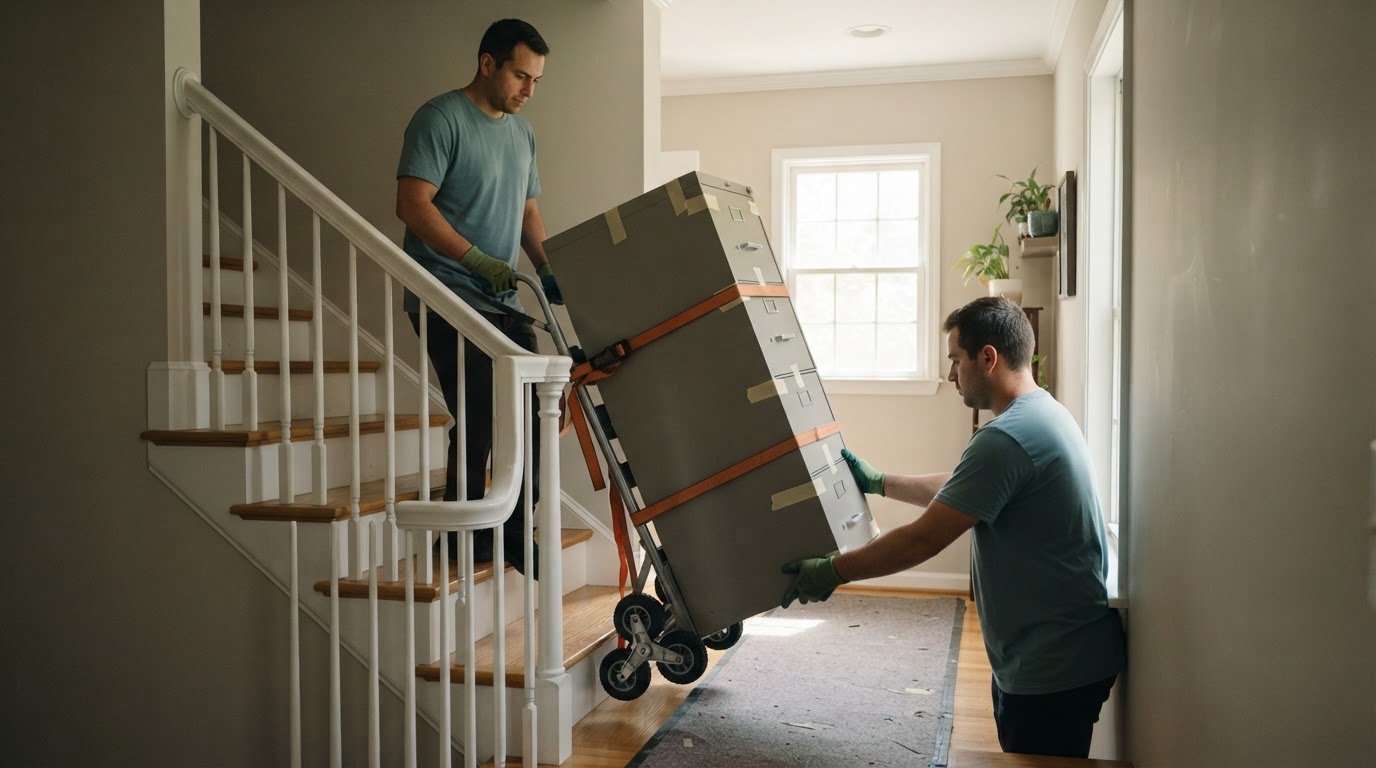
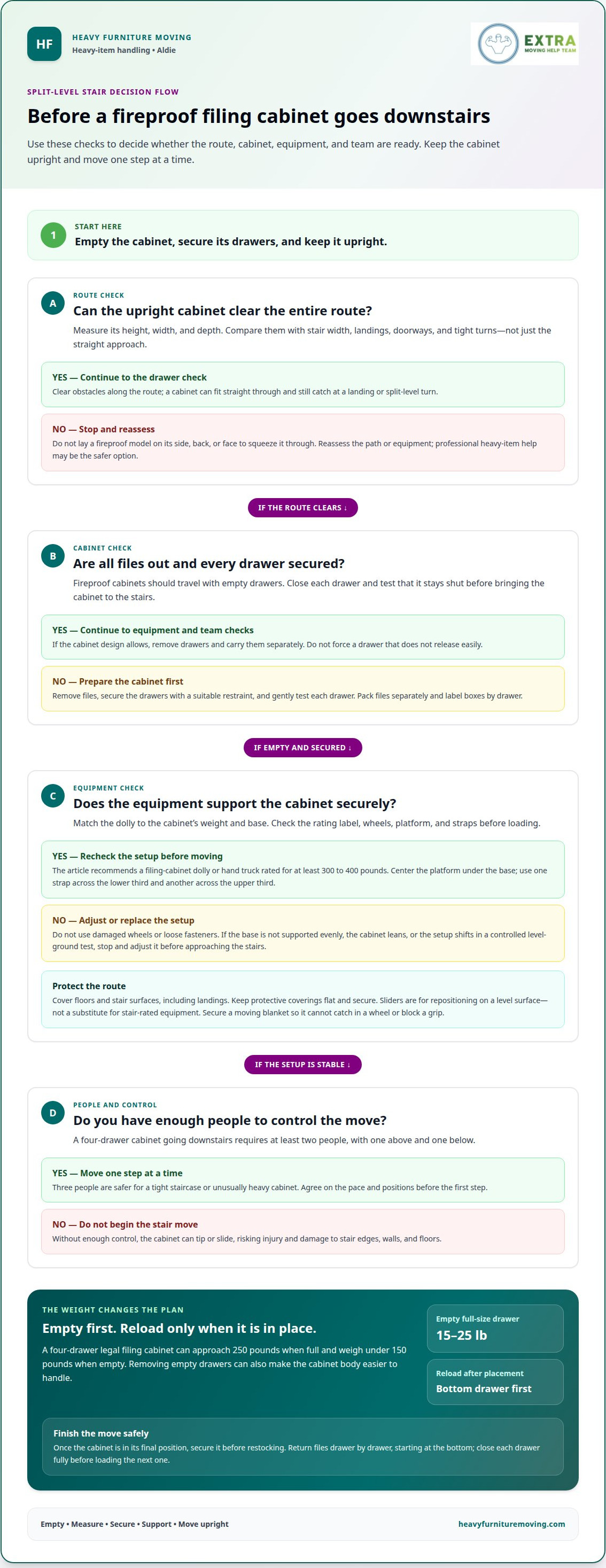
The safest way to move a heavy fireproof filing cabinet down split-level stairs in Aldie is to empty it first, secure the drawers, and keep the cabinet upright. Use at least two people, with one above and one below, and move it down one step at a time. For a four-drawer cabinet, removing the empty drawers and moving them separately can make the cabinet body easier to handle.
Moving a loaded cabinet may seem quicker, but its contents add weight and can shift on stairs. Empty the drawers, secure them, and check the cabinet’s dimensions against the full route before choosing equipment. A split-level staircase with tight turns can make professional heavy-item help the safer option.
Key Takeaways
- Measure the cabinet’s base and stair turns before choosing a moving path or equipment.
- Match the dolly to the cabinet’s weight and base, and protect floors and edges along the route.
- Choose a dependable way to keep drawers from sliding open, then test that they stay secured before moving.
- Account for both the cabinet’s empty weight and the added load of files when planning the move.
- Use the stair layout and cabinet weight to decide whether the move is manageable with your available help and gear.
Do I have to empty a filing cabinet before moving it?
Yes. Empty a fireproof cabinet before taking it downstairs, secure its drawers, and keep it upright. Requirements for permits, insurance, or building access may depend on the property and the move in Aldie or Loudoun County, so don’t assume one rule applies to every situation.
- Remove files and contents first. A four-drawer legal filing cabinet can approach 250 pounds when full and weigh under 150 pounds when empty. Fireproof cabinets should travel with empty drawers; pack files separately in manageable boxes. This reduces shifting weight and protects records from spilling during stair turns. Label each box by drawer so files can be returned to the right place.
- Take out drawers when the cabinet design allows. For a four-drawer vertical cabinet going downstairs, moving the drawers separately and carrying the cabinet body on its own is the safer approach. Even an empty full-size drawer can weigh 15 to 25 pounds, so lift it carefully and keep its path clear. Don’t force a drawer that does not release easily.
- Secure moving parts and check the route. Close each drawer and use a suitable restraint to prevent it sliding open. Measure the cabinet’s height, width, and depth, then compare them with stair width, landings, doorways, and tight turns. Clear obstacles before lifting. A cabinet that fits straight through may still catch at a landing or split-level turn.
- Keep the cabinet upright. Filing cabinets should travel upright, not on their side, back, or face. Don’t lay a fireproof model down to squeeze it through a tight spot. A tilt can shift the load and make control harder on stairs. If the upright cabinet cannot clear the route, stop and reassess the path or equipment before moving.
- Set the team and pace before the first step. Moving a four-drawer cabinet downstairs requires at least two people, with one above and one below, and three are safer for a tight staircase or unusually heavy cabinet. Move one step at a time. Without enough control, the cabinet can tip or slide, causing injury or damage to stair edges, walls, and floors.
- Reload only after the cabinet is in place. Return files drawer by drawer, starting with the bottom drawer. This keeps the heavier contents low rather than loading the upper drawers first. Keep each drawer’s contents organized, and close it fully before adding files to the next one. Secure the cabinet in its final position before restocking.
Dollies, straps, sliders, and floor protection
Choose equipment that supports the cabinet and fits its base. Clear and measure the route, then protect the floors and stair surfaces before moving.
- Match the dolly’s capacity to the load. Choose a filing-cabinet dolly or hand truck rated for at least 300 to 400 pounds. Check the rating label, wheels, platform, and straps before loading. The dolly must support the cabinet without rocking, and its platform should sit securely beneath the base. Don’t use equipment with damaged wheels or loose fasteners.
-
Prepare the Dolly and Straps
Position the dolly beside the cabinet and inspect its contact points before lifting. Use straps to hold the cabinet firmly against the hand truck, with one strap across the lower third and another across the upper third. Tighten them enough to prevent shifting, but keep buckles away from corners that could dent the cabinet. Moving straps can also help two people carry a load that might otherwise take four.
- Set the cabinet onto the platform. Center the dolly beneath the cabinet’s base so no edge hangs over. Check that the base sits flat and the cabinet does not lean. A poor fit can shift the balance, particularly at a turn or change in level. Reposition the platform before moving if it does not support the cabinet evenly.
-
Apply Sliders and Floor Protection
Protect the walking route before moving the cabinet, including exposed flooring near the stairs and landings. Use sliders only on a level surface to reposition the cabinet across a room; they are not a substitute for stair-rated equipment. Keep protective coverings flat and secure so they do not bunch beneath wheels or create a trip hazard.
- Wrap vulnerable surfaces. Cover the cabinet with a moving blanket before shifting it. Secure the blanket so it cannot catch in a wheel, cover a strap buckle, or block a secure grip. Protect corners and edges near walls, doorframes, and stair railings. Blankets cushion contact with surfaces, while floor protection safeguards the route.
- Recheck the setup before moving. Confirm both straps are snug, the cabinet is stable on the dolly, and wheels turn freely. Remove loose sliders from the route and flatten any raised floor covering. If the equipment shifts during a controlled test on level ground, stop and adjust it before reaching the stairs. For hands-on help with a heavy cabinet move, get support for heavy lifting.
Securing drawers with tape or a locking bar
Choose a restraint that keeps the drawers shut without blocking a secure grip or damaging the cabinet’s finish. Check that it holds before bringing the cabinet to the stairs.
- Inspect the drawer fronts and lock. Close each drawer fully, then look for a built-in lock, locking bar, or other designed restraint. A cabinet key may activate its central lock, but don’t assume that locking one drawer secures every drawer. Test each front gently by pulling its handle. If any drawer opens, secure it separately before moving.
- Use a locking bar when the cabinet has one. Fit the bar into its guides and engage the latch as designed. Check that it sits flush and holds all drawers closed. Don’t rely on a loose bar: its ends must be properly seated, and the drawers should stay shut during a gentle test.
- Apply tape carefully if no bar is available. Run tape across the drawer front and onto the cabinet frame, keeping it clear of handles, keyholes, and handholds. Use only enough to restrain the drawer. Test the tape on an inconspicuous area first, since adhesive may leave residue or affect some finishes. Keep drawer identification labels visible.
- Secure each drawer separately. On a four-drawer cabinet, check every drawer rather than taping only the upper front. An unsecured drawer can slide out when the cabinet tilts or changes direction. Make sure tape or a locking bar does not interfere with another drawer, and keep restraints clear of corners that could catch on walls or doorframes.
- Recheck the restraints after positioning the cabinet. Moving the cabinet onto a dolly can loosen tape or shift a locking bar. Before starting along the route, gently pull each handle to confirm the drawer stays shut. Reset any loose restraint while the cabinet is stationary. Never try to push a slipping drawer closed while carrying the cabinet.
- Remove restraints only after the cabinet is stable. At the destination, set the cabinet upright on a level surface before removing tape or disengaging the bar. Open drawers one at a time, keeping hands clear of their path. Peel adhesive slowly and stop if it pulls at the finish. This prevents a drawer from opening unexpectedly while the cabinet is still being positioned.
Choosing dolly casters based on cabinet base and route
Match the moving equipment to the cabinet’s base, then plan how to manage every turn. A split-level route requires controlled movement, not just equipment that rolls smoothly across a flat floor.
- Measure the cabinet base before selecting a platform. Record its width and depth, then compare those measurements with the dolly’s support surface. Filing cabinets are typically 15 to 20 inches deep, so check whether the platform can support the base without leaving an edge unsupported. A narrow platform can make the load unstable, especially when it changes direction.
- Check how the base meets the dolly. Look for feet, a recessed bottom, or a flat frame that might affect contact. Position the cabinet so its weight rests evenly on the platform, rather than balancing on one corner or a narrow edge. For example, if cabinet feet sit outside the dolly’s support area, reposition the setup before moving.
- Choose wheels for the full route, not just the hallway. Roll the empty dolly over the route first. Notice whether its wheels track cleanly across flooring, approach a landing, and turn within the available space. A caster arrangement that works in a straight hallway may be awkward at a split-level turn. Don’t assume a wheeled platform is designed to travel down stairs.
- Use a hand truck for stair movement. A dolly may help position the cabinet on a level floor, but the stair portion calls for equipment that can be controlled step by step. Move a hand truck one step at a time, keeping the cabinet upright and supported. Don’t roll a standard flat dolly over stair edges or use momentum to cross a landing.
- Match the equipment rating to the cabinet’s actual load. A filing-cabinet dolly or hand truck should be rated for at least 300 to 400 lbs. Include the cabinet and anything still inside when judging the load. A rating that falls short can leave the frame or wheels carrying more than their intended capacity. Check the label before placing the cabinet on the equipment.
- Test alignment and movement while the cabinet is still level. Secure the cabinet to the dolly, then make a small controlled movement on a clear, flat area. Watch whether the casters swivel freely, the platform shifts, or the base leans. Stop if the dolly catches or veers. Reposition the load before approaching the first stair, where correcting a poor fit becomes harder.
Filing-cabinet weight and load
Account for the cabinet’s empty weight as well as its contents. The total load affects equipment selection, handling, and whether the stair route can be navigated safely.
-
Check the Cabinet Weight
Identify the cabinet type and estimate its empty weight before choosing equipment. A standard four-drawer steel filing cabinet can weigh 120 to 180 pounds empty. A loaded legal-size cabinet can reach 200 to 300 pounds, while fully loaded four- or five-drawer legal cabinets commonly exceed 300 to 400 pounds. Don’t treat cabinet size alone as a reliable weight guide.
-
Assess the Cabinet Load
Account for the contents in every drawer, not just the cabinet shell. A single packed drawer can weigh 40 to 60 pounds, and a loaded full-size two-drawer lateral cabinet can exceed 200 pounds. Remove files before moving downstairs, then plan around the cabinet’s remaining load.
- Use the cabinet style as a starting point. A four-drawer steel model and a two-drawer lateral cabinet distribute weight differently. A lateral cabinet’s wide body may be difficult to maneuver through a narrow turn, even if its weight seems manageable. Assess its dimensions, base, and route together rather than relying on a weight estimate alone.
- Match the total load to the equipment rating. Add the cabinet body and remaining contents before comparing the load with the dolly or hand truck rating. For example, a 120-pound empty cabinet with two packed drawers carries more than its empty weight. Keep the load within the equipment’s stated capacity, and don’t use a rating that falls below the estimated total.
- Decide whether the move is suitable for DIY handling. Two people may be able to move a small cabinet across a flat floor, but that does not mean it is safe to take downstairs. On stairs, control, clearance, and the cabinet’s load all matter. A heavy cabinet, loaded drawers, or tight split-level turn calls for suitable equipment and experienced help.
- Plan around weight, not guesswork. If the cabinet’s contents or construction make its load difficult to estimate, remove the files and use the lighter empty-cabinet figure as a starting point. Don’t test the load by lifting it on the stairs. For help handling a demanding cabinet move, request heavy lifting support.
Heavy Furniture Moving
Heavy Furniture Moving helps with residential moves involving heavy and bulky items, including in-home furniture handling. If a fireproof cabinet’s weight, base, or split-level route makes a DIY move difficult, a professional moving crew can handle the lift and navigate the route.
Turn to a moving team when the cabinet needs careful handling through tight turns, or when you don’t have suitable equipment and enough help. Share the cabinet type, whether it’s empty, and the stair layout so the move can be considered in context. For a heavy cabinet move in Aldie, contact Heavy Furniture Moving.
Make the Next Move With Confidence
Planning how to move a heavy fireproof filing cabinet down split-level stairs in Aldie means deciding whether the route is safe to manage. If the cabinet’s size, weight, or tight turns concern you, don’t take the lift on alone. Start by describing the cabinet and stair layout, then choose the appropriate help.
Heavy Furniture Moving offers residential moving support, including Movers Near Me, Exercise Equipment Moving, and Sofa Hoisting. Its heavy-item moving services are suited to bulky household goods and challenging moves. For a filing cabinet that needs careful handling through a split-level home, contact Heavy Furniture Moving to discuss the cabinet and route.
Contact Heavy Furniture Moving for help and take the next step with a team focused on heavy-item moves. Your cabinet move can feel more manageable with the right support in place.
Frequently Asked Questions
Can You Move a Full Filing Cabinet?
A full filing cabinet can be moved, but taking it downstairs while loaded adds weight and the risk of shifting contents. Empty it first, especially if it is fireproof or has several drawers. If you cannot empty it, do not attempt the stair move alone or with improvised equipment. The load, cabinet shape, and turning space all affect how it can be moved.
How do I move a fireproof file cabinet by myself?
Don’t move a heavy fireproof cabinet downstairs by yourself. If you’re deciding how to move a heavy fireproof filing cabinet down split-level stairs in Aldie, plan for experienced help to control it throughout the descent. Don’t try to compensate with a rope, shoulder carry, or household cart. Leave the cabinet in place until suitable equipment and help are ready.
How to measure a fireproof filing cabinet and split-level stairway before moving?
Measure the cabinet’s height, width, and depth, including handles or other parts that extend beyond the body. Then measure the narrowest stair opening, landing, doorway, and turn on the route. Compare the cabinet’s full dimensions with each clearance, not just the stair width. It may fit through a doorway but fail to rotate at a landing, so map the entire path.
What equipment is needed to move a heavy cabinet down stairs?
Use a hand truck rated for the load, secure the cabinet with straps, and protect exposed surfaces with a moving blanket. A filing-cabinet hand truck should be rated for at least 300 to 400 lbs. Sliders can help reposition the cabinet on level flooring, but they aren’t stair equipment. Plan for a team that can control the load throughout the descent.
How to protect stair treads, walls, and flooring when moving a heavy cabinet?
Clear the route, then protect vulnerable flooring and stair treads with secure, flat coverings. Avoid loose edges that could bunch beneath wheels or cause a slip. Pad cabinet corners and likely contact points near walls, railings, and doorframes. Keep blankets clear of the movers’ grip and sightlines, and have someone watch clearances at each turn.
How much do local movers charge to move a heavy filing cabinet down stairs in Aldie, Virginia?
The cost depends on the cabinet’s weight and dimensions, the stair layout, access, and equipment needed. A move from a ground-floor room differs from one involving split-level turns or tight landings. Heavy Furniture Moving provides quotes before work begins. Share the cabinet details and route information to get a quote tailored to the move; no general price applies to every home.
Which moving companies near Aldie, Virginia, handle heavy safes or fireproof filing cabinets?
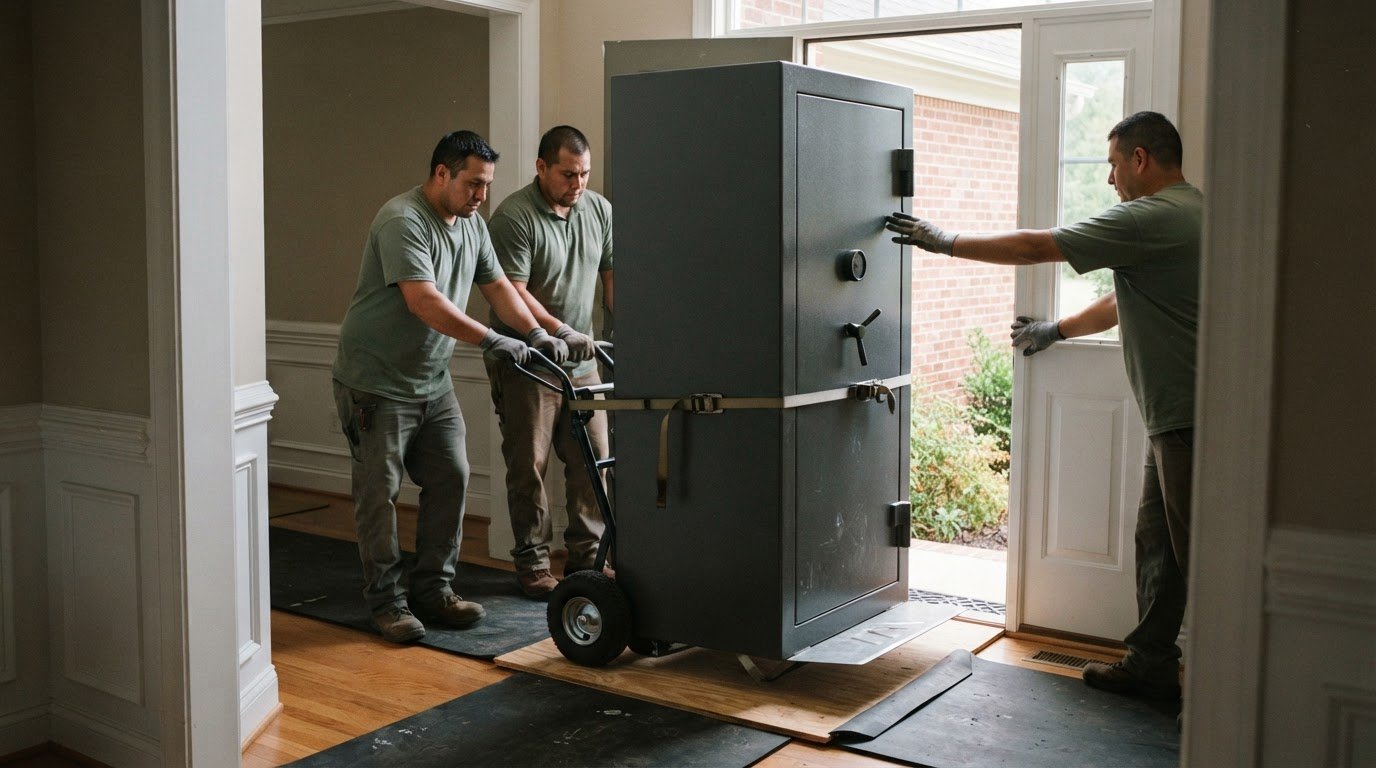
Heavy Furniture Moving serves Aldie with residential moving help for heavy and bulky household items, including safes. To plan how to move a heavy fireproof filing cabinet down split-level stairs in Aldie, describe the cabinet and the route when you contact the company. That information helps the crew plan for the item and access. Heavy Furniture Moving also supports local household moves involving challenging items.
Frequently Asked Questions
A full filing cabinet can be moved, but taking it downstairs while loaded adds weight and the risk of shifting contents. Empty it first, especially if it is fireproof or has several drawers. If you cannot empty it, do not attempt the stair move alone or with improvised equipment. The load, cabinet shape, and turning space all affect how it can be moved.
Don’t move a heavy fireproof cabinet downstairs by yourself. If you’re deciding how to move a heavy fireproof filing cabinet down split-level stairs in Aldie, plan for experienced help to control it throughout the descent. Don’t try to compensate with a rope, shoulder carry, or household cart. Leave the cabinet in place until suitable equipment and help are ready.
Measure the cabinet’s height, width, and depth, including handles or other parts that extend beyond the body. Then measure the narrowest stair opening, landing, doorway, and turn on the route. Compare the cabinet’s full dimensions with each clearance, not just the stair width. It may fit through a doorway but fail to rotate at a landing, so map the entire path.
Use a hand truck rated for the load, secure the cabinet with straps, and protect exposed surfaces with a moving blanket. A filing-cabinet hand truck should be rated for at least 300 to 400 lbs. Sliders can help reposition the cabinet on level flooring, but they aren’t stair equipment. Plan for a team that can control the load throughout the descent.
Clear the route, then protect vulnerable flooring and stair treads with secure, flat coverings. Avoid loose edges that could bunch beneath wheels or cause a slip. Pad cabinet corners and likely contact points near walls, railings, and doorframes. Keep blankets clear of the movers’ grip and sightlines, and have someone watch clearances at each turn.
The cost depends on the cabinet’s weight and dimensions, the stair layout, access, and equipment needed. A move from a ground-floor room differs from one involving split-level turns or tight landings. Heavy Furniture Moving provides quotes before work begins. Share the cabinet details and route information to get a quote tailored to the move; no general price applies to every home.
Heavy Furniture Moving serves Aldie with residential moving help for heavy and bulky household items, including safes. To plan how to move a heavy fireproof filing cabinet down split-level stairs in Aldie, describe the cabinet and the route when you contact the company. That information helps the crew plan for the item and access. Heavy Furniture Moving also supports local household moves involving challenging items.