How to Move a Heavy Farm Table Without Loosening Its Legs
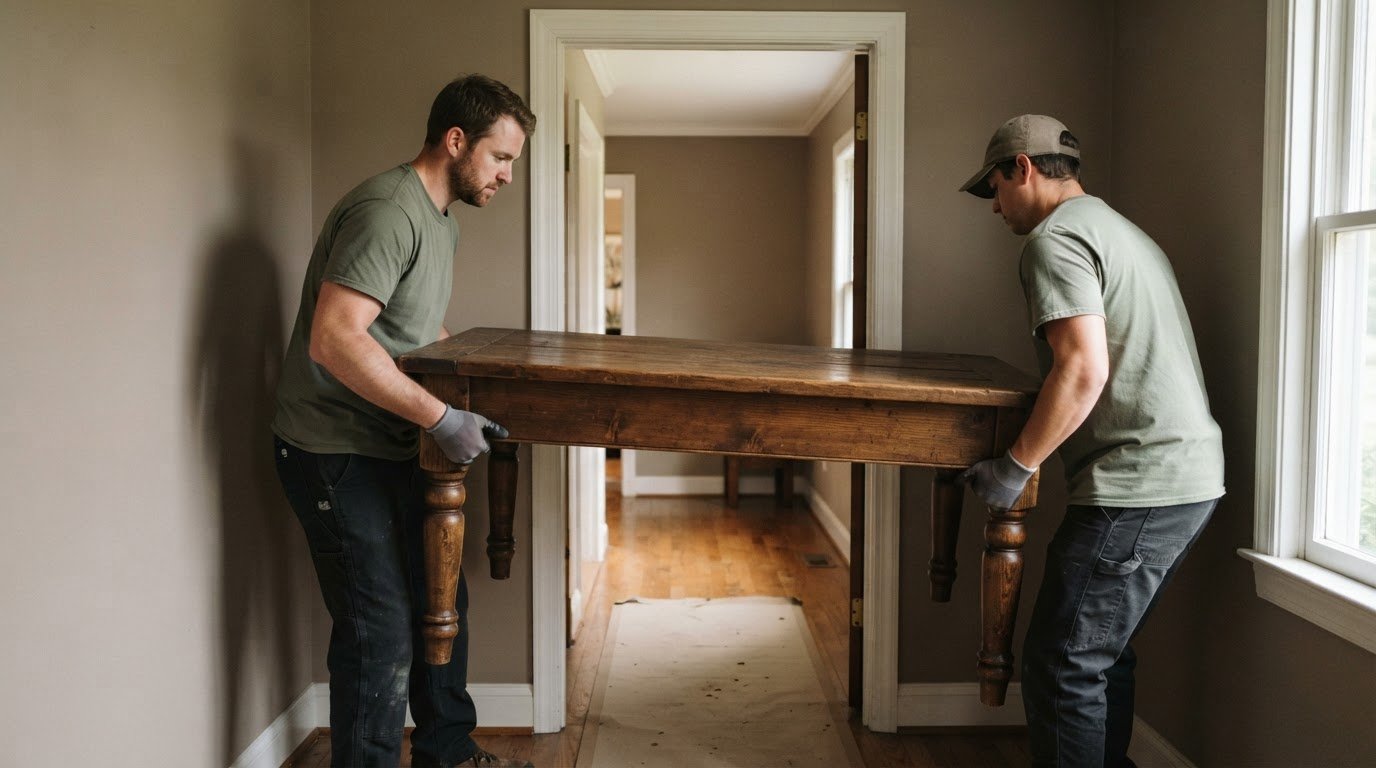
The table legs aren’t handles. If you’re figuring out how to move a heavy rustic wood farm table without loosening its legs in Dumfries, use furniture sliders for a short move across level flooring or a four-wheel dolly for a wide, heavy table. When lifting, have two people hold the base, not the legs or tabletop.
A solid wood table can be awkward to control, especially near doorways and tight corners. Check the route first, protect the table and floors, and agree on simple commands before lifting.
This guide explains what to place under the table, how to lift from its base without stressing the leg joints, and how helpers can guide it through narrow spaces. You’ll get clear steps for keeping the table balanced and avoiding a rushed turn or a damaging drag.
Key Takeaways
- Choose sliders or a dolly to suit the floor and table, and keep the supports centered beneath its feet.
- Protect finished wood with a soft barrier, and avoid putting tape directly on the tabletop.
- Measure the table and route before moving; if a turn is too tight, pause and change the angle instead of forcing it.
- Clear and sweep the path, then agree on simple movement commands so helpers can act together.
- Table weight varies with the wood and construction, so assess the specific piece before deciding how to move it.
Lifting the table by its base rather than its legs
Support the table’s base, protect the wood, and use sliders only for short moves across level flooring. Apartment arrangements vary in Dumfries and Prince William County, so ask property management about elevator reservations, loading hours, and floor or wall protection.
-
Grip the Table Base
Clear the tabletop, then inspect the legs, joints, and underside before lifting. Have two people grip the sturdy base or apron, not the legs or tabletop edges, since uneven pressure can loosen the joints. If the legs are firmly attached or glued, don’t force them off. Wrap the legs and cover the base with a thick moving blanket.
- Keep plastic away from finished wood. Place a clean, soft barrier between the table and its blanket, then secure the blanket around the underside without taping directly to the wood. If plastic wrap holds the blanket in place, keep it over the blanket, not against a delicate surface. A dry table helps prevent moisture from getting trapped beneath its covering.
-
Assess the Table’s Weight
Estimate the load from the table’s wood and construction before choosing how to move it. Solid hardwood dining tables commonly weigh 150 to 300 pounds. Rustic pine farmhouse tables are listed at 150-220 lbs, while reclaimed wood trestle tables are listed at 250-350 lbs. Solid oak extension tables are listed at 200-280 lbs.
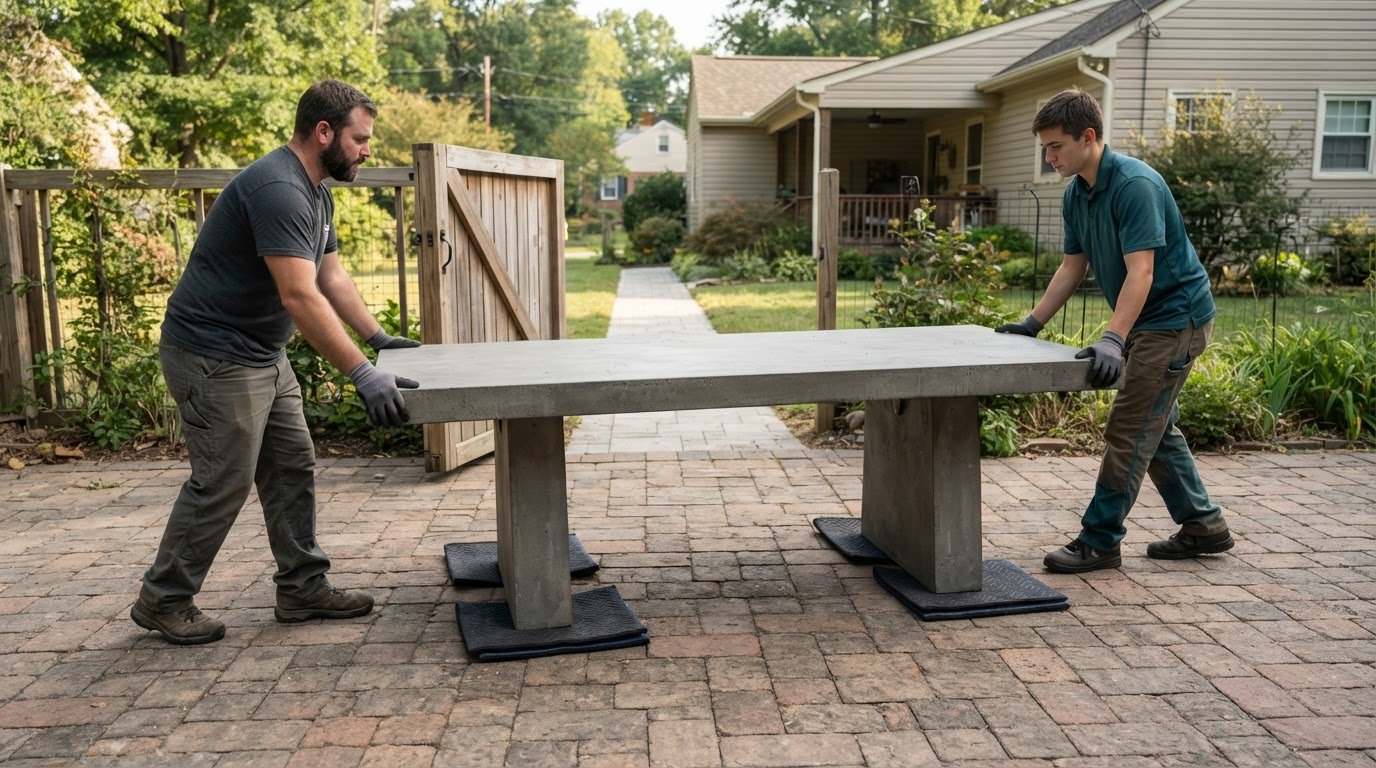
- Choose support based on the table’s weight and shape. Furniture sliders can work for short, level repositioning. Felt-backed sliders generally suit smooth hard floors, while hard-plastic sliders are designed for carpet. Center each foot securely on a slider and keep it centered as the table moves. For a wide, heavy table, a four-wheel dolly can provide a stable rolling base.
-
Avoid Incorrect Lifting Risks
Lift from the base and move in unison. Lifting by a leg or edge can overload the joints, loosening a leg or damaging the table. An uneven lift can also shift the load and make the table harder to control. According to OSHA, loads heavier than 50 pounds increase injury risk even under ideal lifting conditions.
- Bend your knees, keep the table close, and agree on “lift,” “stop,” “turn,” and “lower” before moving. Don’t twist while the legs are planted, drag the table across flooring, or rush it over thresholds. Pause at doorways, keep the base supported, and lower the table onto sliders or a dolly together. If control slips, stop and reset your grip.
Clearing the route and recruiting helpers
Prepare the entire route from the table’s room to its destination before lifting. A clear surface and coordinated helpers help prevent awkward stops with heavy furniture.
-
Clear the Moving Route
Walk the entire route first, including doorways, hallways, and the path to the vehicle. Remove rugs, loose wires, chairs, and other obstacles that could catch a table leg or trip a mover. Check every turn and threshold for enough room to pass without tilting the table into walls or furniture.
- Sweep or vacuum hardwood and engineered wood before laying down protection. Grit beneath a runner can scratch the finish as weight shifts across the floor. Use clean floor protection along the route, and keep its edges flat so nobody catches a shoe. On carpet, move loose items and clear a steady path for each step.
- Protect exposed edges before moving blankets or cardboard enter narrow passages. Place corner protection where the table might brush a doorway, wall, or stair rail. Secure protective pieces out of the walking line. If the building requires elevator reservations, set loading hours, or floor and wall protection, arrange those details before moving day.
-
Recruit Enough Helpers
Plan for two people to carry a heavy dining table, one at each end, holding the base. A coordinated team helps keep the load balanced and prevents the table from twisting. Choose one lead person to call “lift,” “stop,” “turn,” and “lower,” so everyone responds together.
- Before lifting, agree where each person will stand and which route to take. Keep the path clear so helpers can see their next step, especially near thresholds and narrow doorways. If someone can’t maintain a firm grip or the table shifts, call “stop” and lower it together. Don’t try to correct a slipping load mid-step.
- Stage moving blankets, cardboard, and floor protection near the route, not in it. Assign one person to open doors or move protection only when the table is safely set down. That keeps carrying hands free and avoids sudden pauses. For a difficult carry, arrange local moving help suited to the lifting and route.
Navigating tight spaces and corners
Measure the table and each narrow passage before the first lift. A doorway that looks passable head-on may leave no room to turn.
- Measure the table’s length, width, and height, then compare those dimensions with each doorway and hallway. Account for tight turns, stair landings, and space beside door frames. Clear width alone isn’t enough if the table can’t pivot through a corner.
- Map the route from the dining room to the vehicle, noting every corner and threshold. Decide where the table may need to change direction before carrying it. This gives helpers a shared plan and prevents a sudden stop while the table is suspended.
- Check the table’s position before entering a doorway. Keep the legs and base clear of the frame, and move slowly enough to adjust the angle. Don’t push one end forward while the other remains caught against a wall.
- Make controlled pivots at corners. Have the lead mover call the turn, then let both carriers shift together in small movements. Keep the table supported by its base throughout, since sharply twisting one end can strain its joints.
- Protect all four table corners with foam corner protectors before moving through narrow passages. Add corner guards or padding to exposed wall edges where the tabletop could brush them. These barriers help prevent scratches to delicate wood, painted walls, and trim.
- On hardwood, protect the floor around the turning area before moving. Keep the route free of grit that could scratch beneath feet or equipment. Don’t twist the table while its legs are planted, and never drag it around a corner.
- At a threshold, pause and check the table’s balance before crossing. Keep each person’s grip steady, then lift and step over together. Avoid letting a leg catch on the raised edge, which can jerk the table and shift its weight.
- If the table won’t clear a corner, stop rather than forcing it with momentum. Set it down safely, reassess the angle, and try another orientation. A small change in approach may provide clearance without stressing the legs.
- Consider another route if the hallway turn remains too tight. A different doorway or exit may avoid scraping the table along walls. Remove a door if needed to make the route passable, then carry the table through under control.
- Use straps only when the team can keep the table stable and communicate clearly. Agree on commands before lifting, and stop if a strap shifts or a carrier loses balance. During transport, secure valuable furniture to prevent it from shifting.
- Keep helpers in view of one another as the table turns. If a wall blocks sightlines, follow the lead person’s clear calls instead of guessing. Move slowly through each corner, and stop immediately if the table or a person makes contact.
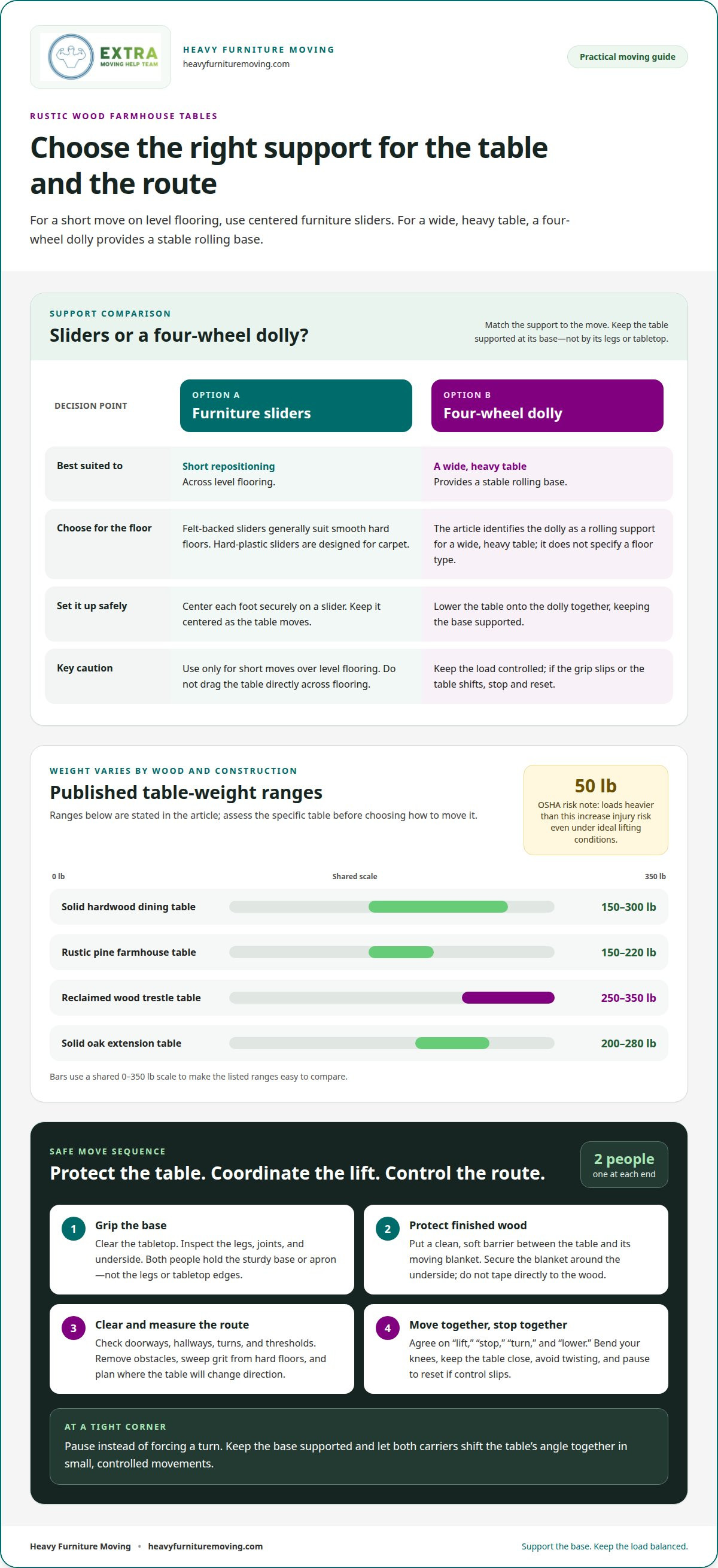
How heavy is a rustic solid wood farmhouse table typically?
Wood species and construction affect a table’s weight. Use the ranges below to plan equipment, handling, and the number of capable movers.
- Start with the table’s construction, not its rustic appearance. Solid hardwood dining tables made from dense woods such as oak, walnut, mahogany, or cherry commonly weigh between 150 and 300 pounds. A broad top, thick apron, or substantial base can make the piece harder to control than its size alone suggests.
- Use the wood type as a planning clue. Rustic pine farmhouse tables are listed at 150-220 lbs. That range still means the table needs deliberate handling, especially if its top is wide or its base is bulky. Don’t treat “pine” as a reason to lift casually.
- Account for trestle construction. Reclaimed wood trestle tables are listed at 250-350 lbs, placing some examples above the other farmhouse-table ranges. Their long bases can also make tight turns awkward. Plan how the table will be supported before moving it.
- Check whether the table has an extension mechanism. Solid oak extension tables are listed at 200-280 lbs. An extension leaf may change the table’s dimensions, so inspect the design and decide whether removable pieces should come off before transport.
- Inspect the underside for a maker’s label or model details that identify the material or construction. If documentation lists a weight, use it for planning. Otherwise, treat material ranges as estimates, not the exact weight of your table.
- Separate removable pieces only when the table’s design allows it. Remove an extension leaf or removable hardware, and protect each piece. Don’t force fixed or glued parts apart to reduce the load, since that can damage the table’s connections.
- Choose handling equipment based on both weight and shape. A four-wheel dolly suits wide, heavy furniture, while sliders can help with short repositioning on level floors. Keep each table foot centered on its slider, and don’t use sliders instead of controlled lifting over thresholds.
- Plan the lift around the estimated load, the table’s grip points, and the route. A heavy lifting moving service can help when the table is too bulky to control with your available helpers or equipment. Don’t assume a familiar-looking dining table weighs the same as another.
- Before moving, inspect the joints and legs for looseness, then check that the route fits the table’s dimensions. Weight estimates help with preparation, but stable support and a clear path matter throughout the move. Keep the base supported, and stop if the table shifts unexpectedly.
How many people are needed to safely lift a heavy dining table?
Use two people for a dining table lift, with each supporting one end and following a lead caller.
- Organize the team before touching the table. Two people should carry it together, holding the base rather than the legs or tabletop edges. Agree on who leads and who responds. A clear plan helps both carriers raise and lower the table at the same time.
- Consider the load before lifting. OSHA notes that loads heavier than 50 pounds increase injury risk even under ideal lifting conditions. OSHA recommends mechanical assistance and two-person lifting for heavy loads. A solid wood dining table can be difficult to control, so don’t judge the lift by appearance alone.
- Check whether two people can keep the table balanced along the entire route. Its length, grip points, and turning space affect control. If the table blocks a carrier’s view or can’t pass through a doorway without awkward tilting, use mechanical assistance rather than relying on strength alone.
- Choose one lead person to call “lift,” “stop,” “turn,” and “lower.” The other carrier should repeat or acknowledge each command before moving. For example, both people lift only after the lead gives the cue, then pause together at a threshold.
- Agree on hand placement while the table is still resting securely. Each carrier needs a firm grip on the base and room to step. Keep hands clear of pinch points between the table and door frames, walls, or a dolly.
- Lift in unison and take controlled steps. Matching pace helps prevent one end from rising or moving ahead. If the table shifts, a grip slips, or someone loses footing, call “stop” and lower it together before resetting.
- Use an extra person for a specific support role when needed. That person can open a door or move floor protection while the carriers keep their hands on the table. Don’t have a helper pull one end or steer by a leg.
- Choose mechanical assistance if the table’s weight or shape exceeds the team’s control. A suitable dolly can support rolling along an appropriate route, but it doesn’t replace coordinated lifting over thresholds or stairs. Plan how to move the table onto and off the equipment before lifting.
- Stop rather than add hurried effort when the table feels unstable. Reassess the grip, route, and equipment, then decide whether a heavy lifting moving service is the safer fit. Arrange heavy lifting help for a table that’s difficult to control with your available team.
Heavy Furniture Moving
Heavy Furniture Moving can help when a farm table is too bulky to control with your available helpers, or its route includes tight turns and thresholds. Its furniture moving support is a practical next step when you want the table handled as a heavy piece, with attention to its base and path through the home. You can also turn to Heavy Furniture Moving for related needs such as in-home furniture moving, exercise equipment moving, or sofa hoisting. Share the table’s size, its location, and any difficult access points when describing the job. Contact Heavy Furniture Moving to discuss help with your table move.
Plan the Move That Fits Your Table
Before moving day, decide whether the route, equipment, and available help suit the table’s size and condition. If the carry feels difficult to control, pause and choose a practical next step rather than risking damage to the table, your home, or anyone helping. Careful preparation helps keep the table’s legs and joints intact throughout the move.
If you’re planning how to move a heavy rustic wood farm table without loosening its legs in Dumfries, focus on a controlled process that suits your specific home and table. Heavy Furniture Moving can help with furniture moves when you’d rather have experienced assistance for a bulky piece. Contact Heavy Furniture Moving for help with planning your table move.
Move forward with a clear plan, and take the next step at your own pace.
Frequently Asked Questions
What can I put under heavy furniture to move it?
Use furniture sliders for a short move across level flooring, or a four-wheel dolly for a wide, heavy table. Match slider material to the floor: felt-backed sliders generally suit smooth hard floors, while hard-plastic sliders are designed for carpet. Check that each table foot sits securely inside its slider before moving. If the route includes stairs or steep ramps, sliders aren’t a substitute for controlled lifting.
How do I move a heavy wooden farm table without loosening or removing its legs?
To move a heavy rustic wood farm table in Dumfries without loosening its legs, don’t use the legs as handles or force fixed parts apart. Clear the tabletop so loose items can’t fall, then keep the table’s support balanced during each lift. If the table shifts or a joint moves, set it down and reassess before continuing. Don’t twist it while its feet are planted.
How do I protect farmhouse table legs and joints while moving the table?
Pad the legs and the areas where they meet the table base. A moving blanket cushions bumps, while a soft barrier helps shield finished wood from direct contact with protective materials. Keep fasteners and joints accessible for inspection, and don’t cinch straps tightly across a leg connection. Before carrying, check for any leg that moves independently, since padding won’t stabilize a loose joint.
When should I use furniture sliders versus a dolly for a heavy table?
Choose sliders to reposition the table over a short, level stretch, such as away from a wall. Use a four-wheel dolly when the table is broad or unwieldy and needs to roll over suitable level flooring. Before loading the dolly, make sure its platform supports the table securely. Neither option replaces a controlled carry over stairs, steep ramps, or difficult thresholds.
How do I move a heavy table through doorways and tight hallways?
Measure the table and the narrowest doorway or hallway point, including the space needed to turn. If the door frame blocks clearance, remove the door if that makes the route passable. Protect exposed corners, then approach the opening in the planned orientation. If the table catches, stop and reset its angle rather than forcing it through or using momentum.
Are there furniture movers near Dumfries, VA, for heavy solid wood tables?
Heavy Furniture Moving offers local furniture moves in Dumfries, including help with heavy and bulky household items. Wrap, blankets, and straps are included on every job. If the table is difficult to manage with your available helpers or the route through your home is challenging, contact Heavy Furniture Moving and share details about the table and access so the move can be planned around the item.
Frequently Asked Questions
Use furniture sliders for a short move across level flooring, or a four-wheel dolly for a wide, heavy table. Match slider material to the floor: felt-backed sliders generally suit smooth hard floors, while hard-plastic sliders are designed for carpet. Check that each table foot sits securely inside its slider before moving. If the route includes stairs or steep ramps, sliders aren’t a substitute for controlled lifting.
To move a heavy rustic wood farm table in Dumfries without loosening its legs, don’t use the legs as handles or force fixed parts apart. Clear the tabletop so loose items can’t fall, then keep the table’s support balanced during each lift. If the table shifts or a joint moves, set it down and reassess before continuing. Don’t twist it while its feet are planted.
Pad the legs and the areas where they meet the table base. A moving blanket cushions bumps, while a soft barrier helps shield finished wood from direct contact with protective materials. Keep fasteners and joints accessible for inspection, and don’t cinch straps tightly across a leg connection. Before carrying, check for any leg that moves independently, since padding won’t stabilize a loose joint.
Choose sliders to reposition the table over a short, level stretch, such as away from a wall. Use a four-wheel dolly when the table is broad or unwieldy and needs to roll over suitable level flooring. Before loading the dolly, make sure its platform supports the table securely. Neither option replaces a controlled carry over stairs, steep ramps, or difficult thresholds.
Measure the table and the narrowest doorway or hallway point, including the space needed to turn. If the door frame blocks clearance, remove the door if that makes the route passable. Protect exposed corners, then approach the opening in the planned orientation. If the table catches, stop and reset its angle rather than forcing it through or using momentum.
Heavy Furniture Moving offers local furniture moves in Dumfries, including help with heavy and bulky household items. Wrap, blankets, and straps are included on every job. If the table is difficult to manage with your available helpers or the route through your home is challenging, contact Heavy Furniture Moving and share details about the table and access so the move can be planned around the item.