How to Move a Heavy Cast Iron Bathtub Down Exterior Steps in Woodbridge
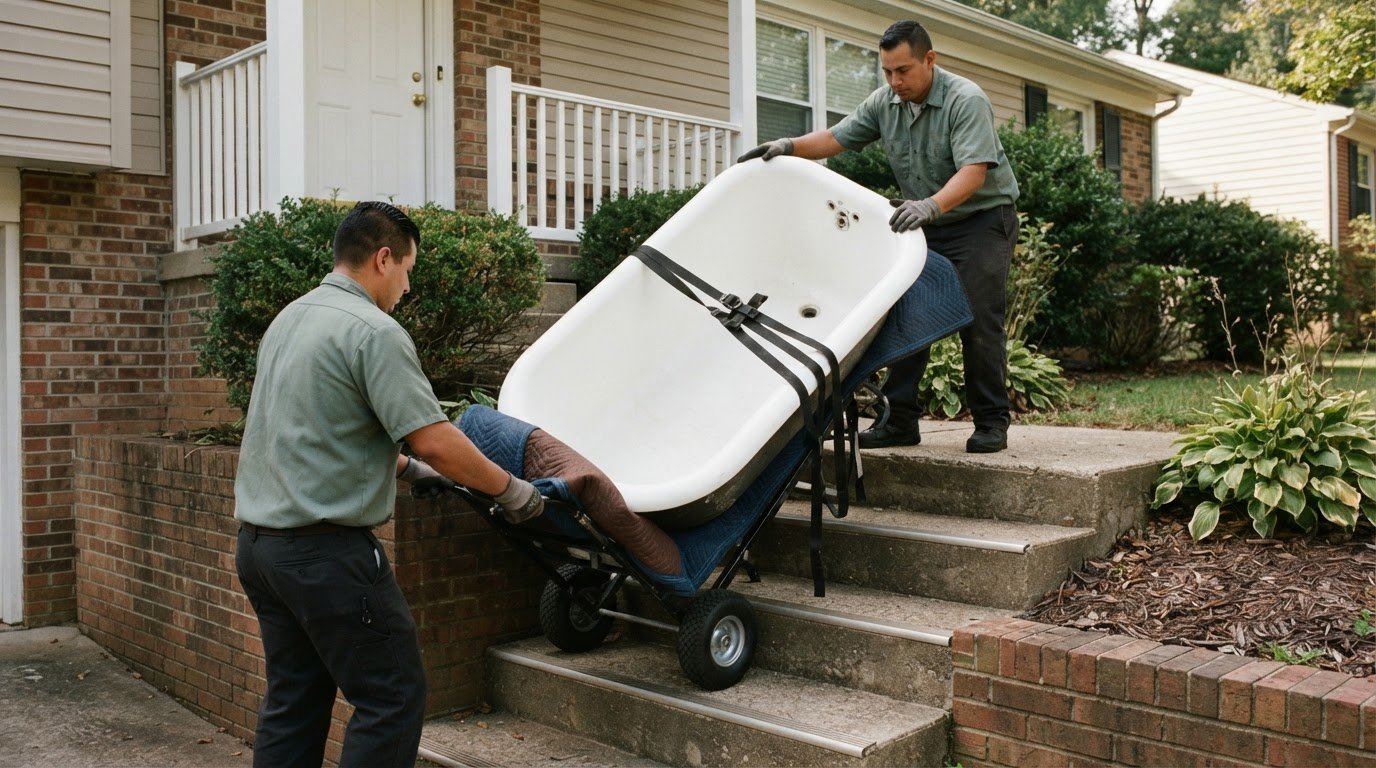
A cast-iron bathtub is not a job for a basic furniture dolly. Moving a heavy cast iron bathtub down exterior steps in Woodbridge takes a clear route, a properly secured appliance dolly, and steady control at every step. A typical cast-iron tub may weigh more than 300 pounds, so don’t rely on muscle alone.
A tight turn, damaged corners, or loss of control on exterior steps are real concerns when moving a heavy cast-iron bathtub down exterior steps in Woodbridge. Start with measurements, not lifting. This guide explains how to assess the tub and route, protect vulnerable surfaces, choose suitable equipment, and plan for stairway turns.
You’ll also learn which details shape a moving quote and how to compare the work included. Before moving day, use these steps to decide whether the route is manageable with the right equipment or needs experienced heavy-lifting help.
Key Takeaways
- Use the tub’s full dimensions, including its widest points, to spot route pinch points before moving day.
- Choose equipment for the terrain: a furniture dolly suits flat surfaces, while stair moves call for a secured appliance-type dolly.
- Protect exposed edges and nearby surfaces with padding, and keep the tub restrained as it moves.
- Plan stairway turns before lifting so helpers can coordinate the tub’s position and direction.
- Compare mover quotes by checking which parts of the move, equipment, and handling are included.
Hiring movers and quoted moving costs
- Describe the tub and the entire route before requesting a quote. Include the starting room, each exterior stairway, landings, turns, and the destination. A request that says only “move a bathtub” may leave out the hardest part: controlling it on the steps.
- Send clear measurements and access details with your request. Record the tub’s length, width, and height, and describe stair surfaces, narrow passages, and tight corners. Note any gate, porch, or doorway along the route. A straight flight ending at a narrow landing, for example, needs a different plan from steps that open onto a wide, level path.
- Ask for a written description of the work being quoted. Clarify the labor, equipment, loading, and handling included, and state whether the quote covers the tub’s entire route down the exterior steps. A concise route description helps both sides assess the job consistently, rather than comparing totals for different scopes.
- Compare quotes for the same moving plan, not just the final total. Check whether stair handling, securing the tub, and protecting nearby surfaces are included. Ask how the quoted scope changes if the crew encounters an unexpected turn or blocked passage. Keep the written terms together so differences in equipment, labor, and included tasks are easy to identify.
- Compare the cost and demands of a DIY move with professional labor. A DIY plan may involve equipment rental, straps, protective materials, and enough helpers to control the tub. Those costs don’t account for the time or risk of handling a heavy load on exterior stairs. Professional labor brings the crew and equipment needed for the route described in the quote.
- Include all the key details in one request: tub dimensions, stair flights, landings and turns, start and finish locations, and obstacles. The quote depends on the route, labor, equipment, and work included. Before deciding, compare the written scope with your description to make sure they match.
These figures describe different quote formats: an hourly labor rate and a company’s quoted job amount. Neither establishes what another crew will charge for your route, so don’t treat either as a guaranteed total. Ask whether the quote is fixed for the work described or depends on the time and handling required.
Before accepting a quote, confirm that it accounts for the tub’s weight, the complete stair route, and loading and securing the tub. Ask what could change the amount if the route differs from your description or the crew encounters an obstacle. Keep the answer with the written scope, and make sure the included work matches your request. A clear explanation makes it easier to compare the proposed service with other plans without assuming the lowest figure covers the same work. Choose only when you understand what the price includes and which parts of the move remain your responsibility.
Maneuvering the tub from a stairway into a bathroom
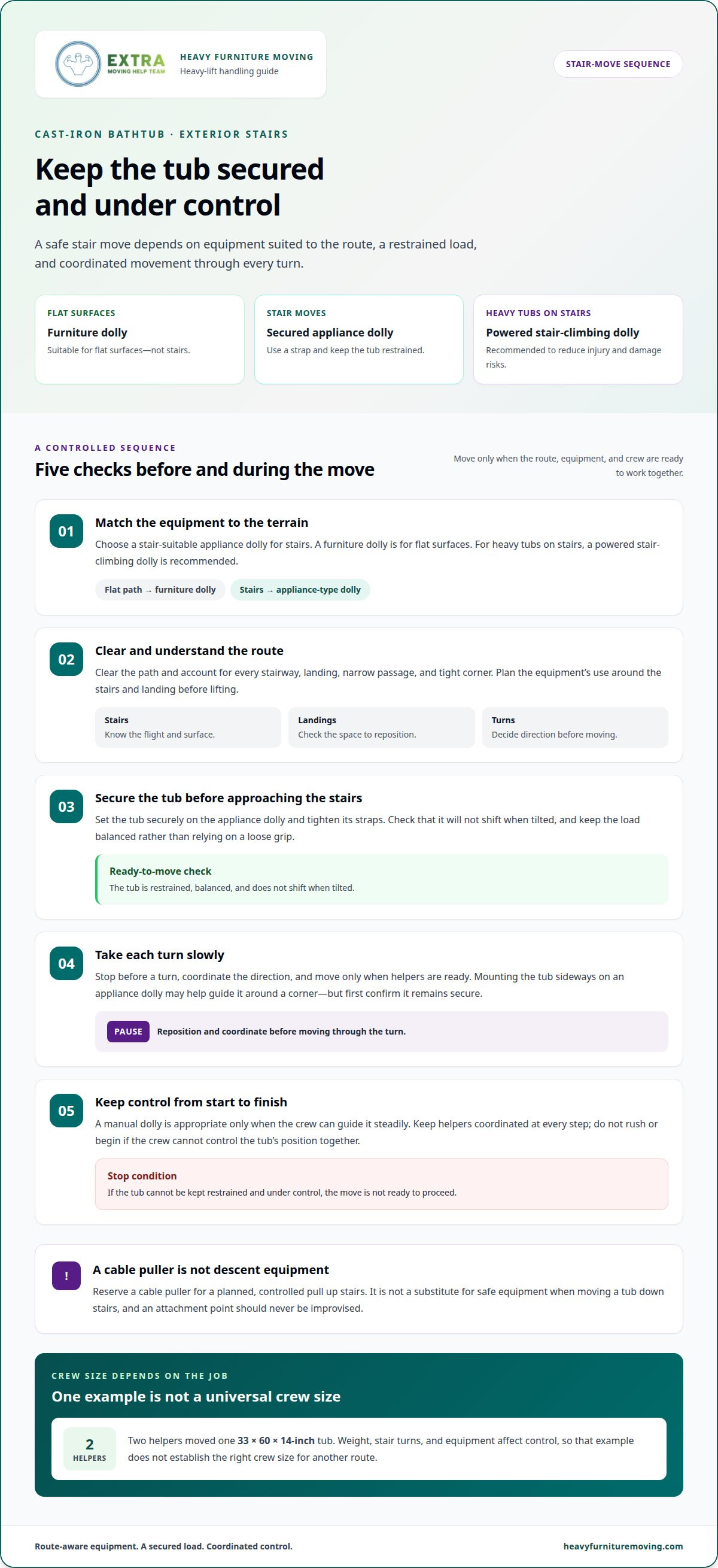
There’s no single mover count for every cast-iron tub; weight, stair turns, and equipment all affect control. One 33-by-60-by-14-inch tub was moved with two helpers, but that example isn’t a universal crew size.
For stairs, secure the tub to an appliance-type dolly and plan each turn before moving. Use a controlled method suited to the route, never a rushed carry.
Determine the Needed Mover Count
Match the crew to the tub and route, and don’t start unless the helpers can control its position together. Two helpers moved the measured tub in the example, but exterior steps, a landing, or a tight turn can change what the job requires. A manual dolly still needs people to guide and steady it. One past move doesn’t prove the same crew can manage your stairs.
Follow Safe Stair-Moving Steps
Choose the equipment before lifting, then secure the tub and clear the path. A heavy-duty appliance dolly with a strap and belted stair climbers is suited to stair movement. A powered stair-climbing dolly is recommended for heavy tubs on stairs to reduce injury and damage risks. Keep helpers coordinated through every step and pause at turns to reposition.
- Set the tub securely on an appliance dolly and tighten its straps before approaching the first step. Check that it won’t shift when tilted. Keep the load balanced and controlled rather than relying on a loose grip.
- Use a manual appliance dolly only when the crew can guide it steadily. A furniture dolly is for flat surfaces, not stairs. Plan the equipment’s use around the stairway and landing.
- Approach each turn slowly. Mounting the tub sideways on an appliance dolly may make it easier to guide around a corner, but first confirm that it remains secure. Stop before the turn, coordinate the direction, and move only when the helpers are ready.
- Reserve a cable puller for a planned, controlled pull up stairs, not as a substitute for safe descent equipment. Homeowners used a 1-ton cable puller to move a tub up stairs. That example doesn’t establish that every puller or anchor suits another route. Don’t improvise an attachment point.
- For a difficult stairway, compare manual and powered equipment against the route’s turns and landing. Cost alone doesn’t determine suitability. The key is keeping the tub restrained and under control from start to finish.
Tools and equipment for moving a cast-iron bathtub
For stair moves, match each tool to its task: secure the tub, protect its finish, and keep the route clear. Disposal is separate from moving. Local permit requirements depend on the disposal method and applicable rules.
Without professional movers, a tub can shift unexpectedly, leading to loss of control, injury, or damage to steps and nearby surfaces. Don’t start unless the crew, equipment, and route are ready.
- Choose a stair-suitable dolly. Use an appliance-type dolly for stairs, not a furniture dolly designed for flat surfaces. Check that the frame and straps hold the tub firmly before moving. A loose load can shift when the dolly tilts, making it harder to steer or stop at a landing.
- Secure the tub with suitable straps. Ratchet tie-down straps can hold the tub against the dolly during movement. Keep straps away from sharp edges, and tighten them until the tub cannot slide. Homeowners moving a cast-iron tub used two sets of ratchet tie-down straps, but the number needed depends on the setup.
- Protect the finish with padding. Place moving blankets or pads between the tub and the dolly’s contact points. They can help prevent scratches where metal or straps touch the porcelain.
- Prepare the team’s basic safety gear. Wear work gloves for a secure grip and closed-toe shoes while handling the tub. Keep hands clear of pinch points between the tub, dolly, and stair edges. Clear loose objects from every landing and keep the route open throughout the move.
- Inspect the tie-down path. Some tubs have three holes that can accommodate nylon straps, but don’t assume every tub has suitable openings. Check that a strap won’t rub against a sharp edge or press on a fragile area. If the tub’s shape prevents a stable hold, change the setup before lifting.
- Use separate tools for separate tasks. Use padding to protect the finish, straps to secure the tub, and an appliance dolly to control movement. Don’t treat one as a substitute for another. A blanket, for example, can cushion contact but cannot stop the tub from sliding.
- Stage equipment before the first lift. Place the dolly, straps, pads, and gloves near the starting point, then check the stair route again. Make sure every helper knows when to lift, pause, and reposition. Stop if the tub shifts, a strap loosens, or the dolly can’t be controlled on a step.
Measuring the tub and exit route
For moving a heavy cast-iron bathtub down exterior steps in Woodbridge, measure the tub and every narrow point along the route first.
- Record the tub’s dimensions. Measure its length, width, and height, including any part that projects beyond the main body. Measure across the widest point, not just the rim. A 30-by-60-inch cast-iron tub may weigh 300-350 pounds, so its dimensions help describe both the load and the space it needs.
- Measure each doorway and passage. Record the clear opening, not the distance from trim to trim. Check the doorway with the door open, and note handles, frames, or nearby walls that limit movement. Compare the opening with the tub’s widest measurement, then consider whether turning the tub could provide more clearance.
- Trace the complete exit route. Follow the tub’s path from where it sits to the final drop-off point. Include indoor passages, exterior doors, steps, landings, and turns. Measure the narrowest section along each part of the route. A clear doorway won’t resolve a tight turn just beyond it.
- Count and inspect every stair flight. Record the number of steps in each flight and note any landings between them. Check whether the stairs are straight or change direction. Allow room to pause and reposition at turns, and note obstacles such as railings, gates, or uneven ground.
- Compare tub measurements with route clearance. Use the tub’s widest and longest dimensions to assess doorways and corners. Think through how it will be angled at each turn instead of assuming it can travel upright. If a turn appears tighter than the available clearance, plan a different orientation before moving.
- Mark potential pinch points. Identify the narrowest doorway, tightest turn, and smallest landing on your route. These spots shape the moving plan. For moving a heavy cast-iron bathtub down exterior steps in Woodbridge, mark each pinch point and nearby surface that needs protection. Measure those areas again and note where helpers may need to pause.
- Share the measurements in one clear route summary. List the tub’s dimensions, the narrowest passage, and each stair flight in travel order. Include landing and turn details. This gives the moving team a practical picture of the job and helps them plan how to position and guide the tub through its tightest section.
Protecting corners while pulling a tub
Professionals protect exterior steps by padding contact points, clearing the route, and controlling the tub rather than dragging it. Keep the load secured, and pause at each landing to check the padding and reposition before continuing.
- Cover vulnerable corners first. Pad exposed tub edges and corners before strapping the load. Add protection where the tub could touch a railing, wall, doorframe, or stair edge. Secure the padding so it can’t slip into the route or interfere with a helper’s grip.
- Protect the stair surface. Lay protective material over steps and landings where the dolly or tub could make contact. Keep each piece flat and stable, not folded into a trip hazard. Check the covering as the load moves, especially where the route changes direction or the dolly rests.
- Use boards only as a planned surface. A 2×10 plank has been proposed for sliding a bathtub down stairs, with old carpet placed over the planks to help avoid porcelain scratches. That setup still needs control and a secure plan. Don’t improvise a slide if the boards can shift or the tub can accelerate.
- Keep the tub secured during any pull. Attach straps so the tub stays restrained against its moving equipment. Check that they won’t rub against a sharp edge or press hard on one corner. Stop if a strap loosens, padding shifts, or the tub tilts away from its planned position.
- Protect corners at turns. Before moving around a landing or doorway, pause and identify the corner most likely to contact the tub. Reposition helpers and padding while the load is stable. Move through the turn with small, coordinated adjustments instead of swinging the tub into a railing or wall.
- Check the route between stair sections. Clear loose objects, open gates, and remove anything that could catch a blanket or strap. At each landing, inspect the step covering and the tub’s corner padding. A shifted pad can expose porcelain, wood, or painted surfaces during the next pull.
- Stop when the protection fails. Don’t continue if a plank moves, a covering bunches, or the tub cannot be held steady. Settle the load in a controlled position, correct the setup, and resume only when the route is clear. For hands-on help with a demanding heavy move, arrange heavy lifting moving help.
One installer recommended placing one or two pieces of lumber on the ground to protect the tub’s finish during installation. Another described moving a crated tub on its end with two people, each holding a bottom corner of the crate. That account refers specifically to a crated tub held at its bottom corners while on its end.
Heavy Furniture Moving
Heavy Furniture Moving can help when a cast-iron tub, tight turn, or exterior stairway makes a move difficult to manage alone. Its moving and heavy-lifting services support customers handling bulky household items, and clear route details help define the job.
Consider professional help if the tub can’t be kept secure on the stairs, the landing leaves little room to turn, or your equipment doesn’t suit the route. Share the tub’s dimensions, stair layout, and obstacles so the moving plan reflects the actual challenge. For a demanding move in Woodbridge, contact Heavy Furniture Moving to discuss the help you need.
Plan Your Next Move With Confidence
Before moving day, decide who will manage the lift and how the tub will leave the property. If the route, tight turns, or stair control make a DIY move impractical, arrange experienced help rather than improvising at the last minute. Moving a heavy cast-iron bathtub down exterior steps in Woodbridge calls for a plan suited to the actual access and handling needs.
Heavy Furniture Moving helps with bulky household moves through services including Movers Near Me, Exercise Equipment Moving, and Sofa Hoisting. Share the tub’s location, the route, and the main obstacle when you reach out. Those details help frame the assistance you’re looking for without guesswork.
Take the next step when you’re ready. Contact Heavy Furniture Moving for help with planning a demanding move, and move forward with a clear, practical plan.
Frequently Asked Questions
How much does it cost to move a heavy cast iron bathtub in Woodbridge, Virginia?
The cost depends on the tub, access, stairway layout, and work included, so share those details for an accurate quote. Heavy Furniture Moving offers flat rates for most single heavy items, while hourly labor has a two-hour minimum. Stairs and landings are priced before the crew arrives. Send a photo of the bathtub and its route to help explain the job.
What equipment is needed to move a cast iron bathtub down stairs safely?
Use an appliance dolly suited to stairs, secure tie-down straps, and padding to protect the tub’s finish and nearby surfaces. Before loading, inspect the dolly, straps, and padding for damage, and make sure the load stays stable when tilted. Clear the stairway, leave the landing free of obstacles, and agree on simple movement signals so helpers can pause together. Heavy Furniture Moving includes wrap, blankets, and straps on every job.
How do I find insured bathtub or piano movers in Woodbridge, VA?
Choose a mover experienced with heavy household items, and request written proof of current insurance before booking. Check that the documentation applies to the work and property involved, and read the quote to confirm the exact item and route. Heavy Furniture Moving handles piano and other heavy-item moves; ask the company for details of the insurance coverage that applies to your move.
Frequently Asked Questions
The cost depends on the tub, access, stairway layout, and work included, so share those details for an accurate quote. Heavy Furniture Moving offers flat rates for most single heavy items, while hourly labor has a two-hour minimum. Stairs and landings are priced before the crew arrives. Send a photo of the bathtub and its route to help explain the job.
Use an appliance dolly suited to stairs, secure tie-down straps, and padding to protect the tub’s finish and nearby surfaces. Before loading, inspect the dolly, straps, and padding for damage, and make sure the load stays stable when tilted. Clear the stairway, leave the landing free of obstacles, and agree on simple movement signals so helpers can pause together. Heavy Furniture Moving includes wrap, blankets, and straps on every job.
Choose a mover experienced with heavy household items, and request written proof of current insurance before booking. Check that the documentation applies to the work and property involved, and read the quote to confirm the exact item and route. Heavy Furniture Moving handles piano and other heavy-item moves; ask the company for details of the insurance coverage that applies to your move.