How to Move a Cast Iron Bathtub in Ashburn: A Safety-First Guide
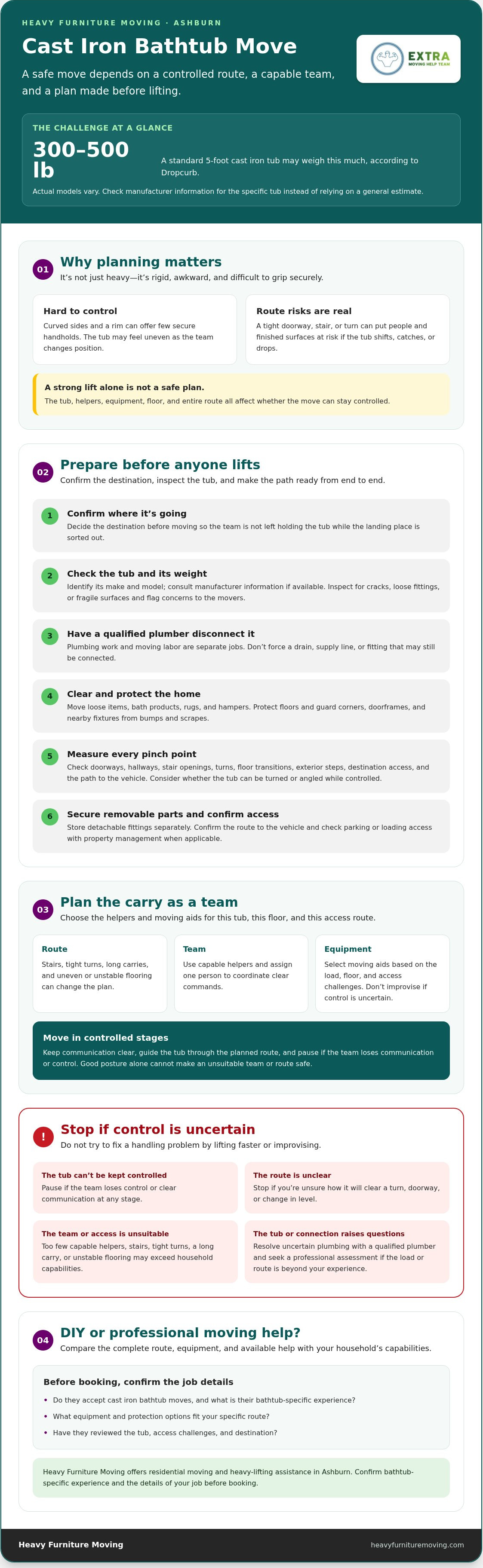
Raw strength won’t make a cast iron bathtub move safely. A controlled route will. If you’re figuring out how to move a cast iron bathtub Ashburn, start by recognizing the challenge: a standard 5-foot cast iron tub can weigh 300 to 500 pounds, according to Dropcurb. That weight is hard to grip, and one tight doorway, stair, or turn can put people and finished surfaces at risk.
You may already know the tub needs several strong helpers and a clear path. Before lifting, you’ll also need to check the tub’s condition, measure the route, protect floors and walls, and decide whether your equipment and team can handle the job without rushing or losing control.
This guide walks you through those decisions. You’ll learn how to assess the tub, plan and protect a safe route, and recognize when it’s time to stop. We’ll also cover when to ask a plumber about disconnecting or removing the tub, and how to evaluate professional moving help. Heavy Furniture Moving offers residential moving and heavy-lifting assistance in Ashburn, but confirm bathtub-specific experience and job details before booking.
Key Takeaways
- Before planning how to move a cast iron bathtub Ashburn, confirm its destination and check the manufacturer’s information for the tub’s weight.
- Have a qualified plumber disconnect the plumbing, then clear and protect the planned route through your home.
- Choose moving aids and helpers based on the tub, floor, and access challenges. Stairs and tight turns may require a different plan.
- Have one person coordinate clear commands, move in controlled stages, and pause if the team loses communication or control.
- Compare the route, equipment, and available help with your household’s capabilities. Before booking movers, confirm their bathtub-specific experience and the details of the job.
Moving a Cast Iron Bathtub in Ashburn: Understand the Risks First
Moving a cast iron tub is a coordinated heavy-item move, not a routine bathroom lift. The challenge isn’t just getting it off the floor. The team must keep a rigid, awkward load controlled while guiding it through the home without striking walls, catching a doorway, or putting people in its path if it shifts or drops.
Weight and awkward shape make a tub harder to control, not just harder to lift. Before planning how to move a cast iron bathtub Ashburn, identify the tub’s make and model and check the manufacturer’s information for its weight, if available. Don’t rely on a general estimate. Models vary, and the specific load affects the handling plan.
Why cast iron tubs are difficult to handle
Cast iron is rigid, and a tub’s curved sides and rim may offer few secure handholds. Its center of mass can feel high or uneven as the team changes position. If someone’s grip slips or the group moves out of sync, control can quickly become harder. Review the basics of safe lifting techniques, but remember that good posture alone can’t make an unsuitable team or route safe.
Possible consequences include strains, a dropped load, damaged flooring, or impact to walls, trim, and doorframes. Treat these as real planning concerns, not reasons to rush. A controlled move depends on the tub, the people handling it, and the space around them.
When a DIY move is not a safe plan
Ashburn homes don’t all have the same layout, so assess the actual route from the bathroom to the destination. Stairs, tight turns, a long carry, unstable flooring, or too few capable helpers can change the job substantially. Don’t assume the tub will fit through a doorway just because the room is accessible.
Stop if the team can’t keep the tub controlled at every stage, or if you’re unsure how it will clear a turn or change levels. Don’t try to solve a handling problem by lifting faster or improvising with equipment. Ask for a professional assessment when the route, load, or available experience exceeds your household’s safe capabilities. If you contact Heavy Furniture Moving, confirm whether the team accepts cast iron tub moves and ask about its experience, equipment, and protection options for your specific route.
Prepare the Cast Iron Bathtub and Ashburn Home Before Moving
Preparation starts before anyone touches the tub. Confirm where it’s going, then map a clear route from the bathroom to that destination and, if needed, to the vehicle. Without a confirmed landing place, the team could be left holding a heavy load while the path gets sorted out.
- Clear the route: Move bath products, rugs, hampers, and other loose items out of the way.
- Protect the home: Cover floors with suitable protective material, and guard corners, doorframes, and nearby fixtures from bumps and scrapes.
- Secure loose parts: Remove bath products and detachable fittings. Wrap or store removable parts separately so they don’t shift or get lost.
- Check access: Confirm the path reaches the destination and the vehicle loading area. Ask property management about parking or loading access if applicable.
Plumbing work and moving labor are separate jobs. A qualified plumber must disconnect the tub before it’s moved.
Disconnect and inspect the tub before handling
Don’t force a drain, supply line, or fitting that still seems connected. Have a qualified plumber confirm disconnection and address any uncertain connections. Once the tub is ready, inspect it for cracks, loose fittings, or fragile surfaces. Note anything that could worsen during handling, and tell the people moving it before they begin.
Measure the Ashburn route from bathroom to destination
Measure the tub and check every pinch point along the route, including doorways, hallways, stair openings, turns, and destination access. Measure more than the opening: consider whether the tub can be turned or angled through it while remaining controlled. Check floor transitions, exterior steps, and the path from the home to the vehicle. Clear obstacles and make sure the route stays usable from end to end.
Distance and posture matter as well as load weight. The NIOSH Lifting Equation explains how lifting conditions can affect risk. Use it as context, not as a substitute for a job-specific plan. If access, parking, or loading arrangements aren’t clear, confirm them with property management before moving day.
A measured, protected route gives the team a clearer plan, but it doesn’t guarantee the tub can be moved safely with the people and equipment available. If you’re considering residential moving help, confirm whether the team accepts this type of move and ask about its experience, equipment, and home-protection options.
Plan the Carry: Equipment, Helpers, and Tight Access in Ashburn
A straight, level route is usually simpler to assess than stairs, sharp turns, or uneven transitions. But it still requires steady control from start to finish. With each turn or change in level, the team may need a different handling plan. If you’re researching how to move a cast iron bathtub Ashburn, choose equipment and helpers based on the entire route, not just the tub’s weight.
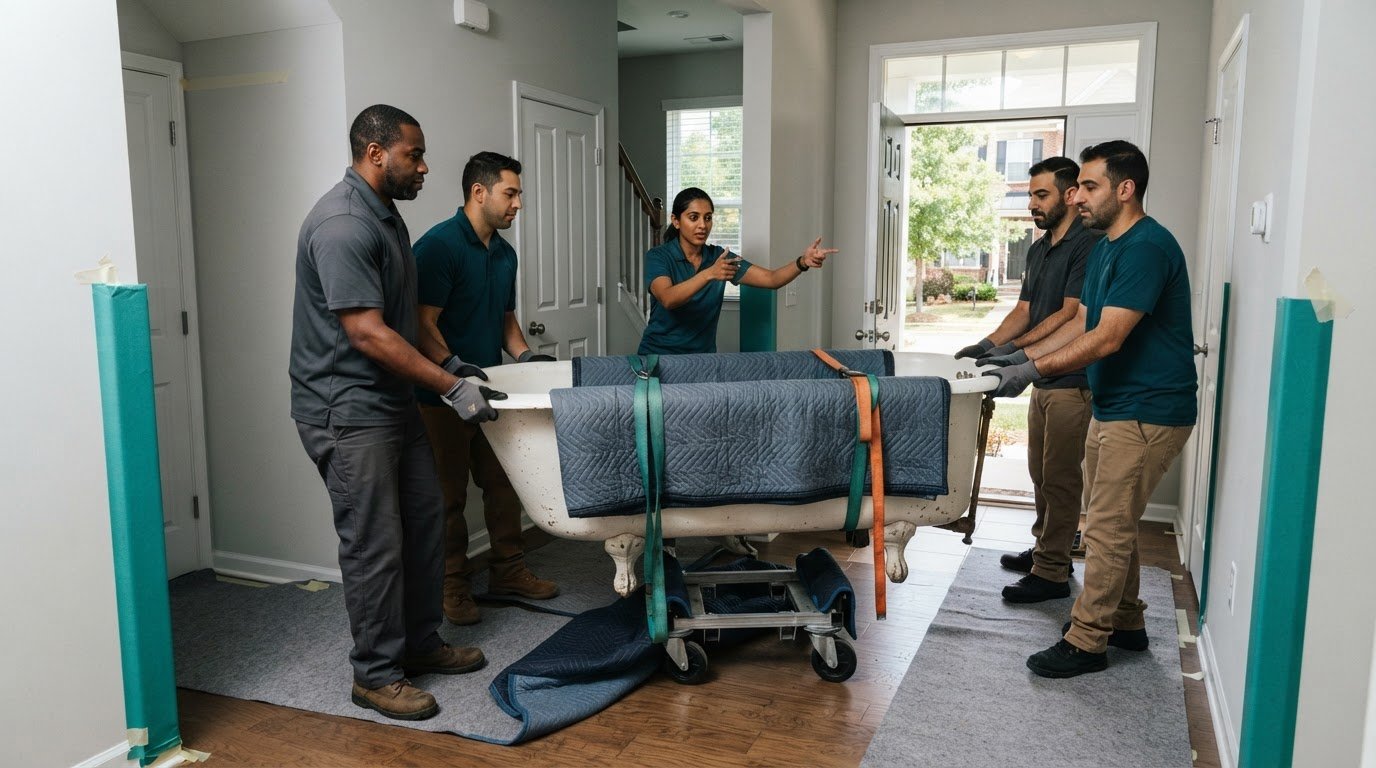
Dollies, carrying straps, and protective materials can help when they’re suitable for the load and used correctly. They aren’t interchangeable solutions. Check equipment capacity and fit with an experienced mover, and make sure the people handling it know how to use it. A dolly that works on a smooth, level floor may not be appropriate for stairs or an uneven threshold. Keep hands and feet clear of pinch points, and don’t stand where a shifting tub could trap you.
Match equipment and help to the route
Consider where the tub needs to turn, whether the floor changes height, and how much room the team has to hold and guide it. Protective materials can help limit scrapes, but they must not create a slippery or unstable surface. Don’t guess at tool capacity or assume more helpers automatically make the carry safer. If you’re unsure whether the equipment or team is suitable, ask an experienced mover to assess the job before moving day.
Assess stairs, turns, and exterior access
Walk the full path and note every turn, landing, step, and point where the load may need repositioning. Check that the surfaces and landings appear stable enough for the planned movement. Include the exterior route to the vehicle, not just the path inside the home. A clear landing or level section can matter as much as the doorway itself.
Stop if the tub can’t pass without unsafe tilting or uncontrolled force. Don’t try to muscle it through a tight spot. Pause and get a professional assessment if the route or load exceeds the team’s experience.
| Route condition | Added challenge | Reason to seek professional assessment |
|---|---|---|
| Straight, level path | Maintaining control over the full carry | Equipment fit or handling experience is uncertain |
| Tight turn or narrow opening | Limited room to reposition the tub | The tub may need unsafe tilting to clear it |
| Stairs or uneven transition | Changing levels while keeping the load stable | Surface support or equipment suitability is unclear |
| Exterior steps or long carry | More route changes before reaching the vehicle | The team can’t maintain steady control throughout |
Move the Bathtub in Controlled Stages: Know When to Stop
A safe carry depends on steady control, clear communication, and a team that’s ready to pause. If you’re researching how to move a cast iron bathtub Ashburn, use a planned sequence rather than trying to get the tub from one room to another in a single push.
- Brief the team. Agree on who leads, the route, where you’ll pause, and the commands everyone will use.
- Test the route. Check that the path is still clear and floor protection hasn’t shifted. Reconsider any tight spot before the tub is in motion.
- Move in short stages. Keep the load low and controlled, and stop at planned safe points to reassess the team, grip, and route.
- Check before continuing. Restart only when everyone understands the next move and can maintain control.
If control is lost, set the load down safely and reassess before continuing. Don’t attempt a solo lift or improvise a recovery while the tub is unstable. If there’s no safe way to bring it under control, keep people clear and get qualified help.
Use clear communication and planned pauses
Choose one person to lead and agree on simple commands before lifting begins. Everyone should know how to call for a pause. Stop at planned safe points, not only when someone is already struggling. If voices can’t be heard, instructions conflict, or a helper needs to change position, pause and reset the plan. Schedule pressure isn’t a reason to continue an unsafe carry.
Protect people and property throughout the move
Keep bystanders and pets out of the route and landing areas. Before each stage, check that floor protection is secure, the next passage is clear, and the team’s grip and communication are ready. Watch for slipping, a shifting grip, unexpected resistance, strain, or contact with a wall or doorway.
After any impact, slip, or sudden shift, stop and reassess before moving again. Check the tub, the route, and the team’s ability to continue safely. If the load won’t stay controlled or the path has become blocked, don’t force it. Get experienced help to review the situation.
If you need help with a heavy household move in Ashburn, ask about heavy-lifting moving help. Confirm whether the team accepts cast iron tub moves and ask about its relevant experience, equipment, and protection options for your specific route.
Decide Whether to Move It Yourself or Get Ashburn Moving Help
A DIY move may be reasonable only if the route is straightforward, the team has relevant experience, suitable equipment is available, and everyone can manage the load safely. Stairs, tight turns, long carries, uncertain floor conditions, or limited trained help are good reasons to step back. The safest answer to how to move a cast iron bathtub Ashburn may be to have experienced movers assess the route before you commit to lifting.
Heavy Furniture Moving serves Ashburn and specializes in heavy, bulky household items. However, bathtub-specific handling isn’t confirmed, so ask whether the company accepts this type of job before booking. Confirm the proposed scope, crew, equipment, surface-protection options, and whether transport is included. Share the tub’s details and describe the full route so the team can assess the actual task, not just the item.
Questions to ask before hiring bathtub movers
Be specific when you describe the job. Share measurements, stairs, turns, the destination, and parking or loading access. Then ask:
- Has the team handled cast iron bathtubs or similar heavy, awkward loads through comparable access?
- Does the team accept this specific tub and route, and what crew and equipment would it use?
- Who is responsible for protecting floors, doorframes, and other surfaces?
- Does the moving scope include loading and transport, or only moving labor?
Get clear answers before scheduling. Don’t assume that “heavy-item moving” automatically includes bathtub handling or every part of the job.
Know which professional handles each part of the job
A qualified plumber should handle plumbing disconnection and answer questions about reconnecting the tub. Movers may handle agreed moving or transport work, but don’t assume they provide plumbing or tub removal. Confirm who is responsible for each task, including preparation, surface protection, loading, and delivery, before the work begins.
For more help comparing local moving options, read this Fairfax and Northern Virginia movers guide. If you’re considering Heavy Furniture Moving, reach out to ask whether the team can take on your tub and route, and confirm the equipment, crew, and services available for your specific move.
Make a Safe Plan Before You Move
A cast iron tub move calls for more than strength. Confirm the tub’s weight and destination, have a qualified plumber disconnect the plumbing, and assess every doorway, turn, and change in level before lifting. If the route, equipment, or available helpers don’t give you confidence that the tub can stay controlled, pause and get professional advice.
Knowing how to move a cast iron bathtub Ashburn starts with knowing when not to handle it yourself. Heavy Furniture Moving serves Ashburn and specializes in heavy, bulky household items, but bathtub-specific experience and job details need to be confirmed before booking. Ask whether the team accepts this move, and clarify the crew, equipment, surface protection, and transport involved.
If you’re weighing your options, ask Heavy Furniture Moving about your Ashburn heavy-item move. A clear plan and the right support can help you move forward with greater confidence and protect the people and home around the job.
Frequently Asked Questions
How heavy is a cast iron bathtub?
The weight depends on the tub’s size, design, and model, so don’t use a generic estimate to decide whether a lift is safe. Check the manufacturer’s information or product documentation if available. Weight is only part of the challenge: a tub’s awkward shape and limited handholds can make it hard to control. Plan the route and handling method for the specific tub, not an assumed average.
Can I move a cast iron bathtub by myself?
Moving a cast iron bathtub alone generally isn’t a safe plan. Its weight, shape, and limited handholds make it difficult to control, especially through a doorway or turn. Don’t attempt the lift if you lack suitable equipment, trained help, or a clear route. If stairs, tight access, or uncertainty are part of the job, stop and ask experienced movers to assess the specific load and route first.
How do I prepare a cast iron tub for moving?
Clear the tub and the full route, protect floors and vulnerable corners, and measure doorways, turns, stairs, and destination access. Have a qualified plumber disconnect connected plumbing before moving. Check the tub for loose parts or damage, then plan how the team will handle each section of the route. Don’t force fittings or begin if the path, equipment, or helpers aren’t ready to keep the tub controlled.
Do I need a plumber before moving a bathtub?
If the tub is connected to plumbing, have a qualified plumber assess and disconnect it before anyone attempts to move it. Plumbing work and moving labor are separate tasks, so don’t assume movers can disconnect or reconnect the tub. Confirm who is responsible for disconnection and any later reconnection before scheduling. If you’re unsure whether a connection remains attached, pause and get qualified advice rather than forcing it.
Can a cast iron bathtub be moved down stairs?
It may be possible, but stair width, landings, turns, surface condition, and the tub’s dimensions determine whether the route is workable. Measure the full path, including each landing and turn, and consider whether the load can stay controlled throughout. Extra helpers don’t automatically make a difficult staircase safe. Seek an experienced assessment if clearance is tight, footing is uncertain, or the tub would need unsafe tilting to pass.
What equipment is needed to move a cast iron bathtub?
The right equipment depends on the tub, route, floor, and team’s experience. A suitable dolly, carrying aids, and protective materials may be considered, but each must match the load and conditions. A dolly isn’t automatically appropriate for stairs or uneven surfaces. Before attempting the move, ask an experienced mover to confirm equipment capacity and suitability, and make sure anyone using it knows how to handle it safely.
Can movers in Ashburn move a cast iron bathtub?
Confirm directly, since moving teams’ experience and services vary. Heavy Furniture Moving’s stated local coverage includes Ashburn, Fairfax, Woodbridge, Manassas, Manassas Park, Aldie, McLean, Vienna, Reston, Centreville, Chantilly, Clifton, Dumfries, South Riding, Fairfax Station, Haymarket, and Gainesville. The company specializes in heavy, bulky household items, but ask whether it accepts cast iron tubs, and clarify the crew, equipment, loading, transport, and plumbing arrangements before booking.
Frequently Asked Questions
The weight depends on the tub’s size, design, and model, so don’t use a generic estimate to decide whether a lift is safe. Check the manufacturer’s information or product documentation if available. Weight is only part of the challenge: a tub’s awkward shape and limited handholds can make it hard to control. Plan the route and handling method for the specific tub, not an assumed average.
Moving a cast iron bathtub alone generally isn’t a safe plan. Its weight, shape, and limited handholds make it difficult to control, especially through a doorway or turn. Don’t attempt the lift if you lack suitable equipment, trained help, or a clear route. If stairs, tight access, or uncertainty are part of the job, stop and ask experienced movers to assess the specific load and route first.
Clear the tub and the full route, protect floors and vulnerable corners, and measure doorways, turns, stairs, and destination access. Have a qualified plumber disconnect connected plumbing before moving. Check the tub for loose parts or damage, then plan how the team will handle each section of the route. Don’t force fittings or begin if the path, equipment, or helpers aren’t ready to keep the tub controlled.
If the tub is connected to plumbing, have a qualified plumber assess and disconnect it before anyone attempts to move it. Plumbing work and moving labor are separate tasks, so don’t assume movers can disconnect or reconnect the tub. Confirm who is responsible for disconnection and any later reconnection before scheduling. If you’re unsure whether a connection remains attached, pause and get qualified advice rather than forcing it.
It may be possible, but stair width, landings, turns, surface condition, and the tub’s dimensions determine whether the route is workable. Measure the full path, including each landing and turn, and consider whether the load can stay controlled throughout. Extra helpers don’t automatically make a difficult staircase safe. Seek an experienced assessment if clearance is tight, footing is uncertain, or the tub would need unsafe tilting to pass.
The right equipment depends on the tub, route, floor, and team’s experience. A suitable dolly, carrying aids, and protective materials may be considered, but each must match the load and conditions. A dolly isn’t automatically appropriate for stairs or uneven surfaces. Before attempting the move, ask an experienced mover to confirm equipment capacity and suitability, and make sure anyone using it knows how to handle it safely.
Confirm directly, since moving teams’ experience and services vary. Heavy Furniture Moving’s stated local coverage includes Ashburn, Fairfax, Woodbridge, Manassas, Manassas Park, Aldie, McLean, Vienna, Reston, Centreville, Chantilly, Clifton, Dumfries, South Riding, Fairfax Station, Haymarket, and Gainesville. The company specializes in heavy, bulky household items, but ask whether it accepts cast iron tubs, and clarify the crew, equipment, loading, transport, and plumbing arrangements before booking.