How to Move a 400 lb Executive Desk Down Curved Stairs in Reston
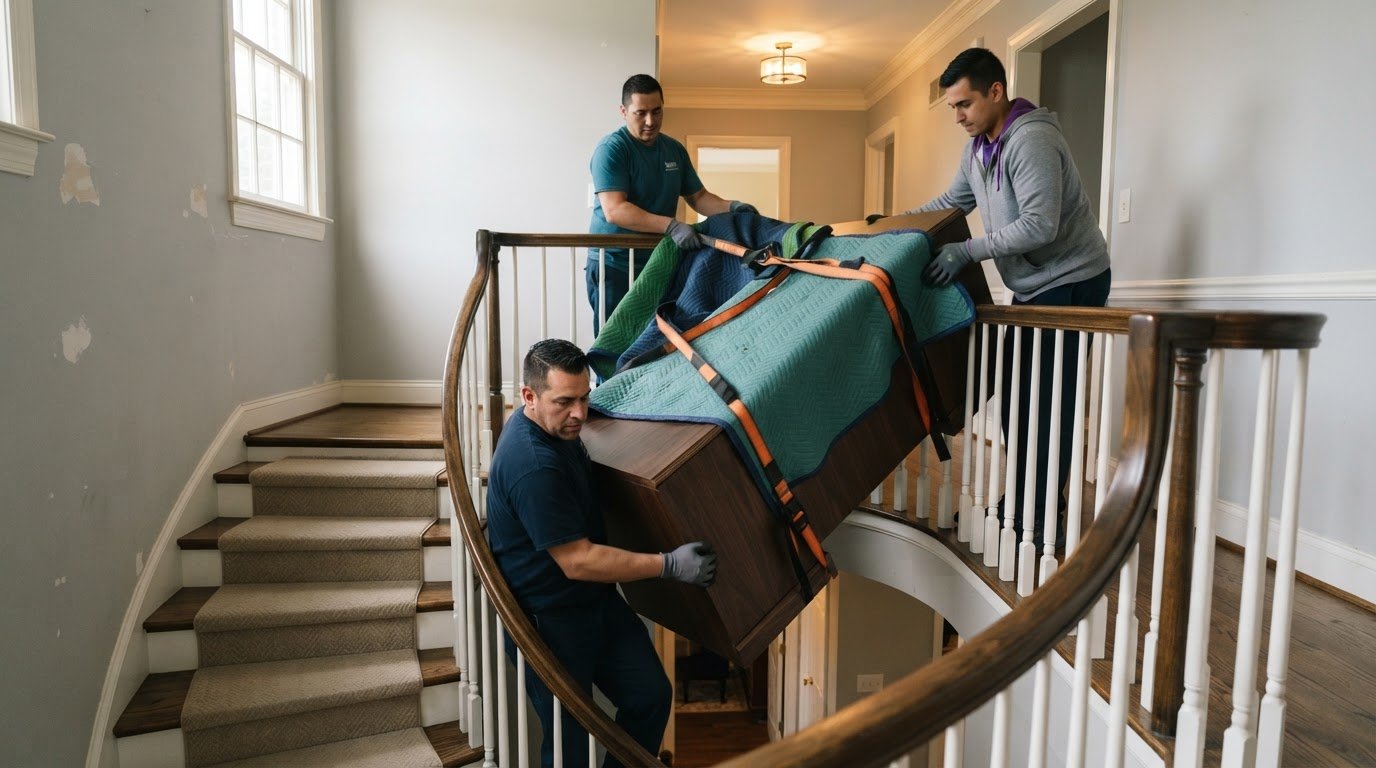
A 400-pound executive desk is too heavy to carry down curved stairs as a DIY job. To safely move a 400-pound executive desk down curved stairs in Reston, use professional moving help: the desk exceeds the 200-pound point at which professional help is recommended, and a curved stairway adds tight turns and limited space. Don’t try to manage the descent alone.
You can still make the move safer by measuring the desk, doorway, stair width, turns, and landings before anything is lifted. This guide explains how to prepare the route, choose suitable moving equipment, protect the desk and walls, and coordinate slow, controlled movement. You’ll also learn the warning signs that mean the stairs are too tight or difficult for a safe carry, so you can make a clear plan before moving day.
Key Takeaways
- Measure the desk, doorways, stair width, turns, and landings to spot tight clearances before the move begins.
- Remove detachable parts and secure the desk with suitable padding and straps to help control shifting and protect surfaces.
- On curved stairs, plan each turn and landing before lifting; limited space can make a standard dolly unsuitable.
- Use clear commands, move one step at a time, and keep the load close without twisting to reduce strain and sudden shifts.
- Recognize when the route or load is beyond a safe DIY carry and bring in professional moving help.
Measuring furniture, doorways, stairways, and landings
Map the full route from the desk’s starting point to the exit before lifting. On curved stairs, measure the turning space and overhead clearance, not just the stair width.
-
Measure the Desk and Route
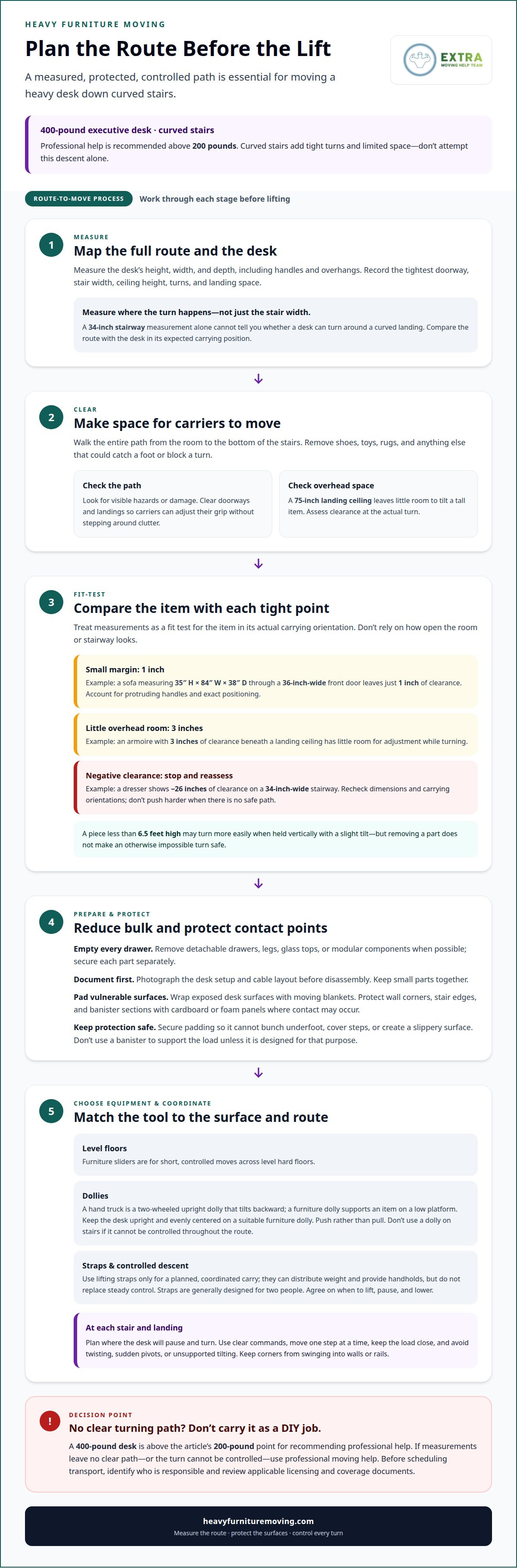
Measure the desk’s height, width, and depth, including handles and any overhang. Record doorway widths, stair width, ceiling height, and landing space at the tightest points. A 34-inch stairway measurement alone won’t show whether a desk can turn around a curved landing. Compare each measurement with the desk’s dimensions in the position you expect to carry it.
-
Clear the Furniture-Moving Route
Walk the route from the room to the bottom of the stairs. Remove shoes, toys, rugs, and anything else that could catch a foot or block a turn. Check for visible hazards or damage before moving heavy furniture. Clear the landing and doorway so carriers have room to adjust their grip without stepping around clutter.
-
Assess the Tight Staircase
Use the measurements to decide whether the desk can pass without forcing it against a wall or ceiling. A 75-inch landing ceiling, for example, leaves little room for a tall item to tilt. A piece less than 6.5 feet high may turn more easily when held vertically with a slight tilt. Don’t assume that removing a part makes an otherwise impossible turn safe.
- Prepare the desk before moving it. Empty every drawer, then remove detachable drawers, legs, glass tops, or modular components when possible. Take photos of the desk setup and cable layout before disassembly. Wrap exposed surfaces with moving blankets, and protect vulnerable wall edges with cardboard or foam panels. Keep small parts together so reassembly doesn’t delay clearing the route.
- For the descent, plan where the desk will pause and turn at each landing. Keep it controlled and close to the carriers, with no sudden pivots or unsupported tilting. Virginia licensing and insurance questions depend on the moving arrangement and who handles transport. For a Reston move, identify transport responsibility and review applicable licensing and coverage documents before scheduling. A 400-pound desk on curved stairs calls for professional help if measurements leave no clear turning path.
Treat the measurements as a fit test for the item in its actual carrying orientation, rather than relying on a room’s apparent openness. One example gives a sofa dimensions of 35" H / 84" W / 38" D; moving it through a 36-inch-wide front door leaves 1" of clearance. That small margin makes exact positioning and a clear approach important, so account for protruding handles and avoid assuming that a wide item will pass simply because its height fits. A separate example shows 3" of clearance between an armoire and a landing ceiling. Such narrow overhead space leaves little room for adjustment while turning, so compare the item and the route at the point where the turn occurs.
Negative clearance signals a mismatch, not a challenge to overcome by pushing harder: the dresser example has -26" of clearance on a 34-inch-wide stairway. Recheck dimensions and possible carrying orientations, and stop if there is no safe path. Before a heavy item goes onto stairs, check for structural problems and hazards, and remove rugs or obstacles that could cause trips. Clear toys, rugs, and shoes from the walkway as part of that preparation. Keeping the route open helps carriers maintain footing and focus on the turn instead of stepping around clutter.
Using dollies, straps, sliders, and protective materials
Choose equipment to suit the surface and route, and secure the desk before moving it. A dolly that works on a flat floor may not be suitable for curved stairs.
-
Protect Floors, Walls, and Stair Edges
Use furniture sliders for short, controlled moves across level hard floors. Use a dolly on the stairs only if it fits and can be controlled throughout the route. Protect exposed wall corners and stair edges with cardboard or foam panels where the desk might bump or scrape. Secure protective materials so they do not bunch underfoot or obstruct a landing.
-
Protect the Stairs and Banisters
Pad vulnerable banister sections and nearby walls with moving blankets before positioning the desk. Make sure the blankets stay in place without covering steps or creating a slippery surface. On a curved stair, the desk may pass close to the rails during turns, so keep padding between potential contact points and the furniture. Do not use a banister to support the load unless it is designed for that purpose.
- Match the equipment to the move. A hand truck is a two-wheeled upright dolly that tilts backward; a furniture dolly supports an item on a low platform. Keep the desk upright and evenly centered on a suitable furniture dolly, and secure bulky furniture with straps. Push rather than pull a dolly, and do not use it on stairs if its design prevents controlled movement.
- Use lifting straps only for a planned, coordinated carry. They can distribute weight and provide handholds, but they do not replace steady control. Straps are generally designed for two people, so carriers should agree when to lift, pause, and lower. Keep the desk close enough to guide without letting its corners swing into a wall or rail.
- Can an executive desk be disassembled to make it safer to move? Yes. Remove detachable parts, such as legs or a glass top, where possible, and secure each part separately. This can reduce bulk and make tight turns easier, but a heavy desk still needs a controlled moving plan.
- For a stair descent, a sturdy moving blanket or tarp can help protect the desk while carriers control its speed and direction using the corners. This method requires deliberate control, not a loose slide. Roller tracks or ramps attached to stairs can help large items glide, but curved steps and landings may limit their use. If the route needs coordinated heavy lifting, moving help for heavy furniture can take the strain off your muscles and reduce risky maneuvering.
When to hire professional movers for stairs or oversized desks
A 400-pound desk on curved stairs calls for a careful assessment before anyone lifts. Use the route, load, and ability to control the desk to decide whether friends can help safely.
-
Recognize When to Hire Professionals
Choose professional movers when the desk weighs over 200 pounds, or the staircase is narrow, steep, or difficult to navigate. Professional help is also recommended for moves to the third floor or higher. A curved landing can leave little room to turn, even when the desk fits through the doorway. Don’t start if the route offers no controlled way to pause or change direction.
-
Weigh the Risks of Moving Without Professionals
Assess the risks before asking friends to carry heavy items downstairs. A desk can shift, tip, or catch on a stair edge, upsetting the carriers’ balance and putting the person at the bottom under extra strain. A slip can injure someone or damage the desk, walls, stairs, or banister. More than 100,000 injuries each year are linked to carrying items such as furniture up or down stairs.
-
Arrange Help for the Move
Plan the crew around the desk’s weight, shape, and turning space. There’s no safe fixed headcount for every 400-pound desk; the route and equipment affect how many people can control it. Lifting straps are generally designed for two people, but a curved descent may need additional hands for guiding and clearing the path. Don’t treat that minimum as a complete crew plan.
- If friends are helping, assign positions before lifting. Have one person lead the commands, and make sure every carrier knows when to stop, lower, or turn. Keep the route clear for the person at the bottom, who may bear more of the load during a descent. If anyone cannot maintain a steady grip or move in sync, stop before the desk leaves its starting position.
- Use a professional crew when control depends on equipment or coordinated handling that your group can’t provide. A 400-pound executive desk exceeds the recommended threshold for professional help. Curved stairs add a turning challenge that makes moving furniture harder to manage easily with untrained helpers. Professional movers can assess the desk and route together, then plan a controlled descent rather than forcing a tight turn.
- Decide before moving day, not halfway down the stairs. Do not attempt a DIY carry if the desk cannot stay balanced through a landing, carriers lack secure footing, or there is no room to pause. For a heavy desk and curved staircase, professional help is the safer choice.
Using stair-climbing dollies and moving straps
Choose equipment for the desk’s weight and the route, not simply what is available. Curved stairs, corners, door frames, and carpet all affect how you can control the load.
-
Choose Moving Equipment
Use a stair-climbing dolly only if it fits the curved steps and landing. Confirm it is rated for the desk’s weight and can be controlled through every turn. A standard furniture dolly works on level floors, but stairs need a different plan. Use sliders on hard floors; do not assume they will glide safely over carpet or stair treads.
-
Use Moving Straps
Position straps as their design specifies, then secure them before lifting. Moving straps can distribute weight and provide handholds, but they do not replace coordination and steady control. Lifting straps are generally designed for two people. Agree on who gives commands, and stop if a strap slips, twists, or shifts the desk’s balance.
-
Guide the Desk Through Corners and Door Frames
Approach each corner slowly, with one person guiding the turn and another controlling the opposite end. Keep the desk supported as you change its angle; do not force it past a corner by scraping it against the frame. At a doorway, pause to check clearance on both sides. On carpet, avoid dragging the desk, which can catch and disrupt the move.
- Test the equipment on a clear, level area before bringing the desk to the stairs. Confirm that it stays centered and secure, and that each carrier can maintain a stable grip. Check for a doorway or landing where the dolly cannot turn. If the equipment compromises anyone’s footing or control, do not take it onto the stairs.
- Set a clear stop point before each turn. Use short commands such as “Stop,” “Turn,” and “Down,” and move only when everyone is ready. Keep straps taut enough to control the desk without jerking it. A stair-climbing dolly must remain under control at every step, especially when a curved tread changes direction.
- Consider an alternate route only after assessing the opening, landing area, and safe access from outside. Hoisting the desk through a window may avoid the curved stairs, but it requires suitable access and controlled lifting. Do not improvise a lift from a window or balcony. If neither route allows steady control, stop and arrange professional help.
Safe lifting and carrying techniques
Safe carrying depends on coordinated movement, secure footing, and a load people can control. A 400-pound desk on curved stairs leaves little room for sudden corrections. The answer to how to safely move a 400 lb executive desk down curved stairs in Reston starts with choosing control over speed.
- Wear sturdy, closed-toe shoes with good grip. Clear loose rugs and obstacles from every step, and make sure each carrier has a stable place to stand. Do not begin if shoes slide on the stairs or anyone cannot hold a secure position. Good footing is especially important before the desk’s weight shifts during a turn.
- Agree on a shared pace before lifting. Choose simple commands such as “Up,” “Down,” “Stop,” and “Turn,” and make sure anyone can call a stop. Move only when all carriers respond together. A sudden start or uneven step can shift the desk’s balance, especially where a curved stair narrows the available space.
- Bend your knees and keep your back straight as you lift with your legs. Hold the desk close rather than reaching forward with your shoulders. Keeping the load close can limit strain, but it does not make an extremely heavy item easy to carry. Do not twist your torso while lifting or changing direction.
- Descend slowly, one step at a time, testing each step with a foot before proceeding. Keep the desk controlled; do not drop it onto a tread or let it swing toward the banister. The person at the bottom bears more of the load during a descent, so they need secure footing and clear communication with the person guiding from above.
- Pause on a landing before changing direction. Keep the desk supported while carriers reset their grip and position their feet for the next section. If a narrow turn forces anyone to reach, twist, or lose balance, stop and reassess rather than pushing through. An awkward angle adds effort and makes the load harder to control.
- Keep drawers empty and remove detachable parts before the carry, so contents can’t slide and the desk has fewer loose components. A 400-pound desk still requires a professional plan, even after preparation. Don’t use strength alone to overcome a tight turn or unstable footing. A safe plan for how to safely move a 400 lb executive desk down curved stairs in Reston puts a controlled descent ahead of a DIY attempt.
Heavy Furniture Moving
Heavy Furniture Moving is a practical next step when a 400-pound desk and curved stairs make a DIY carry difficult to control. Its in-home furniture moving help is suited to challenging household moves involving bulky pieces and tight routes. Share the desk’s dimensions, the stair layout, and any narrow turns so the move can be approached with the route in mind. If the staircase doesn’t allow a steady, controlled descent, avoid forcing the desk through it. Contact Heavy Furniture Moving to discuss help with your desk move.
Make the Next Move a Planned One
For a desk this demanding, treat the decision as a matter of control, not a test of strength. If you’re weighing how to safely move a 400 lb executive desk down curved stairs in Reston, make your next step a clear plan for the desk and its route. Share the desk’s size, the stair configuration, and any tight turns so the move can be considered as a complete path, from the room to the destination.
Heavy Furniture Moving also offers Movers Near Me, Exercise Equipment Moving, and Sofa Hoisting. The company handles bulky household items and challenging moves. Arrange help before attempting a descent that feels difficult to control, and keep the desk safely in place until there is a clear plan.
Contact Heavy Furniture Moving for help with planning your desk move. A steady plan can make the next step feel more manageable.
Frequently Asked Questions
What equipment is needed to move heavy furniture down curved stairs?
Choose equipment suited to the load and stair shape: a stair-climbing dolly, secure moving straps, and protective blankets. A hand truck’s two wheels do not automatically make it suitable for a curved descent. The dolly must stay stable through the turn, not just on a straight stretch of stairs. Use floor sliders on level hard-floor sections, not on stair treads.
How do I measure a desk and curved staircase before moving?
Record the desk’s height, width, and depth, then measure the doorway and stair width at their narrowest points. Include the landing’s turning space and overhead clearance. Check whether door stops, hinges, or projecting trim reduce the usable opening. Sketch the route and note which edge of the desk must lead each turn. This gives the moving team a practical view of the route, beyond a single doorway measurement.
How do I protect curved stair treads, walls, and banisters during a heavy furniture move?
Cover exposed floors and vulnerable corners with stable protective materials, and pad banisters where the desk could make contact. Keep coverings off walking surfaces so they do not create slip or trip hazards. In a Reston home with a tight landing, protect the wall at the turn as well as the stair edge. Do not drag the desk across treads or scrape its corners against rails.
Which Reston, VA, movers handle heavy furniture on curved staircases?
Heavy Furniture Moving handles residential moves involving heavy, bulky furniture in Reston. Before lifting, the team measures item dimensions, doorways, and stairs to plan challenging routes. Wrap, blankets, and straps are included on every job, along with floor and corner protection. This preparation matters on curved stairs, where turning space is as important as stair width.
Frequently Asked Questions
Choose equipment suited to the load and stair shape: a stair-climbing dolly, secure moving straps, and protective blankets. A hand truck’s two wheels do not automatically make it suitable for a curved descent. The dolly must stay stable through the turn, not just on a straight stretch of stairs. Use floor sliders on level hard-floor sections, not on stair treads.
Record the desk’s height, width, and depth, then measure the doorway and stair width at their narrowest points. Include the landing’s turning space and overhead clearance. Check whether door stops, hinges, or projecting trim reduce the usable opening. Sketch the route and note which edge of the desk must lead each turn. This gives the moving team a practical view of the route, beyond a single doorway measurement.
Cover exposed floors and vulnerable corners with stable protective materials, and pad banisters where the desk could make contact. Keep coverings off walking surfaces so they do not create slip or trip hazards. In a Reston home with a tight landing, protect the wall at the turn as well as the stair edge. Do not drag the desk across treads or scrape its corners against rails.
Heavy Furniture Moving handles residential moves involving heavy, bulky furniture in Reston. Before lifting, the team measures item dimensions, doorways, and stairs to plan challenging routes. Wrap, blankets, and straps are included on every job, along with floor and corner protection. This preparation matters on curved stairs, where turning space is as important as stair width.