How to Hoist an Oversized Sectional Over a Balcony Without a Crane in McLean
What if the safest way to get a sectional upstairs starts with measuring, not lifting? If you're wondering how to hoist an oversized sectional over a balcony without a crane McLean homeowners should first assess the item and access route. A balcony can look like an easy way in, but door openings, railing layout, clearance, and the landing all affect whether hoisting is feasible.
It’s understandable to look for a way around a narrow stairwell. But improvised rigging can put people, the sectional, and your home at risk. This guide explains which access details matter, compares practical moving options, and shows how professional sofa hoisting can help you avoid a risky DIY attempt. Heavy Furniture Moving measures the item and access points before lifting, and wrap, blankets, straps, floor protection, and corner protection are included on every job. You’ll also learn which photos and measurements help prepare a clear quote and assessment.
Key Takeaways
- Learn which access conditions help determine whether a sectional can pass through a balcony opening.
- Compare an interior-route move, professional balcony hoisting, and situations that call for a different access plan.
- Prepare useful photos and measurements for a project-specific assessment.
- Approach how to hoist an oversized sectional over a balcony without a crane McLean without attempting risky DIY rigging.
- See which protective materials Heavy Furniture Moving includes with sofa hoisting.
Why an Oversized Sectional May Need Balcony Access in McLean
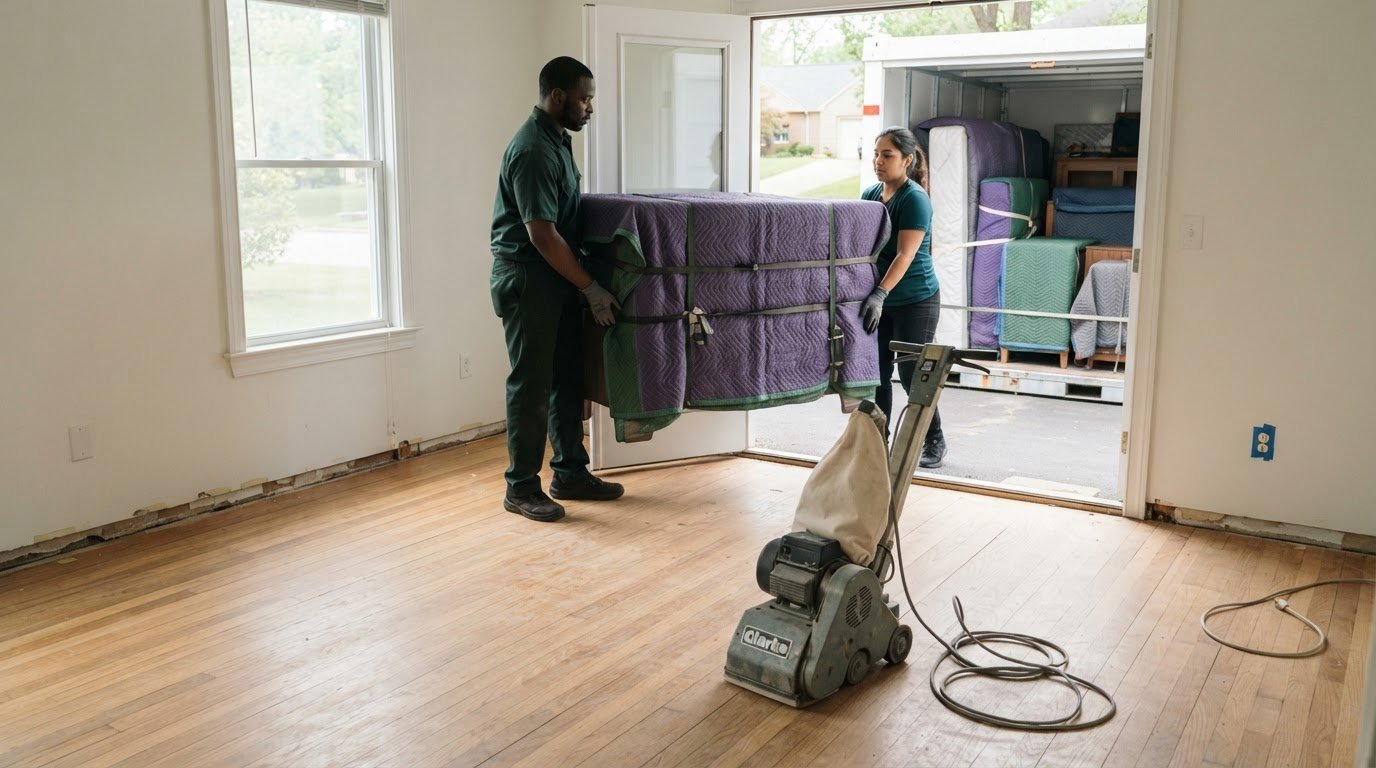
A sectional that stops at a doorway, won’t make a stair turn, or can’t enter the elevator can bring a move to a halt. If the interior route is unsuitable, balcony hoisting may provide another way to move the furniture through an exterior opening. The right approach depends on the sectional, the building, and the available access, not simply on whether the sofa looks as if it might fit.
In McLean, the assessment also needs to account for the specific building and property. Review building access, balcony clearance, and any property-manager requirements before planning the move. The route to the balcony matters too: an exterior opening won’t help if the sectional or crew can’t reach it safely from inside.
Which access problems make a sectional difficult to move indoors?
Assess the sectional and the route as parts of the same problem. The item’s length, depth, and height affect whether it can pass through an opening. Its configuration determines how much room is needed to turn or angle it. Some sectionals have separate pieces, while others may be difficult to separate, so don’t assume yours comes apart without checking.
Measure and review:
- Door-frame width and height, including the space available to maneuver near the opening.
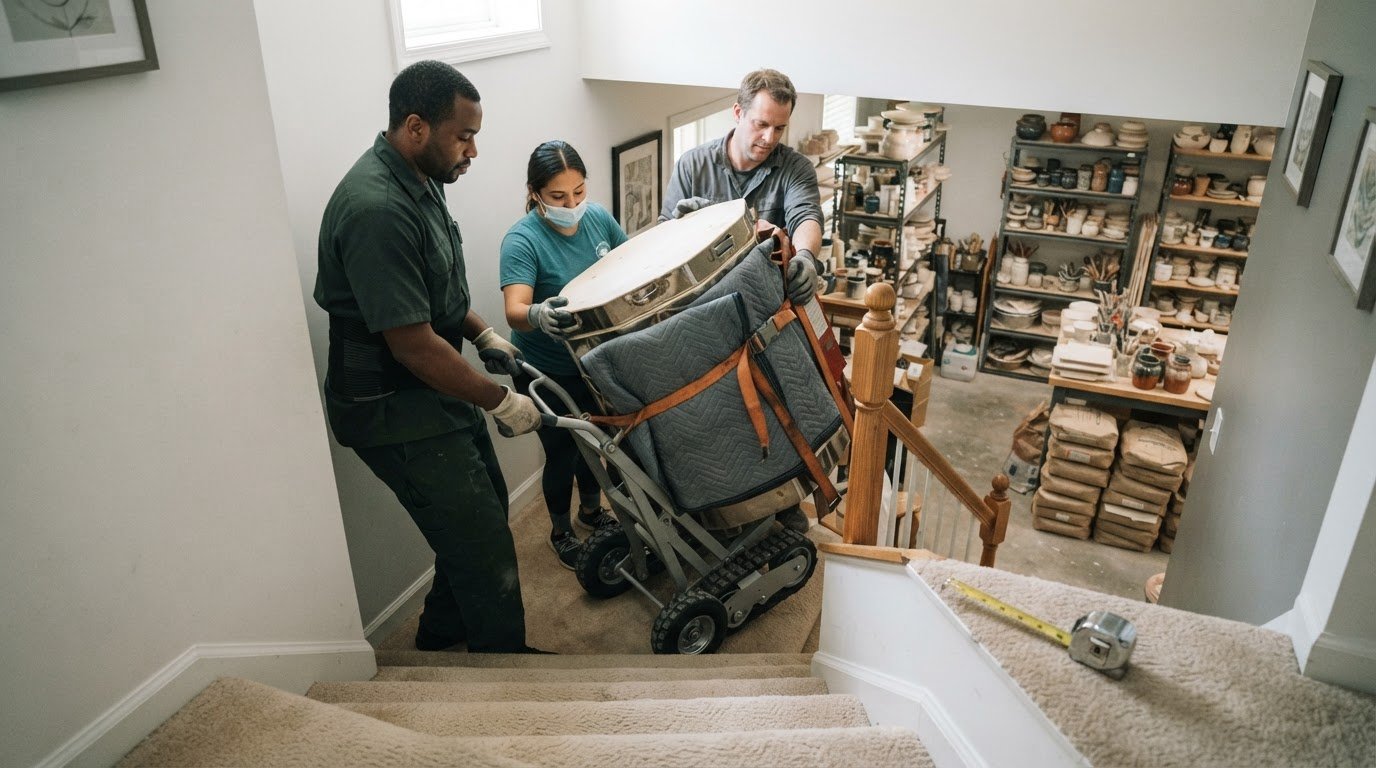
- Landing dimensions and stair turns, where a long or deep piece may run out of turning room.
- Elevator openings and interior clearance, not just the apparent size of the elevator.
- Ceiling clearance along the route, especially where a piece may need to be angled.
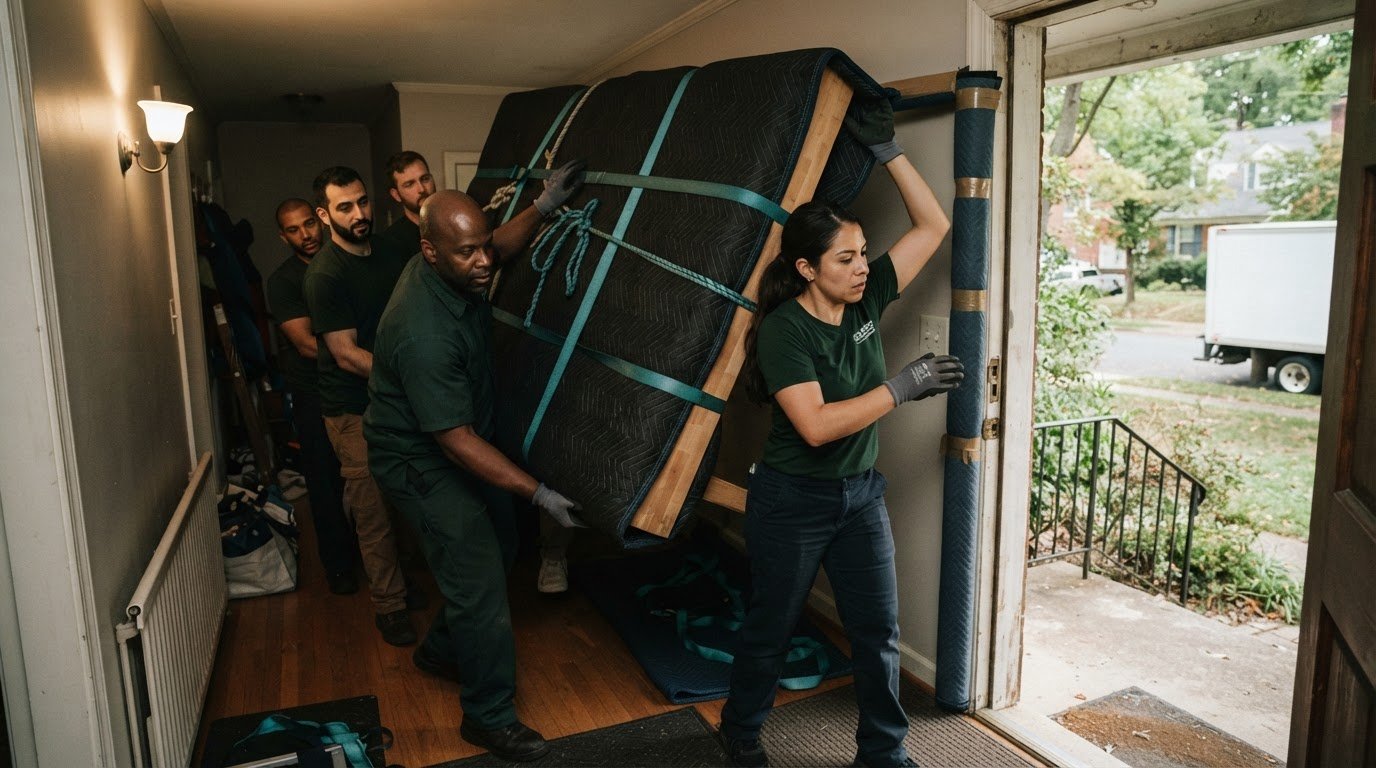
A route can look wide enough and still fail at a tight turn. Measure the sectional in its moving configuration and compare those dimensions with the narrowest points along the route.
What does crane-free balcony hoisting actually mean?
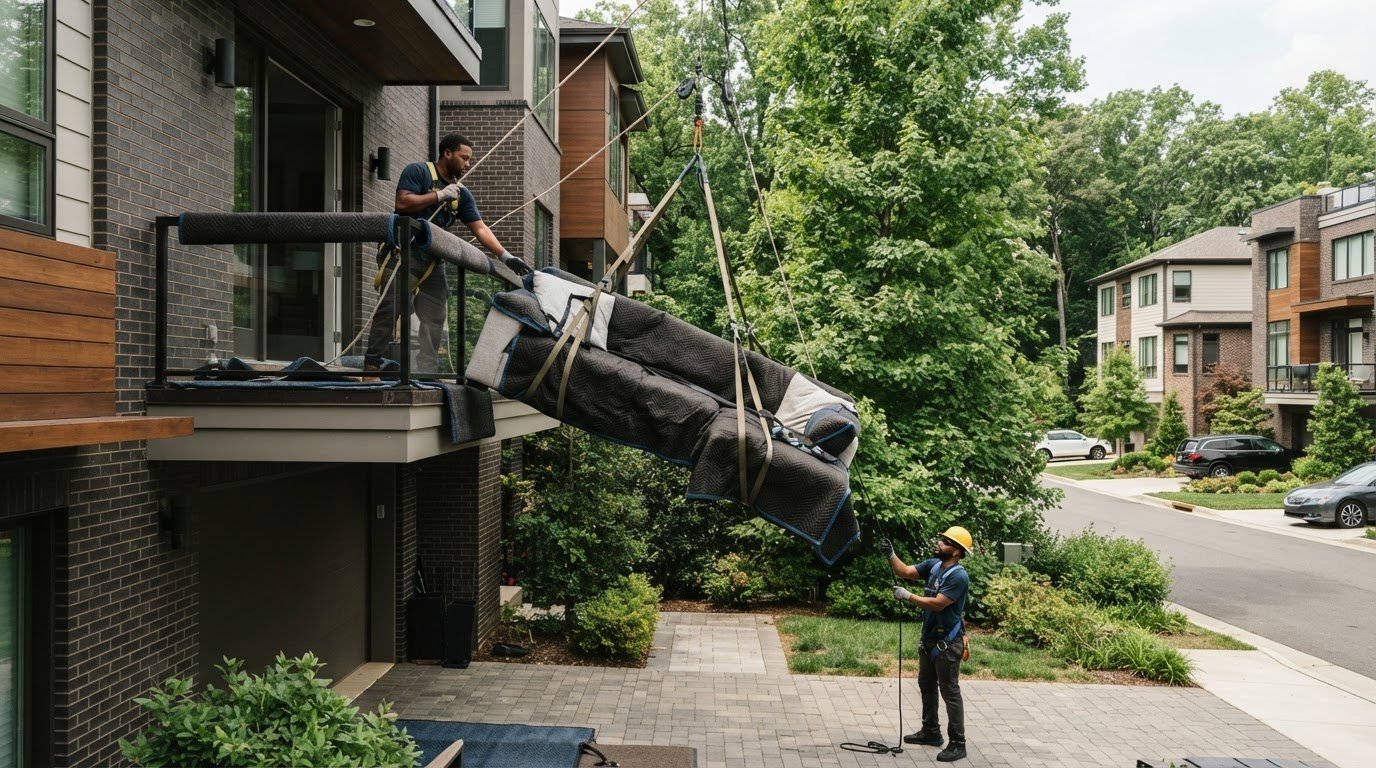
“Without a crane” describes the equipment involved. It doesn’t mean a homeowner should improvise a lift. Balcony hoisting requires a professional assessment of the item, building, opening, landing area, and surrounding obstacles. A block and tackle pulley system illustrates how pulleys can provide mechanical advantage, but understanding that principle doesn’t establish that a particular balcony lift is safe to attempt.
There’s no universal rope, pulley, or manual technique that suits every balcony. The railing, access above and below, nearby structures, and room to control the item all affect whether exterior access is workable. Leave rigging decisions to professional movers rather than testing a setup with people or property at risk.
Crane-free feasibility depends on a site-specific assessment, not sofa size alone. To assess how to hoist an oversized sectional over a balcony without a crane McLean homeowners should share the sectional’s dimensions and relevant access details. That information helps determine whether the interior route, balcony access, or another plan is practical.
How Professionals Assess a Crane-Free Sectional Hoist
A useful assessment starts with information, not a lift. Heavy Furniture Moving measures the sectional and access points before lifting, then uses those details to plan the move and prepare a quote. Photos can help the team understand the layout and provide a clearer estimate before the crew arrives.
What should you measure and photograph in McLean?
Gather details that show both the item and its full route. Measure each sectional piece in its moving configuration if it separates, and note the narrowest point along the path. Don’t assume the sectional comes apart. Describe the configuration you know.
- Record the sectional’s length, depth, and height, plus the dimensions of each separate piece.
- Measure the narrowest door, hallway, stairway, landing, elevator opening, and balcony opening along the route.
- Take clear photos of the sectional, interior approach, balcony access, railings, overhead obstructions, and ground-level work area.
- Note building access instructions or property-manager requirements that could affect the move.
Show the approach from more than one angle when possible. A photo that captures the balcony opening and surrounding space can reveal obstacles that a close-up won’t. Share your measurements and photos with Heavy Furniture Moving’s sofa hoisting team for a project-specific quote.
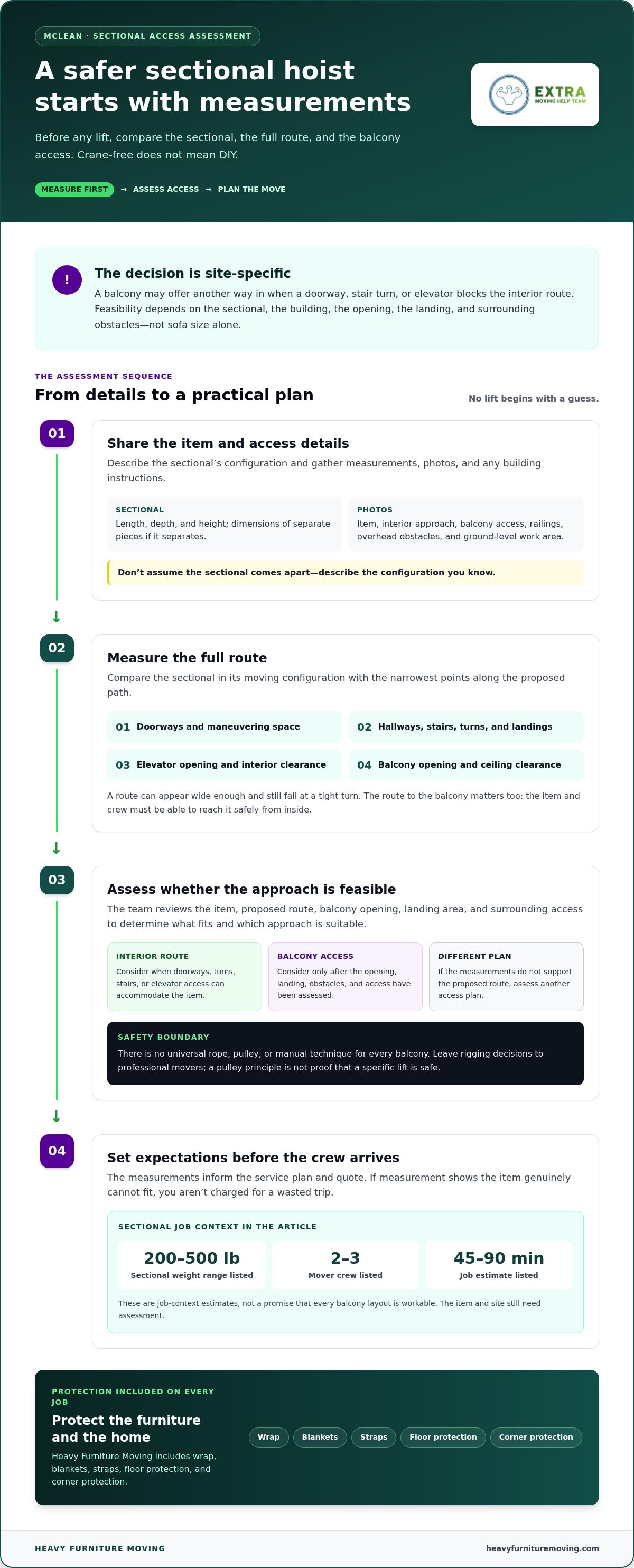
What happens during a measurement-first assessment?
The team compares the sectional’s dimensions with the doorways, stairs, balcony opening, landing area, and surrounding access. It also reviews whether the work area provides a suitable path for the planned approach. The aim is to determine what fits and establish an appropriate service plan before anyone begins moving the item.
- Review the item and access details. Share the sectional’s configuration, measurements, photos, and any building instructions.
- Measure the route. The crew measures the item, doorways, stairs, and access points before lifting.
- Assess feasibility. The measurements help determine whether the sectional can fit through the proposed route and which approach is suitable.
- Set expectations. The team provides a quote before the crew arrives. If measurement shows the item genuinely cannot fit, you aren’t charged for a wasted trip.
For context, sectionals are listed at 200 to 500 lb, with a 2 to 3 mover crew and a 45 to 90 minute job estimate. Those figures describe the sectional job, not a promise that every balcony layout is workable. The item and site still need assessment. OSHA’s rigging and material handling standards cover specific workplace requirements for slings and related equipment. They aren’t a DIY lifting guide.
For homeowners researching how to hoist an oversized sectional over a balcony without a crane McLean, the practical next step is to send clear photos and measurements, not test a rigging setup. A careful review helps establish whether the route is workable before the lift is planned.
Compare Sectional Moving Options When You Want to Avoid a Crane
A crane-free move is a preference, not a guarantee. The right option depends on whether the sectional and building access work together. Compare routes by fit, handling demands, and the protection required. A professional assessment can also show when neither the interior route nor balcony access is suitable as planned.
| Option | Access fit | Property protection | Handling complexity | Specialist help |
|---|---|---|---|---|
| Interior-route move | Works when the sectional or its separate pieces can pass through doors, halls, stairs, or an elevator and make each turn. | Careful handling is still needed around walls, floors, door frames, and stair edges. | Can be straightforward when the route has enough clearance. Tight turns or landings make it more challenging. | Use professional movers for heavy or awkward pieces, especially on a tight route. |
| Professional balcony hoisting | May suit a layout where interior access is restrictive and the balcony opening and landing are workable. | Heavy Furniture Moving includes wrap, blankets, straps, floor protection, and corner protection on every job. | Requires review of the item, balcony, opening, work area, and surrounding obstacles. | Yes. This is specialist-managed work, not a homeowner rigging project. |
| Different access plan | May be needed if measurements or site conditions rule out the proposed interior or balcony route. | Protection needs depend on the route and plan selected after assessment. | Requires a fresh assessment of feasible access. Don’t force a route that doesn’t fit. | Yes. A professional assessment helps determine a suitable next step. |
When might an interior route remain a practical option?
An interior move may work if the sectional’s components and the route’s clearances allow the pieces to pass and turn without forcing them through narrow points. When the route is genuinely workable, it may be simpler than exterior access. Sofa-leg disassembly and reassembly are included when needed, but that doesn’t mean every sectional separates into smaller pieces.
When should balcony access be assessed by a professional?
Arrange an assessment if a restrictive doorway, tight stair turn, or oversized assembled section blocks the indoor route. Balcony access needs its own review: the opening, balcony, clearance, landing, and work area all affect feasibility. The assessment may show that another access plan is needed. Don’t try to solve a difficult layout by improvising rigging.
For anyone asking how to hoist an oversized sectional over a balcony without a crane McLean, the useful comparison is not simply “crane or no crane.” It’s which route can be assessed as workable for this item and property. Share the access details with Heavy Furniture Moving, then use the assessment to plan the move instead of assuming a crane-free lift will suit every site.
Prepare Your McLean Balcony and Sectional for a Safe Assessment
A little preparation makes it easier to understand the access route and provide a useful quote. You don’t need to move the sectional or alter the balcony before the assessment. Share clear details, keep the route visible, and note any building instructions that could affect access.
What should be cleared before the crew arrives?
Clear loose belongings from the indoor route and balcony work area so the access points and surrounding space are easy to see. Keep doorways, stair landings, and the balcony opening unobstructed. Don’t remove balcony fixtures, adjust railings, or alter building components. Leave them as they are so the team can assess the actual site conditions.
- Move small furniture, boxes, planters, and other loose items away from the route and work area.
- Keep the entry, stairs, landings, and balcony opening visible instead of stacking belongings beside them.
- Note building access instructions, entry arrangements, or property-manager requirements relevant to the visit.
- Describe the sectional’s current configuration. Don’t take it apart just to prepare for an assessment.
- Point out features that could affect access, such as a narrow landing, a balcony door that opens into the space, or an overhead obstruction.
A clear work area helps the crew see where access narrows and what could get in the way. It also reduces confusion between the route shown in photos and the space the team encounters on site. You don’t need to move anything that would be unsafe or difficult to handle. Describe the situation when you share the details.
What should you share when requesting a quote?
Send a photo of the sectional and clear photos of the stairs, landings, and balcony access you’re considering. Include multiple angles if one view doesn’t show the route. Add the sectional’s dimensions and any access notes, along with building or property-manager instructions. These details help Heavy Furniture Moving understand the job and provide a real number in minutes from the information supplied.
Stairs and landings are priced before the crew arrives, so include those parts of the route in your description and photos. If you’re unsure whether a detail matters, mention it rather than leaving out a potential obstacle. Photos don’t replace measurement before lifting, but they give the team a clearer basis for preparing the quote and assessment.
For a project-specific quote, send a sectional photo and access details. Clear information is a practical first step for anyone planning how to hoist an oversized sectional over a balcony without a crane McLean. It keeps the assessment focused on the actual home and route.
Arrange Professional Sectional Hoisting in McLean Without Guesswork
Once the access route and balcony conditions are understood, professional sofa hoisting is a practical next step. Heavy Furniture Moving serves McLean with a uniformed, background-checked crew that measures the item and access points before lifting. That keeps the plan grounded in the actual sectional and property, rather than a guess about whether an improvised lift might work.
What to expect from Heavy Furniture Moving
The crew measures the sectional and access points before lifting, then prices stairs and landings in advance. Sectionals have a planning range of 200 to 500 lb, with 2 to 3 movers and a 45 to 90 minute job estimate. These figures help frame the work, but the assessment determines the suitable approach for your home.
Wrap, blankets, straps, floor protection, and corner protection are included on every job. Sofa-leg disassembly and reassembly are included when needed. If measurement shows the item genuinely cannot fit, you aren’t charged for a wasted trip.
There’s a 2-hour booking minimum. Heavy Furniture Moving offers hourly labor and flat rates for most single heavy items, with the price provided up front on the phone. Labor-only service is also available when you provide your own truck, pod, or container. The quote is based on the item and access details, including stairs or landings.
How to take the next step in McLean
Text a photo of the sectional and access route to 703-747-9224. Include photos of the stairs, landings, or balcony approach, plus any measurements and building access notes you have. A clear view of the item and route helps Heavy Furniture Moving prepare a project-specific quote and plan around the actual conditions.
Same-day and next-day heavy-item jobs are often available when slots are open. For same-afternoon service, call before 2 PM. Share the access details early so the team can discuss the project and scheduling. Don’t begin rigging or lifting while you wait. Leave that work to the crew after the measurements and access plan are reviewed.
Heavy Furniture Moving serves McLean and nearby communities, including Fairfax, Woodbridge, Manassas, Manassas Park, Aldie, Ashburn, Vienna, Reston, Centreville, Chantilly, Clifton, Dumfries, South Riding, Fairfax Station, Haymarket, and Gainesville.
To arrange professional sectional hoisting in McLean, contact Heavy Furniture Moving about sectional hoisting. Send the photos and describe the route so the team can help turn a difficult access problem into a measured plan.
Take the Next Step With a Clear Plan
Before deciding how to hoist an oversized sectional over a balcony without a crane McLean, turn uncertainty into a practical next step: share the sectional’s details and have the route assessed. A careful plan starts with the actual home, not a guess based on the sofa’s appearance. Keep the balcony and interior access unchanged, and leave lifting and rigging decisions to the crew.
Heavy Furniture Moving is veteran-family owned and operated, with 500+ verified five-star reviews and a 4.9 Google rating. The team focuses on your specific sectional and access conditions to make a challenging furniture move more manageable.
Send a photo and describe the route so the team can help plan what comes next. Send a photo and get help planning your sectional move. With an assessment of the actual access, you can move forward with a clear plan.
Frequently Asked Questions
Can you hoist an oversized sectional over a balcony without a crane?
It may be possible if a professional assessment finds the item, balcony, opening, and work area suitable. A balcony alone doesn’t guarantee a workable route. For planning how to hoist an oversized sectional over a balcony without a crane, McLean homeowners should share building access details and any property-manager instructions. If the conditions don’t support that approach, the assessment can help determine another plan.
Is it safe to hoist a sectional over a balcony by yourself?
No. Don’t attempt a balcony hoist by yourself or recruit friends to improvise a lifting setup. A sectional can shift, catch on the opening, or be difficult to control, putting people and property at risk. Crane-free doesn’t mean risk-free, and no single rope or pulley arrangement suits every building. Leave the assessment and lifting plan to professionals who can review the item and site conditions.
What photos should I send for a sectional hoisting quote in McLean?
Send a clear photo of the sectional and views of the route you’re considering. Include the stairway, landings, balcony opening, railings, overhead space, and area below the balcony. If the sectional has separate pieces, photograph them and describe how they connect. Add dimensions if you have them, and mention obstacles or building access instructions that photos may not show.
Do I need to empty or disassemble a sectional before it is moved?
Usually, you don’t need to empty a sectional. Avoid taking it apart before the crew assesses its configuration and access route. If sofa legs need to come off for the job, their disassembly and reassembly are included. Don’t assume the main sections separate or force a connection apart. Describe the model and any known removable parts when arranging the move.
What happens if the sectional cannot fit after it has been measured?
If measurement shows the sectional genuinely cannot fit through the assessed route, Heavy Furniture Moving won’t charge you for a wasted trip. The crew measures before lifting, so the decision is based on the item and access rather than guesswork. The crew won’t force a piece through a route that doesn’t work. You can then consider a different access plan.
Can I request same-day sectional moving help in McLean?
Yes, same-day and next-day heavy-item jobs are often available when slots are open. For same-afternoon service, call before 2 PM. Share the sectional and access details when you reach out so the team can understand the job. If your timing is flexible, you can also discuss another available date.
How long does a sectional moving job usually take?
A sectional job is estimated at 45 to 90 minutes, with a 2 to 3 mover crew for sectionals in the 200 to 500 lb range. That estimate refers to the sectional job, not the full booking window. Stair access, landings, and the route to the destination affect the work involved, so provide those details when requesting a quote and planning the move.
Frequently Asked Questions
Assess the sectional and the route as parts of the same problem. The item’s length, depth, and height affect whether it can pass through an opening. Its configuration determines how much room is needed to turn or angle it. Some sectionals have separate pieces, while others may be difficult to separate, so don’t assume yours comes apart without checking. Measure and review: A route can look wide enough and still fail at a tight turn. Measure the sectional in its moving configuration and compare those dimensions with the narrowest points along the route.
“Without a crane” describes the equipment involved. It doesn’t mean a homeowner should improvise a lift. Balcony hoisting requires a professional assessment of the item, building, opening, landing area, and surrounding obstacles. A block and tackle pulley system illustrates how pulleys can provide mechanical advantage, but understanding that principle doesn’t establish that a particular balcony lift is safe to attempt. There’s no universal rope, pulley, or manual technique that suits every balcony. The railing, access above and below, nearby structures, and room to control the item all affect whether exterior access is workable. Leave rigging decisions to professional movers rather than testing a setup with people or property at risk. Crane-free feasibility depends on a site-specific assessment, not sofa size alone. To assess how to hoist an oversized sectional over a balcony without a crane McLean homeowners should share the sectional’s dimensions and relevant access details. That information helps determine whether the interior route, balcony access, or another plan is practical. A useful assessment starts with information, not a lift. Heavy Furniture Moving measures the sectional and access points before lifting, then uses those details to plan the move and prepare a quote. Photos can help the team understand the layout and provide a clearer estimate before the crew arrives.
Gather details that show both the item and its full route. Measure each sectional piece in its moving configuration if it separates, and note the narrowest point along the path. Don’t assume the sectional comes apart. Describe the configuration you know. Show the approach from more than one angle when possible. A photo that captures the balcony opening and surrounding space can reveal obstacles that a close-up won’t. Share your measurements and photos with Heavy Furniture Moving’s sofa hoisting team for a project-specific quote.
The team compares the sectional’s dimensions with the doorways, stairs, balcony opening, landing area, and surrounding access. It also reviews whether the work area provides a suitable path for the planned approach. The aim is to determine what fits and establish an appropriate service plan before anyone begins moving the item. For context, sectionals are listed at 200 to 500 lb, with a 2 to 3 mover crew and a 45 to 90 minute job estimate. Those figures describe the sectional job, not a promise that every balcony layout is workable. The item and site still need assessment. OSHA’s rigging and material handling standards cover specific workplace requirements for slings and related equipment. They aren’t a DIY lifting guide. For homeowners researching how to hoist an oversized sectional over a balcony without a crane McLean, the practical next step is to send clear photos and measurements, not test a rigging setup. A careful review helps establish whether the route is workable before the lift is planned. A crane-free move is a preference, not a guarantee. The right option depends on whether the sectional and building access work together. Compare routes by fit, handling demands, and the protection required. A professional assessment can also show when neither the interior route nor balcony access is suitable as planned.
An interior move may work if the sectional’s components and the route’s clearances allow the pieces to pass and turn without forcing them through narrow points. When the route is genuinely workable, it may be simpler than exterior access. Sofa-leg disassembly and reassembly are included when needed, but that doesn’t mean every sectional separates into smaller pieces.
Arrange an assessment if a restrictive doorway, tight stair turn, or oversized assembled section blocks the indoor route. Balcony access needs its own review: the opening, balcony, clearance, landing, and work area all affect feasibility. The assessment may show that another access plan is needed. Don’t try to solve a difficult layout by improvising rigging. For anyone asking how to hoist an oversized sectional over a balcony without a crane McLean, the useful comparison is not simply “crane or no crane.” It’s which route can be assessed as workable for this item and property. Share the access details with Heavy Furniture Moving, then use the assessment to plan the move instead of assuming a crane-free lift will suit every site. A little preparation makes it easier to understand the access route and provide a useful quote. You don’t need to move the sectional or alter the balcony before the assessment. Share clear details, keep the route visible, and note any building instructions that could affect access.
Clear loose belongings from the indoor route and balcony work area so the access points and surrounding space are easy to see. Keep doorways, stair landings, and the balcony opening unobstructed. Don’t remove balcony fixtures, adjust railings, or alter building components. Leave them as they are so the team can assess the actual site conditions. A clear work area helps the crew see where access narrows and what could get in the way. It also reduces confusion between the route shown in photos and the space the team encounters on site. You don’t need to move anything that would be unsafe or difficult to handle. Describe the situation when you share the details.
Send a photo of the sectional and clear photos of the stairs, landings, and balcony access you’re considering. Include multiple angles if one view doesn’t show the route. Add the sectional’s dimensions and any access notes, along with building or property-manager instructions. These details help Heavy Furniture Moving understand the job and provide a real number in minutes from the information supplied. Stairs and landings are priced before the crew arrives, so include those parts of the route in your description and photos. If you’re unsure whether a detail matters, mention it rather than leaving out a potential obstacle. Photos don’t replace measurement before lifting, but they give the team a clearer basis for preparing the quote and assessment. For a project-specific quote, send a sectional photo and access details. Clear information is a practical first step for anyone planning how to hoist an oversized sectional over a balcony without a crane McLean. It keeps the assessment focused on the actual home and route. Once the access route and balcony conditions are understood, professional sofa hoisting is a practical next step. Heavy Furniture Moving serves McLean with a uniformed, background-checked crew that measures the item and access points before lifting. That keeps the plan grounded in the actual sectional and property, rather than a guess about whether an improvised lift might work.
It may be possible if a professional assessment finds the item, balcony, opening, and work area suitable. A balcony alone doesn’t guarantee a workable route. For planning how to hoist an oversized sectional over a balcony without a crane, McLean homeowners should share building access details and any property-manager instructions. If the conditions don’t support that approach, the assessment can help determine another plan.
No. Don’t attempt a balcony hoist by yourself or recruit friends to improvise a lifting setup. A sectional can shift, catch on the opening, or be difficult to control, putting people and property at risk. Crane-free doesn’t mean risk-free, and no single rope or pulley arrangement suits every building. Leave the assessment and lifting plan to professionals who can review the item and site conditions.
Send a clear photo of the sectional and views of the route you’re considering. Include the stairway, landings, balcony opening, railings, overhead space, and area below the balcony. If the sectional has separate pieces, photograph them and describe how they connect. Add dimensions if you have them, and mention obstacles or building access instructions that photos may not show.
Usually, you don’t need to empty a sectional. Avoid taking it apart before the crew assesses its configuration and access route. If sofa legs need to come off for the job, their disassembly and reassembly are included. Don’t assume the main sections separate or force a connection apart. Describe the model and any known removable parts when arranging the move.
If measurement shows the sectional genuinely cannot fit through the assessed route, Heavy Furniture Moving won’t charge you for a wasted trip. The crew measures before lifting, so the decision is based on the item and access rather than guesswork. The crew won’t force a piece through a route that doesn’t work. You can then consider a different access plan.
Yes, same-day and next-day heavy-item jobs are often available when slots are open. For same-afternoon service, call before 2 PM. Share the sectional and access details when you reach out so the team can understand the job. If your timing is flexible, you can also discuss another available date.
A sectional job is estimated at 45 to 90 minutes, with a 2 to 3 mover crew for sectionals in the 200 to 500 lb range. That estimate refers to the sectional job, not the full booking window. Stair access, landings, and the route to the destination affect the work involved, so provide those details when requesting a quote and planning the move.