How to Hoist an L-Shaped Leather Couch Through Second-Story French Doors in Vienna
A couch that won’t fit through the front door may still have a workable route through second-story French doors. To plan how to hoist an L-shaped leather couch through second-story French doors in Vienna, measure the couch, the fully opened doorway, and every turn along the route. Standard doorways are 30-36 inches wide, but the actual clear opening and the couch’s shape determine whether it can pass.
It’s easy to focus on the French doors and overlook a tight hallway, stair landing, balcony edge, or overhead obstruction that could block the move. Measure the full route before lifting to catch problems early, protect the leather from scrapes, and avoid forcing the couch through a space that cannot safely accommodate it.
This guide explains how to measure the couch and its route, assess clearance at the French doors, and consider the risks of a second-story hoist. You’ll also learn when tight angles or difficult access make professional sofa-hoisting help a safer choice than a DIY attempt.
Key Takeaways
- Map every doorway, hallway, landing, stair, and turn so you can spot tight points before moving the couch.
- Measure the sofa in its moving configuration, including its longest and tallest dimensions, and compare them with the route’s narrowest clearances.
- Consider removing hinges or door stops only when it can be done safely and without damaging the frame.
- Know when a vertical pivot may help, and stop if the couch’s weight or angle becomes difficult to control.
- For a challenging second-story lift, sofa-hoisting help can take the strain out of maneuvering a bulky couch through French doors.
Doorway, hallway, corner, and stair measurements
To prepare an L-shaped leather couch for moving, remove loose cushions and check whether its sections are connected. If they separate, release the fasteners according to the couch’s assembly instructions, then protect the exposed leather before moving each section.
- Measure the French doors at their narrowest point. Open both doors fully. Measure the clear width between the closest fixed edges, not the door panels. Standard doorways are 30-36 inches wide, but your actual opening may differ. Record the opening’s height, too. Note handles, locks, and any raised threshold that reduces usable space.
- Measure the hallway where the couch must pass. Use a tape measure to record the narrowest wall-to-wall width. Check the full hallway, including spots beside radiators, built-ins, and open doors. A clear doorway can lead into a tighter passage. Compare the route’s tightest width with the couch section you plan to carry.
- Check each corner from more than one angle. Measure the open floor space at the turn, then note nearby walls, railings, and door frames. A long couch section may need room to swing while turning. Stand at the corner and trace the intended path with your hands, keeping the couch’s length and depth in mind.
- Measure stair width and landing space. Record the clear width between the stair walls or rails. Check the landing above and below the staircase, including its depth and ceiling clearance. Look for low ceilings, light fixtures, and railings that could block a tilted section. A narrow landing can prevent a turn even when the stairs fit.
- Include the approach to the second-story doors. Measure from the stair landing to the French-door opening. Look for sharp turns, narrow corridors, and ceiling features along that stretch. Check how far the doors open and whether nearby walls limit positioning. The couch needs space to line up before anyone starts lifting.
- Write down each measurement and mark the route. Label your notes “door,” “hall,” “turn,” “stairs,” and “landing.” Use painter’s tape to mark tight widths on the floor, where it won’t damage the surface. Compare those points with the couch’s longest section and its depth, not just its overall footprint.
- Recheck measurements before moving the couch. Measure with obstacles removed, doors fully open, and the route in its planned condition. Keep the tape measure nearby during setup. If a stair rail, door handle, or hallway corner changes the clear path, update your notes before carrying any section toward the second-story French doors.
Measuring a sofa and the full delivery route
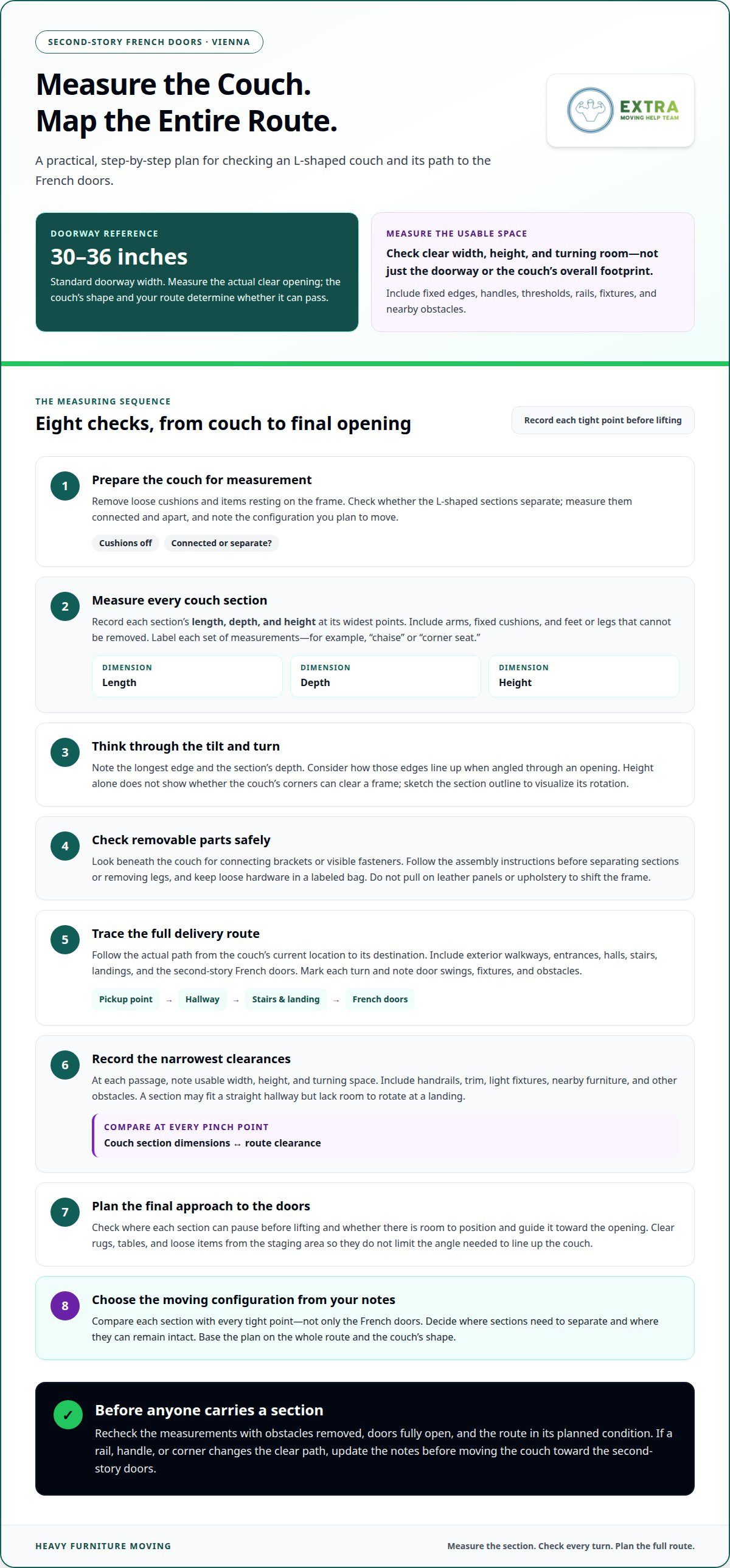
Measure each couch section, then map the full route. To plan how to hoist an L-shaped leather couch through second-story French doors in Vienna, compare the shape of each piece with every narrow passage and turn.
- Prepare the couch for measurement. Remove loose cushions and items resting on the frame. Check whether the L-shaped sections separate, and measure them connected and apart. Record which configuration you plan to move. A connected sectional can have a different turning profile than separate pieces.
- Measure each section’s key dimensions. Use a tape measure to record length, depth, and height. Measure the widest points, including arms and fixed cushions. Include feet or legs if they cannot be removed. Label each set of figures clearly, such as “chaise,” “corner seat,” or “arm section.”
- Check how the couch changes when tilted. Note the longest edge and the section’s depth. Consider how those edges align when angled through an opening. An upright height alone won’t show whether corners can clear a frame. Sketch the section’s outline to visualize how its shape may rotate.
- Identify removable parts without forcing them. Look beneath the couch for connecting brackets or visible fasteners. Read the assembly instructions before separating sections or removing legs. Place loose hardware in a labeled bag. Don’t pull on leather panels or upholstery to shift the frame.
- Trace the route from the pickup point. Follow the actual path from the couch’s current location to its destination. Include exterior walkways, entrances, halls, stairs, landings, and the French doors. Mark each turn on a sketch. Note door swings, fixtures, and obstacles that could affect positioning.
- Record each route’s tightest clearances. At every passage, note usable width, height, and turning space. Include handrails, trim, light fixtures, and nearby furniture. A couch section may pass through a straight hall but lack room to rotate at a landing. Compare each obstacle with the section’s dimensions.
- Plan the final approach to the doors. Check where each section can pause before lifting. Allow room to position and guide it toward the opening. Clear rugs, tables, and loose items from the staging area. A blocked approach can limit the angle needed to line up the couch.
- Use your notes to choose the moving configuration. Compare each couch section with every tight point, not only the doorway. Decide where sections need separation and where they can remain intact. A plan for how to hoist an L-shaped leather couch through second-story French doors in Vienna should account for the entire route. If extra hands are needed, heavy lifting moving help can support the move.
Removing hinges and door stops for extra clearance
- Confirm the doorway is the actual pinch point. Compare its clear opening with the couch section’s moving dimensions. Check the hallway and landing, too. Removing hardware won’t solve a tight turn beyond the French doors. Mark the specific edge that blocks passage, such as a hinge barrel or projecting door stop.
- Measure the opening before changing anything. Record the current clear width and height with both doors fully open. Removing door hinges can free about ½ inch of width. Removing door stops can add another inch of width and ½ inch of height. These gains depend on the doorway’s construction.
- Decide whether the extra space addresses the problem. Compare the measurements with the couch’s widest edge and planned angle. Removing hinges and door stops can provide up to 1.5 inches of clearance. That figure is not a guarantee for every opening. A tight corner or a projecting handle may still control the route.
- Inspect the hinges and door before removing them. Check how the French-door panels are supported and where each hinge attaches. Identify which panel would need to move, and clear its swing area. Don’t start with a loaded or unstable door. Keep the couch away from the opening until the doorway is ready.
- Remove door panels only with controlled support. Have another person steady the panel while its hinge pins or fasteners are handled. Set removed hardware together, and place the panel on a protected surface. Don’t let a detached door lean in the route. If the panel feels difficult to control, stop rather than forcing the removal.
- Assess the door stops before loosening them. Door stops are trim pieces attached around the frame. Look for paint, caulk, or finish that could tear when the trim moves. Use suitable hand tools carefully, and work gradually. Avoid prying against the leather couch, glass, or finished frame.
- Re-measure the clear opening after removal. Measure the usable width and height again, including any remaining hinge parts or frame projections. Compare those figures with the couch’s planned path. Don’t count space hidden behind trim as usable clearance if the couch cannot pass through it.
- Restore the doorway after the move. Keep hinges, pins, screws, and trim together for reassembly. Return each door panel and stop to its original position, then check that the doors open and close properly. If hardware removal risks damage or leaves the panel hard to control, use another route instead.
Risks of DIY furniture maneuvering
Before lifting, weigh the load, route, public-space setup, and leather protection plan.
Assess DIY Maneuvering Risks
Walk through the planned carry without lifting the couch. Check footing and hand positions, and agree on clear communication between helpers. A sectional can shift as its weight changes during a turn. Don’t proceed if anyone would need to twist, reach awkwardly, or lose sight of the couch’s corners.
- Identify pinch points. Mark the French-door frame, landing edges, and railing posts. Those spots can trap fingers or scrape the couch.
- Plan commands. Choose one person to call each pause, lift, and movement. Stop if helpers can’t respond together.
- Account for falling hazards. Keep people clear below the second-story opening. Never lean out or rely on a single grip to control the couch.
A 2025 Furniture Today report found that 18% of U.S. delivery claims involved maneuvering damage. Treat a leather gouge, damaged frame, or dropped section as real risks, not minor setbacks.
Check Vienna Hoisting Rules
Distinguish a lift on private property from one involving a sidewalk, street, or crane. Whether permission is required depends on where equipment will be placed and whether public passage is affected. Plan the setup around these details before placing equipment or restricting access.
- Map the equipment footprint. Mark where a lift device, supports, and helpers would stand. Note any part extending onto a sidewalk or street.
- Check the public route. Identify whether pedestrians, vehicles, or building entrances could be blocked. Keep the hoisting path distinct from their route.
- Define the crane path. Record where the crane would sit and where its load would travel. Avoid assuming a private doorway makes public-space use irrelevant.
For a Vienna home, include the building entrance and curbside approach in your assessment. A crane reaching over a public area raises different access questions than a lift from a private balcony. Plan the setup before moving the couch outside.
Protect the Leather Couch During Hoisting
Cover the couch before moving it near a doorway or exterior wall. Rough edges, hardware, and grit can scratch leather. A second-story lift also exposes the couch to wind and precipitation, so keep its surface covered and the route clear.
- Use clean, smooth padding. Place moving blankets over arms, corners, and contact points. Remove dirt or grit first, since particles can rub against leather.
- Secure the cover carefully. Keep straps and fasteners away from exposed leather. Don’t attach adhesive directly to the upholstery or pull tightly across seams.
- Protect against weather. Keep the couch under cover while staging. If rain or wind reaches the lifting area, pause and protect the furniture before continuing.
During the lift, watch for contact with the door frame, balcony edge, and hoisting lines. Assign a spotter to monitor these points, and stop if the couch swings or its cover shifts.
Using a vertical pivot to maneuver a sofa
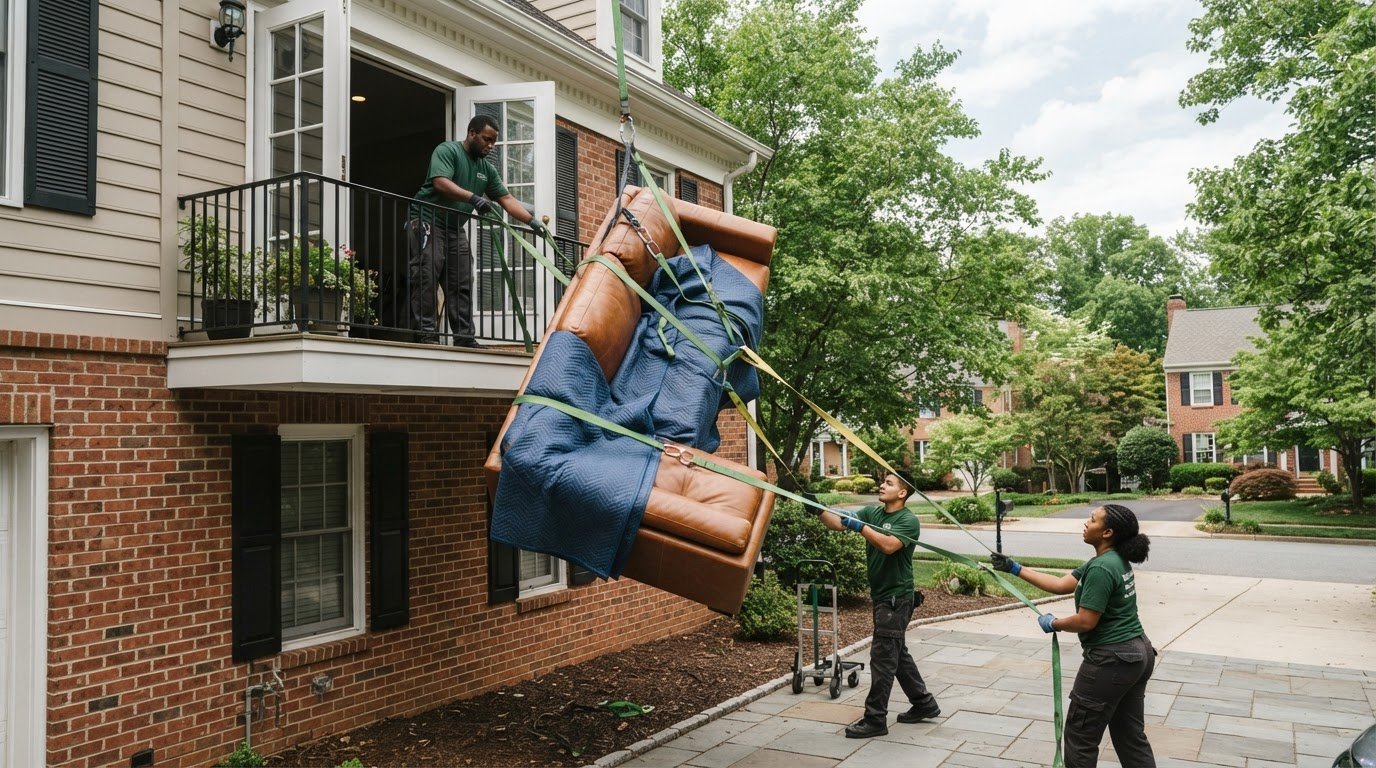
A vertical pivot changes the sofa’s angle to help it clear a tight opening. For a second-story lift, use a trained crew, suitable lifting gear, and a controlled path.
Hoist Furniture Safely to French Doors
Start the lift only when the landing, doorway, and path are clear. Keep the couch controlled throughout, and never use a balcony railing as an anchor. Plan any vertical pivot around the couch’s frame, balance, and the opening rather than improvising midair.
- Choose a stable starting position. Place the sofa section on a protected surface below the French doors. Remove loose cushions that could shift. Confirm its frame can handle the planned orientation.
- Assign clear roles. One person should direct movement, while others guide the load. Agree on simple commands such as “hold,” “lower,” and “stop.” Keep everyone’s hands clear of door edges.
- Control the pivot gradually. Change the couch’s angle in small, coordinated movements. Keep it from swinging into the wall, balcony, or frame. Pause if the load twists or becomes difficult to steady.
- Keep the opening and landing clear. Remove furniture, rugs, and loose items from the receiving area. Make sure the people guiding the couch can step back without crossing paths.
Gather Hoisting Equipment
Choose equipment to suit the couch, lift path, and anchor arrangement. A heavy sectional may require lifting straps, a suitable hoist, protective padding, and gloves. Use equipment rated for the load, and have the anchor point assessed for the intended weight.
- Prepare lifting straps or a sling. Position them to support the frame, not the leather upholstery or detachable cushions. Check for wear, fraying, or damaged stitching before use.
- Use a hoist designed for lifting furniture. Match its capacity and setup to the couch and lift. Don’t attach equipment to door frames, railings, or other structures without confirming they can bear the load.
- Bring protective materials. Use clean padding at contact points, plus gloves for a secure grip. Keep padding from blocking a helper’s view of the load.
- Set a clear exclusion area. Keep people away from beneath the suspended couch. Use a spotter to watch the load, doors, and landing during movement.
Stop if the sofa shifts, equipment slips, or the anchor moves. A second-story lift calls for a controlled setup, not trial and error. For a difficult French-door hoist, arrange professional sofa hoisting rather than improvising a lift.
Heavy Furniture Moving: Movers Near Me
Heavy Furniture Moving provides Sofa Hoisting for bulky couches that cannot pass through a standard interior route. Consider this service when measurements reveal a tight stairwell, difficult landing, or second-story French-door lift. The crew plans a controlled path for the couch and keeps the entry route in view.
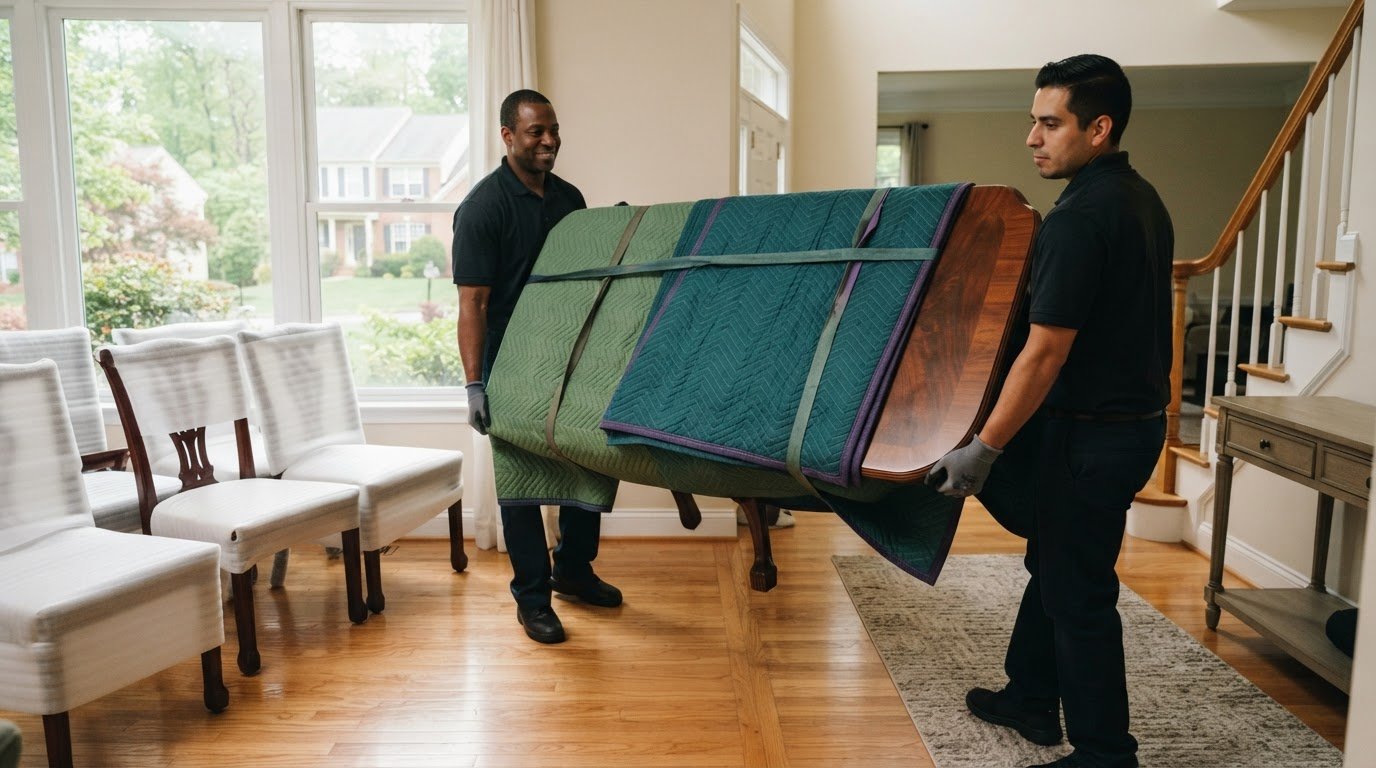
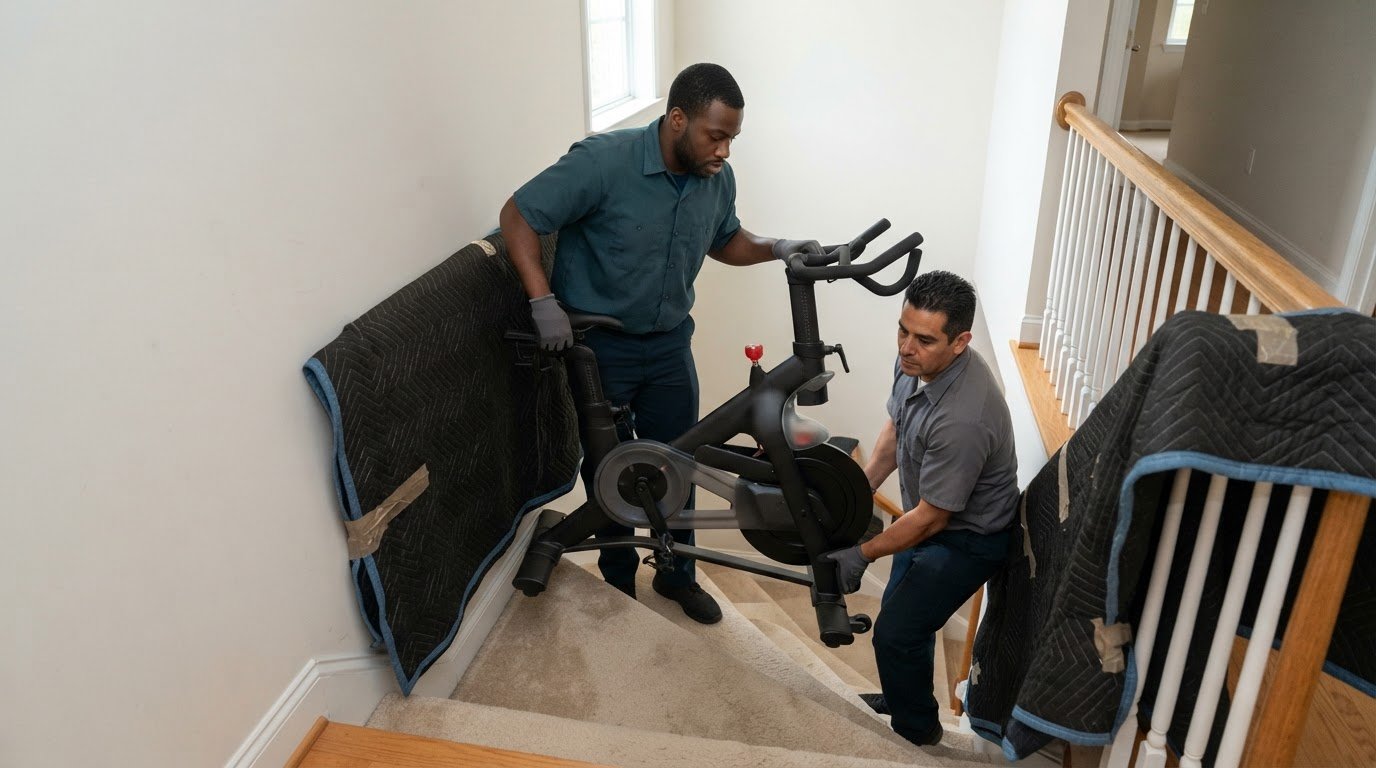
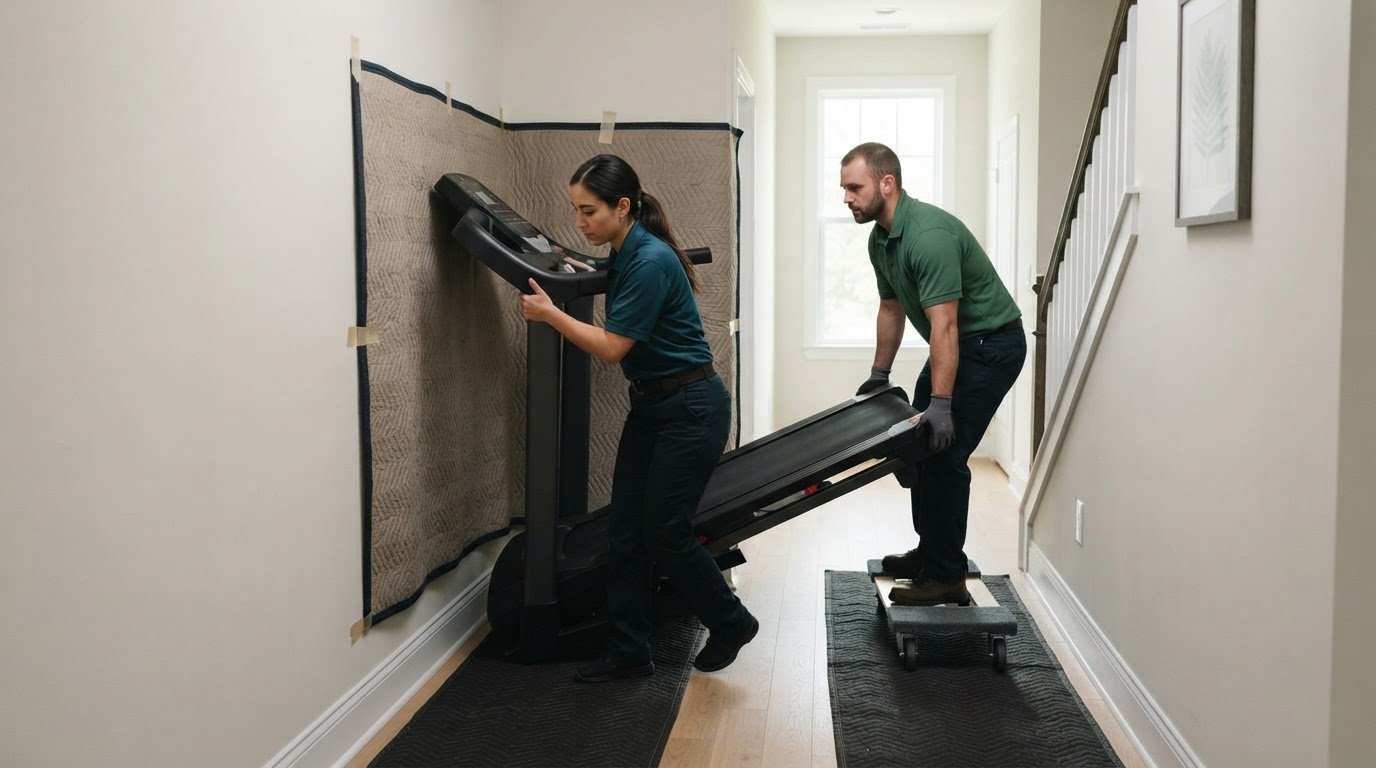
For an L-shaped leather couch, share the section dimensions, door measurements, and any tight turns. These details help shape the moving plan around the couch and its route. Heavy Furniture Moving also provides local moving help for other furniture and heavy items, including exercise equipment.
Contact Heavy Furniture Moving or visit heavyfurnituremoving.com to discuss your sofa-hoisting needs.
Choose a Clear Next Step for Your Couch
Before lift day, decide who will guide the move, where the couch can pause, and when everyone should stop. A written plan keeps decisions clear if the route changes or the couch shifts. Planning how to hoist an L-shaped leather couch through second-story French doors in Vienna also means knowing when not to force a difficult lift.
If the measurements or setup concern you, leave the hoist to experienced movers. Heavy Furniture Moving can help plan the next step without turning a careful assessment into a rushed attempt. Share the couch’s shape and access details so the conversation starts with the specific challenge.
Contact Heavy Furniture Moving for help and take the next step with confidence.
Frequently Asked Questions
Sofa too big to fit through door?
Not necessarily. A couch that won’t pass straight through may fit if a section separates or its angle changes. Compare the largest piece with the tightest turn, not just the doorway. Check whether fixed arms, a chaise, or an attached back limit rotation. If the couch still won’t pass without force, consider another route or a professional hoist to avoid damaging the furniture or home.
How to measure an L-shaped sectional couch and second-story French door opening for moving?
Measure each sectional piece separately, recording its longest side, depth, and height at the widest points. Open the French doors fully and measure the clear opening, including the threshold. Then compare the couch’s dimensions with the landing and approach. For example, check whether a chaise can clear the doorway but cannot turn near a wall or railing.
Can an L-shaped couch fit through French doors when tilted or rotated?
It can, if the couch’s shape and the surrounding space allow the necessary angle. Use measurements or a cardboard outline to test the planned position before lifting. Include the arms, fixed back, and chaise in the shape you assess. A clear doorway alone doesn’t prove the couch can turn through it, particularly if a wall or railing limits movement.
How many movers are needed to hoist a sectional sofa, and what does professional furniture hoisting cost in Vienna?
Crew size depends on the sectional’s weight, separable pieces, access, and lifting method; there is no single safe headcount for every couch. The price of a professional hoist depends on the job details. Heavy Furniture Moving uses a two-hour minimum for hourly labor, while most single heavy items have an upfront flat-rate quote.
How to find insured furniture movers or crane services in Vienna, Virginia?
Heavy Furniture Moving provides Sofa Hoisting for couches that need an exterior lift. A crane isn’t automatically necessary; the building access and lifting path help determine the method. If insurance matters for your move, review the written coverage information that applies to the work and property involved. When discussing how to hoist an L-shaped leather couch through second-story French doors in Vienna, share the access details.
What alternatives are there if an L-shaped couch will not fit through second-story French doors?
Check whether the sectional separates into smaller pieces or whether removable legs or arms can reduce its profile. Another entrance or stairwell may offer a clearer route. If neither path works, a professional hoist may be an option. Planning how to hoist an L-shaped leather couch through second-story French doors in Vienna starts with matching the couch’s shape to the access route. Don’t force it or cut the upholstery to make it fit.
Frequently Asked Questions
Not necessarily. A couch that won’t pass straight through may fit if a section separates or its angle changes. Compare the largest piece with the tightest turn, not just the doorway. Check whether fixed arms, a chaise, or an attached back limit rotation. If the couch still won’t pass without force, consider another route or a professional hoist to avoid damaging the furniture or home.
Measure each sectional piece separately, recording its longest side, depth, and height at the widest points. Open the French doors fully and measure the clear opening, including the threshold. Then compare the couch’s dimensions with the landing and approach. For example, check whether a chaise can clear the doorway but cannot turn near a wall or railing.
It can, if the couch’s shape and the surrounding space allow the necessary angle. Use measurements or a cardboard outline to test the planned position before lifting. Include the arms, fixed back, and chaise in the shape you assess. A clear doorway alone doesn’t prove the couch can turn through it, particularly if a wall or railing limits movement.
Crew size depends on the sectional’s weight, separable pieces, access, and lifting method; there is no single safe headcount for every couch. The price of a professional hoist depends on the job details. Heavy Furniture Moving uses a two-hour minimum for hourly labor, while most single heavy items have an upfront flat-rate quote.
Heavy Furniture Moving provides Sofa Hoisting for couches that need an exterior lift. A crane isn’t automatically necessary; the building access and lifting path help determine the method. If insurance matters for your move, review the written coverage information that applies to the work and property involved. When discussing how to hoist an L-shaped leather couch through second-story French doors in Vienna, share the access details.
Check whether the sectional separates into smaller pieces or whether removable legs or arms can reduce its profile. Another entrance or stairwell may offer a clearer route. If neither path works, a professional hoist may be an option. Planning how to hoist an L-shaped leather couch through second-story French doors in Vienna starts with matching the couch’s shape to the access route. Don’t force it or cut the upholstery to make it fit.