How to Hoist a Sectional Through a Dumfries Townhouse Window Safely
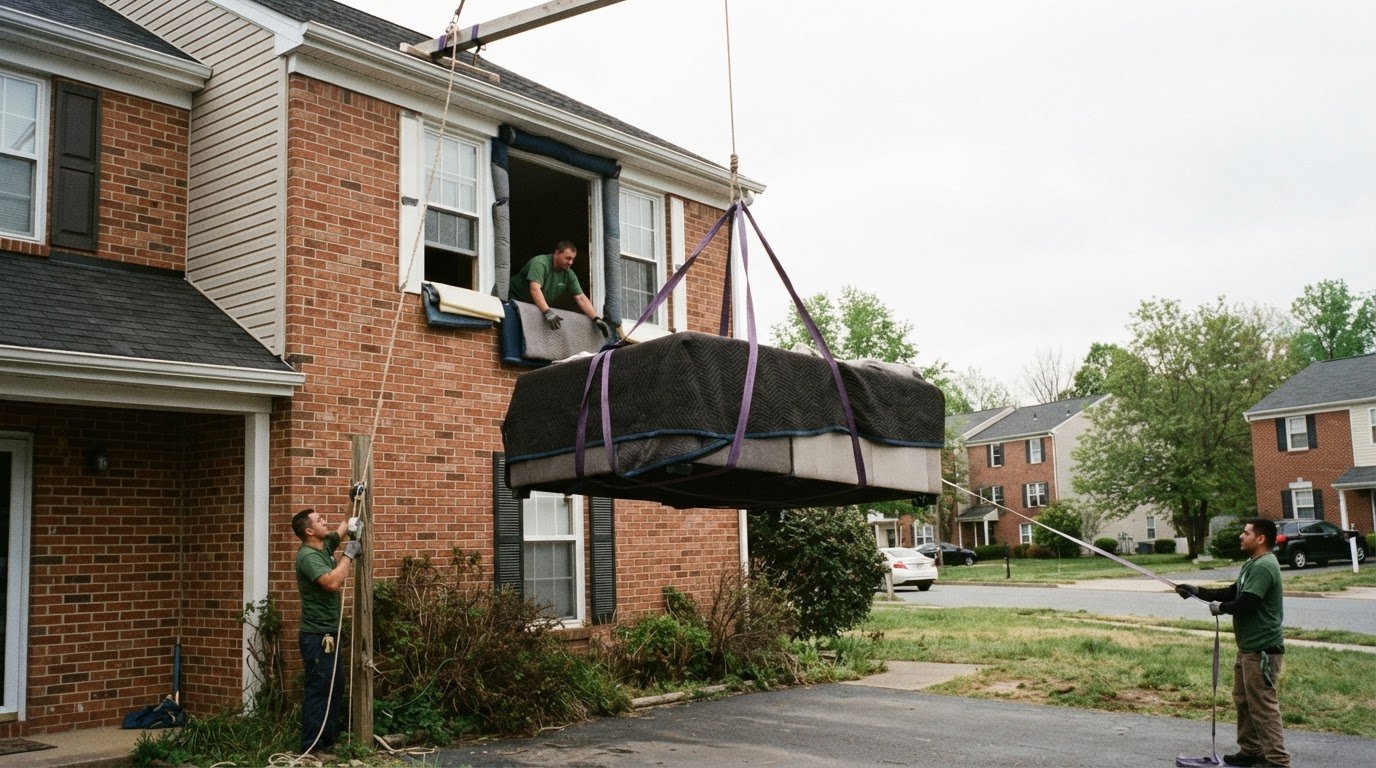
A window hoist should be a last resort, not your first move. To decide how to hoist a heavy sectional couch through a townhouse window in Dumfries, first check whether each piece can pass safely through the doors, hallway, and stairs after removing cushions, detachable legs, or modular sections. If it still needs to go through a window, measure the clear opening at its narrowest point when fully open, and allow at least an inch of clearance after padding.
A tight stair turn can make a sectional seem impossible to move, but forcing it can cause damage or injury. This guide explains how to assess the route, decide whether a window lift is suitable, and recognize when another moving method is safer.
Measure the sectional and window, choose a lifting approach that suits the floor and load, and prepare both the indoor landing area and outdoor drop zone. Before lifting, also inspect the window area and make a practical plan for the move.
Key Takeaways
- Decide whether a window lift is truly needed by testing safer ways to move each sectional piece through the home.
- Match the lifting approach to the window’s floor and the sectional’s weight; upper-level lifts call for trained crews and suitable equipment.
- Reduce the load and dimensions where possible by separating modular pieces and removing detachable parts.
- Prepare the landing area and outdoor drop zone before lifting, then inspect the window and surrounding surfaces afterward.
- Learn when professional sofa hoisting can help manage a difficult townhouse move.
Is it safe to hoist furniture through a window?
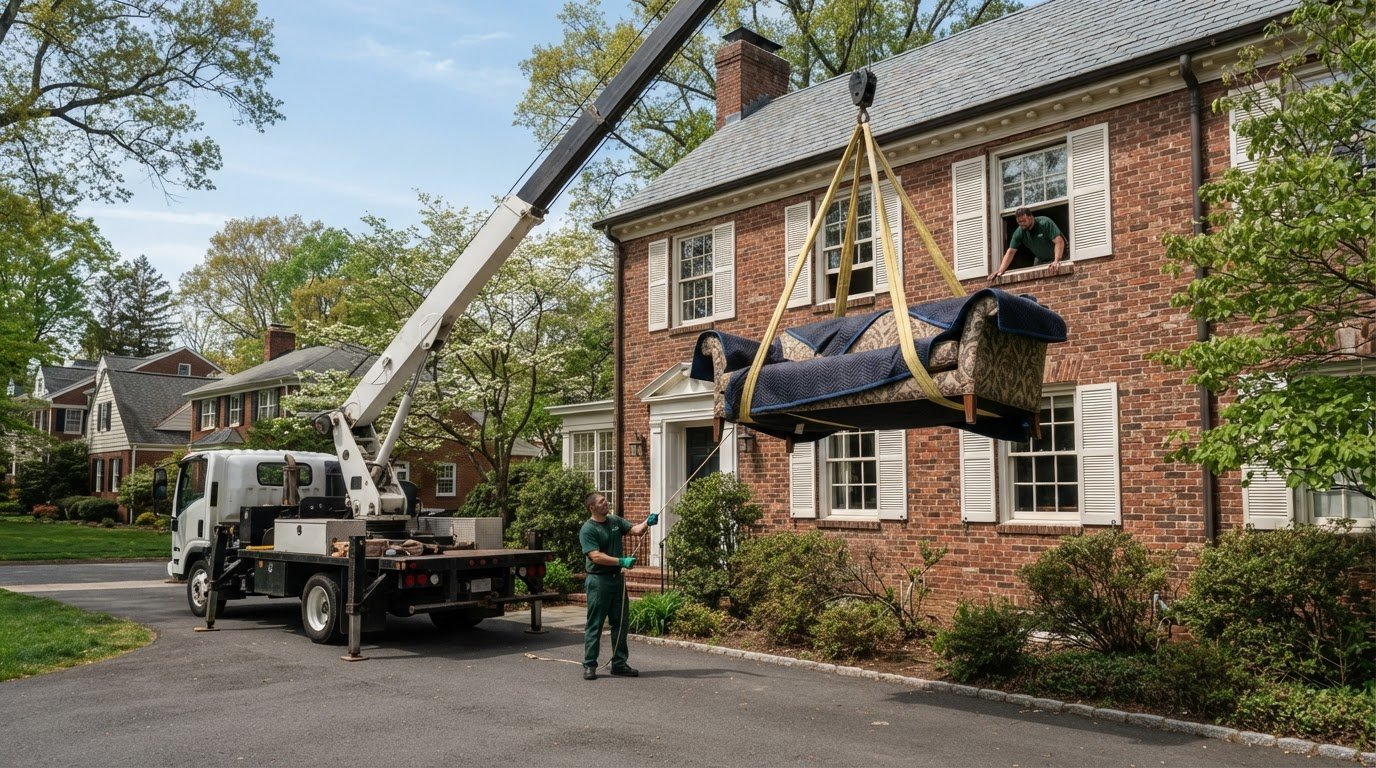
A window hoist can work when a sectional cannot pass through the doors, hallway, or stairs. For an upper-story lift, use suitable hoisting equipment and a trained crew rather than an improvised rope setup.
-
Measure Furniture and Window Openings
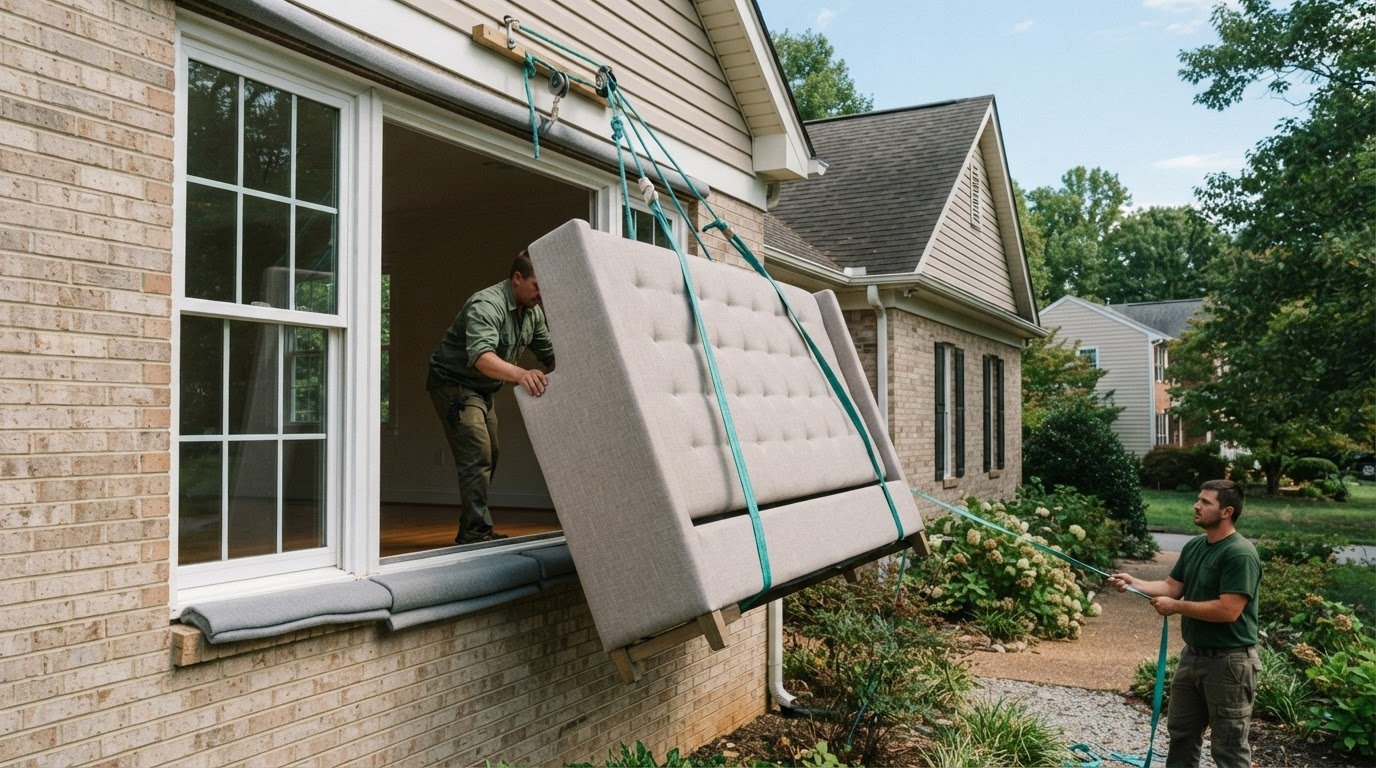
Measure each sectional piece at its widest, tallest, and deepest points, then measure the fully open window at its narrowest point. Compare those dimensions with the furniture after padding; leave at least an inch of clearance so fabric and corners don’t scrape the frame. For example, a 38-inch-deep, 34-inch-tall sofa may fit a 36-by-48-inch opening after the sash is removed, if the lift angle allows it. Plan at least 6 feet of clear landing space inside the room.
-
Prepare the Furniture and Surrounding Areas
Remove cushions, loose pillows, and detachable legs to reduce the sectional’s profile before lifting. Protect exposed corners with cardboard, and cover nearby floors or railings with padded guards or heavy-duty neoprene runners. Clear people, pets, and vehicles from the indoor landing path and outdoor drop zone. Open the window fully, and remove a sash only if it is designed to come out safely.
-
Gather Hoisting Equipment
Use hoist straps or suitable exterior rigging to control the couch as it rises; the exact setup depends on the opening, floor, and load. Rope-and-pulley hoisting should be handled by a trained crew using suitable rigging. An upper-level lift should use equipment suited to the load and a crew that can guide it from both sides. Don’t substitute a makeshift platform or unsecured rope for proper lifting gear.
-
Hoist Furniture Through an Upper-Level Opening
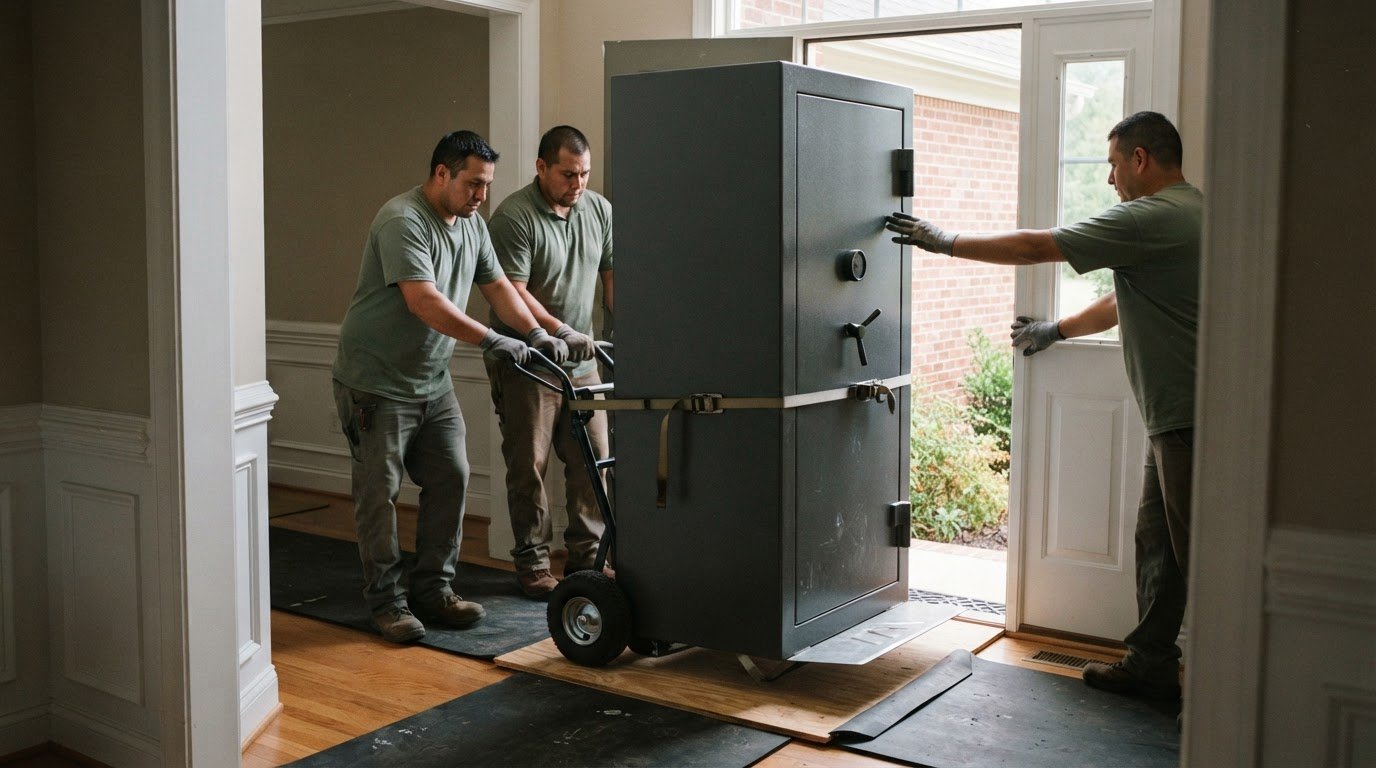
Consider a window or deck-door lift only if oversized furniture cannot clear the interior route after sensible disassembly and repositioning. Sectionals and sofas are common candidates; pianos, safes, and exercise equipment may also need an exterior lift. Keep the load controlled as it approaches the opening, with clear communication between the crew inside and outside. Stop if the piece catches, shifts unexpectedly, or lacks room to pass.
Before choosing a hoist, carefully test tight turns. Compare each section’s diagonal depth with the stairwell’s narrowest width, ceiling height, and available turning space. Standing a section vertically may help it pivot around a bannister. If it sticks, ease it back down and reset the angle instead of forcing it.
Choosing lifting methods by floor and item weight
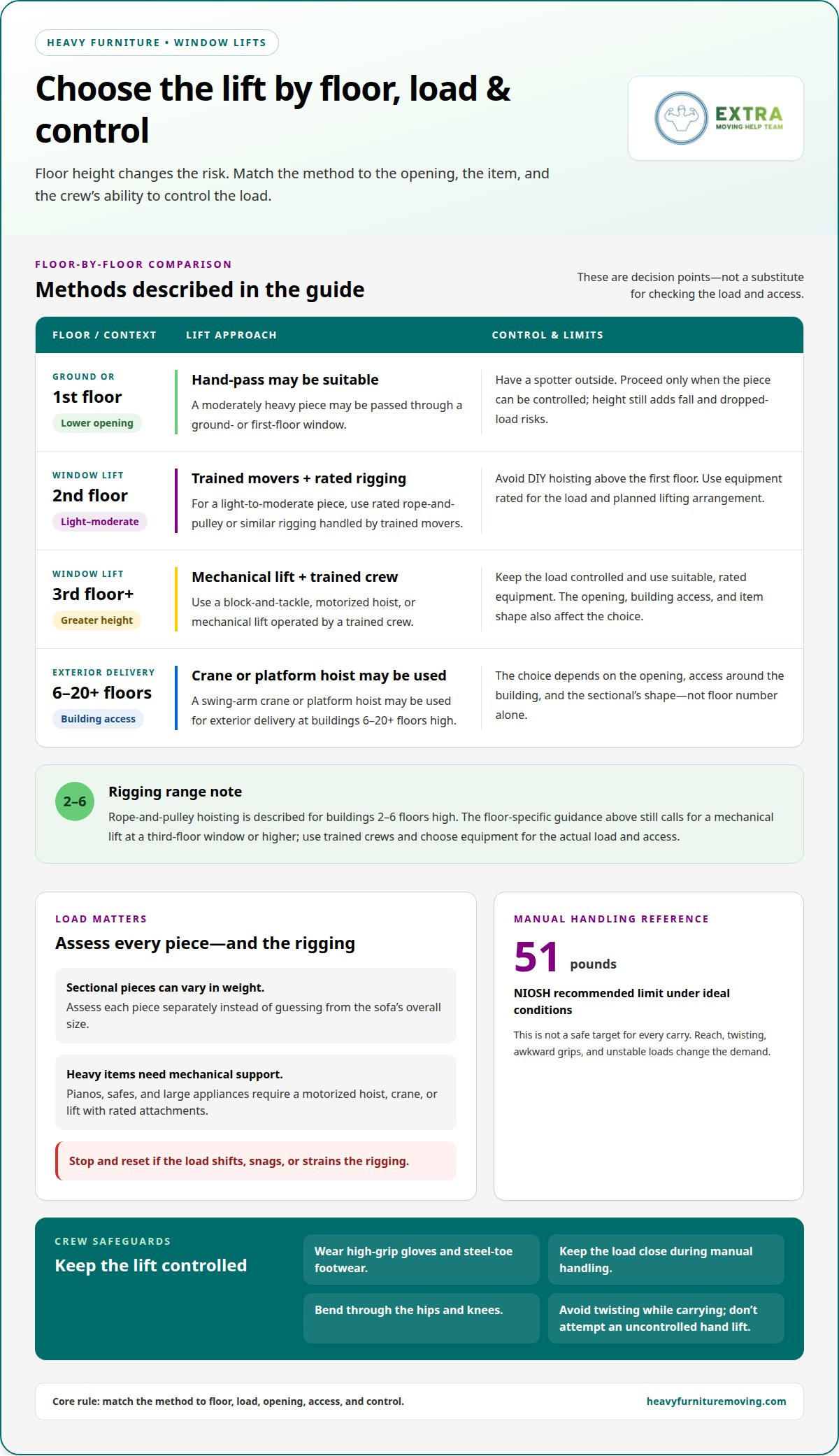
Choose the lift by floor, load, and control needed. A sectional’s weight matters, but height adds fall and dropped-load risks.
- Match the method to the floor. For a ground- or first-floor window, a moderately heavy piece may be hand-passed with a spotter outside. Above the first floor, avoid DIY hoisting because a slipping load can fall or injure someone. For a second-floor lift involving a light-to-moderate piece, trained movers can use rated rope-and-pulley or similar rigging. Rope-and-pulley hoisting is a method for buildings 2-6 floors high.
- Use mechanical lifting for greater height. At a third-floor window or higher, use a block-and-tackle, motorized hoist, or mechanical lift operated by a trained crew. For exterior delivery at buildings 6-20+ floors high, a swing-arm crane or platform hoist may be used. The choice depends on the opening, access around the building, and the sectional’s shape, not floor number alone.
- Weigh the item and rigging together. Sectional pieces can vary in weight, so assess each one separately rather than guessing from the sofa’s overall size. Heavy items such as pianos, safes, and large appliances require a motorized hoist, crane, or lift with rated attachments. Use equipment only when its rating supports the load and planned lifting arrangement. If the piece shifts, snags, or strains the rigging, stop and reset.
- Protect the crew during each lift. Wear high-grip gloves and steel-toe footwear. Keep the load close to the body during manual handling, bend through the hips and knees, and avoid twisting while carrying. According to the National Institute for Occupational Safety and Health lifting equation, the recommended limit is 51 pounds under ideal conditions. That figure isn’t a safe target for every carry; reach, twisting, awkward grips, and unstable loads change the demand. Don’t attempt a hand lift that feels uncontrolled. A heavy lifting moving service can help manage demanding furniture lifts with an appropriate method.
Alternatives to hoisting, including disassembly and tilting
Before choosing an exterior lift, test whether smaller pieces or a different angle can clear the townhouse route. Try these alternatives in order, and stop if a sectional becomes stuck.
- Separate the sectional into movable pieces. Disconnect modular base units and move them individually instead of treating the sofa as one oversized load. Remove cushions, pillows, and detachable legs to reduce each piece’s profile and weight. Keep connectors and removable hardware together for easier reassembly. A wide chaise section may need a different route from a smaller corner unit. Assess each piece separately: one section may fit through a narrow doorway even if the assembled sectional cannot.
Break down the sectional before moving day, not while a piece blocks a stair landing. Check how the sections attach, and separate only parts designed to come apart. Smaller pieces are easier to rotate through a doorway, but still need a clear path and controlled handling.
- Try a careful tilt before ruling out the stairs. A sectional may pass a tight turn when stood vertically and pivoted around the bannister. Compare its diagonal depth with the stairwell’s narrowest width, ceiling height, and turning space. If its diagonal depth is less than the narrowest width, the turn may be workable in that orientation. Keep the movement controlled, and don’t force the piece against the wall or railing.
Use the landing as a reset point. If a section catches during a turn, ease it back down and change the angle instead of pushing harder. A small change in orientation can alter which dimension meets the stairwell’s tightest point.
- Create clearance only where the route needs it. Removing an interior door, bannister handrail, or screw-in furniture legs may provide the inch or two needed to clear a landing. Identify the exact obstruction first; taking apart more than necessary adds work without improving the route. Keep removed parts together, and leave the path clear while carrying each section through.
Recheck the tight spot after removing an obstruction. A few inches of added clearance may let a section pass without changing the lifting method. If the furniture still cannot turn safely, stop and reconsider the route rather than forcing it into the stairwell.
- Choose the window only after testing practical routes. Try every separated piece through the doors, hallway, and stairs in different orientations before arranging a hoist. A window lift is the fallback when the furniture cannot pass through those routes in any position. For example, separate sectional bases might fit through the hallway, avoiding an exterior lift altogether.
Note which piece gets stuck and where. That detail helps distinguish an access problem from a removable obstruction or awkward angle. If the sectional remains blocked in every reasonable position, an exterior hoist is the next method to assess.
Hoisting sequence and post-lift window checks
Use a controlled sequence, from rigging setup to final inspection. For a difficult upper-level lift, have one person direct each movement and pause whenever the load shifts.
- Assign crew roles before the sectional leaves the ground. One person should give clear instructions while others guide the load and keep the path open. Agree on simple commands such as “stop,” “lower,” and “continue.” Check that the rigging is secure and the indoor landing area is ready before lifting. A clear plan helps everyone respond together instead of pulling in different directions.
-
Complete the Hoisting Sequence
Start with a slow test lift, raising the sectional just enough to check its balance and the rigging’s hold. If it tilts sharply, slips, or catches, lower it and correct the setup before continuing. Guide it toward the townhouse opening without letting it swing against the frame. Pause at the sill, and move it through only when the crew can control its position.
- Keep people, pets, and vehicles out of the drop zone throughout the lift. Stop if wind or rain makes the exterior movement difficult, and postpone the lift. Once the sectional clears the opening, guide it into the room and lower it onto a stable surface. Don’t release the rigging until the piece is secure and the crew agrees it has settled.
-
Check the Window After the Lift
Inspect the window frame, sill, glass, and nearby wall after bringing the sectional inside. Look for fresh cracks, chips, scuffs, or loosened trim. Open and close the sash gently, then check that its lock still lines up. If the sash was removed, reinstall it as designed and make sure it sits evenly before securing the opening.
- Finish by checking the room and the sectional’s contact points. Look for rub marks on upholstery, loose legs, or damage near corners that passed close to the frame. Move protective coverings only after the route is clear and the hoisting equipment is away. In an apartment or townhouse, note any window or wall marks before returning the room to normal use.
Hoisting sectional sofas
A sectional needs its own lift plan because long sides, projecting chaise sections, and corner joints affect balance. Treat each piece as a separate load, then plan its orientation through the opening before lifting. Knowing how to hoist a heavy sectional couch through a townhouse window in Dumfries starts with matching the sectional’s shape to the access route.
- Map the sectional’s shape before rigging. Identify the main sofa section, corner unit, and chaise, then note which parts detach. An L-shaped piece can catch a window edge as its long side turns, even if its front face fits the opening. Sketch the intended orientation for each piece, including which end enters first. This gives movers a shared plan and helps prevent last-second twisting near the frame.
Keep connectors and loose hardware together as you separate the sections. Mark each piece’s destination so the lift order matches the placement plan. If the chaise must go through before the main section, keep its landing area clear rather than stacking other furniture there.
- Choose an orientation that protects the corners. A sectional may need to travel upright, on its side, or at a controlled angle. Choose based on the opening’s shape and the piece’s balance, not appearance alone. Protect exposed corners before they approach the sill, and keep upholstery clear of rough edges. Rotating the sofa can narrow its profile, but only if its weight remains controlled throughout the turn.
Check the route from the exterior approach to the room’s landing area, not just the window. A sharp turn immediately inside can make it difficult to finish the lift. Clear that turn before raising the first piece, and identify a stable place to set it down.
- Plan the lift around the frame, not the upholstery. Position supports so the sectional’s solid structure carries the load. Don’t rely on loose cushions, removable legs, or fabric arms as lifting points. Keep the piece controlled so one corner cannot swing toward the window trim. If the section starts to rotate unexpectedly, pause and regain control before moving it through the opening.
Repeat these checks before lifting each piece. Different shapes can shift the balance, so a setup that worked for a straight sofa section may not suit a chaise or corner unit. A careful plan for how to hoist a heavy sectional couch through a townhouse window in Dumfries should account for each piece’s balance and path, not just the assembled sofa’s overall dimensions.
- Coordinate placement before the final approach. Assign one person to guide the sectional through the opening and another to receive it at the landing. Agree on clear stop and lower commands, then communicate directly as the piece moves. Keep everyone clear of the area beneath a suspended load. If the route or balance changes, stop and reset rather than forcing the sectional around the frame.
For an awkward sofa shape or upper-level opening, arrange professional sofa hoisting instead of improvising the lift.
Heavy Furniture Moving: Sofa Hoisting
Heavy Furniture Moving provides Sofa Hoisting for sectionals that cannot safely pass through a townhouse’s doors, hallway, or stairs. Consider this service when the route is too tight, a piece cannot clear a landing, or an upper-level opening calls for a planned lift. The sectional’s size and shape, window access, and indoor landing all affect the move. Share which pieces need lifting and where the route narrows to help plan around the actual obstacles. To discuss a window lift for your sectional, contact Heavy Furniture Moving.
Make the Next Move With Confidence
Your plan for hoisting a heavy sectional couch through a townhouse window in Dumfries should leave room to choose a safer option if the route changes. A sectional can shift during a lift, and a difficult angle may call for a pause rather than a push. Decide who will coordinate the move, keep the path clear, and make the final call if conditions are no longer controlled. That preparation can make a stressful access problem more manageable.
If the sectional still cannot pass through the home, professional help can ease the planning and handling involved in a lift. Heavy Furniture Moving offers Sofa Hoisting, along with Movers Near Me and Exercise Equipment Moving. Choose support that fits the item and access challenge, then share the details of your townhouse move.
Contact Heavy Furniture Moving to discuss your sofa-hoisting needs. You can move forward with a clear plan and a little more confidence.
Frequently Asked Questions
Do I need permission from my building?
Get approval from the property owner or building manager before arranging an exterior lift. Townhouse rules may cover shared grounds, window access, lift timing, or equipment near neighboring homes. If you rent, ask your landlord before moving a sectional through a window. A short written confirmation can prevent a moving-day dispute, especially if the lift uses a common walkway or affects another resident’s access.
What should I do if my sectional gets stuck on a staircase landing?
Stop pushing and ease the section back to a stable position. Keep the stairway clear, then reassess which corner or edge is catching. For example, lower the chaise and turn it so its shorter end leads around the landing. Don’t pull against a bannister or force the upholstery past a wall. If the piece won’t move under control, get trained help.
How do professional movers hoist a heavy sectional couch through a window?
Professional movers assess the sofa’s pieces, access route, and window before selecting suitable lifting gear. They control the sectional’s orientation as it approaches the opening, communicate during the lift, and guide it toward a clear indoor landing. Heavy Furniture Moving lists sectional sofas at 200-500 lb across all pieces, with 2-3 movers and a 45-90 min estimate. The actual arrangement depends on the item and access conditions.
How do you measure a sectional sofa and townhouse window for a safe hoist?
Measure each detached section at its widest, tallest, and deepest points, including any rigid frame or protruding arm. Measure the window’s clear opening at its narrowest point when open, not the outer frame. Compare dimensions in the orientation you plan to use for the lift. Include padding and allow at least an inch of clearance afterward. Also measure the turn from the window to the intended placement.
Which furniture hoisting companies serve Dumfries and Prince William County, VA?
Heavy Furniture Moving serves Dumfries and lists Prince William among its local service areas. Its Sofa Hoisting service is for furniture that cannot pass through standard entryways or elevators. Share whether the sectional separates into pieces, which floor the window is on, and what outdoor access is available. These details describe the job clearly and help distinguish a window hoist from an ordinary in-home furniture move.
Do Dumfries or Prince William County require permits to hoist furniture from a townhouse window?
Permit requirements depend on the equipment and where it will operate; there is no single assumption that applies to every townhouse lift. Equipment used entirely on private property raises different planning questions from equipment placed in a street or other public area. Before scheduling, identify the lifting method and whether it affects public access, then confirm applicable requirements with the relevant local office and property management.
What are the risks and safety precautions when hoisting a couch through a window?
The main hazards include a dropped or swinging couch, falls near the opening, and damage to glass, trim, or siding. Keep people, pets, and vehicles clear of the lift path, and use equipment suited to the load. Pause if the sectional shifts, catches, or moves unpredictably. Wind or rain can make exterior handling unsafe, so postpone the lift rather than risk losing control.
When should you hire professional movers instead of attempting a couch hoist yourself?
Hire trained movers when the lift is above the first floor, the sectional is difficult to control, or you lack suitable rigging and enough people to manage it. An upper-level window adds fall and dropped-load hazards that a household setup may not handle safely. Professional help also makes sense when the sectional needs a careful rotation through the opening or the exterior route is restricted.
Frequently Asked Questions
Get approval from the property owner or building manager before arranging an exterior lift. Townhouse rules may cover shared grounds, window access, lift timing, or equipment near neighboring homes. If you rent, ask your landlord before moving a sectional through a window. A short written confirmation can prevent a moving-day dispute, especially if the lift uses a common walkway or affects another resident’s access.
Stop pushing and ease the section back to a stable position. Keep the stairway clear, then reassess which corner or edge is catching. For example, lower the chaise and turn it so its shorter end leads around the landing. Don’t pull against a bannister or force the upholstery past a wall. If the piece won’t move under control, get trained help.
Professional movers assess the sofa’s pieces, access route, and window before selecting suitable lifting gear. They control the sectional’s orientation as it approaches the opening, communicate during the lift, and guide it toward a clear indoor landing. Heavy Furniture Moving lists sectional sofas at 200–500 lb across all pieces, with 2–3 movers and a 45–90 min estimate. The actual arrangement depends on the item and access conditions.
Measure each detached section at its widest, tallest, and deepest points, including any rigid frame or protruding arm. Measure the window’s clear opening at its narrowest point when open, not the outer frame. Compare dimensions in the orientation you plan to use for the lift. Include padding and allow at least an inch of clearance afterward. Also measure the turn from the window to the intended placement.
Heavy Furniture Moving serves Dumfries and lists Prince William among its local service areas. Its Sofa Hoisting service is for furniture that cannot pass through standard entryways or elevators. Share whether the sectional separates into pieces, which floor the window is on, and what outdoor access is available. These details describe the job clearly and help distinguish a window hoist from an ordinary in-home furniture move.
Permit requirements depend on the equipment and where it will operate; there is no single assumption that applies to every townhouse lift. Equipment used entirely on private property raises different planning questions from equipment placed in a street or other public area. Before scheduling, identify the lifting method and whether it affects public access, then confirm applicable requirements with the relevant local office and property management.
The main hazards include a dropped or swinging couch, falls near the opening, and damage to glass, trim, or siding. Keep people, pets, and vehicles clear of the lift path, and use equipment suited to the load. Pause if the sectional shifts, catches, or moves unpredictably. Wind or rain can make exterior handling unsafe, so postpone the lift rather than risk losing control.
Hire trained movers when the lift is above the first floor, the sectional is difficult to control, or you lack suitable rigging and enough people to manage it. An upper-level window adds fall and dropped-load hazards that a household setup may not handle safely. Professional help also makes sense when the sectional needs a careful rotation through the opening or the exterior route is restricted.