How to Hoist a Large Outdoor Sofa Over a Patio Wall in Clifton
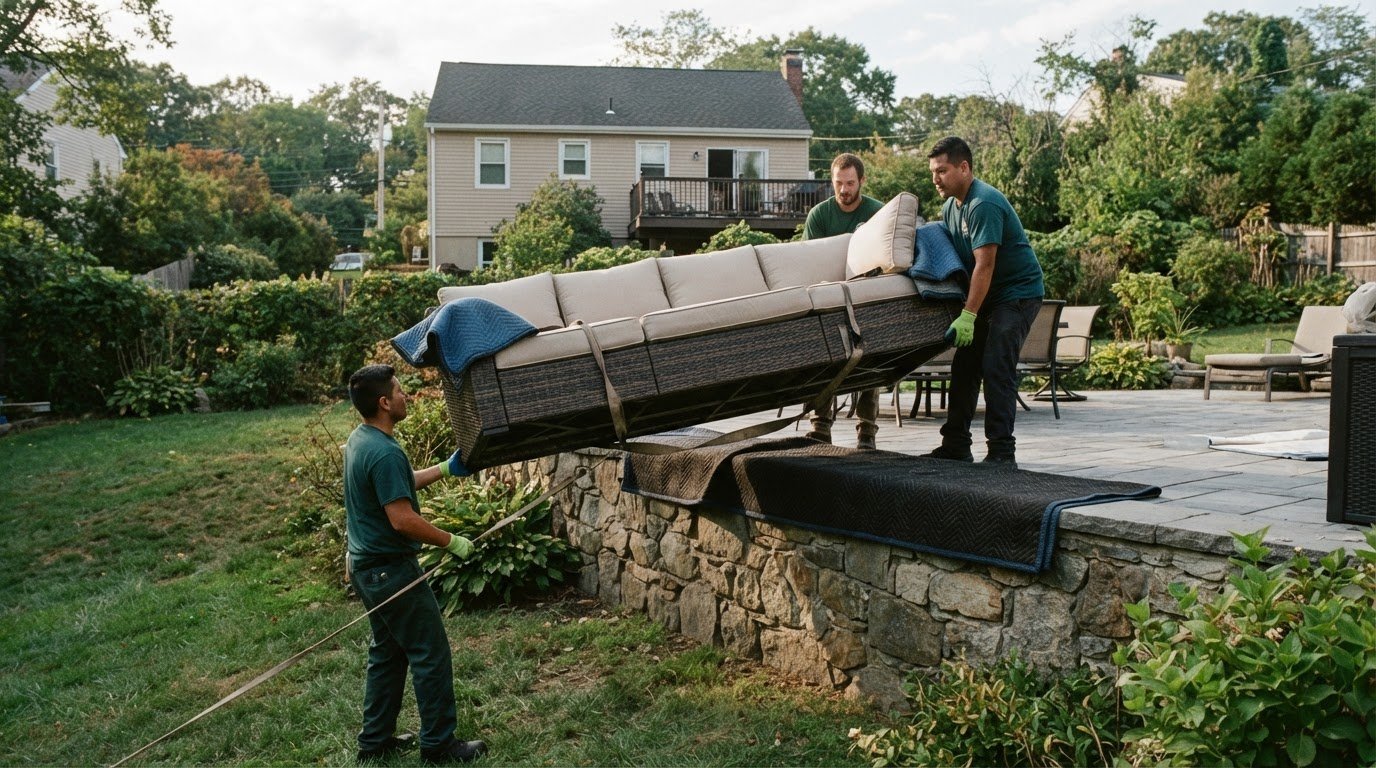
A retaining wall can make a tricky sofa move possible by creating level, usable patio space, but it also adds an obstacle the lift plan must account for. Planning how to hoist a large outdoor sofa over a patio retaining wall in Clifton starts with the sofa’s size, the wall’s height, and the space available on both sides.
It’s understandable to focus on getting the sofa safely over the wall. The retaining wall matters too: it stabilizes the slope, helps limit erosion, and can create more usable outdoor space. A professional can assess the route and plan the lift around the sofa and patio layout.
This guide explains what to measure, how the wall and patio affect access, and what details help a sofa-hoisting team prepare. You’ll also see how retaining walls can create a more usable outdoor area, so the move fits the space you’ve worked to make.
Key Takeaways
- Learn which sofa and wall measurements help professionals plan a clear lifting route.
- See how the furniture’s size, the wall, and access conditions shape equipment and crew needs.
- Follow the main stages professionals consider when planning a controlled lift over a retaining wall.
- Understand why crane use or sidewalk access can affect permit and site-planning requirements in Clifton, New Jersey.
- Find out when professional sofa hoisting can help move a large outdoor sofa into your patio space.
How do professional movers measure a large outdoor sofa and patio retaining wall before moving it?
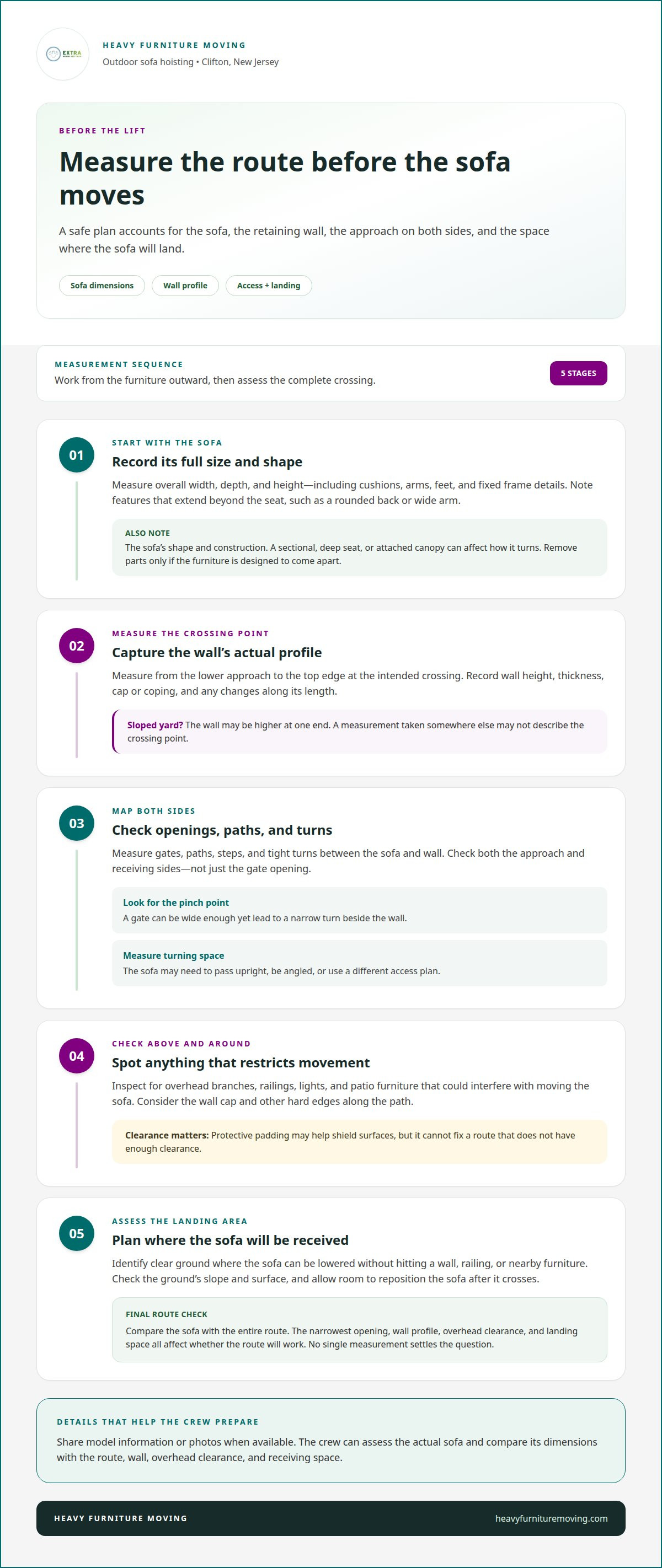
Professional movers start with the sofa, not the wall. They measure its overall width, depth, and height, including cushions, arms, feet, and fixed frame details. These measurements show how much space the sofa needs during the lift. A rounded back or wide arm may extend beyond the seat’s dimensions.
Movers also inspect the sofa’s shape and construction. A sectional, deep seat, or attached canopy can affect how it turns. They remove parts only if the furniture is designed to come apart. You can share model information or photos, and the crew can assess the actual sofa before planning its route.
Next, the crew measures the wall from the lower approach to the top edge. They note its height, thickness, cap or coping, and any changes along its length. On a sloped yard, the wall may be higher at one end. Measure the intended crossing point rather than relying on a measurement taken elsewhere.
Movers then map the approach on both sides, measuring gates, paths, steps, and tight turns between the sofa and wall. They also look for overhead branches, railings, lights, and patio furniture that could restrict movement. A gate may be wide enough, for example, but lead to a narrow turn beside the wall.
- Sofa: Record width, depth, height, shape, and fixed protrusions.
- Wall: Record height, thickness, cap projection, and surface changes.
- Route: Measure openings and turning space on both sides.
- Landing area: Identify clear ground where the sofa can be received.
The landing area needs its own assessment. Movers look for enough clear space to lower the sofa without hitting a wall, railing, or nearby furniture. They consider the ground’s slope and surface, as well as the room needed to reposition the sofa after the crossing. A retaining wall may create level patio space while still limiting access between levels.
Finally, the crew compares the sofa’s measurements with the entire route. They determine whether it can pass upright, needs to be angled, or requires a different access plan. No single measurement settles the question. The narrowest opening, wall profile, overhead clearance, and landing space all affect whether the route will work.
Equipment for Lifting a Sofa Over a Retaining Wall
The equipment depends on the sofa’s construction, the wall’s layout, and the planned route. For a heavy outdoor sofa, professionals may use lifting straps or slings to support the frame. They choose equipment to suit the furniture and lift, rather than relying on one tool for every job.
Straps help distribute support across stable parts of the sofa. Placement matters: pressure on loose cushions, thin arms, or decorative trim can shift the load or damage the upholstery. Movers inspect the frame and identify suitable support points before attaching lifting gear. A sectional may need a different setup from a one-piece sofa.
Protective materials also help. Moving blankets or padding can shield sofa surfaces from the wall, railings, and other hard edges. The crew may protect vulnerable parts of the route too. Padding cannot fix a clearance problem, so movers still need to plan a path that avoids scraping the wall cap or catching the fabric.
For a controlled lift, professionals may use a mechanical hoist or crane when the site and sofa call for it. The choice depends on access, the route, and where equipment can be positioned. A crane is not automatically right for every patio. The crew considers whether it can reach the landing area without obstructing the route or creating conflicts around the property.
- Support gear: Straps or slings selected for the sofa’s shape and frame.
- Surface protection: Blankets or padding for exposed upholstery and contact points.
- Mechanical lifting: A hoist or crane when the route and setup make it appropriate.
- Ground protection: Mats or other protective coverings where equipment could affect the surface.
The crew may also use radios to coordinate when team members need to work from separate positions. Clear signals help them control the sofa and pause together if it shifts. The receiving side needs enough room to guide the sofa down, not just space for its footprint. Allow room to turn it afterward as well.
Professionals check lifting gear before use and match it to the planned move. They consider whether the equipment can be positioned securely and whether it can support the sofa without twisting. If the route calls for a crane, access to the sidewalk may need additional planning. Equipment choice and site setup go together.
For a large sofa or a difficult wall crossing, professional heavy-lifting support can take the equipment planning off your shoulders.
How many professional movers are needed to hoist a large outdoor sofa over a wall?
There’s no single crew size for every sofa hoist. The team depends on the sofa’s weight and shape, the wall’s height, the access route, and the lifting method. A compact one-piece sofa with a clear approach presents different challenges from a deep sectional crossing a high wall. Professionals match the crew to the conditions.
The crew needs clear roles. One mover can lead the lift and coordinate its pace while others control the sofa from the approach and receiving sides. The receiving position matters because the sofa must be lowered and moved clear of the wall. A narrow patio landing may require more hands to manage the transition and keep the area clear.
Equipment affects the staffing plan. If the team uses a mechanical hoist or crane, the people operating it and guiding the sofa need defined responsibilities. The equipment operator may be separate from the movers handling the furniture. For a manual lift, the crew needs positions that let them support and control the sofa throughout the route.
Professionals also consider which parts of the sofa can safely bear weight. A rigid frame may offer suitable support points, while delicate arms and loose cushions are not reliable handholds. A wide sofa may need more control at its ends than a narrow one. The crew assigns positions based on the sofa’s construction, not simply the number of workers available.
- Lift lead: Coordinates movement and communicates pauses.
- Approach-side movers: Support and guide the sofa toward the wall.
- Receiving-side movers: Control its arrival and guide it onto the patio.
- Equipment operator: Operates mechanical lifting equipment when used.
These roles describe the work, not a fixed headcount. Team members may combine responsibilities when the sofa and route allow. A tight corner, uneven approach, limited landing space, or awkward sectional shape can require more hands. The key is whether the assigned crew can maintain control through each change in position.
Before the move, the team reviews the route and assigns positions. It identifies who controls the approach, who receives the sofa, and who gives instructions. If the plan includes a crane, the operator’s role is included too. This coordination helps prevent conflicting directions as the sofa crosses the wall.
For a sofa with a difficult shape or patio approach, professional in-home furniture moving can include assessing the lift and assigning a crew suited to the route.
Steps to Safely Lift a Sofa Over a Retaining Wall
Professional movers plan the lift before the sofa leaves its starting position. They use the measurements, route, and landing area to choose a controlled path. For example, a sofa crossing a capped stone wall needs enough clearance to protect both the furniture and the wall surface.
- Review the route. The crew checks the approach, crossing point, and patio landing together. They clear movable obstacles and identify fixed features, such as railings, steps, or overhead branches. If the planned path leaves too little room to guide the sofa, they adjust the approach before lifting.
- Prepare the sofa. Movers remove loose cushions and other detachable pieces when appropriate, then secure what remains. They protect exposed upholstery and select stable frame areas for support. A sectional may require separate handling from a one-piece sofa, so the crew accounts for its shape and connection points.
- Position the team and equipment. The lift lead assigns roles on the approach and receiving sides. If straps or mechanical lifting equipment are part of the plan, movers position them before movement begins. The retaining wall is treated as an obstacle, not an assumed lifting anchor or support point.
- Raise and guide the sofa. The team moves at a controlled pace, following one lead’s directions. Movers keep the sofa aligned with the selected crossing point and watch for contact with the wall cap, railings, or nearby features. If the sofa shifts or the route becomes obstructed, the crew pauses and resets its position.
- Lower and settle the load. Receiving-side movers guide the sofa onto the patio landing. They maintain control until it rests securely, then move it clear of the wall before changing direction. Cushions and removed parts can be returned after the main piece is positioned.
Communication continues at every stage. The lift lead gives clear instructions, and the crew stops together when something needs to change. This matters at a wall crossing, where the sofa moves between levels and the receiving space may be tight. If the landing is blocked or an unexpected obstacle appears, the team needs to revise the plan rather than rush the lift.
After placing the sofa, movers check its position and look for contact marks or displaced items along the route. They can position it where directed if the patio layout allows. A professional heavy lifting moving service can manage the full sequence when the wall makes ordinary carrying impractical.
Do Clifton, NJ permits or rules apply when professionals use a crane or block a sidewalk for a furniture lift?
A permit question depends on where the crane and crew need to operate. A lift contained within private property differs from one that uses a sidewalk, street, or other public space. In Clifton, NJ, the location and equipment setup are key details for determining which local requirements may apply.
Identify the full work area, not just the sofa’s path. A crane may need space for its base, supports, and operating position. If any part of the setup occupies a sidewalk or street, using that public space requires separate planning. A nearby parked truck can also affect access, even when the sofa crosses a wall on private property.
Blocking a sidewalk is different from guiding furniture briefly across a private patio. Equipment, barriers, or workers near the lift can affect pedestrian access. Professionals consider how people can pass safely and whether the setup would obstruct the public way. An open sidewalk should not be treated as available work space by default.
Before scheduling equipment, the crew should identify:
- Property boundaries: Whether the crane, truck, or supports extend beyond the home’s private area.
- Sidewalk impact: Whether equipment or workers would restrict pedestrian passage.
- Street impact: Whether vehicle positioning or the lift plan affects traffic access.
- Lift method: Whether a different approach could avoid public-space use.
These details help determine whether the specific setup requires permissions or other arrangements. Requirements can depend on the precise location and activity. A crane positioned entirely on private ground raises different questions from one placed partly over a sidewalk. The sofa’s size alone does not determine whether a permit is needed.
Clarify the plan before equipment arrives. The moving team can map the crane position, sofa route, and landing area, then identify any planned use of public space. If the setup would block sidewalk access, account for that before proceeding instead of assuming the obstruction is acceptable.
For a Clifton sofa lift involving a crane or a constrained sidewalk, arrange professional sofa-hoisting help to plan the move around the property and access conditions.
Heavy Furniture Moving: Sofa Hoisting
Heavy Furniture Moving provides sofa hoisting for oversized outdoor furniture that cannot pass through the usual route. Use this service when a patio retaining wall, narrow gate, or tight access point makes carrying the sofa around the yard impractical. The team assesses the furniture and access, then plans the lift around the wall and landing area.
Share the sofa’s dimensions, its location, and the wall or access features involved. These details help the team plan the job and route. If you need to move a large sofa over a patio wall in Clifton, contact Heavy Furniture Moving to discuss sofa hoisting.
Plan the Patio Around Your Next Move
Before arranging the lift, picture how you want to use the patio once the sofa is in place. Decide whether it should face the garden, create a conversation area, or leave a clear route between the seating and the house. That gives the move a destination, not just a way over the wall.
If you’re planning how to hoist a large outdoor sofa over a patio retaining wall in Clifton, share your intended placement and access details with the moving team. A clear destination helps the crew plan the transition and consider how the sofa will fit your outdoor space. The goal is simple: put the furniture where you want it without making patio access awkward.
Share your sofa-hoisting plans with Heavy Furniture Moving and take the next step toward enjoying your outdoor seating. Your patio can feel ready for a fresh arrangement.
Frequently Asked Questions
When should you hire professional furniture movers or a crane for a sofa lift?
Hire professional movers when the sofa’s route includes a retaining wall, restricted access, or a difficult landing. For a project in Clifton, Virginia, planning how to hoist a large outdoor sofa over a patio retaining wall can help determine whether a crane is appropriate. Professionals assess the furniture, route, and equipment position. A crane may suit a lift that requires mechanical assistance when the site allows a workable setup.
What does it cost to move a large outdoor sofa over a wall in Clifton, Virginia?
The cost depends on the sofa, access, and lifting plan, and is provided after a quote request. Heavy Furniture Moving uses flat-rate pricing for most single heavy items; hourly labor has a 2-hour minimum. The quote is provided upfront before work begins. Sharing the sofa details and wall-crossing requirements helps the quote reflect the actual job, rather than assuming a standard indoor sofa move.
How do you find local furniture movers or rigging services in Clifton, VA?
Use the full town and state when describing the job. Heavy Furniture Moving serves Clifton, Virginia, not Clifton, New Jersey. If your project is in Virginia, explain that you need help hoisting a large outdoor sofa over a patio retaining wall in Clifton, and describe the property access. This makes the location and moving plan clear.
Frequently Asked Questions
Hire professional movers when the sofa’s route includes a retaining wall, restricted access, or a difficult landing. For a project in Clifton, Virginia, planning how to hoist a large outdoor sofa over a patio retaining wall can help determine whether a crane is appropriate. Professionals assess the furniture, route, and equipment position. A crane may suit a lift that requires mechanical assistance when the site allows a workable setup.
The cost depends on the sofa, access, and lifting plan, and is provided after a quote request. Heavy Furniture Moving uses flat-rate pricing for most single heavy items; hourly labor has a 2-hour minimum. The quote is provided upfront before work begins. Sharing the sofa details and wall-crossing requirements helps the quote reflect the actual job, rather than assuming a standard indoor sofa move.
Use the full town and state when describing the job. Heavy Furniture Moving serves Clifton, Virginia, not Clifton, New Jersey. If your project is in Virginia, explain that you need help hoisting a large outdoor sofa over a patio retaining wall in Clifton, and describe the property access. This makes the location and moving plan clear.