Sub-Zero Fridge Moving: Preparation and Height Reduction
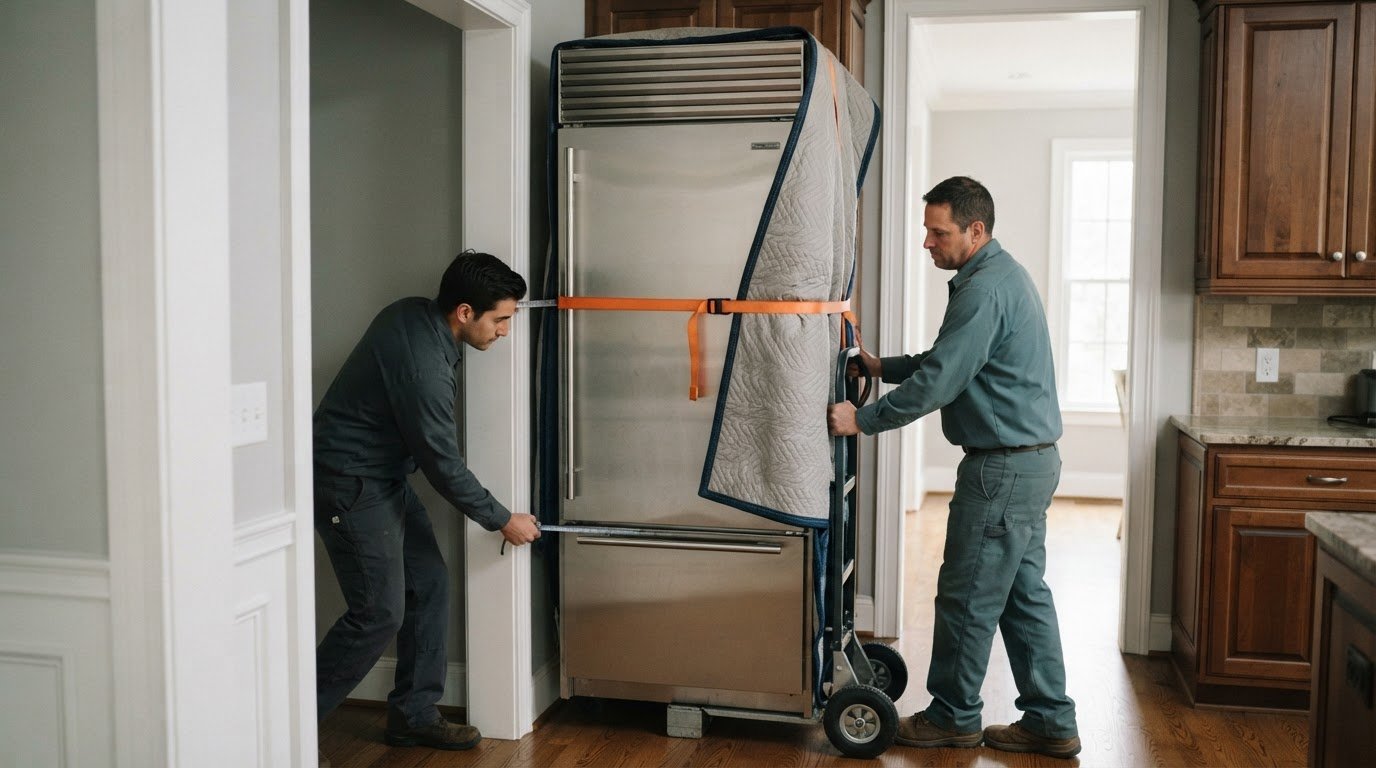
Keep a Sub-Zero upright if the route allows. If it must travel on its side, lower the side on the mover’s left when facing the front of the unit. For moving a heavy Sub-Zero fridge into a tight kitchen opening in Vienna, measure both the appliance and the entire route, not just the kitchen entrance.
A narrow doorway doesn’t automatically mean the refrigerator needs to be laid down or altered. Depending on the model, removing compressor components can reduce its height by 8, 9, or about 11 inches, but that work should be done by a qualified Factory Certified Service provider. This guide explains what professional movers prepare before transport, how they assess tight clearances, and when height reduction may help. You’ll also learn what happens after a tilted move, so you can plan the delivery without guesswork.
Key Takeaways
- Compare the refrigerator’s dimensions with the full route, not just the kitchen opening. Doorways, hallways, stairs, and turning space all affect the move.
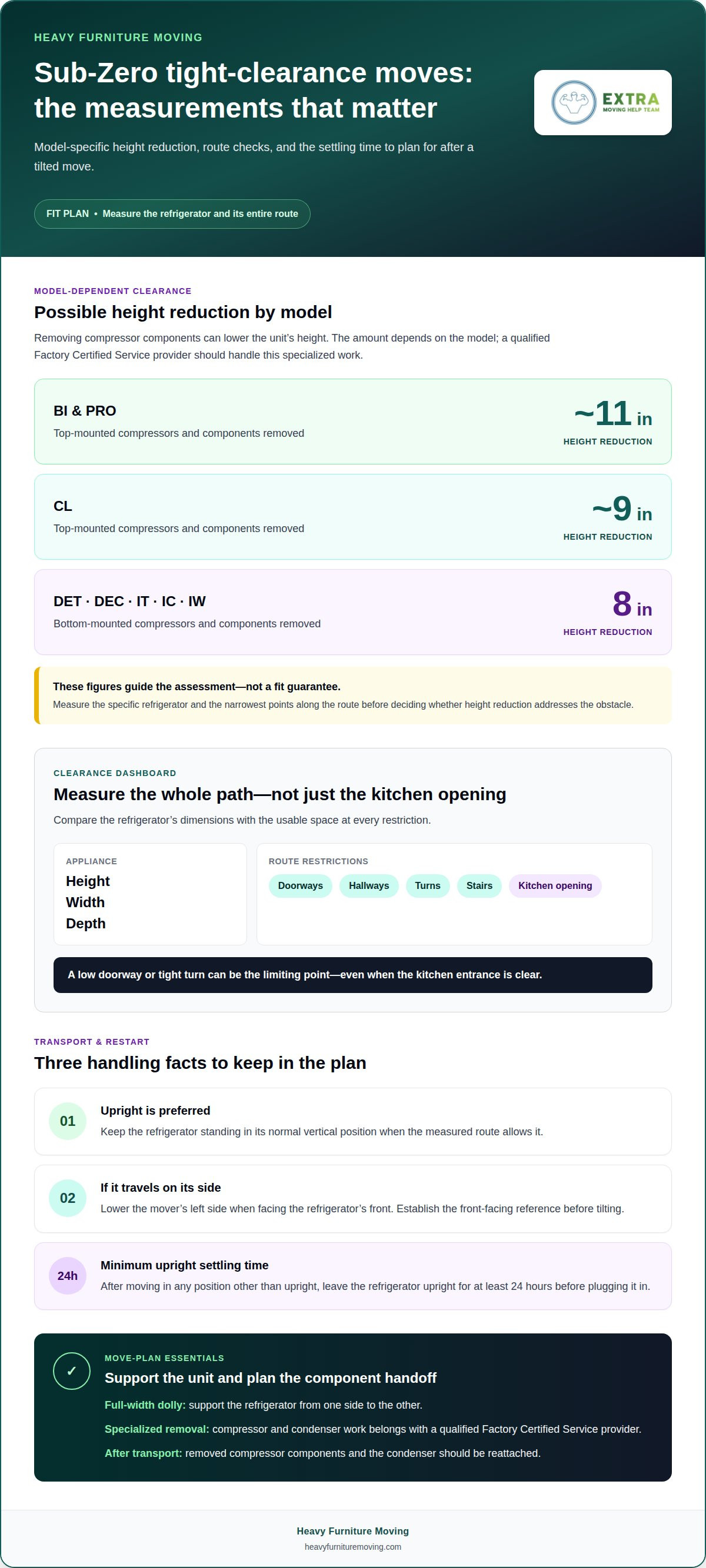
- Height reduction depends on the model: removing top-mounted components reduces BI and PRO models by about 11 inches and CL models by about 9 inches; bottom-mounted components reduce listed Designer and Legacy models by 8 inches.
- Compressor and condenser removal is specialized work. A qualified Factory Certified Service provider should handle it when needed for the move.
- Keep the refrigerator upright when possible. If it travels in another position, it should remain upright for at least 24 hours before being plugged in.
- Removing interior shelves and drawers helps protect the inside, while a used unit may still contain water that can spill if it is tipped.
How professional movers assess whether reducing a Sub-Zero’s height can help it fit through a home opening
Height reduction means temporarily removing compressor components to lower a refrigerator’s overall height. For moving a heavy Sub-Zero fridge into a tight kitchen opening in Vienna, professionals first identify the model and compare its dimensions with the narrowest point along the route.
Opening clearance is the usable space through a doorway or other passage. Assess the refrigerator’s height, width, and depth against the full route, including hallways, turns, and stairs. The kitchen opening may not be the only obstacle: a low doorway or tight turn can determine whether reducing the height addresses the actual problem.
The possible reduction depends on the model and the location of its components:
- BI and PRO models: removing top-mounted compressors and components reduces height by about 11 inches.
- CL models: removing top-mounted compressors and components reduces height by about 9 inches.
- DET, DEC, IT, IC, and IW models: removing bottom-mounted compressors and components reduces height by 8 inches.
These figures help frame the assessment, but they don’t replace measuring the specific unit and route. Compressor and condenser removal may be necessary for Classic (CL), Legacy Classic (BI), Designer (DET, DEC), Legacy Designer (IT, IC), Designer Wine (IW), and PRO models. When this procedure is necessary, a qualified Factory Certified Service provider should remove those components. Movers can coordinate the transport plan around that specialized work.
Appliance-moving expertise means planning the handling and route for a large refrigerator, while general moving work can cover a wider range of household items. For a built-in Sub-Zero, the key is a move plan that accounts for the exact model, clearances, and any component removal. Compressor work belongs with a qualified Factory Certified Service provider.
Custom-panel removal means taking off a refrigerator’s fitted exterior panels when possible. Professional movers can include removable custom panels in the handling plan to help prevent damage. Removing doors or handles is a separate decision; the model and the tightest clearance determine whether it helps, and it should not be assumed to replace height reduction.
Post-move cooling troubleshooting begins after the refrigerator is back in place and its compressor or compressors and condenser have been reattached. If a Sub-Zero still doesn’t cool after a move, consider seeking service. That cooling check is separate from the earlier fit assessment, so plan for both the entry route and the appliance’s return to operation.
Moving a Sub-Zero refrigerator
Upright transport means keeping the Sub-Zero standing in its normal vertical position during the move. This is the preferred plan when the route allows it. Assess the refrigerator and the complete path before choosing how to handle it. A tight doorway, hallway, or turn can affect the plan, so consider the entire route, not only the kitchen entrance.
A full-width appliance dolly is a wheeled moving platform that supports the refrigerator across its width. It should extend from one side of the Sub-Zero to the other, so the appliance rests securely on the dolly during movement. A smaller platform that leaves part of the unit unsupported does not meet this requirement.
The dolly is one part of the move, not a substitute for planning. Consider how the refrigerator will approach each opening and be guided through the available space. A clear kitchen doorway, for example, may lead to a turn that limits how the unit can be positioned. Use the measured route to decide whether upright handling is practical.
Component reattachment means reinstalling the compressor or compressors and condenser after the Sub-Zero reaches its place inside the home. If those components were removed for transport, they should be reattached after the move. This is separate from physically carrying the refrigerator, so include it in the plan to avoid overlooking the handoff between transport and reassembly.
Post-tilt settling is the period a Sub-Zero must remain upright before it is plugged in after traveling in another position. Compressor oils can shift when the refrigerator is tilted, so allow at least 24 hours upright before connecting power. The same 24-hour minimum applies if the unit was moved in any position other than upright. This waiting period is part of planning the appliance’s return to use, not a delay to solve by plugging it in sooner.
A clear move plan therefore covers the dolly, the route, any component reattachment, and the refrigerator’s final position. Each decision affects the next: a route restriction can change handling, while non-upright transport changes the timing before power-up. Professional refrigerator moving support can help coordinate the heavy handling involved in this process.
Moving the appliance on its side or back
Side transport means moving a Sub-Zero with one side facing downward instead of keeping it upright. If a side position is necessary, lower the side on the mover’s left when facing the refrigerator’s front. The front-facing reference matters: identifying the left side from behind reverses the instruction. Establish the front and intended lower side before tilting the appliance.
Orientation planning means deciding how the refrigerator will travel through each restricted part of the route. A doorway, landing, or turn may limit its position, but follow the side-specific direction if the unit travels on its side. A back position is a different orientation, so don’t apply the side instruction to it. Plan the handling position around the actual route rather than changing orientation mid-move without coordination.
Upright settling is the waiting period before plugging in a Sub-Zero that traveled in a position other than upright. Keep the refrigerator upright for at least 24 hours before connecting power. Compressor oils can shift when the unit is tilted, so they need at least 24 hours to settle. Plan this pause as part of the move, especially when the appliance needs to be ready for use after delivery.
Building access requirements are property rules that affect how movers enter and use a home or building. For a move in Vienna, Virginia, appliance orientation and building access are separate considerations. Account for property-specific arrangements, such as permitted entry points or restrictions on shared spaces. These details affect the route available to the moving team, not which side of the refrigerator faces down.
Before using a side or back position, make sure the professional move plan covers these points:
- Which orientation the route requires, and where that position begins.
- If the unit travels on its side, which side will face downward, identified from the front.
- How the refrigerator will return to an upright position after transport.
- When the 24-hour upright settling period begins before power is connected.
For example, if a tight passage requires side transport, identify the refrigerator’s front first, then apply the left-side rule. If the route suggests placing it on its back, treat that as a separate handling decision rather than assuming the side instruction applies. Coordinate the orientation, access path, and upright waiting period in one plan.
How professional movers prepare a Sub-Zero refrigerator for moving
Interior preparation means securing removable parts before the refrigerator leaves its space. Remove the interior shelving and drawers to help prevent damage during transport. Handle each shelf and drawer as a separate piece instead of leaving loose parts inside the cabinet.
Water management means accounting for water that may remain inside a used Sub-Zero. Water can collect in the evaporator, drain pan, ice maker, or other areas and may spill if the refrigerator is tipped. Consider whether the route requires tilting before moving the unit, as this affects the handling plan.
Panel protection means removing custom door panels when possible to help prevent damage. Treat the refrigerator’s panels as part of the move, not as ordinary door surfaces. For a built-in unit with custom panels, whether they can be removed affects how the exterior is protected and handled.
Appliance support means using equipment that supports the refrigerator during movement. An appliance dolly should have a platform that extends from one side of the Sub-Zero to the other. This full-width platform is a specific equipment requirement; a narrow platform does not provide the necessary coverage.
Crew size is the number of movers assigned to handle the unit and its route. No single crew count fits every built-in refrigerator. Consider the appliance’s dimensions, route restrictions, and planned handling position. A clear path and a tight turn create different demands, so base the plan on the actual move rather than an assumed number.
Prepare the transport plan around the refrigerator, its removable parts, and the path through the home. Determine whether the unit can remain upright and where tilting may be needed. If the route requires specialized work on compressor components, that is separate from ordinary moving preparation and belongs with a qualified Factory Certified Service provider.
Installation requirements are the model-specific steps for connecting and securing a refrigerator in its final position. Moving preparation alone does not establish whether a particular Sub-Zero needs professional installation, a water-line hookup, or anti-tip brackets. These needs depend on the model and installation setup, so don’t assume hookup or bracket work is part of transport.
Before the move, account for the shelves, drawers, possible retained water, custom panels, and dolly support. These details shape how the Sub-Zero is handled from its original position to the kitchen opening. Keeping them in one plan helps avoid treating a built-in refrigerator like an ordinary household cabinet or an empty appliance shell.
How do professional movers measure a tight kitchen opening, doorway, hallway, and stairway before moving a Sub-Zero fridge?
Route clearance is the usable space at the narrowest point between the refrigerator’s starting position and destination. Compare the Sub-Zero’s dimensions with every opening along that route. Record its height, width, and depth rather than relying on a doorway’s advertised size or a quick visual estimate.
Opening width is the clear horizontal space available after accounting for anything that projects into the passage. At each doorway, measure between the closest obstructions, including trim, hardware, or nearby fixtures. Also assess the refrigerator’s widest points, such as handles or attached panels. The clearance at the top may differ from the space near the floor.
Opening height is the vertical clearance from the floor to the lowest overhead obstruction. Check the entire passage, including trim, a low beam, or a raised threshold. Compare that clearance with the refrigerator’s height in its planned moving position. If considering height reduction, account for the model and proposed component removal.
Hallway clearance is the space available to carry or guide the appliance between openings. Measure the hallway’s narrowest point and check how nearby doors, corners, or built-in features affect the path. A straight passage and a sharp turn present different clearance problems. Assess the refrigerator through the turn, not just along the hallway’s longest stretch.
Stairway clearance is the usable space on the stairs and at each landing. Assess stair width, overhead space, handrails, and room to change direction at landings. Consider how the refrigerator’s dimensions relate to the stair angle and turning space. A landing can be the limiting point even when the stairs appear wide.
Measure the route in sequence. Record the refrigerator’s dimensions, then check each doorway, hallway, turn, stair, and kitchen opening. A clear kitchen entrance won’t solve a narrow hallway corner that blocks the appliance’s approach. Each recorded clearance helps determine whether the planned orientation and handling path will work.
Movers use those findings to identify the tightest constraint and adjust the route plan. They can compare a different approach angle, account for removable panels, or consider model-specific height reduction. Those options address different dimensions, so the crew matches the adjustment to the actual obstruction. Arrange professional heavy-appliance moving help for a route planned around your Sub-Zero and home openings.
Heavy Furniture Moving
Heavy Furniture Moving can help when a Sub-Zero’s weight and tight route make the move difficult to coordinate. The team provides moving support for heavy, bulky household items and their movement through the home. Turn to the movers when the refrigerator’s path involves narrow openings, hallways, or stairs and you need help with the physical move.
Share the route details and measurements you have so the team can discuss the move alongside the appliance’s handling needs. For a built-in Sub-Zero, compressor or condenser removal remains specialized work for a qualified Factory Certified Service provider. Moving support and appliance service have distinct roles.
Ready to plan the heavy lifting? Contact Heavy Furniture Moving.
Plan the move with a clear next step
For moving a heavy Sub-Zero fridge through a tight kitchen opening in Vienna, bring the route details together first. Note the appliance model, narrowest openings, and any turns or stairs. This gives the moving team practical context to discuss the heavy handling involved and how the move fits alongside any specialized appliance work.
Heavy Furniture Moving provides moving help for bulky household items, including Movers Near Me, Exercise Equipment Moving, and Sofa Hoisting. These services reflect the range of lifting and access challenges the team handles. Compressor or condenser work remains a separate task for a qualified Factory Certified Service provider.
You don’t need to solve every access challenge alone. Share the details you have, discuss the move, and choose a plan that suits your home and appliance. Contact Heavy Furniture Moving to talk through your heavy move and take the next step with confidence.
Frequently Asked Questions
When moving a Sub-Zero, do professional movers transport it on its side or its back?
Professional movers plan to keep a Sub-Zero upright when the route allows. If it must travel on its side, lower the side on the mover’s left when facing the refrigerator’s front. Moving it on its back is a separate orientation, not covered by that side-specific instruction. For example, a narrow landing may affect the route plan, but the crew should still distinguish clearly between side and back transport.
How do professional movers protect flooring, cabinets, walls, and refrigerator components during the move?
Professional crews can protect floors with masonite, cover door jambs, and use blankets, shrink film, and ratchet straps to protect and secure items. Plan the path around cabinets and walls, paying attention to tight turns where contact may occur. Remove the Sub-Zero’s shelves and drawers to help prevent damage to its interior. Custom door panels may also be removed when possible to help protect them during handling.
What are the risks of professional movers tilting or laying a Sub-Zero refrigerator on its side, and how long should it stand before reconnecting?
Tilting can shift compressor oil, and a used refrigerator may also contain water that can spill from the evaporator, drain pan, or ice maker. If the Sub-Zero travels in any position other than upright, keep it upright for at least 24 hours before plugging it in. This gives the shifted oil time to settle. If it still doesn’t cool after being off for 24 hours, seek service.
Which appliance movers or Sub-Zero-authorized installers serve Vienna, Virginia, and what do they charge?
Heavy Furniture Moving offers moving help in Vienna for heavy household items, but moving a refrigerator is distinct from Sub-Zero-authorized service or installation. Compressor and condenser removal, when needed, should be handled by a qualified Factory Certified Service provider. Moving prices depend on the case and are given after a quote request; the route, access conditions, and handling needs affect the quote. No specific charge applies to every move.
Frequently Asked Questions
Professional movers plan to keep a Sub-Zero upright when the route allows. If it must travel on its side, lower the side on the mover’s left when facing the refrigerator’s front. Moving it on its back is a separate orientation, not covered by that side-specific instruction. For example, a narrow landing may affect the route plan, but the crew should still distinguish clearly between side and back transport.
Professional crews can protect floors with masonite, cover door jambs, and use blankets, shrink film, and ratchet straps to protect and secure items. Plan the path around cabinets and walls, paying attention to tight turns where contact may occur. Remove the Sub-Zero’s shelves and drawers to help prevent damage to its interior. Custom door panels may also be removed when possible to help protect them during handling.
Tilting can shift compressor oil, and a used refrigerator may also contain water that can spill from the evaporator, drain pan, or ice maker. If the Sub-Zero travels in any position other than upright, keep it upright for at least 24 hours before plugging it in. This gives the shifted oil time to settle. If it still doesn’t cool after being off for 24 hours, seek service.
Heavy Furniture Moving offers moving help in Vienna for heavy household items, but moving a refrigerator is distinct from Sub-Zero-authorized service or installation. Compressor and condenser removal, when needed, should be handled by a qualified Factory Certified Service provider. Moving prices depend on the case and are given after a quote request; the route, access conditions, and handling needs affect the quote. No specific charge applies to every move.