How to Hoist a Heavy Bed Through a Balcony Window in Aldie

A second-floor balcony can be a workable route for a heavy platform bed frame when the opening, frame, and hoisting setup are suitable. To plan how to hoist a heavy platform bed frame through a balcony window in Aldie, measure the frame and clear opening, allowing at least an inch of clearance after padding, and make sure the window opens or has a removable sash or panel.
It’s understandable to look for a way around tight stairs or hallways. But lifting a bulky frame outside carries real risks, so leave this job to trained professionals rather than attempting it yourself.
Learn how professionals assess a bed frame and window, when balcony hoisting may be appropriate, and which access and safety conditions shape the plan. These details can help you decide whether an exterior lift makes sense for your Aldie move.
Key Takeaways
- Account for the bed frame’s shape, padding, and path from the balcony opening into the room, not just its listed dimensions.
- Learn how building height, load, and access conditions influence the lifting equipment professionals use.
- See how trained crews protect the landing area and keep people clear of the moving load during a hoist.
- Use building access, approval requirements, and weather conditions to judge whether a balcony lift is a practical option.
- Know which details about the frame and property help determine the right plan and affect the cost.
Measuring furniture and window openings
Professionals assess the bed frame, route, and balcony opening before choosing a lifting method. Measurements must account for protective padding and the space needed to guide the frame indoors.
-
How Professionals Measure the Bed Frame and Window Opening
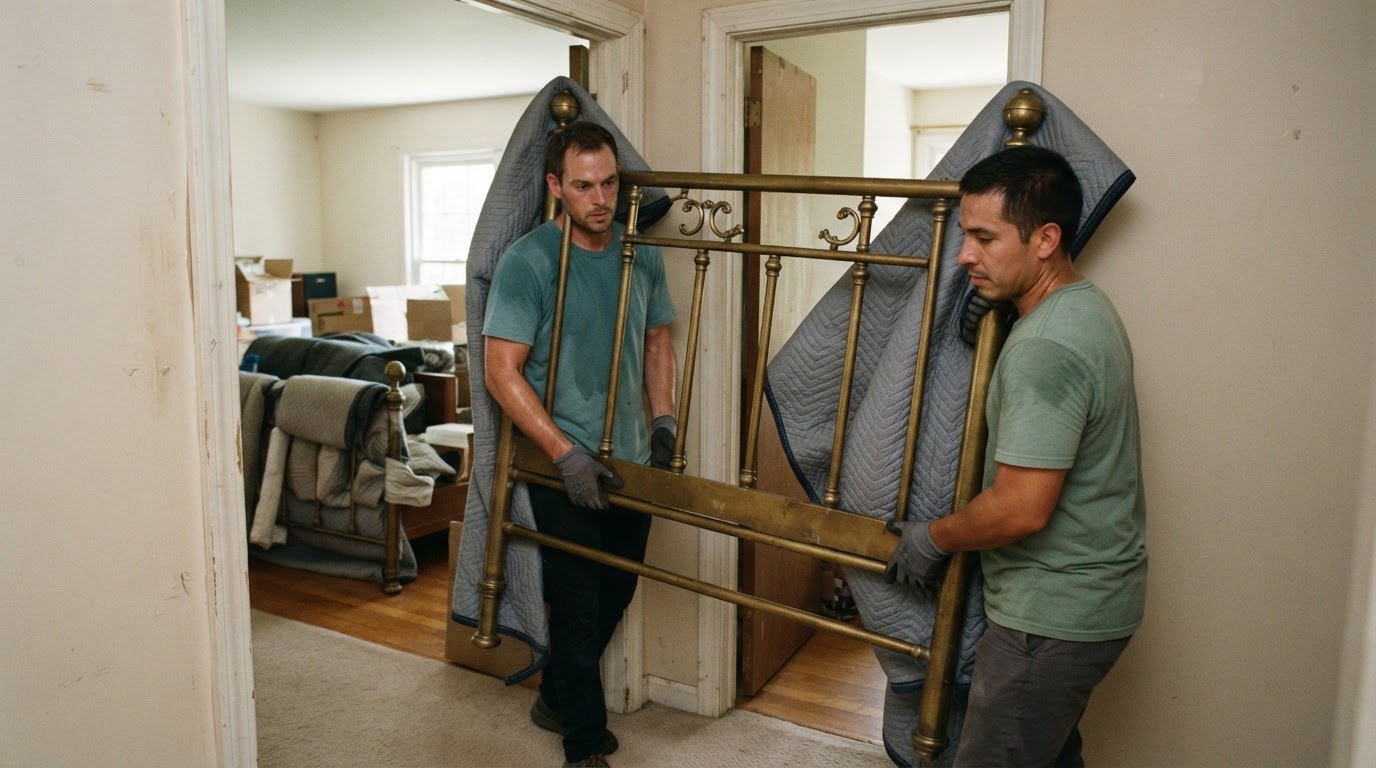
Have the crew measure the frame at its widest, longest, and deepest points, then compare those dimensions with the clear window opening. The angle matters too: a bulky piece may fit only when tilted. Allow at least an inch of clearance after padding, and account for handles, brackets, or other parts that cannot be removed.
- Ask the crew to measure the full route, including the doorway, balcony access, and indoor landing space. A window used for furniture delivery must open or have a removable sash or panel. For comparison, a sample opening measures 36 inches wide by 48 inches high after sash removal. A sample sofa is 38 inches deep and 34 inches tall. Those examples show why each item needs its own measurements, rather than assumptions based on a bed’s label or room size.
-
How Professionals Prepare the Furniture, Window, Room, and Ground
Expect the crew to prepare the frame and clear the route before the lift begins. Movers wrap vulnerable surfaces, protect corners, and secure loose parts so they don’t shift during the hoist. They also clear the indoor landing area; a clear zone of at least 6 feet from the window is recommended. The crew coordinates access at the opening and below.
- Have the crew confirm the frame’s wrapped dimensions before lifting. Padding protects finishes but adds bulk, so the opening must still provide enough clearance. Inside, move rugs, furniture, and other obstacles out of the landing path. Outside, the crew keeps people clear of the drop zone. OSHA construction guidance calls for barricading hazard areas and posting warning signs.
- Let trained movers select and control the rigging, including a rope-and-pulley system when suitable. They assess the frame’s weight, shape, attachment points, opening, and floor height before choosing equipment. The crew keeps the load within the hoist’s capacity and guides it steadily past the balcony edge. Don’t improvise a platform or attempt a lift from the window yourself.
How much does furniture hoisting cost?
Professionals assess a platform bed frame’s total weight, balance, height, and access before selecting lifting equipment. They also consider whether the frame can be separated into pieces and how the load will pass through the opening.
- Have the crew assess weight and balance. Movers review the frame’s materials, construction, and any available manufacturer weight information. They identify how weight is distributed, since a heavy headboard or uneven frame can shift the center of gravity. The National Institute for Occupational Safety and Health’s lifting equation has a recommended limit of 51 pounds under ideal conditions. That figure concerns manual lifting, not a hoist’s load capacity.
- Match the lifting method to height and access. For furniture on floors 2-6, a rope-and-pulley system may be suitable. Exterior lifts or swing-arm hoists are described for floors 6-20+. A mobile crane may enter the discussion when site access or the required reach calls for larger equipment. The crew considers the building, ground access, and where the frame must travel.
- Confirm the load limit for every component. The hoist, ropes, attachments, and lifting points must suit the load. Professionals consider the frame’s weight and position during the lift instead of relying on a rough estimate. A frame that separates into pieces may need a different approach from a large, assembled unit. Each piece still needs a suitable, controlled lifting arrangement.
- Understand what shapes the quote. The price depends on the frame, height, access, equipment, and crew, and is provided after a quote request. A straightforward lower-floor lift differs from a taller lift requiring specialized equipment or more complex site access. The number of pieces, disassembly needs, and the route from the ground to the room can also affect the work involved.
- Share the details used to plan the estimate. Provide the frame’s dimensions, construction details, and available weight information, along with the target floor and balcony access. Photos can help show stairs, exterior obstacles, and the landing area. For an item that needs an exterior lift, consider professional hoisting support so the equipment choice reflects the actual load and setting.
Is window hoisting safe?
A balcony lift requires trained movers, suitable equipment, and a controlled area below. These checks can help you understand how the crew manages risks around the apartment, landing, and ground.
-
Understand the Safety Risks of DIY Hoisting
Leave balcony hoisting to trained professionals; never attempt a DIY lift at height. A platform bed can swing, tilt, or catch against the building, putting people below and anyone near the opening at risk. OSHA’s 2021 safety bulletin reports 57 incidents, 46 serious injuries, and 33 deaths involving job-made boxes, baskets, and platforms between 2002 and 2020. OSHA recommends manufacturer-approved attachments with known load limits instead.
-
Protect the Hoist Crew and Ground
Keep the ground area clear while the crew controls the load. OSHA construction guidance says workers should avoid standing under moving loads, barricade hazard areas, post warning signs, and stay within the hoist’s lifting capacity. A rope-and-pulley operation calls for a coordinated crew to keep the load controlled. Each crew member needs a defined role, so no one enters the load’s path or crosses the marked zone.
-
How Professionals Complete a Pre-Lift Safety Check
Before raising the frame, have the crew explain the lifting method, attachment points, load limit, and communication plan. For a suitable light-to-moderate lift from a second-floor window, trained movers may use rope-and-pulley or similar rated rigging. From the third floor and above, a block-and-tackle, motorized hoist, or mechanical lift is recommended for a trained hoisting crew.
- Clear an indoor landing zone of at least 6 feet from the window before the lift. The crew needs room to receive and guide the frame without stepping over furniture or moving into the stairs. Keep household members and pets away from the apartment’s work area. A clean route also gives the receiving movers space to set the load down under control.
- Wait for the crew’s go-ahead before anyone approaches the balcony or marked ground zone. OSHA guidance calls for barricades and warning signs, not verbal caution alone. Keep doors and stairs clear of bystanders, and don’t stand beneath the frame to watch. The crew should pause the lift if anyone enters the exclusion area.
- Let the crew assess wind and site conditions before lifting. High winds cancel exterior hoisting because they can push a suspended bed frame off its intended path. The team must also stop if the rigging, attachment, or load behaves unexpectedly. Pausing is safer than continuing with an unstable load or compromised equipment.

When window hoisting is appropriate
Consider an exterior lift when the bed cannot travel safely through the apartment’s stairs, doors, or elevator. At an Aldie property, assess the opening, outdoor access, building approval, and any public-space requirements before scheduling the lift.
- Compare the exterior route with indoor access. Hoisting may suit a frame that cannot turn through a stairwell or fit inside an elevator. A sample passenger elevator cab measures 51 × 68 inches, but the actual cab and route must be assessed. If the bed can move indoors without damage or unsafe handling, a balcony lift may not be necessary.
- Get building approval before planning the lift. High-rise buildings generally require approval before furniture hoisting. Building management may set access procedures, approved operating hours, and protection requirements for shared areas. Some buildings restrict hoisting to hours such as 8 AM-4 PM on weekdays. Confirm the building’s process early, so a scheduled crew doesn’t arrive before access is authorized.
- Clarify permits and operator requirements for the equipment. A crane operating on a public street may require city permits. This matters if the lifting plan needs street access rather than a private driveway or another clear ground area. Ask the crew to identify the planned equipment, responsible operator, and any local authorization needed for that setup. Requirements depend on the equipment and where it operates.
- Review insurance and property exposure. High-rise buildings generally require hoisting companies to carry $1M-$5M in general liability insurance. Building approval and insurance requirements are separate checks. The property’s rules may address common-area protection, exterior access, and responsibility for damage. Have the crew’s plan align with those requirements before moving the bed outside.
- Check whether site conditions support a controlled lift. The balcony opening must provide a workable path, and the ground area must accommodate the planned equipment without blocking access. Weather matters too: high winds cancel exterior hoisting. If street access, building approval, or safe operating conditions aren’t in place, postpone the lift or consider an indoor route instead.
In New York City, an HMO license is required beginning November 7, 2024, to operate an articulating-boom crane, mini crane, or rotating telehandler. Confirm that the operator holds the required license for the specific equipment before the lift, and include this check when reviewing the crew’s authorization and site plan.
When to hire trained hoisting professionals
Hire trained hoisting professionals when the frame, narrow stairs, or building layout makes an indoor move impractical. Disassembly may be safer when the frame is designed to separate and its pieces can pass inside. It isn’t automatically cheaper: the project cost depends on labor, access, frame construction, and equipment, with the price provided after a quote request.
- Choose professional help when the assembled frame has no safe indoor route. A tight doorway, stair turn, or elevator can prevent a large platform bed from moving inside without damage. A professional assesses those obstacles alongside the balcony route. If the frame cannot pass through the apartment and cannot be separated easily, a trained crew can assess whether exterior rigging is suitable.
- Ask the crew to weigh disassembly against a hoist. The decision depends on how the frame is built, whether its parts are designed to separate, and whether they fit through the stairs or doorway. Disassembly can reduce the size of each piece, but adds handling and reassembly work. A professional can compare that route with a hoist based on the actual frame and access.
- Use a hoisting crew when the lift needs rigging or precise control. A platform bed’s shape can make it difficult to keep level past a balcony edge. Trained movers plan the attachment points, exterior path, and how the frame will enter the room. If the load can’t be controlled along that route, they can recommend another handling plan instead of forcing the lift.
- Look for a clear plan before the lift begins. The crew should explain the chosen method, the frame’s path, and how it will be received inside. For example, a plan for a narrow balcony opening should account for the frame’s orientation and the room’s landing space. A vague plan that overlooks these details leaves critical parts of the move unresolved.
- Share the details that help professionals plan the job. Provide the bed’s dimensions, known weight, floor, and photos showing the stairs, elevator, doorway, and balcony access. Mention whether the frame separates into pieces. These details help the crew assess disassembly, equipment, and the exterior route before the moving day. Plan a professional hoist when the frame needs skilled handling.
Heavy Furniture Moving: Sofa Hoisting
Heavy Furniture Moving offers Sofa Hoisting for bulky furniture that can’t move through a home’s regular access routes. For a sofa or another large item that needs an exterior lift, trained movers can manage the move and protect the path into the room. The right approach depends on the item, opening, building access, and lifting conditions.
Heavy Furniture Moving also offers Movers Near Me and in-home furniture moving. When arranging help, share the item’s dimensions, access details, and destination. This gives the team practical information about the route and the work involved, without guesswork.
Contact Heavy Furniture Moving to discuss your furniture move.
Plan Your Next Move With Confidence
If you’re planning how to hoist a heavy platform bed frame through a balcony window in Aldie, start by gathering the frame’s basic details and describing the access challenge, such as a tight stair turn or limited interior route. This gives the moving team a useful starting point for discussing the job.
Heavy Furniture Moving offers Movers Near Me and Exercise Equipment Moving, along with Sofa Hoisting for bulky furniture that needs an exterior route. Choose the service that fits the item and task. A clear description of what needs moving helps keep the conversation focused on your home, access, and next steps.
Ready to discuss your move? Contact Heavy Furniture Moving and take the next step with confidence.
Frequently Asked Questions
Can you get a bed up to a second-floor balcony?
Yes, a bed can be lifted to a second-floor balcony when the opening, frame, and exterior route suit a professional hoist. If you’re planning how to hoist a heavy platform bed frame through a balcony window in Aldie, a trained crew can assess the access and lifting plan. A narrow balcony or nearby overhead obstruction may affect the setup. Leave the lift to professionals, not a DIY attempt.
How do professionals measure a platform bed frame and balcony window opening before hoisting?
Professionals compare the frame’s dimensions with the opening’s clear space and consider how the frame must turn or tilt. They measure it as it will be lifted, including the added bulk of protective wrapping and any fixed brackets. The route matters too: a frame that clears the window still needs room to enter and move away from the opening inside.
How much does professional furniture hoisting or crane service cost near Aldie, Virginia?
The cost depends on the equipment, lifting height, frame dimensions and weight, crew needs, and access at the property. A crane setup also depends on where it can operate and whether the site requires additional arrangements. For a bed frame, provide its details and describe the building access so the scope can be assessed. The price is given after a quote request.
Which furniture hoisting companies serve Aldie and Loudoun County, Virginia?
Heavy Furniture Moving serves Aldie and nearby communities, including Ashburn and South Riding. Other service-area cities include Fairfax, Woodbridge, Manassas, Manassas Park, McLean, Vienna, Reston, Centreville, Chantilly, Clifton, Dumfries, Fairfax Station, Haymarket, and Gainesville. The company offers Movers Near Me and Sofa Hoisting for residential moves involving bulky furniture.
What equipment do professionals use to hoist a heavy bed frame safely through a balcony window?
Equipment depends on the frame’s weight, building height, and access. For a suitable lower-floor lift, a professional crew may use rope-and-pulley equipment; higher lifts may call for a block-and-tackle, motorized hoist, or mechanical lift. Exterior lifts, swing-arm hoists, or mobile cranes may suit other site conditions. The crew matches rated equipment and attachments to the planned load and lift.
What steps do professionals follow to hoist furniture through a balcony window?
When planning how to hoist a heavy platform bed frame through a balcony window in Aldie, professionals begin by assessing the furniture, opening, exterior access, and indoor receiving area. They prepare and protect the item, clear the route, and set up suitable rigging. The crew controls the lift and guides the item through the opening, then receives and positions it inside.
What are the risks of hoisting furniture near balconies, windows, power lines, and people?
A suspended frame can swing, shift, or strike the building, balcony, window, or people nearby. Overhead hazards, including power lines, also need attention when assessing the exterior route. OSHA construction guidance says workers should avoid standing under moving loads, barricade hazard areas, post warning signs, and stay within hoist capacity. Keep people clear of the lift zone and leave the operation to trained movers.
Do Aldie or Loudoun County require permits for a crane or furniture hoist?
A crane operating on a public street may require city permits. Whether this applies to an Aldie or Loudoun County lift depends on the equipment and where it will operate. A crane positioned on a public street presents different access considerations from a lift on private property. The project plan should account for the crane’s location and any applicable local approval before work begins.
Frequently Asked Questions
Yes, a bed can be lifted to a second-floor balcony when the opening, frame, and exterior route suit a professional hoist. If you’re planning how to hoist a heavy platform bed frame through a balcony window in Aldie, a trained crew can assess the access and lifting plan. A narrow balcony or nearby overhead obstruction may affect the setup. Leave the lift to professionals, not a DIY attempt.
Professionals compare the frame’s dimensions with the opening’s clear space and consider how the frame must turn or tilt. They measure it as it will be lifted, including the added bulk of protective wrapping and any fixed brackets. The route matters too: a frame that clears the window still needs room to enter and move away from the opening inside.
The cost depends on the equipment, lifting height, frame dimensions and weight, crew needs, and access at the property. A crane setup also depends on where it can operate and whether the site requires additional arrangements. For a bed frame, provide its details and describe the building access so the scope can be assessed. The price is given after a quote request.
Heavy Furniture Moving serves Aldie and nearby communities, including Ashburn and South Riding. Other service-area cities include Fairfax, Woodbridge, Manassas, Manassas Park, McLean, Vienna, Reston, Centreville, Chantilly, Clifton, Dumfries, Fairfax Station, Haymarket, and Gainesville. The company offers Movers Near Me and Sofa Hoisting for residential moves involving bulky furniture.
Equipment depends on the frame’s weight, building height, and access. For a suitable lower-floor lift, a professional crew may use rope-and-pulley equipment; higher lifts may call for a block-and-tackle, motorized hoist, or mechanical lift. Exterior lifts, swing-arm hoists, or mobile cranes may suit other site conditions. The crew matches rated equipment and attachments to the planned load and lift.
When planning how to hoist a heavy platform bed frame through a balcony window in Aldie, professionals begin by assessing the furniture, opening, exterior access, and indoor receiving area. They prepare and protect the item, clear the route, and set up suitable rigging. The crew controls the lift and guides the item through the opening, then receives and positions it inside.
A suspended frame can swing, shift, or strike the building, balcony, window, or people nearby. Overhead hazards, including power lines, also need attention when assessing the exterior route. OSHA construction guidance says workers should avoid standing under moving loads, barricade hazard areas, post warning signs, and stay within hoist capacity. Keep people clear of the lift zone and leave the operation to trained movers.
A crane operating on a public street may require city permits. Whether this applies to an Aldie or Loudoun County lift depends on the equipment and where it will operate. A crane positioned on a public street presents different access considerations from a lift on private property. The project plan should account for the crane’s location and any applicable local approval before work begins.