How to Hoist a Heavy Armoire Through a Window in Gainesville
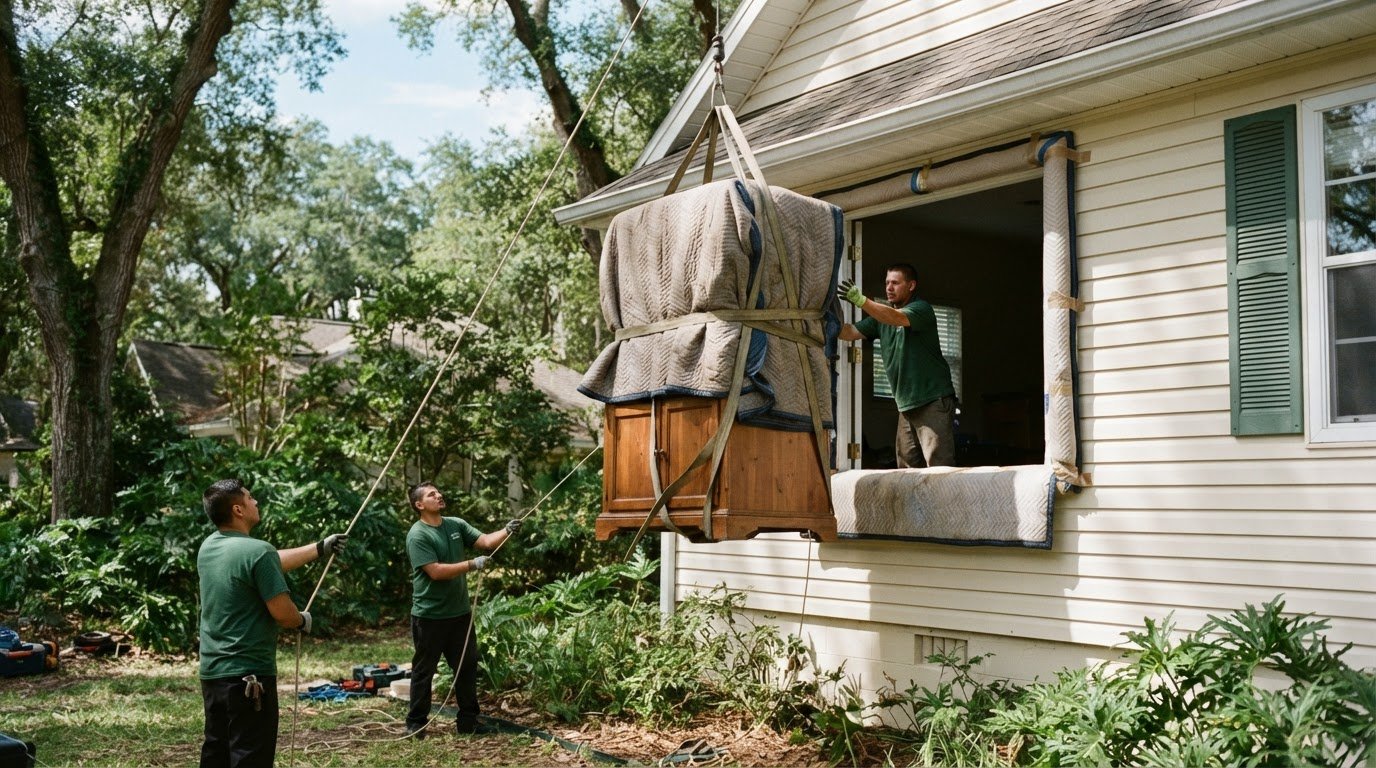
A second-story window hoist is not a shortcut for a difficult doorway. If you’re figuring out how to hoist a heavy armoire through a second-story window in Gainesville, use trained movers and a suitable hoisting setup; these jobs typically take at least three professionals, with two handling the lift and another guiding the piece. Measure the window and armoire with padding in mind, leaving at least an inch of clearance.
Looking for another route makes sense when an oversized armoire won’t fit through the hall or stairwell. But lifting a heavy, awkward piece outside the home brings risks. Careful planning, secure rigging, a clear work area, and clear crew communication can help reduce them.
This guide explains when to bring in specialist movers, which safety precautions matter, and how window or balcony access affects the plan. You’ll also learn how to measure the opening and why the armoire’s size, weight, and route all shape the hoist.
Key Takeaways
- Know when an armoire’s weight, size, or location calls for a trained hoisting crew and more specialized equipment.
- Reduce avoidable hazards by securing the load, clearing the work area, and keeping the crew in clear communication.
- Consider how the window, balcony, outdoor space, and approach path affect the hoisting plan.
- Measure the armoire and opening with padding in mind to assess whether the piece can pass through safely.
- See how sofa-hoisting specialists can help when bulky furniture can’t follow the usual route through a home.
When to hire trained or specialist movers
Hire trained movers when the armoire is too heavy to control by hand, cannot fit through the stairs, or must travel outside the home. A second-story lift requires suitable rigging and a crew that knows how to secure and guide the load. An awkward cabinet can shift as it clears the window, even when its dimensions seem manageable. If the route requires a hoist, treat it as a planned lifting operation, not a DIY workaround.
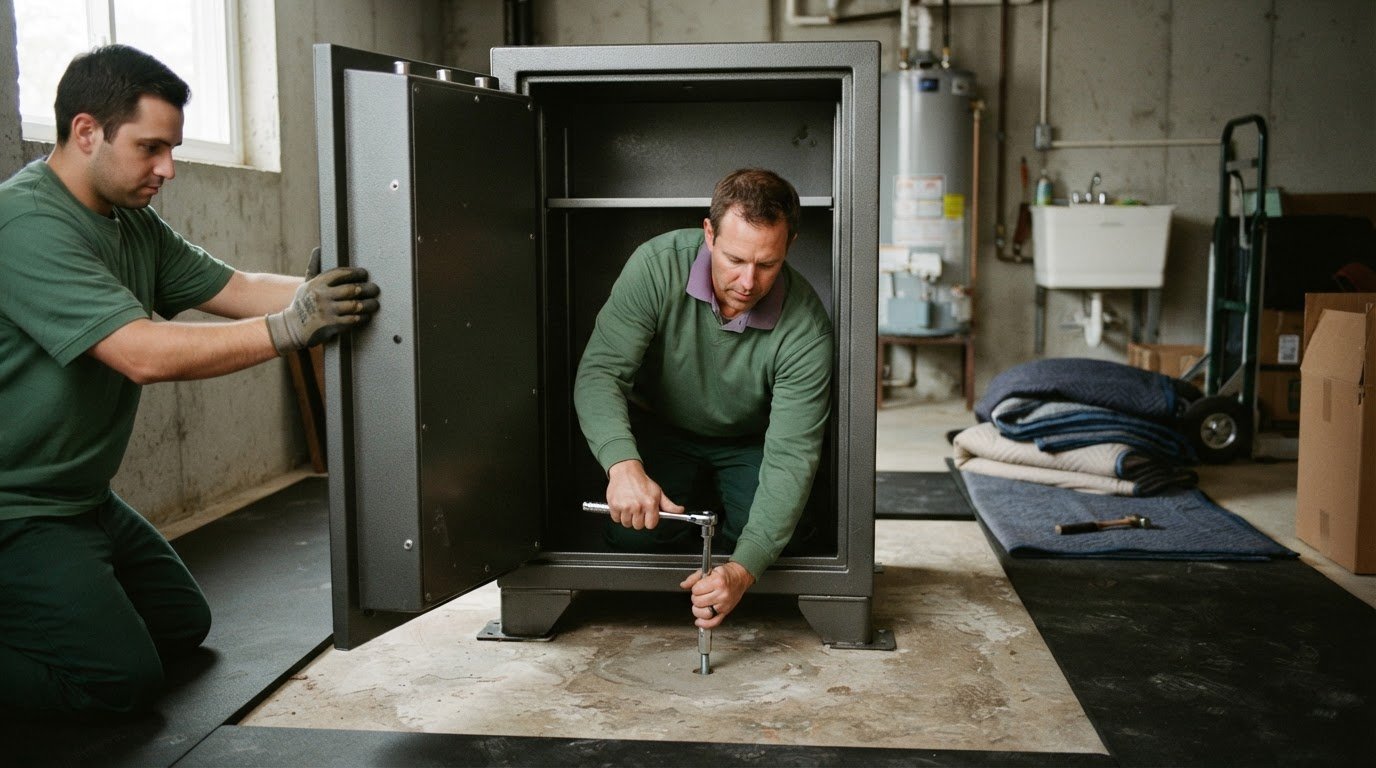
The equipment should match the height and weight of the lift. For a light-to-moderate piece going to a second floor, trained movers may use a rope-and-pulley system or similar rigging with rated hardware. A third-floor-or-higher lift may require options such as block-and-tackle, a motorized hoist, or a mechanical lift operated by a trained crew. Heavy items such as pianos, safes, and large appliances may call for specialized lifting equipment and an experienced crew.
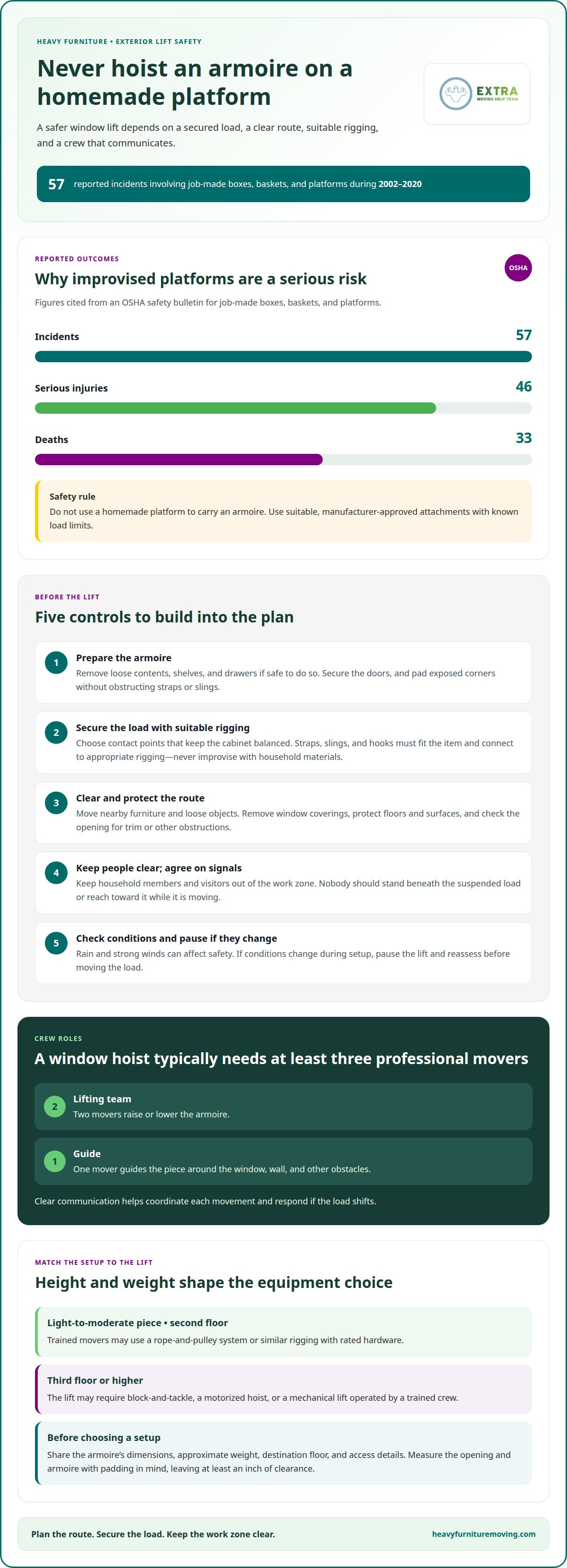
Staffing matters because one person cannot safely manage every part of a window hoist. Large furniture hoisting typically requires at least three professional movers. Two raise or lower the piece while a third guides it around the window, wall, and other obstacles. This division gives the lifting crew a clear task and keeps one person focused on the armoire’s path. Guidance is especially important near a narrow opening or balcony edge.
Before work begins, the crew should check that the hoisting equipment is in good working condition and suitable for the lift. Ask to review the mover’s insurance and written coverage terms, including how they address damage to the armoire and the home. Homeowners insurance depends on the policy’s terms, so don’t assume it covers damage during a furniture hoist. Check what mover coverage applies, what exclusions affect the lift, and how a damage claim is handled.
For a Gainesville home, required permits or approvals depend on the equipment and where it will be set up. A crane or lift operating from or over a public right-of-way can raise different approval questions than equipment kept on private property. Identify the setup location and obtain any applicable local approval before equipment arrives.
A specialist crew is the right choice when the item’s weight, height, or route exceeds what can be managed in a controlled indoor move. Share the armoire’s dimensions, approximate weight, destination floor, and access details during planning. These details help determine the rigging, crew roles, and equipment needed for the lift.
Choose professional specialty movers for a move involving hoisting or a crane, especially when safe handling depends on specialized lifting equipment and experience.
Hoisting safety precautions
Before a hoist, empty and secure the armoire, clear the lifting area, and protect the opening and nearby surfaces. Keep people away from the load’s path, use attachments with known load limits, and agree on clear signals before lifting starts.
Preparing the Armoire for Hoisting
Preparation makes the cabinet lighter, more stable, and easier to secure. Remove loose contents, shelves, and drawers if they can be taken out safely, then secure the doors so they cannot swing open during the lift. Protect exposed corners and surfaces with padding that won’t interfere with straps or slings. These steps reduce shifting and help prevent bumps from damaging the armoire’s finish.
The crew should choose secure contact points that keep the cabinet balanced as it rises. Straps, slings, and hooks must fit the item and connect to suitable rigging. Don’t improvise a lifting attachment from household materials. Manufacturer-approved attachments with known load limits provide a clear basis for securing the load.
Protecting the Window and Home
Preparation also means clearing and protecting the route from the staging area to the opening. Move nearby furniture and loose objects, and protect floors and surfaces where the armoire may pass or rest. The crew should assess the window opening and surrounding area before positioning the load, so the cabinet does not catch on trim or strike a wall.
Remove window coverings and other obstructions from the path. Keep the space below and beside the opening clear, and keep household members and visitors out of the work zone. This gives the crew room to guide the cabinet without distractions or avoidable contact with the home.
Set clear boundaries around the lifting area. Keep people at a safe distance from the suspended armoire, indoors and outside. Nobody should stand beneath the load or reach toward it while it is moving. The ground crew needs enough space to guide the piece without stepping into the hoist’s path. Clear communication between the operator and ground crew helps coordinate each movement and respond if the load shifts.
Include weather in the safety plan. Movers should assess conditions before starting because rain and strong winds can affect safety. Wind can push a broad cabinet away from its intended path, while wet conditions can make footing less reliable. If conditions change during setup, pause the lift and reassess instead of continuing with a moving load.
Improvised platforms create a serious risk. OSHA’s 2021 safety bulletin reports 57 incidents, 46 serious injuries, and 33 deaths involving job-made boxes, baskets, and platforms between 2002 and 2020. Don’t use a homemade platform to carry an armoire. Use suitable, manufacturer-approved attachments, and keep the load controlled from pickup through placement.
For a sofa or another bulky item, professional sofa-hoisting help can support a planned lift with suitable precautions.
Hoisting through windows or balconies
A window or balcony hoist creates an exterior route when an armoire cannot pass through interior doors or stairs. The opening, approach space, and landing point all shape the equipment and lifting plan.
Measuring the Armoire and Window
Compare the armoire’s padded dimensions with the clear opening and the space around it. This helps determine whether the cabinet can pass through without catching or being forced sideways.
Movers need the armoire’s height, width, and depth, plus the window’s usable width and height. Measure the opening between the parts that remain in place, not just the visible window frame. Include padding in the item’s dimensions and allow at least an inch of clearance after padding. The cabinet may need to tilt or rotate, so its diagonal dimensions and the maneuvering space matter, too.
A balcony changes the route, but the access still needs to be assessed. The crew considers the balcony opening, railing, and space available to receive or turn the item. A window that looks wide enough may still be difficult to use if the armoire cannot be aligned with it from outside. Measurements help identify that problem before the lift begins.
Assessing Weight and Hoisting Equipment
Movers assess the armoire’s weight and shape to match the load with suitable hoisting equipment. The rigging must control the cabinet through the opening and along its exterior route.
They consider the cabinet’s dimensions, construction, contents, and balance, then select equipment with an appropriate rated capacity. A-frame hoists can suit window or balcony lifts in high-rise buildings. A crane may be used when the armoire is too large to move through the home by conventional methods. The route and landing point help determine which setup can reach the opening and manage the load.
At a Gainesville property, crane or boom-lift clearance depends on the setup. The crew assesses the approach, ground space, overhead obstructions, distance to the window, and room to position and operate the equipment. These conditions determine whether the site can accommodate the selected machine. No single clearance figure applies to every property.
A second-story balcony can also serve as a transfer point. For example, movers placed a piano on a second-story balcony at a home with an extremely steep driveway, then lowered it to the ground by crane. The example shows how the driveway, balcony, and final landing location can change the route and equipment plan.
Large furniture hoisting carries substantial risk and requires specialized equipment and expertise. The crew plans the armoire’s orientation at the opening, its path outside, and how it will be received at the destination. If measurements show that the cabinet cannot clear the window with padding, the route or lifting approach needs to change before the hoist proceeds.
Moving oversized armoires and other heavy items
If an armoire cannot fit through a second-story window, don’t force it through. Consider another usable window or balcony, a different route through the home, or a crane lift from a suitable exterior position. The right alternative depends on the armoire’s dimensions, the access path, and the space available for lifting equipment.
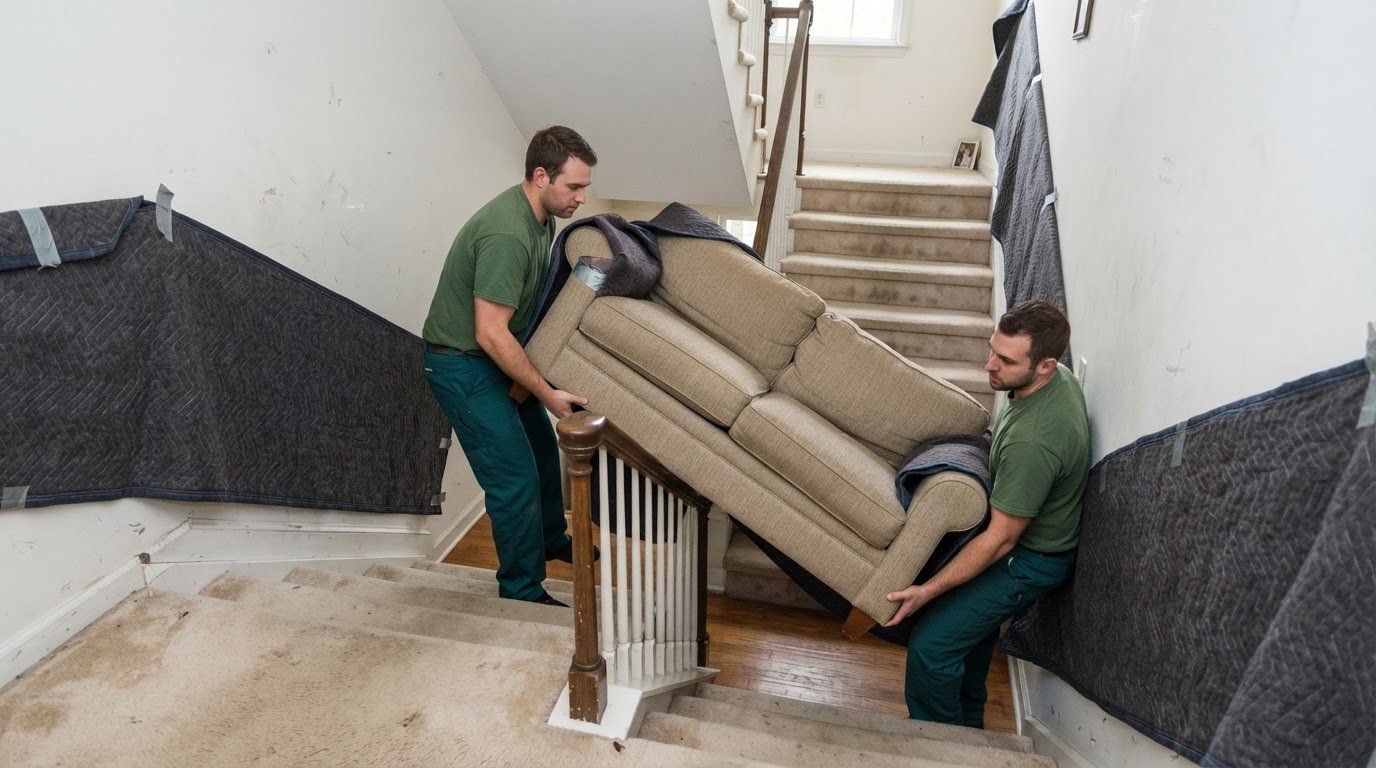
Oversized furniture can exceed the clear width of interior doors, hallways, or stair turns. Armoires, dressers, refrigerators, and bathtubs may not fit through a doorway. A cabinet may clear the doorway but still fail to make a turn at a narrow landing. That’s why the entire route matters, from the room where the item starts to its final placement.
When moving through the home is not possible, a crane can lift heavy furniture outside the building. The crew considers the armoire’s size and weight, the distance it must travel, and the complexity of the lift. A crane needs a workable position and a clear path to the opening. If the property layout rules out that setup, an A-frame hoist may suit a window or balcony route instead.
Choosing between a window, balcony, or crane route takes more than checking whether the armoire fits through one opening. The crew assesses the outside approach, the opening’s usable dimensions, and the space available to receive and maneuver the cabinet. A balcony may provide a transfer point, while a different window may offer a straighter approach. Each route affects how the armoire must be oriented and guided.
- Interior route: Check doorways, hallway turns, stair landings, and ceiling clearance along the full path.
- Window route: Compare the armoire’s padded dimensions with the clear opening and the room to maneuver it.
- Balcony route: Assess the approach, railing, and landing space for receiving the furniture.
- Crane route: Consider whether equipment can be positioned with a clear path to the lift point.
The same considerations apply to other bulky belongings. A refrigerator that cannot turn through a kitchen doorway presents a different handling problem from an armoire that must reach an upper floor. A piano lowered from a second-story balcony by crane shows how a steep driveway or difficult ground route can make exterior access useful.
Before settling on a route, movers compare the item’s dimensions and weight with the path and lifting setup. They also account for the distance the furniture must travel and any obstacles near the opening. If no safe route accommodates the armoire, the crew should reassess rather than force the cabinet through a tight space. That assessment helps determine whether another opening, an A-frame hoist, or a crane is practical.
What measurements should I take to determine whether an armoire will fit through a second-story window?
Compare the armoire’s padded dimensions with the window’s clear opening and the space needed to turn the piece. A tape measure provides useful starting figures, but a successful fit also depends on the cabinet’s orientation and approach path.
Measure the armoire’s height, width, and depth at its widest points. Include handles, trim, feet, and any parts that cannot be removed. If doors or shelves can be safely detached, record the dimensions both assembled and prepared for lifting. Measure after padding is applied, because protective material adds to the cabinet’s outside dimensions. Leave at least an inch of clearance after padding.
Next, measure the window’s usable opening, not just its outer frame. Record the clear width and height with the window fully open, accounting for fixed dividers, hardware, and anything that cannot be moved. The smallest clear dimension can decide whether the armoire passes straight through or needs to be angled. A wide frame does not help if the opening itself is narrower.
Compare the cabinet and opening in more than one orientation. A tall armoire may pass through with its height aligned to the opening’s width, but turning it requires room inside and outside. Consider its diagonal dimensions as well as its face dimensions. A piece that fits on paper may still bind if there is no space to rotate it near the sill.
- Armoire: Record height, width, and depth, including fixed projections and padding.
- Window: Record the clear opening’s width and height, including fixed obstructions.
- Approach: Note the room available to align, tilt, and guide the cabinet.
- Landing: Measure the space where movers will receive and turn the piece.
Check the route beyond the opening, too. A balcony railing, roof edge, nearby wall, or narrow landing can limit the armoire’s movement even when the window measurements work. The crew needs a clear path to align the cabinet and guide it toward its destination. Share those measurements together rather than treating the window as the only constraint.
These figures help movers assess whether a window hoist is practical or another route makes more sense. They also help determine how the armoire should be oriented and where it can safely be received. Measurements are planning inputs, not a reason to force a tight fit. If you want help assessing the opening and furniture dimensions, arrange professional furniture-moving help.
Heavy Furniture Moving: Sofa Hoisting
Heavy Furniture Moving offers Sofa Hoisting for bulky furniture that needs an exterior route into or out of a home. If your armoire cannot clear a doorway, stair turn, or window safely, use the measurements and access details in this guide to plan the next step. Share the item’s dimensions, weight, destination, and possible window or balcony access so the moving plan reflects the space and lifting challenge.
Sofa Hoisting can also help when a large sofa faces the same tight-access problem. For other demanding home moves, Heavy Furniture Moving offers Movers Near Me and Exercise Equipment Moving. Choose help that matches the item and route instead of trying to force a piece through a narrow opening.
Contact Heavy Furniture Moving to discuss your furniture move.
Plan the Armoire’s Next Move
Planning how to hoist a heavy armoire through a second-story window in Gainesville starts with a practical decision: who will manage the lift and its route? Bring together the item’s measurements, the opening dimensions, and details about the outdoor approach. This gives the moving conversation a clear focus and connects the armoire’s needs with the home’s access conditions.
If the window route looks tight, don’t force the piece through. A different opening or an alternate moving plan may better suit the armoire and property. A safe plan for how to hoist a heavy armoire through a second-story window in Gainesville accounts for both the furniture and the access conditions. Discuss those details with a team equipped to handle heavy furniture moves.
Contact Heavy Furniture Moving to talk through your armoire move and possible access options. A clear plan can make a difficult lift a more manageable next step.
Frequently Asked Questions
Which Gainesville, Virginia, furniture movers offer crane, lift, or hoisting services?
Heavy Furniture Moving offers Sofa Hoisting in Gainesville, Virginia, for bulky furniture that cannot pass through standard entryways. For an armoire move, share the item’s dimensions and access challenge so the moving plan can account for the specific home. The route, opening, and available exterior space all help determine how the furniture can be moved safely.
What is the safest step-by-step way to hoist an armoire through an upper-story window?
Use trained movers to plan and carry out the lift rather than attempting a window hoist yourself. The crew should assess the armoire and route, select suitable equipment, and secure the item. They should then clear the work zone, agree on signals, and guide the load slowly through the opening to its landing point. Stop if the load shifts, communication breaks down, or conditions change.
What are the risks of hoisting furniture through a window, including damage and injury?
A suspended armoire can swing, shift, or fall, putting movers and nearby people at risk of impact or crushing injuries. Contact with the window, wall, or trim can damage the home or furniture, and poor control can make the load harder to guide. Keep people clear of the lifting path, and don’t use improvised platforms or attachments. Wind and rain can also affect the operation.
Frequently Asked Questions
Heavy Furniture Moving offers Sofa Hoisting in Gainesville, Virginia, for bulky furniture that cannot pass through standard entryways. For an armoire move, share the item’s dimensions and access challenge so the moving plan can account for the specific home. The route, opening, and available exterior space all help determine how the furniture can be moved safely.
Use trained movers to plan and carry out the lift rather than attempting a window hoist yourself. The crew should assess the armoire and route, select suitable equipment, and secure the item. They should then clear the work zone, agree on signals, and guide the load slowly through the opening to its landing point. Stop if the load shifts, communication breaks down, or conditions change.
A suspended armoire can swing, shift, or fall, putting movers and nearby people at risk of impact or crushing injuries. Contact with the window, wall, or trim can damage the home or furniture, and poor control can make the load harder to guide. Keep people clear of the lifting path, and don’t use improvised platforms or attachments. Wind and rain can also affect the operation.