How to Get a Stuck Oversized Couch Down Fairfax Stairs
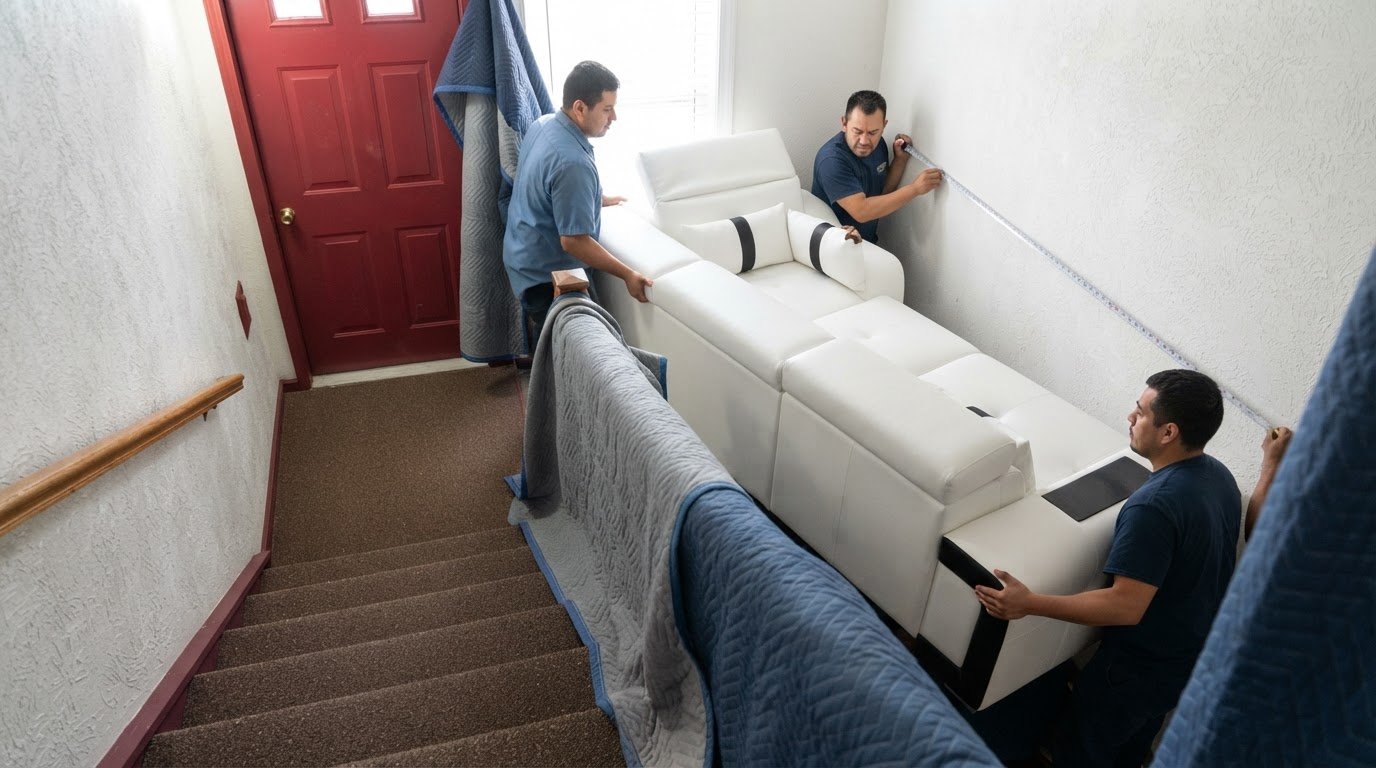
Don’t force an oversized couch that has stopped moving smoothly on a Fairfax stair landing. Measure the couch and the full route, then remove detachable legs or sectional connectors if it barely fits assembled. If measurements leave less than 1-2 inches of clearance, emergency moving helpers for a stuck oversized couch on a stair landing in Fairfax can help assess a safer way through.
A tight landing can make a couch feel impossible to turn, but adding muscle is not always the answer. Learn how to measure the couch, stairs, and ceiling clearance, protect walls and railings, and match the moving equipment to the route.
This guide also explains when disassembly may help, how to recognize an unsafe carry, and why equipment that works in a hallway may not suit stairs. Pause the lift and assess the route before trying again.
Key Takeaways
- Map the full route, including stair turns and landing clearance, before attempting another lift.
- Clear trip hazards and cushion vulnerable walls and railings before moving the couch.
- Choose equipment for the surface and stair layout; a tool that works in a hallway may be hard to control on steps.
- If the couch catches or stops moving smoothly, pause and reassess instead of forcing it through.
- Use disassembly when removable parts or sectional pieces make the route easier to navigate.
Measuring oversized furniture and the full stair route
In Fairfax, apartment rules for moving oversized furniture through shared stairwells vary by building. Review your lease and building move instructions for access, scheduling, and keeping shared paths clear before you begin.
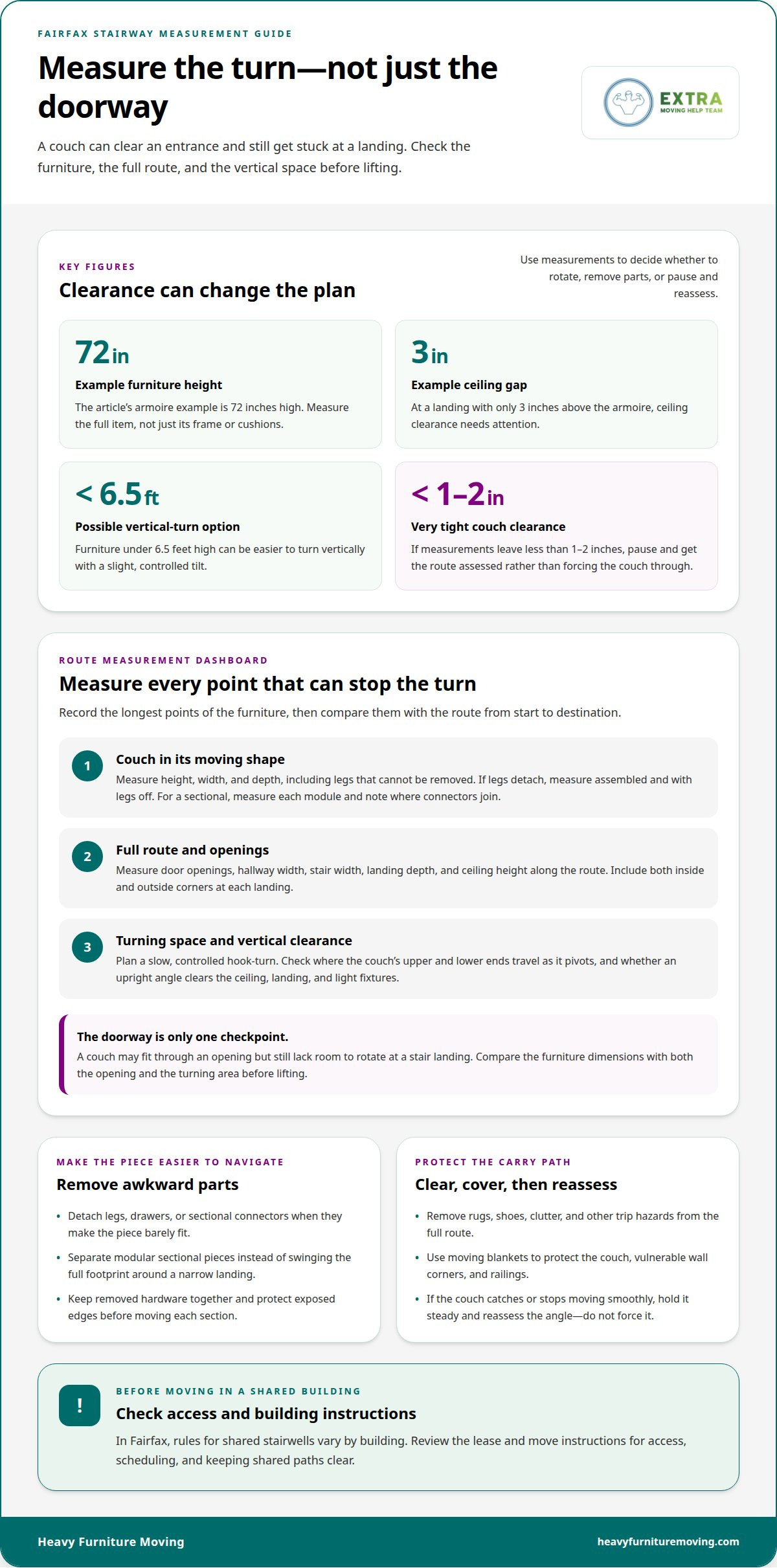
- Measure the couch in its moving shape. Record its height, width, and depth, including legs that cannot be removed. Measure the longest points, not just the cushions or frame. If the legs detach, measure the couch both assembled and with the legs off. For a sectional, measure each module separately and note where the connectors join. These measurements help determine whether a tight turn calls for a different orientation, fewer attached parts, or another plan.
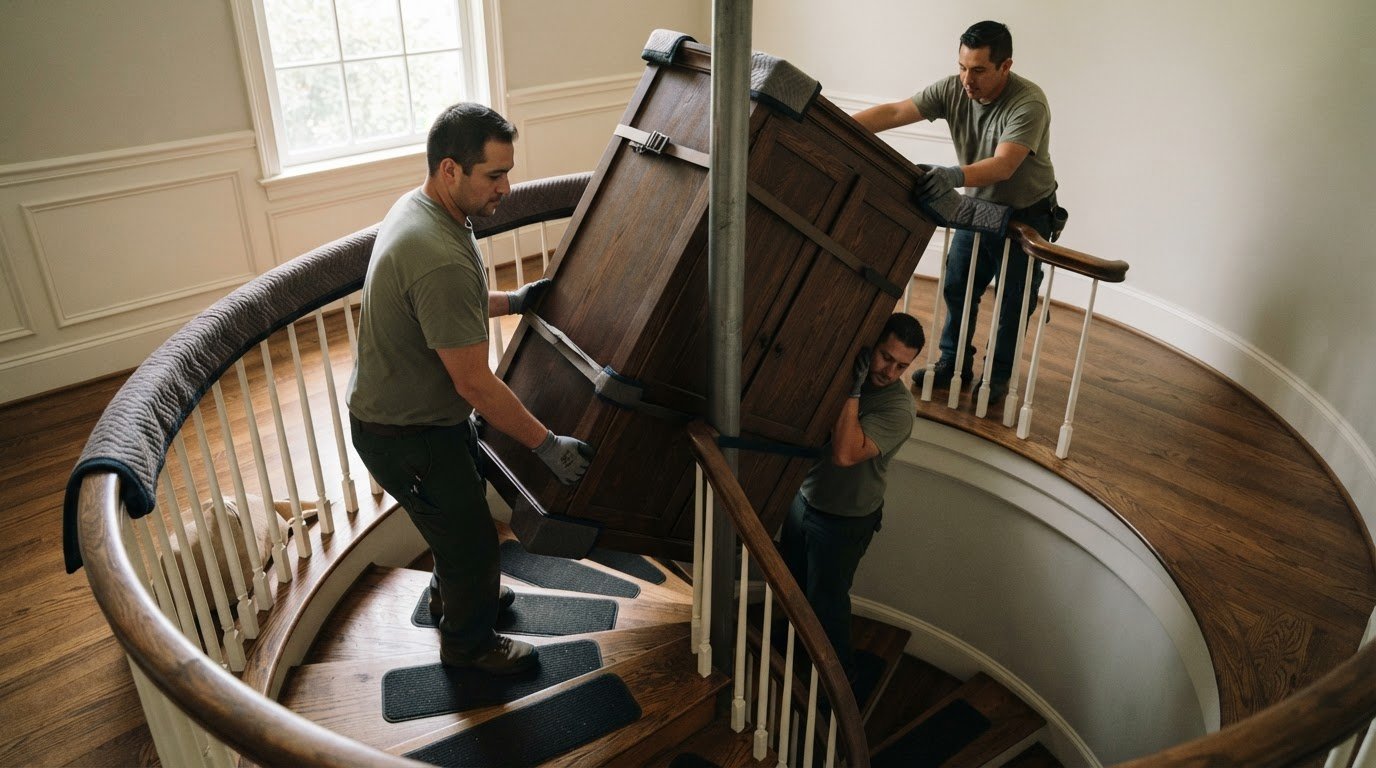
- Trace the full route, not only the staircase. Measure door openings, hallway width, stair width, landing depth, and ceiling height along the route. Pay close attention to the inside and outside corners of each landing. A couch may clear a doorway but still lack the room to rotate at a turn. For example, an armoire measuring 72 inches high needs attention at a landing with only 3 inches between its top and the ceiling.
- Test the turning space before lifting. Compare the couch’s dimensions with the landing and doorway measurements, then plan a slow, controlled hook-turn around each corner. Check where the couch’s upper and lower ends will travel as it pivots. If its diagonal height exceeds the doorway height, carrying it vertically may create a passable angle. Furniture under 6.5 feet high can be easier to turn vertically with a slight, controlled tilt.
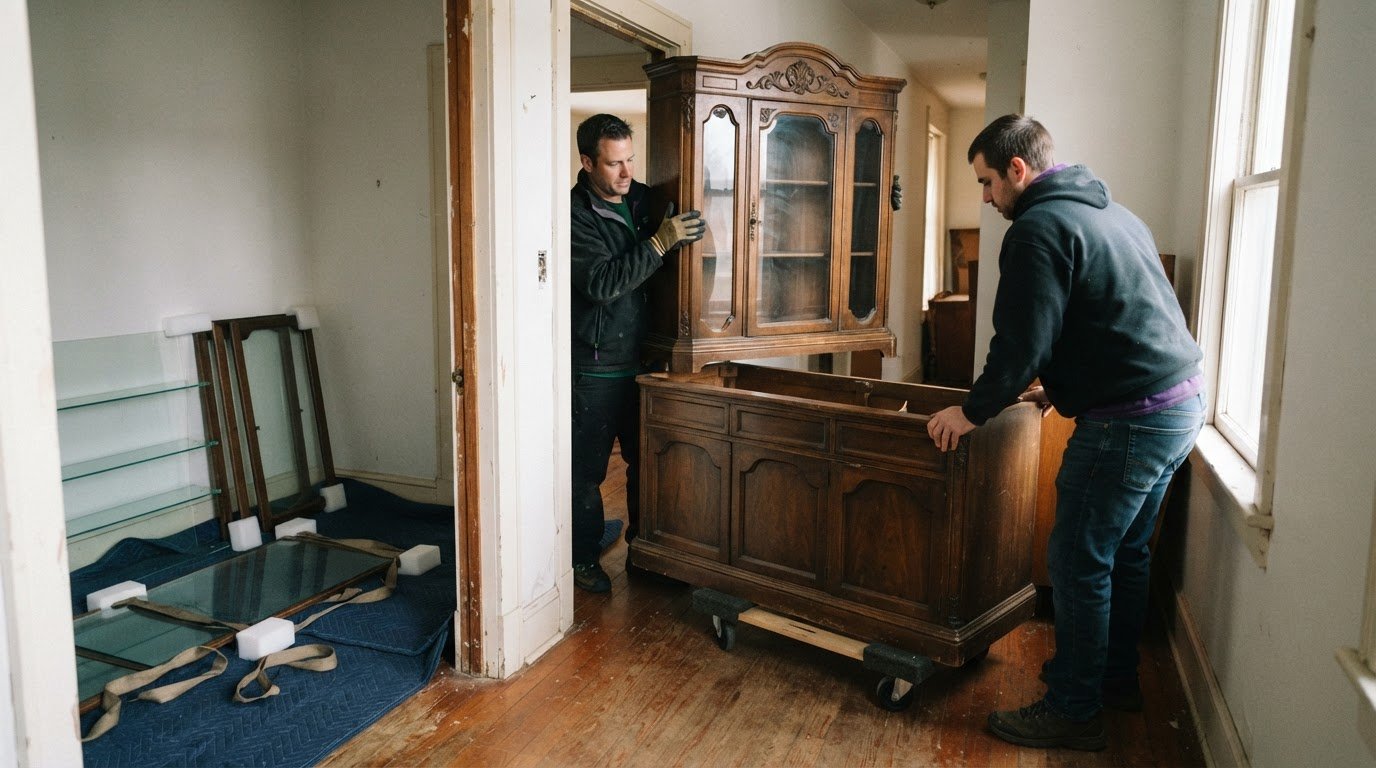
- Remove parts that make the piece awkward. Take off detachable legs, drawers, and sectional connectors when the couch or furniture barely fits assembled. Break a modular sectional into its separate pieces instead of trying to swing the full footprint around a narrow landing. Compact furniture can make the route easier because smaller modules need less turning room. Keep removed hardware together, and protect exposed couch edges before moving each section.
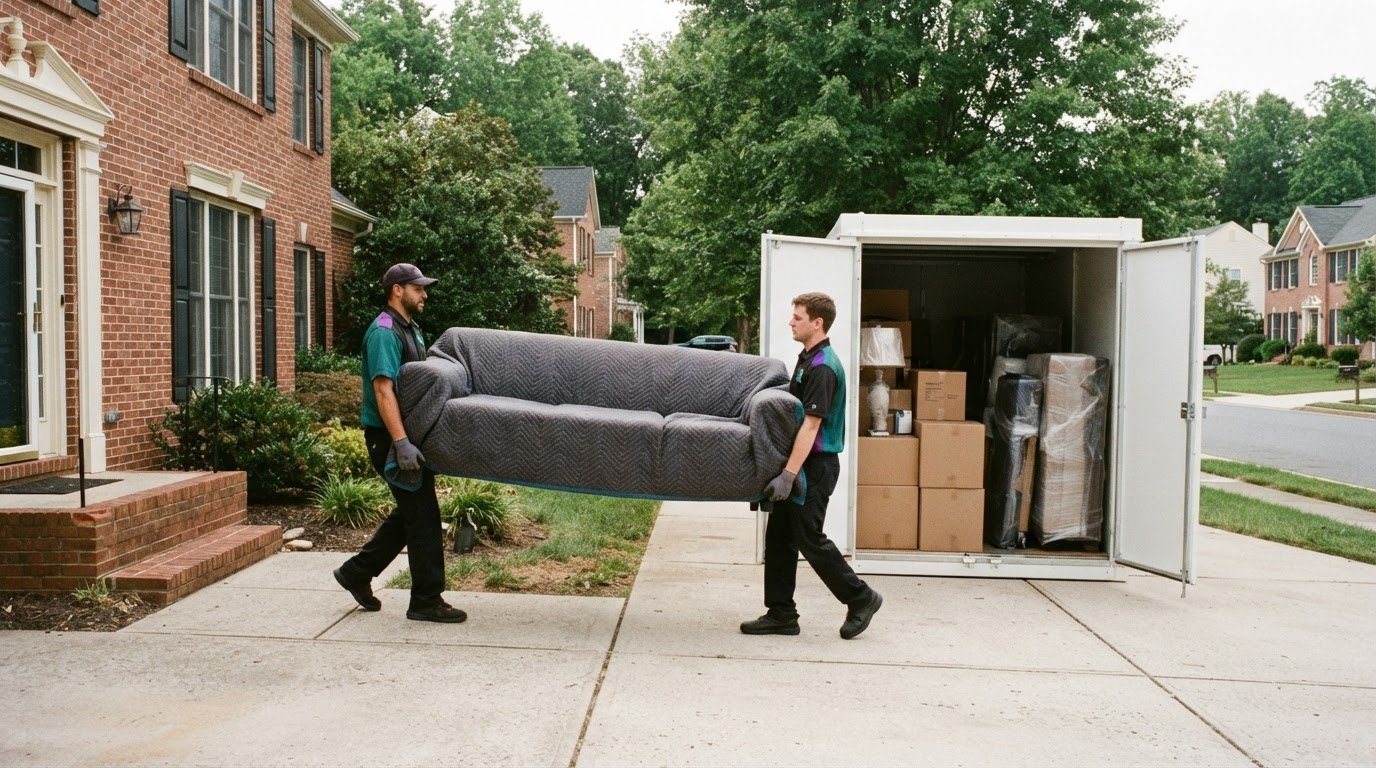
- Protect the route before the first lift. Cover the couch with moving blankets and protect vulnerable wall corners and railings where the frame might brush past. Clear rugs, shoes, and loose objects from the floor. Carry the couch upright only if the ceiling allows enough clearance and the movers can control its balance. If it catches, stop and reassess the angle instead of pushing against a wall or rail.
Building rules vary, so check your lease and move instructions for access and scheduling requirements. Keep shared paths clear while moving furniture.
Clearing and protecting stairs, walls, and railings
- Clear the route from the couch to the exit. Remove rugs, shoes, picture frames, and clutter from hallways, stairs, and landings. Move small tables and floor lamps out of the turning area, too. Check every step for anything that could shift underfoot. Clear the entire route to the destination so movers do not have to pause with the couch balanced on the stairs.
- Keep people out of the carry path. Ask household members to stay clear of the stairs and landing while the couch is moving. Keep pets behind a closed door in another room. Before lifting, choose one person to give clear commands such as “lift,” “hold,” or “lower.” This helps everyone move together without stepping backward into a wall or another person.
- Cover railings and banisters before carrying. Wrap exposed rails in moving blankets and secure the coverings so they do not slide on contact. Pay particular attention to the inside rail at a landing, where the couch frame may scrape during a turn. Make sure blanket folds do not bunch underfoot. Keep the handrail usable where possible, and do not tie anything in a way that prevents a firm grip.
- Shield walls, corners, and floors along the route. Cover vulnerable wall corners and edges most likely to meet the couch. Protect the floor where the couch may be set down, especially on a landing where movers might pause to rotate it. Keep coverings flat and secure. A loose blanket underfoot can create another hazard while moving a bulky item.
- Check vertical clearance before changing the couch’s angle. An upright couch needs enough room beneath the ceiling, including above the landing and around light fixtures. Move slowly near a low ceiling or tight corner, with padded surfaces facing likely contact points. If the couch catches, stop and hold it steady. Adjust the route or angle instead of forcing it.
- Use another route if the landing stays blocked. Compare the current stairs with another entrance, a wider stairwell, or a service corridor. Clear that alternate path and protect its rails before moving any pieces. If the couch remains stuck and you can’t control it safely, heavy lifting moving help can be a practical next step for a difficult carry.
Getting a couch down a straight staircase
- Set up the carry before lifting. Clear the stairs and cover likely contact points with moving blankets. Agree on simple commands such as “lift,” “hold,” and “lower” before anyone grips the couch. Wear non-slip work gloves for better control. If the couch shifts, catches, or stops moving smoothly, pause and reassess its position. Do not push harder against a narrow stair or landing.
- Choose an orientation the staircase can handle. On a straight staircase, two people may carry a couch upright or on its back. Check that the chosen position clears the walls, railings, and ceiling from the first step to the bottom. Stabilize the couch before moving.
- Give each person a clear role. On stairs, the person below supports most of the couch’s weight while the person above guides direction and balance. For a two-person hand carry, place the taller person below and the shorter person above. Move one step at a time, communicating before each shift. A 200-pound sofa can feel like a 240-260-pound load to the person at the bottom.
- Turn the couch only with controlled movement. If the stair width is tight, a couch that narrowly fits may become easier to carry when tilted forward at a 45-degree angle. Keep both carriers’ grips firm, and adjust in small increments rather than swinging the frame. Stop if either person loses balance or the couch presses into a wall. Reposition only when the load is steady.
- Pivot carefully through a narrow doorway. Rotate the couch diagonally and guide it slowly through the opening. Move one end through first, then pivot the other without scraping the doorframe. Keep blankets between the couch and exposed corners. Do not twist while carrying or rush the turn. Everyone should know which end moves next before changing direction.
- Know when friends aren’t enough. A friend should help only if both people can hold and control the couch throughout the flight. If it is stuck, the stair turn is too tight, or its weight shifts beyond your control, stop the carry. Professional movers are a practical option for a difficult lift, especially when you cannot keep the couch stable on the stairs.
Measuring couch dimensions and stairway clearances
Send movers clear photos of the couch, doorway, stairs, and landing, along with measurements. Include the couch’s height, width, and depth, stair width, landing ceiling height, and tightest turn.
- Measure the couch at its widest points. Record height, width, and depth with a tape measure, including fixed legs or arms. For example, a sofa measuring 35 inches high, 84 inches wide, and 38 inches deep needs a plan for each orientation. Note removable legs separately, then measure again with them off. Include sectional pieces individually, and show where connectors attach.
- Measure every opening and stair section. Record the narrowest doorway and stair width, not the widest spot. Measure the landing’s length and depth, plus ceiling height above the landing. A sample route with 34-inch stairs and a 75-inch landing ceiling may limit how the couch can turn. Include door trim, handrails, and other fixed projections in your notes.
- Show the route in photos. Take a full view from the couch’s starting point toward the stairs, then photograph each doorway, flight, and landing. Include close-ups of tight corners and ceiling obstacles. Place the tape measure in each clearance photo so its position is clear. Label images by location, such as “upper landing” or “front doorway,” to show the route in order.
- Record how the couch is currently positioned. Photograph the stuck couch from the front and side, including the points touching walls or railings. Note whether it is upright, on its back, or angled across the landing. Show the approach to the stairs and the direction it needs to move. These details help movers assess whether the issue is couch width, turning space, or ceiling height.
- Compare dimensions before trying another technique. Test the couch’s height, width, and depth against each opening, then consider how its diagonal changes as it turns. A typical staircase angle is 37 degrees, but the landing and doorway still determine the usable path. If measurements leave less than 1-2 inches of clearance, call professional movers rather than forcing furniture through a difficult gap.
- Send one organized measurement note. List the couch dimensions first, followed by doorway widths, stair width, landing dimensions, and ceiling height. Attach route photos in moving order and identify removable parts. This gives movers a clear picture of the challenge before they plan how to move the furniture. Use inches for all measurements so they are easy to compare.
Choosing stair-moving equipment
- Match the equipment to the route. Consider the couch’s position, stair width, and landing turns first. A tool suited to a flat hallway may be awkward on steps. If you need emergency moving helpers for a stuck oversized couch on a stair landing in Fairfax, the equipment must suit the route, not just the couch. Choose gear that allows movers to control the load and clear the railings.
- Use furniture moving straps for a planned two-person lift. These straps are designed for two people carrying long items such as couches. They can help position the load, but both carriers still need steady footing and a shared plan. Check that the straps sit securely before lifting and keep the couch balanced as it moves. Straps do not replace control or clear communication.
- Consider a stair-climbing dolly only when it suits the couch. This dolly has three wheels on each side that rotate over stair edges as it moves. That design can help on stairs, but the couch still needs to be controlled. Confirm that it can be secured and balanced on the dolly. A bulky frame or tight landing may make this setup difficult to maneuver.
- Be cautious with stair rollers. Rollers require a third helper to reposition them continually, which can make the load difficult to control. The helper needs room to reach the rollers without stepping into the couch’s path. If the landing is narrow or the couch is already wedged, rollers may complicate positioning instead of helping. Stop if the team cannot coordinate the movement.
- Reserve a hand truck for a compatible load and route. A hand truck is an upright, two-wheeled dolly that tilts backward. It may suit a load that can sit securely against its frame, but a wide couch can be difficult to position on it. Do not tilt or move heavy furniture on stairs unless the load stays stable and the carriers remain in control.
- Use a furniture dolly on flat sections. A furniture dolly is suited to flat hallways and lobbies, where its wheels can roll over level floors. Keep it away from stair edges, and plan the transition between the hallway and the steps. Moving the couch to the landing on a dolly does not mean that dolly is suitable for taking it down the stairs.
- Choose control over convenience. The right equipment depends on the couch, stair layout, and available handling strength. If emergency moving helpers for a stuck oversized couch on a stair landing in Fairfax are needed, choose support that can manage the specific carry rather than improvising. If the couch remains stuck or the equipment can’t keep it steady, pause the attempt. For difficult, heavy furniture carries, get help with heavy lifting.
Heavy Furniture Moving: Movers Near Me
Heavy Furniture Moving provides Movers Near Me for bulky household moves that are difficult to manage alone. If your couch remains stuck after you have measured the route and stopped forcing the turn, the team can take over the heavy carry. In-home furniture moving and Sofa Hoisting are also available when a couch needs careful handling inside a home or another way out.
Share the couch’s dimensions, its current position, and photos of the stairs and landing when describing the job. Those details help explain the obstacle and the handling the move calls for. If you’re ready for help with the stuck couch, contact Heavy Furniture Moving.
Choose a safer next move
A couch that remains stuck is a reason to pause, not apply more force. Consider whether the next attempt needs a different carry position, another route, or another way to move the piece. If you need emergency moving helpers for a stuck oversized couch on a Fairfax stair landing, send the measurements and route photos so the challenge is clear from the start.
Heavy Furniture Moving provides Movers Near Me, Exercise Equipment Moving, and Sofa Hoisting. Sofa Hoisting may help when carrying the couch through the stair route is not workable. The right next step depends on the couch and access points, so describe where it is stuck and the route you are considering.
Reach out to Heavy Furniture Moving to discuss help with the couch. A careful plan can turn a stressful lift into a manageable next step.
Frequently Asked Questions
Should I disassemble furniture before trying to move it through tight spaces?
Remove parts that detach easily if they make the couch harder to turn, but do not dismantle the frame unless you know how to reassemble it. Put screws, bolts, and connectors in a labeled bag, then secure the bag to the matching piece. Separate a sectional only at its designed connections. Keeping the hardware organized helps prevent a small part from delaying reassembly.
What if your furniture won’t fit?
Stop and reassess the route rather than forcing the couch through a tight opening. Check whether another entrance or a removable part changes the fit. If the measured route still will not work, Sofa Hoisting may be an option for moving the couch through an exterior opening. Consider outside access, the couch’s dimensions, and whether it can be handled safely.
When should you call professional movers for large furniture?
Call professional movers when a large item can’t be controlled safely, the route includes a difficult landing, or another attempt could damage the home. Professional help is also recommended for furniture going to the 3rd floor or higher. Before the move, share the item type, its current position, and any route restrictions. That gives the crew useful context for planning the handling.
Are emergency furniture movers near Fairfax, VA available today?
Same-day and next-day heavy-item jobs are often available through Heavy Furniture Moving, with same-day same-afternoon service for calls made before 2 PM. Availability depends on open schedule slots. Explain that the couch is stuck, where it is on the stairs, and whether anyone has already tried moving it. That helps distinguish a difficult stair carry from a regular furniture move.
Can I get same-day couch moving or furniture rearrangement in Fairfax, VA?
Heavy Furniture Moving provides in-home furniture moving for couch moves within a home or between residences. Same-day service is available when a slot is open. Describe whether the couch needs to move between rooms, floors, or homes, and include the stair layout and its current position. This helps the team understand the work involved before arranging the move.
Can professional movers disassemble or remove couch legs to get it around a stair landing?
Yes. Heavy Furniture Moving handles disassembly and reassembly, including sofa legs, when needed for a move. Tell the crew whether the legs detach and whether the couch is already partly disassembled. Wrap, blankets, and straps are included on every job. Keep loose hardware together with the couch, especially if pieces need to be carried separately through a tight landing.
What are the risks of DIY moving a heavy couch on stairs, and how can I prevent injury or damage?
A heavy couch can shift suddenly, strain a carrier, pinch fingers, or scrape walls and rails. Do not lift while twisting or place hands beneath a load that could drop. Clear the steps, use a steady command system, and stop if anyone loses footing or control. If the couch is stuck or the load feels unstable, professional help is safer than another forced attempt.
Frequently Asked Questions
Remove parts that detach easily if they make the couch harder to turn, but do not dismantle the frame unless you know how to reassemble it. Put screws, bolts, and connectors in a labeled bag, then secure the bag to the matching piece. Separate a sectional only at its designed connections. Keeping the hardware organized helps prevent a small part from delaying reassembly.
Stop and reassess the route rather than forcing the couch through a tight opening. Check whether another entrance or a removable part changes the fit. If the measured route still will not work, Sofa Hoisting may be an option for moving the couch through an exterior opening. Consider outside access, the couch’s dimensions, and whether it can be handled safely.
Call professional movers when a large item can’t be controlled safely, the route includes a difficult landing, or another attempt could damage the home. Professional help is also recommended for furniture going to the 3rd floor or higher. Before the move, share the item type, its current position, and any route restrictions. That gives the crew useful context for planning the handling.
Same-day and next-day heavy-item jobs are often available through Heavy Furniture Moving, with same-day same-afternoon service for calls made before 2 PM. Availability depends on open schedule slots. Explain that the couch is stuck, where it is on the stairs, and whether anyone has already tried moving it. That helps distinguish a difficult stair carry from a regular furniture move.
Heavy Furniture Moving provides in-home furniture moving for couch moves within a home or between residences. Same-day service is available when a slot is open. Describe whether the couch needs to move between rooms, floors, or homes, and include the stair layout and its current position. This helps the team understand the work involved before arranging the move.
Yes. Heavy Furniture Moving handles disassembly and reassembly, including sofa legs, when needed for a move. Tell the crew whether the legs detach and whether the couch is already partly disassembled. Wrap, blankets, and straps are included on every job. Keep loose hardware together with the couch, especially if pieces need to be carried separately through a tight landing.
A heavy couch can shift suddenly, strain a carrier, pinch fingers, or scrape walls and rails. Do not lift while twisting or place hands beneath a load that could drop. Clear the steps, use a steady command system, and stop if anyone loses footing or control. If the couch is stuck or the load feels unstable, professional help is safer than another forced attempt.