How to Carry a Heavy Sleeper Sofa Down Narrow Chantilly Stairs
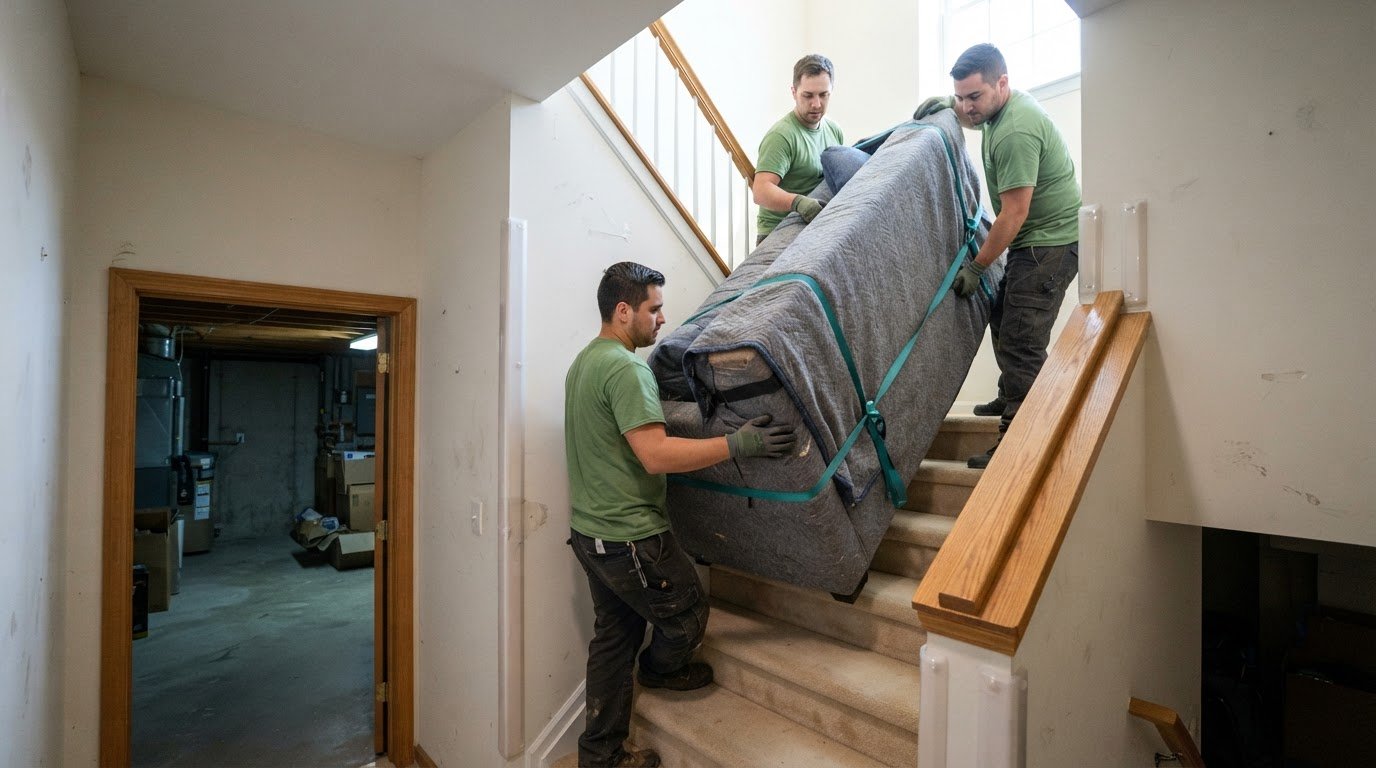
To plan how to safely carry a heavy sleeper sofa down narrow basement stairs in Chantilly, assess both the sofa and the entire route first. The folding bed mechanism can shift the load, so a sleeper sofa may need more movers than a standard couch. Clear access, agree on each movement, and plan every turn before starting the descent.
It’s understandable to worry about scraped walls, damaged furniture, or losing control on the stairs. A tight landing makes a bulky sofa harder to handle, especially when its weight shifts. Rushing only increases the risk.
This guide explains how to assess the sofa and route, protect the path, manage turns, and control the load on each step. You’ll learn which measurements matter and how to plan a safe way to carry a heavy sleeper sofa down narrow basement stairs in Chantilly.
Key Takeaways
- Have the moving team assess the sofa and the full route, including basement access, stair width, landings, and tight turns.
- Clear the carry path and protect nearby walls, floors, and doorways before the sofa moves.
- Plan each turn in advance and use one person to call movements so the team pivots together.
- Choose handling equipment based on the staircase and sofa, and keep the load controlled rather than relying on sliders on stair treads.
- Pay special attention to the lower end on the descent, where the carrier bears more of the sofa’s load.
How professionals clear and protect the moving path
Before moving a sleeper sofa, professional movers clear the route, improve visibility, and protect exposed surfaces. They also prepare the sofa carefully, removing parts only when its design allows.
-
Clear and Light the Moving Route
Clear the entire route from the sofa to the basement, including doorways, hallways, landings, and stair treads. Move small furniture, shoes, rugs, and loose items out of the carry path. Even a basket beside a landing can obstruct a turn. Light the stairs and each transition so carriers can see tread edges, railings, and obstacles before moving.
Make sure doors stay open without swinging into the route, and keep pets and household members away from the stairs while the crew works. A clear path gives the team room to carry, pause, and adjust the sofa without stepping over objects.
-
Protect the Path and Remove Sofa Parts
Have the crew protect vulnerable floors, walls, doorframes, and stair edges before carrying the sofa through. They can place suitable coverings where contact or scuffing is likely, while keeping the stair treads secure underfoot. Check that coverings lie flat and don’t bunch where carriers need stable footing, especially near a basement turn.
Have the crew inspect the sleeper sofa before removing its mattress, cushions, or legs. They should detach parts only if the sofa’s construction allows, then keep those pieces together and out of the route. Removing parts can reduce bulk, but the folding-bed mechanism should remain secure.
- Have the crew make a final pass from the sofa’s starting point to the basement. They should open doors fully, move remaining objects, and spot hazards at every threshold. Check the stairwell for hanging fixtures, low ceilings, protruding trim, or a handrail that narrows the usable space. A clear hallway alone isn’t enough if the basement entry still has an obstruction.
Set aside a safe staging area for cushions, a mattress, or detached legs. Keep these pieces out of the hallway and away from stair landings, where they could block the crew. Tools and protective materials should also be kept off the stairs once the carry begins.
- Before lifting, confirm that the crew can see the full stair route. Turn on basement and nearby hallway lights, and address dark corners or shadows around the landing. If the light switch is beyond the stairs, arrange lighting before positioning the sofa. Carriers need a clear view of the next step and the space where they’ll pause.
Before moving the sofa, have one crew member walk the route and point out any remaining obstruction. This final walkthrough can catch a doorstop, loose floor covering, or an item beside the basement entrance. Clear hazards first, then keep the stairs open for the controlled carry.
How professional movers handle tight landings and staircase turns
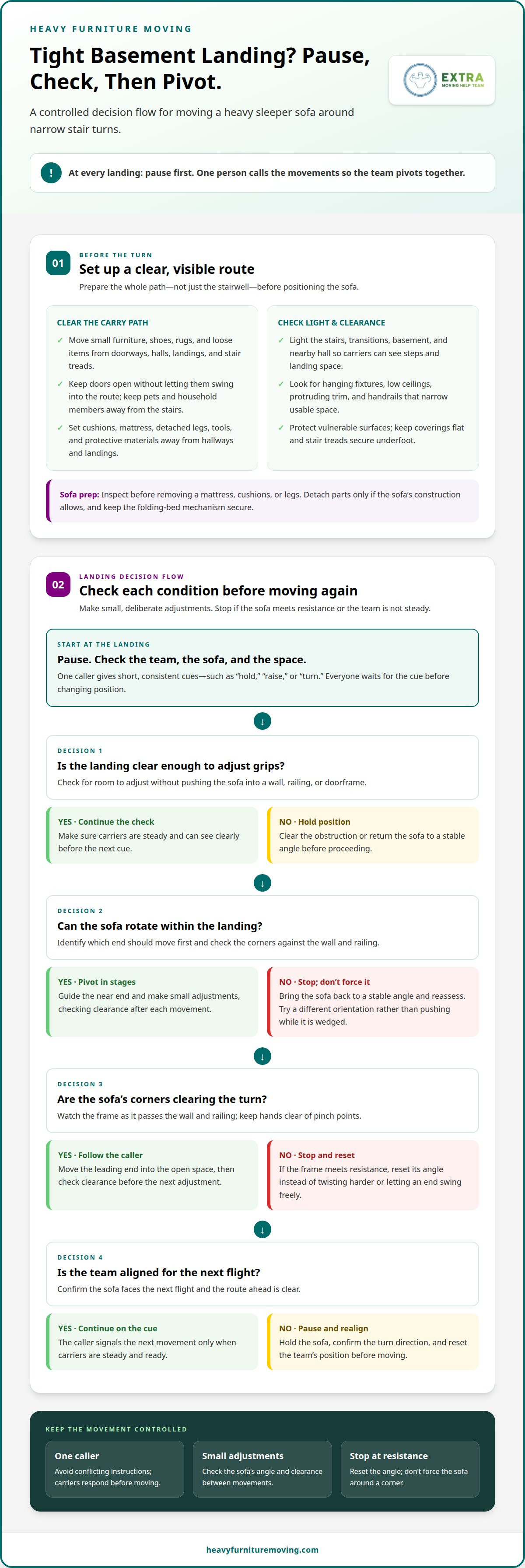
At each landing, the crew pauses, communicates, and changes the sofa’s angle together. One person calls the moves so carriers don’t pivot in opposite directions.
-
Coordinate at Staircase Landings
Pause at each landing and let one person direct the next movement. The caller gives clear cues, such as “hold,” “raise,” or “turn,” before anyone changes position. This keeps carriers coordinated instead of reacting to conflicting instructions.
Before moving again, check where the sofa’s ends and corners are positioned. Keep the landing clear enough for carriers to adjust their grips without pushing the sofa into a wall, railing, or doorframe.
-
How professional movers pivot the sofa at each turn
Have the crew identify which end needs to move first before pivoting. At a basement turn, one carrier guides the near end while the others follow the caller’s direction. Make small, deliberate adjustments rather than forcing the sofa around the corner in one movement.
Watch the sofa’s corners as they pass the wall and railing. If the frame meets resistance, stop and reset its angle instead of twisting harder or letting one end swing freely.
- Use the landing for a controlled pause, not a rushed turn. The caller should wait until each carrier is steady and can see clearly before giving the next cue. The team might hold the sofa level, confirm the turn direction, and then move the leading end into the open space.
Keep communication short and consistent throughout the turn. One caller gives an instruction, and carriers respond before moving. Avoid several people calling different directions at once. Conflicting cues can make one end rise while the other swings toward the stair rail or wall.
If the sofa cannot rotate within the landing, stop and reassess its position. The crew can bring it back to a stable angle, then try a different orientation. Don’t keep pushing while the frame is wedged against a corner.
- Make the turn in stages. The caller directs a small movement, checks the sofa’s clearance, and signals the next adjustment. This keeps the frame’s movement predictable and gives the team time to correct its angle before continuing down the next section of stairs.
Keep hands clear of pinch points between the sofa and nearby walls or railings. Each person should know which end they’re guiding and wait for the caller before changing grip or direction. A sudden independent pivot can pull the sofa off its intended path.
Once the sofa faces the next flight, pause again. The caller confirms that the team is aligned and the path ahead is clear before the descent continues. In a narrow Chantilly basement stairwell, careful coordination at every landing helps prevent rushed turns and uncontrolled swings.
How professional movers measure a couch, stairwell, landings, and turns
- Measure the sleeper sofa at its widest, tallest, and deepest points before choosing a carry angle. Include the arms, back, feet, and any hardware that projects from the frame. A folded sofa can have a different profile from one with its bed section extended, so assess it in the configuration it will be moved in.
Record the sofa’s dimensions and compare them with the narrowest points along the route. A wide arm may clear the hallway but catch on a basement doorframe. Measure usable clearance, not just the room’s wall-to-wall width.
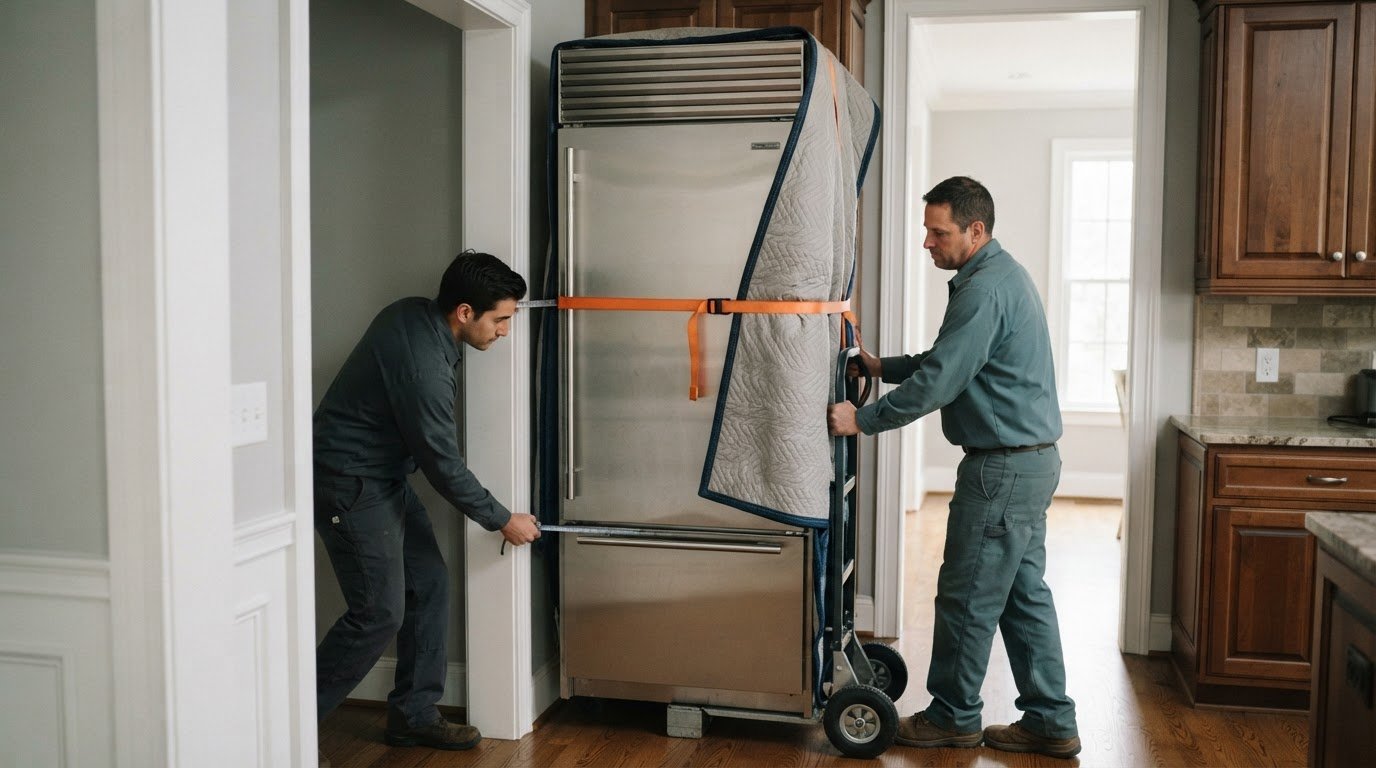
- Measure every doorway, stairwell, landing, and turn along the route. Check the clear opening between doorjambs, the space between stair rails, and any low ceiling or fixture above the stairs. At each landing, note both depth and width, since the sofa needs room to change direction.
Account for anything that reduces clearance, including a handrail, trim, or a door that cannot open fully. For example, the stairs may look wide enough until the handrail narrows the space where the sofa’s arm must pass.
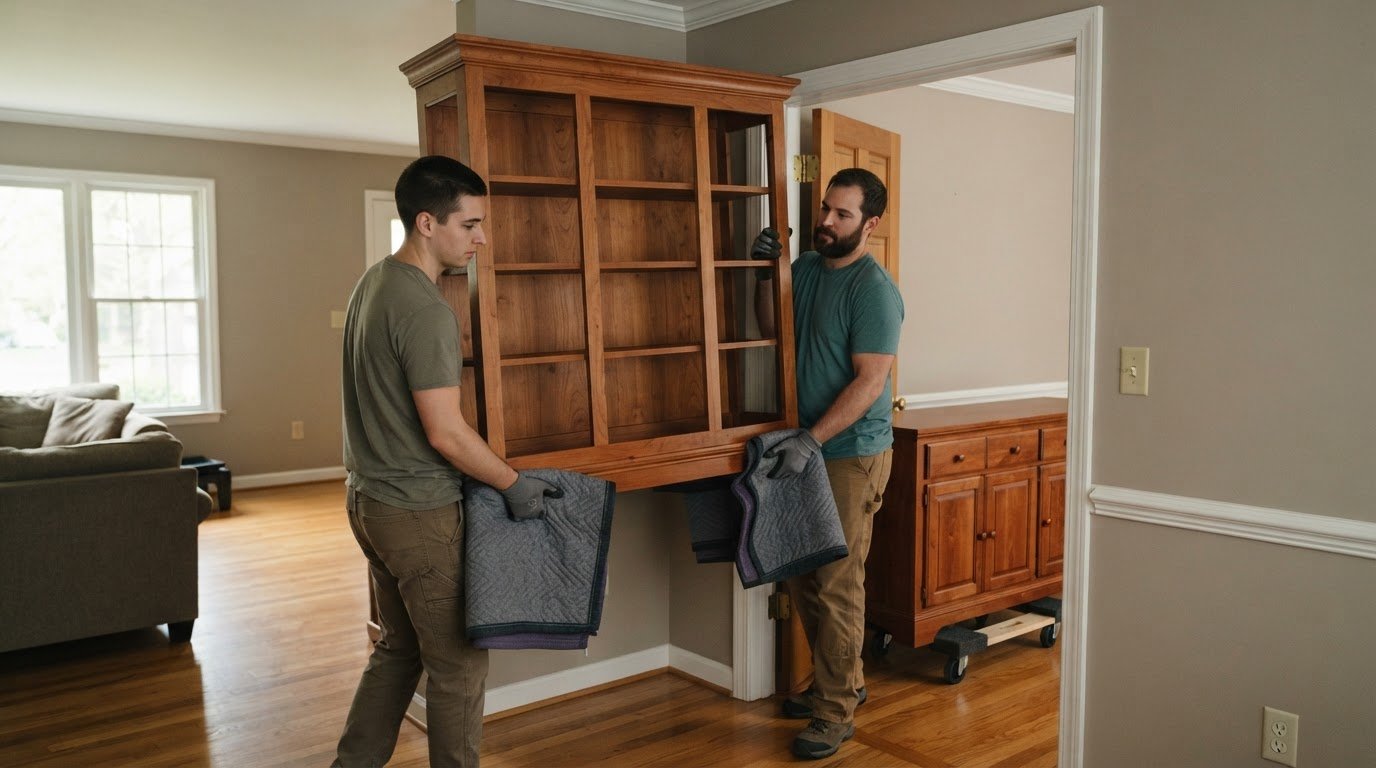
- Plan each doorway approach by comparing the sofa’s dimensions with the opening in more than one orientation. Movers assess whether tilting or turning changes its effective width and height. They also account for the space needed to rotate it before the doorway, not just the opening itself.
Visualize the planned path before lifting. A sofa that fits through a doorway when angled may still need room in the hallway to reach that angle. Identify where each end will travel and which side needs clearance from the doorjamb.
- If measurements show the sofa won’t fit as planned, stop before attempting the carry. Movers can reassess its orientation, identify parts that can be detached, and measure the route again. Removing a door from its hinges may increase clearance, but it won’t resolve a tight turn beyond the doorway.
Compare viable routes, such as another exit with a wider opening or a path that avoids the restricted landing. If no route has enough clearance, don’t force the sofa through or twist its frame against the walls. Measurements can help determine whether another professional moving method is needed.
How professional movers use straps, blankets, and stair-climbing dollies
Professional movers choose equipment to suit the sofa, stairs, and planned route. Straps, protective blankets, and a stair-climbing dolly each have a different purpose.
- Have the crew assess whether a stair-climbing dolly suits the basement stairs before using one. It must fit the stairway and let the team control the sofa through turns. A narrow landing or tight bend may make carrying a better option. Choose equipment based on the route, not just the sofa’s weight.
If using a dolly, the crew positions the sofa securely and coordinates its movement. Stop if the dolly cannot travel smoothly or the sofa shifts. Don’t use furniture sliders on stair treads: they can let heavy furniture move without the control needed on stairs.
- Moving straps can help the crew manage the sofa’s load and coordinate its movement. Movers position them to support handling, then check that the sofa remains stable before moving. Straps don’t replace a secure grip or coordinated lifting, especially when the sofa changes angle at a landing.
The team should adjust or reset a strap if it slips, twists, or presses against a vulnerable part of the sofa. Keep strap material clear of stair edges and nearby obstacles. The crew should move only when everyone is ready.
- Wrap exposed parts of the sleeper sofa with moving blankets to reduce rubbing against walls, railings, or doorframes. Pay particular attention to corners and arms that may pass close to the stairwell. Tuck the blankets securely so they don’t drag under the sofa or interfere with the carriers’ grip.
Blankets protect the furniture, but shouldn’t block anyone’s view of a stair edge or the sofa’s position. Before entering the basement, check the wrap and readjust it if loose fabric catches on a handrail or turn.
- Bring in professional moving labor when the sleeper sofa’s size, weight, or stair layout makes a coordinated carry difficult. Sleeper sofas may require three or four people to move because their folding bed mechanisms add weight that can shift. The crew can decide whether straps, a dolly, or a controlled carry best fits the route.
Share details about the sofa and basement access when arranging the move. This helps the team plan suitable labor and equipment. Don’t assume a dolly makes a narrow stairway manageable: the landing shape and turning space still affect how the sofa can be handled.
How professional movers keep heavy furniture controlled on stairs
Professional movers control a heavy sofa by coordinating its angle, pace, and support throughout the descent. This keeps movement deliberate and helps prevent sudden shifts that can strain carriers or damage nearby surfaces.
To understand how to safely carry a heavy sleeper sofa down narrow basement stairs in Chantilly, focus on a controlled pace, coordinated support, and clear stop signals. The main risks include losing control, straining while handling the load, and striking the sofa or stairway against nearby surfaces.
-
Control the Sofa During the Descent
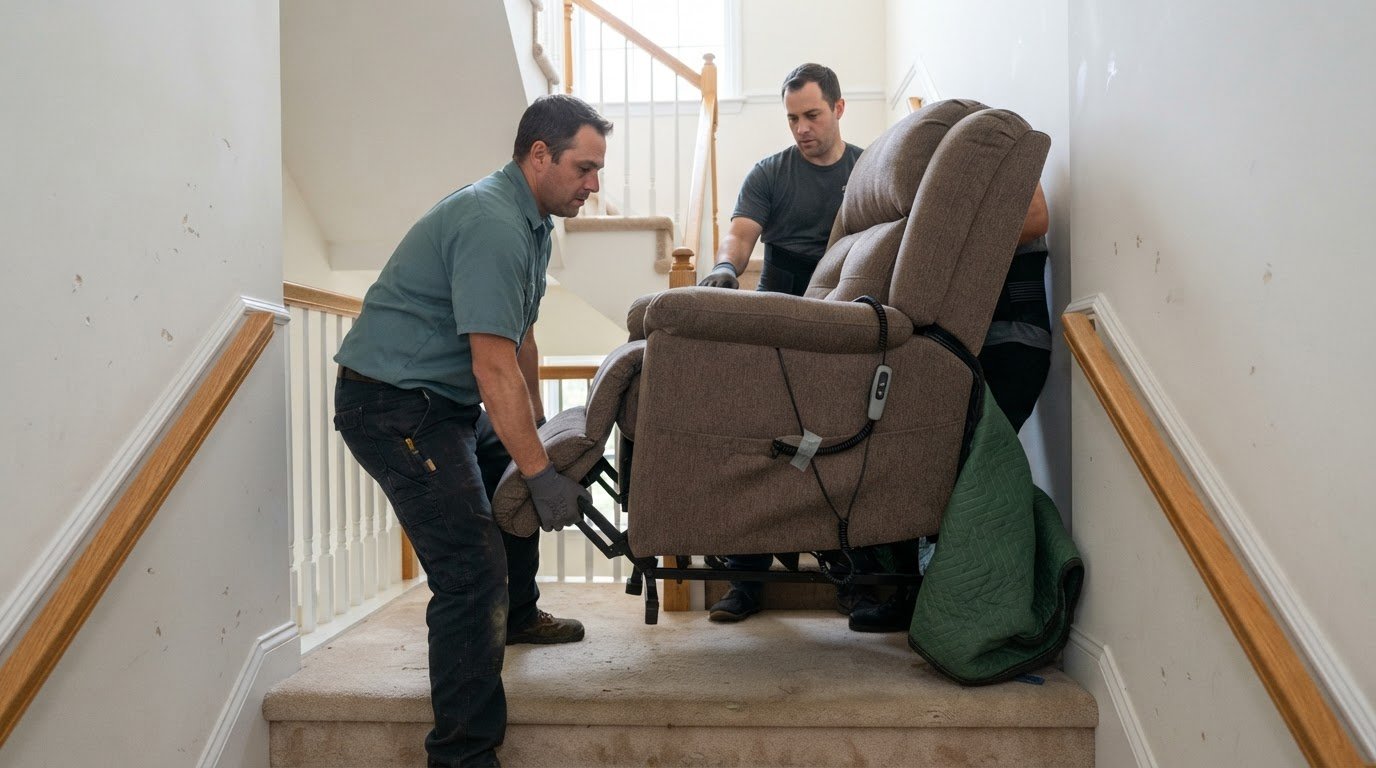
Have the crew position the sofa securely before starting down the stairs. The person carrying the lower end bears more of the load as the sofa descends, so that carrier needs steady footing. The upper carrier should feed the sofa forward only when the lower carrier is ready.
Move one stair at a time. Keep the sofa’s angle deliberate, and pause if it tilts, shifts, or catches. Don’t let momentum pull it toward the next step.
-
Prevent Injuries and Damage
Keep hands clear of pinch points between the sofa frame and the stairwell. A sleeper sofa’s folding bed mechanism adds concentrated weight that can shift during a move, changing how the team needs to support it.
Carriers should avoid twisting under load or reaching beyond a stable position. If someone loses footing or the sofa shifts unexpectedly, stop and reset instead of trying to recover with a sudden pull.
- Keep one person in charge of movement cues from the top of the stairs. That caller tells the team when to hold, feed the sofa forward, or pause. For example, the caller can wait until the lower carrier has stepped down and regained balance before directing the upper end forward.
Clear instructions help prevent carriers from moving in opposite directions. The caller watches the sofa’s corners and the stair edges, then signals a pause if the frame nears a wall or railing. Resume only when the team has regained control.
- Use a team sized for the sofa and stair conditions. Large sectionals, sleeper sofas, reclining sofas, and solid wood-framed pieces may need more than two people to move. Give each carrier a clear role, such as guiding an end, supporting the load, or calling movements.
Don’t use furniture sliders on stair treads. They can let the sofa move without the controlled support needed on steps. If the team can’t keep it steady, stop and reassess rather than forcing it down.
- For a Chantilly basement move, a clear plan for how to safely carry a heavy sleeper sofa down narrow basement stairs helps the crew keep the descent controlled. Get professional sofa-moving help if the team can’t maintain a steady pace or grip.
Heavy Furniture Moving: Sofa Hoisting
Heavy Furniture Moving offers Sofa Hoisting when a sleeper sofa cannot be maneuvered safely through a narrow basement stairwell. If measurements show that the sofa won’t clear a doorway, landing, or turn, hoisting may offer an alternative to forcing it down the stairs. It may also suit a route where the team can’t keep the sofa controlled during the descent.
Share the sofa’s dimensions and describe the stairway, landing, and access points. These details help determine whether stair carrying or Sofa Hoisting better suits the move. For a heavy sleeper sofa in Chantilly, contact Heavy Furniture Moving to discuss your move.
Plan the Next Step for Your Sofa Move
If you’re planning how to safely carry a heavy sleeper sofa down narrow basement stairs in Chantilly, let the route guide the moving plan. Share details about access, the sofa’s destination, and any tight spots before the move. This gives the team useful context to plan the approach.
Consider the destination room as well. It needs enough space to receive and position the sofa, and the route should stay clear all the way there. If the stairs seem too restrictive, discuss another approach rather than relying on force or a last-minute change.
A clear conversation about the sofa and the home’s layout can turn an uncertain move into a practical plan. Contact Heavy Furniture Moving to discuss your sofa move and the route ahead.
Plan your move around your home, your sofa, and the route.
Frequently Asked Questions
How much does a sleeper sofa weigh, and how do professional movers measure it for a move?
Sleeper sofa weight varies by model, frame, and folding-bed construction, so there’s no single figure that applies to every sofa. Movers use the manufacturer’s weight information when available and assess the sofa’s size and configuration. They also note whether detachable parts change its moving shape. If you have a product label or manual, sharing it can help the team plan the move.
How do professional movers measure a sleeper sofa and narrow basement stairs, including turns and landings?
Movers compare the sofa’s full moving profile with usable space along the entire route. That includes door openings, stair width, ceiling clearance, handrails, and the space needed to turn at each landing. Check the approach to the first doorway too: the sofa needs room to reach its intended angle before entering, not just an opening wide enough for one measurement.
What equipment do professional movers use to carry a heavy sofa down stairs safely?
Depending on the sofa and staircase, a moving team may use carrying straps, protective blankets, or a stair-climbing dolly. The dolly must suit the stairs and turning space; it isn’t right for every basement layout. Blankets help protect sofa surfaces during close passes, while straps support coordinated handling. Equipment is part of a planned carry, not a substitute for team control.
How many professional movers are needed to carry a sleeper sofa down narrow stairs?
The crew size depends on the sofa’s design, weight distribution, and route. Most standard couches need at least two capable adults, while sleeper sofas and other bulky pieces may require three or four people. A narrow landing can also affect how the team assigns positions. Movers account for both the load and the space each person needs to guide the sofa safely.
When should you hire professional furniture movers instead of moving a sleeper sofa yourself?
Hire professional movers when the sofa is too heavy to control comfortably, the basement route has tight turns, or its fit is uncertain. A sleeper mechanism can shift the load, making an awkward descent harder to manage. Heavy Furniture Moving provides furniture-moving help and Sofa Hoisting when a sofa won’t fit through a standard entryway or stair route. Choose a professional plan before attempting a risky carry.
How to remove a sleeper sofa’s mattress, cushions, and legs before moving it?
Have the crew inspect the sofa and remove its mattress, cushions, or legs only if its construction allows. Keep detached parts together in a safe staging area away from the hallway and stairs, and leave the folding-bed mechanism secure.
Frequently Asked Questions
Sleeper sofa weight varies by model, frame, and folding-bed construction, so there’s no single figure that applies to every sofa. Movers use the manufacturer’s weight information when available and assess the sofa’s size and configuration. They also note whether detachable parts change its moving shape. If you have a product label or manual, sharing it can help the team plan the move.
Movers compare the sofa’s full moving profile with usable space along the entire route. That includes door openings, stair width, ceiling clearance, handrails, and the space needed to turn at each landing. Check the approach to the first doorway too: the sofa needs room to reach its intended angle before entering, not just an opening wide enough for one measurement.
Depending on the sofa and staircase, a moving team may use carrying straps, protective blankets, or a stair-climbing dolly. The dolly must suit the stairs and turning space; it isn’t right for every basement layout. Blankets help protect sofa surfaces during close passes, while straps support coordinated handling. Equipment is part of a planned carry, not a substitute for team control.
The crew size depends on the sofa’s design, weight distribution, and route. Most standard couches need at least two capable adults, while sleeper sofas and other bulky pieces may require three or four people. A narrow landing can also affect how the team assigns positions. Movers account for both the load and the space each person needs to guide the sofa safely.
Hire professional movers when the sofa is too heavy to control comfortably, the basement route has tight turns, or its fit is uncertain. A sleeper mechanism can shift the load, making an awkward descent harder to manage. Heavy Furniture Moving provides furniture-moving help and Sofa Hoisting when a sofa won’t fit through a standard entryway or stair route. Choose a professional plan before attempting a risky carry.
Have the crew inspect the sofa and remove its mattress, cushions, or legs only if its construction allows. Keep detached parts together in a safe staging area away from the hallway and stairs, and leave the folding-bed mechanism secure.