How to Carry a Heavy Cedar Chest Upstairs Without Scuffing Walls
A cedar chest can go upstairs without scraping the walls when you measure the route and plan the carry before lifting. If you’re figuring out how to move a heavy cedar chest upstairs without scuffing walls in Fairfax, check the chest, doorways, stair width, ceiling clearance, and landings, then plan each turn. The U.S. Consumer Product Safety Commission advises securing a hinged chest lid during a move because it can drop suddenly.
Caution makes sense: a bulky chest can be hard to steer, and a tight corner can put walls, railings, or the furniture finish at risk. Professional movers assess the fit, protect the route, coordinate the lift, and plan turns at landings. To help them prepare, share the chest’s dimensions and details about the staircase so the carry can be planned from the first step to the final placement.
Key Takeaways
- Accurate chest, doorway, stair, and landing measurements help movers plan a route before lifting.
- Securing the lid and protecting corners, railings, and walls helps reduce the risk of damage along the way.
- A coordinated two-person carry keeps the chest balanced, with clear communication at every step and turn.
- The high-low technique can help movers guide a bulky chest around a stair landing with control.
- When a doorway or stair turn is tight, a planned pivot can help the chest clear the route without scraping nearby surfaces.
How professional movers carry furniture by hand with a partner
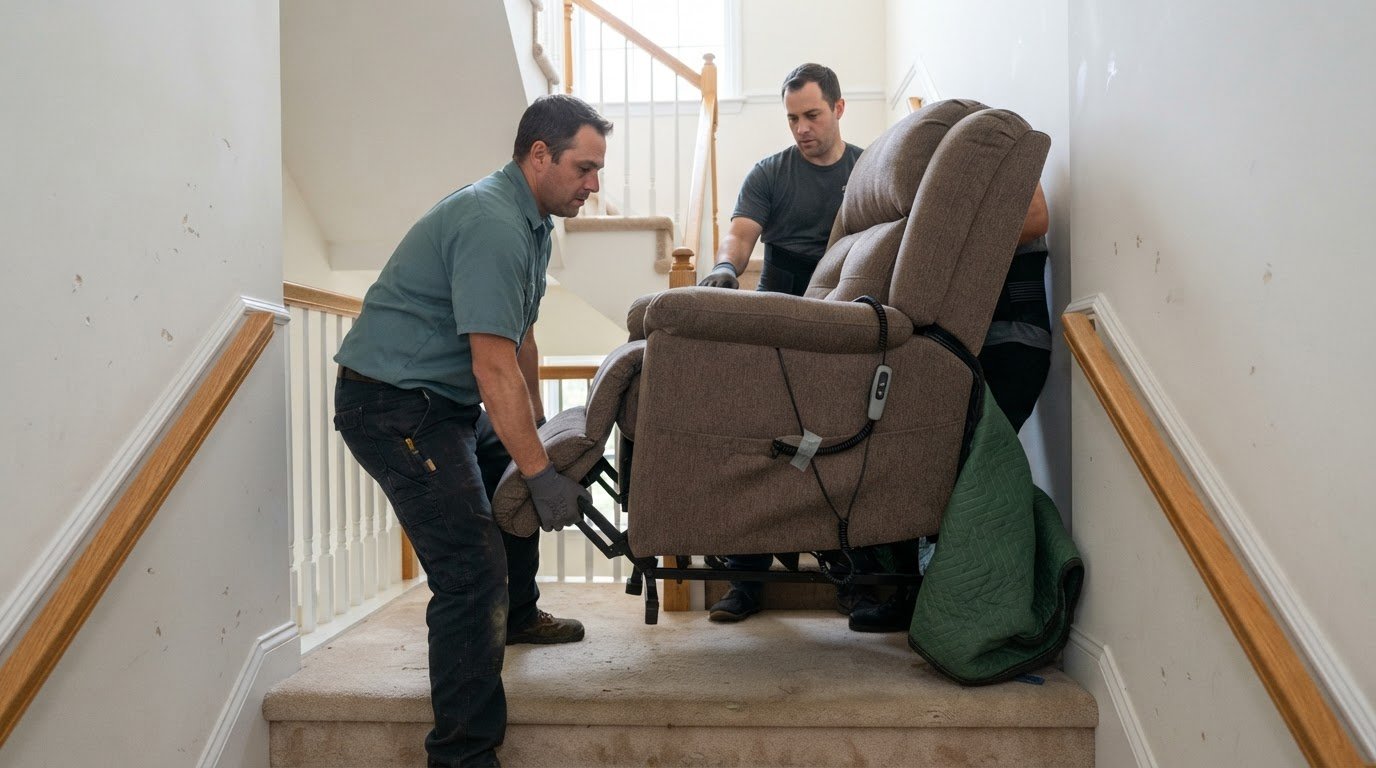
Before lifting a cedar chest, professional movers secure its lid, agree on commands, and assign clear roles. Then they move one stair at a time.
-
How Movers Coordinate During the Stair Carry
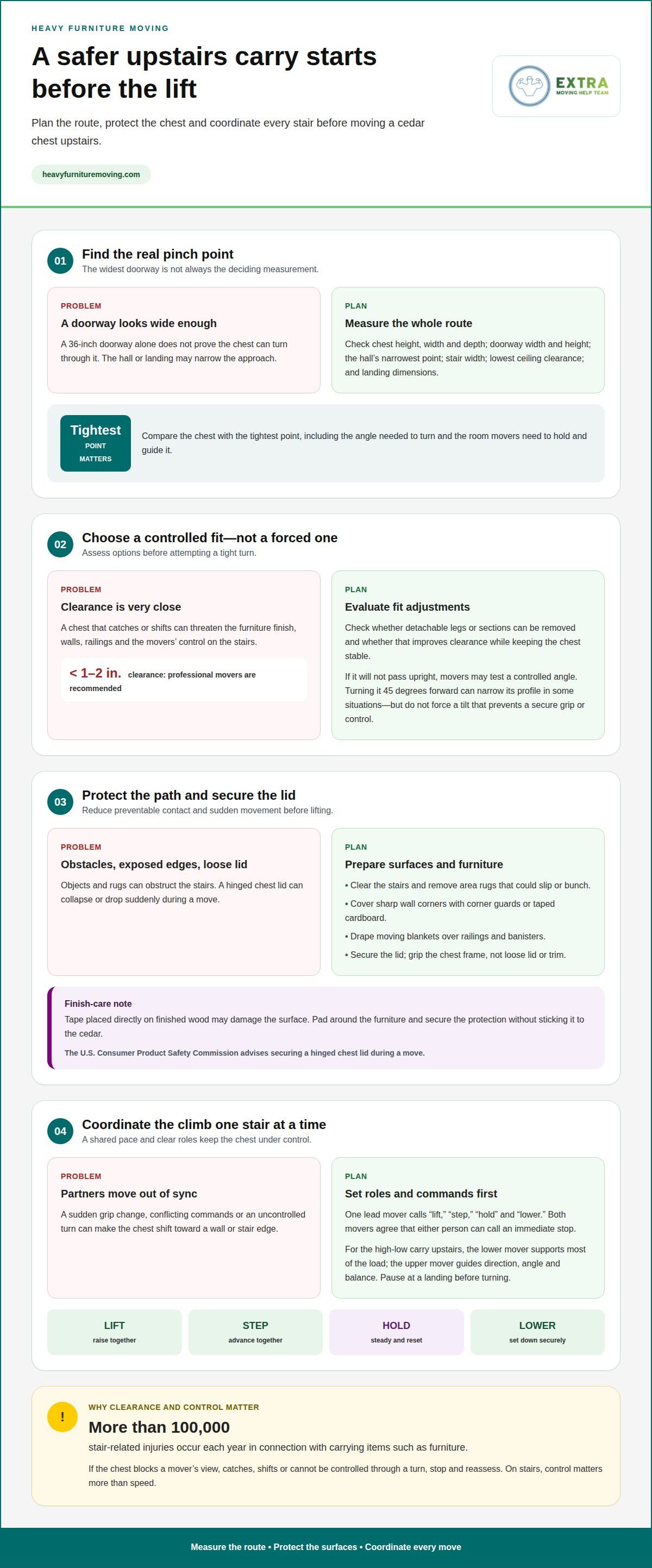
Set the pace with one lead mover and short, agreed commands. The lead calls “lift,” “step,” “hold,” and “lower,” so both movers act together. Before starting up the stairs, they confirm who leads and how either person can call an immediate stop.
During the climb, movers pause on the agreed command and steady the chest before changing position. They don’t talk over one another or take another step while a partner adjusts their grip. If the chest stops moving smoothly, they stop and reassess instead of forcing it through a tight spot.
-
How Movers Use High-Low Carrying on Stairs
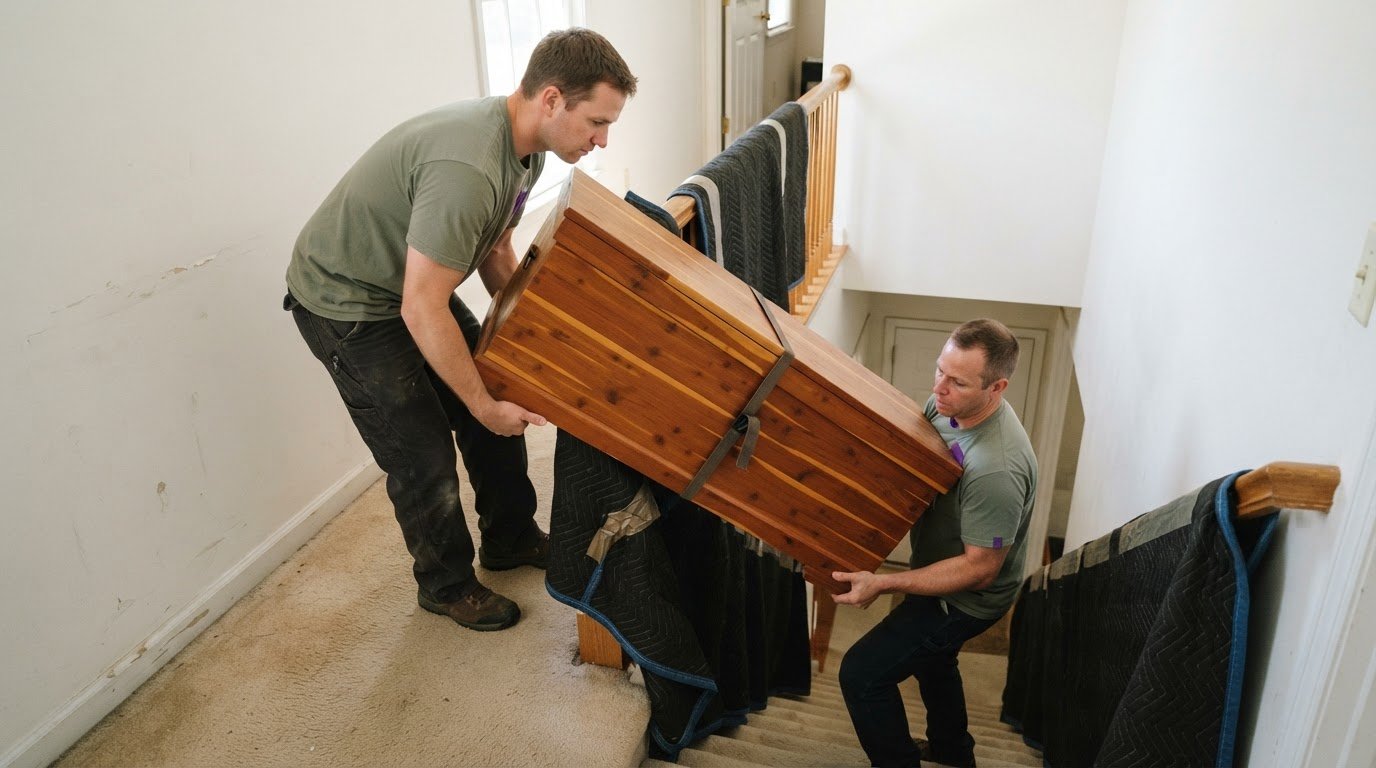
Place the stronger weight support at the bottom of the chest, while the mover above guides direction and balance. For an upstairs carry, the lower mover supports most of the load; the upper mover controls the angle and watches the path. This high-low position lets the partners manage the chest as one coordinated load.
Move one stair at a time, and make sure each person has a firm grip before advancing. The lower mover calls when the chest is stable on a step; the upper mover checks that its top edge clears the wall and railing. At a landing, pause before turning so neither partner has to twist suddenly under the load.
-
Secure the Chest and Set the Grip
Secure the cedar chest lid before lifting. According to the U.S. Consumer Product Safety Commission, a hinged storage-chest lid can collapse or drop suddenly during a move. Movers prevent it from swinging and choose stable handholds on the chest frame rather than relying on a loose lid or trim.
Before lifting, both movers check that the chest is balanced and their hands are secure. They raise it together on the lead mover’s call, keeping it close enough to control without dragging the finish against a wall. If a grip slips or the chest tilts, they call “hold” and reset before continuing.
-
Keep Each Step Controlled
Advance only when both movers are ready. The lower mover supports the weight on each step, while the upper mover guides the chest and calls out nearby obstacles. A steady, shared pace helps prevent the chest from swinging into a wall or shifting toward the stair edge.
At each pause, check the chest’s balance, grip, and clearance before moving again. If it catches or feels unstable, stop, lower it to a secure position, and reassess the route. With a heavy cedar chest, control matters more than speed.
How professional movers measure furniture, doorways, stairways, and landings
Before carrying the cedar chest upstairs, movers map the route and compare its dimensions with narrow openings, turns, and overhead obstacles.
-
How Movers Measure Furniture and Stair Openings
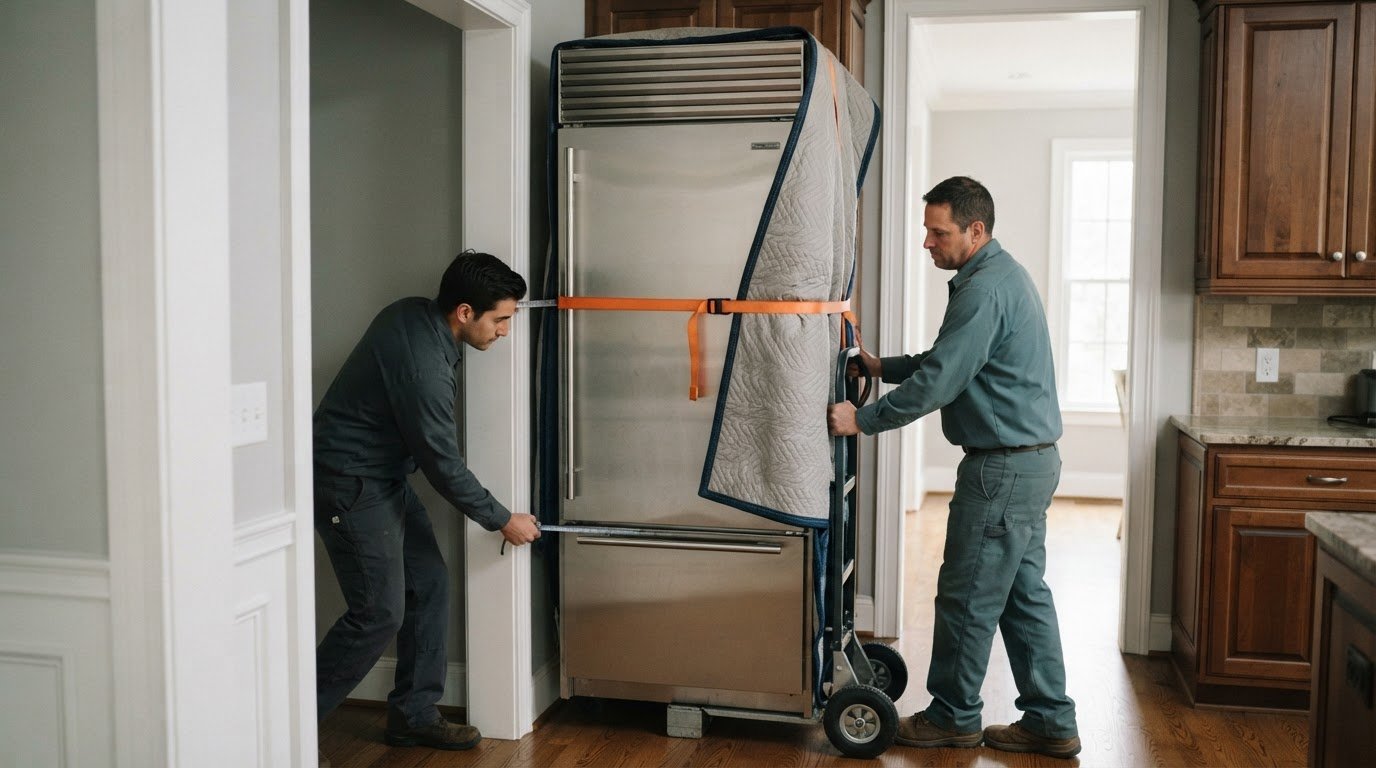
Have movers measure the chest’s height, width, and depth, then compare those dimensions with the route. They check doorway width and height, hallway width at its narrowest point, stair width, lowest ceiling clearance, and landing dimensions. A doorway measuring 36 inches, for example, doesn’t prove the chest can turn through it if the hall or landing narrows the approach.
Movers use the tightest point, not the widest opening, to judge the fit. They account for the chest’s angle during a turn and the space needed to hold and guide it. If the measurements leave less than 1-2 inches of clearance, professional movers are recommended rather than attempting a tight carry.
-
When Movers Disassemble or Tilt Furniture That Will Not Fit
Ask movers to assess removable parts before planning a tilt. If the chest has detachable legs or sections, removing them may make it smaller and lighter. Movers consider whether disassembly is practical, whether the chest will remain stable, and whether the smaller dimensions improve clearance at a doorway or stair turn.
When the chest won’t pass upright, movers may test a controlled angle against the doorway’s height and width. Turning a piece 45 degrees forward can narrow its profile in some situations. They avoid forcing a tilt when it leaves too little room to grip, control, or protect the chest.
- Protect the route before the carry begins. Clear objects from the stairs and remove area rugs that could slip or bunch underfoot. Cover sharp wall corners with corner guards or taped cardboard, and drape moving blankets over railings and banisters. Padding helps reduce direct contact, but movers still need to steer the chest clear of protected surfaces.
Account for the chest’s finish, too. Tape placed directly on finished wood may damage the surface. Use padding around the furniture instead, securing protective materials without sticking them to the cedar.
- Treat stair clearance as a safety issue, not just a fit problem. More than 100,000 stair-related injuries occur each year in connection with carrying items such as furniture. A chest that blocks a mover’s view or cannot be controlled through a turn raises the risk of a fall or collision.
Compare the chest’s size with the route before lifting, and stop if it catches or shifts. Adequate clearance gives movers room to maintain a stable grip and avoid abrupt movements near stair edges, walls, and railings.
- Choose furniture for the actual stair route, not just the room where it will sit. On a tight staircase, movers assess whether the chest’s shape allows a controlled turn at each landing. A compact piece may clear a narrow corner more easily than a wide, deep chest, even if both seem similar beside the doorway.
Share the chest’s approximate dimensions and the home’s stair layout when arranging professional furniture-moving help. Those details help movers plan the route and determine whether a straight carry, removable parts, or a carefully angled pass best suits the space.
How professional movers use partner lifting and the high-low stair technique
On an upstairs carry, the lower mover supports most of the chest’s weight while the upper mover guides its direction and balance. Before lifting, empty the chest and secure its hinged lid. The U.S. Consumer Product Safety Commission warns that a hinged storage-chest lid can drop suddenly.
- Assign lifting positions and agree on commands before the chest leaves the floor. The lower mover carries most of the load; the upper mover guides its angle and watches the space ahead. Clear calls such as “lift,” “step,” and “hold” help both partners move together and pause immediately if the chest shifts.
Move the heavy cedar chest one stair at a time. Keep a steady grip and avoid rushing through a turn. If the load stops moving smoothly, pause and reassess rather than forcing it onward.
- Prepare the chest by removing its contents and securing the lid against sudden movement. Emptying it prevents loose items from shifting inside as the chest changes angle. The secured lid stays closed while movers raise, carry, and reposition the piece.
Choose stable handholds on the chest’s frame, not its lid or decorative trim. Each mover confirms a firm grip before the lead calls the lift. If either person needs to adjust, keep the chest supported until both are ready.
- Use a stair-climbing dolly only if its design and the chest allow a controlled setup. This type of dolly has three wheels on each side that rotate over the edge of each step. Secure the chest to the equipment and guide its movement rather than letting it roll freely.
A hand truck may suit a different route or item, but stairs still require controlled support and clear coordination. Movers assess whether equipment offers better control than carrying the chest by hand. They avoid a dolly if it makes the chest harder to steer or balance.
- For a long couch on stairs, professional movers can use moving straps designed for a two-person lift. Each mover takes a position that supports the couch while leaving room to guide its ends. On a tight staircase, they coordinate the couch’s angle at each turn instead of pushing its corners against the wall.
The same principle applies to a bulky chest: keep the load stable and change its orientation only when both movers are ready. A couch’s long shape may call for a different angle than a cedar chest, so movers adapt the carry to the item and staircase.
- At a landing, use a planned hook turn rather than twisting the chest abruptly. Movers raise the front toward the ceiling, keep the back end low, and swing the bottom inward around the corner. This changes the chest’s direction while keeping both ends under control.
Pause at the landing to coordinate the turn and check clearance from the wall and railing. One mover guides the upper end; the other supports and steers the lower end. Continue only once the chest is aligned with the next flight.
How professional movers clear and protect the moving path
Prepare the entire route before carrying a cedar chest. Clear obstacles and protect exposed surfaces so movers can focus on steering.
- Walk the route from the chest’s starting point to its destination. Look for shoes, boxes, loose cords, open drawers, and furniture that narrows the passage. Clear obstructions before lifting, including items near the stair entrance and top landing.
Keep the planned route open while the chest is moving. A clear path gives both movers room to adjust their grip, pause, and follow the agreed direction. Check for doors that could swing into the carry and arrange to keep them open.
- Remove area rugs before the carry begins. A rug can bunch or slide underfoot, especially when movers are balancing a heavy chest. Check the exposed floor for small objects and debris that could interfere with steady footing.
Protect the floor where the chest will be set down or briefly rested. Place floor coverings flat, without folds that could catch a shoe or shift under the load. Keep extra materials out of the route once the protection is in place.
- Cover vulnerable wall corners and narrow passage edges before the chest approaches. Corner guards or taped cardboard can shield sharp corners where furniture may brush during a turn. Pay close attention to hallway bends and stair entrances, not just straight sections.
Place protection where the chest’s edges will pass, then check that it stays in position. A loose guard can slip at the wrong moment. Continue steering carefully rather than treating padding as permission to bump the wall.
- Pad railings and banisters along the stair route with moving blankets. Secure the blankets so they don’t bunch or fall as the chest passes. Protect surfaces most exposed to contact, including the inside of a turn where the chest may need extra room.
Before the carry, check that blanket edges don’t hang into the movers’ footing or grip area. At a landing, watch the chest’s corners and the railing together. That keeps the protection useful without creating another obstacle.
- Make one final route check before lifting. Confirm that the stairs, landings, and destination area are clear and that protective coverings haven’t shifted. Keep bystanders and pets out of the path while the chest is being carried.
During the move, one person can watch the route ahead and call out a wall edge, railing, or floor covering that needs attention. If protection shifts or an obstacle appears, the movers stop in a stable position and reset the path before continuing.
How professional movers pivot bulky items through doorways
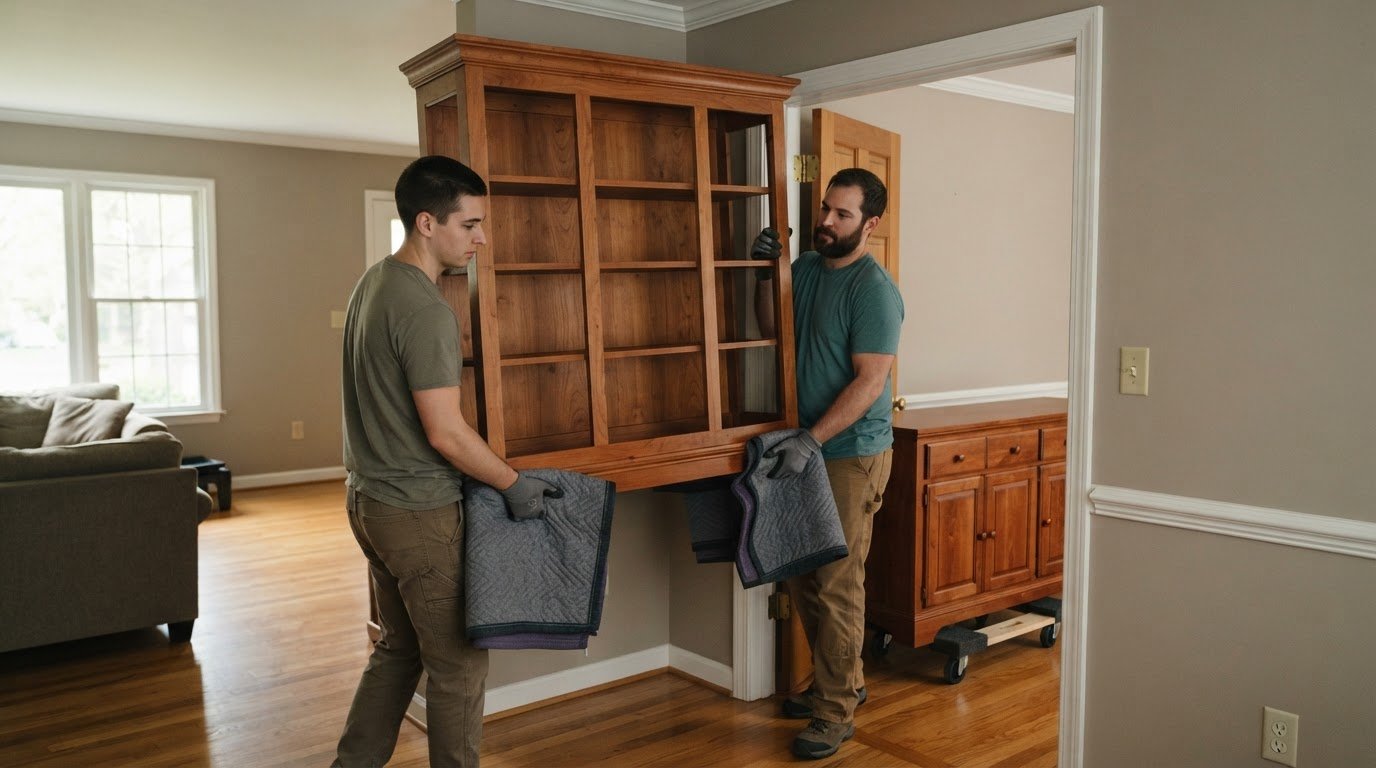
Movers pivot a bulky chest by changing its angle in controlled stages. They use the doorway’s height and width to choose an orientation that clears the frame without scraping it.
- Approach the doorway squarely, then pause before turning the chest. Movers check which edge must pass through first and where the chest’s widest point will travel. A rushed turn can bring a corner into the jamb, even when the chest’s narrow side fits the opening.
Keep the chest under control as its angle changes. One mover guides the leading edge; the other supports the trailing end. Make small adjustments, stopping whenever the chest touches or catches on the frame.
- Compare the chest’s diagonal height with the doorway height before attempting an upright pass. If the diagonal height exceeds the doorway height, bring the furniture through vertically. This orientation changes the clearance needed above the chest and may help it pass under a shorter frame.
Movers control the chest throughout the change in position. They avoid tipping it abruptly or letting one edge bear against the doorframe. The right angle depends on the chest’s shape and the available room on both sides.
- Use a forward tilt when it reduces the chest’s profile and keeps its weight manageable. Turning a piece 45 degrees forward may narrow its profile, creating a different path through the opening. Movers assess the chest’s balance and grip before choosing this position.
Keep the lower edge supported while guiding the upper edge through the doorway. If the chest starts to slide or the movers lose a stable hold, stop and reset. Tilting should improve control, not make the piece harder to handle.
- Pivot around the doorway’s hinge side only if the chest’s path remains clear. Guide one end through first, then rotate the other end after the leading edge clears the jamb. Watch the chest’s corners, the door edge, and nearby walls through each small turn.
For example, a cedar chest brought in at an angle may need a slight rotation once its front corner clears the frame. Coordinate the change so the back corner doesn’t swing into the opposite wall. Never drag the chest across the threshold.
- Finish the pivot only after the entire chest clears the frame. Straighten it in the open area beyond the doorway, where there’s room to adjust its position. Check that no corner caught the trim and that the next part of the route is clear.
Clear, measured pivots take coordination and careful handling of a heavy piece. Arrange professional furniture-moving help for a cedar chest that needs a controlled doorway turn.
Heavy Furniture Moving
Heavy Furniture Moving handles residential moves involving heavy and bulky furniture. Turn to the team when a cedar chest needs careful handling through a tight doorway, stairway, or landing. The movers can assess the chest and route, coordinate the carry, and protect nearby surfaces.
Share the chest’s dimensions, whether it has a hinged lid, and details about the stairs and landings. This information helps the crew plan how to handle the move. For a cedar chest that needs to go upstairs without wall scuffs, in-home furniture movers are a practical next step.
Contact Heavy Furniture Moving to discuss moving your cedar chest upstairs.
Set Up the Move With a Clear Plan
Planning to get a cedar chest upstairs is easier when the crew knows your priorities: protecting the finish, keeping the route clear, and placing the piece where you need it. If you’re deciding how to move a heavy cedar chest upstairs without scuffing walls in Fairfax, share the chest’s dimensions, stair layout, and tight turns when arranging the move. Those details help shape a plan for your home, not a generic carry.
Choose the chest’s final position before moving day, including which way it should face. This helps the crew plan the last turn and avoid extra repositioning in a narrow room. Heavy Furniture Moving also offers Movers Near Me, Exercise Equipment Moving, and Sofa Hoisting, alongside residential furniture moving.
Contact Heavy Furniture Moving to discuss moving your cedar chest upstairs. A clear plan is a solid first step toward getting it into place with care.
Frequently Asked Questions
How much does a cedar chest weigh, and how do professional movers measure it before moving it upstairs?
Cedar chest weight varies with size, construction, hardware, and contents, so no single weight applies to every chest. Movers assess its dimensions and build, then consider how its shape affects handling along the route. Contents add to the load, so note whether the chest is empty. Photos and measurements can help describe the item before the move.
What equipment do professional movers use to move a heavy chest upstairs without scratching floors or walls?
Movers use furniture blankets, shrink-film, ratchet straps, door-jamb covers, and floor protection, choosing materials for the item and route. For example, a door-jamb cover can help shield a narrow frame, while floor protection can guard the area where movers handle or set down the chest. Equipment supports careful handling, but the crew still needs to steer the chest without scraping surfaces.
How do professional movers protect walls, stair rails, corners, and floors when moving furniture upstairs?
Movers protect surfaces most exposed to contact, including door frames, stair rails, and vulnerable floor sections. They secure coverings so they don’t shift into the crew’s path, and keep the chest’s edges clear while steering. On a tight turn, one mover can watch the wall-facing corner while the other guides the opposite end. Clear coordination helps protect the home and furniture finish.
When should you hire professional furniture movers for a heavy chest upstairs?
Hire professional movers when the chest is too heavy or awkward to control, the stairs have tight turns, or there’s little room to maneuver. A chest that blocks your view or requires an unstable grip can make a stair carry especially difficult. If you’re deciding how to move a heavy cedar chest upstairs without scuffing walls in Fairfax, a professional assessment can help determine a safe handling plan.
What is the average cost of hiring movers to take one heavy chest upstairs in Fairfax, Virginia?
The cost depends on the chest, access, stair layout, and handling required; it’s provided after a quote request. Movers consider details such as the item’s size and weight, the number of stairs, tight landings, and whether special handling is needed. Heavy Furniture Moving provides upfront quotes before work begins. Share clear information about the chest and route so the quote can reflect the move’s actual requirements.
Which Fairfax, Virginia, furniture moving companies handle heavy items and protect walls?
Heavy Furniture Moving serves Fairfax and specializes in residential moves involving heavy and bulky items. The team handles furniture moves and uses protective materials such as blankets, shrink-film, ratchet straps, floor protection, and door-jamb covers. Most jobs are covered by 2 movers, while larger items may require 3-4 movers as specified. Describe the chest and stair route to discuss the handling needed for your home.
How do professional movers check whether a cedar chest will fit through stairways, landings, and doorways?
Movers compare the chest’s dimensions and possible carrying angles with the route’s narrowest openings and turns. They consider more than whether it fits straight through a doorway: the crew also needs room to rotate it and maintain a controlled grip. A chest that fits through one opening may still be difficult at a landing, so assess the entire path and possible orientations.
What are the risks of moving a heavy cedar chest upstairs, and how do professional movers prevent injuries?
A poorly controlled chest can shift, catch on a step, or force a carrier into an awkward position. Movers reduce these risks by coordinating the lift, maintaining a stable grip, and stopping when the load becomes difficult to control. They also keep the route clear so carriers can focus on each step. If the chest cannot be handled safely by hand, the crew reassesses the approach before continuing.
Frequently Asked Questions
Cedar chest weight varies with size, construction, hardware, and contents, so no single weight applies to every chest. Movers assess its dimensions and build, then consider how its shape affects handling along the route. Contents add to the load, so note whether the chest is empty. Photos and measurements can help describe the item before the move.
Movers use furniture blankets, shrink-film, ratchet straps, door-jamb covers, and floor protection, choosing materials for the item and route. For example, a door-jamb cover can help shield a narrow frame, while floor protection can guard the area where movers handle or set down the chest. Equipment supports careful handling, but the crew still needs to steer the chest without scraping surfaces.
Movers protect surfaces most exposed to contact, including door frames, stair rails, and vulnerable floor sections. They secure coverings so they don’t shift into the crew’s path, and keep the chest’s edges clear while steering. On a tight turn, one mover can watch the wall-facing corner while the other guides the opposite end. Clear coordination helps protect the home and furniture finish.
Hire professional movers when the chest is too heavy or awkward to control, the stairs have tight turns, or there’s little room to maneuver. A chest that blocks your view or requires an unstable grip can make a stair carry especially difficult. If you’re deciding how to move a heavy cedar chest upstairs without scuffing walls in Fairfax, a professional assessment can help determine a safe handling plan.
The cost depends on the chest, access, stair layout, and handling required; it’s provided after a quote request. Movers consider details such as the item’s size and weight, the number of stairs, tight landings, and whether special handling is needed. Heavy Furniture Moving provides upfront quotes before work begins. Share clear information about the chest and route so the quote can reflect the move’s actual requirements.
Heavy Furniture Moving serves Fairfax and specializes in residential moves involving heavy and bulky items. The team handles furniture moves and uses protective materials such as blankets, shrink-film, ratchet straps, floor protection, and door-jamb covers. Most jobs are covered by 2 movers, while larger items may require 3-4 movers as specified. Describe the chest and stair route to discuss the handling needed for your home.
Movers compare the chest’s dimensions and possible carrying angles with the route’s narrowest openings and turns. They consider more than whether it fits straight through a doorway: the crew also needs room to rotate it and maintain a controlled grip. A chest that fits through one opening may still be difficult at a landing, so assess the entire path and possible orientations.
A poorly controlled chest can shift, catch on a step, or force a carrier into an awkward position. Movers reduce these risks by coordinating the lift, maintaining a stable grip, and stopping when the load becomes difficult to control. They also keep the route clear so carriers can focus on each step. If the chest cannot be handled safely by hand, the crew reassesses the approach before continuing.