
Hoisting a Couch to a Third-Floor Apartment in Reston, VA

What if the safest route for your couch isn’t the stairs at all? If you’re searching for help with “hoisting a couch to a third floor apartment Reston,” you’re likely dealing with a tight entrance, narrow hall, or elevator that can’t handle the fit. A professional hoist may be an option, but the crew needs to assess the access before confirming it’s workable.
You’re right to think beyond the couch itself. A lift needs careful planning to protect the furniture, the building, nearby landscaping, and people below. Window or balcony access, the couch’s size, and apartment rules can all affect the plan and timing.
This guide will help you understand what movers need to check, what photos and details to prepare, and how to coordinate building access with fewer delays. You’ll also learn how to get ready for a professional sofa hoist in Reston, including a single-couch move. Start with the access points, then arrange the lift around what the building and site can safely support.
Key Takeaways
- Learn why a third-floor location alone can’t determine whether a couch hoist is feasible.
- Prepare couch measurements and clear photos of the interior route, opening, exterior access, and landing area for a more useful assessment.
- Compare carrying, permitted disassembly, and professional hoisting based on couch construction, route dimensions, and building approval.
- For hoisting a couch to a third floor apartment Reston, ask property management about permissions, approved hours, and access arrangements before scheduling.
- Know what to share with a sofa hoisting company and what details to confirm in writing before the move.
Why a Third-Floor Reston Apartment May Need Couch Hoisting
A couch can be too bulky for an apartment’s shared route even when it fits inside the unit. Couch hoisting means lifting furniture to an elevated opening, such as a window or balcony, when carrying it through doors, stairs, or an elevator isn’t suitable. The lift may involve specialized rigging equipment, so it needs a careful access and safety assessment.
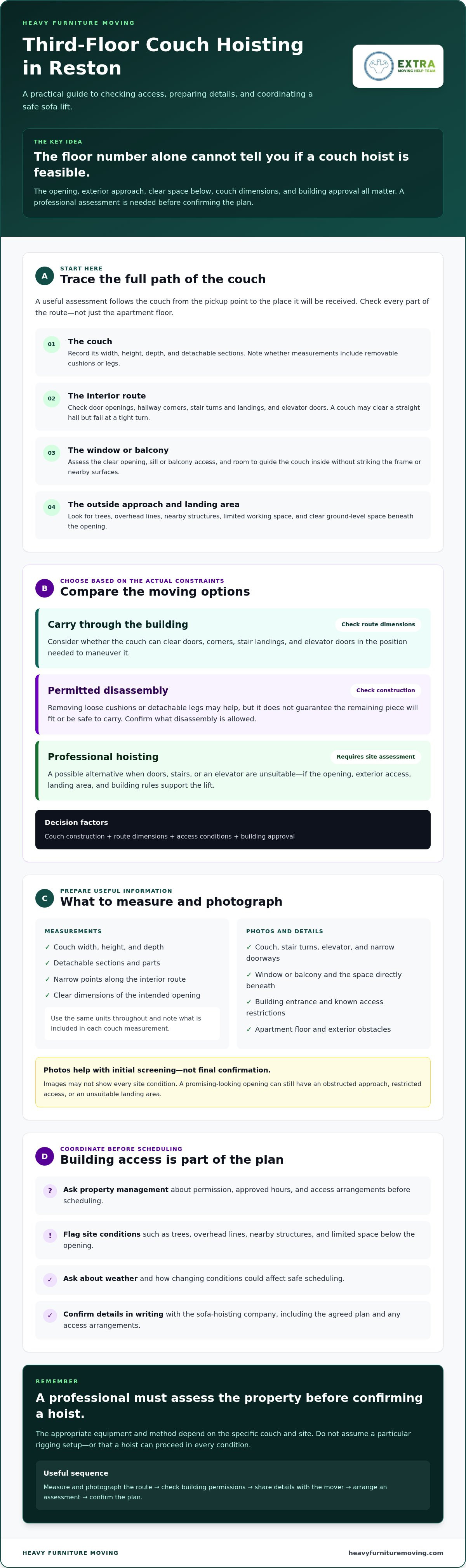
A third-floor address alone doesn’t tell you whether a hoist is possible. The opening, the route outside the building, and the clear space below all matter. Access and safe clearance determine whether a couch hoist is feasible. A professional should inspect the apartment and exterior before confirming the plan.
When stairs, doors, or elevators cannot accommodate a couch
Couch length, depth, height, and shape affect how it turns through a doorway or stairwell. A long sectional piece may clear a straight hallway but get stuck at a tight landing. An elevator can also have enough floor space for people but not enough clearance to maneuver a large couch through its doors.
Measure the couch and the narrowest points along the route before contacting a mover. Check door openings, hallway corners, stair landings, and elevator doors. Include the couch’s dimensions in the position it would need to pass through each tight spot. Removing loose cushions or detachable legs may help, but it doesn’t guarantee the couch will fit or make the remaining piece safe to carry.
What makes a third-floor window or balcony a possible access point
A window or balcony may offer another route, but its size and approach need to work for the couch and the planned lift. Movers will need to consider the clear opening, sill or balcony access, and whether there’s room to guide the furniture into the apartment without striking the frame or surrounding surfaces.
Look at the exterior, too. Trees, overhead lines, nearby structures, and limited ground-level clearance can affect access and the space available to work. Don’t assume an open-looking balcony is usable, or that a window can accommodate a couch. Share clear photos and measurements of the opening and outside area, then let a professional assess the property before confirming whether hoisting a couch to a third floor apartment Reston is suitable. That assessment helps identify the practical limits before anyone attempts the lift.
How Movers Assess a Third-Floor Couch Hoist in Reston
A useful assessment follows the couch from pickup point to landing area. The crew needs more than the floor number: couch dimensions, interior obstacles, the proposed opening, exterior access, and the space where the couch will be received all affect the plan. Clear information helps the mover decide whether to request an on-site inspection and what details to verify before confirming a method or availability.
Measurements and photos to gather before requesting a quote
Measure the couch’s width, height, and depth, plus any detachable sections. Use the same units throughout, such as inches, and note whether measurements include removable cushions or legs. Then document the route and possible opening.
- Take clear photos of the couch, stair turns, elevator, and narrow doorways.
- Photograph the intended window or balcony, along with the area directly beneath it.
- Record the apartment floor, building entrance details, and known access restrictions.
Photos show angles and obstacles that a verbal description can miss. They support an initial screening, but they can’t reveal every site condition.
Exterior access, weather, and building conditions to review
The mover should assess the opening, the approach to it, possible attachment points, exterior clearance, and the landing area. Point out anything that could affect access, such as trees, overhead lines, nearby structures, or limited space below. Ask how changing weather could affect safe scheduling; don’t assume a hoist can proceed in every condition.
The appropriate equipment and method depend on the specific property and couch. Don’t assume a crane, pulley, or particular rigging setup will be used. OSHA’s crane-hoisting safety standards address safeguards for covered construction crane operations, but a mover must determine which requirements apply to a particular job.
Photos and measurements can support preliminary screening; only a property assessment can confirm on-site feasibility. That distinction matters for hoisting a couch to a third floor apartment Reston: a promising window in a photo may still have an obstructed approach, restricted access, or an unsuitable landing area. If you’re considering professional sofa hoisting, share your measurements and photos, then ask what needs to be inspected before the crew confirms the plan.
Hoisting vs. Carrying or Disassembly: Choosing the Right Couch-Moving Option
The right method depends on more than the couch’s overall size. Compare its measurements with the route, consider how its frame is built, and check whether the building allows the planned access. A couch that looks too large to carry may still fit after careful repositioning, while a balcony that appears usable may not provide a workable hoisting route.
| Option | May suit these conditions | What to confirm |
|---|---|---|
| Carry through the building | Doorways, stair turns, elevator, and hallways provide enough clearance to maneuver. | Whether a mover can reposition the couch without obstructing shared areas or striking walls and fixtures. |
| Permitted disassembly | The couch has parts designed to detach, such as legs, backs, or modular sections. | Manufacturer guidance, whether the pieces will fit separately, and whether reassembly is practical. |
| Professional hoisting | Standard routes don’t accommodate the couch, and a suitable opening and exterior approach may be available. | On-site feasibility, building approval, access conditions, and the method the mover can use. |
When carrying through the building may still work
Measurements help clarify whether an interior route is truly blocked. Compare the couch’s dimensions with door clearances, elevator openings, hallway widths, and the tightest stair turns. A professional can assess whether careful repositioning is practical, including whether the couch can be angled through a corner without forcing it. Don’t attempt a risky lift yourself or leave a couch blocking a shared hallway while testing the route.
When hoisting or couch disassembly deserves professional review
If the couch can’t pass through the measured route, professional hoisting may be an option to assess. Disassembly may also help, but only if the couch is designed to come apart and the parts can be reassembled correctly. Check the manufacturer’s instructions before removing legs, backs, or modular sections. Don’t pry apart a fixed frame based on guesswork.
For hoisting a couch to a third floor apartment Reston, a mover should review both the furniture and the property before recommending an approach. Building permission matters, and neither a hoist nor disassembly is automatically possible. Ask what the assessment covers and what remains subject to confirmation. The FMCSA’s consumer guide to hiring movers explains rights and responsibilities for interstate moves; for a local Reston job, confirm the service scope and arrangements directly with the mover.
How to Prepare Your Reston Apartment Before Couch Hoisting
Once a professional has reviewed the access plan, handle the building arrangements and clear the work areas before the scheduled move. For hoisting a couch to a third floor apartment Reston, a little coordination can prevent delays and help keep residents, belongings, and the building clear of the lift area.
Coordinate permissions and access with the apartment building
Contact your property manager or condominium association early. Ask whether exterior lifting is allowed, which hours are approved, and whether the building needs advance notice, documents, or a reserved time window. Confirm how the crew can reach the apartment opening, use shared spaces, and access a suitable staging area. Share any instructions or restrictions with the mover before the job is finalized.
Clear and protect the indoor and outdoor work areas
Make a clear path from the apartment entrance to the intended opening, and move plants, small furniture, decorations, and fragile items out of the way. Keep the landing area inside the apartment open so the couch can be received without having to shift other belongings mid-move. Outside, follow the crew’s directions for keeping the ground-level area clear.
Resident preparation checklist:
- Confirm building permission, approved hours, required notice, and access arrangements.
- Clear the interior route, landing area, and space near the opening.
- Keep people, pets, vehicles, and movable items away from the lift area as directed.
- Tell the crew about any access changes or building instructions before arrival.
Leave the lifting setup to the moving crew. Don’t install ropes, platforms, or lifting equipment yourself. The crew must determine what equipment and work area the approved plan requires. During the lift, keep children and pets away, and follow the crew’s instructions rather than entering or crossing the work zone.
These steps prepare the apartment without asking you to manage the technical work. If you’re arranging a couch hoist in Reston, contact a professional sofa hoisting team to discuss the access plan and what your building requires.
Arrange Professional Couch Hoisting in Reston and Confirm the Next Steps
Once you’ve gathered the couch dimensions and access details, send them to a mover and request a feasibility review. For hoisting a couch to a third floor apartment Reston, useful information helps the company understand the job before discussing the next steps. Heavy Furniture Moving offers sofa hoisting in Reston, but the crew must review your specific couch and property before confirming the method and availability.
Questions to ask before confirming the service
Start with the basics: ask what measurements, photos, and building details the company needs. Share the couch’s dimensions, the interior route, the proposed opening, and any exterior obstacles you’ve noticed. Then confirm who will coordinate with property management and which permissions or access arrangements you’re responsible for securing.
Ask what could change the plan or make a lift unsuitable. Weather, restricted access, or conditions at the opening may affect the assessment. Request written confirmation of the agreed scope, arrival details, building coordination, and any assumptions that still need to be checked. Don’t treat an initial estimate or conversation as confirmation of a specific method, schedule, or availability.
Request a Reston couch-hoisting assessment
Make your inquiry clear and complete. Include:
- The apartment’s floor and building entrance details.
- The couch’s width, height, depth, and any detachable sections.
- Photos and measurements of stairs, elevator, hallways, and the proposed opening.
- Details about balcony or window access, ground-level clearance, and visible outdoor obstacles.
- Building rules, required permissions, and any known access restrictions.
After reviewing the information, the company may need to inspect the property before confirming whether the lift can proceed and how it would be handled. Use the assessment to clarify what the crew plans to do and what you still need to arrange with the building. If you’re comparing providers or need broader help, see the company’s local moving services in Fairfax and Northern Virginia.
Reston residents with a couch that won’t fit through standard routes can ask Heavy Furniture Moving about couch hoisting in Reston. Share the measurements, photos, and building details so the team can review the job and discuss next steps.
Make Your Couch Move the Next Step
A third-floor apartment doesn’t automatically call for a hoist. The right option depends on the couch, the route, the building’s rules, and whether the exterior access can be assessed and approved. Share measurements and photos early, then get the plan and remaining arrangements confirmed before scheduling.
If the usual entrance, stairs, or elevator won’t work, hoisting a couch to a third floor apartment Reston may be worth discussing with a professional. Heavy Furniture Moving offers sofa hoisting in Reston and specializes in heavy, bulky household items. The crew can review the details of your couch and apartment before confirming feasibility.
Ask Heavy Furniture Moving about couch hoisting in Reston and share what you’ve learned about the access points. With a clear assessment and building coordination, you can take the next step with more confidence.
Frequently Asked Questions
Can a couch be hoisted to a third-floor apartment in Reston?
Yes, hoisting a couch to a third floor apartment Reston may be possible, but the floor number alone can’t confirm it. Heavy Furniture Moving lists sofa hoisting and serves Reston. A crew needs to review the couch, opening, exterior access, and landing area before confirming feasibility. The company’s local service area also includes Fairfax, Woodbridge, Manassas, Manassas Park, Aldie, Ashburn, McLean, Vienna, Centreville, Chantilly, Clifton, Dumfries, South Riding, Fairfax Station, Haymarket, and Gainesville.
How do movers decide whether a couch can fit through a window or balcony?
Movers compare the couch’s dimensions with the usable opening and the space needed to guide it through. They’ll also consider the sill or balcony access, the approach outside, nearby obstacles, and where the couch will be received. Photos and measurements help with an initial review, but they may not show every site condition. The crew may need to inspect the property before confirming whether the opening and exterior route can work.
Do I need apartment management approval before hoisting a couch?
Check with property management before arranging a hoist. Building policies may address exterior lifting, access to shared spaces, approved hours, or advance notice, and requirements can vary by property. Ask what permissions or documentation are needed, whether a time window must be reserved, and how the crew can access the opening and staging area. Share those instructions with the mover so the building’s arrangements can be considered during planning.
What measurements and photos should I send to a couch-hoisting company?
Send the couch’s width, height, and depth, plus measurements for detachable sections if applicable. Include the apartment floor and building entrance details. Take clear photos of the couch, tight points along the indoor route, the proposed window or balcony, and the area below it. Note visible obstacles and building access restrictions. Consistent units, such as inches, make measurements easier to compare, while photos help clarify angles that dimensions alone can’t show.
Is hoisting a couch safer than carrying it up three flights of stairs?
Not automatically. The safer option depends on the couch, the stair route, the building, and the exterior access available. A professional should compare the measured interior route with the conditions for a potential hoist, then explain what’s feasible for that specific job. Don’t try to force a couch around tight turns or attempt an exterior lift yourself. Ask the mover what risks or constraints affect the recommended approach.
Can a sectional couch be disassembled before it is hoisted?
Sometimes, if the sectional is designed to separate and its parts can be safely handled and reassembled. Check the manufacturer’s instructions for detachable backs, legs, or modular pieces; don’t force apart a fixed frame. Share the configuration and any assembly guidance with the mover. The crew can consider whether disassembly changes the access plan or whether a professional hoist should be assessed for the couch in its current form.
What happens if weather or building access prevents the couch hoist?
If conditions change, the planned lift may need to be paused or reconsidered. Weather, an obstructed work area, or unavailable building access can affect whether the crew can proceed safely. Ask the company in advance what conditions could change the plan, how it will communicate a decision, and what rescheduling options may apply. Confirm any timing or availability directly with the mover, since those details depend on the job and schedule.
Frequently Asked Questions
Yes, hoisting a couch to a third floor apartment Reston may be possible, but the floor number alone can’t confirm it. Heavy Furniture Moving lists sofa hoisting and serves Reston. A crew needs to review the couch, opening, exterior access, and landing area before confirming feasibility. The company’s local service area also includes Fairfax, Woodbridge, Manassas, Manassas Park, Aldie, Ashburn, McLean, Vienna, Centreville, Chantilly, Clifton, Dumfries, South Riding, Fairfax Station, Haymarket, and Gainesville.
Movers compare the couch’s dimensions with the usable opening and the space needed to guide it through. They’ll also consider the sill or balcony access, the approach outside, nearby obstacles, and where the couch will be received. Photos and measurements help with an initial review, but they may not show every site condition. The crew may need to inspect the property before confirming whether the opening and exterior route can work.
Check with property management before arranging a hoist. Building policies may address exterior lifting, access to shared spaces, approved hours, or advance notice, and requirements can vary by property. Ask what permissions or documentation are needed, whether a time window must be reserved, and how the crew can access the opening and staging area. Share those instructions with the mover so the building’s arrangements can be considered during planning.
Send the couch’s width, height, and depth, plus measurements for detachable sections if applicable. Include the apartment floor and building entrance details. Take clear photos of the couch, tight points along the indoor route, the proposed window or balcony, and the area below it. Note visible obstacles and building access restrictions. Consistent units, such as inches, make measurements easier to compare, while photos help clarify angles that dimensions alone can’t show.
Not automatically. The safer option depends on the couch, the stair route, the building, and the exterior access available. A professional should compare the measured interior route with the conditions for a potential hoist, then explain what’s feasible for that specific job. Don’t try to force a couch around tight turns or attempt an exterior lift yourself. Ask the mover what risks or constraints affect the recommended approach.
Sometimes, if the sectional is designed to separate and its parts can be safely handled and reassembled. Check the manufacturer’s instructions for detachable backs, legs, or modular pieces; don’t force apart a fixed frame. Share the configuration and any assembly guidance with the mover. The crew can consider whether disassembly changes the access plan or whether a professional hoist should be assessed for the couch in its current form.
If conditions change, the planned lift may need to be paused or reconsidered. Weather, an obstructed work area, or unavailable building access can affect whether the crew can proceed safely. Ask the company in advance what conditions could change the plan, how it will communicate a decision, and what rescheduling options may apply. Confirm any timing or availability directly with the mover, since those details depend on the job and schedule.


